The Twiga Blog is hosting the Christian Non-Fiction Challenge for 2010. The goal of this one is "to read at least 10 Nonfiction books in the Christian genre - Christian Living, Inspiration, or Christian biography/autobiography."
What I actually read for the challenge:
1. The Gospel in Genesis by Martyn LLoyd-Jones
2. Your God Is Too Small. By J.B. Phillips.
3. A Sweet and Bitter Providence by John Piper
4. The Secret Providence of God by John Calvin
5. Be Still My Soul edited by Nancy Guthrie
6. Raised with Christ by Adrian Warnock
7. What Does God Want Of Us Anyway? by Mark Dever
8. Dig Deeper: Tools for Understanding God's Word. By Nigel Beynon and Andrew Sach.
9. Scandalous: The Cross and Resurrection of Jesus by D.A. Carson
10. The Bookends of the Christian Life by Jerry Bridges and Bob Bevington
11. Purity: A Godly Woman's Adornment. Lydia Brownback
12. What is the Gospel? by Greg Gilbert.
13. Unburdened: The Secret to Letting God Carry The Things That Weigh You Down. Chris Tiegreen.
14. The Discipline of Spiritual Discernment. Tim Challies.
15. The Devil in Pew Number Seven: A True Story. Rebecca Nichols Alonzo with Bob DeMoss.
16. Choosing to SEE: A Journey of Struggle and Hope. Mary Beth Chapman. With Ellen Vaughn.
17. The Evangelicals: What They Believe, Where They Are, And Their Politics. Christopher Catherwood.
18. What Good is God? In Search of A Faith That Matters. Philip Yancey.16. Choosing to SEE: A Journey of Struggle and Hope. Mary Beth Chapman. With Ellen Vaughn.
17. The Evangelicals: What They Believe, Where They Are, And Their Politics. Christopher Catherwood.
My list of potential books, my Christian non-fiction pool:

The Life and Diary of David Brainerd. Edited by Jonathan Edwards. With a Biographical Sketch of the Life and Work of Jonathan Edwards by Philip E. Howard, Jr.
David Brainerd (1718-1747) was an early American missionary whose selfless life of prayer and devotion continues to inspire Christians today. Jonathan Edwards (1703 - 1758) was an American Puritan theologian, preacher, and prolific author.
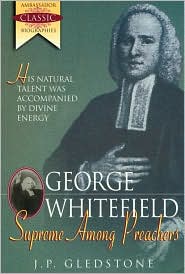
George Whitefield: Supreme Among Preachers by J.P. Gledstone.
George Whitefield (1714-1770) was born in Gloucester, England and educated at Oxford, where he associated with those who formed the 'Holy Club' and who would later become known as the first Methodists. It was also at Oxford that he was converted. His first sermon was of such fervor that a complaint was made that he had driven fifteen people mad. He preached in several London churches and then accepted an invitation from the Wesley brothers to go to Georgia.
On his return to England he preached in the open-air, a practice he was to continue to the end of his life delivering up to twenty sermons a week. He preached throughout the British Isles and made seven journeys to America, where he died shortly after preaching his last sermon
.
Your God Is Too Small by J.B. Phillips
In Your God Is Too Small, J. B. Phillips explains that the trouble facing many of us today is that we have not found a God big enough for our modern needs. In a world where our experience of life has grown in myriad directions, and our mental horizons have been expanded to the point of bewilderment by world events and scientific discoveries, our ideas of God have remained largely static. It is nearly impossible, Phillips argues, for an adult to worship the conception of God that exists in the mind of a child of Sunday-school age, the "God-in-a-box" notion, limiting God to such inadequate conceptions as "Resident Policeman," "Grand Old Man," "Meek-and-Mild," and "Managing Director." As a result of these insufficient ideas of God, many people live with an inner dissatisfaction, without any faith at all.
Your God Is Too Small explores the ways in which we can find a truly meaningful and constructive God for ourselves, big enough to account for our current experience of life and big enough to command our highest admiration and respect.
Desiring God by John Piper
Scripture reveals that the great business of life is to glorify God by enjoying Him forever. In this paradigm-shattering classic, newly revised and expanded, John Piper reveals that the debate between duty and delight doesn't truly exist: Delight is our duty. Readers will embark on a dramatically different and joyful experience of their faith
The pursuit of pleasure is not optional. It is essential.
Scripture reveals that the great business of life is to glorify God by enjoying Him forever. In this paradigm-shattering work, John Piper reveals that the debate between duty and delight doesn’t truly exist: Delight is our duty. Join him as he unveils stunning, life-impacting truths you saw in the Bible but never dared to believe.
The Pleasures of God by John Piper
In this rerelease of a classic, you will find satisfaction in God by knowing why God himself is most satisfied in God. Essential, life-changing truths are presented in a delightful, easy-to-grasp manner.
About the Author:
Beginning where the foundational truth of Desiring God left off, that "God is most glorified in us when we are most satisfied in Him," this expanded rerelease of another classic by John Piper will further explore a life-changing essential "We will be most satisfied in God when we know why God himself is most satisfied in God." Fully understanding the joy of God will draw the reader into an encounter with His overflowing, self-replenishing, all-encompassing grace(the source of living water that all Christians desire to drink. The Pleasures of God will again put God at the center of Creation and leave the reader very satisfied in Him.

The Sovereignty of God by A.W. Pink
Who's in control of the world-God or the devil? In this best-selling classic, A. W. Pink answers such profound questions in a language the average Christian layperson will find not only understandable but totally engaging. Pink, one of the most influential evangelical authors of the last century, writes with fiery passion and brilliant clarity, giving biblical answers to our deepest questions regarding the "sadly neglected and little understood" doctrine of the sovereignty of God.

Knowing God by J.I. Packer
Over the past twenty years J.I. Packer's classic has revealed to over a million Christians around the world the wonder, the glory and the joy of knowing God. This new edition is Americanized and completely retypeset with a new preface by the author. Now more than ever, next to Scripture, this could be the most significant book you will read this year, or next.
The Gospel in Genesis by Martyn Lloyd-Jones
In these never-before-published sermons, Martyn Lloyd-Jones walks readers through the early chapters of Genesis. He examines portions of chapters 3-12, starting with the fall of man and ending with the call of Abram. Along the way, Lloyd-Jones talks of serpents and sin, of the Word of God and the Babel of man. But the destination of The Gospel of Genesis is clear: readers are moved from fig leaves in the garden to faith in the gospel.
As Lloyd-Jones preaches the gospel of Jesus Christ from the pages of Genesis, he awakens nonbelievers to their lostness and emboldens Christians to believe firmly the only gospel that offers answers to life's biggest questions.
Becoming God's True Woman, edited by Nancy Leigh DeMoss
The feminist revolution was supposed to bring women greater fulfillment and freedom. It was supposed to make us feel better about ourselves.It didn't.Across generational lines, inside the church and out, we have lost the wonder of our distinctive makeup and calling as women. We are realizing that what was supposed to lift us up has been tearing down all that we treasure, including our own families.Yet there is a new movement spreading its seeds--seeds of hope, humility, obedience, and prayer. It is a call to return to godly womanhood, and it is resonating in the hearts of women everywhere through the mentors Nancy Leigh DeMoss, Susan Hunt, Mary Kassian, Carolyn Mahaney, Barbara Hughes, P. Bunny Wilson, and Dorothy Patterson.They have found delight in God's created order, sweet purpose in his sovereign plan. And in this fresh edition with its helpful discussion guide, they invite you to join them in bringing back the beauty and restoring the truth of your godly calling.

The Jesus You Can't Ignore by John MacArthur
Best-selling author John MacArthur gives readers a fresh look at how Jesus addressed attacks against the truth.
Meek and mild. Politically correct. A great teacher. These are the popular depictions of Jesus. But they aren't the complete picture. Maybe because it's uncomfortable, or maybe because it's inconvenient, Christians and non-Christians alike are overlooking the fierceness of the Savior, His passionate mission to make the Gospel clear and bring people into the Kingdom of God. A mission that required he sometimes raise his voice and sometimes raise a whip.
In the much-needed message in The Jesus You Can't Ignore, renowned Bible teacher and best-selling author John MacArthur reintroduces the compelling and often unsettling passion of Jesus' ministry. MacArthur points to the compelling picture of the real Jesus the world is so eager to gloss over. And he calls readers to emulate Jesus' commitment to further the kingdom by confronting lies and protecting the truth of God.
A Tale of Two Sons by John MacArthur
In The Tale of Two Sons, one of America's most loved Bible teachers takes you deeper into Luke 15 than ever before, revealing insights into the culture of Jesus' day and an unforgettable ending.
The Parable of the Prodigal Son (Luke 15:11-32) has been preached from nearly every pulpit in the world and is known by many who read and cherish the Bible. The story is so powerful because it presents, in clear and inspiring terms, our struggle with sin, the need for humble repentance, and the Father's inexhaustible mercy and love. Unfortunately, many Christians would say that they have nothing new to learn from this gem of Scripture. It has lost its luster. But in The Tale of Two Sons, John MacArthur restores the brilliance of this passage, giving engrossing historical background and unveiling a surprise ending readers have never heard before.