Showing posts with label science fiction. Show all posts

Monday, March 13, 2017

Journaling 1984

1984. George Orwell. 1949. 268 pages. [Source: Bought]

I have started reading 1984 by George Orwell. I began taking notes almost from the start, so I thought I would share my thoughts as I read. In addition to my thoughts, I will be including quotes from the book, and, as relevant quotes from Scripture.

Chapter one is all about the world-building. It introduces readers to the concepts of the Party, Big Brother, the telescreen, the two minutes of Hate and Hate Week, the three slogans, the three nations, and the four ministries of Oceania. The three slogans are: War is peace; freedom is slavery; ignorance is strength. (7) The three nations are: Oceania, Eastasia, and Eurasia. The four ministries are: Ministry of Truth, Ministry of Peace, Ministry of Love, and Ministry of Plenty.* It also introduces readers to the main character, Winston Smith. (Other characters mentioned: O'Brien, a potential friend or enemy; a nameless woman, a coworker; and Emmanuel Goldstein, the biggest enemy of the state.**)

In this first chapter, Winston writes in a diary for the first time. The crime isn't the writing down of his ideas--though that would be enough to lead to his death--but the thinking of his own ideas in the first place. Thoughtcrime. Winston realizes in this first chapter, that it's just a matter of time before he's killed by the Party. He can't stop thinking. And one day his thoughts will be revealed either on his face, in his mannerisms, or in his words and actions.
How could one communicate with the future? Either the future would resemble the present in which case it would not listen to him, or it would be different from it, and his predicament would be meaningless. (10)
Winston is not automatically lovable as a character. I don't know how much is just pure sin-nature and how much is brainwashing, but the fact that he fantasizes about raping a coworker is disturbing. So far, it's just the one fantasy we witness, but still.

Hate. Two minutes of hate. Every day, or at least every work day, they participate in two minutes of hate. A film, I believe, is shown. And this film--this propaganda--is used to stir up feelings of hate and rage. To rally everyone around a common enemy, someone--something--to hate passionately.
The horrible thing about the two minutes hate was not that one was obliged to act a part, but that it was impossible to avoid joining in. (16)
Today, we don't officially have a "two minutes of hate" built into our workdays. (Though one could argue that most people can find a common enemy to hate.) But hate is programmed into us all the same.  Oh, it's frowned upon to hate some things. The key is to hate what everyone else hates and to love what everyone else loves. We're not really free to hate freely, nor encouraged to love freely. Social media can at times encourage people to be proud of their hate and anger.
Woe to those who call evil good and good evil, who put darkness for light and light for darkness, who put bitter for sweet and sweet for bitter. Isaiah 5:20
What does the Scripture have to say about hate?
  • Let those who love the Lord hate evil, for he guards the lives of his faithful ones and delivers them from the hand of the wicked. Psalm 97:10
  • I will not look with approval on anything that is vile. I hate what faithless people do; I will have no part in it. Psalm 101:3
  • To fear the Lord is to hate evil; I hate pride and arrogance, evil behavior and perverse speech. Proverbs 8:13
  • “But to you who are listening I say: Love your enemies, do good to those who hate you, bless those who curse you, pray for those who mistreat you. Luke 6:27-28
  • If you belonged to the world, it would love you as its own. As it is, you do not belong to the world, but I have chosen you out of the world. That is why the world hates you. John 15:19
  • Love must be sincere. Hate what is evil; cling to what is good. Romans 12:9
  • At one time we too were foolish, disobedient, deceived and enslaved by all kinds of passions and pleasures. We lived in malice and envy, being hated and hating one another. But when the kindness and love of God our Savior appeared, he saved us, not because of righteous things we had done, but because of his mercy. He saved us through the washing of rebirth and renewal by the Holy Spirit, whom he poured out on us generously through Jesus Christ our Savior, so that, having been justified by his grace, we might become heirs having the hope of eternal life. This is a trustworthy saying. And I want you to stress these things, so that those who have trusted in God may be careful to devote themselves to doing what is good. These things are excellent and profitable for everyone. Titus 3:3-8
  • Whoever claims to love God yet hates a brother or sister is a liar. For whoever does not love their brother and sister, whom they have seen, cannot love God, whom they have not seen. 1 John 4:20
I'm not generally a fan of  the "What Would Jesus Do?" brand. But would Jesus participate in two minutes of hate? Would he join in with the crowd and follow their mob-like passionate hate? I don't think so!

The Telescreen. Big Brother. And the idea that someone is always, always watching and judging you. This is a terrifying aspect of the book because it is the PARTY who is doing the watching and judging. The party is arbitrary, unpredictable, untrustworthy. NOT someone you want in your head.
The telescreen received and transmitted simultaneously. Any sound that Winston made, above the level of a very low whisper, would be picked up by it; moreover, so long as he remained within the field of vision which the metal plaque commanded, he could be seen as well as heard. There was of course no way of knowing whether you were being watched at any given moment. How often, or on what system, the Thought Police plugged in on any individual wire was guesswork. It was even conceivable that they watched everybody all the time. (6)
You had to live--did live, from habit that became instinct--in the assumption that every sound you made was overheard, and, except in darkness, every movement scrutinized. (7)
It is true that there is someone always watching, always weighing, always judging. But this someone is GOD. IF and only if you're in right relationship with Him, this is both comforting and convicting.
Hebrews 4:13 Nothing in all creation is hidden from God’s sight. Everything is uncovered and laid bare before the eyes of him to whom we must give account.
Psalm 139:1-12 You have searched me, Lord, and you know me. You know when I sit and when I rise; you perceive my thoughts from afar. You discern my going out and my lying down; you are familiar with all my ways. Before a word is on my tongue you, Lord, know it completely. You hem me in behind and before, and you lay your hand upon me. Such knowledge is too wonderful for me, too lofty for me to attain. Where can I go from your Spirit? Where can I flee from your presence? If I go up to the heavens, you are there; if I make my bed in the depths, you are there. If I rise on the wings of the dawn, if I settle on the far side of the sea, even there your hand will guide me, your right hand will hold me fast. If I say, “Surely the darkness will hide me and the light become night around me,” even the darkness will not be dark to you; the night will shine like the day, for darkness is as light to you.
But I tell you that everyone will have to give account on the day of judgment for every empty word they have spoken. Matthew 12:36
For we must all appear before the judgment seat of Christ, so that each of us may receive what is due us for the things done while in the body, whether good or bad. 2 Corinthians 5:10
Knowledge of this leads to fear of God. And the fear of God is the beginning of wisdom. I think many have lost this notion of fearing God. Of seeing God as completely and overwhelmingly other--completely HOLY.
“Woe to me!” I cried. “I am ruined! For I am a man of unclean lips, and I live among a people of unclean lips, and my eyes have seen the King, the Lord Almighty.” Isaiah 6:5
Therefore, since we are receiving a kingdom that cannot be shaken, let us be thankful, and so worship God acceptably with reverence and awe, for our “God is a consuming fire.” Hebrews 12:28-29
The fear of the Lord is the beginning of wisdom, and knowledge of the Holy One is understanding. Proverbs 9:10
It is comforting if you trust the Lord. God has revealed himself in the Word to be entirely trustworthy, praiseworthy. Good. Faithful. Merciful. Compassionate. Just. Wise. Loving. Unchanging. But also still convicting. Fear of the Lord leaves you humble. And humility is a virtue. It also makes you teachable and usable.

Is the average person giving any thought to the idea that God is omniscient? I include Christians and nonChristians in this question. I think even with Christians, this is one of those doctrines we don't live in light of. That is to say, we affirm it in a creed but don't live by it day by day by day. God is omnipresent. Always with us. Always everywhere. We cannot escape his presence. Light, dark, day, night makes no difference. Our God doesn't sleep. And he isn't ignoring us or disinterested.

Talking about a day of judgment isn't popular. (Has it ever been?) But I think it is necessary to go there--to think uncomfortable thoughts and ponder where you stand before the Lord Almighty.
Seek the Lord while he may be found; call on him while he is near. Isaiah 55:6
I'll close this section with a few Lutzer quotes:
Five minutes after you die you will either have had your first glimpse of heaven with its euphoria and bliss or your first genuine experience of unrelenting horror and regret. Either way, your future will be irrevocably fixed and eternally unchangeable. In those moments, you will be more alive than you ever have been. ~ Erwin Lutzer
Entering hell is easy enough. All that one has to do is neglect Christ, the only one who can save us. ~ Erwin Lutzer

*Ministry of Truth = news, entertainment, education, fine arts; ministry of peace = manages wars; ministry of love = law and order; ministry of platy = economic affairs.

**Emmanuel Goldstein = advocates freedom of speech, press, assembly, thought


© Becky Laney of Operation Actually Read Bible

Friday, February 3, 2017

Book Review: Your Sins and Mine

Your Sins and Mine. Taylor Caldwell. 1955/2017. Open Road Media. 105 pages. [Source: Review copy]

First sentence: My father was no different from other men; he had the wisdom of hindsight. He was also a countryman, and had never been far from the place where he was born, and had always lived close to the earth. So when he told us later of what he had seen in early January—a few months before the strange and awful things had come to pass—we discounted it as superstition, for he was what used to be called a “fundamentalist.”

Premise/plot: Love science fiction? Love apocalyptic fiction? Love dystopias? Ready to read about the end of the world…if the end of the world had happened in the 1950s? Taylor Caldwell's Your Sins and Mine is a must read in my opinion.

Set in a farming community, readers meet Pete and his family. George has two grown sons--both veterans. Edward fought in World War II and came home blind. Pete fought in Korea. Both "boys" are married now with children of their own. They all live on the farmstead. One January evening, George is out late stargazing and notices something eery and ominous in the sky. He doesn't instantly know that the end has come. But. It makes him uncomfortable--increasingly uncomfortable as the drought lengthens month by month. By spring, he fears the worst: no crops. Lest you think he's panicking much too much, you should know: this drought is world-wide effecting every country, every nation. And starvation may be the least of their problems...

My thoughts: I loved this one. I absolutely loved it. This one would pair really well with Pat Frank's Alas, Babylon. It has a lot to say about war, about nuclear weapons, about society, about governments, about the environment.

Quotes:
And the sun shone, cloudless, in the sky, and the rivers dropped and the seas shrank and the creeks and brooks dried up and the mountains were sear and the valleys yellowed—all over the world. The land hated us, the violated land, the faithful land, the exploited and gentle land. The land had decided that we must die, and all innocent living things with us. The land had cursed us. Our wars and our hatred—these had finally sickened the wise earth. We did not know then that we stood indicted as the enemy of life.…
“We’ve got just one court of appeals now,” my father said, “and I don’t suppose most of you have given it any thought. Oh, I suppose you’ve prayed for rain, in church. But have you ever prayed: ‘God have mercy on me, a sinner,’ like the publican in the Bible? I guess you haven’t; your faces are the answer. I wonder how many of you even know your Bible? I wonder how many of you know we’re all being punished, and that we’ve had a sentence of death handed to us?” “Yes, a sentence of death,” he said, with authority. “Because every man in the world is a sinner against every other man, and against God. It isn’t only all the wars we’ve had in this century. We’ve forgotten God.” My father tightened his belt and ran his hand over the stubble on his chin. His blue eyes were vivid—vivid and condemning—as they traveled slowly over every face in the room. “I’m no politician. I’m a farmer, just as you are. When we were little fellows we took it seriously when the parsons told us we owed a duty to our fellow man, and that the things, of the spirit are more important than the things of the body. Every church told its people that; every church still does, though mostly the parsons speak to empty rows. We don’t hear these things with our ears any more. Why? Because every one of us has come to believe that the things of the body are the only valuable things, and we’ve scrambled for them over the rights of all other men. We’ve become too materialistic, too atheistic. Look, I’m no orator. You know what I’m talking about.
We heard, over the radio that night, that rain was falling all over the world in gushing floods. And for the first time we learned that the drought had been worldwide. It rained for many days, and the farmers plowed joyously in it and sang, and set their crops, and held up their faces to the dark and pouring heavens. All over the world it rained, and the cruel sun was gone for a long time. The forests freshened and the rivers tumbled everywhere. But the wheat did not come up, and the fruit trees, though green as jade, did not put out any flowers, and the inundated earth did not brighten with grass. It remained lifeless except for bursting acres of poisonous weeds. Vegetables did not grow, though flowers bloomed everywhere—flowers which men and beasts could not eat.
We did not know at that time that millions of Bibles were being opened all over the world, and that churches were beginning to burst with new members. But the ministers did not speak of what was happening all over the country. They, too, had been given their orders. Fear hung over the world like a vast cloud.


My father spoke louder, moving in his chair indignantly. “I’ve heard you talk about the Sermon on the Mount as if it was just another Declaration of Independence. When you pray, you speak to God politely, and remind Him that we’d like to have a little peace on this earth. You mentioned once that the parables of Jesus are excellent examples of profound human psychology. That was the Sunday when you devoted your whole lecture to the ‘science of psychiatry,’ and what it can do for disturbed minds.” His voice became even louder and was touched with anger. “You mentioned God in passing, but there was a hell of a lot more of Freud in your lecture! Disturbed minds! You’re damned right we’ve got disturbed minds. And why? Because our parsons think it primitive to talk about an ever-present God in the affairs of men. It never occurs to them that a human soul is thirsting for the living God, and hungering to know He is there for the asking.” His voice softened and deepened. “They come to you in grief and bewilderment and pain and you quote textbooks at them, and deny them the bread of life.” “George,” said my mother gently.
“There is still something a man can say to God that He wants to hear. And when He hears it, perhaps He will spare us—but He wants the whole world to say it.”
It was my father’s custom to read the account of the Nativity on Christmas Eve. But on this night he opened the Bible to the Book of Job, and we sat about him and listened to the dolorous lamentations of an afflicted man. “The arrows of the Almighty are within me, the poison whereof drinketh up my spirit; the terrors of God do set themselves in array against me.”
Mr. Herricks came that night, brought to us by a neighbor’s belching tractor. We had not seen him for some time, and I was aghast at the change in him. He seemed weary and broken and very sad. Yet, as he shook my hand he smiled at me, and his youthful eyes became radiant. He had brought his own food with him, and my mother and Lucy prepared it and we all sat down together for our sparse meal. He told us that very few people, if any, came to church now. Either they were dead or dying, sick or desolate, unable to travel even a little distance, or nursing their children or their parents. He visited them in their homes, giving them what comfort he could. He looked at me directly, now. “The gospel of repentance,” he said. “How can I say to them: ‘Pray for forgiveness’? Wouldn’t it be cruel? But that is the only prayer which will save the world now. True repentance, true penance.

© Becky Laney of Operation Actually Read Bible

Wednesday, January 18, 2017

Book Review: Out of the Silent Planet

Out of the Silent Planet. C.S. Lewis. 1938. 224 pages. [Source: Bought]

First sentence: The last drops of the thundershower had hardly ceased falling when the Pedestrian stuffed his map into his pocket, settled his pack more comfortably on his tired shoulders, and stepped out from the shelter of a large chestnut-tree into the middle of the road.

Premise/plot: When Dr. Ransom (the Pedestrian in the first sentence) intervenes in a private squabble, he gets more than he bargained for. The story begins with him looking for a place to stay the night--a place that is nearby since he's already walked a long way. He is looking for a night's stay when he overhears a boy protesting loudly against two men. The boy claims the men mean him harm, mean to lock him up in a shed, I believe. Ransom intervenes, and, to add another creepy element into the mix, he recognizes one of the men from his university days! The men now mean him--not the boy--harm. It's no shed that he'll be locked up in--after he's drugged--but a spaceship. The three will go to the planet Mars--aka Malacandra. Ransom doesn't know their plans for him, but he overhears enough to fear them more than the unknown planet. He does know that it's populated, however. And that, for better or worse, he's to be given to the aliens.

My thoughts: Out of the Silent Planet is science fiction, adult science fiction. (Though there's no reason why teens couldn't enjoy this as well.) I'd not read it before, and, I'm definitely glad I finally got around to it. I found myself shouting at Ransom several times in this one. Like at the beginning when he meets the two strangers. Even though he's heard a super-creepy conversation, he shows absolutely no caution at all. NO one is expecting me; no one knows where I am or where I might be or where I might be going; no one will miss me because they have no idea when I'll be back. After voluntarily giving them this information, he accepts a drink from them!

Because it is C.S. Lewis expect some philosophy interwoven in the story.

Favorite quotes:
  • "The love of knowledge is a kind of madness" (55)
  • "A pleasure is full grown only when it is remembered" (73)
  • "When you and I met, the meeting was over very shortly, it was nothing. Now it is growing something as we remember it. But still we know very little about it. What it will be when I remember it as I lie down to die, what it makes in me all my days till then--that is the real meeting. The other is only the beginning of it." (73)
  • "And how could we endure to live and let time pass if we were always crying for one day or one year to come back--if we did not know that every day in a life fills the whole life with expectation and memory and these are that day?" (74)
  • "Bent creatures are full of fears." (122)

© Becky Laney of Operation Actually Read Bible

Monday, December 15, 2014

Book Review: Revolutionary (2014)

Revolutionary (Anomaly #3) Krista McGee. 336 pages. [Source: Review copy]

The first book in the series is Anomaly. The second book in the series is Luminary. The third book in the series, the one I'll be reviewing today, is Revolutionary.

I thought I would start by sharing my thoughts on the series as a whole. I really enjoyed the series. I enjoyed the premise of it and the world-building. Dystopias seem to be ever-trendy in the field of YA fiction. But there just aren't many YA dystopias being published in the Christian market. So I was very excited to see this trilogy published by Thomas Nelson. It follows the crowd in some ways: heroine who doesn't know her own strength and/or worth, strong romantic elements including a love triangle, a corrupt government or power-system that needs to be opposed/overthrown. But it's also distinct in that it includes spiritual themes. Thalli and most of her friends come through the series to know--in part due to the strong witness and testimony of John Turner--the Designer.

What did I think of the last book in the series? Well, I enjoyed it very much! I think I enjoyed it more than the second book. That could be because it's the last in the series and it brings the series to a good, solid conclusion. (Cliff-hanger endings, while understandable, can be frustrating!) Though it had been a few months since I read the second book, I soon found myself hooked and connected right back into the story.

The third book, as you might expect, is the book where readers finally get answers and then some! The book is very intense and there really isn't a calm moment where all the characters are safe and happy and out of danger. The threat is felt on nearly every page. And just when the threat seems manageable, something happens to change all that. (I wouldn't say it is as bloody as say Hamlet or MacBeth, but, do expect loss.)

I wanted to keep reading because I had to know how it all ended.

But. I must admit that love triangles don't really thrill me. There are exceptions to the rule, I suppose, but I never "like" or "love" a book more because of the presence of a love triangle. If anything, I like or love a book in spite of the fact that it includes a pesky love triangle. The love triangle in Revolutionary seems more dramatic, more life-and-death, than in other series I've read. I thought the characterization was nicely done. I came to care for many if not all of the characters--though not the villain: boo, hiss--I just wish they'd been less romance and more friendship.

© Becky Laney of Operation Actually Read Bible

Monday, July 29, 2013

Book Review: Anomaly

Anomaly. Krista McGee. 2013. Thomas Nelson. 2013. 320 pages. [Source: Library]

Fifteen minutes and twenty-three seconds. That's how long I have to live. The wall screen that displayed the numbers in blood-red letters now projects the image of a garden. 

I enjoy reading dystopian novels and post-apocalyptic novels. It is one of my favorite science fiction sub-genres. There aren't as many titles published by Christian authors and Christian publishers in this sub-genre, so I was very delighted to discover Anomaly.

Thalli, our heroine, was designed to be a musician. She is THE musician of pod B. But unlike others in her generation, Thalli is curious, questioning, emotional. She is more observant, more thoughtful--always wanting to know why. Thalli knows this gets her into trouble sometimes, that she is not supposed to question authority or ever be curious enough to ask why. (For the record, Thalli is not rude, obnoxious, or disrespectful.) So Thalli is generally careful about appearances, about covering up what makes her so different. But one day that becomes impossible. Thalli is asked to play a new-to-her piece of music, a song from "before", a song by Bach, Jesu, Joy of Man's Desiring. She's overwhelmed with emotion. She cries. This is when they know beyond all question, that she's an anomaly. They take her away from her pod, away from the only home she's known, and put her in a cell. She's scheduled to be eliminated...

There is a man, an old man, who is not allowed to speak with anyone--of any generation, but especially these new ones that have only known life deep underground--a man of faith. It is only to the dying that he's allowed to speak. His name is John, and he speaks to her of a Designer.

Berk is a young scientist from Thalli's generation. The two have always been really close. When he learns of her fate, he decides to do whatever he can to save her...but will it be enough?

I really LOVED this one.

© Becky Laney of Operation Actually Read Bible

Sunday, July 15, 2012

Book Review: The Kingdom

The Kingdom. Bryan Litfin. 2012. Crossway. 448 pages.

From the prologue: The rulers of the earth took counsel together, and the Pact they made defined the centuries to come. 

The Kingdom concludes the Chiveis Trilogy by Bryan Litfin. The first two novels in the series are The Sword and The Gift. The trilogy has an interesting premise. It explores a post-apocalyptic Europe beginning several centuries after "the end of the world as we know it." In this world, Christianity has both fallen into decay (just naturally--slowly but surely--been forgotten with the passing of each generation) and been outlawed. In the first novel, Ana and Teo discovered--by chance--a copy of the Old Testament. This presumably being the only known copy in existence. The two learn that it is only the first half of the Sacred Writings. And, of course, they WANT to find the second half, the second testament. But they hardly know where to begin. But just because their knowledge is incomplete, doesn't mean that they aren't eager--very, very eager--to share what they do know. For this is the first they've heard of a Creator God--Deu or Deus, as they call Him. And they're drawn to Him, trusting in Him, in His goodness, in his justice, in his righteousness. Teo in addition to being an incredibly brave, strong, oh-so-handsome soldier, is, of course an extremely brilliant scholar who speaks two or three languages, at least--including some of the ancient languages. Chiveis is the country (nation) where they both live. But it is immoral and corrupt. And the 'state religion' is idolatrous. The High Priestess, let's say, LOVES power, and loves the control she has over others. She's definitely into cruelty and torture. So when Teo and Ana begin spreading the good news--what they know of it--she is most displeased. The two end up being exiled. The second novel follows the two after their exile. Their true mission (which they sometimes forget about) is to find the New Testament, the Second Testament. This second novel introduces readers to two or three other countries or regions. It introduces at least one or two new villains to the general story, and, essentially has hundreds of pages worth of torture for the reader to endure alongside the characters. The bad news? They find the New Testament only to lose it to their enemy. The good news? The message and content of the New Testament is NOT lost after all. The book concludes with Teo hard at work translating this one into several different languages so they can spread the good news to all countries and nations. Which brings us to the third novel....

...Ana and Teo have finally, finally admitted they have feelings for one another. And they've finally found a community of believers who are eager to share in their work in evangelism. Actually, Ana and Teo fit into their already-present community. Teo may have many qualities to be a leader--of sorts--in the Christian community, since he's so brilliant and can translate the New Testament in just a few short months into several different languages, but he's not trying to take the role of the Papa in Roma. This novel begins with the couple preparing to be separated for many months--Teo seeking to travel to another country in search of Knights of the Cross, to see if they still remember what "the cross" means, to see if they are still loyal to the Papa. What Teo learns in his journeys--and what Ana learns as well--is that WAR is coming, that there are powers that be coming together united in hatred for the Christian faith.

How do I feel about The Kingdom? How do I feel about the trilogy? Well, I'm not sure there's an easy answer. It does have an interesting premise, in a way. And the books do give me something to think about. But. The characters annoy me just as often as they satisfy me. And essentially all three books are high on torture and "intense" situations that seem like desperate this-is-it close calls. Perhaps because of the high-frequency of these dramatic moments, perhaps because the characters always seem to come away safe, I never truly worried. I was also annoyed with the "romance" in this one. I felt Ana's love for Teo strained her common sense at times, and the same with Teo. Because Teo was so in love with Ana, he had his stupid moments.

© Becky Laney of Operation Actually Read Bible

Wednesday, June 27, 2012

Book Review: The Gift

The Gift. (Chiveis Trilogy #2) Bryan Litfin. 2011. Crossway. 416 pages.

From the prologue: The people of the twenty-first century nearly destroyed the earth in a global nuclear holocaust. This is the story of what God did next.

It has actually been several centuries--at least--since the 'modern world' collapsed due to virus, war, food shortages, etc. And the world has reorganized itself, new civilizations have been formed, several societies put into place. This trilogy is set in a nearly unrecognizable Europe. The Gift is the second book in the trilogy. The Sword is the first novel, The Gift is the second novel, and The Kingdom is the third novel--this final book in the trilogy will be published this summer.

It had been over two years since I first read The Sword, and I think that proved problematic when I picked up this one. The big things--the name of our hero and heroine, the name of their God (Deu), the fact that the last book ended with their exile--I remembered. Everything else I had forgotten, all the little things, details big and small, including the author's very distinct writing style. So it took me over two hundred pages to reconnect with the story, with the characters. For the first two hundred pages, I was definitely a reluctant reader. The last two hundred pages went smoother, it helped that I made up my mind that no matter what I was going to finish the book that day.

What did I struggle with in this second book? I'm not sure if I struggled more with the plot or with the characters. Teo and Ana are exiled from their country, but, are soon welcomed into a new country. Ana is accepted into the social elite (I'm not sure if this was just because she was so beautiful, or, if they assumed she was a fine lady in the other country and deserved the same special treatment there), but, Teo is not. He manages to stay very, very, very loosely connected with Ana by claiming the role of her tutor. But almost everyone assumes that he's merely her love slave. Ana glories in her new lifestyle, she loves her new rich friends, loves all the parties, loves the clothes, loves the attention and flattery. The more materialistic Ana becomes, the less prone she is to listen to Teo who warns her not to forget the most important thing. But does Ana listen? Oh, no, she does not. Does she drink? Does she party? Does she start sunbathing topless in public? Yes, yes, yes. She stops listening to Teo, stops listening to God, and then starts questioning and doubting things she knows to be true. Teo is a man who is torn in his duties. On the one hand, he knows that finding the New Testament is the MOST important, most essential thing he could do. He knows that finding the New Testament, translating it into a language that can be understood, getting the full truth of God's message to men is the MOST IMPORTANT thing he could do. It's worth living and dying for. He knows he must attempt it no matter the risk. But, at the same time, he's torn because he wants to save Ana from herself, and from outside dangers as well. He knows that she's not safe, he knows she's being really stupid, he knows that her faith is endangering her life, he knows that she has enemies--as he knows that he has enemies. So part of him wants to stay in the background just watching and waiting and watching and waiting and watching and waiting...to see what happens next in Ana's life. Does Ana even know that Teo is around? No, not really. She assumes that he's moved on, moved away, accepted their new places in society. Because she has pushed him out of her thoughts--essentially--she doesn't really appreciate the sacrifices he's making for her. So essentially, the first half of the novel could be summed up as: watch Ana be stupid. The second half of the novel is different, however, for Ana realizes that she's walked away from God, and she's made some big mistakes. She turns towards God, finds forgiveness, becomes selfless, humbles herself, etc. Teo does not change in the second half, he remains the hero he's been since page one, book one.

The plot. What can I say? There's a dark side to these books, a dark side that delights in torture, torture, and more torture. Readers are forced to "overhear" evil, evil plots that endanger the characters we care about, or are supposed to care about. In a way, I suppose, the dark side adds tension, contrast, suspense to the novel. But there's only so much torture a person can take without becoming sick of it.

The second half of the novel does become intense, but I'm not sure it's a good enough intense. Part of me got frustrated even with the second half of this one because it was Teo's turn to be stupid, I suppose. In a couple of crucial moments, moments where he had to choose between his mission to serve God, to find the New Testament, to find out the truth, the whole truth of God's message, to restore Christianity, he chose saving the girl.

S
P
O
I
L
E
R

So in this one scene, the scene when they discover the last remaining copy of the New Testament, the only copy supposedly still in existence on the whole planet, and the bad guys show up and he has to choose between saving the girl's life (supposedly, they have her in their grasp) and handing the copy over knowing that it's just a matter of time--perhaps minutes, perhaps hours, perhaps days--before it is destroyed....and he chooses the girl. Never mind that a whole secret community is counting on him, never mind that there is no one left on the planet who knows who Jesus Christ is, why he came to Earth, why he died, the fact that he rose again, the fact that he saves us from our sins, delivers us from our sins, restores and redeems us, adopts us. Etc. This body of believers--men, women who believe in the one true Creator God--who knows nothing at all about the New Testament, any event, any promise, any doctrine, etc. And he chooses the girl. And the New Testament is burned. Part of me was like, how is saving Ana going to bring salvation to the world? Do you even realize what you just threw away? I mean, sure, this proves that he *loves* her in that way, something she was in doubt about for the first half of the novel because he hadn't spent every moment of every hour of every day flattering her, complimenting her, and trying to kiss her, etc. But I was a little frustrated with Teo here.

The novel does have some strengths. For example, it is hard to read this one without reflecting on your faith and your knowledge of the Bible, the Old and New Testaments, your knowledge of doctrines, etc. In this story, we see that "Christianity" has been preserved through the sketchy-fuzzy memory of a five year old boy who grew up to be "Papa" and live in "Roma." He remembers the act of communion, but not what it means, not what it signifies. He remembers that Christians were commanded to love others and serve others, to be compassionate to the needy, to welcome the outcasts, the needy, the sick and dying. But he doesn't really remember why--just that God loves them, so we should too. He remembers vaguely the symbol of the cross--the wounded man on the cross--but he doesn't remember why he died, what his death accomplished, and the fact that "the pierced One" rose again on the third day. So this "Christian" community that essentially is an echo of an echo of an echo of an echo from faded centuries  is desperately in need of the truth--the WHOLE truth. They have no sacred writings, no sacred texts, no religious texts or treatises at all. Nothing to help them spiritually or practically in terms of knowing the God that they risk their lives to worship. And there is a lot to contemplate. One, Christianity was in its dying stages even as the big war came, even as the evil virus threatened humanity's survival. People just didn't care enough to live the faith, to know the Bible, to know God, to pass the gospel, to pass the Word down to their children and grandchildren and great-grandchildren. Doctrines weren't seen as being important and relevant--and neither was the Word of God. Perhaps there were some that were going through the motions. We are told very, very, very little about this time--mainly just through the prologues and we're left to form our own conclusions as to how everything degraded into the mess it was. But. We're also told that in the next twenty, thirty, forty, fifty years after IT happened, that governments came together to make a pact and part of that pact was to make Christianity illegal, to make the sacred texts illegal, to make proselytizing illegal. They formed an army of men dedicated to hunting down Christians killing them, men dedicated to destroying/burning sacred/religious texts. Two, in terms of reconstruction, how well could you do, how well could the average believer do, the average church-goer, the average child. How important is it to you to KNOW the Bible? How important is it to you to know your doctrine? To be firmly rooted and grounded in the faith--in historic faith. How relevant is it to you in your own life? Is it something you've even thought about at all? How much do you take for granted? And should you be taking it for granted? How much do you VALUE the Bible? How thankful are you that God is not silent, that the mystery can be known and explored?


© Becky Laney of Operation Actually Read Bible
Thursday, October 28, 2010

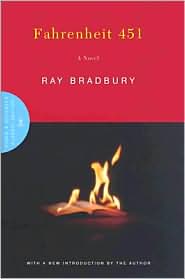
Book Review: Fahrenheit 451

Fahrenheit 451. Ray Bradbury. 1953. 179 pages.

It was a pleasure to burn. It was a special pleasure to see things eaten, to see things blackened and changed.

Our hero, Guy Montag, is a fireman. It is his job to start fires, to burn books. In Ray Bradbury's imagined future, intellectual thinking is too dangerous for the masses, as is reading. Thinking leads to feeling, and feeling leads to unhappiness, to self-awareness. To have a people aware of their feelings--their dissatisfaction, their differences, the true state of the world around them--would be dangerous. The threat of war is high in Fahrenheit 451. Yet, for all the concern people show, you'd hardly notice it. Why? Because people are too connected with the walls in their homes--their "families" on the screen--and listening to the shells in their ears. Guy's wife, Mildred, is just one of the mindless, pleasure-driven, 'family'-addicted individuals in this society. She has three walls--but she needs a fourth. She needs her family to surround her. It's not a big surprise that Guy Montag finds himself married to a stranger, unable to remember when they first met and why they fell in love.

Guy Montag is a fireman with a secret. Though he knows he's breaking all the rules, he can't help himself from rescuing the occasional book--from hiding them in his own home. Yes, he knows if he gets caught then that will be the end of him. The books will be burned. He'll be killed or arrested. But. Since a conversation with a man--Faber, a former English professor--he hasn't been the same. Guy Montag can't help noticing the world around him; can't help noticing the war--the threat of war; can't help noticing how hopelessly lost the world has become; how horrible, how bleak the situation really is. He sees but doesn't quite know what to do about it. One day he decides to visit Faber. He brings him the Bible.
’It’s been a long time. I’m not a religious man. But it’s been a long time.’ Faber turned the pages, stopping here and there to read. ‘It’s as good as I remember. Lord, how they’ve changed it in our parlors these days. Christ is one of the family now. I often wonder if God recognizes His own son the way we’ve dressed him up, or is it dressed him down? He’s a regular peppermint stick now, all sugar-crystal and saccharine when he isn’t making veiled references to certain commercial products that every worshiper absolutely needs.’ (81)

Do you know why books such as this are so important? Because they have quality. And what does the word quality mean? To me it means texture. This book has pores. It has features. This book can go under the microscope. You'd find life under the glass, streaming past in infinite profusion. The more pores, the more truthfully recorded details of life per square inch you can get on a sheet of paper, the more 'literary' you are. That's my definition, anyway. Telling detail. Fresh detail. The good writers touch life often. the mediocre ones run a quick hand over her. The bad ones rape her and leave her for the flies.
So now do you see why books are hated and feared? They show the pores in the face of life. The comfortable people want only wax moon faces, poreless, hairless, expressionless. we are living in a time when flowers are trying to live on flowers, instead of growing on good rain and black loam. (83)
The novel is very intense. And Guy Montag's life is in danger, and his world is on the verge of collapse. But it's such a great, thought-provoking novel!!!

Earlier this month, I reviewed the graphic novel, Fahrenheit 451, at Becky's Book Reviews. It had been several years since I'd read the original novel, and I wanted to see if it had been adapted well. I enjoyed it so much, I decided to take a risk--to watch the movie adaptation. I expected many changes--it is a movie adaptation after all. So I wasn't particularly surprised by the change of which book our hero, Guy Montag, "becomes" at the close of the film. You see, in the book--and even in the graphic novel--Montag "becomes" Ecclesiastes. He reveals to his new friends--new allies--that he has a little bit of Revelation and some Ecclesiastes. The Bible is one of the books he'd hidden away--"rescued" from the flames he--as a fireman--was required to start. The novel closes with TWO scriptural references! Ecclesiastes 3:1-8 and Revelation 22:2.


© Becky Laney of Operation Actually Read Bible
Saturday, June 5, 2010

Book Review: The Sword


The Sword. Bryan M. Litfin. 2010. April 2010. Crossway. 412 pages.

Prologue: In the year 2042, the world as we know it came to an end. The edifice of civilization proved far more fragile than anyone ever realized. One hard blow, then another--that was enough to shatter it into a million pieces.
The collapse all began with the friendly exchange of a papaya for a photograph.


Chapter One: The lone man deep in the woods of the Beyond knew a good sword could make the difference between life and death.

If I seem to stumble through this review, blame me not the author. Bryan M. Litfin has created a compelling, futuristic novel with a great premise. Four hundred years after the world (as-we-have-known-it) has been destroyed, there remains the thriving kingdom of Chiveis. A kingdom ruled by a king strongly influenced by a high priestess.

Chiveis doesn't have one god--it has four! Vulkain, Pon, Elzebul, and Astrebril. The high priestess has dedicated her life to serving Astrebril, and there is little she wouldn't do for her god. Officially, the people are allowed to worship--or not worship--as they see fit. (The worship can get a little out of hand. It can be a bit wild, a bit violent, a bit lusty.) Not all in the community are happy with the gods--with religion as they know it. Some wish there was another god, a better god, a god who is good instead of being a scoundrel.

Teo is our young hero. He happens--while saving a damsel in distress, though Ana isn't your typical damsel in distress--upon a forgotten text, an ancient one. Teo has discovered the Old Testament. Unfortunately, the New Testament has been damaged so badly that Teo can't salvage it. But he does start to translate the Old Testament, and he does start a small gathering of god-seekers. Men and women (all ages) who want a little bit more out of life. Men and women who are asking questions and finding little to love in the gods they've grown up with. Ana, Teo's love interest, finds this sacred book amazing. Its description of God--or Deu--creates a sense of wonder, of awe for her and some of the others. She is more than willing to take this God at His word. To worship him, to love him, to serve him--with her life if need be. Others in the community aren't as sure, as confident. Some would prefer to keep this text as mysterious as possible. To distort the straight-forward message, to make this 'wisdom-text' more about them being special and less about God. (One man in this community reads Genesis 3 and sees the snake--the serpent--as the hero of the story!)

Ana, our young heroine, is a beautiful woman. And though Teo does rescue her on numerous occasions throughout the novel, she rescues him several times too. These two seem to need each other. Is Ana everything Teo dreamed of? She comes close. Is Teo everything she dreamed of? At first it seems that way. But as Ana becomes more devoted to Deu, she realizes that the man by her side needs to love and worship the same God she does. What Ana wants is for Teo to be that man. She wants Teo to come to love her God. Not just have an intellectual curiosity about him. But to love him, trust him, to be willing to follow him no matter the cost. (She wants Teo to be her Boaz.)

This 'new' religion--one belonging to the Ancients--may just cost them their lives if the High Priestess has her way.

What I liked best about The Sword was the opportunity to see the Bible--the Old Testament--through new eyes. When was the last time you read the Bible with a sense of wonder, of awe, of appreciation? I think it is easy--quite natural--to take the Bible for granted. Many Christians (though by no means all Christians) grow up hearing Bible stories, singing Bible songs. The message of the Bible seems so familiar--in a way. In this scenario, the Bible is being read for the very first time in generations. Hundreds of years have passed since this message was known, was preached, was followed. Everything is brand new. To see Ana and others awaken to God's truth, his Word, it was thrilling.

© Becky Laney of Operation Actually Read Bible
Monday, May 24, 2010

Book Review: The Last Christian


The Last Christian. David Gregory. 2010. Waterbrook Press. 416 pages

I see your neurons firing, Ray.

The Last Christian has an interesting premise. A very thought-provoking premise. It's set in 2088, in the United States, for the most part. In this day and age, Christianity is essentially dead.

Abby Caldwell, our heroine, is the daughter of a missionary couple; she has only known one way of life, the Christian way of life. She's from Papua New Guinea--from the jungle where she was born and raised. But when a mysterious illness kills everyone in her village, well, she sets off on an adventure of her own. She's on her way to America to try to fulfill her grandfather's vision.

Abby received a message--though the message came sixteen years late--from her grandparents. They told her of a dream, a vision. Of how she may be America's greatest hope. Of how she may be the one to bring Christianity back to a country, a nation.

But fulfilling that dream may cost her her life. Because the country is not only unreceptive to the gospel, but openly hostile. She may face jail time for her "hate speech" if she tries to share the gospel with others.

Of course, that is only the beginning of the story David Gregory has written. The Last Christian reads more like an eery Twilight-Zone episode. Artificial intelligence. Silicon Brains. The obsession to combine technology and biology--to take humanity to a whole other level, to be transhuman. The quest of driven men to live forever and ever.

Science. Politics. Religion. Ambition. Greed. Murder. The Last Christian is a compelling read. It is a bit more premise-driven, action-driven, than character-driven, but that isn't necessarily a bad thing.

What I liked best about The Last Christian was it made me think. I'm not sure I liked every little thing about the book. The book makes some strong statements here and there about our church culture, our faith. But. If nothing else it makes you think about faith. What would happen--what could happen--if faith fails. (I think truth is infinitely more important than entertainment value. That the church shouldn't be so open to compromising the truth--changing the gospel--in order to bring more people in the doors.) I liked that Abby didn't have all the answers. That she wasn't perfect. That she was human. That she had her own faith challenges to work out.


© Becky Laney of Operation Actually Read Bible

Tuesday, July 28, 2009

Book Review: Offworld

Parrish, Robin. 2009. Offworld. Bethany House. 361 pages.

Offworld by Robin Parrish has a premise that had me curious. I first read about this one early in the year--January or February--and I knew right away I wanted to read this one. What's the premise? A team of four astronauts return to Earth--after a mission to Mars--to discover that humanity has vanished. Completely vanished. Sounds fun, right? Well, if you like dystopian fiction it does. This mystery starts in space actually. The astronauts lose communication with Earth several months into their return trip. The closer they get the more they realize is missing. There is nothing coming from Earth.

Christopher Burke. Trisha Merriday. Owen Beechum. Terry Kessler. Are these four astronauts all that remain of the human race? Not quite, as we come to find out, the first person they stumble across is a young woman named Mae. She's an odd one. Why should she be--seemingly at least--the only human that survived whatever it was that happened? These four astronauts survived because they were off planet. But why did she? Are there others likes her? Tis a mystery no doubt. But not the main mystery--at least not to our four heroes--they're trying to figure out what this bright light is that is coming from Houston. Is the bright light connected with this disappearance? Will traveling cross country to Houston answer all the unanswerable questions they have? They certainly hope so!

It's a weird road trip. And a dangerous one as well. Are all these close calls a coincidence or is someone trying to send them a message?

S
P
O
I
L
E
R

While the back cover says that this is "not a trick." I have to disagree. At least slightly disagree. I think it is a trick--a dangerous trick, a risky trick--but a trick nonetheless. Someone has plotted this disappearance with the so-called intentions of bringing back the human race after their master plan has been achieved. If that's not a trick--making someone disappear and reappear--I don't know what is.

Becky Laney of Operation Actually Read Bible