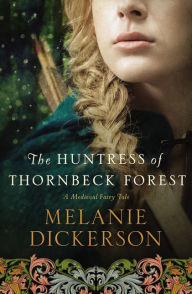
The Huntress of Thornbeck Forest. Melanie Dickerson. 2015. Thomas Nelson. 306 pages. [Source: Library]
First sentence: The tip of the arrow found its mark, a perfect shot through the deer's heart and lungs.
Premise/plot: Odette Menkels, the heroine in this medieval fairytale, is a poacher. She breaks the law of the land for a good cause, she reasons, her kills help feed hungry, starving, peasant children. But when she starts to fall head-over-heels in love with the forester, the man responsible for CATCHING all poachers on the margrave's lands, well, things get complicated. Jorgen Hartman is all kinds of wonderful, and, she hates keeping the truth from him. But it turns out that she isn't the only one with a secret...
My thoughts: Loved this one! The book is set in Europe in the 1300s, 1363 to be exact, and I love it. I'm not sure I *loved* this time period before Dickerson started writing fairy-tale like historical romances. But I sure do love it now. She's a great writer!
© Becky Laney of Operation Actually Read Bible
Showing posts with label young adult. Show all posts
Monday, October 3, 2016
Friday, May 22, 2015
Book Review: Christy
Christy. Catherine Marshall. 1967. 512 pages. [Source: Bought]
Only my father saw me to the Asheville station that Sunday morning in 1912.
Christy Huddleston is the heroine of Catherine Marshall's historical novel, Christy. It is set in a small community in the Smoky Mountains. Christy is the new school teacher hired by the local mission. She'll be working alongside, Miss Alice Henderson, and David Grantland. (Miss Alice Henderson runs the mission. David Grantland is the new minister, the oh-so-young, just-fresh-from-seminary minister.)
How to describe Christy? Well, she's young, spirited, enthusiastic, optimistic, naive, and well-intentioned. She's got a lot to learn, but, she's the type who's eager to learn. She comes to idolize (deeply respect and admire) Miss Alice. She sees Miss Alice as being the wisest woman ever, essentially. Miss Alice, to her credit, sees how loved she is by Christy, and seeks to show Christy how very human she is. Miss Alice would be the last person to say she had it all together and had all the answers. (She just knows who has the answers: God, and she trusts him and his providence.)
So the book is about Christy's experiences as a teacher, as a young woman. It's about the children she teaches, the families she meets, the women she befriends, the men she comes to know, namely David and Doc Neil MacNeill. It's a coming-of-age story, a spiritual coming-of-age story. How Christy came to the mountains believing certain things about God, but, during her time away from home and family, those beliefs were tested and questioned. She came out of her experiences KNOWING God instead of knowing about God.
I love the teaching aspect of this one. I like books about teachers: Anne of Avonlea, Anne of Windy Poplars, Good Morning, Miss Dove, Up A Road Slowly, When Calls the Heart, etc.
I like the spiritual aspects of this one as well. So many characters are in so many different places spiritually speaking. You do have to weigh all the statements about faith and God and Christianity while you're reading. Not all end up being true theologically. (I didn't necessarily like what the book said about Calvinism, at one point, Calvinism is blamed for their believing only in a God of wrath and their unwillingness to see him as a compassionate, forgiving, gracious God. It was a very generalized statement. It's on page 68.)
There is David, the minister, who came out of seminary knowing a lot of big words, but not knowing anything of the faith for certain. His conversations are heartbreaking, in my opinion. For example, when he and Christy go to visit a dying woman, she asks him to read from the Bible, and to talk to her of heaven. And he's hesitant. Oh, he reads the Bible fine. But when it comes to talk about the afterlife, about heaven, about dying. He stumbles a lot. Even Christy sees this as a weakness. He seems so uncertain of so many things we can be certain about. The old lady ends up giving him quite a speech. She knows God, David, well, it seems he may not even know about God. Not the God of the Bible. (chapter sixteen)
Doctor MacNeill also comes to mind. He and Christy have quite a discussion. He has been shaken in his faith by a tragedy, and, he's in a place where he's doubting God's goodness and faithfulness. He doesn't necessarily trust or love this God who permits such suffering. The discussion they have, the questions he asks of Christy, are good for her, good for her spiritual journey. (chapter twenty-five) And I love the ending.
I love the romance of this one. It's a very understated romance novel though. David proposes to Christy, relatively early on, after six or seven months of working together. He'd never expressed any interest in her before the proposal. And even after the proposal, he doesn't really ever say that he loves her. Just that he needs her. And at times he seems most interested in having her body than anything else. Doctor MacNeill, well, it might take a few rereads before their scenes start to have an effect on you. (For example, chapter thirty-five). But once you do, it's hard not to love them as a couple.
I love, love, LOVE, LOVE, LOVE Doctor MacNeill. I do.
© Becky Laney of Operation Actually Read Bible
Only my father saw me to the Asheville station that Sunday morning in 1912.
Christy Huddleston is the heroine of Catherine Marshall's historical novel, Christy. It is set in a small community in the Smoky Mountains. Christy is the new school teacher hired by the local mission. She'll be working alongside, Miss Alice Henderson, and David Grantland. (Miss Alice Henderson runs the mission. David Grantland is the new minister, the oh-so-young, just-fresh-from-seminary minister.)
How to describe Christy? Well, she's young, spirited, enthusiastic, optimistic, naive, and well-intentioned. She's got a lot to learn, but, she's the type who's eager to learn. She comes to idolize (deeply respect and admire) Miss Alice. She sees Miss Alice as being the wisest woman ever, essentially. Miss Alice, to her credit, sees how loved she is by Christy, and seeks to show Christy how very human she is. Miss Alice would be the last person to say she had it all together and had all the answers. (She just knows who has the answers: God, and she trusts him and his providence.)
So the book is about Christy's experiences as a teacher, as a young woman. It's about the children she teaches, the families she meets, the women she befriends, the men she comes to know, namely David and Doc Neil MacNeill. It's a coming-of-age story, a spiritual coming-of-age story. How Christy came to the mountains believing certain things about God, but, during her time away from home and family, those beliefs were tested and questioned. She came out of her experiences KNOWING God instead of knowing about God.
I love the teaching aspect of this one. I like books about teachers: Anne of Avonlea, Anne of Windy Poplars, Good Morning, Miss Dove, Up A Road Slowly, When Calls the Heart, etc.
I like the spiritual aspects of this one as well. So many characters are in so many different places spiritually speaking. You do have to weigh all the statements about faith and God and Christianity while you're reading. Not all end up being true theologically. (I didn't necessarily like what the book said about Calvinism, at one point, Calvinism is blamed for their believing only in a God of wrath and their unwillingness to see him as a compassionate, forgiving, gracious God. It was a very generalized statement. It's on page 68.)
There is David, the minister, who came out of seminary knowing a lot of big words, but not knowing anything of the faith for certain. His conversations are heartbreaking, in my opinion. For example, when he and Christy go to visit a dying woman, she asks him to read from the Bible, and to talk to her of heaven. And he's hesitant. Oh, he reads the Bible fine. But when it comes to talk about the afterlife, about heaven, about dying. He stumbles a lot. Even Christy sees this as a weakness. He seems so uncertain of so many things we can be certain about. The old lady ends up giving him quite a speech. She knows God, David, well, it seems he may not even know about God. Not the God of the Bible. (chapter sixteen)
Doctor MacNeill also comes to mind. He and Christy have quite a discussion. He has been shaken in his faith by a tragedy, and, he's in a place where he's doubting God's goodness and faithfulness. He doesn't necessarily trust or love this God who permits such suffering. The discussion they have, the questions he asks of Christy, are good for her, good for her spiritual journey. (chapter twenty-five) And I love the ending.
I love the romance of this one. It's a very understated romance novel though. David proposes to Christy, relatively early on, after six or seven months of working together. He'd never expressed any interest in her before the proposal. And even after the proposal, he doesn't really ever say that he loves her. Just that he needs her. And at times he seems most interested in having her body than anything else. Doctor MacNeill, well, it might take a few rereads before their scenes start to have an effect on you. (For example, chapter thirty-five). But once you do, it's hard not to love them as a couple.
I love, love, LOVE, LOVE, LOVE Doctor MacNeill. I do.
© Becky Laney of Operation Actually Read Bible
Wednesday, June 18, 2014
Book Review: The Hawk That Dare Not Hunt
The Hawk That Dare Not Hunt. Scott O'Dell. 1975/1988. JourneyForth. 182 pages. [Source: Bought]
Tom Barton is the young hero of The Hawk That Dare Not Hunt By Day. Tom sails with his uncle. They're smugglers during the reign of Henry VIII. One of the things both are interested in, to a certain degree, is the Reformation, in part led by Martin Luther. The novel opens with Tom smuggling in some of Luther's pamphlets or tracts. It is not without risk.
One of the men he approaches early on is William Tyndale. Tyndale is able to put Tom in touch with some booksellers who might just be interested in Luther's work. During their conversation, Tyndale also lets Tom know that he's looking to leave England. Tom welcomes him aboard his uncle's ship even though they don't typically take passengers. The novel focuses on Tom's interest in the Reformation, his relationship with William Tyndale, and his willingness to risk it all to smuggle dangerous books into England. The novel is about William Tyndale translating the New Testament into English.
Having the Bible in English is something that most readers take for granted, I imagine. This book brings that time period to life. I really loved this historical novel. I do.
© Becky Laney of Operation Actually Read Bible
Tom Barton is the young hero of The Hawk That Dare Not Hunt By Day. Tom sails with his uncle. They're smugglers during the reign of Henry VIII. One of the things both are interested in, to a certain degree, is the Reformation, in part led by Martin Luther. The novel opens with Tom smuggling in some of Luther's pamphlets or tracts. It is not without risk.
One of the men he approaches early on is William Tyndale. Tyndale is able to put Tom in touch with some booksellers who might just be interested in Luther's work. During their conversation, Tyndale also lets Tom know that he's looking to leave England. Tom welcomes him aboard his uncle's ship even though they don't typically take passengers. The novel focuses on Tom's interest in the Reformation, his relationship with William Tyndale, and his willingness to risk it all to smuggle dangerous books into England. The novel is about William Tyndale translating the New Testament into English.
Having the Bible in English is something that most readers take for granted, I imagine. This book brings that time period to life. I really loved this historical novel. I do.
© Becky Laney of Operation Actually Read Bible
Saturday, January 14, 2012
Book Review: The Healer's Apprentice
The Healer's Apprentice. Melanie Dickerson. 2010. Zondervan. 272 pages.
The townspeople of Hagenheim craned their necks as they peered down the cobblestone street, hoping to catch a glimpse of the Duke of Hagenheim's two handsome sons. The top-heavy, half-timbered houses hovered above the crowd as if they too were eager to get a peek at Lord Hamlin and Lord Rupert.
Melanie Dickerson may just be a new favorite of mine. In December, I reviewed The Merchant's Daughter, a fairy tale retelling of Beauty and The Beast set in the fourteenth century. Now I've had the chance to read her first novel, The Healer's Apprentice, a fairy tale retelling of Sleeping Beauty. Are either books true retellings? Well. The 'beast' is just a scarred man, and Rose, the heroine of The Healer's Apprentice never falls into an enchanted sleep. But. I think both books capture the spirit of the original fairy tales.
In The Healer's Apprentice, readers meet a young woman named Rose. She does not want to be forced into a marriage of her mother's choosing, so she is very thankful that the village's healer has chosen her to be her apprentice. She'll be living with the healer, living within the castle. It's an exciting time in her life, and it only seems to be getting better. Rose even captures the attention of both the older son, Lord Hamlin (Wilhelm is his first name) and the younger son, Lord Rupert, who's 'destined' for the church since his older brother will inherit everything when their father dies. At first, she's confused by the attention. Why would any of the nobility pay attention to her?! She's just a woodcutter's daughter. She may be beautiful, but she could never hope to marry someone that above her station, her class.
The Healer's Apprentice is narrated by Rose and Wilhelm. Wilhelm is a good man, a kind man. And he wants to do the right thing, he wants to do his duty. He's been betrothed practically forever to a young woman he's never met. He doesn't even know where she is--just that her life is in danger from someone. He's supposed to be seeking out the threat and protecting her. And that is his plan, his intention, but he keeps noticing how wonderful Rose is. He's so drawn to her. He knows it's wrong to fall in love with anyone but his betrothed, he knows it's not fair to anyone. But. He just can't help feeling what he feels....
I liked this one. I really, really, really liked this one. I think I loved The Merchant's Daughter a little bit more. But I would still recommend this one!!!
Read The Healer's Apprentice
and here is the trailer for The Merchant's Daughter:
© Becky Laney of Operation Actually Read Bible
The townspeople of Hagenheim craned their necks as they peered down the cobblestone street, hoping to catch a glimpse of the Duke of Hagenheim's two handsome sons. The top-heavy, half-timbered houses hovered above the crowd as if they too were eager to get a peek at Lord Hamlin and Lord Rupert.
Melanie Dickerson may just be a new favorite of mine. In December, I reviewed The Merchant's Daughter, a fairy tale retelling of Beauty and The Beast set in the fourteenth century. Now I've had the chance to read her first novel, The Healer's Apprentice, a fairy tale retelling of Sleeping Beauty. Are either books true retellings? Well. The 'beast' is just a scarred man, and Rose, the heroine of The Healer's Apprentice never falls into an enchanted sleep. But. I think both books capture the spirit of the original fairy tales.
In The Healer's Apprentice, readers meet a young woman named Rose. She does not want to be forced into a marriage of her mother's choosing, so she is very thankful that the village's healer has chosen her to be her apprentice. She'll be living with the healer, living within the castle. It's an exciting time in her life, and it only seems to be getting better. Rose even captures the attention of both the older son, Lord Hamlin (Wilhelm is his first name) and the younger son, Lord Rupert, who's 'destined' for the church since his older brother will inherit everything when their father dies. At first, she's confused by the attention. Why would any of the nobility pay attention to her?! She's just a woodcutter's daughter. She may be beautiful, but she could never hope to marry someone that above her station, her class.
The Healer's Apprentice is narrated by Rose and Wilhelm. Wilhelm is a good man, a kind man. And he wants to do the right thing, he wants to do his duty. He's been betrothed practically forever to a young woman he's never met. He doesn't even know where she is--just that her life is in danger from someone. He's supposed to be seeking out the threat and protecting her. And that is his plan, his intention, but he keeps noticing how wonderful Rose is. He's so drawn to her. He knows it's wrong to fall in love with anyone but his betrothed, he knows it's not fair to anyone. But. He just can't help feeling what he feels....
I liked this one. I really, really, really liked this one. I think I loved The Merchant's Daughter a little bit more. But I would still recommend this one!!!
Read The Healer's Apprentice
- If you like fairy tale retellings
- If you like historical novels set in the fourteenth century
- If you like clean romance
- If you like inspirational/Christian romances
- If you are looking for a great Christian YA novel
and here is the trailer for The Merchant's Daughter:
© Becky Laney of Operation Actually Read Bible
Wednesday, December 21, 2011
Book Review: The Merchant's Daughter
The Merchant's Daughter. Melanie Dickerson. 2011. Zondervan. 285 pages.
Annabel sat in the kitchen shelling peas into a kettle at her feet.
I loved this one. I just LOVED, LOVED, LOVED this one. It was just a perfect, perfect fit for me. It's a Christian fairy tale retelling!!! Of my most FAVORITE fairy tale, Beauty and the Beast. It's set in England in the 1350s. And it was such a sweet, delightful read. I really don't know how it could have been any better!!!
Annabel's family owes a debt--a large debt--to the lord of the village. While her brothers hope to marry Annabel off to Bailiff Tom (boo, hiss), Annabel dreams of becoming a nun and reading Scripture for herself. (Yes, she knows Latin. Yes, she can read.) Her brothers hope is that Annabel's husband would pay off the family's debt and enable them to keep their home. But Annabel knows there is another way to pay that debt, to enter the lord's service as an indentured servant, to serve her three years without grumbling or complaining. If Annabel was of the complaining sort, she would have much to say. For her two older brothers are the ones refusing to work. They are unwilling to do anything at all--except arrange unwanted marriages--to help the family.
The newly-arrived lord (Lord le Wyse) is an intimidating figure to be sure. He has many, many scars on his face. And his hand is disfigured. He's rumored to be quite beastly--in his temper. But after a few days in his service, Annabel sees him with different eyes. She sees someone brave and honorable and heroic. She sees that he is far from cursed, far from a monster.
Readers get this story from Annabel's point of view and Ranulf's point of view. And it was so great to get this story from 'the beast's' perspective!!! It made a good story, great.
There are many, many, many things that brings these two together. But one of the main things, perhaps, is his desire to be read to. He is thrilled to learn that one of his servants can read Latin for he has a Bible and a great desire to learn from it.
Read The Merchant's Daughter
© Becky Laney of Operation Actually Read Bible
Annabel sat in the kitchen shelling peas into a kettle at her feet.
I loved this one. I just LOVED, LOVED, LOVED this one. It was just a perfect, perfect fit for me. It's a Christian fairy tale retelling!!! Of my most FAVORITE fairy tale, Beauty and the Beast. It's set in England in the 1350s. And it was such a sweet, delightful read. I really don't know how it could have been any better!!!
Annabel's family owes a debt--a large debt--to the lord of the village. While her brothers hope to marry Annabel off to Bailiff Tom (boo, hiss), Annabel dreams of becoming a nun and reading Scripture for herself. (Yes, she knows Latin. Yes, she can read.) Her brothers hope is that Annabel's husband would pay off the family's debt and enable them to keep their home. But Annabel knows there is another way to pay that debt, to enter the lord's service as an indentured servant, to serve her three years without grumbling or complaining. If Annabel was of the complaining sort, she would have much to say. For her two older brothers are the ones refusing to work. They are unwilling to do anything at all--except arrange unwanted marriages--to help the family.
The newly-arrived lord (Lord le Wyse) is an intimidating figure to be sure. He has many, many scars on his face. And his hand is disfigured. He's rumored to be quite beastly--in his temper. But after a few days in his service, Annabel sees him with different eyes. She sees someone brave and honorable and heroic. She sees that he is far from cursed, far from a monster.
Readers get this story from Annabel's point of view and Ranulf's point of view. And it was so great to get this story from 'the beast's' perspective!!! It made a good story, great.
There are many, many, many things that brings these two together. But one of the main things, perhaps, is his desire to be read to. He is thrilled to learn that one of his servants can read Latin for he has a Bible and a great desire to learn from it.
Read The Merchant's Daughter
- If you're a fan of Beauty and the Beast
- If you're a fan of fairy tale retellings
- If you're a fan of historical fiction
- If you're a fan of historical romances
- If you're looking for good, clean YA reads
© Becky Laney of Operation Actually Read Bible
Labels:
2011,
book review,
Christian Fiction,
historical,
library book,
romance,
young adult,
Zondervan
Sunday, June 19, 2011
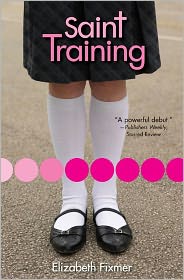
Book Review: Saint Training
Saint Training. Elizabeth Fixmer. 2010. Zonderkidz. 256 pages.
At the start of the novel, Mary Clare knows one thing for sure. She is destined to be a saint. And since the first step to being recognized as a saint is to be a nun, she's decided that will be her holy vocation. She's even decided that she'd love to become a nun after completing eighth grade. She reckons that will be soon enough. (She wants to become a nun before she starts liking boys.)
But Mary Clare is going to try her best right now to be a saint. She sees it clearly in her mind. Has a list of do's and don'ts. Knows exactly what she needs to do to earn her sainthood. But no matter how hard she tries, she can't go a day without sinning. (She's very precise about it. Keeps a tally of everything.)
If you take theology out of the evaluation, if you think of it merely as a book written about the late 1960s, this turbulent, anxious time when there were more questions than answers and many things seemed to be turned upside down, then Saint Training is an interesting and entertaining read.
In other words, the problems I had with Saint Training are all theological. I was disappointed with Saint Training, if I'm being honest. I expected better theology from Zondervan. I really did. I think if it had been published by any other publisher--any secular publisher--I would not have had such high expectations. I would have been happy with what the novel was and not felt as frustrated with what it was not.
Mary Clare believes in works salvation--that is that doing good works gets you into heaven. If you don't do enough good deeds on earth, well, you spend some time in purgatory. Mary Clare believes in sin, and believes in hell. But sadly, she doesn't know that no one can earn their way into heaven. That there was ever only ONE person who was perfect. That it is the sufficiency of Christ in both cleansing us from OUR sins and clothing us with HIS righteousness that makes heaven a reality for believers. We need both. We desperately need both. It's not enough to believe that Jesus died for the world, to save the world from sin, if you don't take that necessary next step. Without Christ's righteousness covering us, clothing us, without his righteousness being counted as my righteousness, then it's incomplete. It's not Christ's death on the cross + my righteousness = ticket to heaven.
I'm not blaming Mary Clare. I'm not. She just didn't know about grace. She tried her best to be righteous. She did. She prayed to the Virgin Mary regularly. She closeted herself with her glow-in-the-dark saints. She spent time looking at her collection of angels. She cherished her First Confession booklet. She confessed her sins weekly and kept a careful tally of it all so she could do penance for everything. She tried to witness to her protestant friends to show them the true faith. She gets an A for effort, for straining to reach that level of perfection, that level of righteousness. But. It's just not enough. It could never be enough. I wanted to reach out to Mary Clare. I wanted to tell her about grace. I wanted to tell her to trust in Christ for it all. That God declares us righteous because of His Son.
I'm not sure I should be taking my fiction so seriously.
© Becky Laney of Operation Actually Read Bible
March 25, 1967Mary Clare O'Brian is the heroine in this middle grade novel set in Littleburg, Wisconsin, in the late 1960s. Throughout the book, Mary Clare writes the Reverend Mother asking questions, questions, and more questions. Questions about the civil rights movement, questions about the war in Vietnam, questions about the protesters, questions about the feminists or the women's liberation movement, questions about birth control, questions about Vatican II, questions about the faith, etc. Some of the questions are theoretical; some are practical. Many are personal and reveal how this sixth grader--soon to be seventh grader--is dealing with all the changes in her life. Her mom and dad are fighting all the time. Her dad can get very angry at times--and hard to deal with. And her mom? Well, her mom is not the same since her latest pregnancy. She's miserable. She's always reading Betty Friedan's Feminine Mystique and either crying or getting angry. And her brothers and sisters, well, they prove that you cannot go a day without sinning.
Dear Reverend Mother,
My name is Mary Clare O'Brian. I am in sixth grade and I am writing because I want to become a Good Shepherd nun. I like the Good Shepherd runs best because you work with unwed mothers and their babies. I love little babies.
I have lots of experience with kids. God gives my family a new one every year even though we have more than we can handle now. Everyone says that I am very mature for my age because of how well I take care of my little brothers and sisters. Also I'm a good leader. The nuns at school can be really strict and when I'm in charge of the little kids at home, I have to be strict lots of times.
I saw The Sound of Music where the Mother Superior helped Julie Andrews face her problems. I could do that. Everybody tells me their problems, and I'm good at solutions.
At the start of the novel, Mary Clare knows one thing for sure. She is destined to be a saint. And since the first step to being recognized as a saint is to be a nun, she's decided that will be her holy vocation. She's even decided that she'd love to become a nun after completing eighth grade. She reckons that will be soon enough. (She wants to become a nun before she starts liking boys.)
But Mary Clare is going to try her best right now to be a saint. She sees it clearly in her mind. Has a list of do's and don'ts. Knows exactly what she needs to do to earn her sainthood. But no matter how hard she tries, she can't go a day without sinning. (She's very precise about it. Keeps a tally of everything.)
If you take theology out of the evaluation, if you think of it merely as a book written about the late 1960s, this turbulent, anxious time when there were more questions than answers and many things seemed to be turned upside down, then Saint Training is an interesting and entertaining read.
In other words, the problems I had with Saint Training are all theological. I was disappointed with Saint Training, if I'm being honest. I expected better theology from Zondervan. I really did. I think if it had been published by any other publisher--any secular publisher--I would not have had such high expectations. I would have been happy with what the novel was and not felt as frustrated with what it was not.
Mary Clare believes in works salvation--that is that doing good works gets you into heaven. If you don't do enough good deeds on earth, well, you spend some time in purgatory. Mary Clare believes in sin, and believes in hell. But sadly, she doesn't know that no one can earn their way into heaven. That there was ever only ONE person who was perfect. That it is the sufficiency of Christ in both cleansing us from OUR sins and clothing us with HIS righteousness that makes heaven a reality for believers. We need both. We desperately need both. It's not enough to believe that Jesus died for the world, to save the world from sin, if you don't take that necessary next step. Without Christ's righteousness covering us, clothing us, without his righteousness being counted as my righteousness, then it's incomplete. It's not Christ's death on the cross + my righteousness = ticket to heaven.
I'm not blaming Mary Clare. I'm not. She just didn't know about grace. She tried her best to be righteous. She did. She prayed to the Virgin Mary regularly. She closeted herself with her glow-in-the-dark saints. She spent time looking at her collection of angels. She cherished her First Confession booklet. She confessed her sins weekly and kept a careful tally of it all so she could do penance for everything. She tried to witness to her protestant friends to show them the true faith. She gets an A for effort, for straining to reach that level of perfection, that level of righteousness. But. It's just not enough. It could never be enough. I wanted to reach out to Mary Clare. I wanted to tell her about grace. I wanted to tell her to trust in Christ for it all. That God declares us righteous because of His Son.
I'm not sure I should be taking my fiction so seriously.
© Becky Laney of Operation Actually Read Bible
Labels:
2010,
book review,
children's books,
library book,
young adult,
Zondervan
Thursday, October 7, 2010
Book Review: Dark Sons
Dark Sons. Nikki Grimes. 2005. Hyperion. 218 pages.
A few weeks ago, I reviewed Nikki Grimes' A Girl Named Mister, a verse novel about how a Christian teen handles her pregnancy by taking comfort from Mary's story.
Dark Sons, like A Girl Named Mister, is a verse novel. It stars a young man, Sam, who is struggling to accept his new reality. His father has left his mom. His dad has fallen in love with a white woman--a young woman--and he is starting a new life, a new family.
Dark Sons is about his struggling to make peace between his past and present. How the father he loved and respected and admired goes missing. How he feels about his father marrying again. How he feels about having a half-brother, David. Where does Sam belong? Has this divorce displaced him forever? Or will he find a place to belong in this new home?
Sam may be confused, but he never falters in his faith. He holds onto his belief in God. He sees God as his Father. The one Father who will never fail him. He identifies with Ishmael's story.
Dark Sons is a verse novel. The book alternates between a modern story (Sam) and an ancient story (Ishmael).
Newly available in paperback from Zondervan. I really liked this one. I liked both narrators. I liked seeing the bible story through fresh eyes. I liked the poetry.
© Becky Laney of Operation Actually Read Bible
A few weeks ago, I reviewed Nikki Grimes' A Girl Named Mister, a verse novel about how a Christian teen handles her pregnancy by taking comfort from Mary's story.
Dark Sons, like A Girl Named Mister, is a verse novel. It stars a young man, Sam, who is struggling to accept his new reality. His father has left his mom. His dad has fallen in love with a white woman--a young woman--and he is starting a new life, a new family.
Dark Sons is about his struggling to make peace between his past and present. How the father he loved and respected and admired goes missing. How he feels about his father marrying again. How he feels about having a half-brother, David. Where does Sam belong? Has this divorce displaced him forever? Or will he find a place to belong in this new home?
Sam may be confused, but he never falters in his faith. He holds onto his belief in God. He sees God as his Father. The one Father who will never fail him. He identifies with Ishmael's story.
Dark Sons is a verse novel. The book alternates between a modern story (Sam) and an ancient story (Ishmael).
Child of Promise
Long awaited.
Twice promised.
Heir of Canaan.
Born of Sarah.
Son of miracles.
The one intended.
The son
who is
not me. (75)
Newly available in paperback from Zondervan. I really liked this one. I liked both narrators. I liked seeing the bible story through fresh eyes. I liked the poetry.
© Becky Laney of Operation Actually Read Bible
Labels:
2005,
book review,
Hyperion,
library book,
verse novel,
young adult,
Zondervan
Sunday, September 26, 2010
Book Review: A Girl Named Mister
Her mom may call her Mary Rudine, but everyone else calls her Mister. Mister's a good girl--a Christian girl--sings in the church choir, loves volleyball. She has a best friend, Sethany, she tells all her secrets to. But things change when she meets Trey.
Things start off safe--and pure. Trey and Mister go on group dates--often at the church, or with the church youth group. But soon that isn't enough for Trey. And well, Mister, has to admit being alone with Trey feels right. Yes, she knows that being alone with him might lead her to temptation. Might lead her to have second thoughts about her commitment for purity. But. She does it anyway.
One time. Mister has sex with Trey just one time. But that was all it took for a new life to form, and for one teen's life to change forever.
Mister struggles with the guilt and shame of being a pregnant teen. She struggles with the truth. She tries to deny the pregnancy--for a time. But she is relieved to find comfort and support not only from her mom but from others in her church as well. She also takes great comfort in reading a book of poetry--a book she borrowed from her mom. A book of poems about Mary, the mother of Jesus.
Readers read not only the contemporary story of Mister but Mary's story as well. It imaginatively examines what it might have been like for Mary. Yes, readers may be familiar with the Christmas story. But have you really, really thought about what it might have been like for Mary and Joseph?
A Girl Named Mister is a verse novel. I enjoyed both Mary's narrative and Mister's narrative. I loved how Mister finds grace and peace in the gospel, in the church. I loved how she was able to turn this experience into a growing one--growing closer to her mother, growing closer to God.
Soft
Soft as fleece,
God's forgiveness
falls over me
like a quilt,
and this time,
I let it smother
my guilt. (145)
© Becky Laney of Operation Actually Read Bible
Sunday, July 11, 2010
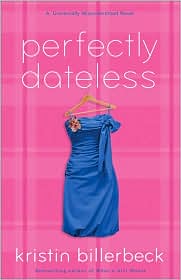
Book Review: Perfectly Dateless
Perfectly Dateless: A Universally Misunderstood Novel. Kristin Billerbeck. 2010. July 2010. Revell. 256 pages.
They say the first step to recovery is admitting you have a problem. So I guess I have a problem. I am a bit of a perfectionist, and my life is anything but perfect.
Our heroine Daisy Crispin has so many problems. No, she's not being abused--physically or sexually. No, she's not addicted to drugs or alcohol. No, she doesn't have an eating disorder. No, she doesn't cut. No, she isn't a compulsive liar or thief. No, she's not grief-stricken from the loss of a parent, grandparent, sibling, or best friend. No, she's not being stalked. No, she doesn't have cancer. No, she's not pregnant. But she's suffering none the less. Why? Because her mom makes all her clothes. And though she could buy her own--from an approved list of stores--with the money she makes from her job, she chooses to save her money for college. And wearing handmade clothes (with handmade labels) instead of designer clothes is just one of the ways our heroine, Daisy, is suffering. She has the most embarrassing parents in the universe. She's sure of it. And they're super-strict: she's also not allowed to date.
I found it extremely difficult to like Daisy. That's not to say I sided with Daisy's parents. I may not like Daisy, but even I have to admit that her parents cross a couple of lines. Like when they perform at a school assembly, talk about how lonely and invisible their daughter, Daisy, feels, and then rap about peer pressure. I would cringe right along with Daisy. But does having embarrassing parents really excuse Daisy's flaws?
I didn't like how Daisy treated her parents. I didn't like how she felt justified in bending the rules, sneaking out of the house, keeping secrets, telling lies, etc. I didn't like her attitude. But. At the same time, I didn't like her parents' attitude towards her. Just as Daisy was disrespectful to her parents, I found her parents weren't really being understanding and supportive of their daughter either. Especially when it comes to their daughter's choices in colleges, in majors. Using the "we only want what is best for you" speech to specify one college, one major, no exceptions. If you don't do exactly what we tell you, then you're a selfish brat. I have no problem seeing Daisy as a selfish brat. I really don't. But selfish because she doesn't want to follow her parents' dreams for her when it comes to choosing a college, choosing a major, choosing a career? Selfish because she wants to follow her own dreams, make her own choices? I don't think that Daisy is being selfish by being interested in neuroscience.
So I didn't like Daisy, I didn't like Daisy's parents, how about her friends? Daisy has a few friends. Claire is Daisy's best friend. And she's a sad case. She actually has something worth complaining about her--her dad has left her and her mom, her mom has gone to Hawaii on an extended-extended vacation, and the maid quit. So poor Claire is left all on her own--with neither parent aware of the situation--for most of the book. (We're talking months and months.) Claire who has been ever-desperate for attention continues down an unhealthy path. And Daisy just wants Claire to go shopping with her, wants Claire to take care of her, to help her out with her problems.
There are two other friends mentioned by name. Neither worthy of mention when it comes to plot. Which is part of the problem I have. Why make friends exist in the first place if they're only going to be stereotypical? Angie Chen is the Asian-American teen with less of a social life than Daisy because she's super-good in math and music. Sarika Singh, an Indian, is again a teen with a "less-than" social life--at least when it comes to guys--because her parents are traditional and believe in arranged marriages. How many times are Angie and Sarika mentioned? Maybe two or three times? Do they even have any lines? I'm not so sure. We're just told that Sarika will one day marry the man her parents choose for her--a man from India. And we're told that Angie doesn't have time for parties or boys because she's too busy being smart.
How about love interests? Well, there are a couple of guys Daisy is interested in. Chase being the dream-guy. And Max being the one guy not on Daisy's list of potential prom dates. He's new. He's Argentinian. He can tango. And flirt. And he loves Jesus too. But. She hasn't known him since kindergarten. Max is probably my favorite of the two.
Perfectly Dateless follows the oh-so-dramatic senior year of Daisy Crispin. Chances are you'll like this one better than I did. Maybe you can sympathize with Daisy's problems. Her not having a boyfriend. Her wanting to go to prom more than anything in the whole wide world. Her thinking that having that one perfect prom date for the prom picture will mean that only good things are in store for her in the future.
Labels:
2010,
blog tour,
book review,
realistic fiction,
Revell,
review copy,
young adult
Sunday, February 21, 2010
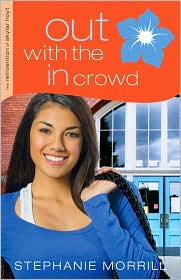
Book Review: Out With The In Crowd
Out With The In Crowd by Stephanie Morrill. 2010. [January 2010] Revell. 252 pages.
All winter break, I'd planned for this moment, the one about to happen.
Skylar Hoyt may be beautiful--her mom is Hawaiian--and popular, but that doesn't mean her life is perfect. Far from it. A senior in high school, Skylar should be preparing for college, making plans for living her own life. Instead, Skylar is spending most of her time worrying about her family. Her younger sister, Abbie, is pregnant. And her mom and dad are separated and talking divorce. Add to the mix some seriously complex and conflicted relationships with her friends, and it's no wonder Skylar is feeling lost.
There is just something so high school about Out With The In Crowd. Here are just a few of the complications in Skylar's life: Eli--her ex-boyfriend; Jodi--her ex-best-friend, and the current girlfriend of Eli; and Connor, her current boyfriend, but Jodi's ex-boyfriend. Of course, that's just the very beginning...
Out with the In Crowd is the second novel in the series. Me, Just Different is the first. (I haven't read it.)
Labels:
blog tour,
book review,
family,
friendship,
Revell,
review copy,
romance,
young adult
Sunday, February 7, 2010
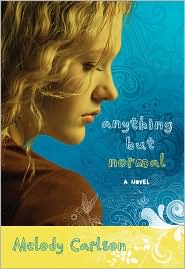
Book Review: Anything But Normal
Anything But Normal. Melody Carlson. 2010. [January 2010] Revell. 254 pages.
I wasn't crazy about the title of this one. I think normal is a loaded word, and it's one I try to avoid when possible. I think it's a word that can be packed with a lot of judgment. And sometimes these are judgments we place on ourselves. And sometimes these are judgments others place on us. But. I guess that's a whole other story.
What is this one about? Well, it's about a Christian teen becoming pregnant. While she's away at a Christian summer camp. It's about the lies she tells herself, and the lies she tells others. It's about guilt and shame. It's about judging and misjudging others. It's about how words can hurt. Just as much as actions. At times.
Sophie, our heroine, is so ashamed of her "condition" that she denies the pregnancy altogether. Keeping one big secret from her family, from her friends, from her church, from her classmates. Sophie has some judgmental friends. No question about that. And some of these judgmental friends have judgmental parents. They've been raised that being right is more important than being loving. Her friends are callous, in my opinion, and so is Sophie in a way. Especially in the beginning. There were times when I thought that every single person was missing the big picture, being so fundamentally clueless. But. Sophie does begin to change. Mostly.
I thought this novel was a bit clumsy in places. And I don't know how quite to explain what I mean by clumsy. I think it was definitely an issue novel. Sometimes it was a quiet issue novel; sometimes it was a loud and demanding ISSUE NOVEL. There were a few elements in the plot that I found a little unbelievable. (I'm thinking of the sudden uproar of protest against the school's pregnancy center; the angry parents demanding this and that and calling for town meetings, etc. And then with one little speech from Sophie, all is made well again. Not only has the uproar blown over, there is now so much love and support that many now want to volunteer at the pregnancy center.)
Do I think the subject matter important? Yes. Of course I do. I think teen pregnancy is an important issue. I think more needs to be said than "it's bad" and "don't do it." I think it's important to show unconditional love. That becoming pregnant as a teen, out of wedlock is not the unforgivable sin. It's not something outside of grace. Grace and love extend to both mother and child.
Available January 2010 at your favorite bookseller from Revell, a division of Baker Publishing Group
Labels:
book review,
fiction,
realistic fiction,
Revell,
review copy,
young adult
Sunday, January 3, 2010
Book Review: The Fiddler's Gun
Peterson, A.S. 2009. The Fiddler's Gun. Rabbit Room Press. 293 pages.
The trouble with Phineas Michael Button began the moment she was born.
It continues,
"She had the expected two ears, two eyes, one nose, and dimpled cheeks, but in her father's mind there was a problem. He had twelve children, daughters all, and was convinced that number thirteen would be his long-awaited son. So on the twenty-fifth of September, 1755, when he drew another baby girl from the womb of his long-suffering wife, he declared the discovery of an unacceptable mistake."
Abandoned by her parents, left in an orphanage in Ebenezer, Georgia, Fin, our young heroine has no problem being tough and staying strong. She's needed to be her whole life. But she is not the person the Baab Sisters--especially Hilde--would have her to be. She's not ladylike enough. She's too manly, too strong, too wild in their minds. Maybe a little kitchen duty will do the trick...
At first Fin is angry that she's been thrust into the kitchen, and forced into apprenticing with the orphanage's cook, Bartimaeus. (She's jealous that her best friend, her would-be-could-be husband, Peter, gets the better deal, the better job. He gets apprenticed to a carpenter.) But she soon realizes that this may just be the best thing that ever happened to her. For Bartimaeus --though not a simple man or a perfect man--loves her like she's his own child, his own daughter. He's a man with a past, a history--a dark and tangled mess of a past. But he's a good man, a changed man*.
With increasing hostilities between the colonies and England, it's not an easy time for Fin to come of age. Not with Fin's temperament. Her quick temper leads to...well...a great big dangerous adventure**.
Historical fiction. Action. Adventure. Pirates. Orphans. And a little old war.
What did I enjoy about this one? So very much! I love historical fiction. Usually. And this was no exception. A bit violent at times, yes, but what else would you expect in a sea-adventure filled with pirates?! It was exciting, compelling, hard to put down. It's anything but boring! I cared about Fin from the start. And her companions--especially Jack, Knut, and Tan--became important to me as well. The characters definitely felt human--felt flawed--which is a good thing. I would definitely recommend this one. (Especially if you enjoyed The True Confessions of Charlotte Doyle.)
The story will conclude in a second book, Fiddler's Green. (I want it now!)
You can order a copy of The Fiddler's Gun book through Rabbit Room Press.
*I will say this part of the story was just awesome for me. Peterson was able to connect the story with George Whitefield. True, it's a very small--very tiny--part of the overall story. But still, it made me happy.
**It probably helped that I love films like Pirates of the Caribbean, Captain Blood, and The Sea Hawk. I think having this background helped me visualize the fighting-at-sea scenes.
Labels:
2009,
action,
adventure,
book review,
historical,
young adult
Wednesday, February 25, 2009
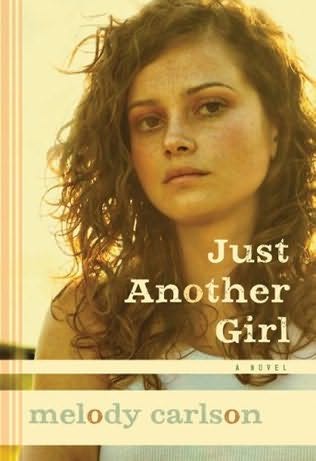
Book Review: Just Another Girl
Carlson, Melody. 2009. Just Another Girl.
For as long as I can remember, I've been stuck in the middle. Like being dealt a loser's hand with no more turns to take, my luck seemed to run out even before I was born.
What's a girl to do when the guy she's crushing on doesn't love her God? Meet Aster Flynn. The girl in the middle. One older sister, Rose, one younger sister, Lily. One mostly neglectful work-driven mother. One completely (well-mostly) absent father. Seventeen and tired of not having a life--a life complicated by the fact that her younger sister has a mental disability--the mind of a five year old in the body of a fifteen year old--Aster is more than thrilled when a popular guy, Owen, starts paying attention to her. It's summer. And the timing seems right, Owen is there right when she needs. Right when she thinks she can't take another day of life "as is." But is Owen--cute and dreamy though he may be--really the answer to her prayers? What about his reputation? What about his lifestyle? What about his beliefs? Life is definitely complicated for Aster. She knows that she needs a break, a life; she knows that she should not be shouldering the responsibility for caring for her sister all alone. But how can she make her mom and dad listen to her? How can she find her voice?
I liked this one. Aster's narrative is strong and mostly authentic. It did have a few moments where it felt a little bit like an after-school special. And there were a few more places where it felt like an episode of Full House. (Minus the make-up-with-your-sisters-and-hug music.) But all that being said, I liked it more than not. And I'd definitely recommend it to teens and tweens looking for clean reading material. While it is a Christian book, it is more of a morality-values kind of book. Not a bad thing--not at all. It's refreshing to read a book now and then that shows a teen girl happy to be herself, who would choose to be herself instead of falling for the "everybody's doing it..." trick when it comes to drinking and dating, etc. Her life isn't perfect. Her life will never be perfect in that sitcom-ey way.
© Becky Laney of Operation Actually Read Bible
Tuesday, August 12, 2008
Book Review: On The Edge of the Dark Sea of Darkness
Peterson, Andrew. 2008. On the Edge of the Dark Sea of Darkness.On the Edge of the Dark Sea of Darkness by Andrew Peterson is the first book in the Wingfeather Saga*. Andrew Peterson isn't new to writing; he's a creative genius in my opinion, a singer-songwriter.** But this is his first novel. And it releases MARCH 18TH, 2008. The publisher is Water Brook (a division of Random House).
The novel boasts of having "adventure, peril, lost jewels, and fearsome toothy cows." A boast which proves true of course.
There are three "brief" introductions to the novel. (Three mini-prologues.) As is the case in some prologues, they are written in a different manner than the novel itself. I think that's a good thing in this situation because Peterson's prologues are a bit over-the-top***.
First sentence of "A Brief Introduction to the World of Aerwiar": The old stories tell that when the first person woke up on the first morning in the world where this tale takes place, he yawned, stretched, and said to the first thing he saw, "Well, here we are." The man's name was Dwayne and the first thing he saw was a rock. Next to the rock, though, was a woman named Gladys, whom he would learn to get along with very well. In the many ages that followed, that first sentence was taught to children and their children's children and their children's parents' cousins and so on until, quite by accident, all speaking creatures referred to the world around them as Aerwiar.
First sentence of "A Slightly Less Brief Introduction to the Land of Skree": The whole land of Skree was green and flat. Except for the Stony Mountains in the north, which weren't flat at all. Nor were they green. They were rather white from all the snow, though if the snow-melted, something green might eventually grow there. Ah, but farther south, the Plains of Palen Jabh-J covered the rest of Skree with their rolling (and decidedly green) grasslands. Except, of course, for Glipwood Forest. Just south of the plains, the Linnard Woodlands rolled off the edges of all maps, except, one would suppose, those maps made by whatever people lived in those far lands.
First sentence of "An Introduction to the Igiby Cottage Very Brief": Just outside the town of Glipwood, perched near the edge of the cliffs above the Dark Sea, sat a little cottage where lived the Igiby family. The cottage was rather plain, except for how comfortable it was, and how nicely it had been built, and how neatly it was kept in spite of the three children who lived there, and except for the love that glowed from it like firelight from its windows at night. As for the Igiby family? Well, except for the way they always sat late into the night beside the hearth telling stories, and when they sang in the garden while they gathered the harvest, and when the grandfather, Podo Helmer, sat on the porch blowing smoke rings, and except for all the good, warm things that filled their days there like cider in a mug on a winter night, they were quite miserable. Quite miserable indeed in that land where walked the Fangs of Dang.
First sentence of Chapter One: Janner Igiby lay trembling in his bed with his eyes shut tight, listening to the dreadful sound of the Black Carriage rattling along in the moonlight.
The Igiby family are the stars in Andrew Peterson's On the Edge of the Dark Sea of Darkness. There is a grandfather, Podo, a mother, Nia, the oldest son, Janner, the sister, Leeli, the younger brother, Tink, and the dog, Nugget. They live in occupied territory. The Fangs are dangerous that's for sure. And within a few chapters, the Igibys accidentally make themselves the target of the Fangs hatred and abuse. This leads to the promised "adventure, peril, lost jewels, and fearsome toothy cows." The book is full of adventure and mystery. And it is quite enjoyable. It is one of those fantasy novels that creates a new world, new lands, new peoples, new creatures, etc. And like a few fantasy novels these days it does make use of footnotes. Fun little asides meant to entertain. I won't lie and say the footnotes were as enjoyable as those found in the Bartimaeus trilogy, however, I will say that their use is a positive and not a negative attribute of the novel. There are also appendices at the end.
What can I say about the novel? I tended to enjoy it. It could be in part to the fact that I think Andrew Peterson is so wonderful. But it could be something more. I think for kids that can't get enough fantasy it will be thoroughly enjoyable. For those that get impatient with fantasy--the strange names of people and places and maps--then it might not be "thoroughly" enjoyable. (It might just be enjoyable.) For those that are skeptical that a musician can write, let me assure you that it is better than the prologue. That's not to say I dislike the prologue. But the third prologue in particular would be very very very very annoying if that was the style of the book and the best the author had to offer. It was cute for one page, but for 279 pages it would have been overkill. Also, I think kids that love funny books will enjoy this one. I'm not sure the book is 'as funny' for adults as it would be (or might be) for kids. It's REALLY hard to be an adult and judge if the humor is going to work for kids. For one thing, each kid is different. And what is 'funny' to one might not be 'funny' to another. But I think it has potential there.
So I recommend this one.
-------
*I don't know if the publication of the series depends on the success of the first book or not.
**He writes all types of songs. Sometimes they are deep and meaningful. Sometimes they just ring with truth and authenticity. Sometimes they make you cry (songs about grandpa's dying, etc.). Sometimes they make you laugh. Two examples: Andrew Peterson is one of the geniuses responsible for "The Monkey Song" featured on the Veggie Tales video The Wizard of Ha's. He also wrote one of the funniest songs of all time: Alien Conspiracy or The Cheese Song. (Unfortunately the lyrics aren't available online or it would have been a Poetry Friday post long long ago. I'm too lazy to try to transcribe it myself.)
***I'll try to explain through examples.
Labels:
2008,
adventure,
book review,
children's books,
Christian Fiction,
fantasy,
young adult
Subscribe to:
Posts (Atom)