Showing posts with label short stories. Show all posts

Thursday, November 7, 2019

Book Review: The Oregon Trail Romance Collection

The Oregon Trail Romance Collection: 9 Stories of Life on the Trail Into the Western Frontier. Featuring Stories by Amanda Cabot, Melanie Dobson, Pam Hillman, Myra Johnson, Amy Lillard, DiAnn Mills, Anna Schmidt, Ann Shorey and Jennifer Uhlarik.  2015/2019. Barbour Books.  448 pages. [Source: Review copy]

I love pioneer stories. I do. It's "my one weakness" you might say. (Of course, I have many "one" weaknesses.) I also enjoy a good romance every now and then. This collection recently republished by Barbour was just the treat I needed. So I requested to review it.

The Sagebrush Bride by Amanda Cabot. This was a GREAT choice for an opening story. I was swept up, up and away by this swoon-worthy romance.

Beckoned Hearts by Melanie Dobson. I enjoyed this one. I did. It was a good, solid read, a nice edition to the collection.

Shanghaied by the Bride by Pam Hillman. This is not your traditional romance--for better or worse. Unless by traditional you mean predictable that the hero and heroine would ultimately fall in love. I didn't care for it much. But it wasn't awful.

Settled Hearts by Myra Johnson. If I had to pick one word to describe this one it would be SILLY. Yet I can't help recalling that it was also satisfying. I found it silly because of the way the heroine/hero treat traveling east and west--the year is 1852--as if it's no big deal, not a hardship or challenge to be found!!! Her mother is DYING and so she decides to go west to try to track down her father so they can return together to be with the dying woman--wife/mother. Anyway, the focus is NEVER on the trail or the trip. Just on all the feels. Now I admit that the feels were there for this couple. I definitely liked the characters--just found the plot/story ridiculous.

As Good As Gold by Amy Lillard. Is it horrible that I can't remember one thing about this one?! Maybe this was the story that I stopped in the middle of and took a break of several weeks?! The summary provided in the book doesn't help me recall anything either!

Daughter of the Wind by Diann Mills. One word to describe this one: INTENSE. WOW. I found this story hard to put down--not because I found myself swooning at the hero or feeling like a girl again but because I had to know what happened next. This is incredible story.

His Frontier Family by Anna Schmidt. Oh this story, this one I remember too! I definitely found it charming. Not focused on the trail west--far from it--but a great romance with a good, solid hero and heroine.

State of Matrimony by Ann Shorey. Just when I think I couldn't possibly find another "favorite" in the collection...I really enjoyed this one. The heroine hires herself out as a COOK so she can go west...and there's a love triangle of sorts. This is a book I thoroughly enjoyed now, but would have LOVED, LOVED, LOVED as an eleven year old.

Sioux Summer by Jennifer Uhlarik. At first I didn't much like this one. But then I read in the author's note about the events it was based upon (...the Indian attack/hostilities). The more I thought about it, the more I liked it.

© Becky Laney of Operation Actually Read Bible

Monday, February 20, 2017

Book Review: No One Hears But Him

No One Hears But Him. Taylor Caldwell. 1966/2017. Open Road Media. 212 pages. [Source: Review copy]

First sentence: Many years have passed since old John Godfrey, the mysterious lawyer, built his Sanctuary in a great city for the hopeless, the grieving, the despairing, the churchless, the cynical, the defeated, the dying and the bereaved, the betrayers of men and the betrayed, the burdened and the old, the young and the lost. Here, in the Sanctuary, waits the Man who Listens, who waits and listens endlessly and patiently to the anguished stories told to him in a blue and marble silence. There is no experience that he has never heard before. There is no grief with which he is not familiar. There is no crime against God or man that he has not seen with his own eyes. He has heard the blasphemies of the self-congratulatory. He has heard the cry of all parents and all children. He has listened to all prayers and all excuses. The experiences of all men are his own. Nothing disturbs him except hatred and violence. He knows them, too.

Premise/plot: No One Hears But Him is a collection of twelve short stories. Each story is a 'soul'. Readers hear from twelve distinct voices. At some point in each story, the character goes to the Sanctuary, waits his or her turn, and goes into the room to speak with the Man Who Listens. Most choose to press the button to meet this Listener face-to-face, but, not all do. Each story ends with hope; all stories are tied together by hope. The stories can be dark, gritty, pessimistic, angry, doubting, critical, questioning, sarcastic--essentially anything and everything under the sun but the connection each makes with THE MAN WHO LISTENS brings hope.

In the preface or the introduction of this one, the author makes a startling statement: This book is deliberately designed to anger many.

Soul One: The Watchman (Fred Carlson, disgruntled cop)
Fred Carlson had had an excellent lunch with his prospective employers. They had parted from him with expressions of great cordiality, for they respected good and dedicated and intelligent men.
Soul Two: The Sadducee (Dr. Edwin Pfeiffer, unbelieving minister)
“Is that all you can tell me?” asked the desolate woman. What is it you want me to say to you? the man commented to himself. Do you want old-fashioned and sentimental cant in which I don’t believe and which is absurd in these enlightened and sophisticated days? I am no parson, dear lady, full of soothing platitudes and maudlin aphorisms. I am a teacher, a leader, a guide to my congregation. Do you expect me to soothe you with evangelical hysteria or invoke some tribal god?
Soul Three: The Afflicted (Francis Stoddard, contemplating murderer)
“I didn’t come here for counsel,” said Francis Stoddard to the hidden man behind the blue curtain. “I’ve had plenty of that stupidity. When I lost my business fifteen years ago, you should have heard all my self-appointed advisers! I should have listened to them; I shouldn’t have done this, I should have done that, if I’d only watched my step here, or been plenty smart there—it wouldn’t have happened to me. Then when I made my comeback, they were almost offended. I hadn’t asked their advice; I’d done it all myself. When I was down, they could feel superior and pity me—and avoid me, too, afraid I’d ask them for money.
Soul Four: The Ostracized (Paul Winsor, black man who wants to first and foremost be seen as a man)
He supposed they had been offended when he had left the lunch so abruptly. He had ended his talk on a note of despair, but they had not heard the despair. Of that he was positive. They never heard anything but their self-congratulation and the applause of their colleagues for their “tolerance” and “liberalism.” When he had quoted Seneca and had demanded “Am I not a man as you are a man?” they had only nodded their heads solemnly and had looked at each other with grave eyes of assent. But they did not know what he had meant. He had meant it for them. They had not known or were too stupid and self-engrossed to know.
Soul Five: Only A Kid (Johnnie Martin, a spoiled brat with many ex-wives and many children who won't grow up)
He came smiling rosily into the waiting room, walking with his usual boyish insolence and waiting for every eye to turn on him indulgently and every woman’s eye to warm. But no one seemed to know he had entered.
Soul Six: The Senior Citizen (Bernard Carstairs, does NOT want to retire)
The mauve-blue twilight lay over the snowy city and the street lamps began to bloom like faint golden balls.
Soul Seven: The Shepherd (Mr. Henry Blackstone, a minister who believes but is losing his congregation because he's not keeping up with the world)
The month of May, the flowering month, the month of the Queen of Heaven. Isn’t that what his friend, Father Moran, called it? Yes. A beautiful month, full of light and promise, gold and green and blossoming, with the heady scent of jubilation and rejoicing. But when did I feel that last? asked the Reverend Mr. Henry Blackstone of himself. I am as old as death, honestly, in these days, though by modern calculation I am only sixty. I’m not with it, as my younger parishioners would say. No, I’m not “with it.” It’s strange; I was always such an optimistic man until the last few years. Now I feel totally despondent; I walk despondently; I think despondently. Who is wrong, the world or I? Am I of the past, hopelessly? I’m so damned confused, so helpless.
Soul Eight: The Husbandman (Adam Faith, farmer about to lose the farm)
“Well, hello, Parson,” said the old man with gravity as he faced the calm blue curtain of the alcove. “You are a parson, ain’t you? That’s what everybody says, anyhow. You listen to folks’ troubles and then you tell them what to do. That’s real kind of you. Didn’t know there was that kind left in the world, no sir. Everybody loving each other and nobody loving anybody: that’s what goes on now. Like the patriotism you read about in the newspapers and nobody’s patriotic, seems like. Why, there was a time, I remember, if folks had trouble, even in the city, everybody’d come with baked goods and fruit and maybe a roast chicken, and there’d be real sympathy. Now it’s all fake, newspapers full of brotherly love and the rights of everybody, and people talkin’ and the pastors telling you, in their pulpits, to do good to everybody, ’specially people you don’t know in foreign parts, and nobody gives a damn about their next-door neighbor. Easy to be sympathetic about people a thousand miles away or more; costs you nothin’ to roll your eyes and make your voice all deep and soft. But gettin’ off your butt and doin’ something about the people next door, with your own money and your own work: Oh, no. That doesn’t mean anythin’ now. It isn’t havin’ a sense—what do they call it with their mealy-mouths?—of world-wide responsibility.
Soul Nine: The Richest Man in Town (John Service, Has everything, satisfied with nothing. Can't decide if he's more angry than bored or more bored than angry)
It was enough to make, a man kill himself. He, John Service, had been seriously considering this for over six months. Or was it longer? He could not remember. He was bored to death, bored by pleasantness, smoothness, affluence, laughter, cocktail parties, wood-paneled offices, amiable employees, serene wife, well-established children, rosy fat grandchildren, summer homes, winters in Florida or the Caribbean, or in those exotic out-of-the-way places in Mexico and Central America, or in Paris, or London or Madrid or Mallorca. The world was really small; one finally ran out of places to visit and explore. Besides, everything had become Americanized and sterile and cellophaned and sanitary, with excellent bathrooms, fast jets, gourmet meals, and tender stewardesses. Sweet and Lovely. As he waited in the quiet room John Service hummed that old popular song from his boyhood. It rang in his brain now, not liltingly, but with a kind of horror and terror, mocking, a refrain of demons, a refrain from the very black pits of hell. Sweet and lovely. An excellent epitaph for a world—and especially for a human life.
Soul Ten: The New Breed (Lucy Marner, young and desperate)
“Where’re you going, Lucy?” asked a young girl of her companion as they moved together to the parking lot of the campus. “Well, I thought I’d just run around—someplace,” said Lucy Marner. Her friend peered at her inquisitively. “Something wrong? You haven’t been looking on the ball for a couple of months.” The friend giggled. “Nothing wrong, uh?” Lucy flushed. “No,” she said in a short tone. She did not invite her friend to accompany her. “But I—well, I’m going to the doctor for the early summer check-up. No use waiting until the end of the semester, when things begin. ’Bye now, Sandy.” She walked very fast to the parking lot. She was usually proud of her smart white convertible and would glance over it to be sure no hot-rod had marred its bright finish. But today she merely threw herself onto the red leather seat and roared off the campus. Friends, young men and women, hailed her but she did not reply for she did not hear them.
Soul Eleven: The Dream-Spinner (Maude Finch, past-her-prime liar)
The golden spring day was no fresher than the air in the white and blue waiting room.
Soul Twelve: The Adversary and the Man Who Listens (a show-down between the devil and Christ)
The waiting room was almost filled when he entered, but no one seemed to see him except for a very young girl with mad eyes. He became aware that she saw him and he stopped, and it was as if a dark shadow had fallen over her distraught face. She most certainly saw him and he half-smiled. He knew at once what troubled her and what had caused that dilated appearance in her pupils, and the long, fixed stare. He knew her very well. There was no pity in him, no regret, but only contempt. Weakling. Wretch. Contemptible animal. She was only eighteen, he recalled, but her soul was shriveled within her like a bud that had withered before it had opened. Anathema, anathema, he thought. It was no triumph to him that he had brought down that meager soul so easily. She had needed little tempting! “Emily?” he said, very softly.
My thoughts: I loved, loved, LOVED this one. I thought the stories were compelling and relevant. Yes, the stories are perhaps a bit dated here and there. But I'm of the opinion that truth is never out of date even if it it seen as out of style. Caldwell meant the book to be critical of society in 1966, and, today's readers should probably still feel offended by the gospel truths on display in this one.

Favorite quotes:
When somebody tells me they’re awful happy, I think, ‘You’re either a liar or a fool.’ ’T’ain’t possible to live in this world and be happy, after you’re about three years old.”
He shook his head. “I’m remembering something. When it was a choice between you and a criminal the people chose the criminal. They always do; it never fails. But you didn’t hold that against them. You’ve been watching all through the night, and you’ll be on hand when the last night comes.”
We speak only of the world and never question the stars, for the world is all we know—and all we want to know. Our little bright corner is enough for us, and there we can sit and talk our blasphemous and urbane nonsense, and utter our words of peace in a world where there is no peace, and offer up well-rehearsed prayers which are empty of content, as we are empty of content. Who shall forgive us?”
“What is it that is so frightful in most men these days that they must pretend to ‘love’ others?” asked Paul. “Never was the world so loveless as it is now, so degraded, so full of hate. Yet, you can’t go anywhere but that you hear love, love, love. A steamy bath of it. A miasma. It is particularly smothering for my people. They are choking in it, especially in the North. But it isn’t really love, is it? It is hatred. It is the self-righteousness of the cruel Pharisee.”
No one has ever earned the right to leave the harvest.
“They never said you were like this—When I heard about you, they said you were a terrible person; it scared me; they said you were the Judge. I only heard about you a few times, so long ago I don’t remember, but I thought you’d hate me—all the lies and everything. They said you hated liars and hypocrites, and I guess I’ve been that all my life, and maybe it don’t mean anything to you that it was the only way I could live, lying like that to myself and everybody else, and pretending. After all, you are the Judge, and you’re terrible. That’s what they said, all those years ago, and it scared me.” She opened her eyes and the man was still regarding her with gentle suffering and love, and she began to weep again, but softly. “I see! You don’t hate me for what I did, do you? And all that I went through in my life—it wasn’t even all that as bad as one day of yours, was it? And you didn’t have anybody to talk to, either, did you? Oh, they listened to you, they sure did, but what good did it do? They didn’t believe you, but people believed me a little, and that’s something. They don’t even believe you now. “You didn’t have anyone to talk to except yourself. And God.” Her eyes suddenly shone with wonder and she sat upright. “That’s it, you had God to talk to! And so do I! That’s what you mean, isn’t it? I can talk to you, any time I want to, anywhere! If only I’d known a little more about you in the beginning. That’s what the real depriv—the real not-having—not having you in all those years. “But now I have you!” The wonder brightened on her face and the years left her and she was a child again, hoping. But this time the hope had verity and truth. “That’s what you’re trying to tell me, isn’t it, that I have you, and that if I have you you’ll always listen and help me, and that I mustn’t be afraid any longer.”
© Becky Laney of Operation Actually Read Bible

Monday, October 28, 2013

Book Review: The Cat in the Window


The Cat in the Window And Other Stories of the Cats We Love. Callie Smith Grant, ed. 2013. Revell. 192 pages. [Source: Review copy]

Cat in the Window is a charming collection of true cat stories. There are many contributors to this collection: Callie Smith Grant, Vicki Crumpton, Andrea Doering, Alison Hodgson, Kathryn Ann Mays, Mark Muhich, Ila J. Smith, Mary Ann Osborn, Jill Eileen Smith, Robert Benson, Kathi Lipp, Pamela Allnutt, Donna Acton, Ed Peterson, Donna Hollingsworth with Pam Lione, Lonnie Hull DuPont, Cindy Crosby, Sandy Cathcart, April McGowan, Marilyn Guidinger, Melody Carlson, David Manuel, Jeanette Thomason, Cathy E. Watkins, and Dusty Rainbolt. Some are telling about current (or more recent) cats; some are reminiscing about former cats they've loved and lost. Some are meant to bring a laugh, others a smile. Some are definitely more emotional than others. I didn't connect with each and every story if I'm being honest. Some felt to be stories just featuring a cat. The cat was there when this happened in my life stories. Other stories, however, truly focus more on the special relationship between cats and their owners. You can imagine both types of stories being told in conversation: to friends, perhaps, or, even to strangers.

For anyone who enjoys cats, who loves cats, this one is a good, enjoyable collection.

Tuesday, November 13, 2012

Book Review: The Good News from North Haven

The Good News From North Haven. Michael L. Lindvall. 1991. 176 pages.

I enjoyed this short story collection by Michael L. Lindvall. The book is set in the small town of North Haven, Minnesota. The stories are all told from the point of view of a local Presbyterian pastor. I thought he was a great choice as narrator because he was in a unique position to know just about everyone in town--and could perhaps with a little help from the Spirit--see the people with loving, grace-filled eyes. Not that he was a perfect character, he'd probably be the first to admit that he's a sinner, but because he tried even when it was difficult, even when he didn't want to, even when he really really didn't want to, to see the people through God's eyes. Each of stories offers a moral or lesson. And I suppose some readers who don't like lessons or who feel too manipulated by lessons may not appreciate this one. But. I do think it will work for plenty of readers. The first and last stories are Christmas-related. So it does capture 'a full year' of small town life.

The stories included in this one are:


  • The Christmas Pageant
  • The Little Things
  • Merciful Snow
  • The Ocarina Band
  • The Affair
  • The Motorcycle
  • Learning to Dance
  • A Strange Providence
  • Reunion
  • Lamont Wilcox's Boat
  • Sherry Moves Home for a While
  • Air-Conditioning
  • The Treasure Hunt
  • The Dreadful Omniscience of God
  • The Jefferson Street Leaf War
  • Hunting
  • Rapture
  • Christmas Baptism


© Becky Laney of Operation Actually Read Bible

Monday, September 26, 2011

Book Review: Still More Stories from Grandma's Attic

Still More Stories from Grandma's Attic. Arleta Richardson. 1980/2011. David C. Cook. 160 pages.

In June, I reviewed the first two books in the Grandma's Attic series: In Grandma's Attic and More Stories from Grandma's Attic. This fall, two more books in the series have been released: Still More Stories from Grandma's Attic. And Treasures from Grandma's Attic.

I have really enjoyed revisiting these books from my childhood years. As I mentioned before, Mabel and her family were just as dear to me as the Ingalls family.

The stories included in this one:

  • Face Cream from Godey's Lady Book
  • It Rhymes with Mop
  • High Society
  • The Dog Who Could Spell
  • The Wrinkled Stockings
  • Whenever I'm Afraid
  • Grandpa Hobbs
  • The Spelling Bee
  • The Prettiest House in the County
  • My Own Boss
  • The Harvest Home Festival
  • The Surprise Birthday Present
  • The Perfect Party
  • Windfalls

While the first two books felt very, very familiar to me--like old friends--I admit that the third one almost felt unfamiliar. I remembered a few of the stories, but not most of them! Which isn't good or bad, I suppose! I am a bit puzzled at my memory though. For there are stories that I remember--somewhat clearly--that I haven't found in any of the four books. I kept thinking, it'll be in the next one, it has to be in the next one. I seem to remember more stories about a quilt--with the granddaughter asking about each fabric. And the fabrics used weren't just the grandmother's but almost each member of the family was connected in some way. And I remember one story having to do with an apron with TONS of pockets. And I haven't found that one.

I do recommend this series.

© Becky Laney of Operation Actually Read Bible

Saturday, June 4, 2011

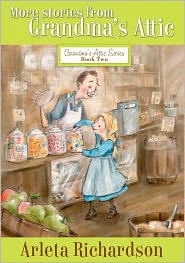
Book Review: More Stories from Grandma's Attic

More Stories from Grandma's Attic. Arleta Richardson. 1979/2011. David C. Cook. 144 pages.

From The Nuisance in Ma's Kitchen
When Grandma called from the backyard, I knew I was in for it. She was using her would-you-look-at-this voice, which usually meant I was responsible for something.

"What, Grandma?" I asked once I reached the spot where she was hanging up the washing.

"Would you look at this?" she asked. "I just went into the kitchen for more clothespins and came back out to find this."

I looked where she was pointing. One of my kittens had crawled into the clothes basket and lay sound asleep on a clean sheet.

"If you're going to have kittens around the house, you'll have to keep an eye on them. Otherwise leave them in the barn where they belong. It's hard enough to wash sheets once without doing them over again."
I grew up loving the Grandma Attic series by Arleta Richardson. These books were definitely comfort reads to me. Books that I read again and again and again and again. Books with beloved characters that were my friends. I loved Mabel and Sarah Jane and Roy and Reuben. I did. So I was very excited to see that David C. Cook was reprinting these! The first two, In Grandma's Attic and More Stories From Grandma's Attic, are available now. The other two, Still More Stories from Grandma's Attic and Treasures from Grandma's Attic will be released in August. And a wonderful "treasury" of all four books will be released in October.

The stories from this collection are:

  • The Nuisance in Ma's Kitchen
  • Grandma's Sampler
  • Mrs. Carter's Fright
  • When Grandma Needed Prayer
  • The Stranger
  • The Big Snowstorm
  • Grandma and the Slate
  • A Pig in a Poke
  • Grandma's Day Off
  • How News Spread
  • Charlotte
  • The Slate Pencil
  • What Shall We Write About?
  • The Cover-Up
  • The Haircut
  • Grandma Makes A Friend


The books are decidedly moral, decidedly Christian. Most--if not all--stories have a definite moral or lesson attached to them. And these lessons are clearly stated or restated at the end of each story so there's no possibility of missing what the author wants you to know. Technically, I suppose this makes these stories didactic in nature. And technically, "modern" readers are supposed to frown on didactic literature whether they agree with it or not. But. You won't be hearing me complain. No. I still love these books. I do. There's no talking me out of it. Call me old-fashioned. But I will stay a loyal fan of these!


© Becky Laney of Operation Actually Read Bible

Book Review: In Grandma's Attic

In Grandma's Attic. Arleta Richardson. 1974/2011. David C. Cook. 144 pages.

From Pride Goes Before a Fall:
"Grandma, what is this?"

Grandma looked up from her work, "Good lands, child, where did you find that?"

"In the attic," I replied. "What is it, Grandma?"

Grandma chuckled and answered, "That's a hoop. The kind that ladies wore under their skirts when I was a little girl."

"Did you ever wear one, Grandma?" I asked.

Grandma laughed. "Indeed I did," she said. "In fact, I wore that very one."

Here, I decided, must be a story. I pulled up the foot-stool and prepared to listen. Grandma looked at the old hoop fondly.

"I only wore it once," she began. "But I kept it to remind me how painful pride can be." 

I grew up loving the Grandma's Attic series by Arleta Richardson. The first four books in the series--In Grandma's Attic, More Stories from Grandma's Attic, Still More Stories from Grandma's Attic and Treasures from Grandma's Attic--were some of my favorite books from childhood. How favorite is favorite? Well, let's just say that Mabel, Roy, Reuben, and Sarah Jane were as familiar, as beloved as say Laura, Mary, Ma and Pa Ingalls, Ramona and Beezus Quimby, and Lucy, Edmund, Susan and Peter Pevensie. These weren't books that I read two or three times and forgot about (like the Babysitter's Club), no, these were books that I read dozens of times. These were books that I read so much that all the pages were loose and the spine practically nonexistent. If books could be made real--like Velveteen bunnies--then these books were real.

So I was super-excited to learn that David C. Cook is releasing these books again! The first two, In Grandma's Attic and More Stories From Grandma's Attic, are available now. The other two, Still More Stories from Grandma's Attic and Treasures from Grandma's Attic will be released in August. And a wonderful "treasury" of all four books will be released in October.

So the framework for this book--for all the books--is a storytelling format. A little girl is asking her grandmother to tell her stories. These are stories about the grandmother's childhood. These are stories about her grandmother's family. There are stories about attending school in a one room school house; stories about attending church; stories about life on the farm--the chores and hardwork that went into it; stories about the 'excitement' of going into town for a day of shopping. There is something undeniably charming about these stories. Through these stories, a family does come to life. And our lives are richer for it, I think!

So the stories in In Grandma's Attic are:

  • Pride Goes Before a Fall
  • When God Knew Best
  • The Red Bonnet
  • Ma's Busy Day
  • Grandma's Mistake
  • The Button Basket
  • Little Gray Shoes
  • Nellie and the Buttons
  • The Pearl Buttons
  • Nellie's Trips to Town
  • The New Pump
  • You Can't Always Believe
  • The Old Door
  • Pa and the Dishwater
  • The Dishes
  • Ma's Birthday Cake
  • Grandma's Warm Clothes,
  • Grandma's Prayer
  • Molly Blue
  • Grandma and the Gun
  • What Grandma Lost 

The books are decidedly moral, decidedly Christian. Most--if not all--stories have a definite moral or lesson attached to them. And these lessons are clearly stated or restated at the end of each story so there's no possibility of missing what the author wants you to know. Technically, I suppose this makes these stories didactic in nature. And technically, "modern" readers are supposed to frown on didactic literature whether they agree with it or not. But. You won't be hearing me complain. No. I still love these books. I do. There's no talking me out of it. Call me old-fashioned. But I will stay a loyal fan of these!

© Becky Laney of Operation Actually Read Bible

Thursday, December 11, 2008

Book Review: While Shepherds Watched


Roberts, Steven. 2007. While Shepherds Watched.

I meant to review this one on Saturday, but things got away from me. Earlier in the year I reviewed Steven Roberts book, Christmas On Deery Street. I loved that book. I loved, loved, loved that book. I wish I could say the same about While Shepherds Watched. I didn't love, love, love it. But I enjoyed it. I'd give one an A+ and the other a B. Although since reading is subjective, you may find yourself loving this one more than the other. I can only speak to my own experiences here. First of all, Steven Roberts has once again created authentic characters. Characters that you feel you actually begin to know, begin to love by the time the story is through. That is rare for short stories, at least in my experiences. I'm used to bonding with characters in novels, but short stories--not so much. But Roberts does have a gift for characters, a gift for capturing human emotions, human nature so authentically, so genuinely. The stories presented here are: Gabriel's Trumpet, Peace In the Valley, Miracle in the Clearing, The Madam and the Paperboy, Transforming Christmas, and Full Circle. Of those stories, Gabriel's Trumpet, The Madam and the Paperboy, and Full Circle stand out to me. With Gabriel's Trumpet and Full Circle tying for first place in my thinking. Again this is subjective. In the first collection, I loved each and every story. In this second collection, well I loved a few, I liked a few, and I was neutral about a few. There weren't any that I hated by any means. But there were a few that left me unaffected, unmoved. But I'm glad I read this one, it would be worth your time and energy even if you just ended up loving two or three out of the six. There really is something for everyone--from every generation--to appreciate. Although I think this is a book for adults. (But what I meant by "every generation" was whether you're twenty-five or sixty-five, you're going to find something to enjoy in this collection.)

Wednesday, December 10, 2008

Book Review: Christmas on Deery Street


Roberts, Steven. 2006. Christmas on Deery Street & Other Seasonal Stories.

I rarely read short stories. True, I have read a lot of short stories in literature classes in college, but I don't typically make a point of seeking out collections of short stories in my normal non-assigned reading. I like--love--well-developed characters, characters that you come to care about and know. And truth is, that rarely happens for me in such a short amount of time and space. So I was wonderfully surprised to find that Steven Roberts has an incredible gift with characterization. His characters in the stories--so real, so human. It is so easy to care about what happens to them. So natural to love them. Each story in this collection was great. There are no duds. I loved them all. In fact, it would be hard to choose a favorite. Although I suppose under duress I would answer "Christmas on Deery Street" or "Nanny's Locket". But how could I not equally love "The Angel of Union Station" and "Magic Socks"? The stories? How to describe them? They make me feel good. Warm and fuzzy. But not in a cheesy way. I know if I call them heartfelt or sentimental that someone will say, "that's not for me." And that would be a disservice. The stories cover a lot of emotions. There is love and heartache and loss and sadness. There is anger and guilt. There is hope. There is regret. And there is plenty of humor. But above all there is a feeling of genuineness, authenticity, a realness, knowing that these stories are indeed true-to-life and true to the human spirit. This is a book that I loved--I simply loved it. Adored might even come into fashion as a way to describe how much I loved it. Why? I know this is a book that I can share with my mother, my grandmother, my great-aunt, not to mention my best friend and her mother. It's a book I know so many people will enjoy that it's just a real treat to have been the one to discover it first.