Showing posts with label speculative fiction. Show all posts

Thursday, June 26, 2025

52. Every Hour Until Then


52. Every Hour Until Then (Timeless #5) Gabrielle Meyer. 2025. 368 pages. [Source: Library] [speculative fiction, historical fiction, time travel, christian fiction, 5 stars]

First sentence: A cold wind rattled the window frame in my bedroom at 11 Wilton Crescent as the edges of a tree branch scraped across the glass.

Premise/plot: The Timeless series by Gabrielle Meyer are speculative fiction heavy on the romance. Each is a 'timeslip' novel where the heroine is living in two time periods. She lives each day twice: once in each time period. She alternates where she wakes up essentially. Her first name is the same in both timelines. Kathryn, our heroine, is living in 1888 and 1938. In one timeline, JACK THE RIPPER is splashed across the newspapers. IN the other timeline, ADOLF HITLER is. She loves history in both timelines. But she has perhaps a better job in 1938. She is, in fact, hired to put together an exhibit on Jack the Ripper in 1938 for the London Museum. For better or worse, her time in the 'present day' of 1938 is effecting how she is living life in 1888. She knows WHO the victims will be and the details surrounding their death. She knows that the killer will not be brought to justice and is in fact still very much a mystery. She is tempted to see for herself if she can figure out WHO he is by hiding at the scene of his crimes. Especially when she knows one of the future victims. Will she risk it all to save a life?

My thoughts: This might be my favorite of the series. Perhaps. For the record, some of the books in this series I have not cared for at all. This one was extremely different from previous books. It was more MYSTERY and SUSPENSE then romance. That's not to say the love interest in the past lacked charm, he did. It's just that there was no love triangle--like in previous titles in the series where some attempt is made to be angsty in the love department. 

© Becky Laney of Operation Actually Read Bible

Tuesday, January 21, 2025

6. Across the Ages


6. Across the Ages. (Timeless #4) Gabrielle Meyer. 2024. 384 pages. [Source: Library] [2 stars, christian fiction, historical fiction, speculative fiction, historical romance]

First sentence: My bare toes dug into the hardpacked earth as I beat the rug on the back line, watching the dust melt away into the setting sunlight. It moved through the drooping Spanish moss on the ancient oak trees overhead, making me long for my troubles to fade away so easily.

The Timeless series has a relatively unique premise. I'll clarify if I can, for christian romance it has a definitely unique premise. Each book stars at least one heroine--sometimes two--that can time cross or cross time. They live two lives; they go to sleep in one time and awake in the other. Each book features a "love triangle" of sorts. Of sorts being the key word. For better or worse, the development of the love interest, the love story, the romance is ALL in one time period--for the most part. That might not be fair. It might be closer to 90/10 or 85/15. But without a doubt, ANY reader can predict which man will be chosen extremely early on. And despite the fact that the stories are about to be deeper and more layered than just falling in love, that development is on the lighter side. Every book *is* different. Which has kept me coming back. I am not always frustrated or disappointed. Sometimes I am entertained.

Caroline (aka Carrie, Caro, Carl) lives in 1727 and 1927. She has not known any other time-crossers which makes her in far worse shape than the reader of the series. She is clueless while the reader is not. This can be frustrating at times, but it is mostly forgivable and understandable. 

The heroine--in both times--was annoying to me personally. Her life-choices while perhaps necessary for plot reasons are poor, very poor. Her reasoning or lack of reasoning is frustrating. In both time lines she decides to hunt for her birth mother. She runs away from home (in 1727), dresses up as a boy, joins a pirate crew, and goes off in search of her birth mother last known location some island. (I *can't* remember off hand which island.) She ignores all potential dangers going off the clue from a letter dated twenty years previously??? Anyway, it was the letter she arrived with as a baby to her grandfather's estate. in the 1927 timeline, she KNOWS her birth-mother is an outlaw (inspired by the real life Bonnie of Bonnie and Clyde) and she seeks out all the clues so she can go meet her and have a little chit-chat. As if you could just approach a bank robber and say, HEY, I THINK YOU'RE MY MOM. I guess you could. But that takes a certain mindset. 

I tentatively like the two timeline in theory. But it almost always comes to the point where you're tolerating one to get back to the other. I am never as invested in both stories equally. 

I do think this book will be a better fit for other readers. You do have to suspend your disbelief and NOT overthink things. The more you are an over-thinker, the less you may enjoy this one. I do think you need a bit of patience allowing for the heroine to get caught up with things you already know. I think certain readers may be charmed by certain real-life inspirations. 


© Becky Laney of Operation Actually Read Bible

Thursday, March 21, 2024

25. In this Moment


In This Moment. (Timeless #2) Gabrielle Meyer. 2023. 416 pages. [Source: Library] [Speculative fiction; historical romance]

First sentence: Most days, I could pretend that my life was normal. I was a twenty-year old woman searching for my place in the world, trying to decide my future. The only difference was that I had three normal lives, and on my twenty-first birthday, just eight and a half months from now, I would have to choose which one to keep and which to forfeit. Forever. 

Our heroine is "Margaret Wakefield," "Maggie Hollingsworth," and "Meg Clarke." Her timelines are respectively 1861, 1941, and 2001. In each timeline she has an interest in medicine be it as a nurse or doctor/surgeon. A little bit of backstory, she is the daughter of TWO time slippers or two time travelers. She bears two birthmarks which signify that she has this special ability; one is inherited from her father and the other is inherited from her mother. 

This is the second novel in the series. Unlike the first book, I really LOVED this one. Mainly because it was so much improved from the first novel. What I appreciated about his novel is the characterization and storytelling. Characters are fully fleshed out in all three timelines. Well, mostly. Two of the timelines definitely get more attention to detail. However, I felt that the stories in all three were actually engaging and well-balanced. I did not feel that there was a super incredible obvious choice within the first three or four pages. I did not feel that there was one obvious HERO that would be THE ONE within the first three chapters. I think the balance between the three storylines, the cast of characters in each timeline, were well done. Most importantly, I think the heroine was actually likable. And that makes all the difference in the world. If you can't stand to be anywhere near the main character and you think she is off-putting, it's hard to like a book well enough to finish it.

Loose lips apparently don't sink ships in the world Meyer has created. Our main character can't really keep her abilities to herself. She confides in friends, family, and love interests. In every timeline she has a support system in place which allows her to talk relatively freely about her other lives, other families, other love interests. I don't know how I feel about this to be honest. 

There was one scene that I thought was theologically iffy. But I think the theology of this speculative fiction is just necessarily iffy. Because it is all make believe and has a different set of rules. God somehow seems less sovereign and less in charge of his universe. Like he's waiting on his special time-travelers to figure out how the story is going to play out. 

"Sometimes I wish God would just choose for me."
"You wouldn't really want that, would you?"
I shrugged. "I don't know. It would be easier." 

© Becky Laney of Operation Actually Read Bible

Monday, May 24, 2010

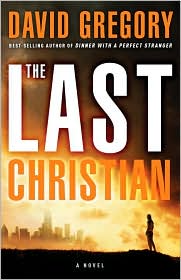
Book Review: The Last Christian


The Last Christian. David Gregory. 2010. Waterbrook Press. 416 pages

I see your neurons firing, Ray.

The Last Christian has an interesting premise. A very thought-provoking premise. It's set in 2088, in the United States, for the most part. In this day and age, Christianity is essentially dead.

Abby Caldwell, our heroine, is the daughter of a missionary couple; she has only known one way of life, the Christian way of life. She's from Papua New Guinea--from the jungle where she was born and raised. But when a mysterious illness kills everyone in her village, well, she sets off on an adventure of her own. She's on her way to America to try to fulfill her grandfather's vision.

Abby received a message--though the message came sixteen years late--from her grandparents. They told her of a dream, a vision. Of how she may be America's greatest hope. Of how she may be the one to bring Christianity back to a country, a nation.

But fulfilling that dream may cost her her life. Because the country is not only unreceptive to the gospel, but openly hostile. She may face jail time for her "hate speech" if she tries to share the gospel with others.

Of course, that is only the beginning of the story David Gregory has written. The Last Christian reads more like an eery Twilight-Zone episode. Artificial intelligence. Silicon Brains. The obsession to combine technology and biology--to take humanity to a whole other level, to be transhuman. The quest of driven men to live forever and ever.

Science. Politics. Religion. Ambition. Greed. Murder. The Last Christian is a compelling read. It is a bit more premise-driven, action-driven, than character-driven, but that isn't necessarily a bad thing.

What I liked best about The Last Christian was it made me think. I'm not sure I liked every little thing about the book. The book makes some strong statements here and there about our church culture, our faith. But. If nothing else it makes you think about faith. What would happen--what could happen--if faith fails. (I think truth is infinitely more important than entertainment value. That the church shouldn't be so open to compromising the truth--changing the gospel--in order to bring more people in the doors.) I liked that Abby didn't have all the answers. That she wasn't perfect. That she was human. That she had her own faith challenges to work out.


© Becky Laney of Operation Actually Read Bible