Tuesday, May 20, 2025
44. A Child's Garden of Bible Stories
Thursday, March 27, 2025
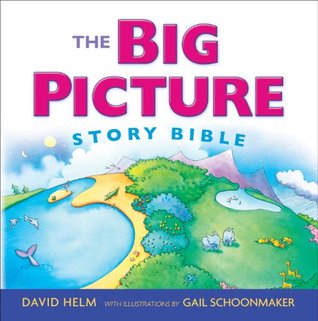
29. The Big Picture Story Bible
First sentence from the Old Testament section: The Bible is God's story, and it begins with these big words: "In the beginning, God created the heavens and the earth." Do you know how God created everything? Simply by speaking words. Imagine, making the world with words! Strong words. Powerful words. With words God created everything!
First sentence from the New Testament section: Years passed without a single word from God. And the years turned into many years, and the many years turned into hundreds of years. And the great promises of God seemed to fade away. Israel became less important in the world. Other nations became great--strong nations, powerful nations, whose kings ruled over God's people. One such king...was Caesar Augustus.
The Big Picture Story Bible is one of my favorite bible story books. Why? Because it presents the Bible not as a series of entertaining, informational, educational, inspirational stories but as a unified story. The Bible does in fact have a big picture. If you miss the big picture, you miss the point. By understanding--grasping, appreciating--the big picture, you are enabling yourself to appreciate the smaller as well because you can see how everything fits, everything belongs.
The Big Picture Story Bible has twenty-six illustrated stories. Together they tell one big story. These stories build upon one another. They are interconnected. Everything is building up to the big climax--the appearance of Jesus Christ. The first eleven stories cover the Old Testament. The remaining fifteen stories cover the New Testament.
The Bible is for believers young and old. The story it tells is grand, glorious, but above all TRUE and TRUSTWORTHY. Yet people of all ages can struggle to read the Word for themselves. Perhaps because it seems so strange and otherworldly. Perhaps because it is intimidating. Perhaps because they don't know where to begin. A familiarity with the BIG PICTURE of the Bible could be the very boost one needs to begin to ACTUALLY read the Bible.
The Big Picture Story Bible gives readers of all ages the orientation they need to grasp not only the story but the theology behind the story. It covers the basics of the gospel, the good news of Jesus Christ. It is not so thorough and comprehensive that it would ever--could ever--take the place of the Word itself. That would be silly. But by showing you the structure of the Word, how everything fits together, how every story belongs to the whole, it can be a considerable help.
I think this one is for readers of all ages. I definitely think parents with children should have this one in their homes. (Christian parents and grandparents). Parents have an awesome responsibility to teach and instruct their children in the faith. It isn't anyone else's responsibility to do so for you. It is a great task, but it isn't an impossible one. It's never too early. It's never too late. You might feel overwhelmed, but you can learn alongside your children. You can go on this glorious, wonderful journey together.
But I also think adults without children could benefit from this one as well. There are a million excuses why believers don't read the Bible. Grasping the big picture and holding onto the big picture could be a great stepping stone into actually reading the Bible and tasting for yourself the sweetness of the Lord.
Friday, March 21, 2025
26. Adventure Bible: Read through the Bible: 8 Bible Stories for Early Readers
Wednesday, March 6, 2024
21. Rand McNally Book of Favorite Stories of Jesus
The Rand McNally Book of Favorite Stories of Jesus. Mary Alice Jones (according to GoodReads). Illustrated by Elizabeth Webbe, Eleanor Corwin, Manning de V. Lee, and Janet Robson Kennedy. 1981. 109 pages. [Source: Bought]
Mary and Joseph were going to Bethlehem. Mary was riding on a little gray donkey. Joseph was walking, leading the donkey. Soon it would be dark. Mary was tired. She knew it was time for her baby to be born. She drew her shawl closer about her to keep warm. "There," Joseph said. "There is Bethlehem. It is not far now." Mary looked up and saw the town. "We are almost there," she said. Mary and Joseph came to the town. They went to the inn where the travelers stayed. The door was closed. Joseph knocked at the door. He knocked again and again.
Tuesday, October 17, 2023
71. I Am: 40 Bible Stories, Devotions, and Prayers About the Names of God
I Am: 40 Reasons to Trust God. Diane Stortz. 2016. 224 pages. [Source: Library] [Bible story book; children's storybook]
Monday, April 24, 2023
39. Go and Do Likewise
Go and Do Likewise: The Parables and Wisdom of Jesus. John Hendrix. 2021. [February] 40 pages. [Source: Review copy]
Saturday, October 16, 2021
68. Behold the Lamb of God
God’s promised Messiah was a merciful gift of love to a people who needed both mercy and love. He would come to them in all their pain, brokenness, and struggle, and make everything new.
They were to worship the Lord, and they were to understand why they should. The call to worship wasn’t a detached decree to render affection to an unknown deity—the God who called them was anything but detached. This command was a call to remember. They were to rehearse in their minds and hearts and homes this story—their story—the story of how the Maker of heaven and earth had called their people to himself and bound himself to them as their God. In their creativity and in their learning, in their working and in their resting, in their building up and in their tearing down, they were to love him. They were to love him as whole people, in all their weakness and in all their strength. On their best days and on their worst, in the darkest hours of their loneliest nights, and at the tables of their most abundant feasts, they were to love him. This was the heart of Israel’s religion: love. Only divine love made sense of the world. This love went beyond a mere feeling. This love was doctrine. Israel’s story was a story of being kept, and the only reasonable response was to love the Keeper.They were never to depart from this harmony of story and statute. It was to be their life. They were to teach it to their families. They were to recount the wondrous deeds of their almighty God, never stopping until the story was so ingrained in their children that those little ones not only understood that this story was, in fact, their story, but also that they would be able to tell it well when they had children of their own.It was a religion of relationship, but this relational response of love to a singular, omnipotent God was so gloriously uncommon in those days that it must have sounded to many like a tall tale. And it is. But a true one.Woven throughout the story are all of humanity’s wrath and greed and lust and gluttony and sloth and envy and pride—together in force with all of their consequences. But through that darkness shine the bright rays of love, joy, peace, patience, kindness, goodness, gentleness, faithfulness, and self-control. (Gal 5:22) It is the story of evil against good, of darkness locked in an epic struggle to snuff out the light forever. Will the darkness prevail in the end, or will the light overcome the darkness? (Jn 1:5)This, ultimately, is what the story is about. It is a tale filled with people in trouble, all living somewhere between wandering and homecoming, between devastation and restoration, between transgression and grace. Every mortal character in the story needs rescue, but they have all turned aside, and together they have become corrupt. There is no one who does good, not even one. (Psalm 14:3)
Since the beginning, this story has had an end—a glorious end. God’s call on the lives of his people, ultimately, is to himself—though it would come at a greater cost than anyone could imagine. The story ends with the maker and lover of the souls of men drawing his people to himself—purchasing their redemption through the lifeblood of his own Son. God did not spare his Son but gave him for us all. And if this is true, how will he not also, through his son, graciously give us all things? (Rom 8:32) The tale is a tall one, but it’s true.
There lay a chasm between God and his people that ran as deep as the sin in the hearts of men. It was one thing if their holy God deigned to grace them with his presence, but it was another thing entirely for one of his people to presume that they held the right to ascend to his holy throne. Saul thought he could bend the providence of God around the persuasion of his sacrifices, even though he had never been anointed to act as his people’s priest. Saul’s presumption was a foreshadowing of how he would become everything the Lord warned his people about. Any king who thinks he commands the God who appointed him to rule will come to regard himself as the Lord over his people, as though they belong to him.
The great king was a great sinner, but God would never leave him. As it had been since the days of Adam, God’s promises didn’t depend on anyone but himself to keep them.
So tell them, Isaiah. Even as the sparks of Assyrian exile are fanning into flame, tell them God will send his Messiah. Tell them he hasn’t forgotten his promise to Abraham, that he hasn’t forgotten them. Tell those living under the blood red sky of the purifying fires that a new light is about to dawn. (Isa 9:2) Tell them that God’s rescue is coming. Isaiah did. But from as far back as anyone could remember, there remained this irrefutable fact: God cannot be hurried. To be helped by God, it seemed, was to wait on him. With Assyria poised to have their way, the people of Judah didn’t think they had the luxury of time. They needed to be rescued, redeemed, saved.
What else could they do? They could pray. They could pray with all their hearts. Come. Messiah, come! And they could fast so that their thoughts and consciences might be clear. Come. Messiah, come! They could study God’s word so that their lives might better prepare a place for him, that they might usher in his advent. They could sing songs in the night over their children and over their beloved spouses. Come. Messiah, come! They could bid him come in the midst of their mourning, even with their cheeks still wet with the grief of death. Come. Messiah, come! Oh, that their Redeemer would come! But how, Isaiah wondered, could this be? How would his people even know the Messiah if they saw him? What glorious implications! God was at work in his world, responding perfectly in the fullness of time to every need, every wound, and every desire. Someday, in a stable outside of Bethlehem, a child would be born. A son would be given. He would be wounded for his people’s transgressions. He would be crushed for their iniquities. Upon him would be the chastisement that would bring them peace, and with his stripes we would be healed.
To worship God is to dwell on who he is, to consider his handiwork. (Job 37:14) Often worship requires stillness. Stillness allows a mind to hold complicated thoughts without losing them. Silence was a gift God gave to Zechariah, and the old man put it to work.
The old priest would be among the last of his kind. When the Lord loosed Zechariah’s tongue, everyone present felt the weight of John’s divine purpose. What would this child become? This question gave rise to so many others. “If the Messiah is coming and his people are called to bear witness to him, what then will our lives be? What will our sons’ lives be? What will our daughters’ lives be?”
Zechariah understood that though his life’s work as a priest was insufficient and thus unending, if God were to preside as the priest over his people, and if he were to select the atoning sacrifice his people needed, that sacrifice would be sufficient. It would be perfect. And the river of blood would cease to flow from the heart of the Holy Place where God’s presence dwelt.
Sunday, May 16, 2021
31. Go and Do Likewise
Go and Do Likewise: The Parables and Wisdom of Jesus. John Hendrix. 2021. [February] 40 pages. [Source: Review copy]
Thursday, May 30, 2019
Book Review: My First Read-Aloud Bible
First sentence: Making Our World
I believe that Christian families need many Bible story book collections to read with little ones as they grow. Perhaps because it's hard to find a perfectly, perfect book that meets all the needs--and continues to meet all the needs--of a growing child. There are books that focus more on building solid doctrine and are theology-driven. There are books that focus more on narrative writing--embellishing stories at times. There are books that focus more on interaction: narrators directly speaking to readers, asking questions, drawing conclusions, etc. There are books that are written exclusively in rhyming verse. Some are written intentionally with a limited vocabulary. There are books that are written exclusively "for boys" or "for girls." Some story collections are short--a handful of stories from each testament. Some story collections are long--many, many stories from both testaments.
My First Read-Aloud Bible is not theology-driven. The narrative isn't directly concerned with shaping morals or values or building a solid theology in the hearts and minds of the readers. The emphasis is not on mankind's sin or God's grace. If you're looking for a text to lead you step by step to faith in Christ, this isn't that book. There are plenty of dots, but it is up to readers to play connect-the-dot. The narrator isn't going to do that for you.
My First Read-Aloud Bible does not speak directly to readers. It doesn't seek to be an interactive read-aloud. Readers aren't asked questions about how characters might have felt or what they might have done if they were in that situation. The text isn't written to tell you how to feel or how to respond to the story. (For example, aren't you thankful that God gave us rainbows to remind us of His goodness?) Readers also aren't asked to find rabbits or donkeys or lambs or anything like that in the illustrations.
My First Read-Aloud Bible is NOT written in rhyming verse. I, for one, am relieved. Rhyme is so very difficult to get right. It is just sad, sad, super-sad when good stories from the Bible are turned into mediocre verse.
My First Read-Aloud Bible does not seek to be super-creative in its narrative. It isn't about embellishing details and making stories "come alive." It isn't trying to turn bible stories into fairy tales, fables, or nursery tales. The language is not fanciful and prose-y. Instead the text is straight forward, factual, informational. It isn't that it communicates ALL the details of a given story. It doesn't give readers everything they need for placing the story into context. But what is there in the text is factual.
My First Read-Aloud Bible offers a VARIETY of stories told in CHRONOLOGICAL order from both testaments. It isn't comprehensive and thorough. It doesn't boast that it contains every single story or that it covers events from every single book of the Bible. But it's a good variety. I do believe that reading this one cover to cover would give readers a good idea of what the Bible is all about. Perhaps not the whys of the Bible. (Again, it isn't theology-driven. It isn't written with the purpose to lead your child to Christ, to bring them to their knees and praying for forgiveness.)
I think this would be a great addition for Christian families. But I wouldn't go so far as to say that this one book is the only book you'll ever need.
God said to Moses, "These rules will help my people every day: Put me first and love me best. Don't worship anyone but me. Don't use my name carelessly. Keep one day each week as a resting day with me. Obey your father and mother. Don't hurt others. Keep love between a husband and wife special. Don't take what isn't yours. Don't tell lies about other people. Don't be jealous of other people and want what they have." (54-55)
Our Father in heaven, may everyone know and love you. Come and be our King. Give us today the food we need. Forgive the bad things we do. Help us to forgive others too. When we want to do something bad, help us choose to do good instead. (187)
© Becky Laney of Operation Actually Read Bible
Monday, May 27, 2019
Book Review: The Big Picture Story Bible
First sentence from the Old Testament section: The Bible is God's story, and it begins with these big words: "In the beginning, God created the heavens and the earth." Do you know how God created everything? Simply by speaking words. Imagine, making the world with words! Strong words. Powerful words. With words God created everything!
First sentence from the New Testament section: Years passed without a single word from God. And the years turned into many years, and the many years turned into hundreds of years. And the great promises of God seemed to fade away. Israel became less important in the world. Other nations became great--strong nations, powerful nations, whose kings ruled over God's people. One such king...was Caesar Augustus.
The Big Picture Story Bible is one of my favorite bible story books. Why? Because it presents the Bible not as a series of entertaining, informational, educational, inspirational stories but as a unified story. The Bible does in fact have a big picture. If you miss the big picture, you miss the point. By understanding--grasping, appreciating--the big picture, you are enabling yourself to appreciate the smaller as well because you can see how everything fits, everything belongs.
The Big Picture Story Bible has twenty-six illustrated stories. Together they tell one big story. These stories build upon one another. They are interconnected. Everything is building up to the big climax--the appearance of Jesus Christ. The first eleven stories cover the Old Testament. The remaining fifteen stories cover the New Testament.
The Bible is for believers young and old. The story it tells is grand, glorious, but above all TRUE and TRUSTWORTHY. Yet people of all ages can struggle to read the Word for themselves. Perhaps because it seems so strange and otherworldly. Perhaps because it is intimidating. Perhaps because they don't know where to begin. A familiarity with the BIG PICTURE of the Bible could be the very boost one needs to begin to ACTUALLY read the Bible.
The Big Picture Story Bible gives readers of all ages the orientation they need to grasp not only the story but the theology behind the story. It covers the basics of the gospel, the good news of Jesus Christ. It is not so thorough and comprehensive that it would ever--could ever--take the place of the Word itself. That would be silly. But by showing you the structure of the Word, how everything fits together, how every story belongs to the whole, it can be a considerable help.
I think this one is for readers of all ages. I definitely think parents with children should have this one in their homes. (Christian parents and grandparents). Parents have an awesome responsibility to teach and instruct their children in the faith. It isn't anyone else's responsibility to do so for you. It is a great task, but it isn't an impossible one. It's never too early. It's never too late. You might feel overwhelmed, but you can learn alongside your children. You can go on this glorious, wonderful journey together.
But I also think adults without children could benefit from this one as well. There are a million excuses why believers don't read the Bible. Grasping the big picture and holding onto the big picture could be a great stepping stone into actually reading the Bible and tasting for yourself the sweetness of the Lord.
© Becky Laney of Operation Actually Read Bible
Thursday, April 25, 2019
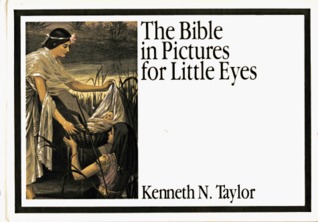
Book Review: The Bible In Pictures for Little Eyes
First sentence (from the introduction): Even little children can understand great truths when told to them in simple words. And when pictures are added, doubly indelible impressions are made that can last forever.
First sentence:
When it is nighttime and the lights are out you know how dark everything gets. You can't see anything. That is how all the world once was. There were no pretty flowers; there were no trees or grass or birds. There were no children either. There was only darkness. God did not want everything to be all dark. He decided to make some people. People could not live in the darkness so God made a beautiful world full of light.This is a Bible story book intended for "little eyes." I'm supposing the intended use is for parents to share ONE picture and story per day during their family devotions. The stories are short--very, very short. These stories are shorter than almost any other that I've seen in bible story books through the years I've been reading. But is that a good thing?
Questions: 1. Can you see anything at night when you go to bed and the lights are out?
2. Did God want everything to be all dark?
The stories are from the Old Testament and the New Testament. Plenty of stories get skimmed over or skipped altogether.
Here's one of his stories about Jeremiah:
This man is Jeremiah. Can you say "Jeremiah"? He is one of God's friends. God has sent him to tell the people to be good. The people do not like Jeremiah to tell them this. They want to be bad so they have tied Jeremiah's hands together. They will put him in a room and lock the door so Jeremiah cannot get away. He must sit there all day. People go by laughing at him and making fun of him. Poor Jeremiah! But God is with him and God will punish the people who do this to His friend.I am curious about the pictures, the illustrations. No credit is given for the artwork. Did Kenneth Taylor use artwork that had already been made for his book? Did he start with finding pictures and then write stories to go with these pictures? OR did the stories come first? Why is there so much emphasis on the details of the pictures perhaps focusing on details that are from artists' imaginations rather than the Bible itself?
Questions:
1. What has happened to Jeremiah's hands?
2. Is Jeremiah God's friend?
3. Will God help Jeremiah?
© Becky Laney of Operation Actually Read Bible
Tuesday, April 9, 2019
Book Review: Mighty Acts of God
First sentence: Even though the Bible is made up of sixty-six different books with many different authors, written over a period of centuries, it tells one main story. That story is the story of God planning, creating, redeeming, and perfecting people who would be his own special people. The main character of the Bible story is God. In smaller story after smaller story, he is the one who plans, who promises, who keeps his promises, who saves, who blesses, and who judges. Each story shows us God at work. As we read Bible stories, we always want to ask ourselves: What is God doing in this story? What can I learn about God here?
Mighty Acts of God is a text-heavy, illustration-light, Bible story book appropriate for Christian families to read together--particularly Reformed families. There are forty-one stories from the Old Testament. There are forty-nine stories from the New Testament. Each story is several pages in length.
Each story is referenced. Families can choose to read the Scripture passage(s) that connect with the story. Each story features one highlighted verse. Often--if not always--this verse complements the earlier Scripture reference but is not from the reference itself. (For example, in the story "Adam and Eve Sin" the Scripture reference is Genesis 2:15-3:19. The highlighted verse is Psalm 95:6, "O come, let us worship and bow down; let us kneel before the LORD our Maker!")
Each story concludes with family discussion points and/or activities. These are not light nor fluffy. These are challenging.
- To clarify "bearing your own cross," discuss things your own family members might feel like doing sometimes and must say "no" to, even though it is difficult (204)
- One thing we all resist heartily is the idea that we are sinners, incapable of pleasing God as we are. Children growing up in Christian homes struggle with the universal trait of fallen humans: self-righteousness. Help your children examine their thoughts and attitudes to see that they do sin, even if externally they demonstrate good behavior. (213)
- Help your children to see that the image of God in man includes the capacity for anger. Discuss what makes the difference between proper anger and sinful anger. (228)
Theology is stressed in each and every story. I like to think of this one as being doctrine-driven story-telling. In some stories this feels more natural--more organic--than others. Reformed families may appreciate this more. The doctrinal statements--the meaty theology--appears in different color text. In the Old Testament section, the doctrines appear in RED. In the New Testament section, the doctrines appear in GREEN.
From "Adam and Eve Sin"
Sin is doing what we ant to do instead of what God wants us to do. (21)
God didn't make the world as it is. Everything he created was good. Sin damaged God's creation and brought in all that is ugly. (22)
From "God Promises a Savior"
Grace is the giving of blessings and good things to people who do not deserve them. (25)
From "God Gives Abraham a Son"
Nothing unexpected can ever come up that would make it impossible for God to keep his promises. We can always trust God to keep his promises because he is absolutely faithful. (37)
From "God Chooses Jacob for Blessing"
God chooses which people will receive his blessings and, when he does so, he always chooses because of his grace alone, and for no other reason. (40)
From "Slave to Ruler in Egypt"
The Bible makes it clear that when people intend evil, as Joseph's brothers did, it is wrong and God will hold them accountable for it. At the same time, though, the Bible tells us that God is always at work in everything that happens to accomplish his purposes. (44)
From "God Gives Moses His Law"
God, in his goodness, has revealed to us what he is like and what he requires. Not only that, but in his wisdom, God had that revelation written down for us in the Scriptures. (55)
All Scripture is inspired by God, or God-breathed. (56)
From "God's People Worship a Golden Calf"
God is holy. That means that he never sins and he hates all sin. A mediator would need to get rid of God's anger at sin. Jesus did that. When he died on the cross, he took all God's anger at his people's sin and was punished for it in their place. (59)
Left to themselves, people do not love God; they hate him. Jesus, the mediator, changes the hearts of his people so they will love God and want to please him. (59)
From "Jesus Speaks With Nicodemus"
Before anyone can understand the gospel, accept its message, and repent and trust in Christ, that person must be made spiritually alive. We call this regeneration or being born again. (158)
From "Jesus Calls His First Disciples"
Every time the gospel is preached, people hear the call to repent and to believe in Christ. But only some respond. In the hearts of these people, Jesus has given what they need to answer his call. We use the term effectual calling or effective calling for this. It means that Jesus calls a person in such a way that an effect is caused--and the effect is that person believing the gospel. (167)I enjoyed rereading this one. I did. I'm not sure the narrative quality is amazing or excellent. But the theology is great. There may be other story book bibles with equally great theology that have a better narrative style or approach. But this one is good.
There is nothing baby-ish about this Bible story book. It is not for the very young. It probably wouldn't be my first choice as a read aloud to toddlers or preschoolers--bedtime or not. But bible story books shouldn't have to be for that age group. They shouldn't be something you grow out of quickly. This one has the potential to grow with your child throughout their elementary years.
© Becky Laney of Operation Actually Read Bible
Monday, September 5, 2016
Book Review: The Lion First Book of Bible Stories
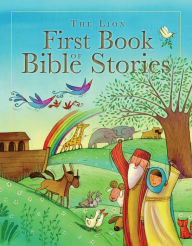
The Lion First Book of Bible Stories. Lois Rock. Illustrated by Barbara Vagnozzi. 2012. Lion Hudson. 96 pages. [Source: Library]
The Lion First Book of Bible Stories contains eighteen stories. Eleven of the stories are taken from the Old Testament. (Adam and Eve, Noah, Abraham, Isaac, Jacob and Esau, Joseph, Moses, Joshua, David and Goliath, Jonah, and Daniel.) Seven of the stories are from the New Testament. (These all focus on Jesus and his disciples. There is a balance between his teaching, his storytelling, his miracles.)
The length of each story is good: not too long, not too short. I'd say the average is between six and eight pages per story. The book has a lot of text. But the amount of illustrations balance out the text and perhaps will help keep children engaged.
The writing is good. The narrative style is light and entertaining. Nothing stilted.
I think there are strengths and weaknesses in this one. On the one hand, this retelling of Jonah is complete. It tells the WHOLE story. The Jonah-was-a-prophet-who-really-never-got-it story. Not all story book's capture that aspect of Jonah. The fact that Jonah was forgiven by God but didn't want anyone else--especially especially Israel's enemies--being forgiven by God too. On the other hand, I think some of the stories miss out on some important truths. For example, I think God's grace was completely absent from the story of The Garden of Eden. Grace is to be found--in several places, in several ways--in Genesis 3. Yet this retelling one only sees a harsh, angry God.
© Becky Laney of Operation Actually Read Bible
Sunday, September 4, 2016
Book Review: Miracle Man
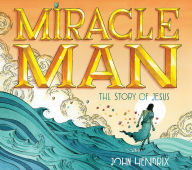
Miracle Man. John Hendrix. 2016. Harry N. Abrams. 40 pages. [Source: Library]
First sentence: Ages ago, in a dry and dusty land, the people were in need. The land was a sick place, in need of healing. The land was a blind place, in need of sight. The land was a thirsty place, in need of water...the kind of living water that would last forever.
Premise/plot: Miracle Man is a picture book for readers of all ages. It is the story of Jesus. It begins, not with his birth, but with his ministry. The book ends on the verge of the greatest miracle of all: his resurrection. Readers see the empty grave clothes, the stone rolled away, and read the words, "But God's Son, Jesus, the Miracle Man, had in store one last glorious miracle...."
My thoughts: I thought the storytelling was excellent. No story book--or picture book--will ever take the place of Holy Scripture--but writers can creatively craft a narrative worth reading and sharing.
I definitely enjoyed this one. It was one of those books that I wanted to reread a couple more times before turning back into the library. One of those books that I wanted to get everyone in my family to read so I could talk about it with someone.
Text: 5 out of 5
Illustrations: 4 out of 5
Total: 9 out of 10
© Becky Laney of Operation Actually Read Bible
Monday, May 16, 2016
Book Review: The Rhyme Bible Storybook
The Rhyme Bible Storybook. L.J. Sattgast. Illustrated by Laurence Cleyet-Merle. 1996/2012. Zonderkidz. (Zondervan) 344 pages. [Source: Borrowed]
First "sentence": The world was once/ As dark as night,/ But then God said/ "Let there be light!/ The light appeared;/ It shone so bright!/ And so began/ The day and night.This children's bible story book contains twenty-five stories: seventeen from the Old Testament, eighteen from the New Testament. There are seven stories originating from Genesis. Two stories are about Moses. Joshua, Samuel, David, Elijah, Jonah, Daniel, Esther, and Nehemiah all get one story apiece. The New Testament stories come from the four gospels Matthew, Mark, Luke, and John. Readers learn about Jesus from his miraculous birth to his ascension into heaven. Each story is told completely in rhyme. (That is one of the reasons this bible is so unique.) While it might be a stretch to say that every single poem is creatively unique and thoroughly engaging, it would be more than fair to say that the author does a good job with narrative voice. Some stories--or poems--I really, really love. Some I merely liked. The stories vary in length between eight to twelve pages. The book has a generous proportion of illustrations providing a nice balance between text and illustration. I really enjoyed reading this one. |
© Becky Laney of Operation Actually Read Bible
Monday, December 14, 2015
Book Review: Behold the Lamb of God
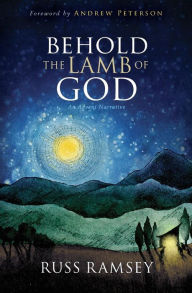
I would definitely recommend Russ Ramsey's Behold the Lamb of God. Is it an advent devotional? Yes and no. Yes, it's perfectly fine to use the book as an advent devotional. It would make a lovely early Christmas present. But is it only an advent devotional? I say that this is one "advent" devotional that is worth reading all twelve months of the year.
One reason why I think this is so is that it is all about engaging the reader with the Bible story. One could perhaps think of it as a bible story book for grownups. (Though I will add that this one would be fine to share aloud with the whole family.) Perhaps you're a new Christian, and, you're curious about what's in the Bible but the idea of reading the Bible through intimidates you more than excites you. Perhaps you've tried in the past to get the "big picture" of the Bible but for whatever reason, you gave up or lost interest. Perhaps you've been a Christian for many, many years, but, you're still not all that clear what the Bible is all about and how the testaments fit together.
Biblical literacy is important to Ramsey, and he's adapted the 'big picture' of the Bible into twenty-five readings. These readings point the way to Jesus Christ, and help emphasis the reason WHY we celebrate Christmas. About seventy-five percent of the book focuses on the Old Testament, but, don't think this means that Jesus is excluded--far from it! Christ is to be found in both Old and New Testaments, and, if you've never realized how or why, then, perhaps this devotional will help you see the Bible in a new way. That is perhaps the Holy Spirit will use Ramsey's book to minister to you.
I enjoyed this one. But I didn't enjoy all twenty-five readings equally. But by the time we get to the end of the book, it was absolutely giddy-making, and a true delight. The excitement built throughout the book as the plot advances towards Jesus: his birth, his life, his ministry, his death and resurrection. There was just something JOYOUS about it.
My hope is that reading this devotional will encourage you--inspire you--to pick up the Word of God and read it with new passion, new devotion, new longing to TASTE AND SEE spiritual things.
Woven throughout the story are all of humanity’s wrath and greed and lust and gluttony and sloth and envy and pride—together in force with all of their consequences. But through that darkness shine the bright rays of love, joy, peace, patience, kindness, goodness, gentleness, faithfulness, and self-control. (Gal 5:22) It is the story of evil against good, of darkness locked in an epic struggle to snuff out the light forever. Will the darkness prevail in the end, or will the light overcome the darkness? (Jn 1:5) This, ultimately, is what the story is about. It is a tale filled with people in trouble, all living somewhere between wandering and homecoming, between devastation and restoration, between transgression and grace. Every mortal character in the story needs rescue, but they have all turned aside, and together they have become corrupt. There is no one who does good, not even one. (Psalm 14:3)
It’s the story of the one true God calling a people his beloved, though they’ve lived in perpetual rebellion against him. Since the beginning, this story has had an end—a glorious end. God’s call on the lives of his people, ultimately, is to himself—though it would come at a greater cost than anyone could imagine. The story ends with the maker and lover of the souls of men drawing his people to himself—purchasing their redemption through the lifeblood of his own Son. God did not spare his Son but gave him for us all. And if this is true, how will he not also, through his son, graciously give us all things? (Rom 8:32) The tale is a tall one, but it’s true.
To worship God is to dwell on who he is, to consider his handiwork. (Job 37:14) Often worship requires stillness. Stillness allows a mind to hold complicated thoughts without losing them. Silence was a gift God gave to Zechariah, and the old man put it to work.
There was no one around to coach them, no one to tell them everything would be all right. He held her and he prayed. They thought of the angels who visited their dreams. They thought of Adam and Eve taking the forbidden fruit and how one of the consequences of that act of rebellion was shooting through Mary from head to toe, every three minutes now. It was not a silent night. She strained and groaned and fought for every breath. She pushed as sweat beaded on her forehead. Joseph wiped her brow and told her a hundred times that he loved her, he loved her, he loved her. Swept up in waves of pain and contractions, Mary continued to push and breathe and strain while time passed. Eventually, as if cresting a ridge, her labor gave way to delivery, and her groaning gave way to the sound of the cries and the coos of little lungs drawing in the breath of earth for the first time. Joseph laid the baby on Mary’s chest, and to the wonder of the helpless man and the relief of the weary woman, they beheld him who, though he was the Son of God, was every bit a fragile, tiny baby.
© Becky Laney of Operation Actually Read Bible
Monday, October 19, 2015
Book Review: The Biggest Story
First sentence: Once upon a time there lived a man and a woman. They were the happiest people on the planet. True, they were the only people on the planet, but they were still terrifically happy. Their names were Adam and Eve, and God made them. He made them in his image, little mirrors to reflect God's glory. And like everything else God made, he made them good.
The Biggest Story is a bible story book for believers of all ages. Yes, you might think that a bible story book would have to be for children and ONLY for children. But I'm not convinced. Especially when you pair the text with illustrations like these. (I'd classify the illustrations as sophisticated and abstract. Please visit Kevin DeYoung's post on his book to see interior spreads of the illustrations AND also to see a video.) No, I think this is a book for readers of all ages. One reason is that everyone needs to know the Bible, that the Bible tells one BIG story, and the Bible really fits together well. It is not a mishmash of random stories and lists. The Biggest Story is a clear presentation of the bible's gospel message. How we were created in God's image. How humans sinned and became separated from God. Why the law was given, and, yet, how we could never keep all of the law. Why we needed a Savior who was both God and man. Just to get started by mentioning a few basics! (I do get excited when I start thinking about the gospel.) I think readers--believers and unbelievers--could use a little clarity as to what it is Christians believe.
But, of course, it is a bible story book made up of various bible stories: Adam and Eve, Cain and Abel, Noah and the flood, Abraham, Isaac, Jacob, Moses, Saul, David, etc. They are all touched upon--some more briefly than others. But the narrative has a fast pace, it flows really well. DeYoung takes you through both testaments quite quickly!
I liked the writing style. I did.
God gave the Israelites rules (but they didn't follow them).and
God made his dwelling among them (but they didn't act like they wanted him to stick around).
God sent prophets (but Israel didn't listen).
God provided priests (but the priests didn't know how to be holy).
Later, God gave them kings (but the kings were a royal pain).
Israel was a mess.
Of course, God still had his promises to keep. But most days it was hard to imagine how anyone could save this stubborn people.
It would have been even harder to imagine how the Promised Man could come from among this people. (77)
After all these downs--and not too many ups--we come to a manger in the little town of Bethlehem. This is where we meet the new Adam, the child of Abraham, the Son of David. It's with the stinky shepherds and the singing angels where we see the real Deliverer, the real Judge, the real Conqueror. No one understood it completely at the time, but when Mary pushed out that baby, God pushed into the world the long-expected Prophet, Priest, and King. God gave his people a new law, a new temple, and a new sacrifice. Best of all, he gave his people a new beginning. Just as he promised. (101)and
It's a familiar story to some of us. It's a true story for all of us. But we haven't seen the end of the story--not yet. We live in the beginning of the end of the story that we are still in the middle of. We know it's not the end because we haven't made it back to the garden. (120)In the author's note, Kevin DeYoung mentions that The Biggest Story started as a Christmas sermon. I found this a fascinating afterthought as a reader. I was getting ready to recommend this one for families to use during the advent season, and, I learn that it was originally preached during Advent!!!
Did I like the illustrations? Honestly, the abstract-ness of the art lost me. I think it is Art, no doubt. But not the cozy-happy illustrations I'm used to seeing in children's books. That's why I think, in part, that adults may be a good match for this one. Also, I couldn't help but get Sesame Street's Pinball Number Count stuck in my head!!! I do love, love, LOVE the cover though. To me, it just says CHRISTMAS. And the endpapers say ORNAMENTS.
© Becky Laney of Operation Actually Read Bible
Saturday, October 17, 2015
Book Review: The Story of God's Love For You
First sentence: God wrote, "I love you"--he wrote it in the sky, and on the earth, and under the sea. He wrote his message everywhere! Because God created everything in his world to reflect him like a mirror--to show us what he is like, to help us know him, to make our hearts sing. The way a kitten chases her tail. The way red poppies grow wild. The way a dolphin swims. And God put it into words, too, and wrote it in a book called "the Bible."
The Story of God's Love for You is a great choice for any reader who wants to know what the Bible is all about, but, doesn't have the time or perhaps even the desire to sit down and read the Bible for themselves. Which is understandable. 208 pages versus 1700+ pages. It can seem overwhelming or intimidating or even impossible. (Emphasis on seem. I believe wholeheartedly that anyone can learn to read the Bible and can grow in that desire to read the Bible. Taste and see that the Lord is good; blessed is the one who takes refuge in him. Psalm 34:8.)
The Story of God's Love for You provides readers--of all ages--with an overview of the Bible. They can see "the big picture" of the Bible. Maybe for the first time, seeing how the Bible is ONE book, ONE story.
The Bible is most of all a Story. It's an adventure story about a young Hero who comes from a far country to win back his lost treasure. It's a love story about a brave Prince who leaves his palace, his throne--everything--to rescue the one he loves. It's like the most wonderful of fairy tales that has come true in real life! You see, the best thing about this Story is--it's true. There are lots of stories in the Bible, but all the stories are telling One Big Story. The Story of how God loves his children and comes to rescue them. It takes the whole Bible to tell this Story. And at the center of the Story, there is a baby. Every Story in the Bible whispers his name. He is like the missing piece in a puzzle--the piece that makes all the other pieces fit together, and suddenly you can see a beautiful picture.Lloyd-Jones makes a point to weave Jesus into each and every story within the book. You might, at least at first, be skeptical. How can Jesus be connected to every story in the Bible? How can every story really "whisper" his name? Isn't that forcing things a bit? But I hope you'll see differently soon enough. For this is how Christ taught us to read the Bible. (Luke 24:27; John 5:39-40; John 5:46)
Lloyd-Jones excels at storytelling: at crafting words together in a creative, descriptive way. She doesn't stay strictly with the facts as revealed in the Bible. She uses her imagination and crafts a story. I think this is a strength, for the most part, so long as readers are aware.
From "Operation No More Tears"
Dear Little Flock,Does not that sum up the book of Isaiah?! I think she did a wonderful job!
You're all wandering away from me, like sheep in an open field. You have always been running away from me. And now you're lost. You can't find your way back. But I can't stop loving you. I will come to find you. So I am sending you a Shepherd to look after you and love you. To carry you home to me. You've been stumbling around, like people in a dark room. But into the darkness, a bright Light will shine! It will chase away all the shadows, like sunshine. A little baby will be born. A Royal Son. His mommy will be a young girl who doesn't have a husband. His name will be Emmanuel, which means "God has come to live with us." He is one of King David's children's children. The Prince of Peace. Yes, Someone is going to come and rescue you! But he won't be who anyone expects. He will be a King! But he won't live in a palace. And he won't have lots of money. He will be poor. And he will be a Servant. But this King will heal the whole world. He will be a Hero! He will fight for his people and rescue them from their enemies. But he won't have big armies, and he won't fight with swords. He will make the blind see; he will make the lame leap like a deer! He will make everything the way it was always meant to be. But people will hate him, and they won't listen to him. He will be like a lamb -- he will suffer and die. It's the Secret Rescue Plan we made--from before the beginning of the world! It's the only way to get you back. But he won't stay dead--I will make him alive again. And, one day, when he comes back to rule forever, the mountains and trees will dance and sing for joy! The earth will shout out loud! His fame will fill the whole earth--as the waters cover the sea! Everything sad will come untrue. Even death is going to die! And he will wipe away every tear from every eye. Yes, the Rescuer will come. Look for him. Watch for him. Wait for him. He will come! I promise. Love God.
So what do I think of The Story of God's Love For You? I really love Sally Lloyd Jones' work. I do. I loved it when it was originally published as The Jesus Storybook Bible, and I love it as The Story of God's Love For You. (The lack of illustrations is the difference between the two).
Resources for readers who want MORE after reading The Story of God's Love For You:
For upper elementary through middle schoolers, I'd recommend either the NIV Jesus Bible published by Zondervan OR the ESV Following Jesus Bible published by Crossway.
For middle schoolers through high schoolers, I'd recommend either the NIV Student Bible published by Zondervan OR the ESV Student Study Bible published by Crossway.
For high schoolers through adults (of all ages), I'd recommend the following:
- ESV Gospel Transformation Bible published by Crossway
- NIV Zondervan Study Bible published by Zondervan
- HCSB Study Bible published by B&H
- Chronological Life Application Study Bible, NLT, published by Tyndale
- MacArthur Study Bible, available in ESV, NIV, NASB, NKJV….
© Becky Laney of Operation Actually Read Bible
Friday, August 7, 2015
Book Review: Five-Minute Bedtime Bible Stories
I enjoyed reading Amy Parker's Five Minute Bedtime Bible Stories. It did indeed take me about an hour to read the whole book--all twelve stories. I imagine it would be difficult to select only twelve stories for a bible story book collection. (I know that I would find it a challenging task.) Consider that plenty of bible story books have around twelve stories just from the first two books of the Bible--Genesis and Exodus.
Six stories are from the Old Testament:
- Trees, Bees, You, and Me!
- A Big, Big Boat for a Big, Big Flood
- Walls of Water
- A Boy, A Giant, and an Almighty God
- The Brave Young Queen
- Safe in the Lions' Den
Six stories are from the New Testament:
- A Child is Born
- Seeds and Storms
- One Little Lunch
- Now I See
- Who Is My Neighbor?
- Jesus is Alive!
The stories are detailed and descriptive.
Daisies and daffodils jumped up from the soil! Lilies and lilacs bloomed big and beautiful! Trees stretched out their bright green leaves, reaching for the sun. Apples burst forth in red and green and yellow. Tall grasses, reeds, and wheat waved in the new, sweet-smelling breeze. (2)
Somehow, every time a person reached for food, it was there. The people ate and ate. And somehow, everyone ate until they were full. Before long, over five thousand people had been fed. (142)
Even after all of Jesus's miracles, the Pharisees did not believe that Jesus was the Son of God. But with just one miracle, the blind man believed. (161)Overall, I enjoyed this one. I was pleased with the story selection. I was pleased with the length of each story. I really enjoyed the six stories from the New Testament. I thought these six stories did a good job--cohesively telling the story of Jesus. The Old Testament stories were not as interconnected as I would have liked. (Also no stories about Abraham, Isaac, Jacob, or Joseph!) It would have been nice if the word 'sin' had been mentioned. I won't lie. Yes, readers meet Adam and Eve, but, there isn't a mention of the fall…at all…or of them leaving the garden of Eden. And I think all twelve stories could have been linked together better with a little work. The Bible is one big story, after all. That being said, I did enjoy it.
© Becky Laney of Operation Actually Read Bible
Sunday, January 25, 2015
Book Review: Behold the King of Glory
Looking for a book to read for Lent? You might want to consider reading Russ Ramsey's Behold the King of Glory. Ramsey retells gospel stories for his readers in forty chapters. The goal of this one, I believe, is to help readers grasp the big picture, to see how all the stories within the four gospels, come together to tell one story: an amazing story of a Savior and King.
It is slightly similar to John MacArthur's One Perfect Life. Slightly. One Perfect Life is made up of Scripture. The Scriptures have--at times--been rearranged or made more concise. But it seeks to give readers a big picture of who Jesus is from Genesis to Revelation. One Perfect Life is also twice as long as Behold the King of Glory.
Behold the King of Glory is a retelling: an informed retelling, no doubt. It is a retelling that seeks to bridge culture gaps and provide deeper context to contemporary readers. It is a substantive project. And it's a project that I can appreciate. The chapters are not short. The reading are not overly devotional. The readings are meaty, substantive, giving readers something to think about. Don't expect a novel. Don't expect a devotional book. It won't read like either type of book. It is not a paraphrase of Scripture. It is at all times reverent.
At times it is creative, imagining how people felt, what people saw, what people said, etc. At times it reads more like an introduction to a Bible book or a study note. But most of the time it is factual sticking closely to Scripture though not the wording of Scripture.
- Life for the Dying (John 4:43-54)
- Wild with Hope (Matthew 4:1-11)
- Behold the Lamb of God (John 1:19-51)
- One Hundred and Fifty Gallons (John 2:1-12)
- Destroy This Temple (John 2:13-25)
- Zeus and The Pharisees (John 3:1-21)
- Herod's Half Brother's Wife (John 3:22-4:3)
- Famous (Luke 5:1-26)
- Lord of the Sabbath (Luke 6:1-11)
- Only Say the Word (Matthew 8-9)
- The Death of John (Mark 6:14-29; Luke 7:18-35)
- The Storm Treader (Matthew 14:22-33; Mark 6:45-56)
- Bread of Life (Matthew 14:34-16:12; John 6:22-7:1)
- You Are the Christ (Luke 9:18-36)
- Before Abraham Was Born (John 7-8)
- Born Blind (John 9-10)
- The Good Samaritan (Luke 10:1-37)
- The Leaven of the Pharisees (Luke 11:29-13:35)
- Lost Things Found (Luke 14-15)
- Lazarus of Bethany (John 11:1-44)
- A World Upside Down (Mark 10:35-45)
- The Living Legend (mark 10:46-52; John 12:9-11)
- The King's Coronation (1 Kings 1; Luke 19:28-36)
- Hosanna (Luke 19:36-40)
- The Vinedresser's Tree (Matthew 21:18-22; Luke 13:6-9)
- Indignation (Matthew 21:12-17)
- John's Baptism (Mark 11:27-12:44)
- The Scent of Opulence (Matthew 26:6-13; Mark 13:3-13; John 12:1-8)
- Thirteen Men (John 13:1-35)
- The Last Cup (Mark 14:22-42; John 14)
- Trial at Night (Matthew 26:47-68)
- The Reckoning (Matthew 26:69-27:2; Mark 10:17-31)
- What Is Truth (John 18:28-19:16)
- Crucifixion (Luke 23:26-46)
- The Forgotten Day (Matthew 27:51-66)
- He Is Not Here (Matthew 28:1-10; John 20:1-10)
- Flesh and Bone (Matthew 28:11-15; John 20:11-29)
- Do You Love Me? (John 21:1-23)
- Behold the Man of Sorrows (Isaiah 53; Luke 24:1-35)
- Behold the King of Glory (Philippians 2:5-11; 1 Corinthians 15:3-49; 1 Peter 1:3-9; Romans 8; Revelation 21)
© Becky Laney of Operation Actually Read Bible