Showing posts with label nonfiction. Show all posts

Tuesday, July 8, 2025

54. The Anxious Generation Goes to Church


54. The Anxious Generation Goes to Church: What the Research Says About What Younger Generations Need and Want From Your Church. Thom S. Rainer. 2025. [August] 192. [Source: Review copy] [4 stars, nonfiction, christian nonfiction]

First sentence: I was well on my way to completing the research on a different book when I hit a wall.

The book I thought I was 'getting' was not the book I got. That's on me, mostly. I didn't see or pay enough attention to the subtitle. Perhaps. I have thoughts. I do. I'll try to share them when appropriate. 

So what IS the book about? The book addresses from a statistical, sociological, analytical, research-oriented viewpoint how the two youngest generations--Gen Z and Gen Alpha--could benefit from the structure of the church and the church community. Gen Z refers to those born between 1997 and 2012. Gen Alpha refers to those born between 2013 and the present. 

His inspiration for writing is DIRECTLY connected to his reading a secular book called The Anxious Generation by Jonathan Haidt. Much of his book is spent summarizing and analyzing Haidt's book and spinning or tilting it perhaps to see it from a Christian perspective. The concerns are roughly the same, I believe, but Rainer focuses on a possible solution to the 'problem.'

Rainer defines and describes each generation from The Silent Generation on through Gen Alpha. Each generation is defined in GENERALIZED terms--very wide brush strokes, if you will. It starts from a place that these sociological terms and generalizations are essentially true. He does not question these foundational blocks. [I'm not saying that is in and of itself a bad thing. It's just that almost all of the building blocks in this book, the foundation, the walls, the supports, etc., are all sociological and not in any way drawing from Scripture.] All people from a generation are lumped together despite unique, personal, individual differences. A very one-size-fits-all cookie-cutter approach to viewing humanity.

The Anxious Generations--Gen Z and Gen Alpha--are being shaped, rewired essentially by "the big four" : high speed internet, smartphones, social media, and polarization. Rainer spends time explaining the evils of the big four. Though high-speed internet, smartphones, social media, and polarization are so closely connected and intertwined, so knotted and tangled together that I'm not sure it makes sense to separate them from each other. You can probably guess what makes the big four evil without further explanation. Polarization is the only one that might perhaps need a little help. Essentially the polarization of society on every subject--mostly online but in person as well perhaps. (For example, how EVERYTHING is one baby step away from being a political issue.) 

He spends the most time on describing, defining, illustrating, etc., the 'special' problems facing the Anxious Generation. He then begins with a big picture, distant approach to how the church may be able to help. Again, his technique is more on statistics, research, polls, surveys, etc. He spends a chapter introducing readers to a series of atheists--yes, atheists--sharing quotes from them that allegedly show how even atheists admit that church can be stabilizing and morally good for society. How they may reject all religions and religious doctrines, etc, but they like the structures of the community--in theory at least. 

When he speaks of the church most often it is in a distant sociological research way. There's little to no theology in this one. 

The book isn't so much THE ANXIOUS GENERATIONS NEED JESUS AS THEIR LORD AND SAVIOR because they are sinners in need of a Savior, as Gen Z and Gen Alpha need the structure of weekly fellowship, in-person friendships, socialization and camaraderie. They need youth groups, discipleship, mentorship, to be a part of a family. It will benefit their mental health if they attend church. It doesn't really go into spiritual needs and spiritual solutions. 

He encourages the church to actively invite and welcome younger people in the church. That means, most notably, bringing someone to church--literally. Not just inviting casually. But making plans, going with them, sitting with them, sharing a meal, etc. He points out time and time again, that most are not willing to go to a church alone, but if they had someone to go with them, they'd go. He also emphasizes that "the unchurched" of all ages are not hostile to the faith, to church, to Christians, they just are waiting for us to go to them and actively care about them. (I'm not sure *where* he is getting this not hostile thing. I'm not sure which polarized view is right.) 

© Becky Laney of Operation Actually Read Bible

Thursday, July 3, 2025

53. I Still Believe


53. I Still Believe. Jeremy Camp. 2013/2020. 160 pages. [Source: Library] [4 stars, memoir, biography]

First sentence: Pick up your guitar. I didn't want to. I didn't want anything to do with music. It had been two weeks since Melissa had gone to heaven. My wife was only twenty-one, and we had been married just three and a half months when she passed away from ovarian cancer.

I Still Believe is Jeremy Camp's memoir. The edition I read was newly updated in timing with the 2020 movie release for I Still Believe. Both book and movie tell the love story of Jeremy and Melissa. 

The book provides so much more context to Jeremy's life--both before and after. The movie focuses almost exclusively on their love story and nothing but their love story. The book gives a much fuller picture in regards to Jeremy's spiritual journey AND his actual biography. Learning of his family, his childhood, his teen years, and the decade(s) following Melissa's life certainly gives you a more complete picture of who he is. 

The book and movie are both sad. Sad in a bittersweet way. Melissa's life was short--yet every day of her life's story was written by God [before one of them came to be] and written to bring him glory.

I Still Believe isn't necessarily a book [or movie] that you "enjoy." But I think there are spiritual lessons within both. 

© Becky Laney of Operation Actually Read Bible

Wednesday, March 12, 2025

24. The Wages of Cinema


24. The Wages of Cinema: A Christian Aesthetic of Film in Conversation with Dorothy L. Sayers. Crystal L. Downing. 2025. 256 pages. [Source: Review copy] [philosophy, film history, biography; 3 stars]

First sentence: The cultural power of narrative cinema has long captured the attention of priests, pastors, and professors who write books assessing film through the lens of Christian faith. 

What is it about? The short answer, of course, is movies. The real answer, however, can best be shared from the book's introduction, "It emphasizes the history of film as well as the development of secular theories about the artistry of its form." 

Sounds simple and straight-forward enough, right? Wrong. Mostly. It complicates the subject--for better or worse. The book theoretically offers a look at film--its past and present. It theoretically offers various summaries of different philosophies or schools of how films are interpreted or critiqued. It theoretically explores how directors and screenwriters relate to their creations--their vision, intent, energy, passion, etc. It theoretically explores film as art and film as philosophy. How what we see on the screen shapes or world views--impacts who we are as human beings. Theoretically. 

Where it is at its messiest--from my personal perspective--is the introduction of this super-analogy (all-encompassing) between cinema and theology. I think this could have been done in a clearer way if the book hadn't spread its focus so thin. 

It makes a good amount of sense to make the connections of ANCIENT THEATRE with the Greek language the New Testament is written in.  It makes sense to share verses where the language/imagery being used to express theological ideas, concepts, doctrines, etc. were drawn from the theatre. However, it isn't satisfied with the historical elements. It persists in this extremely convoluted, intimately connected--joined at the hip--idea that cinema AND Christianity are still just as integral to one another. Which if the author's train of thought was slowed down a couple hundred times, might make sense if properly explained. 

The element that will either make or break the book for readers, however, may be the presence of Dorothy Sayers. The author persists in having Sayers as tour-guide and host for the duration of the book. Sayers being long, long dead, of course, this is done artistically using her nonfiction and fiction. The author sees Sayers as both being qualified as an expert (to borrow a court term) in both FILM and in THEOLOGY. (But was she either???) Sayers words--ideas, concepts, perceived views--are used as a lens to analyze films made long after her death. 

The films being offered as examples are more often than not obscure and far from pop culture. (Not that I expected Sayers to analyze Captain America or Star Wars.) This is to be expected in a book about the history of cinema. Nothing terribly surprising. But what was surprising is that most of the examples come not from the history of film--but from more "contemporary" times. Films whose trailers I would have come across--reviews I would have come across--if not so incredibly obscure and out of the way. I personally wanted more HISTORY and less present day. I wanted a deeper dive into the first thirty years of cinema and not just a deep dive into the past fifteen to twenty years. The focus, for better or worse, was rarely American films--particularly in the history section. The author seems only to care about Russian, Italian, French, German directors in the history of cinema. Same with the film theorists. Again, the movies being discussed throughout are taste-specific, perhaps out of necessity. 

This is without a doubt a book that focuses centrally on ART and being ARTY and ARTSY. About wearing exclusive little genius caps.

What the book truly lacked, in my opinion, was a clear introductory chapter or two about HOW to talk about film, in other words HOW to assess what you are watching and HOW to talk about it. SIMPLE vocabulary lessons with ACCESSIBLE down-to-earth examples that just about anyone/everyone could understand BEFORE progressing into the deep depths of the ocean. 

So the book felt substantively deep--for better or worse. You're deep-diving into THEOLOGIANS from the past and present--from ancient church fathers through the twentieth century. You're deep-diving into film theorists, into philosophers, into directors. You're expected to unpack all of Sayers' philosophy as well. And to make sense of how her thoughts on ARTY-ART directly relate to humanity's connection with God himself. Her theology is tough on its own. But you're not only having to interpret her theology as theology but also her theology as a way to make sense of film. 

I think there has to be a better way for Christians to understand films and film theory. Do I know that such a book exists? No. No, I don't. Do I wish there was a book within reach that is CLEAR and accessible and relatable that would help me unpack more details of what I'm watching--very much so. I would LOVE to learn how to better talk about movies, to more intelligently assess what works or doesn't in a film. 

The one thing I definitely took away from the book was that Sayers truly appreciated when films have consequences AND she didn't really care for sappy happy endings. 

© Becky Laney of Operation Actually Read Bible

Friday, January 20, 2023

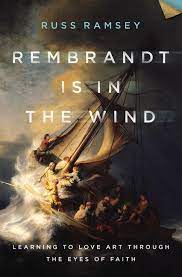
5. Rembrandt is In the Wind


Rembrandt Is In the Wind: Learning to Love Art Through the Eyes of Faith. Russ Ramsey. 2022. 272 pages. [Source: Library]

First sentence: Henri Nouwen wrote in The Return of the Prodigal Son, "Our brokenness has no other beauty but the beauty that comes from the compassion that surrounds it." Our wounds are not beautiful in themselves; the story behind their healing is. But how can we tell the story of our healing if we hide the wounds that need it? This book is about beauty. To get at it, the book is filled with stories of brokenness. 

Art history through a Christian perspective--that's how I'd sum up Rembrandt is in the Wind. Ramsey looks at art through the lens of goodness, truth, and beauty. He argues that beauty is the glue that holds the three together. And those three are communal (universal)--not only shared by all humans everywhere, but also shared by God. (For these three are attributes of God). 

Ramsey writes, "The pursuit of goodness, the pursuit of truth, and the pursuit of beauty are, in fact, foundational to the health of any community." He argues that beauty is essential and should actively be sought. 

He has selected a handful of artists--around nine or ten--and is sharing their stories through their works. (Not all their works, mind you, but selected works. He is choosing artists and stories (and works) to make his argument. I am sure these stories are just the tip of the iceberg. That there would be even more stories, more lessons, more wisdom if the book was longer.

My personal favorite chapter was chapter one, "Beautifying Eden: Why Pursuing Goodness, Truth, and Beauty Matters." I found all the chapters interesting to a certain degree. But some chapters were "extra" good for me. Other chapters were perhaps a little less so. 

Table of contents:

Beautifying Eden: Why Pursuing Goodness, Truth, and Beauty Matters
Pursuing Perfection: Michelangelo's David and Our Hunger for Glory
The Sacred and the Profane: Caravaggio and the Paradox of Corruption and Grace
Rembrandt is In the Wind: The Tragedy of Desecration and the Hope of Redemption
Borrowed Light: Johannes Vermeer and the Mystery of Creation
Creating in Community: Jean Frederic Bazille, the Impressionists, and the Importance of Belonging
The Striving Artist: Vincent Van Gogh's The Red Vineyard and the Elusive Nature of Contentment
Beyond Imagination: Henry O Tanner, Race, and the Humble Power of Curiosity
What Remains Unsaid: Edward Hopper, Loneliness and Our Longing for Connection
Measuring a Life: Lilias Trotter and the Joys and Sorrows of Sacrificial Obedience

© Becky Laney of Operation Actually Read Bible

Monday, April 19, 2021

25. Why Social Justice is Not Biblical Justice


Why Social Justice is Not Biblical Justice: An Urgent Appeal to Fellow Christians in a Time of Social Crisis.  Scott David Allen. 2020. [September] 205 pages. [Source: Bought]

First sentence: In recent years, a powerful ideology has made deep inroads into the very heart of the evangelical church. To its mainstream advocates, it is called “social justice” and is nearly always coupled with a commitment to equality, diversity, and inclusion.

There are probably dozens--if not hundreds--of reviews that will do this book on justice actual justice. Reviews that may break down the book chapter by chapter and analyze its contents and provide readers with clues as to whether this is the book for them--or not.

The premise of this one is simple: justice has been coupled--for better or worse--with social justice. Coupled by people without the church (outside the church) certainly, but also coupled by people within the church. Social justice is eclipsing biblical justice. People looking for justice are turning not to God, not to the church, not to the powers that be, but to society, to specific sections of society. 

The truth of the matter is that ANY definition of justice that discounts, discredits, ignores, belittles, twists, or distorts God's definition of justice is wrong. Plain and simple. God is Just. God is Righteous. God is Good. God is Wise. God is Omniscient, Omnipotent, Omnipresent. (In other words, all-seeing and all-knowing. He doesn't just know the outside actions--but the inward thoughts.) God is also the ULTIMATE (final) Judge. 

For Christians--those who profess to be Christians--to give more authority or credit to outside theories or world views when it comes to justice--or when it comes to anything really--is just all kinds of wrong. For example, Critical Race Theory, or CRT. CRT should not be used as a tool to reinterpret or "interpret" Scripture. (Neither should feminism or intersectionality). 

This book isn't written to persuade unbelievers--those outside the Christian faith--of the dangers of jumping on the social justice bandwagon. It is written primarily for those who profess to be Christ-followers (aka Christians, believers) to think biblically and with discernment about injustices in society. In other words, let the Word of God reign authoritatively in their lives--yes, even when it comes to living real life in a messy, messy super-fallen, soul-bruising world filled with tears, pain, and anguish. 

The truth is the Bible has a lot to say both in the Old Testament and New Testament about injustice and justice, about sin and righteousness, about right and wrong, about good and evil. The Bible gives us guidelines and principles, certainly, but it also gives us promises upon which we can base our hope. 

The book could have just focused on biblical justice--how the Bible treats the subject or doctrine of justice--but it also chooses to engage directly with the competition. It is all about comparing and contrasting the two: biblical justice AND social justice. It looks at them both from plenty of angles. It presents the flaws of social justice that Christians should be aware of before they open up their hearts and minds and embrace social justice. 

I would say one of the most important things is to be aware that even though both groups use some of the same words, the two groups mean very different things by those words. So though on the surface the two groups may appear to have much in common--a common goal that is of utmost important--there are major differences in play. People can with completely good intentions fall for it. Especially if they are more tuned into the news--TV, internet, radio--than the Word of God. 

The author does mention--and readers will already be aware--that both sides tend to resort (not even as a  last resort) to name calling and label-throwing. This isn't a kind, friendly debate--an exchange of ideas--but all out war. 

So the book is about dangers from the world, to a certain degree, but also about dangers within the church. It is the dangers within the church--coming from within--that prove costliest and feel like a betrayal. The Bible-believing Christian faces warfare from within and without--the church and the world. 

There isn't a quick solution. It isn't as easy as saying, well, we'll just skip this hot topic altogether and focus on the essentials. No, the author urges justice--BIBLICAL JUSTICE, justice on God's terms--is essential to a right practice of the faith. What we need is preaching and teaching on biblical justice. 

I definitely loved some of the chapters. I did. I found almost all of the chapters thought provoking. 

If I could change one thing about the book, however, it would be his historical discussion of Republicans and Democrats. I think he has perhaps intentionally left this vague and confusing. Instead of pointing out the labels "Democrat" and "Republican" have changed, transformed, evolved through the past hundred plus years, he acts as if they are still the same. For example, he goes on about how it was Democrats that were racists, that were pro-slavery, that were pushing all these racists laws, that founded the KKK, and that it was always Republicans who were the good guys, who stood in opposition to the hateful, despicable Democrats. If you are at all familiar with history, you know that you can't do that. Or perhaps you shouldn't do that. If you were to go back in time, what passes today for "Republican" and "Democrat" today would be unrecognizable and completely foreign. Policies, ideologies, beliefs, practices morph and change. The issues we argue and debate today would be completely foreign if not horrendously shocking to the past. And that's not because we're "better" people. The truth is the past would shock us and our values just as much as our "values" would shock the past. It works both ways. Anyway, to sum it up, the paragraphs were the author explores this argument weaken his argument--in my opinion. 

I did appreciate his argument not to conform to the world, not to accept the world's world views as your own, to cling to the Word of God, to fight the good fight, to live rightly by God's standards, to be the salt and light, the city on the hill. 
 

© Becky Laney of Operation Actually Read Bible

Thursday, March 5, 2020

24. The Mayflower Pilgrims

The Mayflower Pilgrims: Sifting Fact from Fable. Derek Wilson. 2019. Society for Promoting Christian Knowledge. 256 pages. [Source: Review copy] [nonfiction; adult nonfiction; christian nonfiction]

First sentence: Is there such a thing as a Christian country? If so, what would it look like?

I'll be honest I was shocked when I saw that this one was 256 pages. Why? It felt like it was twice that long! Perhaps because the chapters tended to be on the longer side. (If you need to stop mid-chapter to use the bathroom--there's a clue that the chapter is too long.)

This one is all about putting the Mayflower Pilgrims into context, a specific time and place. The story of the Mayflower Pilgrims does not begin at the dawn of the seventeenth century--far from it. At least the way Derek Wilson tells it. He grounds HIS story into the English Reformation--the split from Roman Catholicism. This alone places us a hundred years back. But even that isn't quite far enough, deep enough. For Martin Luther was not the first nor the only to become disgruntled with the status quo and begin asking questions. Before Luther there was Wycliffe and his Lollards--just to name one. No, this story tells the history of religious (and to some extent religious and political dissent) in England (it only touches on Europe in bits and pieces here and there.)

Primarily it focuses on the years 1520 to 1620. (As I mentioned above, it goes a bit further back here and there as context demands.) It is important for readers to understand from page one that this story ends BEFORE a single pilgrim steps aboard the Mayflower. If you go into the book thinking that it will end with the Pilgrims arriving in America, or dare I say the Pilgrims celebrating the first year or two of survival--celebrating with a feast. You'll be mighty disappointed.

From the introduction, "If we really want to discover, as best we can, who the 1620 pioneers were, we need to probe their past, their heritage and their response to that heritage. And we also need some understanding of their context in the world they grew up in, the convictions they embraced, the assumptions they rejected and the changes with which they attempted–not always successfully–to cope. That is why the following narrative does not begin with the 180-ton Mayflower, after a series of false starts, clearing Plymouth harbour. Rather, it ends there. The huddle of religious separatists on the ship’s deck, watching their past disappear over the eastern horizon, believed they knew what a Christian commonwealth would be like and that, far from the satanic influences of the Old World, they could, under God, create it. We know that they were wrong. The communities they planted replicated the vices and the virtues of the ones they had left. The seeds of corruption lay within themselves. The perfect human society is a chimera. But we would do well to guard against cynical superiority."

This story touches on just about everything--royalty, politics, church politics, war, navigation and exploration, literature, philosophy, science, theology, and BUSINESS. (To name just a few sub-topics).

It explores essentially one question WHY. Why would anyone--man, woman, boy, or girl--set off into the unknown, risking their life??? The voyage across would be dangerous. But after that voyage, then what?!?! Talk about true unknowns and great uncertainty. There is no simple single answer to the WHY question. The answers would be varied and much more complex than we can imagine.

There were a few chapters that I just loved, loved, loved. I found them insightful and interesting. Other chapters I found overwhelming--it seemed the narrative was flying way over my head...and as a result, I found the reading dull. But not every chapter was like that. There were some truly great moments. And I think readers may have to work at staying engaged with the text.

One of my favorite chapters was on the first Bible translations in English. It was fascinating.

© Becky Laney of Operation Actually Read Bible

Tuesday, December 17, 2019

Book Review: Exactly As You Are

Exactly As You Are. The Life and Faith of Mister Rogers. Shea Tuttle. 2019. 211 pages. [Source: Library]

First sentence: Weekday afternoons when I was a child often found me curled up on the brown, plaid couch in our basement family room, draped in a homely, single-yarn brown afghan, my fingers poking through its open knit.

Premise/plot: Exactly As You Are is a spiritualized biography of Fred Rogers, aka Mister Rogers. After a few chapters about his early life, college years, and first job experiences, the book settles down into exploring Mister Rogers and his neighborhood. From here the book becomes almost topical and each topic is a spiritual one. That is what sets this one apart. I have read several biographies of Fred Rogers. Largely each one has the same exact quotes and uses the same sources. Tuttle seeks a spiritual meaning, moral, lesson, observation in each and every aspect of his life, his relationships, his career.

My thoughts: I loved, loved, loved some chapters. I did. Other chapters were more speculative and seemed agenda-driven. My favorite section was the middle one, “Broadcasting Grace.” My least favorite section was the last one that speculated about Mr. Rogers’ sexuality, his views on sexuality and gender identity, his view on heaven.

I would not change one thing about the television show. I would not make it more “Christian” or more specifically Christian. I would not add explicit theological teachings that would be more appropriate coming from the pulpit than a puppet. Can you imagine what it would be like to see Daniel Tiger asking Lady A if she thinks Lady Elaine is going to go to hell because she's so mean?! That would NOT be good. No, I would not change anything about the show.

But I also would not draw conclusions about the complexity or lack thereof of his belief system based on the scripts of the show or his interviews with the media. Neither outlet would be a good one for presenting a systematic theology.

The book is one person’s understanding of Rogers’ faith.

That being said, I found a few things troubling about his theology. Perhaps the things that make him a great neighbor make him a less ideal evangelist. As the book presents it, Mr. Rogers did not believe in the doctrine of sin. Mr. Rogers believed in man’s innate goodness. He believed in a God that loves us exactly, precisely as we are—whether we are in Christ or out of or apart from Christ. When dying friends allegedly asked Fred if they would go to heaven, he’d say yes, of course, God loves you exactly as you are. Now assuming the person is in Christ, that’s a fine answer, but supposing he or she isn’t that’s a terrible answer and a missed opportunity. One example has Fred saying something like, just think of all the people you’ve made happy with your music. Of course you’ll go to heaven. That logic is absurd!

If Tuttle’s assessment and speculation is correct, then Rogers seems to have some faulty foundations to his theology. Perhaps Tuttle is right. But maybe not. Maybe Fred was just uncomfortable broadcasting the necessity and exclusivity of Christ.

Imagine that one foot is the doctrine that humanity was created in the image of God and that God saw his creation as good, very good. The other foot is the doctrine of sin, the original sin, the fall of mankind, and man’s being enslaved to sin, dead in sin, unable to please God, unable to stand in front of a holy God. You need to stand on both feet if you want to stand. One supports human dignity, human rights, the value of life, a reason for treating others with respect, kindness, and love. The other shows the absolute and total necessity for the gospel, for preaching Christ and only Christ, for the urgency of evangelism. Apart from Christ, we stand forever condemned, separated, enslaved, hell-bound. In Christ we stand forever forgiven, accepted, loved, set free. The Bible clearly teaches both. We are created in God’s image. Even after the fall, human life is valuable, of worth, has meaning. But Genesis 3 happened. We are not sinless, innocent, perfect, sweet and lovable. Sin is real and rotten. It rots us from the inside out, spreads like a cancer, is fatal. There is only one cure, one hope, one Savior. There is eternal life in no other. To stand clothed in Christ’s righteousness is our only hope for judgement day. In Christ is security. To cling to our independence, our own righteousness, our own worth is destruction. One sin condemns. Let alone the totality of all our sin. But God is a great God, a loving and forgiving God. No matter how dark, how many, how monstrous our sins he forgives and forgives completely and forever those who confess Jesus as Lord and Savior. To be in Christ is to have life.

To stand on one foot and just one foot is foolish. The bad news of sin leads to the amazing, miraculous news of the gospel of Jesus Christ. To exclude the doctrine of sin from our thinking, teaching, preaching, is short-sighted “love.” Truth must not ever be divorced from love, genuine love. But the genuine purity of our love cannot be divorced from truth or it loses its purity and genuineness. We must love wholeheartedly, but cling to truth as well. It is not loving to keep the truth to ourselves. If hell is real, if God does in fact hate sin, we should care and care deeply enough to share the gospel, to live out the gospel.

Wednesday, April 3, 2019

Book Review: Unbroken

Unbroken: A World War II Story of Survival, Resilience, and Redemption. Laura Hillenbrand. 2010. Random House. 473 pages. [Source: Bought]

First sentence: IN THE PREDAWN DARKNESS OF AUGUST 26, 1929, IN THE back bedroom of a small house in Torrance, California, a twelve-year-old boy sat up in bed, listenin

I first read this biography of Louis Zamperini in 2014. I've been meaning to reread it for years now. It is the story--for those that don't know--of a rebellious young man whose life was transformed first by running and then by his Lord and Savior, Jesus Christ. It is the story of a soldier during the war. He amazingly survives his plane crashing into the ocean; he and another soldier survive for months adrift on a raft; he's "rescued" by the Japanese, imprisoned for years--tortured, starved, diseased. The story does not end with his return to the United States at the end of the war. It does not end with his touring the country sharing his story. The war he faces once he returns home is just as intense and potentially lethal. But he's not alone. He just doesn't know what God has in store for him.

I love, love, love Zamperini's testimony. His story--his testimony--is amazing. I think everyone should read this one.

Quotes:
It is a testament to the content of Louie’s childhood that his stories about it usually ended with “… and then I ran like mad.”
In a childhood of artful dodging, Louie made more than just mischief. He shaped who he would be in manhood.
Confident that he was clever, resourceful, and bold enough to escape any predicament, he was almost incapable of discouragement. When history carried him into war, this resilient optimism would define him.
Louie was never more than an inch from juvenile hall or jail, and as a serial troublemaker, a failing student, and a suspect Italian, he was just the sort of rogue that eugenicists wanted to cull. 
Once his hometown’s resident archvillain, Louie was now a superstar, and Torrance forgave him everything.
Without dignity, identity is erased. In its absence, men are defined not by themselves, but by their captors and the circumstances in which they are forced to live. Dignity is as essential to human life as water, food, and oxygen. The stubborn retention of it, even in the face of extreme physical hardship, can hold a man’s soul in his body long past the point at which the body should have surrendered it. The loss of it can carry a man off as surely as thirst, hunger, exposure, and asphyxiation, and with greater cruelty.


© Becky Laney of Operation Actually Read Bible

Wednesday, January 2, 2019

Book Review: The Faithful Spy

The Faithful Spy: Dietrich Bonhoeffer and the Plot to Kill Hitler. John Hendrix. 2018. Harry N. Abrams. 176 pages. [Source: Review copy]

First sentence: This book follows the life of the man Dietrich Bonhoeffer. But it is equally a story of the German resistance. It is a story that often goes untold.

Premise/plot: This biography of Dietrich Bonhoeffer is told in 'graphic novel' format. As hinted in the above 'first sentence' the book balances the bigger picture with the personal.

The Faithful Spy gives a good overview of Hitler's rise to power and the terrors of the Third Reich and an excellent overview of the German Resistance and a handful of attempts to assassinate Adolf Hitler and overthrow the government. The personal story is that of Dietrich Bonhoeffer. From a young age he acted--thought--as a theologian. He grew up to be a pastor at a dangerous time. The "Christian" church was threatened. One had two choices: give in to Hitler's vision of the future and submit to his reign despite/in spite of one's personal beliefs OR resist and defy and stick to one's principles. Or in other words choose between having the Bible as the authority or Hitler. Bonhoeffer saw no choice--one could not in good conscience choose Hitler over Christ. Where Bonhoeffer did have a choice is to stay or to go. Before the war started, Bonhoeffer with help from friends managed to get to America. He could have waited out the war. He could have spoken out against Hitler from afar. He could have written, studied, taught. But after a few weeks in America he decided that he'd made a big mistake. His place was not one of safety in America, he belonged in Germany. Knowing that it very well could cost him everything--his freedom, his life--he returned to Germany. When opportunity came he joined the resistance and became a spy. He was involved to some degree with the failed attempts at assassination. He was eventually imprisoned, tortured, sentenced to death. But Bonhoeffer could not ignore the plight of 'the other.' To live out his beliefs--to put his doctrine in action--meant defying the Nazis and risking it all.

My thoughts: The Faithful Spy is a compelling read. (I read it in two days.) I haven't read much nonfiction written and illustrated in graphic format. The format worked well. I wouldn't say it added drama to the story--how could it? But it paid tribute perhaps to the natural drama of the story.

The book did not shy away from Dietrich Bonhoeffer as a theologian. Not many books published by a non-Christian (aka secular) publisher openly and unashamedly talk God from cover to cover. This one did. Bonhoeffer was a theologian. He was a believer, a student, a teacher, a preacher, a writer. His story could not be told accurately without talking doctrine, faith, God.

Some readers may not embrace the book because of the religious/spiritual aspects of it. But his legacy is intimately connected with his theology. There were many "spies" and many members of the resistance. Many died in Germany as prisoners. Not all were theologians.

There are other books written about his life that focus solely on his story and not on the bigger picture. I think this is an important book.

© Becky Laney of Operation Actually Read Bible

Monday, May 14, 2018

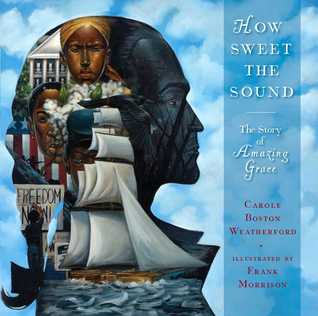
Book Review: How Sweet the Sound: The Story of Amazing Grace

How Sweet the Sound: the Story of Amazing Grace. Carole Boston Weatherford. Illustrated by Frank Morrison. 2018. Simon & Schuster. 48 pages. [Source: Library]

First sentence:
Slave ship Greyhound, ocean faring;
Young John, homeward, brawling, swearing.
Fierce storm, sea squall, ripping sails;
Young John wakes to crewmen's wails. 
Premise/plot: How Sweet the Sound is a picture book biography of John Newton, specifically it focuses on Newton's writing of Amazing Grace and his campaign to end slavery. The last few pages--spreads--focus on the legacy of the hymn.
Choirs make the song their own.
Newton's timeless hymn has grown.
Verses added here and there
Till this song is like a prayer. 
It is written in verse.  The verse, I admit, may take some getting used to for some readers. But once the rhythm catches you, it is quite catchy and instead of a weakness, it becomes a strength.

My thoughts: I loved this one. One of my favorite things about it is the verse--the rhythm of it. If you'd asked me before I read it what I wanted, what I expected, it would not have been verse. It would have been prose. Of course, prose would be the best way to frame the narrative, right? I was so wrong.

The story is worth telling--sharing.

I didn't love, love, love the illustrations as much as I loved the text. But they're good: strong and intense. They convey a LOT of emotion.

Text: 5 out of 5
Illustrations: 4 out of 5
Total: 9 out of 10

© Becky Laney of Operation Actually Read Bible

Tuesday, April 24, 2018

Book Review: A Hobbit, A Wardrobe, and a Great War

A Hobbit, a Wardrobe, and a Great War. Joseph Loconte. 2015. Thomas Nelson. 256 pages. [Source: Bought]

First sentence: In the throes of one of the most destructive and dehumanizing wars in world history, something extraordinary occurred, never to be repeated. It happened on Christmas Eve, December 24, 1914.

Do we owe the existence of the Chronicles of Narnia and The Lord of the Rings to World War I? Loconte argues in this one that we do. He writes, "It can be argued that these epic tales—involving the sorrows and triumphs of war—would never have been written had these authors not been flung into the crucible of combat." He goes on to say, "the Great War helped to frame the sensibilities of both authors, a fact that seems neglected by scholars and ordinary admirers alike...The story of the war’s impact on the creative outlook of Tolkien and Lewis can help historians better understand its moral and spiritual consequences for an entire generation."

A Hobbit, A Wardrobe, and a Great War: How J.R.R. Tolkien and C.S. Lewis Rediscovered Faith, Friendship, and Heroism in the Cataclysm of 1914-18. It's not often that a title of a book is as long as your typical sentence. The title is an accurate description of the book in its fullness.

You should consider reading it if

a) you are interested in the life and works of C.S. Lewis
b) you are interested in the life and works of J.R.R. Tolkien
c) you are interested in how their friendship influenced each other
d) you are interested in learning what life was like BEFORE the war: the dominant ideas in society and culture in regards to morality, spirituality, psychology, etc. ("The Myth of Progress") (gospel of eugenics)
e) if you are interested in how religion mixed and mingled with the war. How did religion influence the propaganda of the war? Why did every single nation involved in the war claim that God was on their side?
f) you are interested in learning what life was like DURING the war: the physical, mental, emotional, spiritual impact of the war. How did war forever change those who lived and experienced it? What effect did it have on their personal lives when they returned?
g) you are interested in learning what SPIRITUAL effect did the war have on society and culture?
h) you are interested in learning what effect did the war have on the arts and sciences? How did the war impact or effect literature in the decades after the war? How did the war impact/effect how we view the world? our worldview and philosophies?
i) you are interested in the effect the war had on the mental health of nations and generations. How were people treated after the war? Did the war shape how we look at mental illness? Did the war provide opportunities for exploring that field and understanding how the mind works? Did it perhaps reveal how little we know or understand?
j) you are interested in how Lewis and Tolkien countered the culture with their works and views; how they were shaped by the war specifically.
k) if you love history

This book has SUBSTANCE. It is not a light, fluffy book, a gimmicky "cutesy" book. It is a scholarly book packed with detail. If you are interested in spirituality, sociology, history, literature, philosophy, or psychology this one has something to keep you turning pages. I learned SO MUCH by reading this one. It was PACKED with facts and details that I didn't know.

I will point out, however, that there was at least one mistake. He mistakenly says that in the opening pages of THE LION, THE WITCH AND THE WARDROBE readers meet "Jadis, “the last Queen,” a woman of immense wickedness." NO, that would be A Magician's Nephew.

Quotes:

  • Tolkien would play a crucial role in Lewis’s conversion to Christianity, while Lewis would be the decisive voice in persuading Tolkien to complete The Hobbit and The Lord of the Rings. Given the massive and enduring influence of their works, it is hard to think of a more consequential friendship in the twentieth century—a friendship that emerged from the suffering and sorrow of a world war.
  • Tolkien and Lewis were attracted to the genres of myth and romance not because they sought to escape the world, but because for them the real world had a mythic and heroic quality.
  • In an era that exalted cynicism and irony, Tolkien and Lewis sought to reclaim an older tradition of the epic hero. Their depictions of the struggles of Middle-earth and Narnia do not represent a flight from reality, but rather a return to a more realistic view of the world as we actually find it.
  • By the start of the twentieth century, attitudes about war and what it could accomplish were bound up with a singular, overarching idea. Let’s call it “The Myth of Progress.” Perhaps the most widely held view in the years leading up to the Great War was that Western civilization was marching inexorably forward, that humanity itself was maturing, evolving, advancing—that new vistas of political, cultural, and spiritual achievement were within reach.
  • “Whatever the local agendas, Christians in all combatant nations—including the United States—entered wholeheartedly in the spirit of cosmic war,” writes Philip Jenkins in The Great and Holy War. “None found any difficulty in using fundamental tenets of the faith as warrants to justify war and mass destruction.”
  • Unfortunately for the Church of England, many chaplains were out of sight and apparently out of touch during the war. Ordered to remain safely behind the lines, at hospitals or field ambulances, they often seemed incapable of relating to the men fighting for survival. “The key to the whole thing,” wrote Theodore Hardy, a chaplain who later won the Victoria Cross, was for ministers to serve in the combat zone: “If you stay back, you are wasting your time. Men will forgive anything but lack of courage.” Most Protestant ministers, however, followed orders and avoided the front. “There is only one Front here and few Chaplains ever get there, and then not during engagements,” complained David Railton. “It is a mistake on the part of the authorities which will cost the Church dearly.”
  • Thus the battle scenes in The Lord of the Rings possess a grim authenticity. When Tolkien describes the Siege of Gondor—where the “fires leaped up” and “great engines crawled across the field” and the ground “was choked with wreck and with bodies of the slain”—he delivers the realism of the war veteran. “Busy as ants hurrying orcs were digging, digging lines of deep trenches in a huge ring, just out of bowshot from the walls,” he wrote in The Return of the King.
  • Reflecting on his experiences years later, Tolkien acknowledged that his taste for fantasy was “quickened to full life by war” and that “the mythology (and associated languages) first began to take shape during the 1914–18 war.”46 Much of the “early parts” of his epic, he explained, were “done in grimy canteens, at lectures in cold fogs, in huts full of blasphemy and smut, or by candle light in bell-tents, even some down in dugouts under shell fire.”
  • Tolkien the soldier lived among these “ordinary men,” fought alongside them, witnessed their courage under fire, joked with them, mourned with them, and watched them die. Thus the “small people” who fought and suffered in the Great War helped inspire the creation of the unlikely heroes in Tolkien’s greatest imaginative work. Like the soldiers in that war, the homely hobbits could not have perceived how the fate of nations depended upon their stubborn devotion to duty.
  • Lewis insisted that war produced at least one benefit: it forced us to consider our own mortality. “If active service does not prepare a man for death,” he asked, “what conceivable concentration of circumstances would?”
  • In the years after the conflict, the cruelty and senselessness of the war—of any war for any reason—became the dominant motifs of a generation. The writings of authors such as Robert Graves (Goodbye to All That), Siegfried Sassoon (Memoirs of an Infantry Officer), Ernest Hemingway (A Farewell to Arms), T. S. Eliot (The Hollow Men), and Erich Remarque (All Quiet on the Western Front) reinforced these themes in the public mind.
  • Indeed, it can be argued that the Great War launched three of the deadliest forces in the history of the West. The first was Spanish influenza, which originated at a US Army base in Kansas in March 1918. Before it ran its course, upward of sixty million people—four times the number killed in the war—died from influenza worldwide. The second epidemic was atheistic communism.  The third epidemic was fascism. 
  • When Freud’s first psychiatric clinic opened in Berlin in 1920, it paved the way for his views about human nature, guilt, and God. Freud proved especially attractive to a generation struggling to find meaning in the war’s aftermath.
  • Tolkien never intended to write a trench memoir. Instead, he set his mind to create a mythology worthy of his beloved England.
  • Middle-earth is not, Tolkien insisted, an imaginary world, but rather our world—with its ancient truths and sorrows—set in a remote past. Indeed, any legends cast in the form of a supposed primitive history of this world, he said, must reckon with the tragic reality of human frailty.
  • Tolkien had long believed that the “fairy-story” was really a genre for adults and “one for which a starving audience exists.”
  • Tens of thousands were overwhelmed by shell shock. In Britain alone, four years after the end of the war, six thousand veterans were confined to insane asylums.

© Becky Laney of Operation Actually Read Bible

Friday, October 13, 2017

Book Review: Preaching to the Chickens

Preaching to the Chickens. Jabari Asim. Illustrated by E.B. Lewis. 2016. 32 pages. [Source: Library]

First sentence: Little John Lewis loved the spring. He loved it not only because it was the time when the whole planet came alive, but also because it was the season of the chicks. Winter was too cold to bring them safely into the world, and summer was too hot. Spring was just right.

Premise/plot: This is a picture book biography of a young John Lewis. As a boy, he was in charge of the chickens on the family farm--about sixty. One of the things he loved to do was to preach to the chickens.
Like the ministers he heard in church, John wanted to preach, so he gathered his chickens in the yard. John stretched his arms above his flock and let the words pour forth. The chickens nodded and dipped their beaks as if they agreed. They swayed to the rhythm of his voice.
"Blessed are the peacemakers," he'd say when they fought over their morning meal.
"Blessed are those who hunger and thirst for righteousness," he would tell a hen who didn't want to share, "for they shall be satisfied."
My thoughts: I enjoyed this picture book biography. I'd read the three volume graphic novel biography series, March, and was intrigued by his preaching to chickens as a young boy. I thought it was a well written story. There aren't an abundance of picture books sharing--showing--how faith impacts lives in the day-to-day. This one definitely does.

Text: 4 out of 5
Illustrations: 4 out of 5
Total: 8 out of 10

© Becky Laney of Operation Actually Read Bible

Tuesday, October 3, 2017

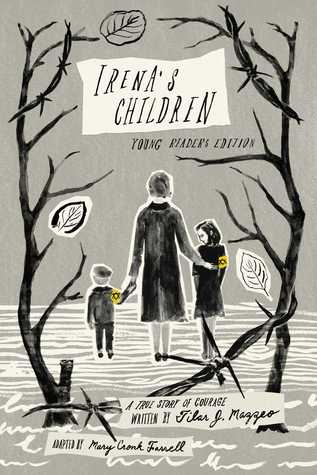
Book Review: Irena's Children

Irena's Children: A True Story of Courage. Tilar J. Mazzeo. Adapted by Mary Cronk Farrell. 2016. 288 pages. [Source: Library]

First sentence: In her native Poland, Irena Sendler is a famous heroine today.

Premise/plot: Irena Sendler rescued Jewish children during the Second World War. She did not act alone. It was a team effort; but she played a leadership role. It's estimated that she (and her team) rescued 2,500 Jewish children during the war before she was arrested and "executed." This is a young reader's edition of the book Irena's Children.

Sendler was a Catholic who followed her conscience. She was in the right place at the right time to do something about the evil she saw. (I believe she was a social worker.) "When Irena thought of the risks she took going in and out of the ghetto, she decided she might as well go all out. She could only die once."(87)

My thoughts: Irena's Children is a fascinating, haunting book.  It is a difficult book to read, and a difficult book to review. How can you do justice to the subject matter?! The simple answer is you can't. The book describes horrible atrocities that happened on a daily basis. One sees humanity at its best and worst within the pages of this book.

Not every reader wants to read about the Holocaust. But I think every reader should read at least one or two books about the Holocaust in their life. Should Irena's Children be that book? Maybe.

I think NONFICTION is so important. While historical fiction can be gripping and compelling, nothing really can take the place of a well written biography or autobiography. (This one is a biography; Sendler died in 2008.)

Definitely recommended.
© Becky Laney of Operation Actually Read Bible

Monday, April 3, 2017

Book Review: Gosnell

Gosnell: The Untold Story of America's Most Prolific Serial Killer. 2017. 347 pages. [Source: Library]

First sentence: It wasn't a homicide case--until it was. Originally the authorities weren't investigating murder, or even illegal late-term abortions. They were just trying to bust a prescription drug mill. But they wound up discovering something far worse.

Premise/plot: This true-crime nonfiction book focuses on the investigation, trial, and sentencing of Dr. Kermit Gosnell. It also brings to light the absence of the media's coverage throughout. No one it seems wanted to present abortion in a negative light. Or to be perceived as presenting abortion in anything but a glowing, empowering light. Question one abortion provider's practices--ethics, procedures, philosophies--and who knows what might be the result. Better to err on the side of caution and ignore the story.

The facts, I won't lie, are gory and disturbing. For example, Gosnell's collection of severed baby feet. Scores of jars of baby feet he kept in the office. (These were not part of the case, part of his charges.) Essentially there were several things going on: filthy, unsanitary, unsafe facilities; untrained, paid under the table employees that had no business dispensing medicine, or assisting during abortions, or overseeing patients after the abortions; an illegal side business of dealing out prescriptions for drugs; doing a lot of illegal late-term abortions (anything past twenty-four weeks is illegal in the state he was practicing in.) What should be shocking is that he was purposely, intentionally delivering babies alive and then killing them a minute or two afterwards. He was proud and happy that he was doing a service for the community. He was not treating the born-alive babies with dignity, or respecting their personhood. Waste, unwanted waste, to be put down the garbage disposal, or, to be stuffed in a kitty litter container. His motivation on all counts is money, money, more money.

My thoughts: Everyone should read this one. No matter if you're pro-choice or pro-life or some hazy position in between. I think the story is disturbing but worthy of your time. How should patients--white or black; poor or middle-class, young or old--be treated. What are a patient's rights? And who is looking out for patients best interests? Multiple government agencies or authorities knew about some of the violations--perhaps even most--and did nothing. Not their problem, not their neighborhood. Perhaps a generalization but some truth I think. No one wanted to step in and shut down this clinic. The authors point is even if you discount the babies or fetuses, how can you discount the dangers posed to grown or nearly grown women? No twenty-four waiting period, no counseling, no consultations with the doctor, drugs dispensed before, during, and after ineffectively or incompetently. Sometimes too much, sometimes too little. Also the conditions of the facilities: no working bathrooms, dirty blankets and chairs and floors, fleas everywhere because of the cats who had free range throughout, the repeat use of medical supplies that are one use only, the lack of training of the staff. How can you support women's rights and ignore the horrors of this clinic?

© Becky Laney of Operation Actually Read Bible

Wednesday, July 13, 2016

Book Review: Night

Night. Elie Wiesel. Translated by Stella Rodway. Foreword by Francois Mauriac. 1958/1960. 109 pages. [Source: Bought]

I first read Night about fifteen years ago. I've been meaning to reread it ever since. It's definitely a book that is worth reading more than once. And the author's recent death made me want to read it now.

I am choosing to review it at Operation Actually Read Bible not because Night is a Christian book that affirms the Christian worldview, but because it is important, significant engaging book that Christians should read.

My edition of Night has a foreword by Francois Mauriac. I highly recommend reading it. Yes, I know it can be tempting to skip over introductions and forewords. But in this case, it is a must read. It contains gems:
It is not always the events we have been directly involved in that affect us the most. (vii)
Have we ever thought about the consequence of a horror that, though less apparent, less striking than other outrages, is yet the worst of all to those of us who have faith: the death of God in the soul of a child who suddenly discovers absolute evil? (ix)
And I, who believe that God is love, what answer could I give my young questioner, whose dark eyes still held the reflection of that angelic sadness which had appeared one day upon the face of the hanged child? What did I say to him? Did I speak of that other Jew, his brother, who may have resembled him--the Crucified, whose Cross has conquered the world? Did I affirm that the stumbling block to his faith was the cornerstone of mine, and that the conformity between the Cross and the suffering of men was in my eyes the key to that impenetrable mystery whereon the faith of his childhood had perished? Zion, however, has risen up again from the crematories and the charnel houses. The Jewish nation has been resurrected from among its thousands of dead. It is through them that it lives again. We do not know the worth of a single drop of blood, one single tear. All is grace. If the Eternal is the Eternal, the last word for each one of us belongs to Him. This is what I should have told this Jewish child. But I could only embrace him, weeping. (xi)
First sentence: They called him Moshe the Beadle, as though he had never had a surname in his life. He was a man of all work at a Hasidic synagogue. The Jews of Sighet--that little town in Transylvania where I spent my childhood--were very fond of him.

Night is nonfiction, an autobiography written by Elie Wiesel. Night covers his experiences from 1941 to 1945; it covers his loss of faith, loss of family, loss of innocence, and, perhaps even hope. Though written in prose, I venture to say that in its potency it more closely resembles poetry. There is beauty in its language, its turn of phrase. Though also a raw, vital, often ugly portrait is presented. One cannot help but be engaged with this book.

Primarily, it is the story of Elie Wiesel (a boy) and his Father. But two other characters are brought to life for readers. And I wouldn't dare review the book without mentioning them both.

The first is Moshe the Beadle. Young Elie is tutored by Moshe before the war comes and interrupts (and ends) lives.
He had noticed me one day at dusk, when I was praying.
"Why do you weep when you pray?" he asked me, as though he had known me for a long time.
"I don't know why," I answered, greatly disturbed.
The question had never entered my head. I wept because--because of something inside me that felt the need for tears. That was all I knew.
"Why do you pray?" he asked me, after a moment.
Why did I pray? A strange question. Why did I live? Why did I breathe?
"I don't know why," I said, even more disturbed and ill at ease. "I don't know why."
After that day I saw him often. He explained to me with great insistence that every question possessed a power that did not lie in the answer.
"Man raises himself toward God by the questions he asks Him," he was fond of repeating. "That is the true dialogue. Man questions God and God answers. But we don't understand His answers. We can't understand them. Because they come from the depths of the soul, and they stay there until death. You will find the true answers, Eliezer, only within yourself!"
"And why do you pray, Moshe?" I asked him.
"I pray to the God within me that He will give me the strength to ask Him the right questions."
We talked like this nearly every evening. We used to stay in the synagogue after all the faithful had left, sitting in the gloom, where a few half-burned candles still gave a flickering light.
One evening I told him how unhappy I was because I could not find a master in Sighet to instruct me in the Zohar, the cabbalistic books, the secrets of the Jewish mysticism. He smiled indulgently. After a long silence, he said:
"There are a thousand and one gates leading into the orchard of mystical truth. Every human being has his own gate. We must never make the mistake of wanting to enter the orchard by any gate but our own. To do this is dangerous for the one who enters and also for those who are already there." (2-3)
Their studies together were interrupted when Moshe, as a foreigner, was expelled from the city by Hungarian policemen. He returns, however, with a story to tell.
He told his story and that of his companions. The train full of deportees had crossed the Hungarian frontier and on Polish territory had been taken in charge by the Gestapo. There it had stopped. The Jews had to get out and climb into lorries. The lorries drove toward a forest. The Jews were made to get out. They were made to dig huge graves. And when they had finished their work, the Gestapo began theirs. Without passion, without haste, they slaughtered their prisoners. Each one had to go up to the hole and present his neck. Babies were thrown into the air and the machine gunners used them as targets. This was in the forest of Galicia, near Kolomaye. How had Moshe the Beadle escaped? Miraculously. He was wounded in the leg and taken for the dead…
Through long days and nights, he went from one Jewish house to another, telling the story of Malka, the young girl who had taken three days to die, and of Tobias, the tailor, who had begged to be killed before his sons…
…People refused not only to believe his stories, but even to listen to them.
"He's just trying to make us pity him. What an imagination he has!" they said. Or even, "Poor fellow. He's gone mad."
As for Moshe, he wept.
"Jews, listen to me. It's all I ask of you. I don't want money or pity. Only listen to me," he would cry between prayers at dusk and the evening prayers.
I did not believe him myself. I would often sit with him in the evening after the service, listening to his stories and trying my hardest to understand his grief. I felt only pity for him.
"They take me for a madman," he would whisper, and tears, like drops of wax, flowed from his eyes.
Once, I asked him this question:
"Why are you so anxious that people should believe what you say? In your place, I shouldn't care whether they believed me or not…"
He closed his eyes, as though to escape time.
"You don't understand," he said in despair. "You can't understand. I have been saved miraculously. I managed to get back here. Where did I get the strength from? I wanted to come back to Sighet to tell you the story of my death. So that you could prepare yourselves while there was still time. To live? I don't attach any importance to my life any more. I'm alone. No, I wanted to come back, and to warn you. And see how it is, no one will listen to me…" (4-5)
The second is Madame Schachter, a woman in the same train car (cattle car, I believe?) as Elie and his Father.
Madame Schachter had gone out of her mind. On the first day of the journey she had already begun to moan and to keep asking why she had been separated from her family. As time went on, her cries grew hysterical.
On the third night, while we slept, some of us sitting one against the other and some standing, a piercing cry split the silence:
"Fire! I can see a fire! I can see a fire!"
there was a moment's panic. Who was it who had cried out? It was Madame Schachter. Standing in the middle of the wagon, in the pale light from the windows, she looked like a withered tree in a cornfield. She pointed her arm toward the window, screaming:
"Look! Look at it! Fire! A terrible fire! Mercy! Oh, that fire!"
Some of the men pressed up against the bars. There was nothing there; only the darkness.
The shock of this terrible awakening stayed with us for a long time. we still trembled from it. With every groan of the wheels on the rail, we felt that an abyss was about to open beneath our bodies. Powerless to still our own anguish, we tried to console ourselves:
"She's mad, poor soul…"
Someone had put a damp cloth on her brow, to calm her, but still her screams went on:
"Fire! Fire!"
Her little boy was crying, hanging onto her skirt, trying to take hold of her hands. "It's all right, Mummy! There's nothing there…Sit down…" This shook me even more than his mother's screams had done.
Some women tried to calm her. "You'll find your husband and your sons again…in a few days…"
She continued to scream, breathless, her voice broken by sobs. "Jews, listen to me! I can see a fire! There are huge flames! It is a furnace!" (22-23)
I will share just one more quote with you. It is a powerful one, one quoted in the foreword as well.
Never shall I forget that night, the first night in camp, which has turned my life into one long night, seven times cursed and seven times sealed. Never shall I forget that smoke. Never shall I forget the little faces of the children, whose bodies I saw turned into wreaths of smoke beneath a silent blue sky. Never shall I forget those flames which consumed my faith forever. Never shall I forget that nocturnal silence which deprived me, for all eternity, of the desire to live. Never shall I forget those moments which murdered my God and my soul and turned my dreams to dust. Never shall I forget these things, even if I am condemned to live as long as God Himself. Never. (32)
The book is short, powerful, compelling, unforgettable. It captures the horror of the Holocaust. I do think it's a subject that Christians should know about and care about. Yes, one could respond to this book with theological arguments and debates. A need to set the record straight. A need to defend God and prove Wiesel was tragically wrong. Or, one could perhaps respond with tears and weeping.

What do you do with the world's sorrow? What do you do when words are hard to come by--if not impossible to come by? Prepackaged words don't seem to fit well, do they? There is a time and place for theological debate, but, in the rawness of the moment when the tears are still fresh and today and tomorrow seem impossible to face--to live through, perhaps tears are best. Even if you think you have the answers.


© Becky Laney of Operation Actually Read Bible

Monday, April 25, 2016

Book Review: Jesus Without Borders

Jesus Without Borders. Chad Gibbs. 2015. Zondervan. 240 pages. [Source: Library]

Jesus Without Borders is a travel narrative written from the perspective of a football-and-soccer loving Southerner (Alabaman) who grew up as an evangelical in the Bible Belt. It is light on the theology, heavy on superficial jesting. A lot of the humor, unfortunately for me, didn't work. I wouldn't say that I always rolled my eyes every time he tried to be funny or witty. But I never laughed either.

It was also very predictable. After the first chapter or two, readers know exactly what to expect: complaining about the plane ride there, complaining about transportation while there, complaining about traffic and road conditions, complaining about bad driving, mentioning the stereotypes he has grown up with about the country he's in, going to a church or bible study that he "discovered" online in his research, complaining about food, mentioning his lack of note-taking, mentioning sports, reporting his conversations with two to three people he met while there, drawing conclusions about a whole country based on the conversations he had with two to three people. Each chapter was supposed to include his insights about faith and God and what he learned--how he expanded his mind and his heart--by traveling. I would say these are light and it's not that they're completely absent from the text it's just that they're not very substantive and memorable.

The premise of the book was great. He is a writer who has had Christian books published. He loves to travel. He decides that it would be great fun to combine the two. To go on twelve to thirteen working vacations. His work would have him going to church in thirteen countries and talking to at least thirteen people about their faith and what it means to "be a Christian" in their various countries. The narrative style is casual, bordering on embarrassingly full of jokes that don't quite work. (I guess readers would have had to been there to 'get' the joke.) At least for me. His half-jesting style may prove quite delightful for other readers. (For example, Lenin's statue is reading The Hunger Games.)

With travel books, sometimes it's more who's doing the narrating...unless the travel writing is really good, really focused, really descriptive. Which his travel writing isn't.

© Becky Laney of Operation Actually Read Bible

Saturday, November 28, 2015

Book Review: Martyn Lloyd-Jones

Martyn Lloyd-Jones: His Life and Relevance for the 21st Century. Christopher Catherwood. 2015. Crossway. 160 pages. [Source: Review copy]

This biography of Martyn Lloyd-Jones was written by his grandson, Christopher Catherwood. Why should Christians still read Martyn Lloyd-Jones today? That is the question Catherwood sets out to answer in his biography. He hopes to prove that Lloyd-Jones legacy is solid and strong. He is worth reading today. He has not lost relevance. His message is still very much needed by the church.

First, the book presents a brief biographical sketch of Martyn Lloyd-Jones' life. Then the  book mainly focuses on his ministry--his preaching, his writing, his friendships--and his books. I appreciate that the book not only provides quick summaries of his books, of his beliefs, but also provides context for understanding and appreciating them.

The book is not as in-depth as titles in Crossway's Theologians on the Christian Life series. (I would love to see him included in this series in the future!) The book is definitely more casual and less organized. (Not that it is un-organized, mind you, just that the Theologians on the Christian Life series seems to be super-organized and very purposefully laid out.) The book also seems to be more argumentative and a ready-defense. That is, the author anticipates arguments and seeks to clarify and reconcile when possible. One strength the book has is the personal nature of it. The focus isn't exclusively on his sermons, on his church, on his ministry. The book shares to a certain extent what he was like in private with the family.

It was an enjoyable read that held my interest. I have read at least four or five books by Martyn Lloyd-Jones, so I was curious to learn more about his life. I am glad I got the opportunity to review this one.

Have you read any Martyn Lloyd-Jones? Do you have a favorite?

If you haven't read him yet, I'd definitely recommend starting with Walking With God Day by Day: A 365 Day Devotional. What I love about that devotional book is that each month of the year has a theme. And most entries from any given month come from one book. So that by the end of the year, you've had a good overview of some of his best works. AND also you've covered some essential doctrines of the Christian faith.

© Becky Laney of Operation Actually Read Bible

Wednesday, February 11, 2015

Book Review: What Every Christian Needs To Know About Passover

What Every Christian Needs to Know About Passover: What It Means and Why It Matters. Rabbi Evan Moffic. 2015. Abingdon Press. 224 pages. [Source: Review copy]

I found What Every Christian Needs to Know About Passover informative and interesting. It is written primarily for a Christian audience, a Christian audience with an interest in Judaism. The author assumes that his readers are curious and seeking. (I imagine he's right about that for the most part!)

Not every Christian will find the subject fascinating. I believe that there is one book and only one book that EVERY Christian needs to read: the Bible. There are few books, in my opinion, that "every" Christian "needs" to read.

That being said, most of my life I've been curious about Judaism: Jewish culture and traditions and beliefs. So this book definitely filled a need for me. It is a reader-friendly book on the subject of Passover.

The first three chapters serve as an introduction. The first chapter focuses on the first Passover. The second chapter focuses on how/why Passover was celebrated throughout the centuries up until the destruction of the Temple in A.D. 70. The third chapter focuses on the celebration of Passover since the destruction of the Temple. In other words, how Passover has changed throughout the centuries, and more on how it is currently being celebrated, and why it still matters.

The next five chapters focus on the preparation for Passover and the meal itself. These chapters are rich in detail. In some ways, I feel these chapters are the most substantive.

The next two chapters focus on contemporary meanings of the Passover story. It's all about the freedom themes of Passover, and the universal quest for freedom.

The final chapter is a script of sorts. A Passover seder that strives to be authentically Jewish yet be primarily (exclusively) for Christian participants.

Christians interested in the subject should find it worth their time. It is informative, and rich in detail. But don't expect it to be gospel-focused. Expect facts and details about Passover, some reflection on what it has meant, and continues to mean to various Jewish communities.

The book is not about how Christ is the fulfillment of the prophecies, the ultimate sacrifice, the Lamb of God. I can't help but feel that Charles Spurgeon would be disappointed with this one! The focus is on the Passover meal itself, and, not on Jesus Christ.


Quotes:
This meal can draw you closer to God, and can help you find God's liberation from the places of scarcity, of imprisonment, that lurk in your life. 
The Passover story can speak to us wherever we are on the journey of our lives. My goal in this book is to help you discover what message this sacred story holds for you.

© Becky Laney of Operation Actually Read Bible

Monday, January 12, 2015

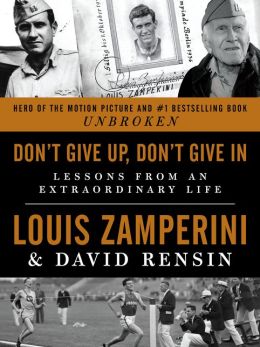
Book Review: Don't Give Up, Don't Give In

Don't Give Up, Don't Give In. Lessons From An Extraordinary Life. Louis Zamperini and David Rensin. 2014. 272 pages. [Source: Library]

If you've read Unbroken, then chances are you're going to want to read Don't Give Up, Don't Give In too. Readers learn more: more about his childhood, more about his training and running, more about the war years--his service, his time adrift, his imprisonment, his survival--more about what happened after the war--before and after his conversion. It brings readers up to date, completes his life story. (In fact, the manuscript was finished just days before Louis Zamperini's death.) And it has a more personal, more intimate feel. I would definitely recommend it.

Don't Give Up, Don't Give In is more than an autobiography. It is packed with advice for readers of all ages.

Run for Your Life

  • The Family Rules
  • Anyone Can Turn Their Life Around
  • The Difference Between Attention and Recognition is Self-Esteem
  • It's Not How You Win, It's How You Lose
  • A Race Isn't Over Until It's Over

Be Prepared

  • Preparation Determines Your Survival
  • My Survival Kit
  • Trust What You Know
  • Keep Your Mind Sharp
  • Don't Forget to Laugh

Don't Give Up, Don't Give In

  • You Are the Content of Your Character
  • Never Let Anyone Destroy Your Dignity
  • Hate Is a Personal Decision
  • The True Definition of a Hero

Attitude is Everything

  • You Must Have Hope
  • Don't Ask Why, Ask What's Next
  • You Choose How To View Your Fate
  • The Secret of Contentment

After the War: Still Lost

  • You Can't Run (Or Sail) Away From Yourself
  • Don't Leave the Crucial Details to Others

There's Always An Answer To Everything

  • You Need a Cloud to Have A Silver Lining
  • Know When You've Done All You Can Do
  • The Gangster and the Gospel


Give Back

  • It Takes a Camp To Help A Child
  • Get Their Attention
  • First You Listen
  • Accomplishment Is the Key to Self-Respect
  • My Private Reward
  • The Mission That Never Ends


What I've Learned

  • Challenge Yourself
  • Learn to Adapt
  • Commitment and Perseverance Pay Off
  • You're Only As Old As You Feel
  • Free Advice

Lessons of the Olympic Spirit

  • It's About People
  • You Have To Carry A Torch
  • Forgiveness is the Healing Factor


Remember Me This Way

  • A Charitable Heart


© Becky Laney of Operation Actually Read Bible

Monday, October 20, 2014

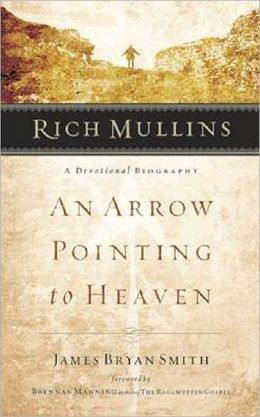
Book Review: An Arrow Pointing to Heaven

Rich Mullins: An Arrow Pointing to Heaven (A Devotional Biography). James Bryan Smith. 2000. B&H. 272 pages. [Source: Bought]

I first read this one years ago, probably seven or eight years ago. I was inspired to pick it up again after watching the new film, Ragamuffin. I was thinking about writing up a post about the movie itself, but, a few sentences in this book review would probably do just as well.

My thoughts on the film. First, I think this one is a movie for Ragamuffins by Ragamuffins. The point of the film seems to be humanity's brokenness: a need for a Savior, a need for honesty or transparency, a willingness to be vulnerable in community, in the church. It is biographical film about Rich Mullins. The film goes to ugly, uncomfortable places. Places that God is more willing to go than His followers, perhaps. There were scenes that were difficult to watch. There were scenes that I loved, however. The book does a better job, perhaps, of contrasting highs and lows, light and darkness. I did think the movie focused more on the darkness and the misery and the ugliness of life. When the movie was good, it was GREAT. I'm thinking in particular of the scenes where Rich and Brennan Manning are together, and he has been given the assignment (by Brennan) to write a letter to himself from his father.

My thoughts on the book. An Arrow Pointing to Heaven is not a traditional biography, a chronological biography. The book shares some details of his life, from various points in his life. But. It's a devotional biography. It is arranged topically. These are topics or subjects that were important to Rich Mullins. These were topics that came up again and again in his writing, in his songs. Each chapter gives readers a glimpse into Rich Mullins' life, a chance to see what was important to him, and why. The book keeps God very central. It is rich in lessons Mullins learned about the God he loved and served.

The table of contents:

  • First Family: Understanding His Roots
  • Creed: Being Made in the Church
  • The Love of God: Encountering the Reckless, Raging Fury
  • Boy Like Me/Man Like You: Trusting in Jesus
  • Calling Out Your Name: Seeing God in The Beauty of Creation
  • Bound to Come Some Trouble: Growing Through Struggle and Pain
  • My One Thing: Finding Freedom in Simplicity
  • Growing Young: Dealing With Sin and Temptation
  • Brother's Keeper: Learning to Love One Another
  • That Where I Am, There You May Also Be: Meditating on Death and the Life to Come
  • Social Aspects of the Beatitudes (by Rich Mullins)
  • Scared of the Dark (by Rich Mullins)

From the introduction:
Rich Mullins was a man who stood among the ruins--the ruins created by his own faults and failings, the ruins that result from the ravages of time. In the midst of the ruins he pointed to heaven, to the God who bundles our brokenness and heals our wounds. (2)
From "The Love of God: Encountering the Reckless Raging Fury"
It is hard to love an angry God. It is also difficult to see ourselves as God's beloved children if we believe we are worthless. (60)
Whatever else we may think we want, the thing we need is God's love. (63)
The love we are longing for is a love that loves not in spite of but in light of our weaknesses and failures. We long to be loved as we are, with all of our defects known. Only then will we truly feel that we are loved. But this kind of love belongs only to God. We humans are too limited to give it. That is why finding it anywhere except in God is impossible. (63)
Comprehending the love of God was difficult for Rich, but it is no less difficult for any of the rest of us. There is no one who can understand how much and how passionately and how tenderly God loves us. There is nothing that is beyond God, but there is much that is beyond us, and grasping this love is one of them. (66)

© Becky Laney of Operation Actually Read Bible