Showing posts with label dystopia. Show all posts

Thursday, July 17, 2014

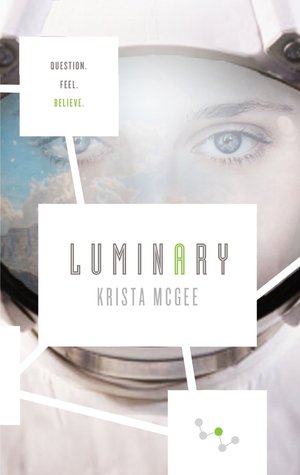
Book Review: Luminary

Luminary. Krista McGee. 2014. Thomas Nelson. 311 pages. [Source: Library]

Luminary is the sequel to Anomaly, a lovely little dystopian novel I read and reviewed last summer. The third novel, Revolutionary, was just released. Luminary is very much the middle book, for better or worse. While I can definitely keep spoilers for this book out of this review, I can't promise that there won't be spoilers for the first book, Anomaly.

Luminary opens with Thalli and three of her friends escaping State. John is the father of one of the Scientists. He is the one whose ideas are deemed to dangerous to allow him access to the rest of the underground community. He believes in a Designer. Berk is Thalli's love interest. He's smart and brave too; he was on his way to becoming a scientist. He isn't just a love interest. Rhen, I wish I could say that she plays an actual part in this one. But she doesn't. She really doesn't. Thalli sees Berk and Rhen talking and assumes that they are falling in love behind her back. And that's it. Thalli sees her as a potential threat and starts treating her accordingly…at least in her private thought life. These four are escaping State, but, their get-away is a little too easy.

So Luminary is about two survivor settlements that they discover. One is New Hope. The other is Athens. Readers spend time learning about the two very different settlements. New characters are introduced. Almost all of the new characters play a bigger role than poor Rhen! One of the main characters we spend time with is a young man named Alex. He is prince of Athens.

Luminary is about community and government. When the incident happened, when nuclear war happened, those that survived tended to have definite opinions on how to rebuild. Readers will see three different perspectives on rebuilding.

If Luminary has a weakness as a novel, it is that it has no real ending! It is one of those frustrating books that just stops.

© Becky Laney of Operation Actually Read Bible

Wednesday, March 26, 2014

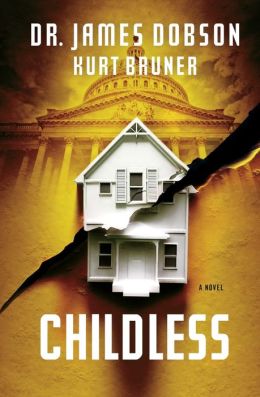
Book Review: Childless (2013)

Childless (Fatherless #2) James C. Dobson and Kurt Bruner. 2013. FaithWords. 448 pages. [Source: Book I Bought]

While some books are character-driven and others are plot-driven, Childless is idea-driven. Characters represent ideas and world views. Childless is all about logically following those ideas and imagining the consequences to both society and individuals. The ideas are definitely centered in the real world, the novel, is set roughly forty or fifty years in the future to give all the ideas time to come to fruition.

The series is about broken families, about the loss of family, about a break down of values. People choosing not to get married. People choosing to have a series of relationships instead of one monogamous relationship. People choosing not to have children at all. People who do choose to become parents being choosy parents and choosing their children's genes in the lab.

But that isn't all. The series is also about the treatment of the elderly.  What happens to a society, a civilization, when there are more old people than young people? Who gets what? How are resources shared and divided? In this fictional series, the author imagines that the elderly are manipulated and urged to make the best decision for everyone: to end their lives so that their grown children and grandchildren can benefit financially. Be a blessing for your loved ones: die today! Don't weigh down your loved ones lives with your continued existence! Make one last contribution to society! Be patriotic! Do good for your country, do good for your family! It is very political. Many politicians have strong opinions. The economy, the budget, is dependent, very dependent, on continuing this business.

Childless is the sequel to Fatherless. I think it is definitely important to read the books in order. There is an ongoing legal case in Childless. No one knows exactly what the three judges will decide or state in their ruling. It is supposed that Judge Victor Santiago will be the deciding judge in the case. Much of this one focuses on threatening letters he receives in the weeks leading up to the decision. A private investigator is hired by the Judge's secretary. Tyler coincidentally crosses circles with previous characters introduced in Fatherless, mainly Julia and Troy.

The main characters of Childless include Julia and Troy, Kevin and Angie, Tyler and Renee. Matthew also continues to be a narrator. It would be hard to put into words exactly how I feel about Matthew. In the first novel, I found his narration to be heartbreaking. I found I could pity him even if I couldn't like him. I'm not strong enough to pity him in the second novel. I thought Matthew's actions in the first novel were despicable, but, the comparison between his actions in the first novel and the second novel would be like comparing littering to assault.

I can't say that I enjoyed Childless. But I can say that I reacted to it. I always emotionally reacted to the characters: what they were saying and doing.

© Becky Laney of Operation Actually Read Bible

Friday, August 30, 2013

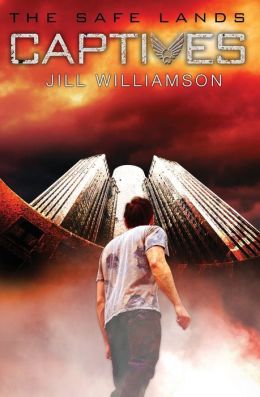
Book Review: Captives

Captives (The Safe Lands #1) Jill Williamson. 2013. Zondervan. 400 pages. [Source: Library]

Captives is the second dystopian novel published by a Christian publisher that I've read this year; the first being Anomaly by Krista McGee published by Thomas Nelson. I am happy to see this trend crossover to Christian publishing. Sometimes I crave a good dystopia.

Captives was an interesting read with multiple narrators. Three of the narrators are brothers: Levi, Mason, and Omar. Some of the other narrators are young women. Both perspectives are essential, I think.

The community of Glenrock is almost completely destroyed, its inhabits either slain or kidnapped. Those that were kidnapped were taken to the "Safe Lands." The "Safe-Lands" is surface-beautiful. Meaning that it is pleasure-oriented, shallow and superficial. Its residents can distract themselves from harsh truths--they are all suffering from an incurable disease--by little daily pleasures. Some pleasures being not so little. Some being quite dangerous and risky. The residents of Glenrock are appealing because they do not have the plague, the disease. They are "pure" and therefore capable of reproducing healthy children. Many scientists believe these outsiders are the only hope.

Levi, one of our heroes, was away from the community when the attack occurred. Though he could have perhaps chosen to walk away and join another outsider community, he knows he can't take the easy way out. He MUST go to the Safe Lands and try to rescue everyone. He is most particularly concerned with rescuing the love of his life, Jemma, but he cares for the whole community really.

I really enjoyed this identity-focused coming-of-age dystopian novel. The characters all struggle with how they see themselves and how they fit into the big picture. They all struggle with labels and expectations. They all have strengths and weaknesses.

I would definitely recommend this one!

© Becky Laney of Operation Actually Read Bible

Friday, July 12, 2013

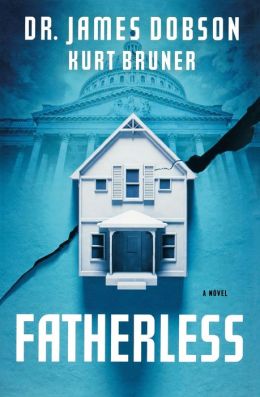
Book Review: Fatherless (2013)

Fatherless. James C. Dobson and Kurt Bruner. 2013. FaithWords. 448 pages. [Source: Bought]
Family affection lies at the root of a well-ordered society. It is one of the few good things which has survived the fall, and prevent men and women from being mere devils. It is the secret oil on the wheels of our social system which keeps the whole machine going, and without which the power of the machine is useless. ~ J.C. Ryle
When I came across that J.C. Ryle quote in my reading this past week, I knew it would be a good way to introduce Fatherless, a new novel by James Dobson and Kurt Bruner.

First sentence: I didn't expect the person killing me to yawn in boredom.

Fatherless paints a disturbing portrait of the future. The novel is set in 2042. The United States is in near-crisis. The majority of the population is old, past the working-and-contributing-age; the burden of medical treatment, of day-to-day care, is stressing the economy. Working adults find it difficult to keep a job and take care of their parents. Their place in the workplace is deemed critical. And hiring someone to parent-sit can be expensive. The burden is especially difficult on the poor, the rich can always afford what's necessary. So in the past decade or so, transitions have become the new norm. For any "debit" in society, for those who cost society more than what they contribute, those who may be older or those who may have physical disabilities or mental limitations. They can truly help their families, help society, help their country by choosing to transition--to transition from life to death. Government is making the idea of transitioning sound so noble, so heroic, so necessary. (Many transitions even include organ donation.) The novel begins and ends with readers getting a glimpse of the transition process. (The first is a paralyzed young man, just turned eighteen. The last is a senior citizen, a mother pressured into it by her son.)

Julia Davidson is a journalist struggling to maintain her place near the top. She has written some incredible stories in the past. Her name has meant something. She has been a somebody. But now other reporters are getting the "big" stories, and Julia finds herself stuck with a weekly column of little significance. But her boss is giving her one last chance.

Kevin Tolbert and his wife, Angie, are "breeders" in a time when it is socially questionable to get married (and stay married) and have children (yes, multiple children). To have a child in wedlock? To have more than one child? Women who are mothers are thought to be extremists, absurd, out of touch with liberated reality. Babies are a burden, always have been, always will be. To have more than one child--at most--is to be oppressed.

Julia Davidson PITIES her old high school friend, Angie. The only reason she's seeking out this old acquaintance is because Angie's husband, Kevin Tolbert, is an up-and-coming politician. Julia has been assigned to write a story about Tolbert's political ideas and policies which are being introduced to a committee. Her paper wants to spin the story so that his conservative ideas are rightly labeled ridiculous, absurd, outrageous, extreme. He has found "bright spots" in the U.S. economy. There are small regions or communities that are doing better than the nation as a whole. The differences between these bright spots and the rest of the nation are higher birth rates (more families having children) and fewer transitions (they're not encouraging their senior citizens to do the right thing and go ahead and die). The idea being that these communities value human life more.

There are multiple stories in Fatherless and many protagonists. Some are Christian; many are not. The book is religious AND political. It goes tough places and asks hard questions. It examines long-term ethics or consequences of some things happening today. For example, hostility towards religion and deeming people of faith, people who hold to the Bible, as being extremists. This book seemed to eerily connect with UnChristian. Another example: the deterioration of the family, of fathers not staying around long enough to parent their children.

Fatherless is heartbreaking and thought-provoking. The Matthew-and-his-mother story line was so disturbing and heartbreaking! Fatherless may not be a flawless novel, weaknesses could be spotted here and there, but it has many strengths as well. (One weakness, perhaps, is the info-dumping.) I enjoyed having multiple points of view. Julia was a broken heroine, troubled with nightmares, struggling in her personal and professional life, clinging to her worldview with fierce determination. But Julia was quite human as well: she has a close relationship with her nephew, and, she is longing for satisfaction of her own. She finds Kevin's friend, Troy, so intriguing though their world-views are so very different from one another. (Troy is a newish Christian). Matthew's brokenness is equally obvious. His searching for spiritual enlightenment and finding it in all the wrong places was so heartbreaking.

Troy to Julia:
Imagine a world of people trying to out-serve, out-love, out-sacrifice, and out-honor one another. Sure beats a world of people trying to outdo and outsmart one another. Don't you think? (238)
Julia's politics:
Didn't one's unalienable rights include controlling one's own body, choosing one's own offspring, and ending one's own existence? (260)
Kevin Tolbert:
We live in a world where the weak and scrawny have little choice but to play by rules set by the big and powerful. By those who rig the game against the dignity of human life. (373)
Julia and Kevin in conversation:
"What kind of choices do you want them to make?" Julia tried to sound sympathetic.
"Natural, commonsense choices," he replied. "Like getting married and raising a family. Like protecting the dignity of aging citizens rather than making them feel guilty every time they take another breath. Like protecting our disabled rather than labeling them worthless debits." (373)
© Becky Laney of Operation Actually Read Bible

Monday, May 24, 2010

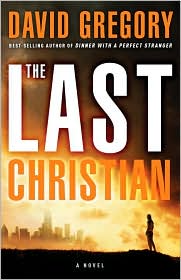
Book Review: The Last Christian


The Last Christian. David Gregory. 2010. Waterbrook Press. 416 pages

I see your neurons firing, Ray.

The Last Christian has an interesting premise. A very thought-provoking premise. It's set in 2088, in the United States, for the most part. In this day and age, Christianity is essentially dead.

Abby Caldwell, our heroine, is the daughter of a missionary couple; she has only known one way of life, the Christian way of life. She's from Papua New Guinea--from the jungle where she was born and raised. But when a mysterious illness kills everyone in her village, well, she sets off on an adventure of her own. She's on her way to America to try to fulfill her grandfather's vision.

Abby received a message--though the message came sixteen years late--from her grandparents. They told her of a dream, a vision. Of how she may be America's greatest hope. Of how she may be the one to bring Christianity back to a country, a nation.

But fulfilling that dream may cost her her life. Because the country is not only unreceptive to the gospel, but openly hostile. She may face jail time for her "hate speech" if she tries to share the gospel with others.

Of course, that is only the beginning of the story David Gregory has written. The Last Christian reads more like an eery Twilight-Zone episode. Artificial intelligence. Silicon Brains. The obsession to combine technology and biology--to take humanity to a whole other level, to be transhuman. The quest of driven men to live forever and ever.

Science. Politics. Religion. Ambition. Greed. Murder. The Last Christian is a compelling read. It is a bit more premise-driven, action-driven, than character-driven, but that isn't necessarily a bad thing.

What I liked best about The Last Christian was it made me think. I'm not sure I liked every little thing about the book. The book makes some strong statements here and there about our church culture, our faith. But. If nothing else it makes you think about faith. What would happen--what could happen--if faith fails. (I think truth is infinitely more important than entertainment value. That the church shouldn't be so open to compromising the truth--changing the gospel--in order to bring more people in the doors.) I liked that Abby didn't have all the answers. That she wasn't perfect. That she was human. That she had her own faith challenges to work out.


© Becky Laney of Operation Actually Read Bible