Showing posts with label fiction. Show all posts

Tuesday, December 1, 2020

97. The Christmas Heirloom


The Christmas Heirloom. Karen Witemeyer. Kristi Ann Hunter. Sarah Loudin Thomas. Becky Wade. 2018. 374 pages. [Source: Bought]

First sentence of Legacy of Love: 1827 LANCASHIRE, ENGLAND From a purely rational standpoint, Sarah Gooding should have been ecstatic with her present position.

First sentence of Gift of the Heart: OCTOBER 1890 HOPE SPRINGS, TX Ruth Fulbright held her sleeping seven-year-old daughter snugly on her lap in the middle of the stagecoach seat while the passengers who considered themselves her betters exited the conveyance.

First sentence of A Shot of Love: NOVEMBER 1958 BETHEL, WEST VIRGINIA Fleeta hunkered low, careful not to rattle the crisp fallen leaves all around her.

First sentence of Because of You: PRESENT DAY MERRYWEATHER, WASHINGTON Maddie Winslow met the man of her dreams the same day that her friend Olivia introduced Maddie to her new boyfriend. Which would have been splendid, except that the man of Maddie’s dreams was Olivia’s new boyfriend.

The Christmas Heirloom is a collection of four holiday-themed, interconnected novellas. The stories all share the same family heirloom. A heirloom that as family legend goes has a lot to do with finding one's true love.

I genuinely loved all four stories. I would say I love, love, LOVED at least three of the four stories. I loved, loved, LOVED the opening story, Legacy of Love by Kristi Ann Hunter. I loved the grandmother that brought the heroine (her companion) and the hero (her grandson) together. It was a very touching story. It had so much heart. It was a great foundational story!!! I loved, loved, LOVED Gift of the Heart by Karen Witemeyer. I loved the LITTLE GIRL. This second chance at love story was beyond giddy-making. It was a JOY to read this one. I loved A Shot of Love by Sarah Loudin Thomas. I didn't love, love, love it--but then again I'm not big into guns and shooting and hunting and all. But I liked the story overall--good characters, well written. I loved, loved, loved Because of You by Becky Wade. While I think I've read the other three authors previously, this is the first time I've read Wade. I think. I don't normally read contemporary romance, but I might be persuaded to read her other books. Because I really enjoyed this romance oh-so-much. 

© Becky Laney of Operation Actually Read Bible

Wednesday, January 18, 2017

Book Review: Out of the Silent Planet

Out of the Silent Planet. C.S. Lewis. 1938. 224 pages. [Source: Bought]

First sentence: The last drops of the thundershower had hardly ceased falling when the Pedestrian stuffed his map into his pocket, settled his pack more comfortably on his tired shoulders, and stepped out from the shelter of a large chestnut-tree into the middle of the road.

Premise/plot: When Dr. Ransom (the Pedestrian in the first sentence) intervenes in a private squabble, he gets more than he bargained for. The story begins with him looking for a place to stay the night--a place that is nearby since he's already walked a long way. He is looking for a night's stay when he overhears a boy protesting loudly against two men. The boy claims the men mean him harm, mean to lock him up in a shed, I believe. Ransom intervenes, and, to add another creepy element into the mix, he recognizes one of the men from his university days! The men now mean him--not the boy--harm. It's no shed that he'll be locked up in--after he's drugged--but a spaceship. The three will go to the planet Mars--aka Malacandra. Ransom doesn't know their plans for him, but he overhears enough to fear them more than the unknown planet. He does know that it's populated, however. And that, for better or worse, he's to be given to the aliens.

My thoughts: Out of the Silent Planet is science fiction, adult science fiction. (Though there's no reason why teens couldn't enjoy this as well.) I'd not read it before, and, I'm definitely glad I finally got around to it. I found myself shouting at Ransom several times in this one. Like at the beginning when he meets the two strangers. Even though he's heard a super-creepy conversation, he shows absolutely no caution at all. NO one is expecting me; no one knows where I am or where I might be or where I might be going; no one will miss me because they have no idea when I'll be back. After voluntarily giving them this information, he accepts a drink from them!

Because it is C.S. Lewis expect some philosophy interwoven in the story.

Favorite quotes:
  • "The love of knowledge is a kind of madness" (55)
  • "A pleasure is full grown only when it is remembered" (73)
  • "When you and I met, the meeting was over very shortly, it was nothing. Now it is growing something as we remember it. But still we know very little about it. What it will be when I remember it as I lie down to die, what it makes in me all my days till then--that is the real meeting. The other is only the beginning of it." (73)
  • "And how could we endure to live and let time pass if we were always crying for one day or one year to come back--if we did not know that every day in a life fills the whole life with expectation and memory and these are that day?" (74)
  • "Bent creatures are full of fears." (122)

© Becky Laney of Operation Actually Read Bible

Wednesday, April 20, 2016

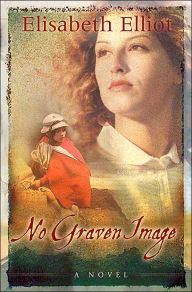
Book Review: No Graven Image

No Graven Image. Elisabeth Elliot. 1966. 267 pages. [Source: Inter-Library-Loan]

No Graven Image is set in Ecuador. It's narrated by an American missionary--a single woman--named Margaret. Ecuador is her first placement, and, it is without a doubt where she feels called by God to serve. She hopes to learn the language--Quichua--and eventually translate the Bible into the native language. She has learned Spanish. She's seeking someone who speaks Spanish and Quichua. About a third of the way through the novel, she meets Pedro. There are some barriers to their friendship--language, culture, social class--but eventually he becomes 'the one' to help her in her work. She will pay him to teach her the language. She will pay him to help her translate the Bible. Now you might think that was challenging enough, but no, before anyone can benefit from this new translation of the Bible, she will have to teach them to read their own native language, that it's worth the time and effort to learn to read. Before she can teach them--at least as she sees it--she has to show them that she's trustworthy and/or worthy of their respect and friendship. She has to overcome the 'who-does-she-think-she-is' and 'is-that-lady-crazy' viewpoint.

From start to finish, Margaret experiences troubles and frustration. Think of it like this: I'm a missionary, now what? Now that I'm actually here in a foreign country instead of back home training to be this missionary whom God will use...what do I do? How does a missionary do missions. Is being a missionary simply living in another country--having other people pay you to live in another country? How does one justify spending one's time when you're a missionary? Is it serving God to go to the marketplace and buy food from natives? Or is the only time that 'counts' the time you spend "sharing the gospel"?

The book has more questions than answers, in my opinion. Margaret wrestles with God quite a bit. Or perhaps I should rephrase that. She wrestles with her beliefs about God quite a bit. She definitely starts out with belief that she is doing God a favor by being a missionary and serving in Ecuador. She definitely believes that by being there and serving, she is doing "her part" to bring people to Christ, and, that God should honor that service by blessing her with definite converts. The issue she doesn't quite address straight-forwardly is the idea that God is sovereign in missions--as He is sovereign over the whole universe--and that it is God who works in the heart, that salvation is all His from start to finish. Her efforts--no matter how mighty and fierce--cannot bring about results. She doesn't have anything to "prove" to God. I'm not sure if Margaret grasped these truths or not. And if Margaret's lacking was intentional on the part of the author, or, if Elliot herself struggled with God's sovereignty.

As a happy, comfy-cozy read, No Graven Image fails to satisfy. If you want to read a book about a woman struggling with living out her calling and wrestling out her doctrines about God in the real world, then this one is worth picking up and reading. Just know that it asks more questions than it answers. There is no tidy ending, no "aha" moment when everything clicks into place and her struggles with herself, with God, cease.

Friday, May 22, 2015

Book Review: Christy

Christy. Catherine Marshall. 1967. 512 pages. [Source: Bought]

Only my father saw me to the Asheville station that Sunday morning in 1912. 

Christy Huddleston is the heroine of Catherine Marshall's historical novel, Christy. It is set in a small community in the Smoky Mountains. Christy is the new school teacher hired by the local mission. She'll be working alongside, Miss Alice Henderson, and David Grantland. (Miss Alice Henderson runs the mission. David Grantland is the new minister, the oh-so-young, just-fresh-from-seminary minister.)

How to describe Christy? Well, she's young, spirited, enthusiastic, optimistic, naive, and well-intentioned. She's got a lot to learn, but, she's the type who's eager to learn. She comes to idolize (deeply respect and admire) Miss Alice. She sees Miss Alice as being the wisest woman ever, essentially. Miss Alice, to her credit, sees how loved she is by Christy, and seeks to show Christy how very human she is. Miss Alice would be the last person to say she had it all together and had all the answers. (She just knows who has the answers: God, and she trusts him and his providence.)

So the book is about Christy's experiences as a teacher, as a young woman. It's about the children she teaches, the families she meets, the women she befriends, the men she comes to know, namely David and Doc Neil MacNeill. It's a coming-of-age story, a spiritual coming-of-age story. How Christy came to the mountains believing certain things about God, but, during her time away from home and family, those beliefs were tested and questioned. She came out of her experiences KNOWING God instead of knowing about God.

I love the teaching aspect of this one. I like books about teachers: Anne of Avonlea, Anne of Windy Poplars, Good Morning, Miss Dove, Up A Road Slowly, When Calls the Heart, etc.

I like the spiritual aspects of this one as well. So many characters are in so many different places spiritually speaking. You do have to weigh all the statements about faith and God and Christianity while you're reading. Not all end up being true theologically. (I didn't necessarily like what the book said about Calvinism, at one point, Calvinism is blamed for their believing only in a God of wrath and their unwillingness to see him as a compassionate, forgiving, gracious God. It was a very generalized statement. It's on page 68.)

There is David, the minister, who came out of seminary knowing a lot of big words, but not knowing anything of the faith for certain. His conversations are heartbreaking, in my opinion. For example, when he and Christy go to visit a dying woman, she asks him to read from the Bible, and to talk to her of heaven. And he's hesitant. Oh, he reads the Bible fine. But when it comes to talk about the afterlife, about heaven, about dying. He stumbles a lot. Even Christy sees this as a weakness. He seems so uncertain of so many things we can be certain about. The old lady ends up giving him quite a speech. She knows God, David, well, it seems he may not even know about God. Not the God of the Bible.  (chapter sixteen)

Doctor MacNeill also comes to mind. He and Christy have quite a discussion. He has been shaken in his faith by a tragedy, and, he's in a place where he's doubting God's goodness and faithfulness. He doesn't necessarily trust or love this God who permits such suffering. The discussion they have, the questions he asks of Christy, are good for her, good for her spiritual journey. (chapter twenty-five) And I love the ending.

I love the romance of this one. It's a very understated romance novel though. David proposes to Christy, relatively early on, after six or seven months of working together. He'd never expressed any interest in her before the proposal. And even after the proposal, he doesn't really ever say that he loves her. Just that he needs her. And at times he seems most interested in having her body than anything else. Doctor MacNeill, well, it might take a few rereads before their scenes start to have an effect on you. (For example, chapter thirty-five). But once you do, it's hard not to love them as a couple.

I love, love, LOVE, LOVE, LOVE Doctor MacNeill. I do.

© Becky Laney of Operation Actually Read Bible

Wednesday, April 29, 2015

Book Review: Prince Caspian

Prince Caspian. C.S. Lewis. 1951. HarperCollins. 240 pages. [Source: Bought]
ONCE THERE WERE FOUR CHILDREN whose names were Peter, Susan, Edmund, and Lucy, and it has been told in another book called The Lion, the Witch and the Wardrobe how they had a remarkable adventure. They had opened the door of a magic wardrobe and found themselves in a quite different world from ours, and in that different world they had become Kings and Queens in a country called Narnia. While they were in Narnia they seemed to reign for years and years; but when they came back through the door and found themselves in England again, it all seemed to have taken no time at all. At any rate, no one noticed that they had ever been away, and they never told anyone except one very wise grown-up.
Prince Caspian is the second book in C.S. Lewis' Chronicles of Narnia series. It is the second visit to Narnia for Peter, Susan, Edmund, and Lucy. Hundreds of years have passed since they reigned as kings and queens in Narnia. Their reigns have become the stuff of legend--along with other details about "old Narnia." Not every one believes that there ever was a King Peter, King Edmund, Queen Susan, and Queen Lucy. Some even dare to go so far as to say there never was an Aslan. But some do still believe and cling to "old Narnia." Among them a young boy, Caspian, who learned of 'the legends' of old Narnia first from his nurse, and, then later--secretly--from his tutor. It is Caspian who calls the four back into Narnia: when he blows the magical horn. Why did he blow it? It was most definitely a great time of need and the horn came with a promise that when it was blown help would come.

Do I love, love, love Prince Caspian? Probably not. I do really like it however. I like spending time with Peter, Edmund, Susan, and Lucy. I enjoyed meeting Prince Caspian. I liked meeting Reepicheep and some of the others. I like the tension in this one as well: the tension between belief and disbelief. I think I appreciate it more each time I revisit it.
“Do you believe all those old stories?” asked Trumpkin. “I tell you, we don’t change, we beasts,” said Trufflehunter. “We don’t forget. I believe in the High King Peter and the rest that reigned at Cair Paravel, as firmly as I believe in Aslan himself.” “As firmly as that, I daresay,” said Trumpkin. “But who believes in Aslan nowadays?”
“Wouldn’t it be dreadful if some day in our own world, at home, men started going wild inside, like the animals here, and still looked like men, so that you’d never know which were which?”
But for the movement of his tail he might have been a stone lion, but Lucy never thought of that. She never stopped to think whether he was a friendly lion or not. She rushed to him. She felt her heart would burst if she lost a moment. And the next thing she knew was that she was kissing him and putting her arms as far round his neck as she could and burying her face in the beautiful rich silkiness of his mane. “Aslan, Aslan. Dear Aslan,” sobbed Lucy. “At last.” The great beast rolled over on his side so that Lucy fell, half sitting and half lying between his front paws. He bent forward and just touched her nose with his tongue. His warm breath came all round her. She gazed up into the large wise face. “Welcome, child,” he said. “Aslan,” said Lucy, “you’re bigger.” “That is because you are older, little one,” answered he. “Not because you are?” “I am not. But every year you grow, you will find me bigger.” For a time she was so happy that she did not want to speak. But Aslan spoke. “Lucy,” he said, “we must not lie here for long. You have work in hand, and much time has been lost today.” “Yes, wasn’t it a shame?” said Lucy. “I saw you all right. They wouldn’t believe me. They’re all so—” From somewhere deep inside Aslan’s body there came the faintest suggestion of a growl. “I’m sorry,” said Lucy, who understood some of his moods. “I didn’t mean to start slanging the others. But it wasn’t my fault anyway, was it?” The Lion looked straight into her eyes. “Oh, Aslan,” said Lucy. “You don’t mean it was? How could I—I couldn’t have left the others and come up to you alone, how could I? Don’t look at me like that … oh well, I suppose I could. Yes, and it wouldn’t have been alone, I know, not if I was with you. But what would have been the good?” Aslan said nothing. “You mean,” said Lucy rather faintly, “that it would have turned out all right—somehow? But how? Please, Aslan! Am I not to know?” “To know what would have happened, child?” said Aslan. “No. Nobody is ever told that.” “Oh dear,” said Lucy. “But anyone can find out what will happen,” said Aslan. “If you go back to the others now, and wake them up; and tell them you have seen me again; and that you must all get up at once and follow me—what will happen? There is only one way of finding out.”

© Becky Laney of Operation Actually Read Bible

Wednesday, June 22, 2011

Book Review: Meet Troo

Troo Makes A Splash (Rainforest Friends). Cheryl Crouch. Illustrated by Kevin Zimmer. 2011. Zonderkidz. 32 pages.

Troo and Keewa looked at the river. "I wish I could swim," said Troo. Keewa said, "I can't swim either. But it would be fun to splash if the water didn't move so fast.""Rilla says her pool is calm. But where is it?" Troo asked. "She'll never tell," said Keewa. "Her pool is her biggest secret." "Let's make our own pool! Help me stop the river," said Troo. Keewa shook his head. "We can't do it." Troo lugged a rock over and dropped it in the river. THUNK. "We can try," he said.

Zonderkidz is introducing a series of I Can Read books. I believe there are three titles available so far in the Rainforest Friends series: Troo Makes A Splash, Troo's Big Climb, and Troo's Secret Clubhouse.

In Troo Makes A Splash, Troo, Keewa, and Rilla learn how important it is to think of other people too. Troo and Keewa were having a great time in the "pool" they created by damming up the river. But after Rilla tells them how their dam is making the river rats unhappy, how others need the river more than they need a pool to splash in, they decide that they can play something else instead.

Troo's Secret Clubhouse. Cheryl Crouch. Illustrated by Kevin Zimmer. 2011. Zonderkidz. 32 pages.

Troo panted and lay down on the wooden floor of the clubhouse. Getting Rilla up the ladder was hard work. "You have to learn to climb," Troo told little Rilla. "Keewa and I can't carry you up forever." "But I am a water rat!" Rilla said. "I told you to build our clubhouse on the ground. Keewa shook his head. "A supersecret clubhouse is much better high in the air. No one can see us or hear our secret plans here."

In Troo's Secret Clubhouse, Troo learns that love is never rude. When Troo's friends Keewa and Rilla were there to play with in his not-so-secret secret clubhouse, Troo told his little sister that she could not play with them. That she was too little. That she was a baby. But now that his friends have gone home, he's feeling sad. He sees his little sister having fun and he wishes that he hadn't been so rude and mean to her. Will she forgive him? Will she allow him to play with her?

Troo's Big Climb. Cheryl Crouch. Illustrated by Kevin Zimmer. 2011. Zonderkidz. 32 pages.


Troo stood beside the biggest, tallest tree in the rainforest. "I can climb it," he said, "easy." Rilla said, "To the top? No way." Troo looked up. He looked up some more. He could not see the top. Maybe his friend Rilla was right. Rilla said, "I dare you to try. I don't think you can do it." "Sure I can," said Troo. "I think you are afraid," she said. Rilla sounded brave and strong. "You climb it!" Troo said. "Water rats don't climb, silly!" said Rilla. "But tree kangaroos do. You should be a great climber." "I am!" Troo said. "I'm the best."

In Troo's Big Climb, Troo learns that parents have GOOD reasons for making rules. His parents have told him NOT to climb the big tree. But. Troo really, really wants to climb it. He wants to prove that he's big enough, strong enough, etc. So he does. And. Well, he learns the hard way that rules are put in place because of love. Will Troo be more obedient from now on? Will he be able to resist his friends dares?

© Becky Laney of Operation Actually Read Bible

Friday, May 7, 2010

Book Review: The Scarlet Letter


Scarlet Letter. Nathaniel Hawthorne. 1850. 237 pages.

A throng of bearded men, in sad-colored garments and gray, steeple-crowned hats, intermixed with women, some wearing hoods, and others bareheaded, was assembled in front of a wooden edifice, the door of which was heavily timbered with oak, and studded with iron spikes.

This "review" will mainly be observations.

I skipped "The Custom House" introduction to the novel. I have no idea if anything in this introduction by Hawthorne is important, is relevant to understanding the novel. But I know that I never would have finished the book if I'd had to finish this introduction.

I don't trust Hawthorne. I don't trust his representation of the Puritans. I think it is just a little too easy for authors to make Puritans the ultimate bad guys.

I think it would be horrible if The Scarlet Letter was a person's only exposure to Christianity. Because you know what, what this book lacks--really lacks--is the gospel message.

Though I suppose you could say that it's content is still relevant today. Stories about ministers (some famous, some not so much) confessing to their congregation, confessing to the world, apologizing for making big, huge mistakes in their personal lives.

I don't think the lack-of-gospel has anything to do with the Puritan characters, the Puritan background. I think one only has to begin reading Puritan theologians to discover gospel truths--gospel gems everywhere.

The characters. How much do we really know about Hester, about Pearl, about Arthur, about Roger? Are any of these characters truly three-dimensional, truly fleshed out characters? Especially Hester, Pearl, and Roger.

Pearl. I thought Hawthorne's descriptions of this child were strange. And it's not because I buy into this Pearl-isn't-quite-a-normal child argument. I don't think her being born out of wedlock makes her otherworldly. I think Hawthorne's description of childhood, of parenthood is lacking in some ways.

Hester. I had trouble connecting with Hester. I'm glad she's painted in a positive light. I'm glad that others come to see her as a good woman. However, when it comes right down to it. I still don't feel like I genuinely know her. I still don't understand her. I am not sure exactly what's right and wrong here. Speaking of the to-tell-or-not-to-tell dilemma. Whether her keeping quiet is the right thing, the noble thing, the brave thing to do. I do get the sense that she felt it was the right thing to do.

Roger. I thought he was very one dimensional. He was only meant to be evil and out for revenge. Yet, I had a hard time buying him as a real person, a human character. No one is so completely evil, so obviously up to no good. And if Roger really was this type of person. Why was Arthur so very, very slow to realize this? And what was Roger's motivation? Did he really care about Hester? I don't get the idea that he really cared about her as a woman, as a wife. And since no one knows that he is the wronged husband, his pride--his vanity--isn't being threatened. If no one knows he's Hester's husband, if no one connects Hester with him at all, not even a little bit, why dedicate your whole entire life--your whole entire being--into discovering the truth and getting revenge?

This observation isn't so much about Roger as it is the writing of the book itself. I'm trying to think if there was ever a moment when I didn't know the truth. When I didn't have all the dots connected. When I didn't know who Pearl's father was. I don't know if this is because this one is a classic and this spoiler is just part of our culture. (Like knowing that Elizabeth and Darcy are so-meant-to-be.) Or if Hawthorne is to blame. Is there suspense? Is there a real mystery to be solved by the reader?

Arthur. Where to start?! His case is both tragic and stupid. Stupid because it's senseless. If this minister had ever opened his Bible at all, he would know that his misery is so unnecessary. His burden didn't have to be so heavy. His guilt, his shame--hidden though it was--was so pointless. Had Arthur never once read Psalm 51? Seriously?! How could he not know about David and Bathsheba? How could he not know that this man--this king--that committed adultery (and murder) was a man after God's own heart? Why was the concept of man's sinfulness and Christ's righteousness so foreign to him? Why did he not grasp the concept of grace? of mercy? of forgiveness? Why did he not understand that we all have sinned and fallen short? Why did he not know that we all like sheep have gone astray? Why does he not know that each and every one of us is in need of a Savior? Why does he think it's all about him? Why does he think he can be holy all on its own? Why is he trying to earn his way into heaven, into God's favor? Why can't he look upon Jesus? call upon Jesus? How could he be a minister in a church and not know the gospel? Why didn't Arthur read the Psalms? Or the four gospels? Or the book of Romans? Just think of the needless suffering, the restless days and nights. Think of being tormented in your very soul for years and years with no hope. That is tragic. God is such a good God, a merciful God.

Did I like Arthur? Not really. He just didn't get it. I'm not sure that any of the characters did.

Am I glad I read this one? Yes. I think I may have "read" this one in high school. But was my reading more than skimming? I can't remember. Even though I didn't necessarily "like" this one, I can't deny that it was thought-provoking.


© Becky Laney of Operation Actually Read Bible

Monday, March 1, 2010

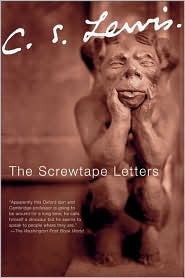
Book Review: The Screwtape Letters


The Screwtape Letters. C.S. Lewis. 1942. HarperCollins. 224 pages.

My dear Wormwood,
I note what you say about guiding your patient's reading and taking care that he sees a good deal of his materialist friend. But are you not being a trifle naive? It sounds as if you supposed that argument was the way to keep him out of the Enemy's clutches. That might have been so if he had lived a few centuries earlier. At that time the humans still knew pretty well when a thing was proved and when it was not; and if it was proved they really believed it. They still connected thinking with doing and were prepared to alter their way of life as the result of a chain of reasoning. But what with the weekly press and other such weapons we have largely altered that. Your man has been accustomed, ever since he was a boy, to have a dozen incompatible philosophies dancing about together inside his head. He doesn't think of doctrines as primarily 'true' or 'false', but as 'academic' or 'practical', 'outworn or 'contemporary', 'conventional' or 'ruthless.' Jargon, not argument, is your best ally in keeping him from the Church.

Thus begins C.S. Lewis' Screwtape Letters. A series of letters--fictional, of course--written by Screwtape and addressed to his nephew Wormwood. Wormwood's patient--his human, a man--has recently become a Christian. It is Wormwood's intent to keep his patient from following the Enemy, from becoming attached to his new Savior, from following this new Way of life; Wormwood is hoping that he can be won back, tempted back, to their side, the dark side. But how is his 'patient' to be kept from the Way? Can advice from a superior demon help him succeed?

As you can imagine reading The Screwtape Letters is a bit topsy-turvy. Everything GOOD becomes bad. And everything BAD becomes good. The Enemy is God Almighty. And Satan is Our Father Below. Once the reader becomes oriented to this, then things should flow smoother.

So what can Christian readers gain from reading this one? Well, I'd say it's all food for thought. Reading The Screwtape Letters gives you something to think about, to consider. It makes you think about how you live and how you think. Especially thought-provoking, in my opinion, are Screwtape's thoughts on the Church. How the Church can be twisted in such a way that it keeps people further away from God.

"One of our great allies at present is the Church itself. Do not misunderstand me. I do not mean the Church as we see her spread out through all time and space and rooted in eternity, terrible as an army with banners. That, I confess, is a spectacle which makes our boldest tempters uneasy. But fortunately it is quite invisible to these humans." (5)

"When he gets to his pew and looks round him he sees just that selection of his neighbors whom he has hitherto avoided. You want to lean pretty heavily on those neighbors. Make his mind flit to and from between an expression like 'the body of Christ' and the actual faces in the next pew. It matters very little, of course, what kind of people that next pew really contains. You may know one of them to be a great warrior on the Enemy's side. No matter. Your patient, thanks to Our Father Below, is a fool. Provided that any of those neighbors sing out of tune, or have boots that squeak, or double chins, or odd clothes, the patient will quite easily believe that their religion must therefore be somehow ridiculous." (6)

"What he says, even on his knees, about his own sinfulness is all parrot talk. At bottom, he still believes he has run up a very favorable credit-balance in the Enemy's ledger by allowing himself to be converted, and thinks that he is showing great humility and condescension in going to church with these 'smug' commonplace neighbors at all. Keep him in that state of mind as long as you can." (9)

Not all the letters carry the same weight, but there are some great ones.

"You will say that these are very small sins; and doubtless, like all young tempters, you are anxious to be able to report spectacular wickedness. But do remember, the only thing that matters is the extent to which you separate the man from the Enemy. It does not matter how small the sins are provided that their cumulative effect is to edge the man away from the Light and out into Nothing. Murder is no better than cards if cards can do the trick. Indeed the safest road to Hell is the gradual one--the gentle slope, soft underfoot, without sudden turnings, without milestones, without signposts." (60-61)

© Becky Laney of Operation Actually Read Bible

Sunday, February 7, 2010

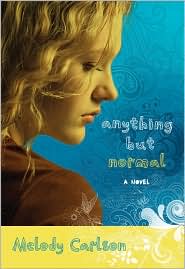
Book Review: Anything But Normal


Anything But Normal. Melody Carlson. 2010. [January 2010] Revell. 254 pages.

I wasn't crazy about the title of this one. I think normal is a loaded word, and it's one I try to avoid when possible. I think it's a word that can be packed with a lot of judgment. And sometimes these are judgments we place on ourselves. And sometimes these are judgments others place on us. But. I guess that's a whole other story.

What is this one about? Well, it's about a Christian teen becoming pregnant. While she's away at a Christian summer camp. It's about the lies she tells herself, and the lies she tells others. It's about guilt and shame. It's about judging and misjudging others. It's about how words can hurt. Just as much as actions. At times.

Sophie, our heroine, is so ashamed of her "condition" that she denies the pregnancy altogether. Keeping one big secret from her family, from her friends, from her church, from her classmates. Sophie has some judgmental friends. No question about that. And some of these judgmental friends have judgmental parents. They've been raised that being right is more important than being loving. Her friends are callous, in my opinion, and so is Sophie in a way. Especially in the beginning. There were times when I thought that every single person was missing the big picture, being so fundamentally clueless. But. Sophie does begin to change. Mostly.

I thought this novel was a bit clumsy in places. And I don't know how quite to explain what I mean by clumsy. I think it was definitely an issue novel. Sometimes it was a quiet issue novel; sometimes it was a loud and demanding ISSUE NOVEL. There were a few elements in the plot that I found a little unbelievable. (I'm thinking of the sudden uproar of protest against the school's pregnancy center; the angry parents demanding this and that and calling for town meetings, etc. And then with one little speech from Sophie, all is made well again. Not only has the uproar blown over, there is now so much love and support that many now want to volunteer at the pregnancy center.)

Do I think the subject matter important? Yes. Of course I do. I think teen pregnancy is an important issue. I think more needs to be said than "it's bad" and "don't do it." I think it's important to show unconditional love. That becoming pregnant as a teen, out of wedlock is not the unforgivable sin. It's not something outside of grace. Grace and love extend to both mother and child.

Available January 2010 at your favorite bookseller from Revell, a division of Baker Publishing Group

© Becky Laney of Operation Actually Read Bible

Saturday, August 22, 2009

Book Review: Whirlwind


Hake, Cathy Marie. 2008. Whirlwind. Bethany House. 358 pages.

"I've come to a decision."
Millicent Fairweather clasped her hands together at her waist and waited in silence for her boss to continue. The clock in the far corner of the dim study ticked loudly.
"My daughters are of an age to expand their horizons. A change is in order. Therefore, I've located a place for them."

After Millicent Fairweather loses her position as nanny, she decides to join her sister and brother-in-law in immigrating to America. They hope to start a dress shop--her sister, Isabelle, has quite a seamstress. On the trip to America, Millicent is hired by a stranger, a Mr. Daniel Clark, to care for his young son, Arthur. Nanny is a role she's entirely comfortable with. And all seems to be going well, through Millicent, Daniel befriends her sister and her brother-in-law. But their arrival in America on Ellis Island does not go as planned. In fact, it turns tragic. Frank, the brother-in-law, dies leaving Millicent and Isabelle a bit perplexed. Where will they go? What will become of them? Fortunately, they're not friendless. Daniel offers for Millicent. He needs a wife--someone to be a mother to his child. And he'd be happy to take Isabelle into his home as well. Perhaps she can have her dress shop after all, as an extension to his own new business, a store.

Daniel Clark has big dreams. He hopes to make a success of it in Gooding, Texas. And this is where his new family will be established. Of course, changes aren't always easy. Millicent has some adjusting to do. She's not used to being a wife and a mother and a store clerk. Even if the marriage is for convenience without any intimacies expected.

Can these two newlyweds fall in love? Is their hope for Isabelle in America? And what secret has Daniel been keeping--and why--from his wife?

© Becky Laney of Operation Actually Read Bible

Thursday, August 20, 2009

Book Review: Bittersweet

Bittersweet by Cathy Marie Hake, 2007.

Bittersweet is the sequel to Letter Perfect. While Letter Perfect was narrated by Ruth, Bittersweet is narrated by several characters including: Laney (Josh's sister and Ruth's sister-in-law), Galen Sullivan (Josh's best friend, Laney's long-time crush), and a new character named Ivy. I don't know if it was the change of narrators, or if my dark cloud has lifted, or if I've just grown used to her writing style, but I really enjoyed Bittersweet. Enjoyed perhaps isn't strong enough of a word. I loved this book.

A year has passed since Letter Perfect ended. It is the fall of 1860. The book opens with Laney and Ruth (not to mention the unforgettable Hilda) at the Fair (I'm assuming a state fair) along with some of the Sullivan family. Galen has remained at home to take care of the farm and tend the horses since he is in charge of one of the pony express stations. (I don't know if station is the right word since my knowledge of the pony express is severely limited.) And the time away from his family has shown him several things: he doesn't know anything at all about cooking OR cleaning. He is surviving on the kindess of strangers--okay, they're not really strangers, they're just neighbors who know that a bachelor would need some care and attention while his mama is away. The other thing that he learns is that there is a family (father, son, daughter) squatting on his land. He is not overly thrilled to find them. He wants them gone. He doesn't trust them. But finally, he relents to the man's pleas and allows them to stay if and only if he agrees for his son (I'm assuming 19 or 20ish) to work for him several days a week. Ishmael is the son's name. Ivy is the daughter. Ivy makes a good substitute cook and housekeeper while his mom is away at the fair. Not that she stays at the house--that would be improper--but she does cook a few meals for him and cleans up the mess he's made of the house.

The book is about what happens when everyone returns. Ivy and Ishmael are now "working" for the Sullivan family. Mrs. Sullivan has mercy on the family and sees how they are on the verge of starvation. So she 'hires' Ivy to help her cook and sew and do other household chores in exchange for food for her family. Ishmael, Galen discovers, is also a hardworker. But both Ivy and Ishmael lack polite manners. They've never been taught how to interact and behave around others. They don't know which subjects are taboo. Galen encourages Laney and Ruth to be patient and to try to teach Ivy some of the things she needs to know. A task that proves more challenging than anyone can imagine.

Galen begins watching Laney. Watching how Laney acts with Ivy. Noticing how kind she is. How patient. How forgiving. And he notices just how beautiful his best friend's little sister has become. He is madly in love with her. And he declares his intentions to Josh. But just as he begins to court the woman of his dreams, the unexpected happens.

Life isn't always easy. It isn't always sweet. Sometimes there is pain and confusion. Sometimes there is heartache. Sometimes there is anger. Sometimes life can make you bitter. As the McCain and Sullivan families learn, you may not have control over what happens to you in life...but you can learn to control how you react to life's unexpected turns.


© Becky Laney of Operation Actually Read Bible

Tuesday, August 18, 2009

Book Review: Letter Perfect


Hake, Cathy Marie. 2006. Letter Perfect.

Ruth Caldwell, a clumsy tomboy, travels west to ultimately find love and danger in California, 1859. Grieving the loss of her mother, Ruth travels west alone to meet the father she never knew. Unfortunately, her father has died. Fortunately, her father's partner Josh McCain, Sr. and Josh McCain, Jr., offer her their home. There is also a sister. Laney, Elaine Louise, McCain. Ruth becomes best friends with Laney, and though Josh at first finds her more than a little frustrating to be around, he soon becomes smitten. But in this "Wild West" setting, little is as it appears. And danger may be closer than they'd ever think.

I was mostly puzzled by Letter Perfect. Greatly puzzled if I'm honest. It's not that the writing is bad. It's not. It's just confusing in a few small ways that end up all in one big mess by the end. The book begins with Ruth Caldwell being introduced as a tomboyish miss who is clumsy both physically and socially. She's always making a mess of things. Always getting in and out of trouble. Just a real handful. You never know what to expect. That is how this character is set up. And it's true for the first chapter. We see Ruth Caldwell out of her element at a ladies' school...a charm school. She ends up making a calamity at a dinner and getting thrown out of school for being unladylike. But once she's out of that environment, that label doesn't really fit anymore. Yet Ruth refers this way about herself over and over and over again. Which I suppose I can see as possible. Certainly we as humans have a way of seeing what we think are our flaws and magnifying them above and beyond what an outside observer would note. So I'm not being over critical there. Not necessarily. But this one thing kept working with a larger theme: I never knew quite what to expect next. This story wasn't predictable at all...not remotely. You might think that was a good thing. It might even be a good thing to another reader. But I wanted to know where I was going. I knew it was a romance. I knew it was set in California. But everything else was like a thousand different plots being juggled in the air and randomly caught and pieced together. First there was a big deal made about the pony express. Then there was a great deal of focus spent on the transcontinental railroad. Then there was a chapter or two where I thought the author was leading the reader in the direction of a Native-American (Indian) versus whites/government/soldier. There was some talk of Indians attacking forts and settlements. Some talk of how unsafe it was to travel. How Indians would murder you. And whatnot. And there were a few chapters were there was a big emphasis on slavery and Abe Lincoln and how the North and South couldn't continue on in peace...that something was brewing. (The book is set in 1859). And then there were bits and pieces about a women's suffrage movement. All those plot elements thrown in and jumbled together. They'd talk about a thing for a chapter or two and then either not mention it again for the rest of the book, OR they'd wait five or ten chapters to bring it back up. Regardless, all of these little indicators were adding up to false advertisement.

The main thread of the novel seems to be a mystery of sorts. But again the clues are all over the place and the reader has no clue they're even supposed to be looking for clues until you're well over halfway through the novel. Up until that point where you learn that

S
P
O
I
L
E
R

one of the characters is embezzling funds from the ranch, you have no clue that there is a mystery to be solved and a villain to be caught and dealt with.

What adds to this confusing "mystery" is the fact that the author whether purposefully or accidentally uses names interchangeably. What do I mean? I mean for two thirds of the book, perhaps except for one scene of introduction, this character is called "Dad." He is the father of the man Ruth eventually marries. Even after the reader learns that he is behind the embezzlement and that he most definitely is a drunk. And he could have other vices as well. He is still referred to as "Dad." Not unusual, right? But then out of the blue, "McCain" shows up. If you're like me, you're going McCain who???? Where did this guy come from??? Who is he??? What's going on???? But then you either flip to the beginning or read a paragraph or two further and discover that Dad and McCain are the same person. From that time on, she refers to "Dad" as "McCain" about 75 or 80% of the time. All the characters by this point know him to be a villain. Yet there is one chapter close to the end, and after about ten or twenty chapters after "Dad" has only been called "McCain" in the text that he all of a sudden--out of the blue--is "Dad" again. Why this switch back again? Why? Why the switch at all? Why use them interchangeably if it's a stylistic thing???? If McCain is a cold, calculating, distant man who is a murderer, then why refer to him as Dad again once the reader is aware of his true nature. His own daughter now knows him essentially to be an immoral criminal who would not stop short of murder. His son knows the same and is trying to protect the woman he loves. Yet he's "Dad" again. But only for that one chapter. I believe the next chapter sees him as "McCain" again.

So while I don't feel Letter Perfect is a bad book by any means, it left me just a wee bit puzzled. Especially this whole McCain/Dad thing. I tend to think that you should pick a name and stick with it. To bounce back and forth seemingly at random is just confusing. Grant you, I thought it odd that this book told almost 99% through her eyes would have this man, this stranger, be "Dad." So in some ways, it was almost a relief for him to be called something else. But he does make a good villain, I suppose. He was bad to the core and he didn't repent.

© Becky Laney of Operation Actually Read Bible

Monday, August 10, 2009

Book Review: Lady of Milkweed Manor


Klassen, Julie. 2009. Lady of Milkweed Manor. Bethany House. 412 pages.

Twenty-year-old Charlotte Lamb laid her finest gowns into the trunk, pausing to feel the silken weight of the sky blue ball gown, her favorite--a gift from dear Aunt Tilney.

Charlotte Lamb has disgraced herself and her family, but her life is far from over. When we first meet our heroine, Charlotte, she is on her way to a place of refuge--a lying-in home for unwed mothers. Who's the father of her unborn child? Who's the man responsible for ruining her? That's what her family would like to know. But having stubbornly refused to name names, Charlotte finds herself abandoned by her family.

Dr. Taylor never expected to see Charlotte Lamb--now calling herself Charlotte Smith--at a place like this. His work with the manor--the home for unwed mothers--is important to him. But to meet a young lady from his own past...some one he admired so...it's a bit of a shock to say the least. And poor Charlotte, she's embarrassed to be recognized. Dr. Taylor was a young apprentice, an assistant, to Dr. Webb, her family's doctor. They spent time together--enjoyed each other's company. Both wanted more. But it was not to be...

It would be hard to say who is more surprised at this unexpected meeting.

It's a complicated story--much more than I was expecting--and I loved it. This wasn't a flimsy Regency romance. Here is substance. It was a great read for me--very hard to put down--and I loved it very much.

© Becky Laney of Operation Actually Read Bible

Wednesday, August 5, 2009

Book Review: The Frontiersman's Daughter


Frantz, Laura. 2009. The Frontiersman's Daughter. Revell. 412 pages.

I've been in a bit of a reading slump lately when it comes to Christian fiction. I've not really enjoyed much of anything in several months--most of the summer really. But The Frontiersman's Daughter changed my luck. I just loved--and I do mean loved--this one. It's good historical fiction with a touch of romance.

Set in the 1770s in Kentucke (which is Indian Territory at this time) it is the story of Lael Click, daughter of Ezekiel Click, one of the first frontiersman in Kentucke. When the novel first opens, our heroine is just thirteen. But as young as that is, it's not too young to have caught the notice of Captain Jack. But I'm rushing into things aren't I? Oh well. That can hardly be avoided. The white settlers have an ongoing struggle for peace with their Indian neighbors, the Shawnee. And Ezekiel Click is an interesting case. A white man who was 'captured' (he chose to surrender instead of to fight) by the Shawnee and lived among them several years. He learned their language, learned their ways, earned their respect. Captain Jack is another white man--one captured as a young boy--living among the Shawnee. He is one of them. When the novel opens, a group of Shawnees are visiting the Click cabin. They're speaking with Ezekiel. And at one point, one asks--in English--to see his young daughter, to see Lael. He asks her to let down her hair. She does. And he obviously likes what he sees because he starts leaving presents for her to discover--a necklace of blue beads, a blanket, etc. But her mother has something to say about this! She won't stand for it. Not one little bit. So Lael is sent away--rather quickly--to visit Ma Horn, a woman who knows her herbs and is known as a healer. Lael learns her art, her techniques, something that will prove helpful later on in life.

The novel spans almost a full decade. We see Lael grow up. Lael loves the outdoors. She loves living in this 'wild' and 'uncivilized' place. So she's most unhappy when her father sends her away--sends her to Briar Hill, a school in Virginia that will teach her how to be a lady--a proper lady, civilized. It isn't until her father's death that she is able to return to Kentucke, to the land she loves.

She's strong. She's intelligent. We see her being pursued by several men: Simon (the brother of her best friend), Captain Jack (her father's friend, a white man living as an Indian), and Ian Justus (a young Scottish doctor). Which man is right for her?

What did I love about this one? The characters. The story. The details. I felt a connection with this one almost immediately. It was an absorbing read, one that was hard to put down.

© Becky Laney of Operation Actually Read Bible

Monday, August 3, 2009

Book Review: Montana Rose


Connealy, Mary. 2009. Montana Rose. Barbour. 318 pages.

I wanted to like this one. But it suffers from the sad condition of having a silly unnecessary villain as a plot device. (Not all readers are bothered by this. Some romance readers actually consider silly a guilty pleasure, something to enjoy.)

What do you need to know about this one? Well, the author was "inspired" by Janette Oke's Love Comes Softly. This made me a bit curious. Love Comes Softly was the first romance I'd ever read. (Well, unless you count These Happy Golden Years by Laura Ingalls Wilder.) And it really doesn't get much better than Marty and Clark. At least for me. Not in this genre of Christian historical romance. How does this one compare? It doesn't. Of course, that's just my opinion.

Cassie Griffin has just buried her husband. But this husband was no gem. (Though it takes a while for Cassie to admit just how awful a husband Griff was to her: physically and emotionally abusive.) Her husband was in debt. And what Cassie needs...and quick...is a husband. The gravedigger, Red Dawson, is the lucky man whose proposal she accepts. (He is not the only man there at the funeral to offer for her. She gets many proposals that day.) He's a good man, a Christian. And he's willing and able to be a father to her unborn child and a good husband to her. He pays off some of her husband's debts--though he can't save any of her things, things her first husband mortgaged, things like her family bible that just happens (oh-so-conveniently) to be a Gutenberg Bible. (A fact that I found more than a little implausible. Since it would have been around four hundred years old, and at the time of the original printing something that only the extraordinarily wealthy could own. Most were owned by monasteries or churches or universities. In other words, not private individuals.)

Cassie and Red are attracted to each other from the start. The only resistance between them coming from Red who doesn't want to rush her, to make her feel that she has to love him. The two do their share of bickering. Cassie doesn't know how to do some of the chores--though she does know how to cook--and working with animals--horses and cows and pigs and chickens--doesn't come naturally or easily for her. But Red is patient--most of the time. And even when he is impatient, he's never cruel or harsh or demeaning or abusive. So he's definitely in the good guy camp.

Insert the superfluous villain, one Wade Sawyer. A young man who for better or worse turns into a drunkard stalker determined to kill Red, though he's a bit of a coward at the killing part, and "rescue" Cassie. He's been stalking Cassie since before her first husband died. He's a creepy guy. (Reminded me of Jud Fry from Oklahoma now that I think about it.) He's got an overactive imagination and that's just the start of his problems. Not that we get to know him well, he's a bit one-dimensional at that.

Readers are also introduced to Belle, an outspoken and slightly-crazy man-hating woman with lots of kids. (She counsels all her daughters to hate men as well.) But Belle being inspired by Cassie decides to be nice to her husband for a change to see if she can inspire her husband to reform. But so far--at least in book one--no such luck. Her husband, Anthony, is one big loser. Perhaps this story line was introduced--these characters were introduced--to prepare for later books in this new series. Since this story only marginally relates to Cassie and Red's romance.

If this story had focused only on Cassie and Red, then I probably would have enjoyed it more. I think there's a chance, you'd like this one more than I did. But I don't care for her self-proclaimed style: "mayhem, disaster, comedy, and gunfire."

© Becky Laney of Operation Actually Read Bible

Tuesday, July 28, 2009

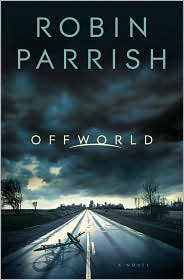
Book Review: Offworld

Parrish, Robin. 2009. Offworld. Bethany House. 361 pages.

Offworld by Robin Parrish has a premise that had me curious. I first read about this one early in the year--January or February--and I knew right away I wanted to read this one. What's the premise? A team of four astronauts return to Earth--after a mission to Mars--to discover that humanity has vanished. Completely vanished. Sounds fun, right? Well, if you like dystopian fiction it does. This mystery starts in space actually. The astronauts lose communication with Earth several months into their return trip. The closer they get the more they realize is missing. There is nothing coming from Earth.

Christopher Burke. Trisha Merriday. Owen Beechum. Terry Kessler. Are these four astronauts all that remain of the human race? Not quite, as we come to find out, the first person they stumble across is a young woman named Mae. She's an odd one. Why should she be--seemingly at least--the only human that survived whatever it was that happened? These four astronauts survived because they were off planet. But why did she? Are there others likes her? Tis a mystery no doubt. But not the main mystery--at least not to our four heroes--they're trying to figure out what this bright light is that is coming from Houston. Is the bright light connected with this disappearance? Will traveling cross country to Houston answer all the unanswerable questions they have? They certainly hope so!

It's a weird road trip. And a dangerous one as well. Are all these close calls a coincidence or is someone trying to send them a message?

S
P
O
I
L
E
R

While the back cover says that this is "not a trick." I have to disagree. At least slightly disagree. I think it is a trick--a dangerous trick, a risky trick--but a trick nonetheless. Someone has plotted this disappearance with the so-called intentions of bringing back the human race after their master plan has been achieved. If that's not a trick--making someone disappear and reappear--I don't know what is.

Becky Laney of Operation Actually Read Bible

Friday, July 24, 2009

Book Review: The Enclave

Hancock, Karen. 2009. The Enclave. Bethany House. 492 pages.

Sometimes books arrive that I don't remember requesting. Such is the case with The Enclave by Karen Hancock. The fault, this time at least, is all mine. This is a blog tour book--apparently I signed up in May for it and forgot all about it! As I said I was surprised when it arrived because it's a genre that I don't really read much in. And there's a reason for that. It's a Christian book. (I don't mind those. That's not where I'm nitpicking.) But it's one of those oh-so-modern-thrillers. In The Enclave it is one of those Evil Institution and Mad Scientists type of thriller.

What is The Enclave about? Who are its stars? We've got two Christian scientists: Lacey McHenry and Cameron Reinhardt. Both are employees at Kendall-Jakes, a research institution under the direction of (the tyrannical and so obviously evil) Parker Swain. The list of 'bad guys' is rather long in this one. But essentially there are plenty of scientists more on the mad side of things who are looking for a way to obtain immortality, to conquer death and the like. One of their schemes includes manipulating genes and human cloning. Employees are encouraged to worship their director and give their all for him. He can be very persuasive. Unfortunately, he can also be very dangerous.

Poor Lacey has quite the time of it. There's a weird "anomalous" creature after her, that is stalking her, who turns murderous when she's transferred out of her department. And then there's the sexual harassment from Swain. She's caught the boss' attention, and he'll stop at nothing to make her one of his girls. He has quite the history, you see. Lacey isn't quite open to all this flirting--she's not stupid exactly--but she's not quite closed to it either. She entertains moments where she thinks he might accidentally be sincere. Moments where she considers that he might be good for her. (Granted, Lacey isn't privilege to all the knowledge readers are. But still, there are moments I wanted to slap her!) Lucky for Lacey, there is Cameron to watch out for her and protect her. Cameron seems to be a bit more aware and open to the idea that his boss is pure evil.

Cameron is prone to having flashbacks. It's written into the story that he has Post Traumatic Stress Disorder. He ever so conveniently flashes back a dozen or so times. I suppose these chaotic interruptions in the text--the shifting from now to then without a second's notice--is authentic enough. These flashbacks overwhelm the narrator without warning, so why should readers be spared the chaos of being flung through time, the disorientation and discomfort of it. Still it can be frustrating to the careless reader. (I'll admit that I'm careless at times. If your mind skips out on a sentence or two, you can get lost very quickly.)

Part mystery. Part thriller. Part action.

While I didn't particularly "like" this one--just not my genre--I do think some readers might find it worth their time. There is quite the sub-genre for this in Christian fiction. So it must have a steady audience of folks who love suspense-thrillers with a Christian slant.

© Becky Laney of Operation Actually Read Bible

Monday, June 29, 2009

Book Review: Love's Pursuit


Mitchell, Siri. 2009. Love's Pursuit. Bethany House. 329 pages.

Poor Puritans. They hardly ever get a good rep in fiction. In Love's Pursuit, readers meet a community of Puritans (Stoneybrooke Towne) living in Massachusetts Bay Colony in the 1640s. More specifically we meet two sisters, Susannah and Mary Phillips. We also meet a woman who wears a cloak of invisibility. (Well, she wears her shame and humiliation as a cloak of invisibility.) Susannah is in love with a man, John Prescotte. But he hasn't proposed yet. And he may never get the chance.

Susannah is a beautiful young woman, and there are other men in town--including a visiting Captain (Daniel Holcombe)--that have noticed just how beautiful and wonderful she is. One of her would-be suitors is Simeon Wright a well-respected man in Stoneybrooke. A man who could have his pick of many of the young ladies in town. They all think he's swoon-worthy. Take for example Susannah's own sister, Mary. Mary thinks that Simeon Wright would make a fine husband...for herself. But when Simeon proposes to Susannah instead, then things begin to crumble for Susannah. She does not love Simeon. She loves John. She doesn't appreciate the fact that Mary is angry with her because he proposed to the 'wrong' sister. Susannah doesn't want to wear any blame there. She didn't "steal" him from her because she doesn't want him!

Despite the fact that her father did NOT consent to his proposal--accepting on his daughter's behalf--the Wrights have the banns published in church. An unfortunate event since John had just days before proposed to Susannah with the blessings of both families. But with the announcement that she's to marry Simeon being read publicly in the church assembly, John Prescotte withdraws his offer of marriage and shuns her. Since John is now refusing to marry her, what choice does Susannah have but to marry Simeon? Other than every bone in her body telling her that Simeon is the wrong man for her, that he is not a good man, period, she has no "logical" reason to refuse her father's request to marry Simeon. The captain sure has a few ideas of how to fix the matter. But will she listen to him? There are a few in town who could warn Susannah about Simeon. A few who could tell her that he is not what he seems. That beneath the surface, he's hiding some cruel tendencies. It's looking like they'll never be a happily ever after for Susannah...no matter what she decides.

I'm not sure I "liked" this one. The narration was first person. But here's the odd bit, it had multiple narrators. Each narrator spoke in the first person. And there was no clear separation marking who was speaking. I think if this had been indicated somehow (it is possible, I've seen other books do it) it would have been an easier read. Readers just have to piece together for themselves the narration the best they can. I do think it gets easier as it goes on. But those first few chapters are a bit rough because things are just beginning to unfold.

S
P
O
I
L
E
R


I do think the book was a little harsh with the Puritan angle. Using the equation that Puritans are bad and evil meant that for our heroine to have any chance to be happy, she has to be outcast and shunned and cut off from her community.

© Becky Laney of Operation Actually Read Bible

Friday, May 8, 2009

Book Review: A Passion Denied


Lessman, Julie. 2009. A Passion Denied. (The Daughters of Boston #3). Revell. 466 pages.

Oh to be a calculating woman! Elizabeth O'Connor sighed.

A Passion Denied is an aptly named novel following the non-romance-romance of Elizabeth ("Beth" or "Lizzie") O'Connor and John Brady. If you've read the first two books, you'll remember John Brady as the soldier-friend of Collin, the man who would eventually (with plenty of twists and turns) become Lizzie's brother-in-law. John became a family friend. And it didn't take long for Lizzie to see him as a mentor, a best friend, though she was just a child (13) at the time and he a man of the world. (Not that he was a man of the world. By the time Lizzie met him, he was a man of God. A man who embodied everything a godly man should be. She's had him on a pedestal for years and years and years. But John was never always perfect. He's carrying some shame and guilt and fear. He wasn't perfect then, and he isn't perfect now.

Lizzie loves John. John loves Lizzie. The problem? He won't admit it. He won't act on it. He's stubborn and foolish and just downright silly. Not that Lizzie isn't these things either. She's silly and immature in a way. Unfortunately in my humble opinion, she decides that Charity is a good role model. That Charity's recommendations of how to hook a man and reel him in would be the right way to go about it. Hint: Her advice isn't all that biblical. Charity isn't a P31 woman by anyone's standards. Faith seems to have mellowed out to such an extreme that she's behind Charity's forward-flirty-push-him-to-the-limits-do-anything-and-everything-to-make-him-notice-you tactics. That and Charity's good-old use another man to make him jealous ploy.

The soap opera continues in A Passion Denied. This family saga is so much more than just an adventure in Lizzie's life. It focuses on the whole family: Marcy and Patrick, Collin and Faith, Charity and Mitch. In this latest adventure, John's past is catching up with him just in time to be part of a love triangle. Yes, John has a secret twin brother, Michael, a man who is his opposite in many, many ways. A man determined to use Beth to manipulate his brother. (And he's not the only competition either!)

So did I like it? Yes. Mostly. There were a few places where I wanted to scream at the characters--be it Patrick or John or Charity or Beth--that they were being stupid. That they were making a mistake. The book mirrored a soap opera in that effect too--I almost always have that response at the television as well. But despite all that--or maybe because of that--I had to keep turning the pages to see how it would all unfold.

© Becky Laney of Operation Actually Read Bible

Friday, April 24, 2009

Book Review: Before The Season Ends


Burkard, Linore Rose. 2008. Before The Season Ends. Harvest House. 338 pages.

Something would have to be done about Ariana.

Meet our heroine, Miss Ariana Forsythe, a young woman--the second daughter of the family, by the way, who loves God with all her heart and soul. She's looking for a godly man to marry. That is her only qualification. He must love God. He must know God, not just know about him. Her parents are preparing to send her away to London to visit her aunt, Mrs. Agatha Bentley, for the season. (For those not in the know, 'the season' is the social season in London where the fashionable and oh-so-wealthy elite did everything to make much of themselves. In other words: one big season of parties and dances and trips to the theatre and the like. This meant that mothers tried to match make for their daughters (and sons). Young women would naturally try to find husbands.)

Ariana doesn't think she's going to London to catch a husband on the marriage mart. But her aunt has different plans. (She thinks she is going to see the sights, not to be seen by all the eligible young men.) Like most Regency romances, the plot revolves around a bachelor who is resolved to remain a bachelor. A stubborn, often-aloof (hard-to-get-to-know), ever-handsome bachelor. Our hero is Mr. Phillip Mornay. He is the paragon of society. He's known for being a bit grumpy (anti-social) and a lot fashionable. (It doesn't hurt that he's very wealthy and associates with only the best people. He's also got a bit of bite to him, known for his banter.)

Ariana bumps into Mr. Mornay--quite by accident and very literally--at a party (a picnic I believe) and his first reaction is a bit anti-social. She knows she didn't make a very good first impression. Later on (that same day I believe) he rescues her from a very embarrassing situation. While out on a walk, Ariana gets inspired to climb a tree. While most of the party searchs for her, she's hiding in the tree hoping to avoid public humiliation. Mornay does spot her, but does not put her to shame. After directing people away from her hideaway, he helps her down from the tree and sees her safely to the house. Lecturing all the way of course.

And that might have been the end of things. If. If only Ariana hadn't made an enemy. Lady Covington has decided to spread false rumors about Ariana and Mr. Mornay. Rumors that while untrue could ruin not only her season, but potentially her chances for marriage as well. Mr. Mornay though he would never in a million years do this for another young woman has decided to court Ariana quite publicly to prove that Lady Covington is crazy. (You see, he has a rep for brushing aside young women who throw themselves at him. If a woman acts all swoon-y (think of the three swooning ladies in Beauty and the Beast who follow Gaston around), he doesn't hesitate from rejecting and humiliating them. He will have nothing to do with silly (mindless) young women who want to manipulate him into saying 'I do.')

Will this show-of-a-courtship prove to be the real deal? Does Ariana want it to become real? Can she catch the uncatchable bachelor? Can she capture his heart? There's no denying he's easy on the eyes. And Ariana does begin to find him charming. But there's something standing in her way. She believes that he doesn't believe. That is she believes he's a "Christian" in name only. He doesn't have personal, saving faith in her opinion. He doesn't know the price Christ paid for him. As long as it's all a game, a show, then it's a non-issue, though she prays for him often, but what if it becomes real? Could she really and truly marry a man--even if she does love him heart and soul--if he doesn't share her faith?

If you love Regency Romance, but like it on the smutty side, then you'll probably find this lacking. But if you love Regency Romance and you love clean romance novels, then I think you'll find Before The Season Ends to be giddy-making. For example, if you love Georgette Heyer and Jane Austen, then you'll probably find it to your liking. It is much more accessible than Heyer and Austen. (There is even a glossary in the back of the book to bring you up to speed on Regency England.) I will say this, I found almost all of it to be giddy-making for me. I was in heaven reading this book. Thought it practically perfect in every way. Loved the hero. Loved the romance. Loved the writing. Thought the dialogue worked well. But. Close to the end, it becomes very heavy in the preaching and sermons. A little too heavy in my opinion. (To each their own I know). So, do I still love it? Yes. Even though I didn't *love, love, love* the direction it took towards the end...I'll still be recommending this one.

© Becky Laney of Operation Actually Read Bible