Showing posts with label biography. Show all posts

Tuesday, January 13, 2026

3. The Story of Corrie ten Boom


3. The Story of Corrie ten Boom: The Watchmaker Who Forgave Her Enemies. Jennifer T. Kelley. 2025. 176 pages. [Source: Review copy] [5 stars, children's book, biography, history, world war II, missionary]

First sentence: Corrie ten Boom's train arrived at the station in Munich. But it was not her first time in Germany.

Jennifer T. Kelley has written a biography of Corrie ten Boom just right for younger readers who perhaps aren't quite ready for the original memoir The Hiding Place. To be fair, The Hiding Place is a memoir of a very specific time in her life, this children's biography is a fuller portrait of her whole life. Namely how God used Corrie ten Boom to reach people all over the world. Corrie ten Boom is known for her radical forgiveness and bold proclamation of the gospel, that the gospel is for EVERYONE, yes everyone. God SAVES and saves to the uttermost. The good news is so amazing that it transforms lives. Because Corrie ten Boom knew God to be a loving, forgiving God, she was able to forgive. 

Corrie ten Boom and her family hid Jews during the Second World War. This led to her family's arrest--where her father died in jail--and subsequent time in a concentration camp--where her sister died. YET how could the family do otherwise? Obeying God meant defying government. Corrie ten Boom was an amazing witness wherever she went.

Definitely recommend this one! 

© Becky Laney of Operation Actually Read Bible

Saturday, August 23, 2025

59. The River of Grace


59. The River of Grace: A Story of John Calvin. Joyce McPherson. 1998. 180 pages. [Source: Bought] [biography, children's book, 5 stars]

First sentence: John brandished his stick in the air. "I am Sir John and I declare that I will go on a pilgrimage to the Holy City." He looked fiercely into the summer sun as he imagined a brave knight would.

The River of Grace is a children's biography of John Calvin. It opens with a young John Calvin in the year 1517 playing knights with a childhood friend, a young boy passionate about the Church and her mission. It follows him through the years, the decades, as he slowly but surely becomes a Reformer--someone who believes that the Bible should be translated into the language of the people AND read, studied, treasured above the traditions of the church and church elders. This was not an overnight transition, but a slow reckoning of convictions, of being led by the Spirit as he read and studied. 

I loved this book so much. I am SO glad that I thrifted a copy. It was written well. It was not 'dry,' 'dull,' or 'boring.' It is written as a compelling narrative. I would say that it leans towards fiction at times in that it does make use of dialogue between the characters. I think it stays true to what we know of his life and times, but, certainly it allows for some creativity in dialogue. 

© Becky Laney of Operation Actually Read Bible

Thursday, July 3, 2025

53. I Still Believe


53. I Still Believe. Jeremy Camp. 2013/2020. 160 pages. [Source: Library] [4 stars, memoir, biography]

First sentence: Pick up your guitar. I didn't want to. I didn't want anything to do with music. It had been two weeks since Melissa had gone to heaven. My wife was only twenty-one, and we had been married just three and a half months when she passed away from ovarian cancer.

I Still Believe is Jeremy Camp's memoir. The edition I read was newly updated in timing with the 2020 movie release for I Still Believe. Both book and movie tell the love story of Jeremy and Melissa. 

The book provides so much more context to Jeremy's life--both before and after. The movie focuses almost exclusively on their love story and nothing but their love story. The book gives a much fuller picture in regards to Jeremy's spiritual journey AND his actual biography. Learning of his family, his childhood, his teen years, and the decade(s) following Melissa's life certainly gives you a more complete picture of who he is. 

The book and movie are both sad. Sad in a bittersweet way. Melissa's life was short--yet every day of her life's story was written by God [before one of them came to be] and written to bring him glory.

I Still Believe isn't necessarily a book [or movie] that you "enjoy." But I think there are spiritual lessons within both. 

© Becky Laney of Operation Actually Read Bible

Tuesday, June 24, 2025

50. Whitefield on the Christian Life


50. Whitefield on the Christian Life: New Birth to Enjoy God. Tom Schwanda and Ian Maddock. 2025. 232 pages. [Source: Review copy] [4 stars, christian nonfiction, biography]

First sentence from the introduction: George Whitefield's life as a Christian was dedicated to knowing God and making him known. His transformative personal experience of the new birth in Christ undergirded and propelled a remarkable public preaching ministry that not only transcended denominations and oceans but also attracted listeners from all segments of society.

First sentence from chapter one: Central to George Whitefield's life and ministry was the new birth. In 1769, one year before his death, he recounted a retrospective review of his conversion in which he narrated his struggle to find peace with God. His listeners were reminded that baptism alone does not assure anyone of entering heaven. He vulnerably rehearsed his misguided journey of excessive asceticism that almost killed him and the futility of seeking God solely by external human efforts.  He joyfully credited Charles Wesley's gift of The Life of God in the Soul of Man by the Scottish minister and professor Henry Scougal (1650-1678) which confronted him with his need to be born again. With a tinge of delight, he then added, "Whenever I go to Oxford, I cannot help running to that place where Jesus Christ first revealed himself to me, and gave the new birth."

Whitefield on the Christian Life: New Birth to Enjoy God is a biography of George Whitefield. It is one of many in a long, continuing series published by Crossway. (I have read a handful of books from the series.) The books focus just as much--if not more--on the theology and doctrine of a particular man than on his actual life. Though the book does to some extent do a bit of both. The book is more arranged thematically than chronologically. (Though, of course, it follows some chronology, but when it comes down to choosing between the doctrinal subject (or theme) and following a strict chronology, doctrinal theme wins out.) 

This book--like many others in the series--works to place the subject--George Whitefield--in the context of his times. It shows what influenced him, and subsequently how he influenced others. 

Whitefield's focus was on PREACHING and then perhaps on having his sermons published. He preached 18,000 SERMONS, AN AVERAGE OF 530 SERMONS A YEAR FROM 1736 TO 1770. That number is staggering. 

I learned plenty while reading this book. 

Quotes:
As a preacher of one book, Whitefield did not regard the Bible as simply providing the raw material or content for his sermons: as a founding father of the evangelical movement, he let Scripture shape both where and how he urged his listeners to experience the new birth. 


© Becky Laney of Operation Actually Read Bible

Friday, September 27, 2024

45. Joni Eareckson Tada

 45. Joni Eareckson Tada. Kristyn Getty. Illustrated by Hsulynn Pang. 2024. 32 pages. [Source: Library] [5 stars] [picture book biography]

First sentence: Joni was born the youngest of four sisters in Baltimore, USA. She was called Joni after her dad, John. He had been hoping for a boy! Joni had sparkling blue eyes, a clever mind, and lots of energy.

I have read several books written by Joni Eareckson Tada. I know I've read two autobiographies and a handful of other books she's written on other topics. So I was SUPER, SUPER, SUPER excited to see that a children's biography was coming this year. 

This one is a picture book biography for readers of all ages. It introduces her life story and her ministry. Let's be honest, this may be the introduction to her life story for younger generations. I do think her story is important; her ministry is important. 

I would recommend this one. 


© Becky Laney of Operation Actually Read Bible

Wednesday, June 12, 2024

34. The Hiding Place A Graphic Novel


The Hiding Place A Graphic Novel. Corrie ten Boom. With Elizabeth and John Sherrill. Adapted by Mario DeMatteo. Illustrated by Ismael Castro. 2024. 240 pages. [Source: Library]

First sentence: It was 1937, just three years before Hitler and his Nazis invaded Holland. It was the 100th birthday party of ten Boom Watches--our little watch shop in Old Haarlem. Although the party was for the shop, the affection of a city was for father. Casper Ten Boom. They called him Haarlem's Grand Old Man.

This book adapts Corrie ten Boom's autobiography The Hiding Place into a graphic novel of the same name. 

Is The Hiding Place memoir worth reading? Yes. Yes. Yes. A thousand times yes.
Is The Hiding Place movie adaptation worth watching? YES. Definitely.
Is The Hiding Place graphic novel memoir worth reading? Definitely. Especially, especially if it helps readers envision the times and events. Some readers respond more to graphic novels, find them easier to read, to digest. It may be "easier" to "hand-sell" (think Reading Rainbow) a graphic novel than a traditional book, a nonfiction memoir at that. 
Does the graphic novel do a good job adapting the original? While I haven't read them close together in time to compare perfectly, as I was reading the graphic novel, I was reminded of scenes from the memoir. I don't recall any memorable, significant scenes from the memoir being left out OR being changed or altered. All the highlights, if you will, of the original can be found in the graphic novel adaptation. Memories not being perfect, however, I haven't examined the two close enough to say with absolute certainty that the two are essentially telling the exact same story. 

I do recommend reading the original OR reading the graphic novel--or both. I do recommend watching the movie. 


© Becky Laney of Operation Actually Read Bible

Tuesday, February 13, 2024

17. The Watchmaker's Daughter


The Watchmaker's Daughter. Larry Loftis. 2023. 384 pages. [Source: Library]

First sentence: Tick. Tick. Tick. It was a soothing sound, methodical and predictable. 

The Watchmaker's Daughter is a [new] biography of Corrie Ten Boom and family. Her father, Casper Ten Boom, was a watchmaker [like his father before him]. Casper [and Corrie] followed in his footsteps in other ways. As a young man, Willem Ten Boom, Corrie's grandfather, began to take a [genuine] interest in the welfare of the Jewish people. The opening chapter reveals that he held prayer meetings to pray for [the [peace of] Jerusalem and the [blessing of the] Jews. A hundred years later, those prayers would be more fervent and needed. The Ten Booms saw this horrifying situation unfold. The Ten Booms could not stand by and do nothing. They opened their home and began hiding Jews, helping them to escape from the Nazis and near certain death. 

Corrie Ten Boom wrote her own autobiography, The Hiding Place. If you've read The Hiding Place do you need to read The Watchmaker's Daughter? Maybe. Maybe not. Probably not. 

The two differ mainly in scope. The Watchmaker's Daughter is a more expansive, big picture story. The Hiding Place is more narrow in scope; it is a biography of HER life and HER family. She does not try to tell the story of Anne Frank or Audrey Hepburn. She does not try to loop in (for lack of better word) other players into the story. 

The book is more history-history than spiritual biography. That is another way the two differ. Though you cannot tell the story of Corrie Ten Boom [and family] without writing of their faith in God. 

© Becky Laney of Operation Actually Read Bible

Tuesday, February 6, 2024

15. My Jesus


My Jesus: From Heartache to Hope. Anne Wilson. 2022. 196 pages. [Source: Library] [Memoir, Biography, Music Industry]

First sentence: I sat on the front step with my backpack loaded for adventure, tapping my tennis shoe on the concrete. My older brother, Jacob, was supposed to pick me up at 3:00 that autumn afternoon, but he was late as usual.

This memoir is essentially the story behind the song, "My Jesus." It is a memoir capturing a very specific time in Anne Wilson's life. The book focuses on a) her coming to faith as a teen, b) the death of her older brother, Jacob, c) her being led by the Spirit to sing a song at her brother's funeral, d) everyone encouraging her to record a video of her singing the same [funeral] song, e) her singing video being 'discovered' on YouTube, f) how she got a manager, g) how she had songwriting sessions with others h) how she got a record deal i) the release of her single, "My Jesus." The overall main theme being how grief transformed her faith and her family. 

This felt more like it could have been or should have been a feature length article in a magazine, a blog post (or two), or a vlog series on YouTube. Don't get me wrong, I really do appreciate and love the song, "My Jesus." I do like the country sound of Anne Wilson. 

For better or worse, it seems like Anne Wilson's faith is more than a little on the charismatic side. She talks of prophets and prophecies, dreams, visions, etc. Some of the theology feels a little questionable, a little strange, perhaps. There were a handful of scenes that just weren't my cup of tea. It's fine as a memoir, but I wouldn't classify it as "christian living." Her life story shouldn't necessarily serve as advice for others. 

© Becky Laney of Operation Actually Read Bible

Thursday, September 14, 2023

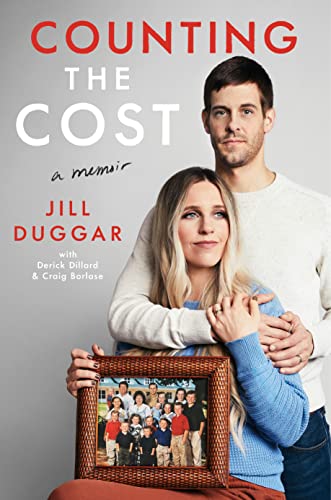
64. Counting the Cost


Counting the Cost: A Memoir. Jill Duggar, Derick Dillard, Craig Borlase. 2023. [September] 287 pages. [Source: Library] [biography, memoir, nonfiction]

First sentence (from the prologue): Technically, there was no problem with Derick and I being outside together that way. We weren't on a date or anything, so we didn't need a formal chaperone. Plus, there were easily a half dozen little Duggars running around out there with us, playing in the snow. We were safe. We were following all the courtship rules that my parents had encouraged us to write down--no holding hands, no in-person, one-on-one conversations without another adult or mature chaperone present, no putting ourselves in a position where we could fall into temptation. All the same, I knew that people would be watching us. It was to be expected.

First sentence (from chapter one): Click. My parents didn't believe in magic. They didn't believe in dancing, either. But they understood the power of music. And like all magicians, they knew exactly when to wield it. Just the sound of Mom loading a cassette into the tape player was enough to call us all to order. 

Jill Duggar Dillard has written a memoir. (Squeal!) She writes truthfully, respectfully about her upbringing. She praises where praise is due. She's grateful for any and all benefits and blessings. She criticizes where criticism is due. Or if not out and out criticism, she calls for questioning. 

Unfortunately, she grew up in a household that was 110% committed to the Institute in Basic Life Principles. And merely questioning or doubting is enough to be viewed as a degenerate rebel. Jill didn't spend much time questioning anything--blindly, willingly, openly following her parents--particularly her father. But as an adult, a married woman, a woman with children of her own, she did begin to question. Not without nerves, anxiety, hesitation. Jill was clueless about confrontation and boundaries. But slowly and surely, with the full and total support of her husband, she did begin to have those difficult conversations. She began to ask honest questions. 

If Jill is to be taken at face value, then she did so in a way that was not inherently hateful or mean-spirited. Perception is tricky. Certainly her father took even the slightest hesitation to 'yes, sir' as out-and-out rebellion and a great sin. That is one problem with the IBLP. Calling things sin that the Bible doesn't necessarily call sin. Adding to Scripture. Misinterpreting Scripture. 

Unlike her sister's book--also published this year, I believe--this one doesn't so much go through her journey of disentangling her faith. It is a more traditional memoir. This is an actual biography that chronicles her life. She has questions, thousands of questions. Like WHY did her father not protect her and her sisters? WHY is Joshua--a convicted criminal--seen as a such a wonderful son, an angel, and she is seen as dangerous, rebellious, sinful? Why didn't she--as a person--matter more than the television show? I won't list every single question Jill poses. 

This is not a book written primarily for gossiping or shock value. I was amazed by Jill's respectful restraint. The way she's been treated, you might think she'd be justified in expressing out and out outrage. If she wanted to rant, rave, rage against those that have hurt her, who could blame her??? But, she is grateful, kind, and HONEST. She cannot be a doormat. But she doesn't have to add fuel to the fire. She goes above and beyond to see the good, to praise the good, to be thankful for the good. She does not come across--at all--as vindictive or a drama queen. She doesn't come across as toxic. Wanting healthy boundaries is not toxic. Wanting to be respected as an adult is not toxic. 

Did I find out new things? YES. Was everything 'shocking' or 'appalling'? No, not really. Again, I don't think the book--despite some people wanting ALL the tea, every ounce of tea, every single little detail (not a one to which they are entitled to)--was written to be scandalous or gossipy. 

One thing the book does bring to light is that the Megyn Kelly interview was conducted with JOSHUA in the room. Which puts yet another spin on it. It would have been 'tainted' enough perhaps by the presence of her parents. (No doubt, the parents were pressuring them to stick to a certain story, to play their roles in the PR campaign). 

© Becky Laney of Operation Actually Read Bible

Wednesday, August 30, 2023

59. Being Elisabeth Elliot


Being Elisabeth Elliot: The Authorized Biography: Elisabeth's Later Years. Ellen Vaughn. 2023. [September] 304 pages. [Source: Review copy] [biography]

First sentence: "I feel perfectly certain that I shall never marry again," Elisabeth Elliot declared early in 1956. It had been nine days since her muscular young husband and his four fellow missionaries had been speared to death by members of a remote tribal people in the Amazon jungle.

This is the second volume of Ellen Vaughn's biography of Elisabeth Elliot. It is an authorized biography. Both volumes are authorized. She was granted access to materials that other biographers haven't been able to access--exclusive access. While other biographers have had access to some of her letters and published excerpts from her journals, Ellen Vaughn was granted access to LOTS of her journals. 

There is no "one" Elisabeth Elliot--her spiritual and theological growth was ever-changing and ever-evolving. And the Elisabeth Elliot of later years--particularly the last two or three decades of her life--radically differs from earlier decades. She was something of a radical in the 1960s and 1970s. Not anti-establishment necessarily, but anti-evangelical establishment. What some refer to today as "big Eva." It wasn't so much that she questioned God, just how the evangelical church liked to box him in and speak for him.

This volume focuses on Elliot's "later years" focusing primarily on the years 1956-1978 (or 1979?). Essentially the biography begins to wind things up when she marries her third husband. A little is said of this time. It was very productive in creating the Elisabeth Elliot legacy--many of her most iconic works were published at this time. (Though not the most iconic, perhaps). But her third marriage...was....well, it came at great sacrifice. For example, if someone tells you I want to FENCE YOU IN ON ALL SIDES AND PROTECT YOU, you should probably give serious thought to what exactly they mean. Because it might not be as swoon-worthy and romantic as you might think.

The writing style worked so well. This was a QUICK read. The chapters were manageable (unlike that other Elliot biography I reviewed this year.) Each chapter seemed to have a purpose, a point. 

Some of the content did surprise me. I didn't necessarily want to read the lusty, sensual side of Elisabeth Elliot. But it is a way of making sense of her later years and the decisions she made. 

© Becky Laney of Operation Actually Read Bible

Saturday, August 12, 2023

57. Elisabeth Elliot: A Life


Elisabeth Elliot: A Life. Lucy S.R. Austen. 2023. Crossway. 624 pages. [Source: Review copy] [adult nonfiction; biography]

First sentence (from the prologue) On Monday January 9, 1956, listeners to HCJB, "the Voice of the Andes," tuning in for the "Off the Record" radio program heard a disturbing news bulletin: five young American missionaries were missing--captured or killed in the jungles of Ecuador. 

Is this the only Elisabeth Elliot biography released in 2023? NO. Will I be reviewing both of them? Probably. I have every intention of reading both. This is an all-in-one volume biography of Elisabeth Elliot. The other is the second of two volumes covering her life. 

What should you know about this one going in? Chapters are long, long, long, super-long. If you are the type of reader who wants to finish whole chapters in one sitting, expect to sit still for at least an hour per chapter. (I'm a fast reader, so it took me anywhere from an hour to an hour and a half per chapter. The author, I suppose, wants to keep things together. There are three sections or parts. Part one covers 1926-1952. This covers from birth to the time she heads off SINGLE to Ecuador. Part two covers 1952-1963. These years are her Ecuador years, mainly. Part three covers 1963-2015. This section covers everything after her return to the United States. Three little chapters. Or not so little chapters as the case may be. The last chapter, for example, covers her third marriage--which I believe was in the late 70s--maybe 77? 78?--through her death in 2015.

I was reminded that theology/spirituality is not stagnant or static. Her views of EVERYTHING relating to faith changed--radically, dramatically, often. Her world view was in a state of constant change. For better or worse. At first, I thought she might be a forerunner of a deconstructionist. But the more I read, the more I realized it might be more of a dis-entangling. She definitely unpacked EVERY doctrine she was raised with and thoroughly questioned everything minutely. I would call the doctrines she was raised with (including home, boarding school, undergraduate and graduate) had fundamentalist leanings mixed with Victory/Holiness leanings. Definitely some strict, harsh, legalistic, judgmental patterns. A tinge of prosperity as well. If you do x, y, and z, then God will bless you with a, b, c. 

Elliot had STRONG feelings at all times--in particular about the evangelical church, about missions, about the structures and organizations of world missions. She came to question a lot of what she'd been taught about missionary life, about missions, about how to do missions, what that looks like, feels like, works. She thought that there was a lot of double-speaking or lies by omission. Remove the sentimentality and flowery inspiration. Be honest about it's incredibly draining and depressing. 

This one does not seek to idolize Elliot. She's not presented as a super-extraordinary-amazing-sinless saint who had all the answers. She's not held up as a model to imitate--not really. I think the goal is to fully flesh out her ENTIRE life. I think it's an honest examination. It doesn't condemn Elliot for being raised in a different--much, much, much--different generation. It doesn't seek to cancel Elliot for being who she was, for having different views. 

I struggled to find Elisabeth Elliot likeable. I know that sounds horrible--horrendous. Everyone is supposed to love Elliot, right????? I mean she's one of the most famous Christian authors from the twentieth century. But the more I read about her, the more I struggled to like her. Perhaps in part because I found Jim Elliot insufferable. (He wasn't the only husband I found insufferable). 

What the book excels at is honest examination and evaluation. She looks at both Elliot's life and works. She keeps things big picture in some ways, but, also does go into greater detail. I was reminded that some things do change, but others tend to stay the same. 

© Becky Laney of Operation Actually Read Bible

Tuesday, March 14, 2023

28. Jesus Revolution


Jesus Revolution: How God Transformed an Unlikely Generation and How He Can Do It Again Today. Greg Laurie and Ellen Vaughn. 2018. 272 pages. [Source: Library]

First sentence: The hippies who plunged into the Pacific Ocean during that summer sunset in 1970 didn't know they were in a revival. They didn't even know what a revival was. They were not acquainted with Christian vocabulary words like revival or salvation or sanctification. But thanks to the Beatles, Jim Morrison, and other countercultural icons of the day, the hippies did know about words like revolution.

How to describe this one? Part biography of Greg Laurie (including his conversion, his ministry, the ups and downs of his personal life). Part history of the Jesus Movement (not thorough nor complete, but an introduction for sure). Part info-dump of the times (feeling very Wikipedia info-dump on the 1950s, 1960s, 1970s, Vietnam War, American politics, etc.). 

I would describe this one as more vignettes, lingering impressions of the Jesus Movement (aka Jesus Revolution). There are personal stories from Greg Laurie and his wife, Cathe, about growing up in California in the late 1960s and early 1970s. There are stories of their courtship. There are stories of Laurie's early ministry work--the people who mentored him, encouraged him. A few stories--in general--of Chuck Smith's ministry before, during, and to a very small extent after. There are a few stories about Lonnie Frisbee, but, not as much as you might expect if you've seen the movie trailer or listened to reviews of the movie. Laurie points out that Frisbee working hand in hand with Chuck Smith was better than anything Lonnie Frisbee did on his own--in terms of theological soundness, biblical accuracy, etc. The book is not a gossipy book. Laurie neither condemns (completely) nor praises Lonnie  Frisbee. 

I don't know if Greg Laurie wrote any of this himself. It is written ENTIRELY in the third person. So if Greg Laurie was involved in the actual writing of the manuscript, it's a very odd choice. More likely, perhaps, Laurie giving interviews etc. 

Do I have thoughts???? Yes. I wish this one wasn't trying to do everything all at once. I'd rather have a book that was solely a memoir of Greg Laurie OR a book that was solely focused on the Jesus Movement (aka Jesus Revolution) perhaps capturing multiple points of view, telling a chronological story of the movement, mini-biographies of those involved, impact statements, follow-up stories, etc. A book could definitely be written gathering together memories/stories of those who were saved during this movement, who were baptized and prayed the sinner's prayer, who attended these churches, who experienced first hand this revival. It would answer a lot of lingering questions that skeptics may have. Reading the vignettes, brief captured moments, doesn't really give me--as a reader--a big picture. It raises more questions than it answers.

I've mostly focused (so far) on the book. That's only fair. The book was written before the filming began, before the movie was edited and ready to be released. 

The movie is released now. I have not seen it. I have seen dozens of reviews on YouTube. They tend to fall into three camps [or reactions]. Reaction 1) The movie is perfectly perfect; it is wonderful; best Christian movie ever; a great evangelical tool; everyone MUST see it; it will be the catalyst for revival; churches everywhere should be inspired and enlightened. Reaction 2) The movie is horrendously awful. It is dangerous. It's a slippery slope. It will lead people away from the Lord. It presents a different Jesus, a different gospel. It may lead to false revival, false conversions. It idealizes Lonnie Frisbee, a complex man with MANY issues (drug use, homosexuality, occult influences). It focuses too much on experiences and not enough on teachings, doctrines, theological soundness. Reaction 3) The movie may be a beautiful film, but, it has some issues, some problems. There are a few great things, a few good things, and some disturbing things. It's a mixed bag. Not the best. Not the worst. Be discerning. 

Seeking out movie reviews, I've stumbled into a PIT of commentary videos about the Jesus Movement, about Lonnie Frisbee, about Calvary Chapel, etc. And again reactions tend to extremes. Everything from a) 100% of converts who prayed the sinner's prayer, who were baptized, who were a part of this revival remained in the Lord--not only remained but were strengthened, discipled, transformed. Not a one fell away. Not a one continued to live in sin--drugs, sexual immorality, etc. to b) 90% of converts who prayed the sinner's prayer, who were baptized, who were a part of this revival fell away, were never transformed, never sanctified, never discipled, never grew in the Lord, never obeyed the Lord, were ultimately 'false' converts. You've got people utterly convinced that this revival was the best thing ever AND people utterly convinced it was the work of Satan. It can be confusing to parse through the videos and find the truth. I'm going to go out on a limb and say that neither extreme can be right--at least not totally, rigidly. There has to be a happy-medium-ground where facts lead us. 


© Becky Laney of Operation Actually Read Bible

Thursday, February 16, 2023

19. Five Puritan Women: Portraits of Faith and Love


5 Puritan Women: Portraits of Faith and Love. Jenny-Lyn de Klerk. 2023. [February] 161 pages. [Source: Review copy]

First sentence: Have you ever had an emotional or intellectual epiphany so significant that it changed your way of being for years to come? When I first pulled a book by a puritan woman off some library stacks, I was not ready for what I would find. 

The Five Puritan Women being introduced to contemporary readers are Agnes Beaumont, Lucy Hutchinson, Mary Rich (Countess of Warwick), Anne Bradstreet, and Lady Brilliana Harley. Jenny-Lyn de Klerk has chosen to focus on these five women, but not just to give mini-history lessons. She's using these women's stories to focus in on five spiritual disciplines that she feels are beneficial. For example, with Agnes Beaumont's story, she's telling Agnes' story AND emphasizing how Agnes' use of memorization as a spiritual discipline or aide proved most beneficial in her life. 

These stories are--for the most part--unexpected and fascinating. These stories are sometimes--though not always--packed with adventures and misadventures. 

Before reading this one, I had only ever heard of Anne Bradstreet. Her story might be the most 'normal' or 'typical.' of the bunch. Though her story is no less touching. 

I found this an interesting read. I loved learning more about all these women. As I just mentioned, most were unfamiliar to me. Yet even though they were strangers, I soon found myself absorbed in their stories. Absorbed is a good word. There was nothing 'technical' or 'boring' or 'dull' about their lives or the presentation of their lives. 

I would recommend this one to those that enjoy biography but also those that like the role modeling of doctrine in practice. 

© Becky Laney of Operation Actually Read Bible

Thursday, February 2, 2023

11. Becoming Elisabeth Elliot


Becoming Elisabeth Elliot. Ellen Vaughn. 2020. 320 pages. [Source: Library]

First sentence: It was April 11, 1948 in Wheaton, Illinois, thirty miles west of Chicago. Jim Elliot was a junior at Wheaton College, a star wrestler, Greek major, poet, and jokester. 

Becoming Elisabeth Elliot is...you guessed it...a biography of Elisabeth (Howard) Elliot. This biography doesn't cover her whole life. It is, I believe, perhaps a first volume in a two volume biography set.  (Perhaps. It certainly felt like that was the set up). This one touches briefly on her childhood years, and goes to a more in-depth treatment of her high school and college years [there were journals]. Ultimately everything is building up to her courtship, marriage, and widowhood. Her husband, Jim Elliot, is one of five who were martyred. This husband-and-wife team were serving as missionaries in Ecuador. [There were five men and their families. Perhaps more in the area??? But these five were specifically seeking to witness to this particular tribe; it was a 'first contact' situation.] The biography ends in the early (maybe mid too) 1960s. Elisabeth Elliot has returned to the United States [after much disagreement with another widow] and is now writing Christian books. 

The book relies on Elisabeth Elliot's journals and books. 

I have read two maybe three books by Elisabeth Elliot...including several about her years in Ecuador. (One was on womanhood? or parenting?) 

I did learn more about Elisabeth Elliot. I knew the basic story, this biography fleshes it out in more context. I had made a few assumptions that I shouldn't have. (For example, I assumed that the five widows and their families would have stayed close/tight. That they would have supported each other. It was quite a shock to read of the super-tense, incredibly-tense relationship she had with Rachel Saint.) 

It gives a good, solid overview. But I don't think there's tedious amounts of details. (Though that could be subjective).

© Becky Laney of Operation Actually Read Bible

Monday, March 15, 2021

17. R.C. Sproul: A Life


R.C. Sproul: A Life by Stephen J. Nichols. 2021. [March] 371 pages. [Source: Review copy]

First sentence from the prologue: R. C. Sproul paced and roared when he preached. But by the end of his life he needed to sit on a stool. He relied on his portable oxygen, which went with him everywhere. He struggled with the effects of COPD. He had long ago sacrificed his knees to the athletic field. The years, but especially the miles, had caught up with him. When he stepped into the pulpit, the athlete that he was burst forth. With passion his game face was on. The stool swiveled. He would clutch the edges of the pulpit, pull himself forward, and lean toward his congregation. He somehow managed still to pace while he preached.

Stephen J. Nichols has written a biography of R.C. Sproul, the founder of Ligonier Ministries. The book is without question a biography of a man (son, student, friend, husband, father, grandfather). But it is also an examination of Sproul as a theologian: preacher, teacher, author, mentor. Nichols examines Sproul's life through the lens of legacy, and perhaps letting his legacy speak for itself. 

The book is framed with his final two sermons taken from Hebrews 1 and 2. The prologue places readers there in his last moments as a preacher in a pulpit, and one of the appendices is the text of his two final sermons. (There are plenty of appendices!)

The book will be of the most interest to those who are already familiar with R.C. Sproul--either through his radio broadcasts, monthly magazine Tabletalk, teaching series, preaching conferences, books, or his massive STUDY BIBLE, the Reformation Study Bible. Perhaps you're just a little familiar with his life and work, then this would be a real treat of an introduction. 

I think it affirms what some already believe: that his work will continue to help, to minister, to challenge, to comfort, to guide for generations to come. Sproul can continue to be used by the Spirit to help bring souls to Christ and to help disciple new believers. His work lives on.

I loved every minute of this one! I did. I found it an enjoyable, compelling read. I loved learning more about Sproul. If you listen to enough Sproul sermons, you get a sense of his life story--his background, his childhood, his conversion, his romance and marriage, etc. But this book puts it all together as a whole and it's lovely to see it that way. Some facts felt like old friends; others were new-to-me. (Did you know he was converted by Ecclesiastes 11:3?)

There is a timeline of his life which includes his meeting the absolute love of his life when he was in first grade. (She was in second.) Also included lists of his BOOKS, teaching series, conference sermons, etc. 

Quotes:
R. C. said he thinks he might be the only man in America who outsold a Fuller Brush man on a house call. 
He would keep a card on his desk that read, “You are responsible to preach and to teach what the Bible says, not what you want it to say.” 
Precision and clarity, not ambiguity, serve the church best in remaining faithful to its biblical, historic, and confessional roots. 
Reading was a bloodsport for R. C. And that was all the more true when it came to reading the pages of Holy Writ. He was not casual in his reading or studying of the Bible. 
R. C. stressed that reading the Bible is one thing, studying the Bible is another thing, and obeying the Bible is another thing altogether. The argument followed a logical chain: (1) We submit to every word of the Bible (obedience), which requires (2) every word of the Bible to be studied, preached, and taught (the whole counsel of God), because (3) every word of the Bible is true (inerrancy), because (4) every word of the Bible is from God (inspiration), because (5) God is truth (doctrine of God). 
R. C. loved that Mike Horton used the analogy of chocolate chip cookies to explain the importance of imputation. Horton said if you have all the ingredients for chocolate chip cookies but leave out the chocolate chips, then you don’t have chocolate chip cookies. Imputation is to the doctrine of salvation what chocolate chips are to chocolate chip cookies. 
This prompted R. C. to see that a study Bible would be a strategic tool to propagate the Reformed faith, “to help influence people in their basic education.” While the Scofield Reference Bible was the motivation. It was not the model. 
Not only was R. C. Calvinist and Reformed, not only did he talk about Aristotle and Aquinas, not only did he use a lot of Latin, but he also used real chalk on a real chalkboard. He even developed a sort of Zoro-like signature move. He would emphatically dot i’s and cross t’s. And he emphatically ended a sentence with a period. And there were times, like a perfect storm, when he had an “i” to dot, a ‘t” to cross, and a period to drill into the board. You could hear the dot, slash, DOT. Zoro with a piece of chalk leaving his telltale mark. To help him, there was a live audience of about thirty people in the recording studio. There was also a lectern with some notes that he never looked at. And there was the aforementioned chalkboard. R.  C. was spending a lot of time in this studio.

© Becky Laney of Operation Actually Read Bible

Thursday, October 8, 2020

83. Dorothy and Jack


Dorothy and Jack: The Transforming Friendship of Dorothy L. Sayers and C.S. Lewis. Gina Dalfonzo. 2020. 208 pages. [Source: Review copy]

First sentence: They could not have been more alike. Born five years apart in the waning years of the nineteenth century, both of them were favored, at least for a time, with the kind of idyllic British childhood you read about in classic children’s stories. Both were highly intelligent, perceptive, and creative from the start, developing a deep knowledge of and passion for literature. Both attended Oxford University, graduated with honors, and became famous writers of novels, essays, scholarly works, and more. Each went through a period of spiritual rebellion in his or her youth but went on to become fruitful lifelong members of the Anglican church and respected Christian apologists with a theologically conservative bent. They could not have been more different. He lost his mother early and had a troubled relationship with his father. She had both of her parents in her life well into adulthood and was very close to them, though was not always able to be as open with them as she would have liked to be. Her marriage was strained; his marriage, though tragically short, was a very happy one. His was generally a contented spirit, hers an adventurous, even reckless one. His manner was winsome if boisterous, hers just plain blunt. Much of what came naturally to her, in work and in life, was difficult for him, and vice versa.

Gina Dalfonzo's newest book celebrates the friendship of Dorothy L. Sayers and C.S. Lewis. The book examines the lives of both Christian writers paying special attention to their friendship largely carried out through correspondence. The two wrote letters for almost two decades. (Her first letter was a fan letter sent in 1942.) 

The book reads like a mini-biography of both writers. If you enjoy the work of either author--Sayers or Lewis--this one might prove of interest. She spends some time examining the idea of male-female friendship. Is it possible for men and women to be friends? Is it beneficial? Is it healthy? Is it dangerous? She argues that their friendship benefited both tremendously. She even goes so far as to say that his friendship with Dorothy L. Sayers helped prepare him to have a relationship with his wife, Joy.

The book provides a behind-the-scenes glimpse at two writers' private lives. Neither was a perfect saint. This sometimes bordered on overshare--not in regards to Lewis or Sayers but when it came to their mutual friend Charles Williams. That being said I am not for covering over or covering up scandals. 

© Becky Laney of Operation Actually Read Bible

Monday, March 2, 2020

23. Suffer Strong

Suffer Strong. Katherine and Jay Wolf. 2020. Zondervan. 224 pages. [Source: Library] [Biography; Christian Nonfiction; Christian Living]

First sentence: Our stories are glorious. They’re also painful, unfair, scary, and almost always quite different from what we thought they would be. Yet it seems that those parts might be the very means through which the glory is most revealed.

Katherine and Jay Wolf continue to share their story, journey, experiences, lessons learned, encouragement with readers. This is the second book together for this husband and wife.

The theme of the book is redefining perspectives, outlooks, and world views. The chapters are alternating narrators.

Redefining limitations
Redefining the past
Redefining celebration
Redefining trauma
Redefining loss
Redefining failure
Redefining beauty
Redefining commitment
Redefining community
Redefining healing
Redefining hope

Pollyanna is often misunderstood and misapplied by our culture and society. This book isn’t about pasting on a happy face and grinning your way through tough times. The joy, hope, and ultimate strength come from faith in the God of the Bible. This isn’t about finding your inner strength and powering through tough situations by speaking what you want into the universe. The book is grounded in Scripture. We may be weak, but He is strong. We may not have the answers, but we can trust in the One who does. We can rest in the sovereignty of God and rest securely in his love knowing that he is working all things for our ultimate good. Not our comfort in the here and now, mind you. Not according to what we think is our ultimate good. Not according to our desires of the moment. Not according to our time of when we want it. But trusting in God, his wisdom, his goodness, his faithfulness, his grace and mercy.

Quotes:
Knowing you can’t do everything is a harsh reality, but it’s also a sweet gift. You couldn’t do it all on your own anyway, and you don’t have to. (25)

It seems that God does give us more than we can handle—sometimes much more. And yet He does this so He can handle it for us and so we can handle it together. (33)

Every story starts with a memory.... I’m convinced that what happens to us in life actually matters far less than how we remember it. Sometimes our memories—and more specifically, the way we remember them—can draw us to a uniquely inspiring way of looking toward our future. Through this lens, we get to tell a whole new kind of story and remember a new kind of future. (37)

Just because your pain might not be the worst-case scenario doesn’t mean it’s not still pain. None of us need to apologize to anyone, ourselves included, for the stories we’ve been given. There will always be harder stories than ours, and there will always be easier ones. For some reason, we’ve been given the one we’ve been given, and it’s up to us to figure out why and, more importantly, what we are going to do with it. In the big scheme of things, our worst stuff falls under a great umbrella of all the worst stuff. That collective worst stuff was bad enough that God himself died to make it all not so one day. Our personal trauma matters to God, because all the traumas ever felt matter to God. (70)


© Becky Laney of Operation Actually Read Bible

Tuesday, February 11, 2020

17. That Way and No Other

That Way and No Other: Following God Through Storm and Drought. Amy Carmichael. 2020. 144 pages. [Source: Review copy] [biography, autobiography, christian nonfiction]

The book opens with two different biographical sketches of missionary Amy Carmichael (1867-1951). One sketch is by Carolyn Kurtz; the second sketch is by Katelyn Beaty. The remaining chapters of this one are written by Amy Carmichael herself--taken from previously published works. (I believe she did most of her writing in the 1930s).

The chapters address different topics. Some chapters include a great deal of stories about her life, her children, her work; other chapters stay focused on one topic/aspect/subject of the Christian life. Both can prove beneficial to readers.

This was my first time reading Carmichael. I found myself agreeing with some of what she wrote; I also found myself disagreeing here and there, in bits and pieces, with a few things. Like always, use discernment and judge all things by the Word of God.

Here are some of my favorite quotes:

"Our Lord did not say, “Go ye into all the world if you feel an ardent flame of love to all the people in it.” He just said, “Go ye,” and as we obey, he gives us all we need to lead them to him. And of course as we most of all need love, he gives it to us. I think often we accept the cross in theory, but when it comes to practice, we either do not recognize it for what it is, or we recognize it and try to avoid it. This we can always do, for the cross is something that can be taken up or left, just as we choose."

"Life is a journey; it is a climb; it is also and always a war. The soldier of the Lord of Hosts is always a soldier. He dare not drivel down to any other kind of life. We can’t be entangled in the affairs of this life if we are to be real soldiers. By its affairs I mean its chatter and its ways of thinking and deciding questions, its whole aspect and trend. God forgive us our love of ease. God forgive us that so often we turn our faces from a life that is even remotely like his. Forgive us that we all but worship comfort, the delight of the presence of loved ones, possessions, treasure on earth."

"All the great staining temptations–to selfishness, ambition, and other strong sins that violently affront the soul–appear first in the region of the mind, and can be fought and conquered there. We have been given the power to close the door of the mind. We can lose this power through disuse or increase it by use, by the daily discipline of the inner man in things which seem small, and by reliance upon the word of the spirit of truth."

"It is the eternal in books that makes them our friends and teachers–the paragraphs, the verses, that grip memory and ring down the years like bells, or call like bugles, or sound like trumpets; words of vision that open to us undying things and fix our eyes on them. We are not here, they tell us, for trivial purposes. . . . We are not here to be overcome, but to rise unvanquished after every knock-out blow, and laugh the laugh of faith, not fear."

"More and more as we go on, and learn our utter inability to move a single pebble by ourselves, and the mighty power of God to upturn mountains with a touch, we realize how infinitely important it is to know how to pray. There is the restful prayer of committal to which the immediate answer is peace. We could not live without this sort of prayer; we should be crushed and overborne, and give up brokenhearted if it were not for that peace. But the Apostle speaks of another prayer that is wrestle, conflict, “agony.” And if these little children are to be delivered and protected . . . then some of us must be strong to meet the powers that will combat every inch of the field with us, and some of us must learn deeper things than we know yet about the solemn secret of prevailing prayer."

"Our loving Lord is not just present, but nearer than thought can imagine, so near that a whisper can reach him. You know the story of the man who had a quick temper and had not time to go away and pray for help. His habit was to send up a little telegraph prayer, “Thy sweetness, Lord!” and sweetness came. Do you need courage? “Thy courage, Lord!” Patience? “Thy patience, Lord!” Love? “Thy love, Lord!” A quiet mind? “Thy quietness, Lord!” Shall we all practice this swift and simple way of prayer more and more? If we do, our Very Present Help will not disappoint us. For thou, Lord, hast never failed them that seek thee (Ps. 9:10). Prayer in the name of his beloved Son cannot lose its way in the void. It must find the ear of God."

"For prayer is not emotion, it is a traffic between earth and heaven, “a commerce of love.” Our ships set sail for heavenly shores; they do not return empty; it is impossible that they should; but we are not told what tide will bring them back. We think in terms of time; God thinks in terms of eternity. We see the near end of the thread on which are strung our moments, minutes, hours, days, like pearls on a string; the other end is out of view, and yet the thread is one, indivisible. We call the near end time, and the far end eternity, as though somewhere the thread broke (at death perhaps). But it is not so. We are living in eternity now."

"If monotony tries me, and I cannot stand drudgery; if stupid people fret me and little ruffles set me on edge; if I make much of the trifles of life, then I know nothing of Calvary love. If I am inconsiderate about the comfort of others, or their feelings, or even of their little weaknesses; if I am careless about their little hurts and miss opportunities to smooth their way; if I make the sweet running of household wheels more difficult to accomplish, then I know nothing of Calvary love. If interruptions annoy me and private cares make me impatient; if I shadow the souls about me because I myself am shadowed, then I know nothing of Calvary love. If souls can suffer alongside, and I hardly know it, because the spirit of discernment is not in me, then I know nothing of Calvary love." 

"Often our flash of haste means little. To read a book in an hour (if the book has taken half a lifetime to write) means nothing at all. To pray in a hurry of spirit means nothing. To live in a hurry means to do much but effect little. We build more quickly in wood, hay, and stubble than in gold, silver, and precious stones; but the one abides, the other does not."

"Thank God, courage is as infectious as discouragement. Have you not often felt the cheer and strength that seem to flow from one whose mind is stayed on God? I have."

"It matters a good deal that your book-food should be strong meat. We are what we think about."

"Can you find a promise that if we follow the Lord Jesus Christ, life is going to be fairly easy? I do not think we shall find even one. But we shall find ever so many promises assuring us that however things are, we may count on strength to make us brave and peace to keep our hearts at rest. I want you to welcome the little difficult things, the tiny pricks and ruffles that are sure to come almost every day. For they give you a chance to say “No” to yourself, and by doing so you will become strong not only to do but also to endure."

© Becky Laney of Operation Actually Read Bible

Tuesday, December 17, 2019

Book Review: Exactly As You Are

Exactly As You Are. The Life and Faith of Mister Rogers. Shea Tuttle. 2019. 211 pages. [Source: Library]

First sentence: Weekday afternoons when I was a child often found me curled up on the brown, plaid couch in our basement family room, draped in a homely, single-yarn brown afghan, my fingers poking through its open knit.

Premise/plot: Exactly As You Are is a spiritualized biography of Fred Rogers, aka Mister Rogers. After a few chapters about his early life, college years, and first job experiences, the book settles down into exploring Mister Rogers and his neighborhood. From here the book becomes almost topical and each topic is a spiritual one. That is what sets this one apart. I have read several biographies of Fred Rogers. Largely each one has the same exact quotes and uses the same sources. Tuttle seeks a spiritual meaning, moral, lesson, observation in each and every aspect of his life, his relationships, his career.

My thoughts: I loved, loved, loved some chapters. I did. Other chapters were more speculative and seemed agenda-driven. My favorite section was the middle one, “Broadcasting Grace.” My least favorite section was the last one that speculated about Mr. Rogers’ sexuality, his views on sexuality and gender identity, his view on heaven.

I would not change one thing about the television show. I would not make it more “Christian” or more specifically Christian. I would not add explicit theological teachings that would be more appropriate coming from the pulpit than a puppet. Can you imagine what it would be like to see Daniel Tiger asking Lady A if she thinks Lady Elaine is going to go to hell because she's so mean?! That would NOT be good. No, I would not change anything about the show.

But I also would not draw conclusions about the complexity or lack thereof of his belief system based on the scripts of the show or his interviews with the media. Neither outlet would be a good one for presenting a systematic theology.

The book is one person’s understanding of Rogers’ faith.

That being said, I found a few things troubling about his theology. Perhaps the things that make him a great neighbor make him a less ideal evangelist. As the book presents it, Mr. Rogers did not believe in the doctrine of sin. Mr. Rogers believed in man’s innate goodness. He believed in a God that loves us exactly, precisely as we are—whether we are in Christ or out of or apart from Christ. When dying friends allegedly asked Fred if they would go to heaven, he’d say yes, of course, God loves you exactly as you are. Now assuming the person is in Christ, that’s a fine answer, but supposing he or she isn’t that’s a terrible answer and a missed opportunity. One example has Fred saying something like, just think of all the people you’ve made happy with your music. Of course you’ll go to heaven. That logic is absurd!

If Tuttle’s assessment and speculation is correct, then Rogers seems to have some faulty foundations to his theology. Perhaps Tuttle is right. But maybe not. Maybe Fred was just uncomfortable broadcasting the necessity and exclusivity of Christ.

Imagine that one foot is the doctrine that humanity was created in the image of God and that God saw his creation as good, very good. The other foot is the doctrine of sin, the original sin, the fall of mankind, and man’s being enslaved to sin, dead in sin, unable to please God, unable to stand in front of a holy God. You need to stand on both feet if you want to stand. One supports human dignity, human rights, the value of life, a reason for treating others with respect, kindness, and love. The other shows the absolute and total necessity for the gospel, for preaching Christ and only Christ, for the urgency of evangelism. Apart from Christ, we stand forever condemned, separated, enslaved, hell-bound. In Christ we stand forever forgiven, accepted, loved, set free. The Bible clearly teaches both. We are created in God’s image. Even after the fall, human life is valuable, of worth, has meaning. But Genesis 3 happened. We are not sinless, innocent, perfect, sweet and lovable. Sin is real and rotten. It rots us from the inside out, spreads like a cancer, is fatal. There is only one cure, one hope, one Savior. There is eternal life in no other. To stand clothed in Christ’s righteousness is our only hope for judgement day. In Christ is security. To cling to our independence, our own righteousness, our own worth is destruction. One sin condemns. Let alone the totality of all our sin. But God is a great God, a loving and forgiving God. No matter how dark, how many, how monstrous our sins he forgives and forgives completely and forever those who confess Jesus as Lord and Savior. To be in Christ is to have life.

To stand on one foot and just one foot is foolish. The bad news of sin leads to the amazing, miraculous news of the gospel of Jesus Christ. To exclude the doctrine of sin from our thinking, teaching, preaching, is short-sighted “love.” Truth must not ever be divorced from love, genuine love. But the genuine purity of our love cannot be divorced from truth or it loses its purity and genuineness. We must love wholeheartedly, but cling to truth as well. It is not loving to keep the truth to ourselves. If hell is real, if God does in fact hate sin, we should care and care deeply enough to share the gospel, to live out the gospel.

Tuesday, November 12, 2019

Book Review: Becoming C.S. Lewis

Becoming C.S. Lewis. A Biography of Young Jack Lewis. Harry Lee Poe. Crossway. 312 pages. [Source: Review copy]

First sentence: Between the death of his mother in 1908 and his war service in 1918, young Jack Lewis made the transition from childhood to adolescence to young manhood.

I have a complex relationship with the author/theologian C.S. Lewis. I do. On the one hand, we share a birthday, and I adore almost all of the books in the Chronicles of Narnia series. (I LOATHE The Last Battle.) I really like Screwtape Letters. But when it comes to his theology, his theological writing, I have issues--some BIG issue, some tiny issues, but too many to ignore.

Who is the primary audience of this new biography? I would say that it would most appeal to scholars. A strong interest in history, literature, philosophy, the first world war would certainly help. A love of Lewis' writing--his literary essays, his philosophy, his nonfiction, his fiction--would be an absolute must. It isn't enough to merely love and adore the Chronicles of Narnia. One must equally love and adore his other books and articles as well.

The premise of this one is simple, "During his school days, the boy who would grow to become C. S. Lewis formed his most important tastes in music, art, literature, companionship, religion, sports, and almost every other aspect of life. While his ideas and critical thought about what he liked and disliked would change, his basic preferences came together during this period and formed the foundation out of which his later life grew." And..."The questions of C. S. Lewis that began to form in his mind during childhood and adolescence would compel him toward answers that resulted in his conversion to faith in Jesus Christ many years later."

But above all else, this one requires an enormous amount of patience--the patience of a saint, perhaps?! It is tedious, cumbersome work. Unless you are incredibly curious to know about the smallest details of his daily life, year after year after year after year...one could probably sum up everything you really needed to know about this time period in his life in about a hundred pages--maybe 112 pages.

This one is idea-driven. What ideas did C.S. Lewis hold during his childhood and adolescence? When did those ideas form? Did those ideas change throughout these years? Did these ideas change as he became an adult? Did they ever change? To what extent did he stay the same and to what extent did he change? What books did he read? When did he read them? Did he reread them? Did he talk about them with anyone? Did his opinions on those books, on those authors change over time? Are there any parallels between his own books that he would later write and those that he read? Are there any similar themes? What relationships were significant to him when he was eight? when he was nine? when he was ten? when he was eleven? when he was twelve? when he was thirteen? ETC.

So many WORDS. It's not that I didn't care at all. It's that I didn't care all that much. For example, do we really need to know how often a young Jack Lewis thought about sex? which friends he discussed sex with? what his sexual fantasies were? who he fantasized about? how Lewis viewed women at this time in his life? where he got his views of women from? I pick on this one issue--which I consider almost non-relevant to C.S. Lewis the author and theologian revered by Christian masses. Almost. I mean, I suppose it shows his fallenness. But still. And this is just one example.

All that being said...I can't deny the book was well-researched. He obviously spent A LOT of time finding out EVERY LITTLE THING he possibly could about C.S. Lewis. And I do believe there are a handful of readers in the world who will care because they share a similar obsession with anything and everything Lewis related. The details go to the extreme. But it's a solid read.

© Becky Laney of Operation Actually Read Bible