Tuesday, March 10, 2009

Question of the Week #10


Welcome to the tenth edition of "Question of the Week"...please answer in the comments OR write a blog post of your own and leave me a link to your answers! Feel free to borrow the graphic as well.

Let's talk firsts. Do you remember your first bible? How old were you? When did you begin reading the Bible? Do you remember liking it? loving it? finding it too frustrating? too boring? too intimidating? Have your feelings changed through the years?

My answer:

I had several Bible-storybooks growing up--including a Jesus comic book, a series of Arch books, etc--but my first actual Bible...I received when I was about eight. I had just turned eight--I guess it was about a month after my birthday. It was a Living Bible. The Children's Living Bible. The first book of the Bible that I ever read was the Gospel of John.

I remember loving it. I carried it with me everywhere--church, school, the doctor's office (I went there a lot.) There was this aliveness about it all. How much I loved it. Reading some of the Old Testament in addition to the New Testament. There were still plenty of books that intimidated me--Leviticus, Numbers, Deuteronomy, Joshua, Judges, 1 Chronicles, 2 Chronicles, Job, Ezra, etc.) But the ones that intimidated me most were probably the OT prophecy books. But I just loved the history books of 1 and 2 Samuel and 1 and 2 Kings. Loved the stories of David. And Elijah and Elisha. I found some books boring--Leviticus, anyone?--but I found some books to be just exciting.

It took a while, but through the years I expanded and grew. I would venture forth into unknown territory like Leviticus and Jeremiah. By the time I was graduating from high school, I was ready to go there. I discovered all that the Old Testament had to offer. But that was ten years later...after my first adventures in the Word. So if you're not ready to go there, if you're still intimidated by some of these books, there's no shame in that. So yes, my feelings about the Bible deepened and changed throughout the years. I came to appreciate it more in many ways, but I still wish for some of the fervor of my younger days when everything was so new, so fresh, so wonderful, so amazing to me.

Sunday, March 8, 2009

Sunday Salon (Week in Review March 1 - March 7)

What I read this week:

Exodus 17-36 ESV Study Bible
Matthew 10-28 Tyndale New Testament
Psalms 30-35 1599 Geneva Bible

My goals for next week:

Finish Exodus.
Pick a new book to read in the ESV Study Bible.
(Hint: I don't think it will be Leviticus.)
Start Revelation in the Tyndale New Testament
(Note to self: I don't want to save Revelation to the end like last time!)
Keep reading in Psalms.


© Becky Laney of Operation Actually Read Bible

Saturday, March 7, 2009

Book Review: The Truth War


The Truth War: Fighting For Certainty in an Age of Deception by John MacArthur, 2007.

I, for one, am always excited to see a new John MacArthur book come out. He is a nice blend between thorough and knowledgeable AND readable. Yes, his books have footnotes, but they're written to be understood and comprehended. (Unlike some books where the only words you understand are "is" and "the." ) But I suppose you can say MacArthur's books are deep as well. They are always about important, relevant topics.

What is The Truth War about? In some ways it is about the "Emerging Church Movement." But in other ways it is just a generalized book about the ongoing fight for truth in a postmodern world. This world is full of compromises. The evangelical church shouldn't be full of compromises, but sometimes it is. Some churches have lost the point. Some have lost the gospel. And some Christians may not be aware of this fact. In their fight to be one with the world, to appear seeker-friendly, some churches have compromised to the point where they are unrecognizable as a true church of God. The Truth War is about recognizing false teachers and preachers from true ones. About discerning the true (and biblical) gospel message from the nicely-repackaged version for today's postmodern generation. So there is discussion about what the gospel is and about what truth is. And there is a discussion of the prophecies about false teachers found within Scriptures. This is a topic that both the gospels and epistles discuss often at great length. The book is about the need for discernment. The need to fight for the truth. The book of Jude is discussed a great deal within the book.

The idea that the Christian message should be kept pliable and ambiguous seems especially attractive to young people who are in tune with the culture and in love with the spirit of the age and can't stand to have authoritative biblical truth applied with precision as a corrective to worldly lifestyles, unholy minds, and ungodly behavior. And the poison of this perspective is being increasingly injected into the evangelical church body.
But that is not authentic Christianity. Not knowing what you believe (especially on a matter as essential to Christianity as the gospel) is by definition a kind of unbelief. Refusing to acknowledge and defend the revealed truth of God is a particularly stubborn and pernicious kind of unbelief. Advocating ambiguity, exalting uncertainty, or otherwise deliberately clouding the truth is a sinful way of nurturing unbelief. (xi)


Does anyone really imagine that many of the entertainment-hungry churchgoers who pack today's megachurches would be willing to give their lives for the truth? As a matter of fact, many of them are unwilling to take a bold stand for the truth even among other Christians in an environment where there is no serious threat against them and the worst effect of such a stand might be that someone's feelings get hurt. . . .The idea of actually fighting for doctrinal truth is the furthest thing from most churchgoers' thoughts. Contempory Christians are determined to get the world to like them--and of course in the process they also want to have as much fun as possible. They are so obsessed with making the church seem 'cool' to unbelievers that they can't be bothered with questions about whether another person's doctrine is sound or not. . . .Christians have bought into the notion that almost nothing is more 'uncool' in the world's eyes than when someone shows a sincere concern about the danger of heresy. After all, the world simply doesn't take spiritual truth that seriously, so they cannot fathom why anyone would. But Christians, of all people, ought to be most willing to live and die for the truth. Remember, we know the truth, and the truth has set us free. We should not be ashamed to say so boldly. (xiv, xv)


Truth is never determined by looking at God's Word and asking "What does this mean to me?" Whenever I hear someone talk like that, I'm inclined to ask, "What did the Bible mean before you existed? What does God mean by what He says?" Those are the proper questions to be asking. Truth and meaning are not determined by our intuition, experience, or desire. The true meaning of Scripture--or anything else for that matter--has already been determined and fixed by the mind of God. The task of an interpreter is to discern that meaning. And proper interpretation must precede application. The meaning of God's Word is neither as obscure nor as difficult to grasp as people today often pretend. Admittedly, some things in the Bible are hard to understand, but its central, essential truth is plain enough that no one need be confused by it. (xx, xxi)


Truth itself does not change just because our point of view does. As we mature in our ability to perceive truth, truth itself remains fixed. Our duty is to conform all our thoughts to the truth; we are not entitled to redefine 'truth' to fit our own personal viewpoints, preferences, or desires. We must not ignore or discard selected truths just because we might find them hard to receive or difficult to fathom. (xxi)

Chapter titles include: Can Truth Survive in a Postmodern Society?; Spiritual Warfare: Duty, Danger, and Guaranteed Triumph; Constrained into Conflict: Why We Must Fight for the Faith; Creeping Apostasy: How False Teachers Sneak In; Heresy's Subtlety: Why We Must Remain Vigilant; The Evil of False Teaching: How Error Turns Grace Into Licentiousness; The Assault on Divine Authority: Christ's Lordship Denied; How To Survive In An Age of Apostasy: Learning From the Lessons of History; and a bonus chapter, Why Discernment is Out of Fashion.

The book is great. Highly recommend it.

© Becky Laney of Operation Actually Read Bible

Friday, March 6, 2009

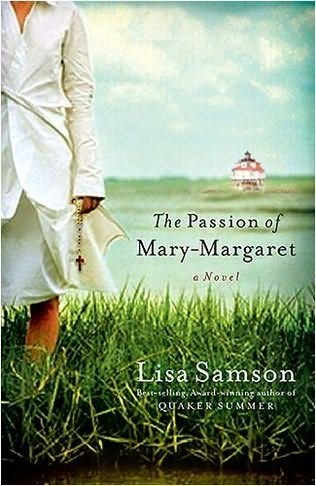
Book Review: The Passion of Mary-Margaret


Samson, Lisa. 2009. The Passion of Mary-Margaret. Thomas Nelson Publishers. 313 pages.

"My sisters, if I began this tale at the end, you would know my heart is full of love even though nothing went as planned. I could tell you God's ways are not ours, but you probably know that already. And I could tell you that his mercy takes shape in forms we cannot begin to imagine, but unless you walked in my shoes for the past seventy years, you could not feel the mercy I have been given."


I'll be honest, I was skeptical about this book right from the start. While it hooked me--intrigued me enough to keep reading--I wasn't sure I was liking what I was reading. It had this other-ness to it. This off-putting (to me) flavor where I wasn't quite sure what to think of it, what to make of it. It is a roughly told story that is all-a-scramble. Within a chapter, the narrator might have touched upon four different years with little or no transition. She might be seven, fifteen, forty-two, and seventy-three all in the same chapter. Which, as a reader, I just found confusing. But the story, while its framework may have left me desiring something more straightforward, was without a doubt compelling the majority of the time. The story of Mary-Margaret from birth to death was an interesting one, a compelling one. Raised by her grandmother, she knows that her mother was raped and died giving birth to her. She's known from childhood that she wants to be a religious--a sister. She grew up believing that Jesus was her husband. That she was his bride. Her faith in Jesus is one thing that's undeniable. How she goes about it, well, that's up to you to decide. (You see, Mary-Margaret sees Jesus, hears Jesus, talks to Jesus, has tea with Jesus.) But despite all that otherness about it, part of me liked The Passion of Mary-Margaret. Mary-Margaret was told by Jesus to marry Jude, a drug addict, a prostitute (sleeping with men and women, whoever will pay), a diseased man. A man she more-than-liked as a kid, but a man whom she doesn't trust or respect much since he's taken a different path as an adult. But Jesus tells her he has a plan. She needs to marry this man one way or another. And so she goes about wooing a man who's seen and done it all. What is God's plan in all this? Mary-Margaret finds out one day at a time. What I loved about this one--probably the thing that surprised me most--was how this woman stepped out in faith and chose to see a man as God sees him. Not as all the mistakes he has made, not all the ugliness of his sins, not all the brutality and rawness of his attitude and character. But as a man whom God had chosen to redeem. She saw him through Jesus' eyes. And through Jesus' eyes, he was beautiful. Not that God was done with him, not that God was content to let him stay addicted to drugs, walking the streets, selling his body and soul for a cheap or not-so-cheap fix. But Jesus saw what the man would be. And that is something. So for that alone, I recommend this book. This book looks at hard issues in life--drugs, sex, sexual abuse and molestation, shame, pain, suffering--and it does so as honestly as it can be done.

© Becky Laney of Operation Actually Read Bible

Wednesday, March 4, 2009

Book Review: Jesus, Keep me Near the Cross


Guthrie, Nancy, editor. 2009. Jesus, Keep Me Near The Cross: Experiencing the Passion and Power of Easter. Crossway. 152 pages.

I loved this book! Similar in concept to Nancy Guthrie's Come Thou Long Expected Jesus, the book is a series of short essays (sermons, writings, whatever you want to call them) reflecting on Christ's passion--particularly the cross and the resurrection. What I loved about this collection--and the previous collection--is that it includes a variety of authors both historic and contemporary: Martin Luther, John Piper, Alistair Begg, Charles Spurgeon, John MacArthur, John Owen, Martyn Lloyd-Jones, James Montgomery Boice, John Calvin, Jonathan Edwards, R.C. Sproul, J.I. Packer. In short, most of my favorites past and present. I love that the book is accessible. The chapters are short--three to six pages. I love that the book has substance. It isn't a fluffy book. It's a book with depth and meat to it. But it's not overwhelming either. It's just right for reading one or two chapters a day.

© Becky Laney of Operation Actually Read Bible

Tuesday, March 3, 2009

Question of the Week #9


Welcome to the ninth edition of "Question of the Week"...please answer in the comments OR write a blog post of your own and leave me a link to your answers! Feel free to borrow the graphic as well.

Where do you go for comfort? When you're feeling sad? anxious? depressed? out-of-sorts? Where do you turn when life has got you down? When you're feeling lost and "disturbled" to borrow a term from good-old-Wycliffe? Do you turn to God? Do you turn to your family? your friends? To food? To chocolate? To exercise? To a book? A song? A movie? Your favorite teddy? These days do come to all of us, and it has always been interesting to me to see how different people cope...coping is an important skill after all! If and only if you feel comfortable sharing, answer a few of these questions...I don't want to make anyone feel too exposed or vulnerable. But this is big, really big, and sharing ideas and thoughts could be helpful, you know...


My answer: I wish I could say I always turn to God in times like these. But I can't, so I won't. I think I am learning more week by week, month by month to lean on Him, to trust in Him. I'm not perfect by any means, but I am trying so hard to learn healthy coping habits--not self-destructive ones. A year ago, I might have said chocolate and cookies and mac 'n cheese. (Not that it's still not tempting...but...)

In the past, I've turned to food and drink (my favorite drug of choice, caffeine and sugar: Dr. Pepper; Coke), I've turned to my mom, of course, I feel she's one of the only people that have ever-always understood me. I've turned to music--pumping up my favorite song and/or favorite album. Losing myself in the melody. Drowning out my thoughts altogether. The second half of the White Album used to always worked for me...somewhere between "Everybody's Got Something to Hide" and " Cry, Baby, Cry" my angst gets dispersed. I've resorted to books too. Escaping in a good book, a comfortable book. (I think there was something cathartic about Gone With The Wind that relieved my stress during finals time.) Speaking of which, sometimes nothing feels better than having a good old ugly cry.

Now, I try to turn to different things. Depending on the time of day, and the mood swing. I turn to my mom still--there's no replacing that support! But I also turn to God. I turn to the Bible. I spend time reading. I spend time searching. I spend time praying. But what can help quicker than anything, I've learned, is listening to worship-filled music. For me, listening to a cd (or two) of hymns can do wonders. I can listen to them over and over. And even if I don't start out feeling it, if I'm not in a place to join in, it happens. Before I know it, I'm in a place where I'm praising. I've taken the focus off of me, off of my feelings of doubt and anxiety....and put the focus on God. Praising God lifts you out of "the depths of despair" (to borrow from good-old-Anne-Shirley).

I'll try to review some of my favorite albums this week. And I'll try to post snippets of my favorite hymns.

© Becky Laney of Operation Actually Read Bible

Sunday, March 1, 2009

Sunday Salon: Week in Review (February 22-February 28)

What I read this week:

Exodus 6-16, ESV Study Bible
Acts 20-28 Wycliffe Bible
James, 1 & 2 Peter, 1, 2, 3 John, Jude, Revelation Wycliffe Bible
Psalms 20-30 1599 Geneva Bible
Matthew 1-9 Tyndale New Testament

I FINISHED the Wycliffe New Testament!!! I'm thrilled to have it completed. And I'm happily beginning all over again in the Tyndale New Testament.

My goals for the next week:

Keep reading in Exodus.
Keep reading in Matthew.
Keep reading in Psalms.

I don't know which books if any I'll finish up next week. Though Matthew might be possible. I know Exodus can get a bit boggy further down the road. But maybe it can happen to. My goal with the Psalms is to read ten to twenty a week in small portions. There's no need to rush through them all just to say you did.

I need to pick two books to read this week....

© Becky Laney of Operation Actually Read Bible