Sunday, July 8, 2012

Book Review: When You Need a Miracle

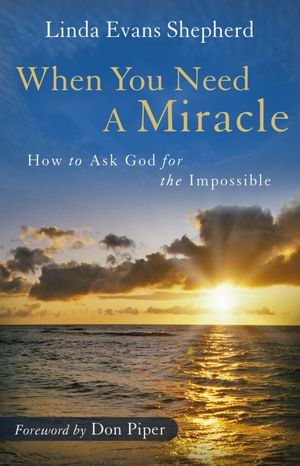
When You Need A Miracle: How To Ask God for The Impossible. Linda Evans Shepherd. 2012. Revell. 207 pages.

I'm guessing you picked up this book because you need a miracle. 

Linda Evans Shepherd is a new-to-me author. When offered the opportunity to review this one, I accepted knowing that it would be a risk. I could potentially find a new author to read, or, I could find her theology not to be a match with my own. As it turns out, Linda Evans Shepherd is not for me. Sometimes it is just a matter of style or preference. For example, I'm not a fan of Max Lucado. (Too many stories, not enough substance.) Sometimes it's a more of an issue with content and subject matter. I'm really, really not a fan of Elizabeth George. (The Elizabeth George in question being the Christian author of "women's books" not the mystery writer whose works I've never tried.) And sometimes it is more a matter of doctrine and theological differences. It's a little bit of all three in the case of Linda Evans Shepherd's When You Need A Miracle. I definitely had some theological concerns about it.

Table of contents:

  • Need a miracle?
  • The Trust Factor
  • The Love Factor
  • The Truth Factor
  • The Forgiveness Factor
  • What Hinders Our Prayers
  • Fighting the Enemy
  • More Strategies for Fighting the Enemy
  • The Praise Factor
  • The Sold Out Factor
  • The Next Step Principle
  • The Intercession Factor
  • The Miracles of It All 

This is a book about prayer. Yes, it's a book about miracles too. But it is a book about prayer, about learning to live with an awareness of God's presence, about learning to trust that God is who He says He is, about learning to accept that God wants to answer your prayers, that God wants to do miracles in your life, that God welcomes your dependence on Him. In the first chapter, she writes, "Miracles are not about praying the perfect prayer; miracles are about what happens when we welcome God's presence and power into our situations and our lives" (16).

For readers who enjoy books with printed prayers to pray for specific situations, for certain circumstances, etc., this one has plenty to offer. Each chapter has at least one prayer for you to pray. Just fill in the blanks and make it yours. Some chapters offer more than one prayer. For example, the chapter, "What Hinders Our Prayers" offers for each of the reasons:

  • wrong perspective of God
  • not knowing who we are in Christ
  • lack of faith and trust
  • disappointments
  • not asking in the name of Jesus
  • grumbling and complaining
  • grudges or unforgiveness
  • self-will and disobedience
  • timidity or fear
  • prayerlessness
  • unconfessed sin
  • not reading the Word
  • not standing against the schemes of the enemy
  • thanklessness
  • not fasting
  • not giving

The book is comprehensive when it comes to the topic of prayer, of answered prayer (miracles), of unanswered prayers, etc.

Why isn't this book a good match for me? Well, I found it had too many stories. A few stories--particularly her own personal stories about her own life, her own experiences--would be fine with me. But there were dozens and dozens of stories, some were stories of her friends, some were stories about people she met or heard about. Some of these stories were about near death experiences. Some were about men, women, children, who died went to heaven, came back to life and had some great spiritual truth to impart. I don't know about you, but these stories take me way out of my comfort zone. The truth is they could be perfectly true, but, it's also true that there is no way that they can be tested. These testimonies or stories are not as rock-solid as the Bible. I personally prefer to learn about God, about heaven, from the Bible. Of course, not all of these stories were about heaven, some were just miracles in the here and now. I suppose stories are what one should expect in a book about miracles. Real-life examples of men, women, teens, children who have prayed to God and received answers. For example, one woman who needs socks but can't afford to buy them, prays to God about her need for socks, and the next day a woman shows up at her door with three bags of socks. Or, a church that had faith that God would provide toys for a toy drive at Christmas, even though they didn't have the money to buy the toys, one woman donated more than enough at the last moment. Of course, some seem--to me--less impressive. Stories about students who "miraculously" managed to finish semesters of school with passing grades. (Don't get me wrong, I prayed when I was in school too, but, I do think it's a matter of applying yourself, of reading what is required, of studying, of taking notes, of attending class, etc.)

Another issue that I had with this one is about spiritual warfare, about Satan and demons and such. There were several chapters about this, and, they were definitely outside my comfort zone. These were prayers to pray specifically to free yourself, your family, your house, your church, etc. from demonic control and/or influence. These are prayers that the author encourages readers to pray daily. These are prayers about how to break curses, how to break family curses, generational curses, curses "placed" on you by your family, your friends, your coworkers, your enemies, etc. The author mentions in several chapters her belief in curses. That there are words we speak that give Satan and his forces power over us, control over us, authority over us. That words spoken in anger, bitterness, frustration, depression, pride, arrogance selfishness, jealousy, disappointment; words spoken casually, playfully; words spoken in complaint, the gossip we speak, the gossip we have spoken about us, etc. act as curses--that they give power and authority to Satan. She definitely writes about praying blessings and praying to lift curses. Here's an example:
Have you ever walked through your house or dwelling and asked God to bless each room with the power of the blood of Jesus? It's a nice thing to do, but let me caution you. The first time I ever blessed my home, my beautiful and healthy dog, a snow-white Samoyed, walked into the one room I had not prayed over and fell over dead. I don't know exactly why this happened, but nevertheless, I count it as a warning. If you decide to bless your home (and you should), please remember to pray over every room, bathroom, and hallway, including the garage, porch, closets, attic, breezeway, and basement. (129)
I got the idea that the author definitely places a lot of power in words, in spoken words, perhaps believing that our words create our reality? or that our words have power over our lives? I'm not sure. So I definitely have some hesitations about this one as a whole.


© Becky Laney of Operation Actually Read Bible

Saturday, July 7, 2012

Book Review: Charity and Its Fruits

Charity and Its Fruits: Living In the Light of God's Love. Jonathan Edwards. Edited by Kyle Strobel. 2012. Crossway. 350 pages.

I have been meaning to read Jonathan Edwards for close to a decade. But he isn't as reader-friendly as say Charles Spurgeon or A.W. Tozer or A.W. Pink or R.A. Torrey. Edwards was a scholar, a theologian. He was a deep thinker; his ideas and concepts are complex, very complex. This publication seeks to bring Edwards to a new audience. The text is Edwards, this is not an abridgment or adaptation. But some additional helps have been added. Strobel has added footnotes defining tricky words that Edwards was so fond of using. Words like concatenation, for example. There are also side-boxes where he highlights key concepts, usually in reader-friendly terms. Sometimes he brings in other quotes to help clarify. And, as you might expect, it adds an introduction and conclusion written specifically to help guide and influence modern readers. Both are very straight-forward. Both ask HARD questions of readers. The questions challenge you to truly reflect on the text and your relationship with God.

So what is this one about? Well, it's a collection of sermons on 1 Corinthians 13. It is an in-depth study of 1 Corinthians 13, Edwards doesn't quite go word by word by word, but, he certainly goes line by line by line. A few of the sermons are broader in scope and focus on several verses. The middle sermons, however, which happen to be my favorite, are narrower in focus. They focus on envy, jealousy, patience, anger, selfishness, etc.

The good news: while each sermon builds upon the others, they are meant to be read and studied as a whole, some sermons are less intimidating. Dare I say it? Some are even relatively easy to grasp and understand? True, some of the sermons are very dense, very complex, very intricate. I do think that a reader CAN benefit from the book as a whole, especially if one is willing to focus on the big picture and go for understanding the basic big picture, the key points. I think a second or third or fourth reading of individual sermons may prove beneficial for getting the finer, more intricate points. One could always keep reading, keep studying, keep digging to get all the richness from the text. But I don't think you'd have to make it your life's mission to comprehend Edwards in order to benefit from reading this one.

So what is the most important thing? Well, that's a trick question isn't it! Why read Edwards at all? Why seek to honor America's greatest theologian? Why read a text that is hundreds of years old? I think Strobel would agree with me that the SOLE reason to read Edwards would be to learn MORE of God, to come to a better understanding of who God is, and have a clearer perception of ourselves in relationship with God. That is, by studying God, who He is, what He has done, what He requires of us, etc., we can better KNOW OURSELVES. Some might think it odd that we would need to know God in order to know ourselves, or to know ourselves truly, but I think it's essential to have a right understanding of who we are, we need God, we need to see ourselves as God sees us.

The subject of this one is love: God's love to us, our love to God, and our love for others--both our brothers and sisters in Christ, and, unbelievers. If you really think about it, this is a book about how to live the Christian life...since the TWO commandments are to love the Lord your God with all your heart, with all your soul, and with all your mind, and Love your neighbor as yourself. (Matthew 22:37; Luke 10:27) Matthew 5:44 goes on to say that we should love our enemies and pray for them.

Section One: Love, The Most Essential Thing

  • Sermon 1: Love The Sum of All Virtue
  • Sermon 2: Love More Excellent than Extraordinary Gifts of the Spirit
  • Sermon 3: Nothing Can Make Up For Want of Sincerity in the Heart

Section Two: Love, The Fountain of All Good

  • Sermon 4: Long-Suffering and Kindness
  • Sermon 5: Charity Contrary to an Envious Spirit
  • Sermon 6: A Christian Spirit is a Humble Spirit
  • Sermon 7: Charity Contrary to a Selfish Spirit
  • Sermon 8: Charity Contrary to an Angry Spirit
  • Sermon 9: Charity Contrary to a Censorious Spirit
  • Sermon 10: Grace Tends to Holy Practice
  • Sermon 11: Undergoing Sufferings A Duty to Christ
  • Sermon 12: Christian Graces Concatenated Together

Section Three: Love, The Divine Gift That Perseveres

  • Sermon 13: Grace Never Overthrown
  • Sermon 14: Divine Love Alone Lasts Eternally
  • Sermon 15: Heaven Is a World of Love

I'd by lying if I said that I understood each point, each and every concept, term, and idea in each and every chapter. But, I do think I was able to grasp the big ones, and hold in mind a big picture of what Edwards was trying to accomplish.

I don't think you can walk away from a study of 1 Corinthians 13 with pride, with your head held high. I think this chapter is VERY humbling, very challenging. It can make you extremely uncomfortable, if you let the meaning of each phrase resonate within you. When you really, truly grasp how we are called to love, how we are called to live...well...it's humbling. What you are left with is your inadequacy, your need, your DESPERATE need for a merciful, gracious Savior. For there is only ONE who has lived and loved like this. That one is Christ Jesus. This chapter points you to the Savior, reminds you of how far you are from being perfect, from loving and living perfectly. Edwards' study of 1 Corinthians 13 is challenging and thought-provoking.

Favorite quotes:

For Edwards, it is the Spirit of love that unites the Father to the Son, Jesus's human nature to his divine nature, his church to himself, and his people to one another. Furthermore, the Spirit is not simply love, as if that were the only attribute of the Spirit, but also peace, beauty, holiness, and grace. As will become clear below, the Spirit is the fountain of virtue because love is the ultimate virtue and is, in fact, the reality of God's own life. (22)

Love is the tune that orients the believer's heart to heaven, whereas hate is the deformity that leads to hell. (24)

Modern evangelicals do well to note this point, because we often err on the side of seeing salvation simply in terms of forgiveness. By grounding salvation in union with God, we are seeking not forgiveness but God himself. Faith does not lead primarily to forgiveness, but to Christ. In him forgiveness and justification are known. Therefore, one's Christianity cannot boil down to a specific moment in conversion, however important that moment is, Christianity, or, as Edwards would say, "true religion," is communion with God. The Christian life is an ever-increasing love of God such that one's soul comes to take on the life of God itself as God's own Spirit of love works in the heart. With Christ at the center of salvation, the whole of one's life is lived before the face of God. To live this life, we are not forgiven and then left alone to work hard to act like Christians. Rather, if we are in Christ, forgiveness and holiness are now ours. Furthermore, by being united to Christ by the Spirit, we have the Spirit indwelling and acting as a fountain of holiness, love, and grace itself. (27)

Primarily, the solution to sin is God himself. The recognition of vice in our hearts can lead us to the cross and cast us, just as in salvation, upon the overflowing mercy and grace of God. Likewise, as noted above, Edwards wants his readers to grasp the idea that knowledge of God and knowledge of self are mutually informing; therefore, it is important to trace out the roots of our sins and expose them to the light of God's revelation. Misunderstanding who we are is almost as problematic as misunderstanding who God is; it is the root of all sorts of sin. (29)

We are aware that we are incredibly sinful. Unfortunately, our way of dealing with this is not to deal with it at all. We hide our sin as best we can, even from ourselves, and seek to project to the world and church a person who doesn't sin and who has everything figured out. Too many people get lost in the false self they create, and they come to be filled with pride as they judge others (309). 

Searching our hearts is a mode of prayer--it is something done not in isolation, but before God. (312)

Edwards' thoughts should warn us against two errors: first, thinking that we are insightful enough to judge other people's hearts; and, second, thinking that even our own hearts are easily discerned. (312)

We should never underestimate how easy it can be to repackage our vices as virtues. (312)

© Becky Laney of Operation Actually Read Bible

Friday, July 6, 2012

Consider Jesus

I was reading Hebrews earlier this week, and I was struck by Hebrews 3:1. (To read the full context, look at Hebrews 3:1-6).

Therefore, holy brothers, you who share in a heavenly calling, consider Jesus, the apostle and high priest of our confession,
(Hebrews 3:1 ESV)

The phrase "consider Jesus" resonated with me in a way it really hasn't in the past. What does it mean to consider Jesus? What does that look like in the Christian life? Surely it means more than just knowing facts about Jesus. Surely it has something to do with being in right-relationship with Christ--a saving union with Christ. It led me to asking some questions. (I'm using the pronoun you--simply because it's easier for me to write in--but I include myself in the questioning. I'm not interrogating my readers!!!) Do you consider Jesus in your day to day life? Do you consider Jesus when you're making decisions on how to spend your time and money? Do you consider Jesus when you're making your priorities? Do you consider Jesus as being present with you in your day-to-day-week-to-week existence? Do you think of Jesus as a person? Or do you think of Jesus merely in the abstract? How would your life change if you took time to consider Jesus? To live as if he was always with you. Would you welcome His presence? Or run from it?

I'd like to share a few things with you. First, I'd like to share with you what the word consider means. The Greek word is: katanoeō. It means "to observe fully, behold, consider, discover, perceive." Of course, we can't observe Jesus Christ fully on earth--we can only read of Him in the gospels. We will not behold him as he really is--in his full majesty and splendor--until Heaven. But we can keep on discovering and beholding him here and now. We can seek a relationship, we can seek to know him now, we can come to love him more and more. The more we behold him, the more satisfied we become in Him. The more we value Him over the world.

Second, I'd like to share this J.C. Ryle quote with you. Yes, I know it's a couple of paragraphs. But, trust me. It is WORTH attention.
 Keep before your mind, as an ever-present truth, that the Lord Jesus is an actual living Person, and deal with Him as such. I am afraid that many who profess Christ in our day have lost sight of our Lord's person. They talk more about salvation — than about their only Savior, and more about redemption — than the one true Redeemer, and more about Christ's work — than Christ Himself. This is a great fault — one that accounts for the dry and shriveled spirit that infuses the religious lives of many who profess faith.As ever you would grow in grace, and have joy and peace in believing — beware of falling into this error. Cease to regard the Gospel as a mere collection of dry doctrines. Look at it rather as the revelation of a mighty living Being in whose sight you are daily to live. Cease to regard it as a mere set of abstract propositions and abstruse principles and rules. Look at it as the introduction to a glorious personal Friend. This is the kind of Gospel that the apostles preached. They did not go about the world telling men of love and mercy and pardon in the abstract. The leading subject of all their sermons, was the loving heart of an actual living Christ. This is the kind of Gospel which is most calculated to promote sanctification and fitness for glory. Nothing, surely, is so likely to prepare us for that Heaven where Christ's personal presence will be all, and that glory where we shall meet Christ face to face, as to realize communion with Christ, as an actual living Person here on earth. There is all the difference in the world, between an idea and a person.
Did you catch that? Many who profess Christ in our day have lost sight of our Lord's person. They talk more about salvation--than about their only Savior, and more about redemption--than the one true Redeemer, and more about Christ's work--than Christ himself. That's a sobering thought, isn't it? Do you find yourself numbered in that many? I have been pondering these paragraphs for days now--and I'm still haunted by these words. Do I live and act as if the Lord Jesus is an actual living Person? And do I treat him that way?  Do I consider Jesus enough? Do any of us?

© Becky Laney of Operation Actually Read Bible

Wednesday, July 4, 2012

Journaling Holiness, part 2

Holiness: Its Nature, Hindrances, Difficulties, and Roots. J.C. Ryle. (1816-1900) 


Last month I started reading J.C. Ryle's Holiness. I wrote a post sharing quotes from the introduction and the first three chapters. I've since read nine more chapters!!! I'm a little over halfway through this theological classic. The chapters I've read include: "The Fight!", "The Cost!", "Growth in Grace", "Assurance", "Moses--An Example", "Lot--A Beacon", "A Woman to Be Remembered", "Christ's Greatest Trophy", and "The Ruler of the Waves." 


From "The Fight!"

The true Christian is called to be a soldier, and must behave as such from the day of his conversion to the day of his death. He is not meant to live a life of pious ease, indolence and security. He must never imagine for a moment, that he can sleep and doze along the way to Heaven, like one traveling in an easy carriage. If he takes his standard of Christianity from the people of this world, he may be content with such vain notions — but he will find no countenance for them in the Word of God. If the Bible is the rule of his faith and practice, he will find his course laid down very plainly in this matter. He must "fight."
With whom is the Christian soldier meant to fight? Not with other Christians. Wretched indeed is that man's idea of religion, who imagines that it consists in perpetual controversy! He who is never satisfied unless he is engaged in some strife between church and church, chapel and chapel, sect and sect, faction and faction, party and party — knows nothing yet as he ought to know. As a general rule, the cause of sin is never so much helped as when Christians waste their strength in quarreling with one another, and spend their time in petty squabbles.


No, indeed! The principal fight of the Christian is with the world, the flesh and the devil. These are his never-dying foes! These are the three chief enemies against whom he must wage war. Unless he gets the victory over these three, all other victories are useless and vain. 

A general faith in the truth of God's written Word, is the primary foundation of the Christian soldier's character. He is what he is, does what he does, thinks as he thinks, acts as he acts, hopes as he hopes, behaves as he behaves — for one simple reason — he believes certain propositions revealed and laid down in Holy Scripture. "He who comes to God must believe that He is, and that He is a Rewarder of those who diligently seek Him" (Hebrews 11:6).
No man will ever be anything or do anything in religion — unless he sincerely believes something.
From "The Cost!"
No doubt Christ's way to eternal life is a way of pleasantness. But it is folly to shut our eyes to the fact that His way is narrow — and the cross comes before the crown.
I grant freely that it costs little to be a mere outward Christian. A man has only got to attend a place of worship twice on Sunday, and to be tolerably moral during the week, and he has gone as far as thousands around him ever go in religion. All this is cheap and easy work — it entails no self-denial or self-sacrifice. If this is saving Christianity and will take us to Heaven when we die — we must alter the description of the way of life, and write, "Wide is the gate and broad is the way that leads to Heaven!"
But it does cost something to be a real Christian, according to the standard of the Bible. There are enemies to be overcome, battles to be fought, sacrifices to be made, an Egypt to be forsaken, a wilderness to be passed through, a cross to be carried, a race to be run. Conversion is not putting a man in a soft armchair, and taking him pleasantly to Heaven. It is the beginning of a mighty conflict, in which it costs much to win the victory. Hence arises the unspeakable importance of "counting the cost."
True Christianity will cost one his SELF-RIGHTEOUSNESS. True Christianity will cost a man his SINS. Also, Christianity will cost a man his love of EASE. Lastly, true Christianity will cost a man the favor of the WORLD. 
A religion which costs nothing — is worth nothing! A cheap, easy Christianity, without a cross — will prove in the end a useless Christianity, without a crown!
Our sins are often as dear to us as our children! We love them, hug them, cleave to them and delight in them! To part with them, is as hard as cutting off a right hand or plucking out a right eye! But it must be done. The parting must come. "Though wickedness is sweet in the sinner's mouth, though he hides it under his tongue; though he spares it, and forsakes it not," yet it must be given up, if he wishes to be saved (Job 20:12, 13). He and sin must quarrel — if he and God are to be friends. Christ is willing to receive any sinners. But He will not receive them if they will stick to their sins.
A single day in Hell — will be worse than a whole life spent in carrying the cross.
From "Growth in Grace"

When I speak of growth in grace, I only mean increase in the degree, size, strength, vigor and power — of the graces which the Holy Spirit plants in a believer's heart. I hold that every one of those graces admits of growth, progress and increase. I hold that repentance, faith, hope, love, humility, zeal, courage and the like — may be little or great, strong or weak, vigorous or feeble — and may vary greatly in the same man at different periods of his life. When I speak of a man growing in grace, I mean simply that his sense of sin is becoming deeper, his faith is becoming stronger, his hope is becoming brighter, his love is becoming more extensive, his spiritual-mindedness is becoming more marked, he feels more of the power of godliness in his own heart — and he manifests more of it in his life. He is going on from strength to strength, from faith to faith and from grace to grace. I leave it to others to describe such a man's condition by any words they please. For myself I think the truest and best account of him is this — he is growing in grace.
Let us follow on, aiming at nothing short of perfection. Let us follow on, making Christ's life and character — our only pattern and example. Let us follow on, remembering daily that at our best — we are but miserable sinners. Let us follow on, and never forget that it signifies nothing whether we are better than others or not. At our very best — we are far worse than we ought to be. There will always be room for improvement in us. We shall be debtors to Christ's mercy and grace, to the very last. Then let us leave off looking at others, and comparing ourselves with others. We shall find enough to do, if we look at our own hearts.
From "Assurance"
A good conscience will save no man, wash away no sin, not lift us one hair's breadth towards Heaven. 
It cannot be wrong to feel confidently in a matter where God speaks unconditionally; to believe decidedly when God promises decidedly; to have a sure persuasion of pardon and peace when we rest on the word and oath of Him who never changes. It is an utter mistake to suppose that the believer who feels assurance, is resting on anything he sees in himself. He simply leans on the Mediator of the New Covenant and the Scripture of truth. He believes the Lord Jesus means what He says and takes Him at His word.
All God's children have faith — but not all have assurance. I think this ought never to be forgotten.
I do not shrink from saying that by grace, a man may have sufficient faith to flee to Christ — sufficient faith really to lay hold on Him, really to trust in Him, really to be a child of God, really to be saved — and yet to his last day, be never free from much anxiety, doubt and fear.
Faith in the Lord Jesus Christ — a man must have, beyond all question, if he is to be saved. I know no other way of access to the Father. I see no intimation of mercy, excepting through Christ. A man must feel his sins and lost estate, must come to Jesus for pardon and salvation, must rest his hope on Him, and on Him alone. But if he only has faith to do this, however weak and feeble that faith may be, I will engage, from Scripture warrants, he shall not miss Heaven. Never, never let us curtail the freeness of the glorious gospel, or clip its fair proportions. Never let us make the gate more straight and the way more narrow, than pride and the love of sin have made it already. The Lord Jesus is very pitiful and of tender mercy. He does not regard the quantity of faith — but the quality. He does not measure its degree — but its reality. He will not break any bruised reed, nor quench any smoking flax. He will never let it be said that any perished at the foot of the cross. "Him that comes to Me," He says, "I will never cast out" (John 6:37).
Many appear to forget that we are saved and justified as sinners, and only sinners, and that we never can attain to anything higher, if we live to the age of Methuselah. Redeemed sinners, justified sinners and renewed sinners doubtless we must be — but sinners, sinners, sinners, we shall be always to the very last! They do not seem to comprehend that there is a wide difference between our justification and our sanctification. Our justification is a perfect finished work — and admits of no degrees. Our sanctification is imperfect and incomplete — and will be so to the last hour of our life. They appear to expect that a believer may at some period of his life be in a measure free from corruption, and attain to a kind of inward perfection. And not finding this angelic state of things in their own hearts — they at once conclude there must be something very wrong in their state. And so they go mourning all their days, oppressed with fears that they have no part or lot in Christ, and refusing to be comforted.
I bless God that our salvation in no way depends on our own works. By grace we are saved — not by works of righteousness — through faith, without the deeds of the law. But I never would have any believer for a moment forget, that our sense of salvation depends much on the manner of our living. Inconsistency will dim our eyes and bring clouds between us and the sun. The sun is the same behind the clouds — but you will not be able to see its brightness or enjoy its warmth; and your soul will be gloomy and cold. It is in the path of well-doing, that the dayspring of assurance will visit you and shine down upon your heart.
From "Moses, An Example"
There is a common worldly kind of Christianity in this day, which many have — a cheap Christianity which offends nobody, which requires no sacrifice, which costs nothing — and is worth nothing! 
Religion of substance which stands, has as its foundation the firmness of faith. There must be a real heartfelt belief that God's promises are sure and to be depended on — a real belief that what God says in the Bible is all true, and that every doctrine contrary to this is false, whatever anyone may say. There must be a real belief that all God's words are to be received, however hard and disagreeable to flesh and blood, and that His way is right — and all others wrong. This there must be, or you will never come out from the world, take up the cross, follow Christ and be saved.
In walking with God, a man will go just as far as he believes, and no further. His life will always be proportioned to his faith. His peace, his patience, his courage, his zeal, his works — all will be according to his faith.
From "A Woman to Be Remembered"
I feel constrained to speak freely to my readers on the subject of Hell. Allow me to use the opportunity which the end of Lot's wife affords. I believe that the time has come, when it is a positive duty to speak plainly about the reality and eternity of Hell. A flood of false doctrine has lately broken in upon us. Men are beginning to tell us that God is too loving and merciful to punish souls forever; and that all mankind, however wicked and ungodly some of them may be — will sooner or later be saved. We are invited to leave the old paths of apostolic Christianity. We are told that the views of our fathers about Hell, and the devil, and punishment — are obsolete and old-fashioned. We are to embrace what is called a "kinder theology" — and treat Hell as a pagan fable or a bugbear to frighten children and fools. Against such false teaching I desire, for one, to protest. Painful, sorrowful, distressing as the controversy may be, we must not blink it or refuse to look the subject in the face. I, for one, am resolved to maintain the old position, and to assert the reality and eternity of Hell.

a. Settle it firmly in your mind, that the same Bible which teaches that God in mercy and compassion sent Christ to die for sinners, does also teach that God hates sin and must, from His very nature, punish all who cleave to sin, or refuse the salvation He has provided. The very same chapter which declares, "God so loved the world," declares also, that "the wrath of God abides" on the unbeliever (John 3:16, 36). The very same gospel which is launched into the earth with the blessed tidings, "He that believes and is baptized shall be saved," proclaims in the same breath, "He who believes not shall be damned" (Mark 16:16).

b. Settle it firmly in your mind, that God has given us proof upon proof in the Bible that He will punish the hardened and unbelieving, and that He will take vengeance on His enemies — as well as show mercy on the penitent.

The drowning of the old world by the flood, the burning of Sodom and Gomorrah, the overthrow of Pharaoh and all his host in the Red Sea, the judgment on Korah, Dathan and Abiram, the utter destruction of the seven nations of Canaan — all teach the same solemn truth. They are all given to us as beacons and signs and warnings — that we may not provoke God. They are all meant to lift up the corner of the curtain which hangs over things to come, and to remind us that there is such a thing as the wrath of God. They all tell us plainly that "the wicked shall be turned into Hell" (Psalm 9:17).

c. Settle it firmly in your mind, that the Lord Jesus Christ Himself has spoken most plainly about the reality and eternity of Hell. The parable of the rich man and Lazarus contains things which should make men tremble. But it does not stand alone. No lips have used so many words to express the awfulness of Hell, as the lips of Him who spoke as never man spoke, and who said, "The word which you hear is not Mine — but the Father's who sent Me" (John 14:24). Hell, Hell fire, the damnation of Hell, eternal damnation, the resurrection of damnation, everlasting fire, the place of torment, destruction, outer darkness, the worm that never dies, the fire that is not quenched, the place of weeping, wailing and gnashing of teeth, everlasting punishment — these, these are the words which the Lord Jesus Christ Himself employs. Away with the miserable nonsense which people talk in this day, who tell us that the ministers of the gospel should never speak of Hell! They only show their own ignorance, or their own dishonesty, when they talk in such a manner. No man can honestly read the four Gospels, and fail to see that he who would follow the example of Christ must speak of Hell.

d. Settle it, lastly, in your mind that the comforting ideas which the Scripture gives us of Heaven are at an end — if we once deny the reality or eternity of Hell. Is there no future separate abode for those who die wicked and ungodly? Are all men after death to be mingled together in one confused multitude? Why, then, Heaven will be no Heaven at all! It is utterly impossible for two to dwell happily together, except they be agreed. Is there to be a time when the term of Hell and punishment will be over? Are the wicked after ages of misery, to be admitted into Heaven? Why, then, the need of the sanctification of the Spirit is cast aside and despised! I read that men can be sanctified and made fit for Heaven on earth; I read nothing of any sanctification in Hell. Away with such baseless and unScriptural theories! The eternity of Hell is as clearly affirmed in the Bible — as the eternity of Heaven. Once allow that Hell is not eternal, and you may as well say that God and Heaven are not eternal. The same Greek word which is used in the expression "everlasting punishment" is the word that is used by the Lord Jesus in the expression "life eternal," and by Paul, in the expression "everlasting God" (Matthew 25:46; Romans 16:26).

I know that all this sounds dreadful in many ears. I do not wonder. But the only question we have to settle is this: "Is Hell Scriptural?" Is it true? I maintain firmly that it is so; and I maintain that professing Christians ought to be often reminded that they may be lost and go to Hell.
I have often heard of "narrow-minded views," and "old-fashioned notions," and "fire-and-brimstone theology," and the like. I have often been told that "broad" views are needed in the present day. I wish to be as broad as the Bible — neither less nor more. I say that he is the narrow-minded theologian who pares down such parts of the Bible as the natural heart dislikes, and rejects any portion of the counsel of God.
But God forbid that I should ever keep back from mortal man that Scripture reveals a Hell as well as Heaven, and that the gospel teaches that men may be lost as well as saved.
If you would ever be a healthy Scriptural Christian, I entreat you to give Hell a place in your theology. Establish it in your mind as a fixed principle, that God is a God of justice — as well as of mercy; and that the same everlasting counsels which laid the foundation of the bliss of Heaven — have also laid the foundation of the misery of Hell. Keep in full view of your mind, that all who die unpardoned and unrenewed are utterly unfit for the presence of God and must be lost forever. They are not capable of enjoying Heaven; they could not be happy there. They must go to their own place — and that place is Hell. Oh, it is a great thing in these days of unbelief, to believe the whole Bible!
From "Christ's Greatest Trophy"
Are you a true believer? If you are, you ought to glory in Christ. Do not glory in your own faith, your own feelings, your own knowledge, your own prayers, your own amendment, your own diligence. Glory in nothing but Christ. Alas! the best of us know but little of that merciful and mighty Savior. We do not exalt Him and glory in Him enough. Let us pray that we may see more of the fullness that there is in Him.
Do you ever try to do good to others? If you do, remember to tell them about Christ. Tell the young, tell the poor, tell the aged, tell the ignorant, tell the sick, tell the dying — tell them all about Christ. Tell them of His power — and tell them of His love; tell them of His doings — and tell them of His feelings; tell them what He has done for the chief of sinners; tell them what He is willing to do to the last day of time; tell it them over and over again. Never be tired of speaking of Christ. Say to them broadly and fully, freely and unconditionally, unreservedly and undoubtingly: 'Come unto Christ, as the penitent thief did; come unto Christ, and you shall be saved.'
From "The Ruler of the Waves"
I see a marvelous proof of love and wisdom — in the union of two natures in Christ's person. It was marvelous love in our Savior to condescend to go through weakness and humiliation for our sakes, ungodly rebels as we are. It was marvelous wisdom to fit Himself in this way to be the very Friend of friends, who could not only save man — but meet him on his own ground. I want one able to perform all things needful to redeem my soul. This Jesus can do, for He is the eternal Son of God. I want one able to understand my weakness and infirmities, and to deal gently with my soul, while tied to a body of death. This again Jesus can do, for He was the Son of man, and had flesh and blood like my own.
Had my Savior been God only — I might perhaps have trusted Him — but I never could have come near to Him without fear. Had my Savior been Man only — I might have loved Him — but I never could have felt sure that He was able to take away my sins. But, blessed be God, my Savior is God as well as Man — and Man as well as God. God, and so able to deliver me — Man, and so able to feel with me. Almighty power and deepest sympathy are met together in one glorious Person, Jesus Christ, my Lord. Surely a believer in Christ has a strong consolation. He may well trust, and not be afraid.
The plain truth is that there is no literal and absolute perfection among true Christians, so long as they are in the body. The best and brightest of God's saints — is but a poor mixed being. Converted, renewed and sanctified though he is — he is still compassed with infirmity. There is not a just man upon earth, that always does good, and sins not. In many things, we all fall short. A man may have true saving faith — and yet not have it always close at hand and ready to be used (Ecclesiastes 7:20; James 3:2).
Above all, I want all Christians to understand what they must expect in other believers. You must not hastily conclude that a man has no grace, merely because you see some corruption in him. There are spots on the face of the sun — and yet the sun shines brightly and enlightens the whole world. There is dross mixed up with many a lump of gold that comes from Australia — and yet who thinks the gold on that account worth nothing at all? There are flaws in some of the finest diamonds in the world — and yet they do not prevent their being rated at a priceless value.
Let us be quick to see grace — and more slow to see imperfections! Let us know that, if we cannot allow that there is grace where there is corruption — we shall find no grace in the world. 
 Keep before your mind, as an ever-present truth, that the Lord Jesus is an actual living Person, and deal with Him as such. I am afraid that many who profess Christ in our day have lost sight of our Lord's person. They talk more about salvation — than about their only Savior, and more about redemption — than the one true Redeemer, and more about Christ's work — than Christ Himself. This is a great fault — one that accounts for the dry and shriveled spirit that infuses the religious lives of many who profess faith.
As ever you would grow in grace, and have joy and peace in believing — beware of falling into this error. Cease to regard the Gospel as a mere collection of dry doctrines. Look at it rather as the revelation of a mighty living Being in whose sight you are daily to live. Cease to regard it as a mere set of abstract propositions and abstruse principles and rules. Look at it as the introduction to a glorious personal Friend. This is the kind of Gospel that the apostles preached. They did not go about the world telling men of love and mercy and pardon in the abstract. The leading subject of all their sermons, was the loving heart of an actual living Christ. This is the kind of Gospel which is most calculated to promote sanctification and fitness for glory. Nothing, surely, is so likely to prepare us for that Heaven where Christ's personal presence will be all, and that glory where we shall meet Christ face to face, as to realize communion with Christ, as an actual living Person here on earth. There is all the difference in the world, between an idea and a person.


© Becky Laney of Operation Actually Read Bible


Tuesday, July 3, 2012

Multiple Choice

Situation: You're reading your Bible and you come across verse(s) you don't "like." Perhaps they make you squirm, perhaps they make you feel uncomfortable, perhaps they make you feel--dare I say it?--ashamed or guilty. What do you do? Do you...

a) Close your Bible, put it back on the shelf, and decide that that is enough. The Bible isn't for you after all.
b) Start making a mental list of people whom this verse to applies and conveniently forget to add yourself to the list
c) Place limitations on the text. Sure, that "might" have been true a thousand years ago, two thousand years ago, three thousand years ago, four thousand years ago. But times have changed, right? Surely, this verse has reached its expiration date!
d) Hope that God grades on a curve, look around, and decide that relatively speaking you're doing a good job of it after all
e) Become argumentative--with God, with others--become stubborn that your way is the right way and that if you don't like what the Bible says, it's time to change what the Bible means. Instead of just ignoring it, you relish the opportunity to engage it with hostility sure that you'll come out the victor.
f) Make fun of people who take the Bible seriously--as if it were all supposed to be true and relevant
g) Decide that you'll think about it next week, next month, next year. What's the rush, after all? Push down those uncomfortable feelings and go do something FUN, something that will distract you.
h) praise God for grace
i) realize your sinfulness, cry out to God, open yourself up and allow God to act on your heart, mind, and soul.

© Becky Laney of Operation Actually Read Bible

Monday, July 2, 2012

July 2012 Goals

I was very pleased to meet my June goal of reading the book of Revelation thirty times in June!!! It was much harder than reading 1 John 30 days in a row! But I think it was very rewarding. And I am so glad I stuck with it--there were a few days I just didn't feel like reading it again. But I think Revelation is a GREAT big picture book. While, I wouldn't say you're guaranteed to notice something new each and every time, you'd be surprised by how much "new" you do notice. How little details come to life, perhaps, as you realize how it all fits. I love it because it is a great book showcasing God's glory and majesty. It is a book full of PROMISE and HOPE. It is a very black-and-white book, meaning, that you see there are only two divisions: the saints (overcomers, conquerers, the elect, children of God, the bride of Christ) and the unbelievers--those who persist in their sins, who choose the world and the world's pleasure over knowing and loving God, those who no matter what refuse to believe in God. We get glimpses of heaven and hell. This is a life-and-death book that demands attention and respect.

So do I have a goal for July?! Yes. My Bible-reading goal is to read 10 to 15 chapters a day--which should be about 70 chapters a week. I hope to read a balance of Old Testament and New Testament. I would love to finish the New Testament this month since I didn't finish it in June. I'm not sure which translation I'll be focusing on this month, I may have one or two that I "focus" on more than others, but I wouldn't be surprised to see a little variety.

I am also going to do something VERY SCARY. I am going to commit to reading 50 PAGES of theology a day. That is a round-figure. If I'm at the end of a chapter and lack three or four pages of reaching 50, I'm not necessarily going to start the next chapter--of course, that would depend on how long the chapters in a book were. Likewise, if I've reached my 50 page goal but my chapter only lacks five or six pages--I'm going to keep reading.

The first book I'll be reading is a newly published edition of CHARITY AND ITS FRUITS: Living in the Light of God's Love by Jonathan Edwards. It is edited by Kyle Strobel and published by Crossway. It is around 350 pages--and I'm 92 pages into it! If all goes well, I hope to finish it this week! If all doesn't go well, I really, really need to have it finished by next week!

I'm not sure the next book qualifies as theology--but, it is certainly still nonfiction, but, I NEED to read Roger Thurow's The Last Hunger Season. The due date for this one is July 20, 2012! Another nonfiction book with a due date is Linda Evans Shepherd's When You Need a Miracle: How To Ask God for the Impossible.

As for reading from my own towering stack of theology--I'd LOVE, LOVE, LOVE to read some Martyn Lloyd Jones, A.W. Pink, A.W. Tozer, Charles Spurgeon, J.C. Ryle. And maybe, maybe some John Piper and John MacArthur!!!

© Becky Laney of Operation Actually Read Bible

Sunday, July 1, 2012

MacArthur System: Revelation, June 24-30


This week I've read Revelation three times, which was enough to bring my monthly total to 32!!! I decided that 32 times through Revelation was enough for a month and that my time could be spent to reading other books of the Bible.

HCSB

  • Ruth
  • 2 Samuel 1-15
  • Proverbs 

ASV, 1901

  • Revelation

NASB

  • Colossians
  • Revelation

ESV

  • Revelation

© Becky Laney of Operation Actually Read Bible