Tuesday, September 30, 2008

Book Review: The Lord is My Shepherd


The Lord is My Shepherd: The Twenty-Third Psalm. Illustrated by Gennady Spirin.

The text should be familiar to most Christians. Perhaps even outside the Christian realm is this one known. The 23rd Psalm has such a poetical flow about it that is very evocative. This is probably *horrible* to admit, but when I read these words, it brings to mind the scene in Gone With The Wind (where Scarlett is nursing the soldiers in the army hospital) right before the seige of Atlanta begins. I believe the shot is of a stained glass window. You can hear the sounds of cannons in the background. Anyway, my confession time is over!

The text is the King James Version of the Bible.

So let's say you know the text, what would make you want this book in your collection? The artwork perhaps. Each two page spread has an incredibly detailed and most often exquisite artistic rendering. These spreads will appeal to some more than others. (There is something very old-fashioned and traditional about the art. Not that it isn't beautiful. But I fail to find it breath-takingly beautiful. The art didn't wow me.) Or perhaps this might make an ideal way to aid memorization of the 23rd Psalm. (That I could understand completely. I attended a Christian school that was big on memorization.)

Rereading my review, it might seem I'm a harsh critic. That isn't at all the case. It's not that I disliked this one at all. I think the Scripture speaks for itself. And in many ways the art does as well. You'll either be drawn to it, or you won't. Nothing that I say--one way or the other--will persuade you.

The LORD Is My Shepherd
A Psalm of David.

1 The LORD is my shepherd; I shall not want.
2 He maketh me to lie down in green pastures:

he leadeth me beside the still waters. Rev. 7.17
3 He restoreth my soul:

he leadeth me in the paths of righteousness for his name's sake.
4 Yea, though I walk through the valley of the shadow of death,

I will fear no evil: for thou art with me;
thy rod and thy staff they comfort me.
5 Thou preparest a table before me in the presence of mine enemies:

thou anointest my head with oil;
my cup runneth over.
6 Surely goodness and mercy shall follow me all the days of my life:

and I will dwell in the house of the LORD for ever.


© Becky Laney of Young Readers

So here I am

It is my goal in October to post each and every day here on Operation Actually Read Bible. I'd love to make this a daily habit. And I'd love to build a readership. But who knows if and when that will happen. 

New since last time...

I've started Mark. Still in the Wycliffe Bible. I've read the first six or seven chapters of this gospel.
I've finished 1 and 2 Timothy for Sunday School. We'll be beginning Titus this upcoming Sunday.
I discovered that R.C. Sproul's Renewing Your Mind show is available for free as podcasts. You can subscribe in iTunes. 
I just discovered that today, but I've already listened to three podcasts: The Touch of Worship, The Taste of Worship, and The Sound of Worship, pt. 1. I'm currently listening to The Sounds of Worship pt. 2. This series, I believe, is based on one of Sproul's books that I read last year. 
I've been listening to Carman's Hymns CD. 


Monday, September 15, 2008

I have been reading...

The lack of updates doesn't mean a complete lack of reading...just a complete lack of blogging about reading. I've read Ephesians, Philippians, Colossians, 1 Thessalonians, 2 Thessalonians. And I finished Matthew. Technically, I don't remember even when I started Matthew. But that happens sometimes.

Sometime last winter/spring, I bought the Wycliffe Bible (well the NT really), and I started reading it in Matthew. After putting it down at some point last spring, I picked it up about four days ago and started reading right where I'd left off. So there you go.

I suppose I'm technically still in Proverbs? (haven't picked that one up in months) and John? (again haven't picked it up in months). 1 Timothy is what we're studying in Sunday School.

Tuesday, September 2, 2008

Tuesday, August 12, 2008

Book Review: On The Edge of the Dark Sea of Darkness


On the Edge of the Dark Sea of Darkness by Andrew Peterson is the first book in the Wingfeather Saga*. Andrew Peterson isn't new to writing; he's a creative genius in my opinion, a singer-songwriter.** But this is his first novel. And it releases MARCH 18TH, 2008. The publisher is Water Brook (a division of Random House).

The novel boasts of having "adventure, peril, lost jewels, and fearsome toothy cows." A boast which proves true of course.

There are three "brief" introductions to the novel. (Three mini-prologues.) As is the case in some prologues, they are written in a different manner than the novel itself. I think that's a good thing in this situation because Peterson's prologues are a bit over-the-top***.

First sentence of "A Brief Introduction to the World of Aerwiar": The old stories tell that when the first person woke up on the first morning in the world where this tale takes place, he yawned, stretched, and said to the first thing he saw, "Well, here we are." The man's name was Dwayne and the first thing he saw was a rock. Next to the rock, though, was a woman named Gladys, whom he would learn to get along with very well. In the many ages that followed, that first sentence was taught to children and their children's children and their children's parents' cousins and so on until, quite by accident, all speaking creatures referred to the world around them as Aerwiar.

First sentence of "A Slightly Less Brief Introduction to the Land of Skree": The whole land of Skree was green and flat. Except for the Stony Mountains in the north, which weren't flat at all. Nor were they green. They were rather white from all the snow, though if the snow-melted, something green might eventually grow there. Ah, but farther south, the Plains of Palen Jabh-J covered the rest of Skree with their rolling (and decidedly green) grasslands. Except, of course, for Glipwood Forest. Just south of the plains, the Linnard Woodlands rolled off the edges of all maps, except, one would suppose, those maps made by whatever people lived in those far lands.
First sentence of "An Introduction to the Igiby Cottage Very Brief": Just outside the town of Glipwood, perched near the edge of the cliffs above the Dark Sea, sat a little cottage where lived the Igiby family. The cottage was rather plain, except for how comfortable it was, and how nicely it had been built, and how neatly it was kept in spite of the three children who lived there, and except for the love that glowed from it like firelight from its windows at night. As for the Igiby family? Well, except for the way they always sat late into the night beside the hearth telling stories, and when they sang in the garden while they gathered the harvest, and when the grandfather, Podo Helmer, sat on the porch blowing smoke rings, and except for all the good, warm things that filled their days there like cider in a mug on a winter night, they were quite miserable. Quite miserable indeed in that land where walked the Fangs of Dang.

First sentence of Chapter One: Janner Igiby lay trembling in his bed with his eyes shut tight, listening to the dreadful sound of the Black Carriage rattling along in the moonlight.

The Igiby family are the stars in Andrew Peterson's On the Edge of the Dark Sea of Darkness. There is a grandfather, Podo, a mother, Nia, the oldest son, Janner, the sister, Leeli, the younger brother, Tink, and the dog, Nugget. They live in occupied territory. The Fangs are dangerous that's for sure. And within a few chapters, the Igibys accidentally make themselves the target of the Fangs hatred and abuse. This leads to the promised "adventure, peril, lost jewels, and fearsome toothy cows." The book is full of adventure and mystery. And it is quite enjoyable. It is one of those fantasy novels that creates a new world, new lands, new peoples, new creatures, etc. And like a few fantasy novels these days it does make use of footnotes. Fun little asides meant to entertain. I won't lie and say the footnotes were as enjoyable as those found in the Bartimaeus trilogy, however, I will say that their use is a positive and not a negative attribute of the novel. There are also appendices at the end.

What can I say about the novel? I tended to enjoy it. It could be in part to the fact that I think Andrew Peterson is so wonderful. But it could be something more. I think for kids that can't get enough fantasy it will be thoroughly enjoyable. For those that get impatient with fantasy--the strange names of people and places and maps--then it might not be "thoroughly" enjoyable. (It might just be enjoyable.) For those that are skeptical that a musician can write, let me assure you that it is better than the prologue. That's not to say I dislike the prologue. But the third prologue in particular would be very very very very annoying if that was the style of the book and the best the author had to offer. It was cute for one page, but for 279 pages it would have been overkill. Also, I think kids that love funny books will enjoy this one. I'm not sure the book is 'as funny' for adults as it would be (or might be) for kids. It's REALLY hard to be an adult and judge if the humor is going to work for kids. For one thing, each kid is different. And what is 'funny' to one might not be 'funny' to another. But I think it has potential there.

So I recommend this one.
-------
*I don't know if the publication of the series depends on the success of the first book or not.
**He writes all types of songs. Sometimes they are deep and meaningful. Sometimes they just ring with truth and authenticity. Sometimes they make you cry (songs about grandpa's dying, etc.). Sometimes they make you laugh. Two examples: Andrew Peterson is one of the geniuses responsible for "The Monkey Song" featured on the Veggie Tales video The Wizard of Ha's. He also wrote one of the funniest songs of all time: Alien Conspiracy or The Cheese Song. (Unfortunately the lyrics aren't available online or it would have been a Poetry Friday post long long ago. I'm too lazy to try to transcribe it myself.)
***I'll try to explain through examples.

© Becky Laney of Operation Actually Read Bible

Thursday, August 7, 2008

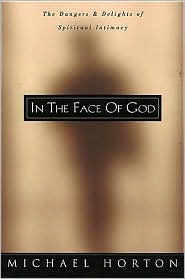
Book Review: In the Face of God


In the Face of God. Michael Horton. 1996. Thomas Nelson. 272 pages.

In the Face of God by Michael Horton

In the Face of God addresses how it is possible even within the Christian community to be too spiritual. He believes it is essential that doctrines and not emotions or experiences be the foundation of our Christian lives. He discusses how gnosticism has infiltrated the Christian church from the very beginning and how it has continued to do so ever since. For example, he argues that nineteenth-century romanticism influenced the church (and its hymns) by allowing gnostic ideas to creep into Christian terminology. He worries that in this seeker-friendly mindset that the church will lose the true message of the gospel as they try to meet the felt needs of the community without addressing the ultimate issue of salvation. He emphasizes the need for the preaching of the Word in churches, sound doctrines in the pulpits (not pop psychology), and above all else a realization that God is a God to be taken seriously. Throughout the book he presents how different men and women (in the Bible) have reacted to their personal encounters with God. Each one reacted not with joy or giddiness but with fear and trembling. Meeting God was a humbling experience for each one. Being in God's presence--being made aware (even a small glimpse) of his glory and power--only makes one more aware of how sinful we are and how small we are in comparison to God. He worries that people are seeking a "God" of their own creation that can be sought by anyone at anytime without a mediator without fear of judgement or punishment. The truth of the matter is that unless Jesus stands as your mediator God is not a "safe" God to approach. Without Christ, only judgement can be the result of a meeting with God.


© Becky Laney of Operation Actually Read Bible

Tuesday, July 22, 2008

Book Review: The Light of the World


Paterson, Katherine. 2008. The Light of the World: The Life of Jesus for Children. Illustrated by Francois Roca.

What I liked about this one? That it begins with the beginning. "The Bible tells us that in the beginning, when God created the heavens and earth, there was nothing but darkness until God said: "Let there be light." And there was light." But it doesn't stop there, it continues, "Many years ago, the prophet Isaiah lived in a dark time for his country. The wise king of Judah had died, and powerful enemies threatened to destroy his tiny land. But Isaiah believed in God's promise that the people who were living in darkness would someday see a great light. This is the story of light coming into the world." I think this is important, significant, that the life of Jesus is grounded in the Old Testament. Even though this is a book for children, it builds on a foundation, a crucial foundation. It is hard to read the New Testament, understand the New Testament, unless one knows at least a few foundational basics from the Old. For one, Jesus, was the child, the man, of prophecy. His coming, his life, his death, had been foretold for hundreds and hundreds of years.

The life of Jesus--from birth to ascension--is told simply and clearly. It's also told in a non-threatening, matter-of-fact way.

It is interesting to see which elements of the story Paterson chooses to focus on, and which elements she skips altogether. However, I don't know that I'd envy her the task of choosing. It's a simple fact--one I understand--that she simply couldn't mention every sermon, every teaching, every parable, every miracle, every confrontation, every event. And I think most of her choices were made to suit her audience. For example, the Slaughter of the Innocents and Jesus' flight into Egypt is passed over. Herod's threatening opposition not making the cut. Also missing from The Light of the World is the story of the twelve-year-old Jesus visiting the temple and astounding those teachers.

The Jesus presented in The Light of the World is wise, kind, compassionate. He's a good man. And he is referred to as the Son of God. But the Jesus presented also lacks confrontation. This Jesus doesn't mention sin. Doesn't mention the fact that all men are sinners and in need of a Savior. In fact, The Light of the World doesn't focus at all--not even a little bit--on the fact that Jesus came into the world to save sinners, to call all men to repent and to follow. Call all men to believe. This Jesus doesn't focus on the hard sayings of Jesus. The difficult bits that might make children and adults squirm a bit. Jesus' teachings to love one another, to be kind, to be generous, to be merciful, to be good, are not at all hard to accept. Everyone likes the treat-others-as-you-want-to-be-treated philosophy.

It's not that anything in Paterson's text is inaccurate. It's just that it is incomplete in many ways. It is far from offensive. Far from abrasive. This one really lacks the ability to rub people the wrong way. This is a very non-threatening Jesus. A Jesus that asks only for people to be good, kind, and loving towards one another. A Jesus that calls for peaceful-loving-happy feelings.

If you're looking for the gospel, you won't find it in The Light of the World. The basics of the gospel--let alone the details of this 'good news'--is not what Paterson has chosen to focus on in her book. Her book is the life of Jesus as separated from the gospel message. Again, it's not that what she says is inaccurate. It's just that it is a very small, very focused fraction of what could have been said.

Is it worth reading? Perhaps. The art by Francois Roca is beautiful. I just can't help thinking that a book that focuses on the life of Jesus should in some way or another explain why he died. This one doesn't. We hear only that he made people angry. Not even the exact reasons why he made people angry. That we're still in the dark about. So we don't know the details of why those men, those leaders wanted Jesus killed. And we don't get the details on why Jesus's death (and I would even go so far as to mention his life and resurrection) matters to us today. All we're told in that respect is that "the light of the world" can continue to shine in believers today when they're good and kind and loving and compassionate and merciful, etc. And it is good to show the love of Jesus, the love of God to others. It is important to minister to everyone--in all the small ways that make a difference--through living a life of love. It is by our actions we are known. So again, it is not that it's inaccurate. Just incomplete. Jesus didn't come to earth so we'd love each and be good neighbors. So we'd all be like Mr. Rogers. That wasn't the purpose. If that was the purpose, then Christians would have never been persecuted then or now or in all the centuries in between.

Still, if a child has parents or grandparents to fill in the missing elements of the story, this one could be worth it.

According to the publisher's site, this one has earned stars in Booklist, Kirkus, and Publishers Weekly. And that is saying something. So whether you love this one or are only luke-warm about it...I think it depends on your expectations and your needs. Obviously, those not judging it from a theological aspect will find it to be of greater quality. Speaking just on literary merits alone, it is well done. And like I said, the artwork, the illustrations, are good--very beautiful, very effective.
Blogged with the Flock Browser