Friday, December 27, 2013

Posts Not To Be Missed...


My Preferred Way to Read the Bible (Jim Elliff) Christian Communicators Worldwide
A Bible Reading Plan for Readers (Peter Krol) Gospel Coalition
How To Read the Whole Bible in 2014 (Justin Taylor) Gospel Coalition
The Bible Eater: A Plan for Feasting on Christ in 2013 (Trent Hunter) Gospel Coalition

Not an article, but, still too fun to miss…

http://www.howlongdoesittaketoreadthebible.com

© Becky Laney of Operation Actually Read Bible

Thursday, December 26, 2013

Goal #2 Read the KJV Chronological Bible

Winner of the ECPA 2013 Christian Book of the Year
Award for Bibles (NLT)
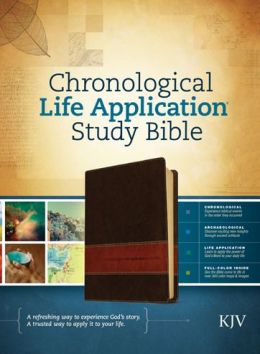
One of my big goals for 2014 is to read the Bible through chronologically. I have not done this in several years. I will be using the Chronological Life Application Study Bible. I will be reading it in the King James Version which was released in October 2013. (They've also got this in the New Living Translation.) If you're curious and want to see more, try reading the sample provided by Amazon.  There is also a video. I was thrilled to see the KJV in paragraph form! And it is black letter as well!!! I also appreciate the fact that the bible clearly states in the introduction that reading the chronological bible should not be the only way you read and encounter Scripture. That it is to supplement  one's reading of the Bible.

The chronology is broken into ten sections:

Beginnings Undated - 2100 BC*
Start Date: December 24, 2013
End Date: December 25, 2013

God's Chosen Family 2100 BC - 1800 BC
Start Date: December 26, 2013
End Date: December 31, 2013

Birth of Israel - 1800 BC - 1406 BC
Start Date: January 1, 2014
End Date: January 12, 2014

Possessing the Land 1406 BC - 1050 BC
Start Date: January 13, 2014
End Date: January 18, 2014

United Monarchy 1050 BC - 930 BC
Start Date: January 19, 2014
End Date: February 12, 2014

Splintered Nation 930 BC - 586 BC
Start Date: March 2, 2014
End Date:

Exile 586 BC - 538 BC
Start Date:
End Date:

Return and Diaspora 538 BC - 6 BC
Start Date:
End Date:

Jesus Christ 6 BC - AD 30
Start Date:
End Date:

The Church AD 30 - Present
Start Date:
End Date:


*This is the shortest of sections. Genesis 1 through Genesis 11.

© Becky Laney of Operation Actually Read Bible

Goal #1 Read the MacArthur Study Bible in 2014

One of my big goals for the year 2014 is to finally finish the MacArthur Study Bible. My goal isn't exactly to finish it in one translation of the study bible, though, that would be a great success in its own way. I hope to finish each book of the Bible in whatever MacArthur translation I happen to be reading in. So there may be some NASB, some ESV, some NIV, some NKJV, etc.

I will indicate which translation I read a particular book in.

Written by Moses

1. Genesis -- NIV
2. Exodus -- NIV
3. Leviticus -- NIV
4. Numbers -- NIV
5. Deuteronomy -- NIV

OT Narratives

6. Joshua -- NIV
7. Judges -- NIV
8. Ruth -- NIV
9. 1 Samuel -- NIV
10. 2 Samuel -- NIV
11. 1 Kings -- NIV
12. 2 Kings -- NIV
13. 1 Chronicles
14. 2 Chronicles
15. Ezra
16. Nehemiah
17. Esther

Wisdom Literature

18. Job
19. Psalms
20. Proverbs
21. Ecclesiastes
22. Song of Songs

Major Prophets

23. Isaiah
24. Jeremiah
25. Lamentations
26. Ezekiel
27. Daniel

Minor Prophets

28. Hosea
29. Joel -- ESV
30. Amos
31. Obadiah
32. Jonah
33. Micah
34. Nahum
35. Habakkuk
36. Zephaniah
37. Haggai
38. Zechariah
39. Malachi

NT Narratives

40. Matthew
41. Mark -- NIV
42. Luke
43. John -- NASB
44. Acts

Epistles by Paul

45. Romans
46. 1 Corinthians
47. 2 Corinthians
48. Galatians -- NIV
49. Ephesians
50. Philippians
51. Colossians
52. 1 Thessalonians -- ESV
53. 2 Thessalonians -- ESV
54. 1 Timothy
55. 2 Timothy
56. Titus
57. Philemon

General Epistles

58. Hebrews -- NIV
59. James
60. 1 Peter
61. 2 Peter
62. 1 John -- NIV
63. 2 John -- NIV
64. 3 John -- NIV
65. Jude

Apocalyptic Epistle by John

66. Revelation -- NASB

© Becky Laney of Operation Actually Read Bible

Wednesday, December 25, 2013

The name JESUS


From J.C. Ryle's Expository Thoughts on the Gospel of Matthew
The name JESUS means "Savior." It is the same name as Joshua in the Old Testament. It is given to our Lord because "He saves His people from their sins." This is His special office. He saves them from the guilt of sin, by washing them in His own atoning blood. He saves them from the dominion of sin, by putting in their hearts the sanctifying Spirit. He saves them from the presence of sin, when He takes them out of this world to rest with Him. He will save them from all the consequences of sin, when He shall give them a glorious body at the last day. Blessed and holy are Christ's people! From sorrow, cross, and conflict they are not saved. But they are saved from sin for evermore. They are cleansed from guilt by Christ's blood. They are made fit for heaven by Christ's Spirit. This is salvation. He who cleaves to sin is not yet saved. Jesus is a very encouraging name to heavy-laden sinners. He who is King of kings and Lord of lords might lawfully have taken some more high-sounding title. But He does not do so. The rulers of this world have often called themselves Great, Conquerors, Bold, Magnificent, and the like. The Son of God is content to call Himself Savior. The souls which desire salvation may draw near to the Father with boldness, and have access with confidence through Christ. It is His office and His delight to show mercy. "For God didn't send his Son into the world to judge the world, but that the world should be saved through him." (John 3:17.) Jesus is a name, which is peculiarly sweet and precious to believers. It has often done them good, when the favor of kings and princes would have been heard of with unconcern. It has given them what money cannot buy, even inward peace. It has eased their wearied consciences, and given rest to their heavy hearts. The Song of Solomon speaks the experience of many, when it says, "your name is oil poured forth." (Cant. 1:3.) Happy is that person, who trusts not merely in vague notions of God's mercy and goodness, but in "Jesus." The other name in these verses is scarcely less interesting than that just referred to. It is the name which is given to our Lord from his nature, as "God manifest in the flesh." He is called EMMANUEL, "God with us." Let us take care that we have clear views of our Lord Jesus Christ's nature and person. It is a point of the deepest importance. We should settle it firmly in our minds, that our Savior is perfect man as well as perfect God, and perfect God as well as perfect man. If we once lose sight of this great foundation truth, we may run into fearful heresies. The name Emmanuel takes in the whole mystery. Jesus is "God with us." He had a nature like our own in all things, sin only excepted. But though Jesus was "with us" in human flesh and blood, He was at the same time very God. We shall often find, as we read the Gospels, that our Savior could be weary, and hungry, and thirsty — could weep, and groan, and feel pain like one of ourselves. In all this we see "the man" Christ Jesus. We see the nature He took on Him, when He was born of the Virgin Mary. But we shall also find in the same Gospels that our Savior knew men's hearts and thoughts — that He had power over devils — that He could work the mightiest of miracles with a word — that He was ministered to by angels — that He allowed a disciple to call Him "my God," — and that he said, "Before Abraham was I am," and "I and my Father are one." In all this we see "the eternal God." We see Him "who is over all, God, blessed forever. Amen." (Rom. 9:5.) Would you have a strong foundation for your faith and hope? Then keep in constant view your Savior's divinity. He in whose blood you are taught to trust is the Almighty God. All power is His in heaven and earth. None can pluck you out of His hand. If you are a true believer in Jesus, let not your heart be troubled or afraid. Would you have sweet comfort in suffering and trial? Then keep in constant view your Savior's humanity.

© Becky Laney of Operation Actually Read Bible

Tuesday, December 24, 2013

Read With Me: Genesis

Do you have reading plans for the month of January? Planning to start the year with Genesis, the first book of the Bible? Hoping the new year is the year that Bible reading will become a habit that sticks around the whole year through? I'd love to have you join me in reading Genesis in January. You may follow your own reading plan if you like.

(Many popular plans have readers finishing the entire book of Genesis in just fifteen days--with Exodus being completed by day 27! The chronological reading plan on the other hand has readers finishing Genesis and Job in thirty days.) But starting a new habit may not prove easy, so don't feel bad if you can't keep up with someone else's chart or plan.

The important thing is to make the effort to read. This might mean reading every single day. Or. It might mean reading every week day, Monday through Friday. Or. It might mean reading every weekend, Saturday and Sundays.

December 29 through January 4; Week 1: Genesis 1-5
January 5 through 11; Week 2: Genesis 6-17
January 12 through 18; Week 3: Genesis 18-27
January 19 through 25; Week 4: Genesis 28-38
January 26 through February 1; Week 5: 39-50

Feel free to use any translation. Find the one that best fits your needs. Not sure which one that is? Browse through chapters using Bible Gateway. ESV. NIV. NASB. NKJV. NLT. HCSB. Of course that's just a sample of available translations.

Feel free to switch back and forth between Bibles or Bible translations. If you start the project with one Bible and feel it's just not working, change it!

Use a text-only bible OR a study bible. It's up to you. If you do use a study bible, allow yourself more time each day so that you may read notes and introductions.

Time estimates. An audio Bible of Genesis is around 3 hours and 35 minutes. Woodrow Kroll estimates (in his book, How To Read The Bible One Book At A Time) that Genesis takes the average reader 3 hours and 15 minutes. I'm not sure that either estimate takes skimming begets into consideration!!! It certainly doesn't apply to those readers using the MacArthur Study Bible!!!

By the way, feel free to skim--perhaps not completely skip--the lists of generations or all the begets. You want a feel for what they show, but there will be no quizzes! Adam. Seth. Enoch. Noah. Shem. Abraham. Isaac. Jacob and Esau. Joseph and Judah. These are the names that you may want to pay attention to.

© Becky Laney of Operation Actually Read Bible
My Last Minute Gift to YOU


A few chapters from the Bible….and a few songs too!

Luke 1 and Luke 2
Matthew 2
John 1


© Becky Laney of Operation Actually Read Bible

Luke Day #24

From J.C. Ryle's Exposition of the Gospel of Luke:
The resurrection of Christ is one of the great foundation-stones of the Christian religion. In practical importance it is second only to the crucifixion. The chapter we have now begun directs our mind to the evidence of the resurrection. It contains unanswerable proof that Jesus not only died, but rose again.
It is not so certain that Julius Caesar once lived, as it is that Christ rose again.
Let us cling firmly to the resurrection of Christ, as one of the pillars of the Gospel. It ought to produce in our minds a settled conviction of the truth of Christianity.
The true cure for a dull memory in religion, is to get deeper love toward Christ, and affections more thoroughly set on things above. We do not readily forget the things we love, and the objects which we keep continually under our eyes. The names of our parents and children are always remembered. The face of the husband or wife we love is engraved on the tablets of our hearts. The more our affections are engaged in Christ's service, the more easy shall we find it to remember Christ's words. The words of the apostle ought to be carefully pondered — "We ought to give the more earnest heed to the things which we have heard, lest at any time we should let them slip." (Heb. 2:1.)
Let us mark, in these verses, what encouragement there is to believers to speak to one another about Christ. [Luke 24:13-35] We are told of two disciples walking together to Emmaus, and talking of their Master's crucifixion. And then come the remarkable words, "While they communed together and reasoned, Jesus Himself drew near, and went with them." Conference on spiritual subjects is a most important means of grace. As iron sharpens iron, so does exchange of thoughts with brethren sharpen a believer's soul. It brings down a special blessing on all who make a practice of it. The striking words of Malachi were meant for the Church in every age -"Then those who feared the Lord spoke often one to another — and the Lord hearkened, and heard it, and a book of remembrance was written before him for those who feared the Lord, and that thought upon His name. And they shall be mine says the Lord, in that day when I make up my jewels." (Mal. 3:16, 17.) What do we know ourselves of spiritual conversation with other Christians? Perhaps we read our Bibles, and pray in private, and use public means of grace. It is all well, very well. But if we stop short here we neglect a great privilege and have yet much to learn. We ought to "consider one another to provoke to love and good works." We ought to "exhort" and "edify one another." (Heb. 10:24; 1 Thess. 5:11.) Have we no time for spiritual conversation? Let us think again. The quantity of time wasted on frivolous, trifling, and unprofitable talk, is fearfully great. Do we find nothing to say on spiritual subjects? Do we feel tongue-tied and speechless on the things of Christ? Surely if this is the case, there must be something wrong within. A heart right in the sight of God will generally find words. "Out of the abundance of the heart the mouth speaks." (Matt. 12:34.)
Let us speak of Jesus, when we are sitting in our houses and when we are walking by the way, whenever we can find a disciple to speak to. (Deut. 6:7.) If we believe we are journeying to a heaven where Christ will be the central object of every mind, let us begin to learn the manners of heaven, while we are yet upon earth. So doing we shall often have One with us whom our eyes will not see, but One who will make our hearts "burn within us" by blessing the conversation.
Let us mark, thirdly, in these verses, how full the Old Testament is of Christ. We are told that our Lord began "with Moses and all the prophets, and expounded in all the Scriptures the things concerning himself." How shall we explain these words? In what way did our Lord show "things concerning himself," in every part of the Old Testament field? The answer to these questions is short and simple. Christ was the substance of every Old Testament sacrifice, ordained in the law of Moses. Christ was the true Deliverer and King, of whom all the judges and deliverers in Jewish history were types. Christ was the coming Prophet greater than Moses, whose glorious advent filled the pages of prophets. Christ was the true seed of the woman who was to bruise the serpent's head — the true seed in whom all nations were to be blessed — the true Shiloh to whom the people were to be gathered, the true scape-goat — the true bronze serpent — the true Lamb to which every daily offering pointed — the true High Priest of whom every descendant of Aaron was a figure. These things, or something like them, we need not doubt, were some of the things which our Lord expounded in the way to Emmaus. Let it be a settled principle in our minds, in reading the Bible, that Christ is the central sun of the whole book. So long as we keep Him in view, we shall never greatly err in our search for spiritual knowledge. Once losing sight of Christ, we shall find the whole Bible dark and full of difficulty. The key of Bible knowledge is Jesus Christ.
He that desires to read his Bible with profit, must first ask the Lord Jesus to open the eyes of his understanding by the Holy Spirit. Human commentaries are useful in their way. The help of good and learned men is not to be despised. But there is no commentary to be compared with the teaching of Christ. A humble and prayerful spirit will find a thousand things in the Bible, which the proud, self-conceited student will utterly fail to discern.
The death of Christ was necessary to our salvation. His flesh and blood offered in sacrifice on the cross were "the life of the world." (John 6:51.) Without the death of Christ, so far as we can see, God's law could never have been satisfied — sin could never have been pardoned — man could never have been justified before God — and God could never have shown mercy to man. The cross of Christ was the solution of a mighty difficulty. It untied a vast knot. It enabled God to be "just, and yet the justifier" of the ungodly. (Rom. 3:26.) It enabled man to draw near to God with boldness, and to feel that though a sinner he might have hope. Christ by suffering as a Substitute in our stead, the just for the unjust, has made a way by which we can draw near to God. We may freely acknowledge that in ourselves we are guilty and deserve death. But we may boldly plead, that One has died for us, and that for His sake, believing on Him, we claim life and acquittal. Let us ever glory in the cross of Christ. Let us regard it as the source of all our hopes, and the foundation of all our peace. Ignorance and unbelief may see nothing in the sufferings of Calvary but the cruel martyrdom of an innocent person. Faith will look far deeper. Faith will see in the death of Jesus the payment of man's enormous debt to God, and the complete salvation of all who believe.
"Repentance and forgiveness of sins" are the first things which ought to be pressed on the attention of every man, woman, and child throughout the world. All ought to be told the necessity of repentance. All are by nature desperately wicked. Without repentance and conversion, none can enter the kingdom of God. All ought to be told God's readiness to forgive every one who believes on Christ. All are by nature guilty and condemned. But any one may obtain by faith in Jesus, free, full, and immediate pardon. All, not least, ought to be continually reminded, that repentance and forgiveness of sins are inseparably linked together. Not that our repentance can purchase our pardon. Pardon is the free gift of God to the believer in Christ. But still it remains true, that an impenitent man, is an unforgiven man.
Repentance and forgiveness are not mere elementary truths, and milk for babes. The highest standard of sanctity is nothing more than a continual growth in practical knowledge of these two points. The brightest saint is the man who has the most heart-searching sense of his own sinfulness, and the liveliest sense of his own complete acceptance in Christ.
We must never despair of any one being saved, however bad and profligate he may have been. We must open the door of repentance to the chief of sinners. We must not be afraid to invite the worst of men to repent, believe, and live. It is the glory of our Great Physician, that He can heal incurable cases. The things that seem impossible to men are possible with Christ.
As a Forerunner, Jesus has gone into heaven to prepare a place for all His members. Our great Head has taken possession of a glorious inheritance in behalf of His mystical body, and holds it as an elder brother and trustee, until the day comes when His body shall be perfected. As a High Priest, Jesus has gone into heaven to intercede for all who believe on Him. There in the holy of holies He presents on their behalf the merit of His own sacrifice, and obtains for them daily supplies of mercy and grace. The grand secret of the perseverance of saints is Christ's appearance for them in heaven. They have an everlasting Advocate with the Father, and therefore they are never cast away. (Heb. 9:24. 1 John 2:1.)
Christ dying on the cross for sinners — Christ living in heaven to intercede — Christ coming again in glory, are three great objects which ought to stand out prominently before the eyes of every true Christian.
Let it be a settled principle with us, that the little degree of joy which many believers feel arises often from lack of knowledge. Weak faith and inconsistent practice are doubtless two great reasons why many of God's children enjoy so little peace. But it may well be suspected that dim and indistinct views of the Gospel are the true cause of many a believer's discomfort. When the Lord Jesus is not clearly known and understood, it must needs follow that there is little "joy in the Lord." Let us leave the Gospel of Luke with a settled purpose of heart to seek more spiritual knowledge every year we live. Let us search the Scriptures more deeply and pray over them more heartily. Too many believers only scratch the surface of Scripture, and know nothing of digging down into its hidden treasures. Let the word dwell in us more richly. Let us read our Bibles more diligently. So doing we shall taste more of joy and peace in believing, and shall know what it is to be "continually praising and blessing God."
© Becky Laney of Operation Actually Read Bible