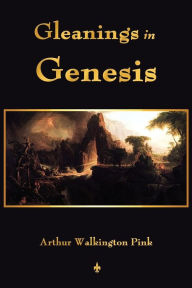
Gleanings in Genesis is not the first Pink I've read, but, it is the first I've reviewed for my blog.
Arthur W. Pink essentially shares his thoughts chapter by chapter through the book of Genesis--except for when he decides to SKIP. (For some reason he did not bother gleaning anything from Genesis 34.)
Are his thoughts--his gleanings--worth reading? Yes and no. I think Pink was into details, and reading big things into little details. He took Jesus' words that the Scriptures were ALL about HIM quite seriously. I think sometimes his interpretations are a bit of a stretch. Key word: sometimes. I found myself walking in agreement with Pink up to a certain point, and, then him pushing things a bit too far for me to wholeheartedly agree with. Never to the point I yelled at the book though!!!
When Pink was right, he was RIGHT. I found myself wanting to go AMEN!!!! If I wrote in my books, which I usually don't, then this one would have lots of exclamation points and only a few question marks.
Quotes:
Appropriately has Genesis been termed "the seed plot of the Bible," for in it we have, in germ form, almost all of the great doctrines which are afterwards fully developed in the books of Scripture which follow.
The opening sentence of Holy Writ is not to be philosophized about, but is presented as a statement of truth to be received with unquestioning faith.
The Bible is couched in human language, it is addressed to human ears, it was written by human hands, but, in the beginning God "holy men of God spake, moved by the Holy Spirit" (2 Pet. 1:21).
Christ is the key which unlocks the golden doors into the temple of Divine truth. "Search the Scriptures," is His command, "for they are they which testify of Me." And again, He declares, "In the volume of the Book it is written of Me." In every section of the written Word the Personal Word is enshrined—in Genesis as much as in Matthew.
The third chapter in Genesis is one of the most important in all the Word of God.
First, the voice of the tempter was heeded. Instead of saying, "Get thee behind me, Satan," Eve quietly listened to the Evil One challenging the word of Jehovah. Not only so, but she proceeds to parley with him. Next there is a tampering with God’s Word. Eve begins by adding to what God has said—always a fatal course to pursue. "Ye shall not eat of it, neither shall ye touch it." Next she proceeded to alter God’s Word, "lest ye die." The sharp point of the Spirit’s Sword was blunted. Finally, she altogether omits God’s solemn threat, "Thou shalt surely die." How true it is that "History repeats itself." Such, in brief, is the Divine account of the entry of sin into our world. The will of God was resisted, the word of God was rejected, the way of God was deserted.
It is the call of Divine justice, which cannot overlook sin. It is the call of Divine sorrow, which grieves over the sinner. It is the call of Divine love. which offers redemption from sin. To each and to every one of us the call is reiterated, ‘Where art thou?’"
Walking with God means that we cease taking our own way, that we abandon the world’s way, that we follow the Divine way.
If we would know God we must walk with Him: we must come into living contact with Him, have personal dealings with Him, commune with Him.
If we doubt God’s Word about one thing, we shall have small confidence in it upon another thing.
Observe that the Lord does not say "Go into the ark," but "Come." "Go" would have been a command, "Come" was a gracious invitation; "Go"would have implied that the Lord was bidding Noah depart from Him, "Come" intimated that in the ark the Lord would be present with him. Is it not the same thought as we have in the Gospel—"Come unto Me and I will give you rest!
It is only as we separate ourselves from the world and walk in the path marked out for us by God that we reach the place where strength is to be found, and, it is only thus that we can enter into fellowship with and learn from Him in whom are hid all the treasures of wisdom and knowledge.
The call which came to Abram comes to each one of his believing children—the call for absolute confidence in God; the call to take Him at His word and step out in simple and unquestioning faith; the call to separate ourselves from the world to a life of pilgrimage in dependency upon Jehovah. The trial of Abram’s faith is also the lot of all his children. Profession must be tested and at times the meal in the barrel will run very low. The failure of Abram is a solemn warning against being occupied with circumstances instead of with God. Look not at the famine but unto God’s faithfulness. Beware of going down to Egypt. The friendship of the world is enmity with God. Time spent in Egypt is wasted. Days lived out of communion with God produce nought but "wood, hay and stubble."
It was love that "suffered long" with Abram’s failings! It was love that persisted with him in spite of every check and drawback. It was love that now met him and promised to grant the desire of his heart, and in old age give him a son.
To walk before is suggestive of a child running ahead and playing in the presence of his father, conscious of his perfect security because he is just behind. To walk after becomes a servant following his master. To walk with indicates fellowship and friendship. To walk in denotes union.
My reader, there are no chance-happenings, no chance-meetings, no chance delays, no chance losses, no chance anythings in our lives. All is of Divine appointment.
© Becky Laney of Operation Actually Read Bible