Showing posts with label 1948. Show all posts

Tuesday, May 20, 2025

44. A Child's Garden of Bible Stories

44. Child's Garden of Bible Stories. Arthur W. Gross. Illustrated by Rod Taenzer. 1948. 146 pages. [Source: Bought] [5 stars, bible story books, children's books, children's classic]

First sentence: Long, long ago there was no world. There were no birds and bees, no fields and flowers, no lakes and rivers, no sun, no moon, no stars. There were no people either. There was nothing at all. Only God was there.

Child's Garden of Bible Stories was originally published in 1948; it has since been republished multiple times through the decades. There are twenty-eight stories from the Old Testament. There are thirty-two stories from the New Testament. Each story has a handful of illustrations. 

What I most appreciate about this children's classic is the variety of stories included. It is always interesting to me when reading and reviewing children's bible story books WHICH stories are included and which are not. Length of the book often plays a big role I imagine in what gets included. But also I think stories can reflect the times in which the book is published. There are stories that rarely make the cut. One of the more unusual stories included in this one is David and Absalom! (Including an illustration of Absalom getting hung in the tree by his hair.) 

The books definitely does a great job in presenting the gospel and a biblical Jesus.

© Becky Laney of Operation Actually Read Bible

Wednesday, March 18, 2015

Book Review: The Pursuit of God

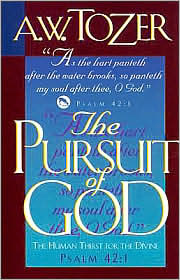
The Pursuit of God: The Human Thirst for the Divine. A.W. Tozer 1948/2006. WingSpread Publishers. 70 pages. [Source: Bought]

Is The Pursuit of God my absolute favorite Tozer book? Not really. Not even close if I'm being honest. I've read quite a few over the past three years.* Would it be my first choice as someone else's first Tozer? Probably not. If not, what would be? Well, I'd have to go with either Knowledge of the Holy OR The Root of the Righteous. (Chances are you've heard of Knowledge of the Holy. I'd guess it's his most well-known work.) All that being said, is it worth reading? Yes, I think so. 

What I loved MOST about The Pursuit of God were the concluding prayers at the end of each chapter. These prayers were well-crafted, beautiful, and inspiring.

The book has ten chapters:
  • Following Hard After God
  • The Blessedness of Possessing Nothing
  • Removing the Veil
  • Apprehending God
  • The Universal Presence
  • The Speaking Voice
  • The Gaze of the Soul
  • Restoring the Creator-Creature Relation
  • Meekness and Rest
  • The Sacrament of Living
As I said, I loved the prayers. How did I feel about the rest of the text? Well, my reaction varied from chapter to chapter, page to page. Some of which I read, I definitely agreed with. Some of which I read, I definitely disagreed with. 

Is this good? Is this bad? I think, overall, it's good. Why? Because I believe it's healthy to engage with a text. To see it as a challenge, a time to think and reflect, a time to test and discern. How does what he's saying line up with the Bible? How does it line up to what I think, what I've assumed to be true, what I've been taught? What biblical proof does he give? None? A little? A lot? Does his interpretation of a biblical text make sense? Or is it off? Has he persuaded me he's right? Or am I convinced that he got it wrong in this area? How important is it that we agree? Is it a BIG deal or a little aside? 

For the most part, I have found more good than bad in his writing. That is, while I have always found paragraphs that I take issue with in most any of his books, I've found much truth as well. I love his passion and zeal. One thing we have in common--or would have had in common--is a PASSION and a DESIRE to read the Word of God; we both LOVE the Bible, and value it as being the very WORD OF GOD. Tozer, I think, above all else, wanted people to LOVE God, to KNOW God, to be in right RELATIONSHIP with God. SEEK HIM WITH YOUR WHOLE HEART, MIND, AND SOUL. He saw people missing out, and, he wanted to wake them up--to shake them up. He does write zealously. He can sound VERY judgmental, I admit it. But he's trying to wake people up to the truth, to the possibilities of what their Christian life could be and should be. His intent is for their good, their well-being. 

So you'll encounter strong, bold, passionate statements. Tozer speaking truth as he sees it, as he's experienced it. He does make very generalized statements about Christians, about nonChristians, about the world, about the church. His observations come from an earlier time in church history--this book, I believe, was published in the late forties. But that does not mean his observations are irrelevant for modern readers. Some things have changed in "the church", and, his statements might not be strong enough in a few cases. (Not in all cases, mind you.)

I want to mention one more thing, before I get to the quotes, there were two chapters--"The Blessing of Possessing Nothing" and "The Sacrament of Living"--that reminded me of  a book I recently read: Joe Rigney's Things of Earth. Rigney's book handles these topics of self-denial and the tension between sacred-versus-secular much better. So if you're confused or unsatisfied with Tozer's ideas, then you might seek out another opinion. 

I encourage you to play true or false with the following quotes: 
The Bible is not an end in itself, but a means to bring men to an intimate and satisfying knowledge of God, that they may enter into Him, that they may delight in His Presence, may taste and know the inner sweetness of the very God Himself in the core and center of their hearts. We Christians are in real danger of losing God amid the wonders of His Word. We have almost forgotten that God is a Person and, as such, can be cultivated as any person can.
We have been snared in the coils of a spurious logic which insists that if we have found Him we need no more seek Him. This is set before us as the last word in orthodoxy, and it is taken for granted that no Bible-taught Christian ever believed otherwise. Thus the whole testimony of the worshipping, seeking, singing Church on that subject is crisply set aside. The experiential heart-theology of a grand army of fragrant saints is rejected in favor of a smug interpretation of Scripture which would certainly have sounded strange to an Augustine, a Rutherford or a Brainerd.**
The simplicity which is in Christ is rarely found among us. In its stead are programs, methods, organizations and a world of nervous activities which occupy time and attention but can never satisfy the longing of the heart. The shallowness of our inner experience, the hollowness of our worship, and that servile imitation of the world which marks our promotional methods all testify that we, in this day, know God only imperfectly, and the peace of God scarcely at all.
There is within the human heart a tough fibrous root of fallen life whose nature is to possess, always to possess. It covets "things" with a deep and fierce passion. The pronouns "my" and "mine" look innocent enough in print, but their constant and universal use is significant.
God formed us for His pleasure, and so formed us that we as well as He can in divine communion enjoy the sweet and mysterious mingling of kindred personalities. He meant us to see Him and live with Him and draw our life from His smile.
The Presence of God is the central fact of Christianity. At the heart of the Christian message is God Himself waiting for His redeemed children to push in to conscious awareness of His Presence. 
The world is perishing for lack of the knowledge of God and the Church is famishing for want of His Presence.
Eternity will not be long enough to learn all He is, or to praise Him for all He has done, but then, that matters not; for we shall be always with Him, and we desire nothing more."
God is so vastly wonderful, so utterly and completely delightful that He can, without anything other than Himself, meet and overflow the deepest demands of our total nature, mysterious and deep as that nature is.
There is something more serious than coldness of heart, something that may be back of that coldness and be the cause of its existence. What is it? What but the presence of a veil in our hearts? It is woven of the fine threads of the self-life, the hyphenated sins of the human spirit. They are not something we do, they are something we are, and therein lies both their subtlety and their power. To be specific, the self-sins are these: self-righteousness, self-pity, self-confidence, self-sufficiency, self-admiration, self-love and a host of others like them. They dwell too deep within us and are too much a part of our natures to come to our attention till the light of God is focused upon them.
A loving Personality dominates the Bible, walking among the trees of the garden and breathing fragrance over every scene. Always a living Person is present, speaking, pleading, loving, working, and manifesting Himself whenever and wherever His people have the receptivity necessary to receive the manifestation.
The spiritual faculties of the unregenerate man lie asleep in his nature, unused and for every purpose dead; that is the stroke which has fallen upon us by sin. They may be quickened to active life again by the operation of the Holy Spirit in regeneration; that is one of the immeasurable benefits which come to us through Christ's atoning work on the cross.
But the very ransomed children of God themselves: why do they know so little of that habitual conscious communion with God which the Scriptures seem to offer? The answer is our chronic unbelief. Faith enables our spiritual sense to function. Where faith is defective the result will be inward insensibility and numbness toward spiritual things.
Important as it is that we recognize God working in us, I would yet warn against a too-great preoccupation with the thought. It is a sure road to sterile passivity. God will not hold us responsible to understand the mysteries of election, predestination and the divine sovereignty. The best and safest way to deal with these truths is to raise our eyes to God and in deepest reverence say, "O Lord, Thou knowest." Those things belong to the deep and mysterious Profound of God's omniscience. Prying into them may make theologians, but it will never make saints.**
The idea of cultivation and exercise, so dear to the saints of old, has now no place in our total religious picture. It is too slow, too common. We now demand glamour and fast flowing dramatic action. A generation of Christians reared among push buttons and automatic machines is impatient of slower and less direct methods of reaching their goals. We have been trying to apply machine-age methods to our relations with God. We read our chapter, have our short devotions and rush away, hoping to make up for our deep inward bankruptcy by attending another gospel meeting or listening to another thrilling story told by a religious adventurer lately returned from afar. The tragic results of this spirit are all about us. Shallow lives, hollow religious philosophies, the preponderance of the element of fun in gospel meetings, the glorification of men, trust in religious externalities, quasi-religious fellowships, salesmanship methods, the mistaking of dynamic personality for the power of the Spirit: these and such as these are the symptoms of an evil disease, a deep and serious malady of the soul.
Let any man turn to God in earnest, let him begin to exercise himself unto godliness, let him seek to develop his powers of spiritual receptivity by trust and obedience and humility, and the results will exceed anything he may have hoped in his leaner and weaker days. Any man who by repentance and a sincere return to God will break himself out of the mold in which he has been held, and will go to the Bible itself for his spiritual standards, will be delighted with what he finds there.
If you would follow on to know the Lord, come at once to the open Bible expecting it to speak to you. Do not come with the notion that it is a thing which you may push around at your convenience. It is more than a thing, it is a voice, a word, the very Word of the living God.
Every soul belongs to God and exists by His pleasure. God being Who and What He is, and we being who and what we are, the only thinkable relation between us is one of full lordship on His part and complete submission on ours. We owe Him every honor that it is in our power to give Him. Our everlasting grief lies in giving Him anything less. The pursuit of God will embrace the labor of bringing our total personality into conformity to His.
The whole course of the life is upset by failure to put God where He belongs.
Let us think of a Christian believer in whose life the twin wonders of repentance and the new birth have been wrought. He is now living according to the will of God as he understands it from the written Word. Of such a one it may be said that every act of his life is or can be as truly sacred as prayer or baptism or the Lord's Supper. To say this is not to bring all acts down to one dead level; it is rather to lift every act up into a living kingdom and turn the whole life into a sacrament.
For other opinions on The Pursuit of God:
Reading to Know, Stray Thoughts, and I'll add more if I come across them.

*Here is a list of all the Tozer books I've read, and, in the order I've read them. "Quite a few" isn't it?!

**These statements I actually strongly disagree with.

© Becky Laney of Operation Actually Read Bible

Saturday, April 21, 2012

Book Review: The Pursuit of God

The Pursuit of God: The Human Thirst for the Divine. A.W. Tozer 1948/2006. WingSpread Publishers. 70 pages.

Christian theology teaches the doctrine of prevenient grace, which briefly stated means this, that before a man can seek God, God must first have sought the man. Before a sinful man can think a right thought of God, there must have been a work of enlightenment done within him; imperfect it may be, but a true work nonetheless, and the secret cause of all desiring and seeking and praying which may follow. We pursue God because, and only because, He has first put an urge within us that spurs us to the pursuit. "No man can come to me," said our Lord, "except the Father which hath sent me draw him," and it is by this very prevenient drawing that God takes from us every vestige of credit for the act of coming. The impulse to pursue God originates with God, but the out working of that impulse is our following hard after Him; and all the time we are pursuing Him we are already in His hand: "Thy right hand upholdeth me."

I have just been LOVING my A.W. Tozer Bible. As in there are no words for how much I LOVE, LOVE, LOVE reading it. So when my library got a copy of A.W. Tozer's The Pursuit of God, I knew I had to read it.

It is a short book: ten little chapters, around 70 to 80 pages. I'll share a list of chapter titles with you because I think the titles alone can help you decide if this is something that you'd be interested in reading for yourself:

  • Following Hard After God
  • The Blessedness of Possessing Nothing
  • Removing the Veil
  • Apprehending God
  • The Universal Presence
  • The Speaking Voice
  • The Gaze of the Soul
  • Restoring the Creator-Creature Relation
  • Meekness and Rest
  • The Sacrament of Living

Each chapter is three or four pages in length. Each chapter concludes with a prayer. I just LOVED these prayers, it's true. For me, they were the highlight of the whole book. I wish the A.W. Tozer Bible had a fourth feature--prayers of Tozer.

From "Following Hard After God"
O God, I have tasted Thy goodness, and it has both satisfied me and made me thirsty for more. I am painfully conscious of my need of further grace. I am ashamed of my lack of desire. O God, the Triune God, I want to want Thee; I long to be filled with longing; I thirst to be made more thirsty still. Show me Thy glory, I pray Thee, that so I may know Thee indeed. Begin in mercy a new work of love within me. Say to my soul, "Rise up, my love, my fair one, and come away." Then give me grace to rise and follow Thee up from this misty lowland where I have wandered so long. In Jesus' Name, Amen.
From "The Blessedness of Possessing Nothing"
Father, I want to know Thee, but my coward heart fears to give up its toys. I cannot part with them without inward bleeding, and I do not try to hide from Thee the terror of the parting. I come trembling, but I do come. Please root from my heart all those things which I have cherished so long and which have become a very part of my living self, so that Thou mayest enter and dwell there without a rival. Then shalt Thou make the place of Thy feet glorious. Then shall my heart have no need of the sun to shine in it, for Thyself wilt be the light of it, and there shall be no night there. In Jesus' Name, Amen.
From "Removing the Veil"
Lord, how excellent are Thy ways, and how devious and dark are the ways of man. Show us how to die, that we may rise again to newness of life. Rend the veil of our self-life from the top down as Thou didst rend the veil of the Temple. We would draw near in full assurance of faith. We would dwell with Thee in daily experience here on this earth so that we may be accustomed to the glory when we enter Thy heaven to dwell with Thee there. In Jesus' name, Amen.
From "Apprehending God"
O God, quicken to life every power within me, that I may lay hold on eternal things. Open my eyes that I may see; give me acute spiritual perception; enable me to taste Thee and know that Thou art good. Make heaven more real to me than any earthly thing has ever been. Amen.
From "Restoring the Creator-creature Relation"
O God, be Thou exalted over my possessions. Nothing of earth's treasures shall seem dear unto me if only Thou art glorified in my life. Be Thou exalted over my friendships. I am determined that Thou shalt be above all, though I must stand deserted and alone in the midst of the earth. Be Thou exalted above my comforts. Though it mean the loss of bodily comforts and the carrying of heavy crosses I shall keep my vow made this day before Thee. Be Thou exalted over my reputation. Make me ambitious to please Thee even if as a result I must sink into obscurity and my name be forgotten as a dream. Rise, O Lord, into Thy proper place of honor, above my ambitions, above my likes and dislikes, above my family, my health and even my life itself. Let me decrease that Thou mayest increase, let me sink that Thou mayest rise above. Ride forth upon me as Thou didst ride into Jerusalem mounted upon the humble little beast, a colt, the foal of an ass, and let me hear the children cry to Thee, "Hosanna in the highest."
The text of this one is available through Project Gutenberg.

© Becky Laney of Operation Actually Read Bible