Showing posts with label futuristic. Show all posts

Monday, August 14, 2017

Book Review: Godless

Godless. (Fatherless #3) James Dobson and Kurt Bruner. 2014. 416 pages. [Source: Library]

First sentence: Veronica's eyes flew open as she felt the rising sun warm her face. Panic forced her upright. "Where are we?" No response. Louder. "Mommy?"

Premise/plot: Godless is the third and final book in the trilogy by James Dobson and Kurt Bruner. (The first two in the series are Fatherless and Childless. The third novel opens in 2044, so two years have passed since the first novel began.)

What would society be like if it was truly godless? The entire series has shown a terrifying future where nothing is wrong because everything is right. It's a world in economic crisis for one thing.

The novel asks: What happens to a society, a civilization, when there are more old people than young people? Who gets what? How are resources shared and divided? In this fictional series, the author imagines that the elderly are manipulated and urged to make the best decision for everyone: to end their lives so that their grown children and grandchildren can benefit financially. Be a blessing for your loved ones: die today! Don't weigh down your loved ones lives with your continued existence! Make one last contribution to society! Be patriotic! Do good for your country, do good for your family!

The result is that medical care is being denied to the elderly. Children are pressuring their parents to transition--to die and leave them everything. Churches are pressuring older members to transition so that the church can have their money and thereby extend their gospel outreach. Politicians are definitely supporting the transition industry and building their campaigns around it.

Imagine this: You're 60+, at home waiting for results from the doctor, someone shows up at your door with the results. But they just don't give you the news, they're there to sell you a solution. Your health is bad. You're being denied coverage or treatment. But there's good news in all of this: you can take control of your diagnosis. Schedule your day to die! Sign up right here, right now and we'll set up your appointment to "transition." You can transition at home even if you'd prefer.

Or imagine this: You're 60+ and have a college-aged grandchild who wants to go to college. Your grandchild "needs" this educational opportunity if they are to succeed in life. The only thing standing in the way of their success, their future...is YOU. If you really love your grandchild, don't you want them to have the best in life even if you're not there to see it?

Godless has many characters. Most of the characters were introduced in the first two books in the series. But this one also focuses in on one pastor and his family as they struggle to do the right thing and stand up against a church board that is pro-transition.

My thoughts: The series has reminded me of Frank Peretti's novels. The ideas are truly terrifying. It isn't just the lack of respect for human life and dignity in regards to how the elderly are treated. (I imagine that the disabled would also be pressured to transition. If you can't work and contribute to society, go ahead and die.)

The breakdown of the family is complete. Adults never marry, never enter monogamous relationships, never learn to love others unconditionally and sacrificially, never have children, never have need to be selfless. The novels do show the other side, however. The "breeder" class where values have not disintegrated and human life is still seen as being in the image of God.

My favorite character was Alex, the pastor of a Colorado church. My least favorite character was Matthew. These two have several conversations throughout the book. Matthew is a tortured soul, chained to his bad decisions past and present. He comes as "Frank" seeking answers to his questions. Not that he's always open to the answers he receives from Alex. But Alex isn't his only counselor.
 
© Becky Laney of Operation Actually Read Bible

Wednesday, March 26, 2014

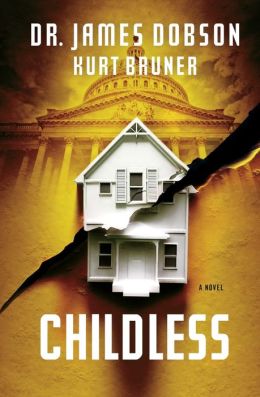
Book Review: Childless (2013)

Childless (Fatherless #2) James C. Dobson and Kurt Bruner. 2013. FaithWords. 448 pages. [Source: Book I Bought]

While some books are character-driven and others are plot-driven, Childless is idea-driven. Characters represent ideas and world views. Childless is all about logically following those ideas and imagining the consequences to both society and individuals. The ideas are definitely centered in the real world, the novel, is set roughly forty or fifty years in the future to give all the ideas time to come to fruition.

The series is about broken families, about the loss of family, about a break down of values. People choosing not to get married. People choosing to have a series of relationships instead of one monogamous relationship. People choosing not to have children at all. People who do choose to become parents being choosy parents and choosing their children's genes in the lab.

But that isn't all. The series is also about the treatment of the elderly.  What happens to a society, a civilization, when there are more old people than young people? Who gets what? How are resources shared and divided? In this fictional series, the author imagines that the elderly are manipulated and urged to make the best decision for everyone: to end their lives so that their grown children and grandchildren can benefit financially. Be a blessing for your loved ones: die today! Don't weigh down your loved ones lives with your continued existence! Make one last contribution to society! Be patriotic! Do good for your country, do good for your family! It is very political. Many politicians have strong opinions. The economy, the budget, is dependent, very dependent, on continuing this business.

Childless is the sequel to Fatherless. I think it is definitely important to read the books in order. There is an ongoing legal case in Childless. No one knows exactly what the three judges will decide or state in their ruling. It is supposed that Judge Victor Santiago will be the deciding judge in the case. Much of this one focuses on threatening letters he receives in the weeks leading up to the decision. A private investigator is hired by the Judge's secretary. Tyler coincidentally crosses circles with previous characters introduced in Fatherless, mainly Julia and Troy.

The main characters of Childless include Julia and Troy, Kevin and Angie, Tyler and Renee. Matthew also continues to be a narrator. It would be hard to put into words exactly how I feel about Matthew. In the first novel, I found his narration to be heartbreaking. I found I could pity him even if I couldn't like him. I'm not strong enough to pity him in the second novel. I thought Matthew's actions in the first novel were despicable, but, the comparison between his actions in the first novel and the second novel would be like comparing littering to assault.

I can't say that I enjoyed Childless. But I can say that I reacted to it. I always emotionally reacted to the characters: what they were saying and doing.

© Becky Laney of Operation Actually Read Bible
Sunday, July 15, 2012

Book Review: The Kingdom

The Kingdom. Bryan Litfin. 2012. Crossway. 448 pages.

From the prologue: The rulers of the earth took counsel together, and the Pact they made defined the centuries to come. 

The Kingdom concludes the Chiveis Trilogy by Bryan Litfin. The first two novels in the series are The Sword and The Gift. The trilogy has an interesting premise. It explores a post-apocalyptic Europe beginning several centuries after "the end of the world as we know it." In this world, Christianity has both fallen into decay (just naturally--slowly but surely--been forgotten with the passing of each generation) and been outlawed. In the first novel, Ana and Teo discovered--by chance--a copy of the Old Testament. This presumably being the only known copy in existence. The two learn that it is only the first half of the Sacred Writings. And, of course, they WANT to find the second half, the second testament. But they hardly know where to begin. But just because their knowledge is incomplete, doesn't mean that they aren't eager--very, very eager--to share what they do know. For this is the first they've heard of a Creator God--Deu or Deus, as they call Him. And they're drawn to Him, trusting in Him, in His goodness, in his justice, in his righteousness. Teo in addition to being an incredibly brave, strong, oh-so-handsome soldier, is, of course an extremely brilliant scholar who speaks two or three languages, at least--including some of the ancient languages. Chiveis is the country (nation) where they both live. But it is immoral and corrupt. And the 'state religion' is idolatrous. The High Priestess, let's say, LOVES power, and loves the control she has over others. She's definitely into cruelty and torture. So when Teo and Ana begin spreading the good news--what they know of it--she is most displeased. The two end up being exiled. The second novel follows the two after their exile. Their true mission (which they sometimes forget about) is to find the New Testament, the Second Testament. This second novel introduces readers to two or three other countries or regions. It introduces at least one or two new villains to the general story, and, essentially has hundreds of pages worth of torture for the reader to endure alongside the characters. The bad news? They find the New Testament only to lose it to their enemy. The good news? The message and content of the New Testament is NOT lost after all. The book concludes with Teo hard at work translating this one into several different languages so they can spread the good news to all countries and nations. Which brings us to the third novel....

...Ana and Teo have finally, finally admitted they have feelings for one another. And they've finally found a community of believers who are eager to share in their work in evangelism. Actually, Ana and Teo fit into their already-present community. Teo may have many qualities to be a leader--of sorts--in the Christian community, since he's so brilliant and can translate the New Testament in just a few short months into several different languages, but he's not trying to take the role of the Papa in Roma. This novel begins with the couple preparing to be separated for many months--Teo seeking to travel to another country in search of Knights of the Cross, to see if they still remember what "the cross" means, to see if they are still loyal to the Papa. What Teo learns in his journeys--and what Ana learns as well--is that WAR is coming, that there are powers that be coming together united in hatred for the Christian faith.

How do I feel about The Kingdom? How do I feel about the trilogy? Well, I'm not sure there's an easy answer. It does have an interesting premise, in a way. And the books do give me something to think about. But. The characters annoy me just as often as they satisfy me. And essentially all three books are high on torture and "intense" situations that seem like desperate this-is-it close calls. Perhaps because of the high-frequency of these dramatic moments, perhaps because the characters always seem to come away safe, I never truly worried. I was also annoyed with the "romance" in this one. I felt Ana's love for Teo strained her common sense at times, and the same with Teo. Because Teo was so in love with Ana, he had his stupid moments.

© Becky Laney of Operation Actually Read Bible

Monday, May 24, 2010

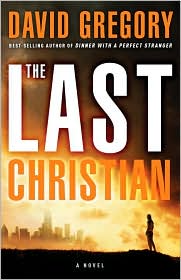
Book Review: The Last Christian


The Last Christian. David Gregory. 2010. Waterbrook Press. 416 pages

I see your neurons firing, Ray.

The Last Christian has an interesting premise. A very thought-provoking premise. It's set in 2088, in the United States, for the most part. In this day and age, Christianity is essentially dead.

Abby Caldwell, our heroine, is the daughter of a missionary couple; she has only known one way of life, the Christian way of life. She's from Papua New Guinea--from the jungle where she was born and raised. But when a mysterious illness kills everyone in her village, well, she sets off on an adventure of her own. She's on her way to America to try to fulfill her grandfather's vision.

Abby received a message--though the message came sixteen years late--from her grandparents. They told her of a dream, a vision. Of how she may be America's greatest hope. Of how she may be the one to bring Christianity back to a country, a nation.

But fulfilling that dream may cost her her life. Because the country is not only unreceptive to the gospel, but openly hostile. She may face jail time for her "hate speech" if she tries to share the gospel with others.

Of course, that is only the beginning of the story David Gregory has written. The Last Christian reads more like an eery Twilight-Zone episode. Artificial intelligence. Silicon Brains. The obsession to combine technology and biology--to take humanity to a whole other level, to be transhuman. The quest of driven men to live forever and ever.

Science. Politics. Religion. Ambition. Greed. Murder. The Last Christian is a compelling read. It is a bit more premise-driven, action-driven, than character-driven, but that isn't necessarily a bad thing.

What I liked best about The Last Christian was it made me think. I'm not sure I liked every little thing about the book. The book makes some strong statements here and there about our church culture, our faith. But. If nothing else it makes you think about faith. What would happen--what could happen--if faith fails. (I think truth is infinitely more important than entertainment value. That the church shouldn't be so open to compromising the truth--changing the gospel--in order to bring more people in the doors.) I liked that Abby didn't have all the answers. That she wasn't perfect. That she was human. That she had her own faith challenges to work out.


© Becky Laney of Operation Actually Read Bible