Sunday, July 11, 2010

The Sunday Salon: July 4-10


This week I...

finished 1 Thessalonians in the ESV Thinline
finished 2 Thessalonians in the ESV Thinline
finished Genesis in the Holman Christian Standard

© Becky Laney of Operation Actually Read Bible

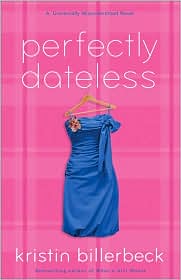
Book Review: Perfectly Dateless


Perfectly Dateless: A Universally Misunderstood Novel. Kristin Billerbeck. 2010. July 2010. Revell. 256 pages.

They say the first step to recovery is admitting you have a problem. So I guess I have a problem. I am a bit of a perfectionist, and my life is anything but perfect.

Our heroine Daisy Crispin has so many problems. No, she's not being abused--physically or sexually. No, she's not addicted to drugs or alcohol. No, she doesn't have an eating disorder. No, she doesn't cut. No, she isn't a compulsive liar or thief. No, she's not grief-stricken from the loss of a parent, grandparent, sibling, or best friend. No, she's not being stalked. No, she doesn't have cancer. No, she's not pregnant. But she's suffering none the less. Why? Because her mom makes all her clothes. And though she could buy her own--from an approved list of stores--with the money she makes from her job, she chooses to save her money for college. And wearing handmade clothes (with handmade labels) instead of designer clothes is just one of the ways our heroine, Daisy, is suffering. She has the most embarrassing parents in the universe. She's sure of it. And they're super-strict: she's also not allowed to date.

I found it extremely difficult to like Daisy. That's not to say I sided with Daisy's parents. I may not like Daisy, but even I have to admit that her parents cross a couple of lines. Like when they perform at a school assembly, talk about how lonely and invisible their daughter, Daisy, feels, and then rap about peer pressure. I would cringe right along with Daisy. But does having embarrassing parents really excuse Daisy's flaws?

I didn't like how Daisy treated her parents. I didn't like how she felt justified in bending the rules, sneaking out of the house, keeping secrets, telling lies, etc. I didn't like her attitude. But. At the same time, I didn't like her parents' attitude towards her. Just as Daisy was disrespectful to her parents, I found her parents weren't really being understanding and supportive of their daughter either. Especially when it comes to their daughter's choices in colleges, in majors. Using the "we only want what is best for you" speech to specify one college, one major, no exceptions. If you don't do exactly what we tell you, then you're a selfish brat. I have no problem seeing Daisy as a selfish brat. I really don't. But selfish because she doesn't want to follow her parents' dreams for her when it comes to choosing a college, choosing a major, choosing a career? Selfish because she wants to follow her own dreams, make her own choices? I don't think that Daisy is being selfish by being interested in neuroscience.

So I didn't like Daisy, I didn't like Daisy's parents, how about her friends? Daisy has a few friends. Claire is Daisy's best friend. And she's a sad case. She actually has something worth complaining about her--her dad has left her and her mom, her mom has gone to Hawaii on an extended-extended vacation, and the maid quit. So poor Claire is left all on her own--with neither parent aware of the situation--for most of the book. (We're talking months and months.) Claire who has been ever-desperate for attention continues down an unhealthy path. And Daisy just wants Claire to go shopping with her, wants Claire to take care of her, to help her out with her problems.

There are two other friends mentioned by name. Neither worthy of mention when it comes to plot. Which is part of the problem I have. Why make friends exist in the first place if they're only going to be stereotypical? Angie Chen is the Asian-American teen with less of a social life than Daisy because she's super-good in math and music. Sarika Singh, an Indian, is again a teen with a "less-than" social life--at least when it comes to guys--because her parents are traditional and believe in arranged marriages. How many times are Angie and Sarika mentioned? Maybe two or three times? Do they even have any lines? I'm not so sure. We're just told that Sarika will one day marry the man her parents choose for her--a man from India. And we're told that Angie doesn't have time for parties or boys because she's too busy being smart.

How about love interests? Well, there are a couple of guys Daisy is interested in. Chase being the dream-guy. And Max being the one guy not on Daisy's list of potential prom dates. He's new. He's Argentinian. He can tango. And flirt. And he loves Jesus too. But. She hasn't known him since kindergarten. Max is probably my favorite of the two.

Perfectly Dateless follows the oh-so-dramatic senior year of Daisy Crispin. Chances are you'll like this one better than I did. Maybe you can sympathize with Daisy's problems. Her not having a boyfriend. Her wanting to go to prom more than anything in the whole wide world. Her thinking that having that one perfect prom date for the prom picture will mean that only good things are in store for her in the future.

© Becky Laney of Operation Actually Read Bible

Tuesday, July 6, 2010

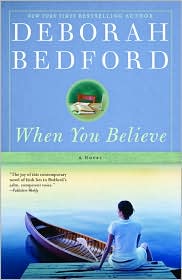
Book Review: When You Believe


When You Believe. Deborah Bedford. 2003/2009. Faith Words. 288 pages.

The afternoon started like any other afternoon. the first Tuesday of October was a solid, bright school day, and outside on the school steps, the sun fell across everyone's arms like a warm shawl.

Lydia Porter is a school guidance counselor. One day a student, Shelby Tatum, comes to her with a shocking story. She's being sexually abused. When Lydia asks her to name her abuser, Lydia is in for the shock of her life, because the man Shelby names is the love of Lydia's life, a man who has just asked her to marry him. Obligated in so many ways to report the abuse, Lydia does what she must. But it isn't easy. It is breaking her heart. Because she believes that Charlie, the man in question, couldn't have done this. But. She also believes that the abuse is real. Someone is abusing Shelby, even if that someone isn't Charlie. Someone needs to be Shelby's advocate. Someone needs to be there for Shelby. Someone needs to reassure Shelby that this is not her fault. That the abuse is not her fault. That she's not a bad person. But being there for Shelby--appearing to take her side--may cost her her happily ever after. Even if Charlie were to be proven innocent. Would he be able to forgive her for her role in this? Lydia is learning that some things you just have to trust God on.

When You Believe is a compelling contemporary novel. It explores what happens when accusations are made, how easy it is for a community, a school, a church family, to be torn apart by taking sides.

© Becky Laney of Operation Actually Read Bible

Monday, July 5, 2010

Book Review: A Morning Like This


A Morning Like This. Deborah Bedford. 2002/2009. Faith Words. 336 pages.

They sat together at their favorite corner table, two of them alone, absorbed in the candlelight and in each other.

David and Abigail Treasure have a "perfect" marriage. The book opens with the two spending their anniversary together. Everything just as cozy as can be. But the very next morning, the perfect marriage begins to crumble. Why? A message left on their answering machine. A message for David from a woman he'd known nine years ago. He's angry and confused. Why would she call his home? Why would she call now?

Susan, the "other" woman, has a good reason--a very good reason for getting back in touch with her former lover. You see, she has a daughter, a dying daughter. Samantha has leukemia, she needs a bone marrow transplant. David and his son, Braden, might be the best chance for Sam to make a recovery.

David has so much to lose--his wife's love, her trust, her respect, his son's love and respect as well, and then there is his church family--but there is something very precious to be gained. David has the opportunity--if he chooses--to get to know his daughter. As much as he hates his sin, his mistake, he can't help looking at his daughter with anything but love. And that's a good thing, right?

One thing surprised me, in a way, about A Morning Like This. I was surprised at who I felt sympathy for. I was surprised that David was the one I most sympathized with. I'm not sure why either.

A Morning Like This is a compelling contemporary novel exploring love and marriage, life and faith. I thought it was well-written. I found the characters to be realistically flawed.

© Becky Laney of Operation Actually Read Bible
Sunday, July 4, 2010

Book Review: Magdalene


Magdalene. Angela Hunt. 2006. Tyndale. 448 pages.

Silence, as heavy as doom, wraps itself around me as two guards lead me into the lower-level judgment hall. When I fold my hands, the chink of my chains disturbs the quiet.

My first impression of Magdalene was a good one. I started the book and felt it had great promise. It's biblical fiction. It's a fictional account of Mary Magdalene. (Miryam of Magdala) It's a nice blend of fact and fiction. We don't know that much about her--as a person, her life before, her life after--but we do know she was a follower of Jesus. The middle third of the book focuses on the year(s) she spent following Christ. The teachings. The parables. The miracles. The signs. Witness to it all. Did Miryam understand who Jesus was? Not in this account. Is that her fault? I don't think so. I think many followers--men and women--were confused, were frustrated, by Jesus' real mission. A mission that led all the way to the cross, but didn't end there. Miryam certainly wouldn't have--couldn't have--predicted the true mission, the true purpose.

The book imagines much more than that however. Readers see the before picture. A Miryam so angry, so bitter, so confused, so hurt that she goes to the dark side. What led her to such a place? Well, in this account, Miryam has lost her husband and her children to the brutality of Roman soldiers. Miryam becomes obsessed with revenge, with justice. She'll do anything--even if it means inviting strange new gods into her life--to get what she wants.

Jesus (in Hunt's account Yeshua) heals Miryam, welcomes her, forgives her. But is that the end of this story? Should that be the end of this story?

Magdalene is a novel within a framework. Miryam is sharing her story with an unfriendly audience--a Roman audience. She's been sentenced to death. And she's telling us just why she's about to die. The whole book is working towards this very dramatic conclusion. You may think you know why she's there, but you may just be surprised. I know I was.

I said I had a good first impression, well, my impression had changed by the end. The good news--Miryam is a human character, a fully flawed human character. The bad news is I was disappointed with Miryam. I wanted a different story, a different result. I can't say much more than that really. Not without spoiling some of the book's twists.

Magdalene is a compelling novel. It kept me reading. Even when I wanted to throw the book across the room, I wanted needed to know what happened next.

© Becky Laney of Operation Actually Read Bible
Sunday Salon: Week In Review: June 27-July 3

This week I...

finished Hebrews ESV Thinline
read Genesis 25-39 in the Holman Christian Standard Bible

© Becky Laney of Operation Actually Read Bible