Showing posts with label 2002. Show all posts

Tuesday, April 15, 2025

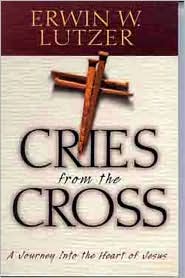
34. Cries from the Cross


34. Cries from the Cross. Erwin Lutzer. 2002. Moody. 170 pages. [Source: Bought] [5 stars, christian nonfiction]

First sentence: Were you there when they crucified my Lord? As a child I wondered what those words could possibly mean. Obviously, the author of the hymn intended that we answer yes to the question. And yet, what could be clearer than the fact that I was not there when they crucified my Lord? 

Cries from the Cross is a wonderful book--whether you are reading it for the first time or treating yourself to a reread. In this one, Lutzer is examining Jesus' words spoken from the cross. There is a chapter for each of Jesus' seven statements or 'cries.' There's also a preface, introduction, and epilogue that help set the book into context. 

Do you know what Jesus' seven cries from the cross were? Have you considered how they can speak into your life--how they relate to you personally? If you haven't--or even if you have--it's worth pondering (again). I know that 'pondering' or 'meditating' or 'reflecting' takes time and that the average person prioritizes just about everything else over silence or quiet--but at what costs to our souls? 

Here they are in the order in which he writes about them:
  • A Cry for Pardon: "Father, forgive them, for they do not know what they are doing." (Luke 23:34)
  • A Cry of Assurance: "Today you will be with me in paradise." (Luke 23:43)
  • A Cry of Compassion: "Dear woman, here is your son...Here is your mother." (John 19:26-27)
  • A Cry of Anguish: "My God, my God, why have you forsaken me?" (Matthew 27:46)
  • A Cry of Suffering: "I am thirsty." (John 19:28)
  • A Cry of Victory: "It is finished." (John 19:30)
  • A Cry of Submission: "Father, into your hands I commit my spirit." (Luke 23:46)

Lutzer clearly and passionately shares the gospel message--that old, old story--that gospel message that when empowered by the Spirit--through the Spirit--can transform lives and take people out of darkness and into the light.

I love, love, love, love, LOVE this one. It is a thrilling read. This was my second or perhaps third time to read it.

Quotes:

To stand at the foot fo the cross is to witness the purpose for which God created the world. Here we see the attributes of God on display; and if we look carefully, we will see ourselves, with all of our needs, sins, and self-deceptions. Thankfully, it is at the cross that God chose to remove His wrath from those who would humbly trust Christ as their sin-bearer. (11)
The cross properly understood exalts no one whom it first does not humble; it gives life only to those whom it first "puts to death." The cross exposes the futility of our self-righteousness; it reminds us that we are sinners, incapable of bringing about our own reconciliation with God. Before the cross we can only stand with bowed heads and a broken spirit. (16)
Unless we see ourselves as deserving of the verdict that Pilate gave to Jesus, unless we see ourselves as worthy of hell, we will never understand the Cross. Someone has said that it is difficult for us to embrace the cross in a day when personal enjoyment is king. Contrary to popular belief, the central message of Christianity is not the Sermon on the Mount or Jesus' parables about love toward one's neighbor. The message that changed the first-century world was that human beings are guilty, helplessly guilty of sins for which they cannot atone. The cross shatters all pride and undercuts the ultimate value of self-effort. The cross stands as proof of God's great love but also reveals our own ugliness. (17)
The church can only live and breathe at the cross; without it, there is no life and no reason to exist. Properly proclaimed, it is "the power of God unto salvation." (19)
Jesus' suffering was terrible for the simple reason that our sin is terrible. (20)
No one can experience the eternal favor of God if they bypass the cross. (25)
Christ was forsaken that we might not be; He experienced hell that we might experience heaven. (28)
Forgiveness sounds like a marvelous idea until you are the one who has to do it. (33)
Words of forgiveness came from His lips when the nails were being driven into His body, when the pain was fiercest, when the jolts of anguish were the sharpest; He prayed as the cross was lowered into the hole with a thud. It was then, when His nerves were yet the most tender, when the pain was the most unfathomable, He who was the victim of history's greatest crime prayed for the criminals. He could forgive because He was about His Father's business. (36-7)
God never lowers His standard of justice to the level of our ignorance. Sins committed in ignorance are still sins. The guilt of those who crucified Jesus was real and objective regardless of how much they understood or did not understand. (41)
We have no idea of the greatness of our sin because we do not understand the greatness of our God. But we have fewer excuses today than ever; we have no reason to turn away from the savior who left us powerful witnesses to His authenticity. (42)
The prayer was not for those who did not want to be forgiven, but for those who would seek it. (45)
Are some sins "unpardonable"? The answer is no, for if the murder of the Son of God was "forgivable" for those who sought forgiveness, then all sins can be forgiven. (46)
There is no unpardonable sin for those who come to Christ for forgiveness. For those who refuse Him, all sins are unpardonable. (46)
He who needed no forgiveness died for those of us who are condemned without it. (47)
Although God forgives us because of Christ, it is neither His job nor His obligation to do so. He forgives us because of undeserved mercy toward us whose just punishment is hell. The cross is the bridge of redeeming love; on it, we walk across the chasm to God, who graciously provided forgiveness for those who believe. If we do not understand this, we do not understand the gospel. (47)
At His birth He was surrounded by beasts, and, now in His death, with criminals. Let no one say God has stayed aloof from the brokenness of our fallen world. He descended that we might ascend with Him to newness of life. (54)
Helplessness is not a curse if it draws us to the only One who can help us. Indeed, if we are not helpless, we cannot be saved. (56)
Jesus was numbered with the transgressors so that you and I could be numbered with the redeemed. Though personally sinless, He was counted as a transgressor by both God and man. He got what He didn't deserve, namely, our sin; and we got what we didn't deserve, namely, His righteousness. (66)
Warren Wiersbe points out that this man was not saved at his last opportunity, but at his first opportunity. (68)
The thief's forgiveness reminds us that there is more grace in God's heart than sin in our past. (69)
If we had been there, how close would we have stood to the cross? Nearby or at a comfortable distance? Would we have been intimidated by the mob, or would we have gladly let the angry rabble-rousers know that we were followers of the Man hanging on the middle cross? Would we stand nearby even if the cross cost us as much as it cost Christ? (82)
Christ did not die to make the Father loving, for He loved us from the foundation of the world. (89)
The first purpose of the cross was not for us, but for God. Yes, Jesus shed His blood for us, but it is even more true to say that He shed His blood for the Father. When the blood was sprinkled on the doorposts of the houses in Egypt, it was put there for the benefit of the families, but it was also put there for God. Jehovah said, "When I see the blood, I will pass over you" (Exodus 12:13). (100)
Let us remember that He was forsaken by God that we might be accepted by Him... Jesus went through darkness that we might have light. He was cursed that we might be blessed. He was condemned that we might be able to say, "Therefore there is now no condemnation for those who are in Christ Jesus" (Romans 8:1). He suffered hell for us so that we can enjoy heaven with Him. (103)
Either Jesus bears our sin, or we do. If the Father turned His face away from His beloved Son when He was regarded as a sinner, we can be sure that the Father will turn away from every sinner who stands before the Judgement Bar on his own merits. We are either saved by His rejection, or we must bear our own rejection for all of eternity. If those who are in hell should cry, "Why have You forsaken me?" heaven shall remain silent, for they receive the just recompense for their deeds. (103-4)
As Matthew Henry put it, "The torments of hell are represented by a violent thirst, in the complaint of the rich man who begged for a drop of water to cool his tongue. To that everlasting thirst we had all been condemned, if Christ had not suffered on the cross." Hell is heightened desires with decreased satisfaction. Hell is the inflamed desires of the body, with no possibility of a drink. Hell is remembering the Living Water we could have enjoyed on earth that would have taken us to heaven. Hell is a lake of fire, a place of endless, unquenchable thirst. Thankfully, Jesus suffered parched lips that we might be able to drink from the wells of salvation. He endured the thirst of hell, so that its fires might be quenched for us. Of those in heaven we read, "Never again will they hunger; never again will they thirst. The sun will not beat upon them, nor any scorching heat. For the Lamb at the center of the throne will be their Shepherd; he will lead them to springs of living water. And God will wipe away every tear from their eyes" (Revelation 7:16-17). (115)
Jesus drank from the cup of death that we might be able to drink from the cup of life. (116)
If your spirit does not go into the hands of God for sakekeeping, it will go into the hands of God for judgment. (146)

© Becky Laney of Operation Actually Read Bible

Monday, March 3, 2025

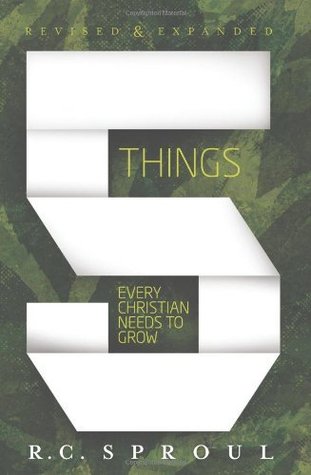
21. Five Things Every Christian Needs to Grow


21. Five Things Every Christian Needs To Grow. R.C. Sproul. 2002/2008. Reformation Trust. 135 pages. [Source: Free Download? Bought?]

First sentence: It is a worldwide phenomenon. Every four years, the world pauses and holds its collective breath while the Olympic Games take place.

Premise/plot: The Christian life is a disciplined life. Sproul writes, "like Olympic athletes, Christians are called upon to train, to make sacrifices, and to embrace certain disciplines in order to give God "our utmost for His highest." This book deals with five of those disciplines: Bible study, prayer, worship, service, and stewardship." There is a chapter dedicated to each discipline or grace. Through the disciplines, grace flows and abounds.

My thoughts: This is a solidly biblical book.

I enjoy spending time with R.C. Sproul. It is good for my soul. I enjoy his stories. For example, "As a new Christian I was infatuated with Scripture. I wanted to spend almost every waking moment reading it. As a result, I made the dean's list in my first semester of college. It was not the list of academic achievement, however; it was the list of students placed on academic probation." OR "At seminars, I often ask for a show of hands indicating ing how many people have read the entire Bible. Rarely do even 50 percent of the people answer "yes." I ask, "How many of you have read the book of Genesis?" Almost everyone raises his hand. Then I say, "Keep your hand up if you've also read Exodus." Only a few hands are lowered. "Leviticus?" That's when hands start dropping quickly. With Numbers it's even worse."

I enjoy his practical teaching. For example, "I suggest that you put a question mark in the margin beside every passage that you find unclear or hard to understand. Likewise, put an X beside every passage that offends you or makes you uncomfortable. Afterward, you can focus on the areas you struggle with, especially the texts marked with an X. This can be a guide to holiness, as the Xs show us quickly where our thinking is out of line with the mind of Christ." Further: "If I don't like something I read in Scripture, perhaps I simply don't understand it. If so, studying it again may help. If, in fact, I do understand the passage and still don't like it, this is not an indication there is something wrong with the Bible. It's an indication that something is wrong with me, something that needs to change. Often, before we can get something right, we need to first discover what we're doing wrong."

I enjoy his honesty. "I don't think there is any area of the Christian life in which people are more weighed down by guilt than in the area of their prayer lives. Most Christians will readily confess that their prayer lives are not what they should be. And one major reason for this problem is that Christians don't really know how to pray effectively." Another favorite of mine is, "I hear people say, "Doctrine divides." Of course doctrine divides, but it also unites. It unites the ones who love God's truth and are willing to worship Him according to that truth. God wants people to worship Him from the heart and from a mind that is informed of who He is by His Word."

His works are full of gems and insights. For example, "I think one of the reasons many Christians never get to the meat of the Word but remain at the milk level is because they never really learned how to drink the milk."

Quotes: 
  • Though sin often brings immediate pleasure, it gives no lasting joy. If we understand the difference, we can avoid the pitfalls that entice the believer.
  • Deception through distortion of the truth of God is a major problem that confronts every generation and every Christian community.
  • The value of the Bible lies, first of all, in the fact that it teaches sound doctrine. Though we live in a time when sound teaching is denigrated, the Bible places a high value on it. Much of the New Testament is concerned with doctrine. The teaching ministry is given to the church for building up its people. Paul said, "And He Himself gave some to be apostles, some prophets, some evangelists, and some pastors and teachers, for the equipping of the saints for the work of ministry, for the edifying of the body of Christ" (Eph. 4:11-12).

© Becky Laney of Operation Actually Read Bible

Wednesday, April 5, 2023

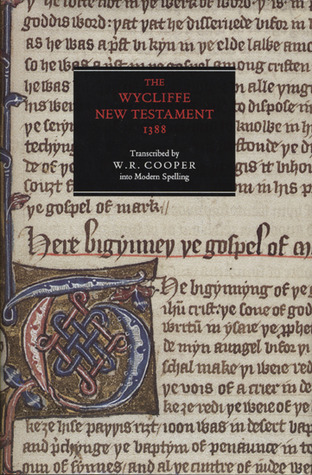
2.5 Wycliffe New Testament 1388


Wycliffe New Testament 1388: An edition in modern spelling, with an introduction, the original prologues, and the Epistle to the Laodicieans. William R. Cooper, ed. 2002. British Library. 528 pages. [Source: Bought]

ETA: I believe this is the third time I've read (and reviewed) the Wycliffe New Testament. I do love it. It isn't one that I read for understanding/comprehension. It is more of a burst of flavor. I like some of the phrasing, some of the archaic peculiarities. It was a delight to spend time with this one again.

Can you imagine NOT having a Bible in your own language? Today we're used to dozens and dozens of translations to choose from--all in English, of course. But this wasn't always the case.

This New Testament is a translation from the Latin into English--the first of its kind. It was translated not by John Wycliffe himself, but, by his followers, the Lollards. The 1388 edition was published after Wycliffe's death in 1384. Essentially, the Lollards placed great value in the authority of the Scripture, and wanted the Bible to be translated into English so everyone could read it for themselves. The Bible was not for the religious or academic elite, but, for everyone.
After the initial translation was finished, talented scribes set to work copying out the Lollard text. With the dangerous associations of Lollardy, both Church and State sought its elimination, and in 1401 a statute was issued banning the Later Version upon pain of death. Lollards were prosecuted for their beliefs and their ownership of forbidden texts. The efforts, however, failed to stop the reproduction of the texts, and scribes continued to copy faithfully the Lollard texts, risking great danger to themselves. (vii)
Is this a translation for each and every believer? Probably not. But it is a joy and treat for some I imagine!

Is it reader-friendly and accessible? Yes and no. Your knowledge of the New Testament + the glossary + the context of the verse/passage = readability and accessibility.
For God loved so the world that He gave His one begotten Son, that each man that believes in Him perish not, but have everlasting life. For God sent not His Son into the world that He judge the world, but that the world be saved by Him. He that believes in Him is not deemed. But he that believes not, is now deemed, for he believes not in the name of the one begotten Son of God. And this is the doom, for light came into the world, and men loved more darkness than light, for their works were evil. (John 3:16-19)
Therefore Jews grouched of Him, for He had said, I am bread that came down from heaven. And they said, Whether this is not Jesus, the son of Joseph, whose father and mother we have known? How then says this that, I came down from heaven? Therefore Jesus answered and said to them, Nil ye grouch together. No man may come to Me but if the Father that sent Me draw him, and I shall again-raise him in the last day. (John 6:41-44)
Nil ye deem, that ye be not deemed. For in what doom ye deem, ye shall be deemed, and in what measure ye mete, it shall be meted again to you. But what see thou a little mote in the eye of thy brother, and see not a beam in thine own eye? Or how say thou to thy brother? Brother, suffer I shall do out a mote from thine eye, and lo, a beam is in thine own eye? Hypocrite! Do thou out first the beam of thine eye, and then thou shall see to do out the mote of the eye of thy brother. (Matthew 7:1-5)
Therefore, brethren, I beseech you by the mercy of God, that ye give your bodies a living sacrifice, holy, pleasing to God, and your service reasonable. And nil ye be conformed to this world, but be ye reformed in newness of your wit, that ye prove which is the will of God, good and well-pleasing, and perfect. (Romans 12:1-2)
For by grace ye are saved by faith, and this not of you, for it is the gift of God, not of works, that no man have glory. (Ephesians 2:8-9)
And do ye all things without grouchings and doubtings, that ye be without plaint and simple as the sons of God, without reproof in the middle of a shrewd nation and a wayward, among which ye shine as givers of light in the world. (Philippians 2:14-15)
Joy ye in the Lord evermore, eft I say, joy ye. (Philippians 4:4)
Savour ye those things that are above, not those that are on the earth. For ye are dead, and your life is hidden with Christ in God. (Colossians 3:2-3
Did I love it? Yes, I loved, loved, LOVED it. This is actually the second time I've read this one. I read it the first time in 2009, I believe? It's been a while. But it was a great way to start off the new year!!!

© Becky Laney of Operation Actually Read Bible

Wednesday, July 15, 2020

1. Wycliffe New Testament

Wycliffe New Testament 1388: An Edition in Modern Spelling, with An Introduction, The Original Prologues, and the Epistle to the Laodiceans. Anonymous Lollards. Edited by William R. Cooper. 2002. 528 pages. [Source: Bought]

First sentence: The book of the generation of Jesus Christ, the son of David, the son of Abraham. Abraham begat Isaac. Isaac begat Jacob. Jacob begat Judas and his brethren.

I absolutely LOVE, LOVE, LOVE the Wycliffe New Testament. I believe this is the second time I've read it. I first became interested in it after Mom got a copy and started sharing portions of it with me aloud. I had a serious case of Bible envy! So I got my own copy.

I will try to share with you why I find it so charming and enjoyable.

Lo, the angel of the Lord appeared in sleep to. him and said, Joseph, the son of David, nil thou dread to take Mary, thy wife, for that thing that is born in her is of the Holy Ghost. And she shall bear a son, and thou shall call his name Jesus, for He shall make His people safe from their sins. (Matthew 1)

Nil thou trump tofore thee as hypocrites do in synagogues and streets, that they may be worshipped of men... (Matthew 6)

Nil ye deem, that ye be not deemed. For in what doom ye deem, ye shall be deemed, and in what measure you mete, it shall be meted again to you. (Matthew 7)

All ye that travail and are charged, come to Me and I shall fulfil you. Take ye My yoke on you and learn of Me, for I am mild and meek in heart, and ye shall find rest to your souls. For my yoke is soft, and My charge light. (Matthew 11)

For he that highs himself shall be meeked, and he that meeks himself shall be enhanced. (Matthew 23)

And shepherds were in the same country, waking and keeping the watches of the night on their flock. And lo, the angel of the Lord stood beside them, and the clearness of God shone about them, and they they dreaded with great dread. And the angel said to them, Nil ye dread, for lo, I preach to you a great joy that shall be to all people. For a Savior is born today to you that is Christ the Lord in the city of David. And this is a token to you, ye shall find a young child lapped in cloths and laid in a cratche. (Luke 2)

In the beginning was the Word, and the Word was at God, and God was the Word. This was in the beginning at God. All things were made by Him, and without Him was made nothing, that thing that was made. In Him was life, and the life was the light of men. And the light shines in darknesses, and darknesses comprehended it not. (John 1)

For God loved so the world that He gave His one begotten Son, that each man that believes in Him perish not, but have everlasting life. For God sent not His son into the world that He judge the world, but that the world be saved by Him. He that believes in Him is not deemed. But he that believes not, is now deemed, for he believes not in the name of the one begotten Son of God. And this is the doom, for light came into the world, and men loved more darknesses than light, for their works were evil. (John 3)

Truly, truly, I say to you that he that hears My Word and believes to Him that sent Me, has everlasting life. And he comes not into doom, but passes from death into life. (John 5)

All thing that the Father gives to Me shall come to Me, and I shall cast him out that comes to Me. For I came down from heaven not that I do My will, but the will of Him that sent Me. And this is the will of the Father that sent Me, that all thing that the Father gave Me, I lose not of it, but again-raise it in the last day. And this is the will of My Father that sent Me, that each man that sees the Son and believes in Him, have everlasting life. And I shall again-raise him in that day. (John 6)

Therefore Jesus answered and said to them, Nil ye grouch together. No man may come to Me but if the Father that sent Me draw him, and I shall again-raise him in the last day. (John 6)

Jesus says to her, I am again-rising and life. He that believes in Me, yea, though he be dead, he shall live. And each that lives and believes in Me, shall not die without end. (John 11)

Be not your heart afeared, nor dread it. Ye believe in God, and believe ye in Me. In the house of My Father are many dwellings. If anything less, I had said to you, for I got to make ready to you a place. And if I go and make ready to you a place, eftsoons I come, and I shall take you to Myself, that where I am, ye are. (John 14)

In the world ye shall have disease. But trust ye, I have overcome the world. (John 16)

Hallow thou them in truth. Thy word is truth. (John 17)

Therefore when Jesus had taken the vinegar, He said, It is ended! And when His head was bowed down, He gave up the ghost. (John 19)

For all men sinned and have need to the glory of God, and are justified freely by His grace, by the again-buying that is in Christ Jesus. (Romans 3)

And we wit that to men that love God, all things work together into good to them that after purpose are called saints. For the ilk that He knew before, He before ordained by grace to be made like to the image of His Son, that He be the first begotten among many brethren. And the ilk that He before ordained to bliss, them He called, and which He called, them He justified, and which He justified, and them He glorified. (Romans 8)

Oh, the highness of the richesses of the wisdom and of the kunning of God. How incomprehensible are His dooms, and His ways are unsearchable! For why, who knew the wit of the Lord, or who was His counsellor? Or who former gave to Him, and it shall be quit to him? For of Him and by Him and in Him are all things! To Him be glory into worlds. Amen! (Romans 11)

Nil ye be conformed to this world, but be ye reformed in newness of your wit, that ye prove which is the will of God, good and well-pleasing, and perfect. (Romans 12)

For when I am sick, then I am mighty. (2 Corinthians 12)

Therefore brethren, see ye how warily ye shall go, not as unwise men, but as wise men, again-buying time for the days are evil. Therefore, nil ye be made unwise, but understanding which is the will of God. (Ephesians 5)

Clothe you with the armour of God, that ye moun stand against aspyings of the devil. (Ephesians 6)

Joy ye in the Lord evermore, eft I say, joy ye. Be your patience known to all men. The Lord is nigh. Be ye nothing busy, but in all prayer and beseeching with doing of thankings, be your askings known at God. And the peace of God that passes all wit, keep your hearts and understandings in Christ Jesus. (Philippians 4)

For this thing, I say, that no man deceive you in height of words. (Colossians 2)

Therefore more plenteously it behoves us to keep those things that we have heard, lest peradventure we float away. (Hebrews 2)

For the word of God is quick and speedy in working, and more able to pierce than any twain-edged sword, and stretches forth to the departing of the soul and of the spirit, and of the jointures and marrows, and deemer of thoughts and of intents and hearts. And no creature is unvisible in the sight of God. For all things are naked and open to His eyes, to whom a word to us. (Hebrews 4)

Wherefore also He may save without end, coming nigh by Himself to God and evermore lives to pray for us. (Hebrews 7)

Therefore, we that have so great a cloud of witnesses put to, do we away all charge and sin standing about us. And by patience run we to the battle purposed to us, beholding into the Maker of faith and the perfect Ender, Jesus, which, when joy was purposed to Him, He suffered the cross and despised confusion, and sits on the right half of the seat of God. (Hebrews 12)

But ye are a chosen kin, a kingly priesthood, holy folk, a people of purchasing, that ye tell the virtues of Him that called you from darkness into His wonderful light, which sometime were not a people of God. But now ye are the people of God, which had not mercy, but now ye have mercy. (1 Peter 2)

But dread ye not the dread of them, that ye be not disturbled. But hallow ye the Lord Christ in your hearts, and evermore be ye ready to satisfaction to each man asking you reason of that faith and hope that is in you. (1 Peter 3)


© Becky Laney of Operation Actually Read Bible

Friday, March 29, 2019

Book Review: Cries from the Cross

Cries From the Cross: A Journey Into the Heart of Jesus. Erwin Lutzer. 2002. Moody. 170 pages. [Source: Bought]

First sentence: Were you there when they crucified my Lord? As a child I wondered what those words could possibly mean. Obviously, the author of the hymn intended that we answer yes to the question. And yet, what could be clearer than the fact that I was not there when they crucified my Lord? 

Cries from the Cross is a wonderful book--whether you are reading it for the first time or treating yourself to a reread. In this one, Lutzer is examining Jesus' words spoken from the cross. There is a chapter for each of Jesus' seven statements or 'cries.' There's also a preface, introduction, and epilogue that help set the book into context. 

Do you know what Jesus' seven cries from the cross were? Have you considered how they can speak into your life--how they relate to you personally? If you haven't--or even if you have--it's worth pondering (again). I know that 'pondering' or 'meditating' or 'reflecting' takes time and that the average person prioritizes just about everything else over silence or quiet--but at what costs to our souls? 

Here they are in the order in which he writes about them:
  • A Cry for Pardon: "Father, forgive them, for they do not know what they are doing." (Luke 23:34)
  • A Cry of Assurance: "Today you will be with me in paradise." (Luke 23:43)
  • A Cry of Compassion: "Dear woman, here is your son...Here is your mother." (John 19:26-27)
  • A Cry of Anguish: "My God, my God, why have you forsaken me?" (Matthew 27:46)
  • A Cry of Suffering: "I am thirsty." (John 19:28)
  • A Cry of Victory: "It is finished." (John 19:30)
  • A Cry of Submission: "Father, into your hands I commit my spirit." (Luke 23:46)

Lutzer clearly and passionately shares the gospel message--that old, old story--that gospel message that when empowered by the Spirit--through the Spirit--can transform lives and take people out of darkness and into the light.

I love, love, love, love, LOVE this one. It is a thrilling read. This was my second or perhaps third time to read it.

Quotes:

To stand at the foot fo the cross is to witness the purpose for which God created the world. Here we see the attributes of God on display; and if we look carefully, we will see ourselves, with all of our needs, sins, and self-deceptions. Thankfully, it is at the cross that God chose to remove His wrath from those who would humbly trust Christ as their sin-bearer. (11)
The cross properly understood exalts no one whom it first does not humble; it gives life only to those whom it first "puts to death." The cross exposes the futility of our self-righteousness; it reminds us that we are sinners, incapable of bringing about our own reconciliation with God. Before the cross we can only stand with bowed heads and a broken spirit. (16)
Unless we see ourselves as deserving of the verdict that Pilate gave to Jesus, unless we see ourselves as worthy of hell, we will never understand the Cross. Someone has said that it is difficult for us to embrace the cross in a day when personal enjoyment is king. Contrary to popular belief, the central message of Christianity is not the Sermon on the Mount or Jesus' parables about love toward one's neighbor. The message that changed the first-century world was that human beings are guilty, helplessly guilty of sins for which they cannot atone. The cross shatters all pride and undercuts the ultimate value of self-effort. The cross stands as proof of God's great love but also reveals our own ugliness. (17)
The church can only live and breathe at the cross; without it, there is no life and no reason to exist. Properly proclaimed, it is "the power of God unto salvation." (19)
Jesus' suffering was terrible for the simple reason that our sin is terrible. (20)
No one can experience the eternal favor of God if they bypass the cross. (25)
Christ was forsaken that we might not be; He experienced hell that we might experience heaven. (28)
Forgiveness sounds like a marvelous idea until you are the one who has to do it. (33)
Words of forgiveness came from His lips when the nails were being driven into His body, when the pain was fiercest, when the jolts of anguish were the sharpest; He prayed as the cross was lowered into the hole with a thud. It was then, when His nerves were yet the most tender, when the pain was the most unfathomable, He who was the victim of history's greatest crime prayed for the criminals. He could forgive because He was about His Father's business. (36-7)
God never lowers His standard of justice to the level of our ignorance. Sins committed in ignorance are still sins. The guilt of those who crucified Jesus was real and objective regardless of how much they understood or did not understand. (41)
We have no idea of the greatness of our sin because we do not understand the greatness of our God. But we have fewer excuses today than ever; we have no reason to turn away from the savior who left us powerful witnesses to His authenticity. (42)
The prayer was not for those who did not want to be forgiven, but for those who would seek it. (45)
Are some sins "unpardonable"? The answer is no, for if the murder of the Son of God was "forgivable" for those who sought forgiveness, then all sins can be forgiven. (46)
There is no unpardonable sin for those who come to Christ for forgiveness. For those who refuse Him, all sins are unpardonable. (46)
He who needed no forgiveness died for those of us who are condemned without it. (47)
Although God forgives us because of Christ, it is neither His job nor His obligation to do so. He forgives us because of undeserved mercy toward us whose just punishment is hell. The cross is the bridge of redeeming love; on it, we walk across the chasm to God, who graciously provided forgiveness for those who believe. If we do not understand this, we do not understand the gospel. (47)
At His birth He was surrounded by beasts, and, now in His death, with criminals. Let no one say God has stayed aloof from the brokenness of our fallen world. He descended that we might ascend with Him to newness of life. (54)
Helplessness is not a curse if it draws us to the only One who can help us. Indeed, if we are not helpless, we cannot be saved. (56)
Jesus was numbered with the transgressors so that you and I could be numbered with the redeemed. Though personally sinless, He was counted as a transgressor by both God and man. He got what He didn't deserve, namely, our sin; and we got what we didn't deserve, namely, His righteousness. (66)
Warren Wiersbe points out that this man was not saved at his last opportunity, but at his first opportunity. (68)
The thief's forgiveness reminds us that there is more grace in God's heart than sin in our past. (69)
If we had been there, how close would we have stood to the cross? Nearby or at a comfortable distance? Would we have been intimidated by the mob, or would we have gladly let the angry rabble-rousers know that we were followers of the Man hanging on the middle cross? Would we stand nearby even if the cross cost us as much as it cost Christ? (82)
Christ did not die to make the Father loving, for He loved us from the foundation of the world. (89)
The first purpose of the cross was not for us, but for God. Yes, Jesus shed His blood for us, but it is even more true to say that He shed His blood for the Father. When the blood was sprinkled on the doorposts of the houses in Egypt, it was put there for the benefit of the families, but it was also put there for God. Jehovah said, "When I see the blood, I will pass over you" (Exodus 12:13). (100)
Let us remember that He was forsaken by God that we might be accepted by Him... Jesus went through darkness that we might have light. He was cursed that we might be blessed. He was condemned that we might be able to say, "Therefore there is now no condemnation for those who are in Christ Jesus" (Romans 8:1). He suffered hell for us so that we can enjoy heaven with Him. (103)
Either Jesus bears our sin, or we do. If the Father turned His face away from His beloved Son when He was regarded as a sinner, we can be sure that the Father will turn away from every sinner who stands before the Judgement Bar on his own merits. We are either saved by His rejection, or we must bear our own rejection for all of eternity. If those who are in hell should cry, "Why have You forsaken me?" heaven shall remain silent, for they receive the just recompense for their deeds. (103-4)
As Matthew Henry put it, "The torments of hell are represented by a violent thirst, in the complaint of the rich man who begged for a drop of water to cool his tongue. To that everlasting thirst we had all been condemned, if Christ had not suffered on the cross." Hell is heightened desires with decreased satisfaction. Hell is the inflamed desires of the body, with no possibility of a drink. Hell is remembering the Living Water we could have enjoyed on earth that would have taken us to heaven. Hell is a lake of fire, a place of endless, unquenchable thirst. Thankfully, Jesus suffered parched lips that we might be able to drink from the wells of salvation. He endured the thirst of hell, so that its fires might be quenched for us. Of those in heaven we read, "Never again will they hunger; never again will they thirst. The sun will not beat upon them, nor any scorching heat. For the Lamb at the center of the throne will be their Shepherd; he will lead them to springs of living water. And God will wipe away every tear from their eyes" (Revelation 7:16-17). (115)
Jesus drank from the cup of death that we might be able to drink from the cup of life. (116)
If your spirit does not go into the hands of God for sakekeeping, it will go into the hands of God for judgment. (146)

© Becky Laney of Operation Actually Read Bible

Wednesday, March 7, 2018

Book Review: 5 Things Every Christian Needs to Grow

Five Things Every Christian Needs To Grow. R.C. Sproul. 2002/2008. Reformation Trust. 135 pages. [Source: Free Download? Bought?]

First sentence: It is a worldwide phenomenon. Every four years, the world pauses and holds its collective breath while the Olympic Games take place.

Premise/plot: The Christian life is a disciplined life. Sproul writes, "like Olympic athletes, Christians are called upon to train, to make sacrifices, and to embrace certain disciplines in order to give God "our utmost for His highest." This book deals with five of those disciplines: Bible study, prayer, worship, service, and stewardship." There is a chapter dedicated to each discipline or grace. Through the disciplines, grace flows and abounds.

My thoughts: This is a solidly biblical book.

I enjoy spending time with R.C. Sproul. It is good for my soul. I enjoy his stories. For example, "As a new Christian I was infatuated with Scripture. I wanted to spend almost every waking moment reading it. As a result, I made the dean's list in my first semester of college. It was not the list of academic achievement, however; it was the list of students placed on academic probation." OR "At seminars, I often ask for a show of hands indicating ing how many people have read the entire Bible. Rarely do even 50 percent of the people answer "yes." I ask, "How many of you have read the book of Genesis?" Almost everyone raises his hand. Then I say, "Keep your hand up if you've also read Exodus." Only a few hands are lowered. "Leviticus?" That's when hands start dropping quickly. With Numbers it's even worse."

I enjoy his practical teaching. For example, "I suggest that you put a question mark in the margin beside every passage that you find unclear or hard to understand. Likewise, put an X beside every passage that offends you or makes you uncomfortable. Afterward, you can focus on the areas you struggle with, especially the texts marked with an X. This can be a guide to holiness, as the Xs show us quickly where our thinking is out of line with the mind of Christ." Further: "If I don't like something I read in Scripture, perhaps I simply don't understand it. If so, studying it again may help. If, in fact, I do understand the passage and still don't like it, this is not an indication there is something wrong with the Bible. It's an indication that something is wrong with me, something that needs to change. Often, before we can get something right, we need to first discover what we're doing wrong."

I enjoy his honesty. "I don't think there is any area of the Christian life in which people are more weighed down by guilt than in the area of their prayer lives. Most Christians will readily confess that their prayer lives are not what they should be. And one major reason for this problem is that Christians don't really know how to pray effectively." Another favorite of mine is, "I hear people say, "Doctrine divides." Of course doctrine divides, but it also unites. It unites the ones who love God's truth and are willing to worship Him according to that truth. God wants people to worship Him from the heart and from a mind that is informed of who He is by His Word."

His works are full of gems and insights. For example, "I think one of the reasons many Christians never get to the meat of the Word but remain at the milk level is because they never really learned how to drink the milk."

Thursday, December 22, 2016

Book Review: The Time of Christmas

The Time of Christmas. Suzanne Richterkessing. 1999/2002. Concordia. 32 pages. [Source: Bought]

First sentence: The cold fall wind sent the leaves skittering across the sidewalk.

Premise/plot: Smidge and Smudge are two mice who seek refuge in a big, warm-looking building that turns out to be the church. It isn't long before the two are listening to a voice explain a lot about the church and three seasons of the church: advent, Christmas, and epiphany.

My thoughts: It is just as instructional as I thought it might be. Readers learn along with mice--presumably--about advent wreathes, candles, chrismons, etc. The text is packed with information; it can get a little text-heavy at times. But it's a nice enough read.

Text: 3 out of 5
Illustrations: 3 out of 5
Total: 6 out of 10

© Becky Laney of Operation Actually Read Bible

Saturday, June 18, 2016

Book Review: When Daddy Prays


When Daddy Prays. Nikki Grimes. 2002. 32 pages. [Source: Library]

First sentence: May my children see beyond my muscles to your strength. May they find across my broad shoulders the imprint of your wings. May they feel your love in the hollow of my hand. May they hear your voice in the echo of my words.

Premise/plot: When Daddy Prays celebrates family life and PRAYER. This picture book is a collection of poems. Each poem either directly or indirectly concerns the father's prayer life both private and public. For example, the book opens with "A Father's Prayer." I would consider that an actual prayer. (See above). The next poem, "When Daddy Prays," is more of a son's poetic reflection of the effects of his father's prayers. In part, "When Daddy prays my fear of darkness disappears and angels tiptoe down the hall. I hear them through the door and wall. They whisper in a velvet husssshhh that floats me off to sleep when Daddy prays." The third poem, "Daddy Says," seems to be a child's prayer to God. It may just be my favorite of the whole book.
Daddy says
you rock him
in your arms
the way he
once rocked me.
That after he
tucks me in
and switches
off the light,
he whispers
secrets to you
through the night
exactly like
I whisper mine
to him.
But yesterday
I think
I heard him say
you're a better
listener.
My thoughts: I LOVED, LOVED, LOVED, LOVED, LOVED this one. I think it is a MARVELOUS celebration of family life, of a family's devotional life, of faith itself. What a WONDERFUL book celebrating Fathers as well.

Text: 5 out of 5
Illustrations: 5 out of 5
Total: 10 out of 10

© Becky Laney of Operation Actually Read Bible

Wednesday, March 2, 2016

Book Review: Walking As He Walked

Walking As He Walked. Joel R. Beeke. 2002/2007. 133 pages. [Source: Bought]

Walking As He Walked is a collection of four sermons preached by Joel R. Beeke all inspired by 1 John 2:6. In the book he argues that walking like Christ walked is not an optional "extra" for Christians; being a Christian by definition means walking like Christ walked. His point is not to expect perfection and instant victory. No, his point is that believers should want--should desire--to grow in Christlikeness, to aspire to a closer walk, a holier walk. We should strive to run the race, in other words. So what does it mean to walk like Christ? Here is how Beeke describes it:
Walking as Christ walked means making Jesus’ priorities my own by faith (John 6:38). It means delighting in and keeping God’s law as Jesus did (Ps. 40:8). It means having compassion for others, repaying evil with good, and acting in love (John 13:15; 1 Pet. 2:23; Luke 23:34). It means despising the same pleasures and vanities of this world that He despised, speaking and living the same truths that He spoke and lived, and being led by the same Spirit that led Him (Rom. 8:14).
The first chapter is on cross-bearing (Mark 15:21, Luke 23:26). The second is on office-bearing (prophet, priest, king). The third is on tears (John 11:35, Luke 19:41, Hebrews 5:7). The fourth is on endurance. Each chapter focuses first on Jesus: how he lived, how he "walked" before moving onto what it means for us, how it applies to how we live our lives, how we walk in this world.

I would have to say that I found his sermons thought-provoking. For example,
When we have an encounter with Jesus Christ, our lives are changed once and for all. Every time we hear the gospel, our path crosses the path of a crucified Jesus, who is now exalted and walks among us in the garments of the gospel. Each encounter will be either for our salvation or our damnation. It will soften or harden us—never leaving us exactly the same.
and
Too often we Christians expect too little of Jesus and too much of each other.
and
If you think that God does not care about your sorrows and that Jesus is insensitive to your suffering, your concept of God needs correction. Perhaps dullness, blindness, or unbelief makes you feel this way. We are told that “Jesus wept.” The message of those two words is that God cares for us.
and
If you will not think of Him or of yourself, then consider the tears of Jesus. He wept for those who would not weep for themselves, who did not think that they had anything to weep about. He mourned for those who were going down the broad road that leads to destruction; He wept for the perishing! Jesus wept because God has no pleasure in the death of the wicked. He wept for hell-worthy, perishing sinners. The fault for your unbelief is yours; there is no one else in the entire world you can blame it on. But note this: though Jesus wept because of your willful unbelief, He did not excuse you from punishment.
and
What do we weep over? If we each had two bottles, and into one we put all the tears we shed for ourselves in the past ten years and, into the other, all the tears we have shed over lost souls, which bottle would be fuller? Do most of our tears spring from selfish, earthly concerns, or do they spring from concerns for the eternal souls of those around us? Have we shed any tears we could claim before the Lord, as David did: “Put thou my tears into thy bottle: are they not in thy book?” (Ps. 56:8).
And I loved how full of quotes this one was!
Samuel Rutherford; he learned so much in the school of Christ that when he saw another affliction coming, he’d say, “Here comes my Jesus!”
And as Martin Luther used to say, “Letting God be God is half of all true religion.”
Dear friends, as we listen to the claims of the devil, we must say with Luther, “We tremble, for so much of what the devil says is true. The devil has enough strength in his tail to knock my conversion out of me.”
Daniel Smart, a nineteenth century Baptist preacher, once remarked, “The sweetest tears a believer sheds are always in relation to the precious blood of Jesus Christ.”
“Sin,” as John Owen put it, “is always at our elbow.”
Bunyan once said that if sin knocks on your door and you open the door, you have not sinned as long as you shut the door as soon as you recognize sin for what it is. We fall into sin when we welcome sin into the home of our minds and dwell upon it.
Luther was so encouraged by the Psalms when he was going through his own trials that he said, “I can scarcely see how you can be a Christian without David being one of your best friends.”
Luther quipped: “Some of my best friends are dead ones.”
I loved this one. I just loved, loved, loved it. This would be a great introduction to Joel Beeke. It is perhaps a tiny bit more reader-friendly than R.C. Sproul's Pleasing God which I reviewed earlier this year. Both books are on sanctification. Both have some great insights.

© Becky Laney of Operation Actually Read Bible

Wednesday, October 1, 2014

Book Review: Key Words of the Christian Life

Key Words of the Christian Life. Warren W. Wiersbe. 2002. Baker Books. 130 pages. [Source: Bought]

I like the idea or premise behind this one. I like the fact that Wiersbe is taking some of the most common theological terms and unpacking them or explaining them to readers.
Some Christians say, “Don’t bother me with doctrine; just give me the beautiful devotional thoughts of the Bible.” But if devotion is not based upon correct doctrine, it is not going to accomplish anything. It is merely shallow sentiment. In this first chapter I would like to explain why it is important for us to understand these key words of the Christian life. The reason is very simple: When we understand these words, we are able to live what they teach. When we understand these key words of the Christian life, then we know what a Christian is, what God has done for us, and what God wants to do for us.
The key words discussed in this one include: justification, adoption, regeneration, propitiation, imputation, sanctification, reconciliation, redemption, intercession, mediation, predestination, and glorification. (Some words get more than one chapter.)

The opening chapters build a foundation. They focus on the why. Why is it important to know the Bible, to understand the words of the Bible, the doctrines of the Bible? The rest of the book then focuses on specific words and doctrines. There is some overlap, perhaps, in doctrines covered, which is not a bad thing!

The book gives readers a general introduction to the essentials. Overall, I liked this one. I thought the book did a good job. That being said, I found myself disagreeing at times with how some of these doctrines were explained. In particular, I disagreed with a few things in his chapter on regeneration.
The reality of the new birth is that you can change; God will change you when you trust Christ.
Still this is one I'd recommend.

Similar books include Kendell Easley's 52 Words Every Christian Should Know and C. Michael Patton's Now That I'm A Christian.

Quotes:
Justification is the gracious act of God in declaring righteous the sinner who believes on Jesus Christ. You should memorize this definition because it is important. Notice, please, that justification is an act, not a process. No Christian is more justified than any other Christian.
Propitiation is the work of Jesus Christ on the cross by which He satisfied God’s holiness so God could extend mercy to lost sinners. If you look up the word propitiation in an English dictionary, you will find it defined as “appeasing someone’s anger.” Some people think God the Father is angry at lost sinners. They think He is sitting in heaven waiting to throw thunderbolts upon people who have disobeyed Him. Then God the Son comes up and says, “Now, Father, please don’t be angry! I will go and die for these sinners, and this will appease Your wrath.” Nothing could be further from the truth. To begin with, Jesus Christ and His Father and the Holy Spirit work together in this great plan of salvation. It is not that one wants to condemn and the other wants to forgive. When Jesus went to the cross of Calvary, the Father was there. It is true the Father forsook His Son when His Son was made sin, but that was just for a brief moment when our Savior cried out, “My God, my God, why have you forsaken me?” (Matt. 27:46). The Father and the Son and the Holy Spirit worked together in the plan of salvation. Propitiation does not mean that Jesus Christ came to appease God’s anger because the Father doesn’t love us. Some people have the idea that, because of His death on the cross, our Lord turned God’s wrath into love. Again, nothing could be further from the truth. Our God is a God of judgment. We want to be very clear about that. Throughout the Bible you find the revelation of the wrath of God as well as the mercy of God. There are almost twenty Hebrew words in the Old Testament translated “wrath.” There are more than five hundred references to wrath and judgment just in the Old Testament. Our Father in heaven is a loving Father, but He is also a holy Father. He is love (see 1 John 4:8), but He is also light (see 1:5). God’s anger does not turn into love, because this would mean that God is changing, and God does not change. Propitiation does not mean appeasing God’s unloving anger; propitiation does not mean turning God’s wrath into love. His wrath is a holy wrath; His judgment is a holy judgment. Because He loves holiness and hates sin, He has to be a God of judgment. Propitiation means that Christ satisfied the holiness of God so that God is able to extend grace and mercy to lost sinners. God is a free God, and because He is holy, sin has to be punished. God cannot break His own Law. If for one instant God broke His Law, the universe would fall apart. All of God’s attributes are consistent. His wisdom does not fight against His power. His power does not fight against His grace. His grace does not fight against His holiness. There is a cooperation, a consistency, a unity about the character of God. God’s attributes are consistent and unified, and so there is no need for Him to lay one aside for the other. God’s holiness demands that sin be punished. God cannot lie; God cannot break His own Law. His love moves Him to save the sinner, but His love is a holy love, and this is where propitiation comes in.

© Becky Laney of Operation Actually Read Bible

Wednesday, September 3, 2014

Book Review: Who Are You To Judge?

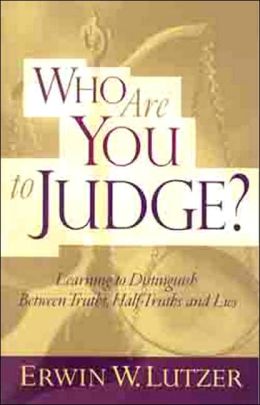
Who Are You To Judge? Learning To Distinguish Between Truths, Half-Truths, and Lies. Erwin W. Lutzer. 2002. Moody Press. 256 pages. [Source: Review copy]

Who Are You to Judge is the most recent book I've read on the subject of discernment.

Here is how the book opens,
The church is to be in the world as a ship is in the ocean; but when the ocean seeps into the ship, the ship is in trouble. I fear that the evangelical ship is taking on water. The world is seeping into the church so rapidly that we might well wonder how long the vessel can stay afloat. The church, which is called to influence the world, finds herself influenced by the world. If we as Christ's representatives can scarcely stay afloat, how can we expect to rescue a society that is sinking around us? We have bought into the world's values; into its entertainment; its morals, its attitudes. We have also bought into its tolerances, its insistence that we should never challenge the private beliefs of individuals, whether outside the church or within it. In the face of cultural pressures, we have found ourselves confused, hesitant to act, unable to give a loving but convincing witness to the world. (13)
and
Officially, we believe that without trusting Jesus as Savior people are lost; unofficially, we act as if what people believe and the way they behave really does not matter. No wonder our light has become a flicker and our salt has lost its savor. (16)
It hooked me from the beginning. It made me think. (Just like the Casting Crowns song "Love You With The Truth" makes me think. And those lyrics work well with this book, by the way. Truth matters. Love is called for, always called for, but, so is truth.)

Lutzer urges his readers to be discerning, to judge wisely. The first two chapters, "Why Are We Afraid to Judge" and "Judge Not, That You Be Not Judged" introduce the subject of judgment or discernment. They serve well as a general introduction. These chapters share some essentials that I believe every Christian needs to know and consider carefully. The nine chapters that follow focus on specifics: "When You Judge Doctrine," "When You Judge False Prophets," "When You Judge Miracles," "When You Judge Entertainment," "When You Judge Appearances," "When You Judge Neopaganism," "When You Judge Ghosts, Angels, and Shrines," "When You Judge Conduct," and "When You Judge Character." The book covers plenty.

Some chapters remain relevant and almost timeless. Other chapters feel a bit more dated, highlighting the fact that it was written twelve years ago. Did I agree with every single sentence, every single paragraph, every single chapter, probably not. Did I agree with most things generally speaking, probably.  In other words, I agreed more than I disagreed.

I liked this one. I liked that it requires you to think, to choose, to decide. I liked that it values truth above all else. I liked the place it gives Scripture. I liked that it emphasizes that what we think matters, that how we live matters. The book is practical in many ways. For example, in the chapter on entertainment, he suggests three tests: the content test, the control test, and the clock test. This book challenges you to change, encourages you to want to change. That doesn't make it easy, by the way.

© Becky Laney of Operation Actually Read Bible

Sunday, July 10, 2011

Book Review: Read Your Bible One Book at a Time

Read Your Bible One Book At A Time: A Refreshing Way To Read God's Word with New Insight and Meaning. Woodrow Kroll. 2002. Gospel Light Publications. 150 pages.

From the introduction:

Have you ever come home in the evening after a long day, clicked on the TV, and found yourself in the middle of a movie? You've missed the first half hour, so you missed the setup. What's the plot? Who are these characters? How do they relate to one another? Or maybe you're quietly watching your favorite TV program when the phone rings. It's your friend from work and she wants to talk. You mute the television. Yak, yak, yak. Finally you give up and just turn it off. You talk for almost an hour. You like your friend, but you're a little upset because you're never going to find out how your program ended. Some people read their Bible this way. They pick it up, begin in the middle of a book, and wonder why they can't figure out the story line. Or they let everything in life interrupt them. They read a chapter or two, lay God's Word aside, and never get back to it to find out how the story ends. You've probably struggled to make sense of the Bible, as everyone has. Maybe this book will help you in that endeavor. Reading whole books of the Bible in one sitting sounds like a crazy idea, but it works...Sometimes the more unusual the idea, the more likely it is to work.

Read Your Bible One Book At A Time is a refreshing way to discover the story line, uncover the plot, and find out how it all turns out. How does the plan work? It's embarrassingly simple. Just read one book of your Bible all the way through in one sitting. "You mean...?" Yes, read the whole book. Get the full story the writer intended you to get. Start at the beginning and don't quit until you reach the end. It sounds a little nutty, I know, but don't dismiss it until you've tried it. It's not really a novel idea, except as it applies to reading the Bible.
He continues,
If you wanted to read one book of the Bible--the whole book, beginning to end--which ones could you read during the same time it takes to watch It's a Wonderful Life? Hold on to your hat. You could read any book of the Bible except twelve. Only a dozen books of the Bible take longer to read than watching that classic Christmas movie. Nearly forty books of the Bible can be read in an hour or less. Half the books of the Bible can be read in less than thirty minutes. And twenty-six books can be read in fifteen minutes or less. That's pretty amazing for a book that many people think is too massive to read. When you think about it, time really isn't the problem when it comes to reading the Bible. It's a good excuse, but not good enough. How much we read of the only book God ever wrote depends mostly on how much of it we want to read. Reading God's Word is less dependent on our schedule and more dependent on our desire and discipline. (12-13)
Chapter one explains the features of the book (Read Your Bible One Book at a Time). It explains how to  best use the book. Chapter two provides readers with seven sensible reasons for reading the Bible one book at a time. (What do readers get from reading the Bible this way as opposed to reading it in other ways. What makes this system worth it...) Chapter three contains hints on how to succeed. He notes the importance of thinking inside the Book, but outside the box.
Reading through your Bible one book a time does not require a year. In fact, there is no minimum or maximum time to do this. But it does require you to think outside of the box. Most people believe the books of the Bible are too long, the language too difficult to understand, and those names--some of them are simply unpronounceable. But as we have seen, most books are not as long as people think. And the language used in the Bible can be quite user-friendly, especially if you read from your favorite translation or a new translation in which the language is more contemporary. And as for the names of people and places? Well, give it your best shot. If you stumble over them you have joined the majority of people who also have stumbled over them. (30)
In other words, the biggest challenge may just be you. You thinking that you can't do it, that it can't be done, that it's too impossible. But you can do it.

Chapter four is the LONGEST chapter! Kroll devotes one or two pages to each book of the Bible. These can be used as a resource when you're reading the Bible. Here is an idea of what each introduction covers:

John
The Book of Christ the Son of God
Written:
Author: John
Audience: Christians and non-Christians of the first century
Date: A.D. 85-95

Overview:
Subject: the life, teachings, death, resurrection, and post resurrection appearances of Jesus Christ
Scope: the events recorded in John's gospel cover from eternity past to the post-resurrection appearance of Jesus Christ in Galilee
Setting: the Holy Land--the Jordan Valley, Galilee, Samaria, Bethany, and Jerusalem

Three keys:
Key chapters: 3 (Jesus, only-begotten of the Father, Savior of the world); 10 (the believer's relationship with Jesus Christ); 15 (abiding in Christ); 19 (the crucifixion and death of Jesus Christ)
Key verses: John 1:1-3, 11-12, 29; John 3:14-18, 36; John 5:24, John 6:66-69; John 8:32, 36; John 14:1-6; John 17:17; John 18:38; John 19:16-21, 30, 38-42; John 20:13-16, 30-31; John 21:15-17
Key people: Jesus, John the Baptist, the disciples, Mary, Martha, Lazarus, Jesus' mother, Peter, Mary Magdalene, Joseph of Arimathea

Book profiles:
Number of chapters: 21
Number of verses: 879
Average reading time: 1 hour, 54 minutes

What to look for:
  • Jesus Christ as the Son of God (John 19:7)
  • John's careful presentation of the facts so as to bring his readers to believe that Jesus is the Son of God and Savior of the world
  • word pictures of who Jesus is, such as water, lamb, bread, light, shepherd, and vine
Why you should read John:
Nowhere is the gospel more clearly presented than in the Gospel of John. If you are looking for a way to share the gospel story with a friend. John has some classic passages that God's servants have used for generations, such as chapter three, five, and ten. Become familiar with these passages and you will never be a witless witness. (81-82)
I think these short introductions are great! I have really been loving reading text-only Bibles this year, but I have missed having short book introductions. This little book may come in very handy for me!!!

The book has SEVEN appendices. Appendix A provides short biographical paragraphs on all the authors of the books of the Bible. Appendix B is a detailed listing of every book in the Old Testament and New Testament. It includes how many chapters each book has and how many verses a book has. Appendix C lists the average reading time for every book in the Bible. The list goes from longest (Psalms and Jeremiah) to shortest (Jude, Malachi). The 'average reading time' listed in this appendix differs from that shared in each book profile. The times have been rounded up, I believe. (For example, Obadiah's time is listed as four minutes in the book profile on page 69, and as 1/4 of an hour in the appendix.) Still, the list does show you--at a glance--which books will take the most of your time. Appendices D-G are reading plans.

Appendix D A plan to read your Bible one book a time by reading Sundays only. If you prefer to read on Saturdays only (or any other day of the week), you could do that instead. By following this five-star plan you will complete your reading in one year of Sundays. Be sure to record the date on which you read each book.

First month
First Sunday -- Genesis -- 3 1/4 hours
Second Sunday -- Romans -- 1 hour
Third Sunday -- Exodus -- 2 1/2 hours
Fourth Sunday -- 1 Samuel -- 2 1/2 hours
Appendix E A plan to read your Bible one book at a time by reading just two days a week and one weekend day. You will complete your reading in six months with this five-star plan. Be sure to record the date on which you read each book.

First Month:
First Monday -- Ruth -- 1/4 hour
First Friday -- Zechariah -- 1/2 hour
First Sunday -- Psalms -- 3 3/4 hours
Second Tuesday -- Philippians -- 1/4 hour
Second Saturday -- 1 Kings -- 1 1/4 hours
Third Monday -- Song of Solomon -- 1/4 hour
Third Friday -- Romans -- 1 hour
Third Sunday -- Revelation -- 1 1/4 hours
Fourth Tuesday -- Colossians -- 1/4 hour
Fourth Thursday -- Ephesians -- 1/2 hour
Fourth Saturday -- Jeremiah -- 3 3/4 hours
Appendix F If you're looking for a real challenge and you want to read the Bible as expediently as possible in order to understand the complete message of the Book, this reading plan is for you. Be sure to record the date on which you read the books.

Appendix G Read in thirty-minute blocks of time over adjacent weekends to read your Bible one book at a time. For those who cannot read for more than half an hour at a time, or cannot read a book all the way through in one sitting, this is the next-best plan to maintain continuity and context. Plus, it allows you to read the Bible in order and only involves weekends. Start any weekend you like. Be sure to record the date on which you read each book. 
I am excited about this book! I am! While I've never tried reading the longer books--the longer Old Testament books--in one sitting, I do try to do that with the New Testament when possible. I've done this with most of the gospels and the book of Revelation, for example. And I think it does make a difference!

What do you think? Is this something you'd ever contemplate doing yourself? Why or why not?!

© Becky Laney of Operation Actually Read Bible

Saturday, May 14, 2011

Book Review: Why One Way?

Why One Way?: Defending an Exclusive Claim in an Inclusive World. John MacArthur. 2002. Thomas Nelson. 96 pages.

Why do evangelicals try so desperately to court the world's favor? Churches plan their worship services to cater to the "unchurched." Christian performers ape every worldly fad in music and entertainment. Preachers are terrified that the offense of the gospel might turn someone against them; so they deliberately omit the parts of the message the world might not like. Evangelicalism seems to have been hijacked by legions of carnal spin-doctors, who are trying their best to convince the world that the church can be just as inclusive, pluralistic, and broad-minded as the most politically-correct worldling. The quest for the world's approval is nothing less than spiritual harlotry. 

I love this book. I just LOVE this book. It's a book that is always relevant. Perhaps because there are always believers trying to compromise God's revealed truth in order to fit in with the world, in order to make the message more friendly to unbelievers, in order to blend in and avoid unpleasantness. Some perhaps are just weak and fearful. Some perhaps are just following others blindly. Assuming that the trust they've placed in others is well-founded. That surely these scholars, these teachers, these preachers, these authors, these experts know best. Others may be a bit more deliberate in thinking that they know better than God. That what they think about God--how they feel God is, how they imagine him to be--is more important than what the Bible says about God. 2 Timothy 4:3-4, for example, reads, "For the time is coming when people will not endure sound teaching, but having itching ears they will accumulate for themselves teachers to suit their own passions, and will turn away from listening to the truth and wander off into myths." (ESV)

I think this book is important for many reasons. One, to help readers understand that the truth is important. That it is necessary, it is wise, to be able to discern truth from error; fact from fiction. Two, it is grounded in the Bible. In each and every chapter the Bible is affirmed--it's true and authoritative--which serves as a reminder that believers should be reading and studying the Word, for how else can they be discerning? How can you know if that preacher or author is teaching the truth or a clever lie unless you're willing to investigate it yourself. Unless you hold the Bible to be absolute, the measure by which you judge or discern everything. You just can't say, well, that sounds good to me. Three, it helps challenge readers in their faith. Do you know the truth? Are you bold in proclaiming the truth? Or are you all too willing to make compromises? Are you serving the world more than you're serving Christ?

It's a short book; it's also reader-friendly. Even if the message itself isn't necessarily reader-friendly to every reader. Does this book have the potential to be offensive? I suppose. I mean it's proclaiming that the Bible is absolute truth, that what you believe does matter, that Jesus is the ONLY way, that all roads do NOT lead to God, that religions aren't equally true.

So the purpose of this one is to be "a reminder of the gospel's distinctiveness. That very narrowness sets Christianity apart from every other worldview. After all, the whole point of Jesus' best known sermon was to declare that the way to destruction is broad and well traveled, while the way of life is so narrow that few find it. (Matthew 7:14). Our task as ambassadors of God is to point to that very narrow way. Christ Himself is the one way to God, and to obscure that fact is, in effect, to deny Christ and to disavow the gospel itself." (x-xi)

My favorite quotes:

It is ironic that so many who are downplaying the exclusivity of Christ are doing it because they believe it is a barrier to relevance. Actually, Christianity is not relevant at all if it is merely one of many possible paths to God. The relevance of the gospel has always been its absolute exclusivity, summed up in the truth that Christ alone has atoned for sin and therefore Christ alone can provide reconciliation with God for those who believe only in Him. (ix-x)

Genuine faith in Christ entails a denial of every worldly value. Biblical truth contradicts all the world's religions. (2)

The word [tolerance] once meant respecting people and treating them kindly even when we believe they are wrong. The postmodern notion of tolerance means we must never regard anyone else's opinions as wrong. Biblical tolerance is for people; postmodern tolerance is for ideas. (14)

It is OK for postmodernists to be intolerant of those who claim they know the truth, particularly biblical Christians. In fact, those who fancy themselves the leading advocates of tolerance today are often the most outspoken opponents of evangelical Christianity. (15)

Authentic Christianity starts with the premise that there is a source of truth outside of us. Specifically, God's Word is truth. (Psalm 119:151; John 17:17). It is objectively true--meaning it is true whether it speaks subjectively to any given individual or not; it is true regardless of how anyone feels about it; it is true for everyone universally and without exception; it is absolutely true. (19)

Attend the typical evangelical home Bible study meeting and you will probably be invited to share your opinion about "what this verse means to me," as if the message of Scripture were unique to every individual. Rare is the teacher who is concerned with what Scripture means to God. (24)

Since His Word is objectively true and perfectly reliable in everything it teaches, Scripture should be both the starting point and the final test of truth in all our thinking. If Scripture is wholly true, then anything that contradicts Scripture is simply false, even if we're talking about the fundamental beliefs upon which the world's most popular ideologies are based. (31)

It's not as if we can make the words mean anything we want them to mean, so that whatever connotation we impose on the words becomes the Word of God. Only the true interpretation of the text is the authentic Word of God, and any other interpretation is simply not what God is saying. (34)

To speak boldly and declare that God has spoken with finality is neither stylish nor politically correct. But if we truly believe the Bible is the Word of God, how can we handle it any other way? (50)

Truth and error cannot be combined to yield something beneficial. They are as incompatible as light and darkness. (60)


© Becky Laney of Operation Actually Read Bible