
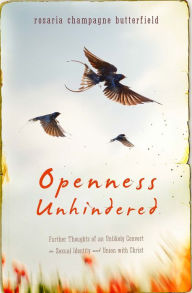
Openness Unhindered: Further Thoughts of an Unlikely Convert by Rosaria Champagne Butterfield was an interesting, weighty read. This isn't one to rush through, but, one to thoughtfully and deliberately engage with. I spent about two weeks reading this one, and I am glad I didn't rush it.
In some ways, this book revisits the conversion experience Butterfield wrote about in her first book. She writes of what it means to be a Christian, to believe and trust in Christ. She writes of repentance and confession. She writes of sanctification and holy living. She talks a lot about sin, about the roots of sin, about the need to battle sin. She tackles doctrine, tackles it fiercely. One of the doctrines she tackles--one that doesn't get a lot of attention these days--is the Christian's union with Christ.
But this book offers readers more than that. It addresses sexuality (homosexuality and heterosexuality) and culture. She declares war on culture essentially and specifically examines minutely all the words used by both sides.
From start to finish, this one is a thought-provoking read. Even if you find yourself disagreeing here and there, I think you'll find it is one that you can engage with spiritually or intellectually or preferably both. I do think it would be interesting to read this one with someone else so that you could bounce ideas--reactions--back and forth and continue the dialogue.
From the preface:
- Openness implies that we hold nothing back from the God who made us and will take care of us. We give him our heart, our desires, our hopes, our dreams, our struggles, our doubts, our fears, and our identity.
- Unhindered means that we are unencumbered by our failures; that is, we do not keep record of the countless times that we have failed God in sin, failed our friends in carelessness, and failed our own conscience by willfully disobeying the God who loves us. Instead of recordkeeping, we pray for the gift to repent of our sin at its foundation. We pray for the gift of God that redeems our mind, allowing us to see not through eyes of flesh, but rather through eyes remade by the Holy Spirit. Instead of remembering our already and often-repented sin, we remember God’s covenant with us in Christ, and Christ’s faithfulness.
- We violate those we love when we try to supplant Christ by trying to fill his role, or by removing ourselves from this lavish outpouring of love by refusing to take God’s point of view on the matter of sin—its nature, origin, and consequences. Christ loves his people best. We cannot love as he did. We cannot suffer as he did. We cannot redeem our lives, our worlds, or our relationships.
- Christ redeems. Even our struggles, our failures, and our suffering are redemptive in Christ. But there is blood involved. There is a cutting off and a cutting away that redemption demands.
- We all make choices along the path of our life journeys, but if sin is only about bad choice-making, we don’t need a savior. Sin is bigger and deeper and longer than bad choice-making.
- It is not the absence of sin that makes you a believer. It is the presence of Christ in the midst of your struggle that commends the believer and sets you apart in the world. Real conversion gives you Christ’s company as you walk through the valley of the shadow of death.
From chapter one:
- If God is the creator of all things, and if the Bible has his seal of truth and power, then the Bible has the right to interrogate my life and my culture, and not the other way around.
- The internal mission of the Bible is to transform the nature of humanity. That is why unbelievers know it is a dangerous text.
- “Knowing Jesus” demands embracing the Jesus of the Bible, not the Jesus of someone’s imagination. The whole Bible. Even the places that took my life captive.
- Of course, there is only one thing to do when you meet the living God. You must fall on your face and repent of your sins. Repentance is bittersweet business. Repentance is not just a conversion exercise. It is the posture of the Christian.
- To the sexual sinner, repentance feels like death—because it is. The “you” who once was is no longer, even if your old feelings remain. Consciousness of sin resides not just in how you feel, but more potently in who Jesus is and what he has done. Your point of view and Christ’s atonement impact like a slow-motion car crash, as you see how he satisfied God’s justice for you. For me. You smell the blood and hear the agony in spurts and fits and all of a sudden you see what you could not see before: you cost Jesus everything—life, dignity, respect, peace. And he did not deserve this. Not even close. But he did more than accept this fate. He embraced it, out of love for me, and a mysterious glory that only this kind of God-love can manifest. When you step into the atonement, you are no longer a bystander. The blood is on your hands. What happens in repentance of sin is you see Jesus: “He is clothed with a robe dipped in blood, and His name is called The Word of God” (Rev. 19:13).
- According to God, sinful temptations are inclinations to do something or become something that cost Jesus his life for my sake.
- When we defend our right to a particular sin, when we claim it as an “I am,” or a defining character trait, we are cherishing it, and separating ourselves from the God who promises rest for our soul through repentance and forgiveness.
- Our feelings can—and often do—deceive us. When we believe that our sin is not really sin, we call God a liar, and we use our personal feelings as proof. All our personal feelings prove is that Original Sin and the deceptiveness of sin are inseparable.
From chapter two:
- The question is, How does experience matter? Does personal experience serve as a form of truth? Can you trust your feelings? We become proficient at what we practice. This is true for obedience and for sin. What relationship does personal experience have with other frames of interpretation or worldview (including the Bible)?
- If I create an identity carved out of my personal pain, even one caused by the sins of my flesh, I will forever struggle in a separate sphere from my God. For that reason, I believe that my personal experience must always be surrendered to what my triune God has done and who my triune God is. I cannot find my identity in what I have done. I can only find my identity in what God has done and is doing.
- Union with Christ is part of the saints’ armor. Satan is the father of lies and the great deceiver whose crafty seductions initiated Adam’s fall.
- Satan specializes in half-truths, in twisting the truth, and in appearing to redeem that which God calls sin. But nothing good comes of Satan. Nothing. Not even a question from Satan is innocent.
- I was not converted out of homosexuality. I was converted out of unbelief.
- The strength that the gospel promises is the strength found only in continued dependence upon Christ.
From chapter 3:
- There is not one moment in the Bible where we see failure as a virtue. And anyone who conflates humility with failure fails to understand the importance of the first term and the seriousness of the second.
- Conversion gives you the freedom to repent, not the freedom to expect failure. It was then that I got it: repentance and the love for God—and the obedience to his law that grows from them—were the missing links between shame and grace.
- Because of our fallen natures, we expect that we will be repenting of sin until glory. But repentance is not simply proof of failure. It is, more importantly, a sign of God’s hand upon us. It is a conversion proof, as only a saved person can repent of sin.
- Our culture resoundingly believes that life is to be interpreted from the point of view of how I feel and perceive things. This explains in part why we have become a Christian culture that admits sin rather than confesses it, and doesn’t linger long enough at the cross to know the difference.
- If we value our point of view over God’s, we will be deceived and betrayed, as sin never takes a Sabbath rest. When we only admit a problem or concern or difference or something about us that we know is not right, we posture in blame shifting, wanting a watching world to see that this problem we have is of no choice of our own and therefore, at least from our point of view, should not be something whose responsibility we should have to burden.
- When we reject Original Sin, we deny the suffering of Jesus on the cross, who paid our ransom because we could not.
- When we confess sin, we own it. This means that sin does not come with a defense attorney who provides all of the excuses for why what God calls sin is really a grace in my life.
- Original Sin is one of the most maligned worldviews of our day. Indeed, many evangelicals meet it with uproarious rejection.
- One very difficult aspect about sin is that my sin never feels like sin to me. My sin feels like life, plain and simple. My heart is an idol factory and my mind an excuse-making factory, especially when it comes to dealing with the kind of sin that clobbers me the most—indwelling sin—the unrelenting, ever-present kind that never takes a Sabbath and that Paul references in Romans 7: “So now, no longer am I the one doing it, but sin which dwells in me” (v. 17); “But if I am doing the very thing I do not want, I am no longer the one doing it, but sin which dwells in me” (v. 20).
- The Word is poison to sin when embraced by a heart made new by the Holy Spirit. You starve indwelling sin by feeding yourself deeply on the Word of God. Sin cannot abide in the Word. So, fill your hearts and minds with Scripture.
- Our battles with sin draw us closer to union with Christ, and in that way much good comes from dealing with sin God’s way.
From chapter 4
- If we privilege secular categories of personhood over and against God’s, we are doubting the Bible’s ability to understand humanity, and we are denying to ourselves our Maker’s instruction.
- Everyone loses when we define ourselves using categories that God does not.
- At a certain point, I realized that the Bible was God’s Word, and it had the right to condemn me, and not the other way around.
- If you are a child of God, washed in the blood of Christ, you should never again be defined by or reduced to an “orientation” linked to a pattern of even persistent temptations.
From chapter 5
- We can use words and words can use us.
- As Christian brothers and sisters, we affirm Christ in us and working through us by grace alone, not our patterns of temptations, special interests, or even our physical conditions.
- Original Sin distorts a person in the way that we are all distorted. It does not set apart someone struggling with unwanted homosexual lust as somehow more distorted, or inherently more broken. Original Sin causes the actual and indwelling sin. Original Sin levels the playing field. Original Sin posits what is true about all people as God declares in Genesis 6:5: “Then the Lord saw that the wickedness of man was great on the earth, and that every intent of the thoughts of his heart was only evil continually.” We pray that the Lord would reveal how we have been distorted by Original Sin from our inheritance in Adam, and for the imputation of this sin nature.
From chapter 7:
- Community renders enemies friends, and strangers brothers and sisters. Christian community is family by adoption, as God weaves divergent strands into a tapestry of divine providence.
- Adoption establishes my identity in Christ, my inheritance through Christ, and my mission because of Christ. Adoption is always both/and: it is about orphaned children and orphaned image bearers who lose the status of orphan through permanent sonship.
- Adoption is not a second-choice inclusion; it is the only way to gospel identity. An adopted person receives all rights, privileges, and family history. Likewise, our identity as Christians is not divided among factions. Strangers and enemies become brothers and sisters through Christ’s blood. Hospitality in the home, neighborhood, and church starts with adoption and ends with keeping the Lord’s Day together, because the purpose of our adoption is worship.
- Sin hurts the church. Public sins cause damage to the name of Christ and build horrific stumbling blocks between image bearers and their God. Sin brings down churches and families. But sometimes the smaller, private, socially acceptable sins can also be horrific. The sin of failing to reconcile because you think yourself better than your brothers or sisters can rot the life out of the fellowship of believers.
© Becky Laney of Operation Actually Read Bible

