Showing posts with label evangelism. Show all posts

Wednesday, March 21, 2018

Book Review: Only One Way

Only One Way: Christian Witness in an Age of Inclusion. Edited by Michael L. Johnson and Richard D. Phillips. 2018. P&R Publishing. 169 pages. [Source: Review copy]

The seven chapters of Only One Way were originally addresses prepared for the 2005 Philadelphia Conference on Reformed Theology sponsored by the Alliance of Confessing Evangelicals. The chapters include:

"One Among Many" by David F. Wells
"One Gospel" by Albert Mohler
"One God" by Peter R. Jones
"One Savior" by Richard D. Phillips
"One Truth" by Philip G. Ryken
"One Way" by D.A. Carson
"One People" by J. Ligon Duncan III

I would definitely recommend Only One Way. If I had to sum up the message of the book, I'd say it was a not-so-gentle call to fellow Christians to WAKE UP and thoughtfully consider what they believe and reflect on if their actions match up with what they say they believe. It's a call to embrace the truth of the Bible, to discern between the true gospel and all other false gospels no matter their origins, no matter the sincerity of their proclaimers and followers. It's a call to be separate from culture, to be transformed by the Word of God instead of conformed to the world. It is also a clear, definite call to evangelize. Not "do evangelism" in a pragmatic, systematic way geared to produce results--numbers. But to proclaim the Good News always--in and out of season, no compromises, no gimmicks.

Each address focuses on a specific scripture passage. David Well's passage is Acts 17.
Our inclination is to get the audience to the gospel in the shortest possible time and in its most stripped-down version. If inquirers have questions, they come later, not at the beginning. Paul, however, was different. Before speaking about Christ and the gospel, he spoke about worldviews. The reason for this is rather clear. Jews who heard Paul’s gospel were people well prepared by the Old Testament in their understanding about the nature of God and his relation to the creation, his holiness, the reality and consequences of sin, and the necessity of sacrifice. The pagans to whom Paul spoke were at sea in all of these matters. It was therefore important to Paul that the worldviews of his listeners be confronted first. Otherwise, the gospel might have been absorbed into false worldviews in which its nature and uniqueness might well be lost. The gospel, after all, is not a disembodied message that can be assimilated into just any worldview. Rather, it comes within its own understanding of the world, outside of which the gospel makes no sense at all. ~ David Wells
Paul assumed that his culture was fallen, that its religions were mistaken, and that redemption meant a clean break with all “natural” religion. We tend to assume the opposite. We assiduously read Barna polls to find the best ways to capitalize on the culture, to find the latest personalities to whom the gospel wagon can be hitched. Evangelicals rush in droves to embrace what they think is “culture” (though what they are really talking about is mostly passing fads and fashions) in the forlorn hope that they will find in it the recipe for their own success and acceptance. What results from this kind of accommodation to the culture is that the Christian gospel seems little different from the kind of general spirituality that is now pervasive throughout all Western cultures.  Evangelicals have been in the business of minimizing and reducing the gospel to its bare essentials, putting it in the most appealing secular form, selling and marketing it, and stripping it of its doctrinal framework. Any kind of doctrine present in the framing of the gospel, it is believed, will put people off; and so, in order to assure more success, all doctrine has now gone. The kind of spirituality that is being offered—a spirituality without doctrinal truth, without the full recognition of the reality of sin, without any sense of the due holiness of God, and without too much need for the cross—is little different from the spirituality pervasive in the culture, a spirituality that is often not religious. The gospel being marketed to postmodern consumers is a gospel perverted by these same postmodern consumers, who have been encouraged to think that they can “buy” on their own terms. And those terms have far more in common with paganism than we realize or might like to know! ~ David Wells 
Albert Mohler's passage is Romans 8:28-39. But he gives an overview of Romans 1-8!
No matter our denominational affiliation—Presbyterian, Baptist, and so on—we are people of the gospel. We are one in the one gospel. Wherever the gospel is found, our people are found. Wherever the gospel is found, this is where God’s people are. The gospel defines us. ~ Albert Mohler
One of the problems with our generation’s presentation of the gospel is that it doesn’t begin with the reality of human sinfulness. We’re living in an age of synthetic gospels. The gospel is under attack. It is being subverted. And, as at so many points in the history of the Christian church, we see the need to clarify the gospel. Gospel confusion is writ large throughout history. The clear articulation of the gospel in terms of what it is and what it is not is the responsibility of this generation.  ~ Albert Mohler
Peter Jones' passage is Genesis 1:1
Many Christians will be surprised to learn that the chief doctrinal attack in our time is directed not against the inspiration of Scripture or the deity of Christ, but against the doctrine of God. The very denial of God is one of the chief obstacles to our preaching the gospel today. ~ Peter Jones 
Richard D. Phillips' passage is Romans 3:23-25. This chapter is SO important and relevant. It should be required reading for anyone who watches the news.
There is something wrong in the world. The question is, what is it? What is the problem facing mankind? This is important, because the nature of a problem always determines the nature of its solution. It is because of Christianity’s and the Bible’s answer to this question—why aren’t things the way they’re supposed to be?—that we proclaim Jesus Christ as the one and only Savior. ~ Richard D. Phillips
What really separates Christianity from all other religions is not merely its doctrine of Christ but its doctrine of sin. According to the Bible, the problem with this world, the reason that things aren’t the way they’re supposed to be, is sin—that is, the transgression of God’s law and the power of evil that thus takes residence in our hearts. ~ Richard D. Phillips
Is Jesus the one way that God has established? Everywhere today we hear, “There are many ways to God.” Let us observe, at least, that Jesus taught the exact opposite. There are many ways to hell, he said, but only one way to God. “The gate is wide and the way is easy that leads to destruction, and those who enter by it are many. For the gate is narrow and the way is hard that leads to life, and those who find it are few” (Matt. 7:13–14). ~ Richard D. Phillips 
Philip G. Ryken's passage is John 18:37-38.
It would be hard to think of even a single major doctrine of the Christian faith that is not under attack in these postmodern times. The doctrine of God (which is attacked by open theism), the doctrine of Scripture (which is undermined by doubts about inerrancy), the doctrine of the atonement (which is destroyed by the denial of our need for a blood substitute), the doctrine of justification (which is redefined and thus disabled by new perspectives on Paul and the law)—everything seems to be under attack. But no attack is more fundamental than the attack on truth itself—the assault on the very claim that some things are true and others are false. ~ Philip G. Ryken
The Bible is constantly discriminating between truth and falsehood, especially in relationship to the gospel. ~ Philip G. Ryken
We cannot be both for and against the truth. We have to choose. If we are not for the truth—the truth that God has revealed in the story and the theology of his Word—then we are against it. Philip G. Ryken
 D.A. Carson's passage is Matthew 7:13
Since critics often measure Christians against Jesus’ Sermon on the Mount, let us begin there. One of the first things a careful inquirer finds is that the Sermon on the Mount is anything but simplistic. The same Jesus who says, “Do not judge, or you too will be judged,” also says, “Do not throw your pearls to pigs”—which means somebody has to figure out who the pigs are (Matt. 7:1, 6). The same Jesus who says, “Turn . . . the other [cheek]” (Matt. 5:39) adds, at the end of the Sermon on the Mount, some startlingly antithetical things. Particularly in the last section, Matthew 7:13–29, Jesus casts four striking antitheses: two ways, two trees, two claims, and two foundations. In each instance, there are but two possibilities, there are only two ways—one of which is right and the other wrong. ~ D.A. Carson
Why must we choose between a narrow gate with a small, narrow road and a broad gate with a wide road? How about an in-between road—not too narrow, not wide and relativistic, but sort of in between? ~ D.A. Carson
At the end of the day there are only two ways: the way of the kingdom or the way of death. But still, we cannot save ourselves by obeying the Sermon on the Mount. This is why Christians have always recognized that the Sermon on the Mount simultaneously tells us how to live and exposes us to the fact that we cannot meet the challenge. It probes us deeply and shows us our inconsistencies and our double standards.  ~ D.A. Carson
 J. Ligon Duncan's passage is 1 Peter 2:9-10.

© Becky Laney of Operation Actually Read Bible

Monday, October 30, 2017

Book Review: The Gospel for Muslims

The Gospel for Muslims: An Encouragement to Share Christ With Confidence. Thabiti M. Anyabwile. 2018. [January 2018] Moody. 176 pages. [Source: Review copy]

This book is written to remind Christians of an important, basic truth: "As a Christian, you already know everything you need to know to effectively share the good news of Jesus Christ with Muslim people. The same message that saves us—the gospel—is the message that will eternally save our Muslim neighbors and friends. In my experience, Christians know the gospel. They simply lack confidence in its power. This book is a call to place our confidence in the message that contains God’s power to save all who believe (Rom. 1:16). We don’t need new techniques for sharing the faith. We need confidence in the gospel in our evangelism to Muslims."

The book serves as a refresher course on the gospel--what it is. And it also serves as a refresher course on evangelism--how to share the gospel.

In part one, key gospel topics are covered: God, humanity, Jesus, repentance, and faith. These topics are presented from a Christian and a Muslim perspective. The goal isn't just to show the contrasts between two faiths, but to help readers better explain the gospel in ways that are meaningful.

In part two, the focus shifts from the gospel to evangelism. The book isn't a theoretical discussion of abstract ideas. It's an appeal to readers to get out there and to evangelize. The book seeks to be practical and helpful. Several chapters focus on hospitality and how important it is for families and churches to be hospitable.

I definitely enjoyed reading this one. I found it a great read. It takes an intimidating subject and makes it less intimidating perhaps. This one is PACKED with information. And it's passionately written.

Favorite quotes:
When we draw lines, we should do so with love because we’re representing a loving God we wish to make known.
Boldness is not what people do when they are unafraid; boldness is what people do in the face of fear.  Boldness comes, in part, when we fear the appropriate person—when we seek to love, revere, and stand in awe of God rather than men who may oppose us. 
When we make our case from the Scripture, we implicitly signal its trustworthiness and authority. Sometimes Christians fear that defending the Scriptures will offend their Muslim and other non-Christian acquaintances. But in my experience, Muslims respect Christians more deeply when we stand firm in our belief in the Scripture as the Word of God. They like to think of themselves as having an unwavering faith in the Quran. So a supposedly faithful Christian who does not honor the sacred Scriptures appears weak and untrustworthy to many Muslims. We gain ground in our evangelism simply by refusing to be embarrassed about the Scriptures and trusting that the Bible is the Word of God.
There are five reasons to address suffering and evangelism, especially as we present the gospel to Muslim friends. First, knowing the Bible’s teaching on suffering can prepare us to rejoice rather than be surprised when it comes. Some Christians feel fear thinking of suffering. Others are surprised God would let them suffer. They should not be surprised, says Peter (1 Peter 4:12). But imagine—we can rejoice at suffering.  Second, knowing the Bible’s teaching on suffering can help us shun the convenience and carnal pleasure that otherwise could dominate our lives. Though we wish to live at peace with all men, it’s not peace at all costs. We are not willing to gain peace at the cost of righteousness, integrity, justice, and loyalty to Christ. Third, by knowing the Bible’s teaching on suffering , we need not be afraid of Muslims when we share the gospel. Jesus repeatedly instructs His disciples in Matthew 10 not to be afraid (vv. 26, 28, and 31). If we let fear drive us, we will wish to avoid all hardship and will fail to tell others the good news of God’s love through Christ. Fourth, knowing the Bible’s teaching on suffering will help us prepare Muslim converts to endure suffering. Most Muslims awakened to faith in Christ will probably face immediate persecution. That’s the way it was in the New Testament world, and that’s the way it is in most of the Muslim world. Fifth, having a right theology of suffering will bring more intimate fellowship with Christ. If we think suffering is to be avoided at all costs, we will miss the unique communion with Jesus that comes only by sharing in His afflictions.


© Becky Laney of Operation Actually Read Bible

Wednesday, December 7, 2016

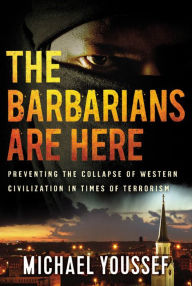
Book Review: The Barbarians Are Here

The Barbarians Are Here. Michael Youssef. 2017. 272 pages. [Source: Review copy]

The Barbarians Are Here by Michael Youssef was a thought-provoking read. I was reminded of several authors, actually: Martin Luther and A.W. Tozer.

I was reminded of Martin Luther because essentially what Youssef is calling for is a new reformation of the church. Just like Luther listed out his grievances with the church of his day, Youssef shares his. To clarify, Youssef is boldly saying that every preacher, every teacher, every person or group that calls himself/herself a "Christian," is not actually a Christian. It doesn't matter if you've got book deals and radio and television slots. If your gospel does not line up--is not true, is not pure--with Scripture, your worshiping a god of your own creation and encouraging others in idol worship.

It was interesting that I was reading The Barbarians Are Here at the same time I was reading Martin Luther's To the Christian Nobility of the German Nation. The two books are surprisingly similar in goals. Luther was calling for the German nation to come together and be great again, to embrace the true gospel message, to reject the false gospel of the Roman Catholic church, to reform all areas of life, not just "the church," but everything. Youssef's goals are similar. He's calling for repentance, for revival, for reform. He wants Americans on their knees in prayer, wants the morals of the nation to change--from the inside out, not some ill conceived outside-in. People need changed hearts. People don't need to do better, try harder. If you consider every church, every denomination, every preacher or teacher with a large following, every bestselling author as "the church in America," it is easy to see why it needs reform and where it needs reform.

Here's how Youssef sees it:
What would that New Reformation look like? It would call men and women in the church to repent of all the things they have added to the gospel—or have taken away from the gospel. It would call them to preach God’s truth out of pure motives, instead of from a lust for wealth or fame. It would call them to put away the false teaching and idols of the Prosperity Gospel, the Social Gospel, the Emerging Church, and all the other distortions and perversions of the good news of Jesus Christ. A New Reformation would expose the lies that have blinded so many professing Christians in our time. A New Reformation would awaken our Western civilization from the false hope that we can bargain with the barbarians or persuade them to turn from their way of destruction. A New Reformation would be rooted in realism, not wishful thinking, and it would recognize that those who seek to destroy our civilization and our faith will never abandon their quest. Only the good news of Jesus Christ can melt a barbarian heart. A New Reformation would stand in opposition not only to political Islam but would also stand in opposition to the City of Man—our secular Western society, drunk on wealth, power, sexual immorality, and drugs. Much of the Islamists’ hatred of Western civilization is rooted in a mistaken belief that all of the ills of secular society are somehow caused and condoned by the church. A New Reformation would draw a clear distinction between the City of God and the City of Man. A New Reformation would show the world the face of authentic biblical Christianity—a Christianity that preaches the good news of Jesus Christ without compromise, that demonstrates truth and love in perfect balance, and that cares about people in need but refuses to back down from the truth in the face of threats and terrorism.

I was reminded of A.W. Tozer because of Youssef's passion and zeal. Youssef, like Tozer, calls it as he sees it. He can be brutally honest and confrontational. Youssef's book may prove shocking, revolting, offensive to some readers. Why? Because Youssef affirms a few things that make people squirm. He affirms that God is God and we are not. He affirms that we are all--one and all--SINNERS. He affirms that God hates sin, and justly and righteously punishes sin. He suggests--without apology--that God is punishing America as he punished Israel and Judah in the Old Testament. He clearly states that TERRORISM is our "Babylonian captivity;" that our exile isn't to be sent to a foreign country, but to have terrorists--within and without or borders--terrorize us. I can see why Youssef's message that we are in part responsible--by our sins, by our immorality, by our idolatry, by our compromising doctrines--for the rise of terrorism would be seen as either ridiculous or offensive. But is there any truth to it? That is the question at hand.

Here's what we know: God is God. We are not. God takes sin seriously regardless of whether we do or not. IT is not our thoughts of God that determine his character, his being. God, we are told time and time again, is sovereign. He is also never-changing. Is it that big a stretch to see that the God who punished nations in the Old Testament--not just Judah and Israel, but Egypt and Assyria, etc.--might still be 'punishing' nations for their idolatry? God cannot be anything but true--true to His Word, true to His Promises, true to Himself--his character, his attributes. The Word clearly reveals that a day of judgement is coming. We don't know when. We don't know how--exactly. But the day that every man, woman, and child stands before the judgment seat of Christ--is coming sooner or later. It's just a matter of when. People can try to laugh it off, try to forget it, try to deny it, try to numb it, whatever.

He writes,
History repeats itself. This was true throughout Old Testament times, and it is still true today. When we are unfaithful and will not repent, God has no choice but to hand us over to our enemies to be shaken and oppressed. Only when we realize that we are reaping the just consequences of our sin do we cry out for deliverance. Only then will He rescue us from the oppressor. God has not repealed this principle. It remains in force today. That’s why I believe we are living in times like the era of the Judges and the era of Jeremiah. I’m convinced God has handed Western civilization over to our enemies. Who are the enemies of Western civilization? The barbarians, the radical Islamists, the violent jihadists, those who are still waging a religious war against the so-called Crusaders of the West.Terrorism is our exile. The terrorists are our Babylonians. Just as God handed over a rebellious and unfaithful Israel to the Babylonian Exile, God has handed over a rebellious and unfaithful Western culture—both our secular culture and our apostate church—to be shaken by terrorism, as Israel was shaken during their captivity in Babylon. God has given us plenty of warning in His Word.
Youssef's message is not just that America is doomed and better repent while she has the chance. Though that is one aspect of his message. No, his message is that every person needs to hear the gospel. Every person--even your enemies, especially your enemies, especially those you discount or discredit as being unlovable, unworthy, a waste of time--needs to hear the gospel.

I think Youssef would fully support Tozer when he says, "Nobody is a challenge for the Holy Spirit," and "What is not built upon the Scriptures will not stand and is not of God."

Youssef talks a good deal about Islam, Isis, the refugee crisis, and the potential dangers--for America, for Europe, for all nations really--of immigration. He is not writing to cause panic or anxiety so much as he's writing to gently or not so gently wake up the church. He's writing from a historical point of view--tracing the history of Islam and the on-again, off-again conflicts with "the West" or the Christian church. His message is not: hate Muslims, fear Muslims, judge Muslims, bully Muslims. It is love Muslims, show grace and be kind, share the gospel with Muslims. Be aware of the dangers of terrorism, but don't stop seeing Muslims as individuals. I mention this because I want to be honest in my review. This content is part of the book.

His title of the book is The Barbarians Are Here. I'll let him explain--in his own words--what that title means.
What is barbarian? Why do I use this term to describe the Islamists who want to destroy us? This is not merely an exercise in name-calling or resorting to insults. I don’t use the term barbarian to hurt anyone’s feelings or to make someone out to be culturally inferior. This word has a specific meaning, and I am using it in a precise and careful way to convey a specific shade of significance. A barbarian is a person who is not part of our civilization, who wants no part of our civilization, and who seeks the conquest and destruction of our civilization. The Islamists—Muslims who seek to restructure all governments and all of society in accordance with the laws of Islam—are cultural chauvinists who see Islam’s Sharia law as vastly superior to Western secular law. They believe a totalitarian Islamic culture would be infinitely superior to the free societies of Western civilization, which are based on Judeo-Christian values. The seek the destruction of Western civilization, and that makes them—by definition—barbarians. As Christians who seek to live in obedience to the Great Commission (the command of the Lord Jesus to preach the gospel to all people in every nation, recorded in Matthew 28:19–20), we want to convert people to a saving faith in Jesus Christ—but only those who come willingly and freely. Unlike the Islamist cult of the barbarians, Christians do not make converts at the point of the sword. We do not conquer in the name of Christ through murder, war, terror, and political subversion. That is one of the many differences between the Christian faith and the cult of the Islamists.

The Barbarians are Here is first and foremost thought-provoking. It is because it is so thought-provoking that I'm recommending it.
How have we, as Christians in the twenty-first century, been unfaithful to God? Answer: by adding to—and taking away from—the crystal-clear purity of God’s Word. The Western church has adulterated the gospel. The good news of Jesus Christ is simple and transparently clear—yet we have clouded and adulterated it with false philosophies, ideologies, and doctrines. We have added business principles, psychological principles, worldly philosophies, “new revelations,” political ideologies, and human greed to the purity of the gospel message. Then we call this poisonous stew “Christianity.” Oh, we have not denied Jesus. We love Jesus. We sing songs about Jesus. We preach sermons about Jesus. We’ve just added a few “harmless” ideas to make Jesus more “relevant.” When we blend worldly philosophies and ideologies with the gospel, we are practicing friendship with the world—and making ourselves enemies of God.
Youssef spends a great deal of time in his book discussing Augustine's notion of the City of God and the City of Man. For the first time, I'm actually contemplating reading Augustine for myself, not just about Augustine. Youssef's passion is contagious!
While we have a Christian duty to oppose injustice and immorality—abortion, homosexuality, pornography, and other forms of depravity in our culture—political action can never take the place of the good news. We will never create a utopia on earth by legislating a conservative social agenda. God’s way of changing society has always involved preaching the good news of salvation—changing one heart at a time through the pure gospel. Many Christians on both the Right and the Left have lost faith in the power of the gospel to change hearts—and to change society. So instead of preaching the gospel, we have tried to force change on society through political power. We’ve tried to change laws instead of hearts.
The notion that Christians ought to mingle biblical truth with the falsehoods of other religions is spiritual poison. Jesus never said, “Tolerance for other religions will set you free,” or, “Doubt will set you free,” or, “Uncertainty will set you free.” Jesus said, “If you hold to my teaching, you are really my disciples. Then you will know the truth, and the truth will set you free” (John 8:31–32; emphasis added). Truth comes from the teachings of Jesus, and only the truth of Jesus will set us free.
We live in a time of moral and spiritual anarchy, when the Christian church has added so many false ideas and unbiblical notions to the gospel that the good news of Jesus Christ has become obscured and unrecognizable.

I will say one thing, however, and I mention this not because I want to discourage you from picking this one up, but I didn't always agree 100% with every little thing he said. For example, he loves, loves, loves to apply 2 Chronicles 7:14 to America. In my humble opinion, we can't just pick verses out of their context and make them fit because we want them to fit. While I think one could argue that God is good and faithful, gracious and merciful, sovereign and wise, compassionate and comforting, and therefore likely to answer the prayers of the Christian church if they pray for repentance and revival and for God's will to be done among the nations, for HIS name to be glorified, and HIS kingdom to come... I don't think one can convincingly argue that GOD PROMISED THE UNITED STATES OF AMERICA in his Word THAT HE WOULD ALWAYS PROTECT US BECAUSE WE'RE SUPER-SPECIAL AND GOD'S CHOSEN NATION. You can't make every verse in the Bible concerning the nation of Israel (or Judah) BE about America. This isn't an episode of Super Why. You can't just replace the word 'Israel' with the word 'U.S.A.' and be done with it and say GOD IS ON OUR SIDE. It says it right here in his word, and his word is true. God has never abandoned His people, never left us alone or forsaken us. But there is a difference between the church--the elect he has called from all nations, all countries, from the beginning to the end of time--and the concept of NATION.

Even with as long as this review has become, it still isn't doing this book justice. It covers so much.


© Becky Laney of Operation Actually Read Bible
Wednesday, June 15, 2016

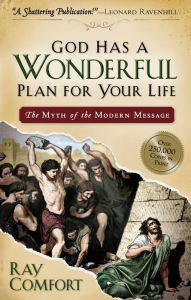
Book Review: God Has A Wonderful Plan For Your Life

God Has A Wonderful Plan For Your Life. Ray Comfort. 2010. Living Waters. 128 pages. [Source: Borrowed]

I loved reading Ray Comfort's God Has A Wonderful Plan for Your Life: The Myth of the Modern Message. The subtitle says it all in my opinion. We live in a culture and society that plays around with the gospel message, with the purity of the gospel message. Sometimes the problem isn't so much on what is being said as it is what is being left unsaid.

In Comfort's book, he argues that sinners--and let's be up front, that is what all of us are (Romans 3:23)--don't need to hear the gospel message. I'll clarify. To start with the gospel message without first starting with the law is confusing and ineffective. The good news is only good news--to their ears, to their hearts and minds--if they feel the impact of the bad news. To talk of a Savior who saves people from their sins when they don't feel lost or in need of saving, when they haven't a clue the depth of their sin makes the good news irrelevant or optional.

What the world needs is the straight-forward, never changing law. The Spirit uses the law to open our eyes, open our hearts, and bring us to our knees. Only when we've been humbled by the law, brought to the realization that we are not good enough, that we will never be good enough through our trying and striving and working and pleading and wrestling, can we come to a place of putting faith and trust in Jesus, the one who says IT IS FINISHED. The law shows us our need, the gospel shows us God's provision for our need.

I read somewhere, and I know Comfort's quoted it in one of his books or sermons, that you've got to get people lost before you can get them saved. That's certainly the spirit of this book.

Comfort is critical of the message of the twenty-first century church. A church too focused perhaps on getting people into their doors and programs. A church too focused perhaps on getting people to be happy.

Comfort calls Christians to be completely honest and upfront about what Christianity is and isn't. Christianity is not about being happy and having an abundant, prosperous life. Christianity isn't about living the dream. It is about putting Christ first and loving HIM more than you love the world, more than you love yourself. It is about delighting in Him above all else. Making him your ONE THING.

So does knowing this make a difference in how you evangelize? Should it make a difference in how you evangelize? He argues that it should. He's passionately, zealously concerned about the world, about the unsaved.

Comfort talks of their being a 95% failure rate among the newly converted. The newly converted being those that the church counts as being saved through coming forward, saying a prayer, being baptized, etc. These are church accounts and not a true spiritual reckoning perhaps. But the point he makes is this. Out of all the thousands that may profess a belief in Christ, over 95 of them will have failed--will have vanished--within a few months or within a year. This notion of "trying on" or "experimenting" with Christianity is a big, big, flop.

These statistics remind me of all the diet books I've read. Diets fail. The diet industry knows--to a certain extent, how could they not--dieting doesn't work. But they write dozens if not hundreds of books each year to sell you on their brand of dieting; each one telling you that THEIR diet is different
from anything and everything you might have tried. Buy this book. Buy into this system. It is a business. A business with a lot of repeat customers. Is religion any different really? I'm not talking about true Christianity. I'm talking religion. I'm talking about what passes for Christianity in some circles. I'm talking about all the books being published about how to get people into your church, how to get people excited about this, that, or the other thing. Focused on improving your life in a certain number of easy steps. Books focused on things that aren't necessarily wrong, just not life-and-death important. People need to be saved. People need hard truths.

One section of the book asks the question, if you could talk to the people who were going to die on September 11, 2001, what would you tell them? What message would you try to sell them or preach to them. Would it be that God is the answer to their loneliness problem? That they need Jesus and not alcohol? Would you tell them that God can help their troubled marriage? Or would you get more to the point? In our quest to be as unoffensive as possible, are we playing hide and seek with the doctrine of heaven and hell?


© Becky Laney of Operation Actually Read Bible