Thursday, May 12, 2016

Quotes from the Cloud #18

This year, I hope share weekly posts of quotes. These quotes are from authors I'm reading and enjoying from the Clouds of Witnesses Reading Challenge. 

For fellow participants, what I would LOVE, LOVE, LOVE to see is for people to share quotes from what they're reading. I'd love for you to share quotes occasionally with your readers and let me know about it. If you don't have a blog, you could always leave quotes in the comments here.
And this nearness to God which all Christians enjoy through Christ is a privilege we take too frequently for granted. Our God does not keep his distance or stand on his dignity, like some foreign potentate, nor does he insist on any complicated ritual or protocol. On the contrary, through Jesus Christ and by the Holy Spirit we have immediate “access” to him as our Father. We need to exhort one another to avail ourselves of this privilege. ~ John Stott
To worship is to quicken the conscience by the holiness of God, to feed the mind with the truth of God, to purge the imagination by the beauty of God, to open the heart to the love of God, to devote the will to the purpose of God. ~ William Temple
Oh, to be filled with the Holy Spirit so that we might experience that excitement, that exhilaration, that ecstasy of belonging to Christ and of having fellowship with Him! Friend, I am talking about something that neither you or I know very much about, do we? We play at church. We talk about being dedicated Christians simply because we are as busy as termites, and often have the same effect. ~ J. Vernon McGee, Thru the Bible, Song of Solomon 
© Becky Laney of Operation Actually Read Bible

Wednesday, May 11, 2016

Book Review: The God We Worship

The God We Worship. Edited by Jonathan L. Master. 2016. P&R Publishing. 192 pages. [Source: Review copy]

The God We Worship is a collection of sermons preached at various conferences held by the Alliance of Confessing Evangelicals--the Princeton Conference. It includes sermons by Bryan Chapell, Charles D. Drew, Richard D. Phillips, Joseph "Skip" Ryan, Philip Graham Ryken, Michael Horton, Michael A.G. Haykin, R. Albert Mohler, and D.A. Carson.

From the preface,
All of these sermons explore and expound upon the nature of God--who he is, how he draws sinners to himself, how he is at work providentially, and how he is to be approached by us in worship. In a sense, the glory of these sermons is that they never begin with man as their subject. They are focused on the triune God revealed in the Bible: the Creator, the Redeemer, and the source of all that is true.
I definitely enjoyed reading The God We Worship. I enjoyed reading these sermons. While I was familiar with most of these preachers, one or two were new to me. I particularly liked the focus of these sermons: God. These are good and meaty sermons that any Christian can benefit from reading and reflecting upon. Each sermon is built around expounding particular scripture verses.

© Becky Laney of Operation Actually Read Bible

Tuesday, May 10, 2016

My Year with Spurgeon #18

A String of Pearls
Charles Spurgeon
1870
1 Peter 1:3-5
THE persons whom Peter addressed were in great need of comfort. They were strangers, strangers scattered far from home. They had in consequence to suffer manifold trials and therefore needed plenteous consolations. Such is our position in a spiritual sense. We, too, are strangers and foreigners. We are pilgrims and sojourners below, and our citizenship is in Heaven. We also require the Word of comfort, for while our banishment lasts, we look for tribulations.
The persons whom Peter addressed were God's chosen, "elect according to the foreknowledge of God the Father," and one sure result of Divine election is the world's enmity. "If you were of the world, the world would love his own: but because you are not of the world, but I have chosen you out of the world, therefore the world hates you."
So you too, my Brethren, chosen out from among men, to be the peculiar people of God, must expect to be partakers of the Cross—for the servant is not greater than his Lord. Since they persecuted Him they will also persecute you. Therefore to you, as to those of old by Peter, the Word of consolation is sent this day. The Apostle also addressed the sanctified. Through the Holy Spirit they had been sanctified and set apart. To the "obedience and sprinkling of the blood of Jesus" they had been brought. They were a people who had "purified their souls in obeying the Truth of God through the Spirit."
And rest assured no man can do this without encountering fiery trials. He who swims with the stream shall find all things go easily with him until he reaches the waterfall of destruction. But he who stems the torrent must expect to breast many a raging billow. And therefore to such the strong consolations of the Gospel are necessary. Speak we then this morning to the same characters as those addressed by Peter, even to you who "are not of the world," but "strangers." To you who are "chosen of God," and therefore the object of the enmity of man. To you who maintain the separated life of true holiness, and are therefore opposed by the profane.
You have need of comfort, and in the Word, and by the Holy Spirit, your need is more than met.
I might almost entitle these three verses a New Testament Psalm. They are stanzas of a majestic song. You have here a delightful hymn. It scarcely needs to be turned into verse—it is in itself essential poetry.
To lead the mind to praise God is one of the surest ways of uplifting it from depression.
In these three verses we have a string of pearls, a necklace of diamonds, a cabinet of jewels—no, the comparisons are poor—we have something far better than all the riches of the earth can ever typify. You have here the heritage of the chosen of God. Your heritage, Beloved, your own peculiar portion if you belong to Christ this day.
We shall conduct you through this mine of treasure, and ask you to dwell upon each blessing, that your souls may be comforted, and that you, lifting up your hearts in blessing, and praising the God of all Grace, may forget your cares and sorrows, and find a young Heaven begun below—a Paradise blooming amid the desert. There are seven choice things in the text, a perfect number of perfect things.
First, I see in the text as the source of all the rest, ABUNDANT MERCY. "Blessed be the God and Father of our Lord Jesus Christ, who according to His abundant mercy has begotten us again unto a lively hope." No other attribute could have helped us had Mercy refused. As we are by nature Justice condemns us, Holiness frowns upon us, Power crushes us, Truth confirms the threat of the Law, and Wrath fulfils it. It is from the mercy of our God that all our hopes begin. Mercy is needed for the miserable, and yet more for the sinful. Misery and sin are fully united in the human race, and Mercy, here, performs her noble deeds. My Brethren, God has vouchsafed His mercy to us, and we must thankfully acknowledge that in our case His mercy has been abundant mercy.   
The next great blessing in the text is that OF INCORRUPTIBLE LIFE. Mark that, O Believer. "The God and Father of our Lord Jesus Christ, according to His abundant mercy, has begotten us again unto a lively hope." One of the first displays of Divine mercy which we experience is being begotten again. Our first birth gave us the image of the first Adam—"earthly." Our second birth, and that alone, gives us the image of the second Adam, which is "heavenly." To be begotten once may be a curse—to be begotten again is everlastingly and assuredly a blessing. To be born once may be a subject for eternal bewailing—to be born a second time will be the theme of a joyful and unending song. My Brethren, saints are "begotten again unto a lively hope" in the hour of their regeneration, when they are "born again from above."    
A third blessing strictly connected with this new life, is A LIVELY HOPE. "He has begotten us again unto a lively hope." Could a man live without hope? Men manage to survive the worst condition of distress when they are encouraged by a hope. But is not suicide the natural result of the death of hope? Yes, we must have a hope, and the Christian is not left without one. He has "a lively hope," that is to say, first, he has a hope within him, real, true, and operative. A Christian's hope purifies him, excites him to diligence, makes him seek after that which he expects to obtain.     
We cannot tarry, but must notice, in the fourth place, another delightful possession which ought effectually to chase away from all of us the glooms of this life, and that is A RISEN SAVIOR. "He has begotten us again unto a lively hope by the resurrection of Jesus Christ from the dead." Our best Friend is not dead! Our great Patron and Helper, our Omnipotent Savior, is not lying in the tomb today. He lives, He ever lives! No sound of greater gladness can be heard in the Christian Church than this—"The Lord is risen, the Lord is risen indeed!" Now, Brethren, observe the connection between a risen Savior and our living hope. Jesus Christ died, not in appearance, but in reality. He rose, not in fantasy and figure, but in reality. Now, note you well the comfort which arises out of this fact, since it proves that we possess a living Advocate, Mediator and High Priest who has passed into the heavens. Moreover, since all Believers, being partakers of the incorruptible life of God are one with Jesus Christ, that which happens to Him virtually happens to them. They died in His death, they live in His life, they reign in His Glory. As in Adam all die who were in Adam, so in Christ shall all be made alive who are in Christ—the two Adams head up their dispensations—whatever happens to either of the Adams, happens to those represented by him. So, then, the resurrection of Jesus is virtually my resurrection.
The fifth is exceedingly rich, but we can only give a word where many sermons would not exhaust—AN INCORRUPTIBLE INHERITANCE—"an inheritance incorruptible, and undefiled, and that fades not away." God has been pleased in His abundant mercy to prepare for His people an inheritance. He has made them sons, and if children, then heirs. He has given them a new life, and if a new life, then there must be possessions and a place suitable for that new life. A heavenly nature requires a heavenly inheritance, Heaven-born children must have a heavenly portion. Now I shall only ask you to notice that the inheritance which God has prepared for us has a fourfold description appended to it. First, as to its substance—it is "incorruptible." Next, for purity—it is "undefiled." And then it is added for its beauty, "it fades not away." The substance of a thing might endure after its beauty was gone, but in Heaven there shall be no declining in the beauty of anything celestial.
Time fails us, therefore we must mention the sixth blessing at once, it is INVIOLABLE SECURITY. The inheritance is kept for you, and you are kept for the inheritance. Herein is our confidence—our great Captain has walled us around—He has appointed Salvation for walls and bulwarks. We are safe, though all the devils of Hell surround us, for we are garrisoned by Omnipotence. Each Believer is kept by that same power which "bears the earth's huge pillars up," and sustains the arches of Heaven. This keeping, observe, my Brothers and Sisters, for I must leave the point—this keeping is complete and continuous—it will never end until we shall need keeping no longer. We shall be kept "unto salvation ready to be revealed in the last time."
The best I have reserved for the last. Out of the seven treasures of the Christian the last comprehends all, is better than all, though what I have already spoken is everything—it is A BLESSED GOD. We left this to the last, though it comes first—"Blessed be the God and Father of our Lord Jesus Christ." It is joy to have Heaven, it is joy to possess a new life to fit me for Heaven—but the greatest of all is to have my God, my own Savior's God, my Father, my own Savior's Father, to be all my own! God Himself has said, "I will be their God, and they shall be My people." He has not given you earth and Heaven only, though that were much. He has given you the Heaven of Heaven—Himself.   

© Becky Laney of Operation Actually Read Bible

Monday, May 9, 2016

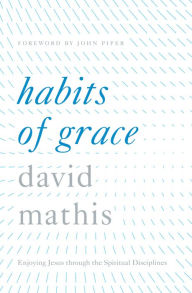
Book Review: Habits of Grace

Habits of Grace: Enjoying Jesus Through the Spiritual Disciplines. David Mathis. Foreword by John Piper. 2016. Crossway. 240 pages. [Source: Review copy]

I really enjoyed reading David Mathis' Habits of Grace: Enjoying Jesus Through the Spiritual Disciplines. I've read three books on spiritual disciplines this year, and, each one has been good in its own way. I'm a bit surprised by the three different perspectives on spiritual disciplines! Though all three share some things in common: a desire to know and love God more and more.

The book is divided into three sections. The first section is titled "Hear His Voice" and focuses on the Word of God. The second section is titled "Have His Ear" and focuses on prayer. The third section is titled "Belong to His Body" and focuses on fellowship. Though just three main sections, more gets covered in this book than just reading the Bible, praying, and attending church! Every page of this one seems to highlight God's grace and God's glory. It is a book that proclaims a big, big God!!!

It is full of practical tips and advice. For example, here are five tips for scripture meditation: 1) diversify your picks 2) take it with you during the day 3) seek to understand, feel, and apply the text as you memorize 4) turn your text into prayer 5) memorize in the light of the gospel.

I really enjoyed this one. I thought it was well written, well organized, and packed with tips and advice. Not just his own advice, but advice from theologians past and present.

From the foreword by John Piper:
Enjoyment of Jesus is not like icing on the cake; it's like powder in the shell.
From the preface:
Much has been said in terms of duty, and too little said about joy.
From section one:
Without the Bible, we will soon lose the genuine gospel and the real Jesus and the true God. For now, if we are to saturate our lives with the words of life, we must be people of the Book.
The battleground is between our ears. What is it that is capturing your idle thoughts? What fear or frustration is filling your spare moments? Will you just listen to yourself, or will you start talking? Preaching the gospel to ourselves is a habit of grace that is both proactive and reactive.
What we need is not just truth, but the truth, the message of the gospel. What preaching the gospel to ourselves requires is pausing, rehearsing some expression of the Father's and Son's love of and provision of goodness and rescue and joy for us, and consciously seeking to have that truth shape and permeate our reality.
If you feel uncomfortable in the Scriptures and inadequate in the art of Bible reading, the single most important thing you can do is make a regular habit of reading the Bible for yourself. There is no substitute for a few focused minutes each day in the text. You may be surprised how much the little bits add up over the long haul.
It takes both an increasing sense of the big picture of Jesus's rescue of sinners as well as a growing depth in the little pieces that make up that big picture for us to stay fresh in applying the gospel to our lives.
When we get alone with the Bible, we are not alone. God has not left us to ourselves to understand his words and feed our own souls.
We were made to meditate. God designed us with the capacity to pause and ponder. He means for us to not just hear him, not only to read quickly over what he says, but to reflect on what he says and knead it into our hearts.
From section two:
Prayer is not finally about getting things from God, but getting God.
Journaling has the appeal of mingling the motions of our lives with the mind of God.
From section three:
Fellowship may be the often forgotten middle child of the spiritual disciplines, but she may save your life in the dark night of your soul.
Our inability to listen well to others may be symptomatic of a chatty spirit that is droning out the voice of God.

© Becky Laney of Operation Actually Read Bible

Sunday, May 8, 2016

Celebrating Mom By Interviewing Her!

1. Why do you think it is important to read the Bible?

The Bible is the Word of God. It is the means by which the Father, Son, and Holy Spirit speak to Christians today. I'm not saying that God is limited in how he speaks, but that what He says or impresses on me will not be in contradiction to His Written Word. It is important to read the Bible in its entirety and in context. When one starts pulling verses out of context to win arguments, they can certainly distort the true meaning. As my Grandma Peterman used to say, "You can make the Bible say almost anything with enough dot, dot, dots."

2. Do you read the Bible? Did you read the Bible then? When did you "become engaged" in reading the Bible?

I read the Bible daily--usually with cups of coffee before I start my day. I read both devotionally and systematically. I keep track of what I read and study so that my reading stays in balance.

When my children were small I tried my best to spend time in God's Word daily. Sometimes it was challenging. I did not give into legalism by thinking that God's love and grace for me was dependent upon following a certain plan, discipline, or rule. To balance that I also knew that it was important to make God and his Word a priority.

I started taking daily Bible reading more seriously during my sophomore year in high school. Before that my study was more sporadic.

3. How do you see the bible? How would you describe it? What role does it have in your life?

I see the Bible as the Word of God. I feel that the Bible is a true blessed gift from God Himself and I strive to cherish it, read it, and meditate on it daily. It is my source of strength and guidance.

4. Do you see the Bible as teaching right and wrong?

The Bible definitely teaches right from wrong, but it is so much more than rigid rules. It is a book that reveals God's amazing love and forgiveness towards his children.

5. Have you taught Sunday School? Which ages? Which age group is most receptive? most argumentative? most distracted?

I have taught Sunday School at different times in my life. I have taught preschoolers, early elementary, upper elementary, and adults. I have not taught middle school or high school. I have seen good reception in all ages. Ditto for argumentative and distracted. I think that Sunday School should definitely be led for children. Adults can go either way depending on their ability to stay focused. I have seen adults that only wanted to argue. But if you have a group of students that are seriously seeking God, shared discussion can be beneficial.

6. Did your parents read the Bible with you or to you as a child?

My parents did not necessarily make a point of reading the Bible with me as a child.

7. Do you remember seeing your parents read the Bible? Who else in your life did you see reading the Bible? What did you learn from your parents, grandparents, and others? Anything specifically that you wanted to pass down specifically to your children?

I do remember seeing both Mama and Daddy reading the Bible. I also saw my Grandma Peterman reading the Bible. I also saw older church members reading the Bible.

I learned to read the Bible for answers, enjoyment, and guidance from my Mama and Grandma.

I chose to pass down to my children the importance of reading God's Word daily.

8. Was faith openly discussed in your home? What "faith" activities were part of your growing up--either formally or informally?

Faith was not preached to me as a child. It was more presented by example. My parents were usually open to my questions about the Bible and faith. We were allowed to participate in church and Sunday School but not forced.

9. Why did you choose to read the Bible to your children? Do you see it as being a deliberate choice? Was it purposeful? Did you have a plan? What were some of the obstacles along the way? Did anything intimidate you?

I chose to read the Bible to my children so that I might share my faith. It was also a good way to sneak in more time with it myself. It was purposeful in that I wanted to train them to love God's Word. I did not follow a set plan. I was not intimidated.

10. Did you feel pressure to "get it right" or "be perfect" in reading with your children? Were you afraid of them asking questions?

I did not feel pressure to get it right. I was not afraid of them asking questions. The main obstacle was being busy, and the main distraction was television. Those obstacles were generally overcome by being flexible.

11. What did you hope to accomplish by reading the Bible to your children? What was your goal or primary objective?

My main objective was for my children to love and cherish the Bible as much as I do.

12. What makes a Bible story book a good Bible story book? What do you look for--did you look for--in a Bible story book?

A good Bible story book has engaging pictures, is true to the gospel, and appropriate to the learning level of the child. If the author or editor was/is not a person of true Christian faith I would automatically reject it.

© Becky Laney of Operation Actually Read Bible

Week in Review: May 1-7

ESV

  • 2 Chronicles
  • Job 1-5
  • Proverbs 24-31
  • Ecclesiastes
  • Song of Solomon
  • 1 Peter (6)
  • 2 Peter (6)
NASB
  • 1 Peter
  • 2 Peter


© Becky Laney of Operation Actually Read Bible

Friday, May 6, 2016

Resources for Parents

This resource guide is for any Christian parent who wants to actively, deliberately share their faith with their child. It assumes that parents want to have an active, living, growing, becoming faith, and to pass this faith on to the next generation. Emphasis on want. It isn't about thinking that you've become, that you've arrived, that you know all the answers, and are content to just slide the rest of the way home.

Books for Parents To Read Themselves


Why Christ Came: 31 Meditations on the Incarnation. Joel R. Beeke & William Boekestein. 2013. Reformation Heritage. 108 pages. [Source: Bought]
Each chapter states one reason why Christ came. That one reason may be drawn from one text of Scripture--or several verses. Each chapter directs readers back to the heart of the gospel. I think that believers should preach the gospel to themselves daily. Believers need to dine daily--find refreshment--from the gospel. The gospel may seem basic and simple at first, but, there is depth, substance, a certain RICHNESS to it that leaves one speechless.


Experiencing the Trinity: The Grace of God for the People of God. Joe Thorn. 2015. Crossway. 144 pages. [Source: Library]
The book is fifty devotionals celebrating the Trinity. The first part focuses on God the Father. The second part focuses on God the Son. The Third part focuses on God the Holy Spirit.


Family Worship. Donald S. Whitney. 2016. Crossway. 64 pages. [Source: Review copy]
The book is NOT a guilt trip. He stresses the simplicity of it. You don't have to prepare a lesson--either formal or informal. You don't have to do study and research before you begin. You don't have to have all the answers to the questions your family might ask. You just have to be present in the situation with a Bible in hand. Open up the Bible, read a chapter or two to your family aloud, talk about what you've read, share prayer requests and pray, and sing one or possibly two songs together--with or without accompaniment. The hardest part may just be establishing the routine in the first place--creating a new habit and making it a priority. But family worship itself--it isn't that hard.

Give Them Truth: Teaching Eternal Truths to Young Minds. Starr Meade. 2015. P&R Publishing. 208 pages. [Source: Review copy]
What is the message? Parents need to actively, deliberately teach their children the Christian faith. Fill their minds with knowledge about God and about the Bible. Give Them Truth is divided into three sections. The first section focuses on WHY our children need to know. The second section focuses on WHAT children need to know. What truths do children need to be taught? The third section focuses on HOW to help our children know. This last section is perhaps the most practical. How can parents begin to instruct their children? What practical steps or guidelines should be followed to begin the journey?

The Whole Story of the Bible in 16 Verses. Chris Bruno. 2015. Crossway. 144 pages. [Source: Library]
The book is a good choice for believers of all ages who haven't "mastered" the contents of the Bible, and, who want to know what it's all about it. That is most people, I imagine. For few, I imagine, would reckon themselves masters of the Word of God. If you've never read the Bible, or, if you've read the Bible two or three times, there's a good chance that this book will help you out either by teaching or refreshing.

Books for Parents to Read and Share With Children


The Big Picture Story Bible. David R. Helm. 2004/2010. Crossway Publishers. 456 pages.
The text is simple and direct--without much fuss and nonsense--yet it is profound too. (I liked how the narrator speaks directly to readers. Asking them to participate in the story. I thought that was a great touch.) I liked the stories Helm included. I liked how the stories were presented. How they all tied together. I also liked the balance between text and illustration.
There is a definite theme to this bible storybook collection. Dare I say it? It's evangelical! I remember Mike Abendroth of Bethlehem Bible Church preaching a sermon called The Gospel in Twelve Words.These are twelve key words--organized under four questions--that can "help" you spread the gospel.
Reading The Big Picture Story Bible, I was reminded of this sermon, of this outline. For in this book, we see a clear presentation of man and God. Of man's need for a Savior. Of God's loving care and provision. Of the BIG PICTURE of the Bible. So the stories are presented as being part of one BIG story. Everything is connected. Yet it isn't forced.
Who is God? Creator. Judge. Savior.
Who is Man? Fallen. Sinful. Foolish.
What Did Jesus Do? Redeemed. Reconciled. Resurrected.
What Did Jesus Command? Believe. Repent. Follow. 

The Jesus Storybook Bible: Deluxe Edition. Sally Lloyd-Jones. 2009. Zonderkidz. 352 pages.
I think what makes this one work--really work--is how Sally Lloyd-Jones has every story whisper His name. Her ability to connect each story with the Big Story, keeps everything in perspective, keeps everything connected and relevant. It also helps that she's a good storyteller! She has a definite way with words! She keeps the stories on a child's level, but yet, the stories are beautifully and compellingly told. 

The Child's Story Bible. Catherine F. Vos. (1938, 1949, 1958,) 1969. Eerdman's Publishing Company. 733 pages.
The Child's Story Bible is one of the most complete story collections I've read. It features 110 stories from the Old Testament; The Child's Story Bible features 92 stories from the New Testament; these stories are taken from Matthew, Mark, Luke, John, Acts, and Revelation. This story collection is so thorough that it almost feels more like a paraphrase. It includes so much more detail than most other children's story book collections I've read. The Child's Story Bible could never be a substitute for the Bible, but it could be a good way to introduce the narrative content of the Bible to readers of all ages. The book summarizes and instructs. It adds details, makes conclusions, and seeks to create teachable moments. The book can be creative, descriptive, unique. In an old-fashioned, comfortable way. I love how evangelistic (gospel-oriented) it is. I would definitely recommend this one! 

 For Such A Time As This. Angie Smith. Illustrated by Breezy Brookshire. 2014. B&H. 256 pages. [Source: Review copy]
What did I love about it? I loved the balance of text and illustration. The stories felt full, or, I suppose a better word might be rich. Some story books are so concise that all stories are made to fit on a two-page spread. The stories feel complete, whole. Each one just the right length. For Such A Time As This is perfect for mothers and daughters to read together. (Though dads and daughters could read as well!!!) The book is subtitled "Stories of Women from the Bible, Retold for Girls." But honestly, I think parents could read it/share it with sons and daughters. 


The Biggest Story. Kevin DeYoung. Illustrated by Don Clark. 2015. Crossway. 132 pages. [Source: Review copy]
I think this is a book for readers of all ages. One reason is that everyone needs to know the Bible, that the Bible tells one BIG story, and the Bible really fits together well. It is not a mishmash of random stories and lists. The Biggest Story is a clear presentation of the bible's gospel message. How we were created in God's image. How humans sinned and became separated from God. Why the law was given, and, yet, how we could never keep all of the law. Why we needed a Savior who was both God and man. Just to get started by mentioning a few basics! (I do get excited when I start thinking about the gospel.) I think readers--believers and unbelievers--could use a little clarity as to what it is Christians believe.

© Becky Laney of Operation Actually Read Bible