Sunday, July 31, 2011

The Sunday Salon: Week In Review: July 24-30

This week I read...

2 Kings in the Revised English Bible
Joel in the Revised English Bible
Amos in the Revised English Bible
Obadiah in the Revised English Bible
Jonah in the Revised English Bible
Micah in the Revised English Bible
Nahum in the Revised English Bible
Habakkuk in the Revised English Bible
Zephaniah in the Revised English Bible
Haggai in the Revised English Bible
Matthew in the Revised English Bible
1 Corinthians in the Revised English Bible
2 Corinthians in the Revised English Bible
Ephesians in the Revised English Bible
1 Thessalonians in the Revised English Bible
2 Thessalonians in the Revised English Bible
Philemon in the Revised English Bible
James in the Revised English Bible
1 Peter in the Revised English Bible
2 Peter in the Revised English Bible
Jude in the Revised English Bible


© Becky Laney of Operation Actually Read Bible

Saturday, July 30, 2011

Spotlight on Woodrow Kroll

July's author of the month was Woodrow Kroll. I read (or reread) three of his books this month: Taking Back The Good Book, How To Find God in the Bible, and Read Your Bible One Book At A Time. (I didn't write a new review of Taking Back the Good Book though I did reread it, but the other two were new to me.) His books inspired me to write quite a handful of posts:

Taste and See: Eating a Balanced Diet
So What's Your Excuse
Looking for Answers?
Taste and See: Redeeming the Time
Christ in the Pages of the Bible
Without a Bible...
Ten Reasons Why Family Devotions Are Important
Five Questions From Taking Back the Good Book

From Read Your Bible One Book at a Time:

If you wanted to read one book of the Bible--the whole book, beginning to end--which ones could you read during the same time it takes to watch It's a Wonderful Life? Hold on to your hat. You could read any book of the Bible except twelve. Only a dozen books of the Bible take longer to read than watching that classic Christmas movie. Nearly forty books of the Bible can be read in an hour or less. Half the books of the Bible can be read in less than thirty minutes. And twenty-six books can be read in fifteen minutes or less. That's pretty amazing for a book that many people think is too massive to read. When you think about it, time really isn't the problem when it comes to reading the Bible. It's a good excuse, but not good enough. How much we read of the only book God ever wrote depends mostly on how much of it we want to read. Reading God's Word is less dependent on our schedule and more dependent on our desire and discipline. (12-13)
From How To Find God in the Bible:

Don't fail to read the Bible simply because you have difficulty relating to the translation. Find a version you do understand. I'm often asked which version of the Bible I think is the best, and I always respond, "The one you read." It doesn't matter if you are convinced your version is the most accurate there is. If you don't read it, you won't connect with God. Hurdle the language barrier by choosing a Bible that is comfortable for you. Then read it for all it's worth. (61)
I have often said that if Christians blew the dust off their Bibles at the same time, we'd all get killed in the dust storm. If you are to benefit from God's Word, you're going to have to read it. It's how you connect with God. (173) 

From Taking Back the Good Book:
The most common excuse for not reading the Bible is our busy lives. We don't seem to have time to do the things we need to do. There's work and school, running to the store, soccer practice, dinner--life is just a bit harried. Who has time to sit and read?
You do. Here's why: time is a set quantity. It's not elastic. We all have sixty seconds in every minute, sixty minutes in every hour, twenty-four hours in every day. Time may fly, but it doesn't change. You have 1,440 golden minutes in every day and so do I.
The issue is never about time; it's always about what we choose to do get done in the time we have. Is reading God's Word, meditating and benefiting from it, something you wish to take the time to do or not? If not, the convenient but pathetic excuse is to say, "I don't have time."
A couple of years ago, I took a stopwatch with me everywhere I flew. I would read my Bible while in flight and time how long it took to read each book of the Bible. Once when I was returning from Frankfurt on a flight to Chicago, a flight attendant saw the stopwatch and asked, "Are you timing our service?" I chuckled and said, "No, I'm timing how long it takes me to read my Bible." Puzzled, she asked why someone would want to do that. I said, "Because everybody tells me they would read their Bible but they don't have time. I want to know how much time they don't have."
Did you know that you can read half the books of the Bible in less than thirty minutes each? You can read twenty-six of them in less than fifteen minutes. The whole Bible, cover to cover, can be read by an average reader in less than seventy-two hours.
Maybe it's time we rethink our reasons for not reading the Bible and just call them what they are--excuses. Take another look at these "Top Ten." How many of them have you used with God as an excuse for not reading his Word? If you can see through the excuses so quickly, imagine how easily he can see through them.
The Bible is read by people who choose to read it. Bible reading is neglected by people who choose to neglect it. It's just that simple. No excuses. Just honesty. (76-77)
We typically think of tithing in monetary terms, but have you ever thought about tithing your time? Suppose you spent 10 percent of your day with God? What would that mean? Mathematically, there are twenty-four hours in a day, which equals 1440 minutes. If you gave the Lord 10 percent of that time, he would receive 144 minutes every day. That's over two hours. Is that how much time you spend in reading the Word and in prayer now? Probably not. But let's be fair. You have to work and sleep each for eight hours. You can't really tithe that time. So we're really talking about tithing in terms of your third eight-hour period in the day. That's 480 minutes, and a tithe of 480 minutes is forty-eight minutes daily. If you gave God forty-eight minutes daily, you'd be giving him one-tenth of one-third of your day. Does that sound reasonable? But how are you going to find forty-eight minutes in a day? You start here: instead of tacking God onto your schedule where you can, instead of watching your third reality show of the night, turn off the television, shut out everything else, and spend forty-eight quality minutes with God. If you do that, you could actually read the Bible through four times in one year--pretty amazing! (160)

© Becky Laney of Operation Actually Read Bible

Five Questions From...Taking Back the Good Book

I love to read nonfiction. I do. (You may have noticed that!) I love it when authors ask really great questions in their books. I love questions that challenge me and make me think.

I thought I would start sharing *some* of these questions with you. I would LOVE to hear what you think...


This week's questions come from Woodrow Kroll's Taking Back the Good Book: How America Forgot the Bible and Why It Matters To You. 
  1. Do you want to get to know God better?
  2. What will we miss if we don't read the Bible?
  3. If we want to know God's Word better, what's stopping us?
  4. What am I receiving from my Bible that truly influences my life and connects me with God and service to him?
  5. Is it really important whether what you believe is true or not?


© Becky Laney of Operation Actually Read Bible

Ten Reasons Why (Family) Devotions Are Important

From Woodrow Kroll's Taking Back The Good Book. (Chapter twenty-one, "What Parents Can Do.")
Having family devotions is crucial. I'm sold on family devotions. They kept my family connected as the kids were growing up. Now they are keeping my grandchildren connected to their families. Here are ten good reasons why you should have consistent family devotions in God's Word:

1) Devotions provide communication with God (Ps. 25:4-5; Ps. 119:145-52)
2) Devotions quench our spiritual thirst (Ps. 42:1-2; Ps. 84:2; Phil. 3:10)
3) Devotions are the basis for personal spiritual growth (1 Pet. 2:2; 2 Pet. 3:18)
4) Devotions provide a safeguard against spiritual immaturity (1 Cor. 3:1-3; Ps. 119:9-11)
5) Devotions provide insight for daily living (Prov. 10:4; Prov. 17:27-28)
6) Devotions prevent schizophrenic faith (1 John 4:1; Eph. 4:11-15)
7) Devotions provide daily comfort and encouragement (Ps. 119:81; Rom. 15:4)
8) Devotions prepare us to share our faith (1 Pet. 3:15; Luke 24:27)
9) Devotions provide daily direction (Deut. 5:27; Ps. 119:105)
10) Devotions show our respect for the Bible's Author. (Ps. 19:9-10; Ps. 119:127-28)

Having a family time in the Bible will not only be a link between family members, but it will also provide a safeguard against creeping Bible illiteracy in the next generation. (170-171)

© Becky Laney of Operation Actually Read Bible

Thursday, July 28, 2011

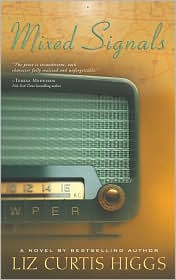
Book Review: Mixed Signals

Mixed Signals. Liz Curtis Higgs. 1999. Multnomah. 384 pages.

Rainy days and Mondays never got Belle O'Brien down. Not when her radio listeners were waiting. 

Mixed Signals is the second contemporary romance novel I've read by Liz Curtis Higgs. I enjoyed both Bookends and Mixed Signals, but I think I definitely liked Mixed Signals more.

The heroine of this one is radio personality, Belle O'Brien. When the novel opens, Belle's having a really bad day. She's just learned that her oldies station--the radio station that she works at--has been bought out. It is now sports radio. (Oh the horror!) She's the only one who hasn't lost her job--and it's not because Belle is a sports fan. No, they've 'creatively' imagined ways to still use her voice on air. (Think Betty Boop).

So when Belle gets a phone call a week or so later, a call from her first boss, Patrick Reese, offering her a job at his brand new oldies station, well, she's thrilled. She counts Patrick as one of her closest friends. And when she worked for him, well, she had a HUGE crush on him. She's not moving just because she's hoping for a romance between the two of them. She's moving because any job (almost) has to be better than her current one. Even if it means moving from Chicago to Abingdon, Virginia.

Belle is very excited about her new job, and she makes an almost instant connection with her landlady, Norah. Who wouldn't love Norah? She's a Christian woman with a big, big, big heart, and she is a GREAT cook. Her home is always inviting and welcoming. And spending any amount of time with Norah makes you want to set your burdens down to share. And Belle confides with Norah about her past with Patrick, which isn't the easiest for Norah to hear since she has a crush on him now.

Patrick may be the most vocal about his interest in Belle, but he's not the only man in town impressed by her. No, David, the radio engineer can't stop thinking about her either. And Christmas may just be an enlightening time for everybody...

I liked this one. I really liked it. I thought the characters were great. It was just very fun, very satisfying.

© Becky Laney of Operation Actually Read Bible

Monday, July 25, 2011

Book Review: Safely Home

Safely Home. Randy C. Alcorn. 2011. Tyndale. 434 pages.

Three men watched intently as peculiar events occurred, one right after the other, on opposite sides of the globe.

I read the tenth anniversary edition of Randy Alcorn's Safely Home. In some ways, it was just what I was looking for. Since reading The Evangelicals: What They Believe, Where They Are, and Their Politics, I've been looking to read more about Christians who are suffering persecution for their beliefs, about Christians living in countries with little religious freedom. And to a certain extent more about missionaries and martyrs. (Through Gates of Splendor, China Cry, City of Tranquil Light.)

If Safely Home had been nonfiction, I think I would have absolutely loved it. I think I would have found it challenging and fascinating and inspiring. I would have loved to hear stories--directly or indirectly--about real Christians living in China. I would love to hear more about the illegal home churches. I would love to hear more about the people's thirst for knowledge--thirst for the Word of God. The sections of Safely Home where they talk about home churches and underground (secret) seminaries where the Word of God is taught so that people can teach others and spread the word. I'm sure there would be plenty of sad or tragic stories--though depending on your perspective--but I'm sure there would always, always be a thread of hope as well. I don't think the truth would need embellishing. I don't think you'd need to work to make it emotional and dramatic. I think the simple telling of facts would do the job just fine.

But Safely Home isn't nonfiction. It's fiction. The story is compelling, emotional, a bit manipulative, perhaps, at times. This is a book that almost demands you slow down to process everything. I don't think that's a bad thing at all. It's just that this isn't a book you can rush through. For the story to mean something, you have to be willing to slow down. You have to see the big picture. You have to step back a little, to see it as a whole, to consider it as a whole.

So Safely Home is the journey of a business man, Ben Fielding, who had to journey to China to meet Jesus Christ. That's a one sentence summary for you. Of course, that is just the beginning....

Ben Fielding is an American business man. He's mean. He's cranky. He's selfish. He's all money, money, money. If he had a heart at one point, he's left it behind him because it's bad for business. He's divorced. He's got two kids--two daughters--that he barely knows. He's just all about getting ahead. He is Vice President of a company, Getz International, and Getz has been doing big business in China--in two major Chinese cities. And it was all his idea. His idea to partner with China. His idea that it was crucial for him to learn Mandarin all those years ago. When the novel opens, he is getting ready to go to China. The company thinks it would be a good idea for him to spend six to eight weeks in China living among the people, the "common" people of China. Live as they live, see the world through their eyes, prove to everyone that you really care. So when Ben Fielding mentions that his former college roommate was from China, well, they decide that would be just about perfect.

Li Quan is the roommate. And it's almost too easy to say he's the complete opposite of Ben Fielding. He's got a big, big heart. And his heart and mind and soul belong to Jesus. He loves his wife. He loves his son. But he knows that God comes first. Not just before his family. But before his life. He asks himself every day will this be the day that I die? Will this be the day that I face that choice of deny God and live, or stand firm in the faith and die? He prays for the strength to endure to the end--to suffer anything and everything for Christ's sake. He's already been arrested a handful of times, and been in prison for months at a time. His own father died a martyr's death. Only at the time Quan was not a believer. No, Quan found Jesus in America, he came to faith when he went to church (or a Bible study perhaps?) with his American roommate, Ben Fielding.

So for the most of the novel you've got Li Quan and Ben Fielding deep in discussion with one another. Ben Fielding trying to persuade Li Quan that he's got all these wrong ideas about China. That he's exaggerating everything. That Christians couldn't possibly be suffering persecution from the government. Not the government he does business with. He keeps trying to convince Quan that all this rule-breaking is unnecessary. I mean, why make such a big deal about how the government-approved churches and government-approved seminaries aren't really free. Can't Quan just go about his business peaceably? Why can't he keep his faith a secret? Why can't he keep his faith private? Why doesn't Quan see that he's only asking for trouble? Quan is patient--tremendously patient with Ben. Some of his actions seem a little risky.

These discussions can--at times--feel a little forced. Like the reader is being invited to a debate between two opposing forces. One voice being morally-relativistic and politically correct and all-too-modern. The other voice being the voice of truth as revealed in the Word of God. Their is a right way and a wrong way to see things--little things, big things, everything--and Ben almost always represents those blinded to the truth, those lost in slavery to sin. At least for most of this one. So the novel is definitely issue-driven. There is a message in this one for readers.

But these discussions aren't unrealistic. For example, Ben is asking questions about God's goodness. If God exists, why is there suffering? If God exists, if God cares for me, then why did my son die? If God is good why did my family fall apart? If God is good why did my mother die? Why does God let people I love suffer or die? Not all of the questions--not all of the discussions--are that personal, that private. Some are more related to politics and society and business and morality and ethics.

Through Li Quan, readers learn about the spread of Christianity in China. How it is thriving in persecution. How desperate they are for Bibles. How desperate they are for teachers/preachers. How strong these believers are--how they're willing to face suffering, imprisonment, torture, even death, for the Lord. How their faith actually MEANS something. How they don't take anything for granted.

So the message is a compelling one. I definitely am glad I read this one. I liked seeing Ben take this journey. And I am happy with how it ended--for the most part.  

© Becky Laney of Operation Actually Read Bible

Sunday, July 24, 2011

Sunday Salon: Week In Review: July 17-23

This week I read...

1 Kings in the Revised English Bible
2 Kings 1-9 in the Revised English Bible
Galatians in the Revised English Bible

© Becky Laney of Operation Actually Read Bible