Showing posts with label Multnomah. Show all posts

Thursday, April 11, 2013

Book Review: The Disappearance of God

The Disappearance of God: Dangerous Beliefs in the New Spiritual Openness. R. Albert Mohler Jr. 2009. Multnomah. 194 pages.

From the preface, Has God disappeared? The tragic reality is that we are living in an age that is marked by so much spiritual and theological confusion that the God of the Bible has largely disappeared from view--replaced by less imposing deities that are more amenable to the modern mind.... The situation is complicated further by the embrace of an "openness" that is not open to authentic biblical Christianity. Tolerance becomes a code word for avoiding truth, and openness means never having to make a judgment about truth at all. A rescue from this predicament would appear more hopeful but for the fact that the church has, in large part, apparently joined the revolution...far too many Christian churches flirt with doctrinal disaster. (xiii-xiv)

I first read this nonfiction book in 2009. This book covers a lot of different subjects or topics. It is not as if each and every chapter stands alone, often two or three chapters go together. But the book could almost be read in any order and used as a resource.

The chapter titles:

  • A Call for Theological Triage
  • Guarded Through Faith -- Assurance and the Doctrine of Perseverance
  • Can We Be Good Without God?
  • The Disappearance of Sin -- A Flight From Reality
  • Hell Under Fire, Part 1
  • Hell Under Fire, Part 2
  • A Christian Vision of Beauty, Part 1
  • A Christian Vision of Beauty, Part 2
  • A Christian Vision of Beauty, Part 3
  • What Should We Think of the Emerging Church?, Part 1
  • What Should We Think of the Emerging Church?, Part 2
  • A Generous Orthodoxy -- Is it Orthodox?
  • It Takes One to Know One -- Liberalism as Atheism
  • The Openness of God and the Future of Evangelical Theology 
  • The Demise of Church Discipline, Part 1
  • The Demise of Church Discipline, Part 2
  • The Demise of Church Discipline, Part 3
  • The Demise of Church Discipline, Part 4
  • Darkness at Noon, Part 1 -- A Post Christian Age
  • Darkness at Noon, Part 2 -- The Closing of the Postmodern Mind
  • Darkness at Noon, Part 3 -- The Commission of a Post-Compliant Church
  • Missions at Risk -- A Failure of Nerve
  • The Urgency of Preaching

The opening chapters are wonderful in establishing the premise of the book: how important, how essential it is for believers to a) KNOW the essentials of the faith, know what they believe, to be grounded in the Word of God b) KNOW the difference between what is truly most important and what is of lesser importance in theology. In other words, it's important for believers to be wise and discerning, something that can't be managed without a good, solid foundation in the Word of God. Before you can hope to discern truth from lies, false teachers from sound teachers, you have to know what the Bible says, you have to know the truth--deeply, personally. But it's also crucial for those who would be discerning that they can distinguish between what matters are absolutely critical or essential--foundational--to the faith, matters that are worthy of taking a non-compromising stand on, worth defending and which matters are of lesser importance. It is important not to waste your "fight" and cause confusion and bitterness. Believers are not called to compromise on the essentials, and we're called to be as unified as possible with fellow believers. In some areas, we're called to be bold, to speak the truth, to take a stand, and in other areas we're called to keep the peace and allow for differences.

Mohler then tackles some issues facing the church today.

I would definitely recommend this one.

Favorite quotes:
God's truth is to be defended at every point and in every detail, but responsible Christians must determine which issues deserve first-rank attention in a time of theological crisis. (2)
We are charged to embrace and to teach the comprehensive truthfulness of the Christian faith as revealed in the Holy Scriptures. There are no insignificant doctrines revealed in the Bible, but there is an essential foundation of truth that undergirds the entire system of biblical truth. (7)
As Rabbi Jacob Neusner once lamented: "A country without a sense of shame or of sin does not have a sense of right or wrong, just what is useful or what you can get away with or not get away with." (20)
The disappearance of sin from our moral vocabulary is one of the hallmarks of the modern age--and of postmodern morality. These days, most people think themselves to be imperfect, leaving room for improvement--but they do not think of themselves as sinners in need of forgiveness and redemption. (25)
Genuine Christianity cannot escape dealing with sin. The gospel will not allow any evasion of sin as the universal human condition of revolt against the Creator, the God of absolute holiness and absolute love. (27)
The word is seldom uttered in many churches--even some who would describe themselves as evangelical. This is an abdication of the gospel. Where sin is not faced as sin, grace cannot be grace. What need have men and women of atonement when they are told that their deepest problem is something less than what the Bible explicitly teaches? Weak teaching on sin leads to cheap grace, and neither leads to the gospel. (28)
How is it that so many evangelicals--including some of the most respected leaders in the movement--now reject the traditional doctrine of hell in favor of annihilationism or some other option? The answer must surely come down to the challenge of theodicy--the challenge to defend God's goodness against modern indictments.
Modern secularism demands that anyone who would speak for God must now defend Him. The challenge of theodicy is primarily to defend God against the problem of evil. The societies that gave to the decades of megadeath, the Holocaust, the abortion explosion, and institutionalized terror will now demand that God answer their questions and redefine Himself according to their dictates. (35)
The first issue is a changed view of God. The biblical vision of God has been rejected by the culture as too restrictive of human freedom and offensive to human sensibilities. God's love has been redefined so that it is no longer holy. God's sovereignty has been reconceived so that human autonomy is undisturbed. In recent years even God's omniscience has been redefined to mean that God perfectly knows all that He can perfectly know, but He cannot possibly know a future based on free human decisions. Evangelical revisionists promote an understanding of divine love that is never coercive and would disallow any thought that God would send impenitent sinners to eternal punishment in the fires of hell. They are seeking to rescue God from the bad reputation He picked up by associating with theologians who for centuries taught the traditional doctrine. God is just not like that, they reassure. He would never sentence anyone--however guilty--to eternal torment and anguish. (35-36)

© Becky Laney of Operation Actually Read Bible

Monday, December 10, 2012

Book Review: Pierced by the Word

Pierced by the Word: Thirty-One Meditations for Your Soul. John Piper. 2003. Multnomah. 140 pages.

I really LOVED John Piper's devotional book, Pierced by The Word. Each devotion has substance. For example, last week I quoted a little of what he had to say about God's love. A week later, I'm still thinking about it--absorbing it. This book may be the devotional book for people who don't know they like reading devotional books. I think it would also be a GREAT introduction to John Piper because the entries are so manageable. (I've tried two or three times to read Desiring God, perhaps his most celebrated work, but I always get intimidated.) I would definitely recommend this one!

The devotions:

  • How Strange and Wonderful Is the Love of Christ!
  • God Is The Gospel
  • Pierced by the Word of God
  • Be Not Mere Shadows and Echoes
  • How To Drink Orange Juice to the Glory of God
  • Big, Sweeping--But Not Insipid--Prayers
  • What is Humility?
  • Wilderness, Worship, Treason, and God
  • How to Be a Refuge For Your Children
  • Going Deep With God By Having Him Carry Our Loads
  • Persevere in Prayer!
  • Dorothy Sayers on Why Hell is Nonnegotiable
  • To You Who Believe, He is Precious
  • What Does Jesus Want?
  • How Does the Law Help Me Know My Sin?
  • A Passion for Purity Versus Passive Prayer
  • The Battle for Breakfast Blessing
  • You Have One Precious Life
  • Terrorism, Justice, and Loving Our Enemies
  • How is God's Love Experienced in the Heart?
  • Reasons Believers in Christ Need Not Be Afraid
  • Embracing the Pain of Shame
  • How Jesus Helped His Disciples Increase Their Faith
  • The Strange Ways of Our Wonderful Builder
  • A*N*T*H*E*M: Strategies for Fighting Lust
  • Mealtime Prayers with the Pipers
  • It Is Never Right To Be Angry With God
  • The Church Was Spoken Against Everywhere
  • By What Death Will You Glorify God?
  • John G. Paton's Father
  • Helping People Have The Assurance of Salvation 

Favorite quotes:

From "Pierced by The Word of God"
The word of God is not a dead word or an inefficient word. It has life in it. And because it has life in it, it produces effects. There is something about the Truth, as God has revealed it, that connects it to God as a source of all life and power. God loves His Word. He is partial to His Word. He honors His Word with His presence and power. If we want our teaching or witness to have power and produce effects, let us stay close to the revealed Word of God. (22)
From "Wilderness, Worship, Treason and God"
There are seasons of pain and loss and grief and darkness when nothing is worth asking for but God. Everything else seems trivial, even life. (40)
From "Going Deep With God By Having Him Carry Our Loads,"
The Christian life is a life of being carried from beginning to end. (50)
From "Persevere in Prayer"
Oh, let us be a praying people, and let this year--and all our years--be saturated with prayers to the Lord of all power and all good. (51-52)
From "Dorothy Sayers on Why Hell is A Nonnegotiable"
If you live only for this world, you will care little for truth... But if you live for eternity, you will forego a few fads in order to be everlastingly relevant. (54)
From "To You Who Believe He Is Precious"
Have you ever thought that Jesus wants you to love Him not merely with your love but with the love which God the Father has for Him? How is this possible? It is possible because of the new birth. Becoming a Christian means getting a new nature, which is given by God. Practically speaking this means that God comes into our lives by the Holy Spirit and begins to give us new affections, new emotions, namely the emotions of God. It is the presence of God the Spirit in our lives that causes us to love Jesus with the love of God the Father.... To be ruled by the Spirit is to be ruled by a divine love for Jesus. (59)
In all the universe none is more precious to God the Father than His Son, Jesus Christ. That is how precious he should be to us. (60)

© Becky Laney of Operation Actually Read Bible
Tuesday, October 18, 2011

Book Review: Do I Know God?

Do I Know God? Finding Certainty in Life's Most Important Relationship. Tullian Tchividjian. 2007. 215 pages.

It was the week after Christmas, and the office was quiet.

The good news is that I remember really liking this one when I read it. The bad news? Well, I read it three weeks ago and I've forgotten everything I wanted to say about it. Almost everything that is.

I do remember that it is conversational and relevant. That it was a practical book that was easy to read. A book that was meant to be read--and understood--by everyone. Not just scholars. Not just theologians. It's a book that ADDRESSES important questions.

Because I read a library copy of this one, I didn't get a chance to mark this one up. So I don't have passages to share with you. (It isn't always convenient to carry around post-it-notes.) I do remember finding many passages that I wanted to remember to mention, to quote. I wouldn't say that there was one for every single chapter, but there were enough that I considered it a rich read.

I'd definitely recommend this one!

© Becky Laney of Operation Actually Read Bible
Thursday, July 28, 2011

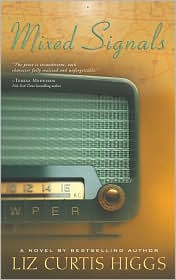
Book Review: Mixed Signals

Mixed Signals. Liz Curtis Higgs. 1999. Multnomah. 384 pages.

Rainy days and Mondays never got Belle O'Brien down. Not when her radio listeners were waiting. 

Mixed Signals is the second contemporary romance novel I've read by Liz Curtis Higgs. I enjoyed both Bookends and Mixed Signals, but I think I definitely liked Mixed Signals more.

The heroine of this one is radio personality, Belle O'Brien. When the novel opens, Belle's having a really bad day. She's just learned that her oldies station--the radio station that she works at--has been bought out. It is now sports radio. (Oh the horror!) She's the only one who hasn't lost her job--and it's not because Belle is a sports fan. No, they've 'creatively' imagined ways to still use her voice on air. (Think Betty Boop).

So when Belle gets a phone call a week or so later, a call from her first boss, Patrick Reese, offering her a job at his brand new oldies station, well, she's thrilled. She counts Patrick as one of her closest friends. And when she worked for him, well, she had a HUGE crush on him. She's not moving just because she's hoping for a romance between the two of them. She's moving because any job (almost) has to be better than her current one. Even if it means moving from Chicago to Abingdon, Virginia.

Belle is very excited about her new job, and she makes an almost instant connection with her landlady, Norah. Who wouldn't love Norah? She's a Christian woman with a big, big, big heart, and she is a GREAT cook. Her home is always inviting and welcoming. And spending any amount of time with Norah makes you want to set your burdens down to share. And Belle confides with Norah about her past with Patrick, which isn't the easiest for Norah to hear since she has a crush on him now.

Patrick may be the most vocal about his interest in Belle, but he's not the only man in town impressed by her. No, David, the radio engineer can't stop thinking about her either. And Christmas may just be an enlightening time for everybody...

I liked this one. I really liked it. I thought the characters were great. It was just very fun, very satisfying.

© Becky Laney of Operation Actually Read Bible
Tuesday, July 19, 2011

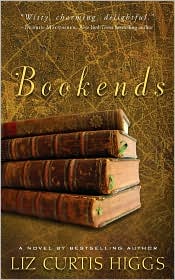
Book Review: Bookends

Bookends. Liz Curtis Higgs. 2000. Multnomah. 340 pages.

It isn't possible! Emilie Getz peered into the window of Benner's Pharmacy, amazed to find every detail exactly as she'd remembered. The soda counter were she'd sat as a child and ordered cherry colas, the stout glass jar stuffed with locally baked pretzels, the racks of colorful greeting cards, the customers--regulars, no doubt--perched on vinyl-covered stools. Gazing out at her, gazing in.

Dr. Emilie Getz, our heroine, has returned to her home town of Lititz, Pennsylvania, to do some historical research for a book she's writing about the 250th anniversary of the Moravian Congregation in Lititz. The novel opens with her attending a Christmas Eve service, she's distracted a bit by the man who sits beside her in the pew. Jonas Fielding, our hero, seems destined to fight with Emilie from the very start. The question, for readers, is not will these two fall or love or when will these two get together. But how will it happen, how will these two admit that what they're feeling is love.

Jonas is her opposite in many, many ways. But this land-developer isn't as evil, as mean, as cruel as Emilie first suspects. He's not out to "destroy" history and "remuddle" things. No, he's a good guy, a very good guy. And she'd be a fool not to realize how great a match he'd be....

As a reader, I often feels less is more especially when it comes to romance. I am not convinced that the Nathan story line was completely necessary to the story--at least for the development of the romance. I think there were enough obstacles between Jonas and Emilie already. And these two were clearly already in love with one another before Nathan arrived to "complicate" things by his desperate actions. And Nathan's scenes, well, they took me away from the characters I did care about. I would never say that Nathan "ruined" the book for me. I wouldn't ever be that silly. But I do think that I would have liked the novel a little more if the Nathan story had been less dramatic.

I don't read a lot of contemporary romance. I tend to prefer historical romance. But. I am SO glad I read this one. While I wouldn't say I loved it, or loved it absolutely, it was such a good read. Maybe not the best, best romance I'd ever read....but it was such a satisfying read!

© Becky Laney of Operation Actually Read Bible
Monday, July 11, 2011

Book Review: How To Find God in the Bible

How to Find God in the Bible: A Personal Plan For the Encounter of Your Life. Woodrow Kroll. 2004. Multnomah. 204 pages.

How to Find God in the Bible is a great little book. I found it to be practical and substantive. You would think that there is only so much that can be said about the Bible. After all, this year I've read Taking Back the Good Book by Woodrow Kroll, Read Your Bible One Book at A Time by Woodrow Kroll, How To Study The Bible. R.A. Torrey, Discovering Jesus: Why Four Gospels to Portray One Person? T.D. Alexander, Knowing Scripture. R.C. Sproul, and How To Get The Most From God's Word. John MacArthur. Yet I haven't found that to be the case. Yes, some chapters may touch on the same subjects, but for the most part each book has been unique; each written in its own style with its own goals.

I am not sure that How to Find God in the Bible is the best of the best of the best of the best. BUT. I do know that I loved it. I found it informative. Each chapter was packed with information. Information that was practical and relevant. And it was written in a very straightforward, reader-friendly style. It wasn't trying to do too much. It wasn't trying to turn the reader into the BEST BIBLE SCHOLAR ever. It wasn't trying to convince the average reader to try to learn Hebrew and Greek. It wasn't trying to persuade you to spend ten hours a day in study and meditation. It also wasn't trying to defend the Bible against skeptics, agnostics, and atheists. You won't find theories and arguments and rhetoric here. No this is a practical book for practical people who want to read the Bible for themselves.

The book is written in three parts. Part One is "Prepare to Encounter God." Part Two is "Why the Bible Can Change Your Life." Part Three is "Four Amazing Bible Discoveries."

Each chapter has an "In this chapter" feature which I just loved. (Maybe because I'm a reviewer who is always trying to find specific things that I want to include in my post. But I believe it has to be useful for other reasons too!)

I'm not a *big* list person--or chart person--but for some reason, I just LOVED the use of charts and lists in this one. For example, there's a list of "people with whom God spoke directly" and "people with whom God spoke through angels" in chapter one. And then there is the list in chapter seven "fourteen reasons to exalt the Lord Jesus Christ."

Favorite quotes:
Every time you read the Bible, you should be prepared for anything. You never know what will happen. (41)
Don't fail to read the Bible simply because you have difficulty relating to the translation. Find a version you do understand. I'm often asked which version of the Bible I think is the best, and I always respond, "The one you read." It doesn't matter if you are convinced your version is the most accurate there is. If you don't read it, you won't connect with God. Hurdle the language barrier by choosing a Bible that is comfortable for you. Then read it for all it's worth. (61)
God doesn't buy the idea of hopelessness because "with God all things are possible" (Matthew 19:26). (109)
"...people have chosen to use the Bible to support their point of view instead of trusting the Bible enough to let it change their point of view--and their way of life." (121)
I have often said that if Christians blew the dust off their Bibles at the same time, we'd all get killed in the dust storm. If you are to benefit from God's Word, you're going to have to read it. It's how you connect with God. (173) 

Monday, May 17, 2010

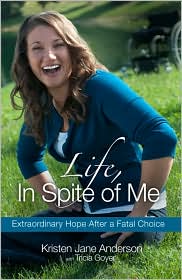
Book Review: Life In Spite of Me


Life, In Spite of Me: Extraordinary Hope After A Fatal Choice. Kristen Jane Anderson. Tricia Goyer. 2010. May 2010. Multnomah. 224 pages.

Numb. The cold Illinois wind chilled my body. Numb. My mind, my heart.

Kristen Anderson shares her story in Life, In Spite of Me. She shares how she battled depression and suicidal thoughts. How she miraculously survived her suicide attempt. Though the attempt left her without both of her legs, Anderson found hope, found Jesus, and found a reason to keep living life, to keep reaching out to others, to keep sharing her story, her faith, with others with the hopes that she can make a difference (with God's help, of course) in others' lives.


© Becky Laney of Operation Actually Read Bible

Monday, November 16, 2009

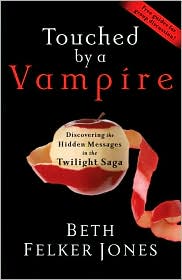
Book Review: Touched By A Vampire


Touched by a Vampire: Discovering the Hidden Messages in the Twilight Saga by Beth Felker Jones. 2009. Multnomah. 180 pages.

Have you read Twilight by Stephenie Meyer? Have you read all the Twilight books? (New Moon, Eclipse, Breaking Dawn) What did you think of them? Beth Felker offers a critical analysis of all four books in Touched By A Vampire. What messages (if any) are biblical? And which messages (if any) contradict christian values?

The purpose of the book isn't to stop people from reading the books. It isn't a strong impassioned plea to ban the books or any such nonsense. What Jones does is argue that the book has strengths and weaknesses. That the books may not be as harmless as they first appear. That there may just be messages about gender, romance, family, etc. that are at odds with the christian faith.

For example, one of the issues Jones addresses is that of romance and gender. Is Edward and Bella's love healthy? Is this a good relationship model? Should girls be encouraged to be more Bella-like? This is something that has bothered me about the books. How her whole entire world becomes centered on Edward. How he is her everything. How she is nothing without him. How lost she is in him. How much of a person is she? It's only, always, ever Edward.

Jones also mentions how she feels this relationship meets all the guidelines for an abusive one, an unhealthy one. And looking at her list of key signs of an abusive relationship--except for one or two--he does show all the signs. He's possessive and jealous. He does try to control what Bella does, who she sees, who she talks to, where she goes, etc. He does tend to isolate her from her family and friends. (Part of this is on Bella. Once Edward is in her life, she begins closing out everyone else.) He does constantly try to check up on her, wanting to know where she is every moment of the day. And both Bella and Edward become suicidal without each other. Overall, if you take away the fact that he's a vampire, if you were to look at him as being a guy minus all the super powers and minus the perfect oh-so-dreamy looks, he's weird and creepy. He sneaks into his girlfriend's house and watches her sleep.

The book is written to help readers think critically about the popular fiction they're reading.
Each chapter has discussion questions. And the book is designed to be used by groups. Again the goal isn't to stop readers from picking up Meyer's books. The goal seems to be to encourage them to think about what they're reading.

© Becky Laney of Operation Actually Read Bible