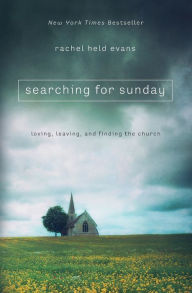
Searching for Sunday. Rachel Held Evans. 2015. Thomas Nelson. 240 pages. [Source: Review copy]
Would I recommend Rachel Held Evans' Searching for Sunday? Probably not. At least not to anyone who comes to my mind. (All the while acknowledging that reading is subjective and that what 'ministers' to one reader might offend others.)
Who isn't a good fit for Searching for Sunday? Those who hold the Bible to be the only authority, the final authority, for how one lives and what one believes. Those who believe it is the very Word of God, God's revelation of himself to us that is ever-relevant no matter the century, no matter the culture. Who is a good fit for Searching for Sunday? Those who always redefining their faith: who they are, who God is, what God says, what church is all about. Those who are perhaps looking for answers outside of the Bible.
Searching for Sunday is an angst-driven confession of almost-faith, or, faith-outgrown-and-then-redefined-according-to-her-preferences. It is one woman's story of her love-hate relationship with church. Not just with the church, but, with faith in general, with evangelical faith to be specific. It felt to me like a celebration of doubt and unbelief. Not that doubt needs to be shamed, mind you, or ignored. Plenty of the psalms, for example, reveal varying degrees of doubt. But most, if not all, then lead you past doubt to rock-solid praise. One may temporarily doubt God's goodness or his justice or his love, but, to stay doubting, to stay in a place where one holds onto doubt and celebrates it doesn't quite seem biblical. Though I'm all for being honest with God, and being honest with yourself and with others. It's the celebrating of doubt that seems out of place, if that makes sense.
It is from start to finish a personal story: her experiences, her opinions, her conclusions. One can't really "disagree" with another's experiences. One can relate or not relate, that is all. But with opinions and conclusions, one can disagree. And I did. Plenty of times. More times than I could count. I found it a frustrating and saddening read. The Bible is God's Word to us, it is his revelation of himself, his sharing who He is, and who we are, and what life is all about. The Bible is the sum of all truth, eternal, revealing a God who is the same yesterday, today, and forever. Who God is does not change according to our whims of who we want him to be, who we need him to be, our own definitions of right and wrong, fair and unfair. We are never to add or subtract from God's revelation of himself. When we disagree with the Bible, it isn't the Bible that needs to be changed to accommodate us!
Is the church perfect? Is any one church perfect? No, of course, not. The church is composed of sinners: sinners saved by grace and grace alone, who remain in varying degrees, for better or worse, sinners still. At the very least, capable of sin and capable of hurting others. Perhaps, at times, blind mainly to their own sins and quite open to "seeing" everyone else's sins. I think pride will always, always, always be a big issue. And pride doesn't have to be an out-in-the-open obvious issue. It can hide behind those embracing honesty and humility. It can hide behind great talent. It doesn't have to be smug and arrogant and in-your-face. I think pride is one sin that all Christians have in common with one another. So the church isn't perfect. I think if one judges the church--any church, all churches--by the Bible, that is one thing. It's another to judge the church by your own standards drawn more from culture than the Word of God. So, yes, there is room for improvement certainly, the church has "fallen short" in some ways. But I felt the book was more insulting the church than embracing it.
© Becky Laney of Operation Actually Read Bible
Wednesday, October 7, 2015
Tuesday, October 6, 2015
My Year with Spurgeon #40
The First and Greatest Commandment
Charles Spurgeon
1857
Mark 12:30
© Becky Laney of Operation Actually Read Bible
Charles Spurgeon
1857
Mark 12:30
To begin, then. This command demands a duty. That duty is, that we should love God. How many men do break this?
You will find those who rail at the very being of a God, though in their consciences they know there is a God, yet with their lips will blasphemously deny his existence. These men say there is no God, because they wish there were none. The wish is father to the thought; and the thought demands great grossness of heart, and grievous hardness of spirit before they dare to express it in words; and even when they express it in words, it needeth much practice ere they can do it with a bold, unblushing countenance. Now, this command beareth hard on all them that hate, that despise, that blaspheme, that malign God, or that deny his being, or impugn his character.
Another class of men know there is a God, but they neglect him, they go through the world with indifference, “caring for none of these things.” “Well,” they say “it does not signify to me whether there is a God or not.” They have no particular care about him; they do not pay one half so much respect to his commands as they would to the proclamation of the Queen.They rise in the morning without a prayer, they rest at night without bending the knee, they go through the weeks business, and they never acknowledge a God.
Religion is a personal matter between you and your Maker. Your Maker says “Thou shalt love me with all thine heart:” it is of no use for you to point your finger across the street, and point at a minister whose life is inconsistent, or at a deacon who is unholy, or to a member of the church who does not live up to his profession. You have just nothing to do with that. When your Maker speaks to you, he appeals to you personally; and if you should tell him, “My Lord, I will not love thee, because there are hypocrites,” would not your own conscience convince you of the absurdity of your reasoning? Ought not your better judgment to whisper “Inasmuch, then, as so many are hypocrites, take heed that thou art not; and if there be so many pretenders who injure the Lords cause by their lying pretensions, so much the more reason why thou shouldst have the real thing, and help to make the church sound and honest.”
The great fault of our time is the fault of indifference; people do not care whether the thing is right or not. What is it to them? They never take the trouble to search between the different professors of religion to see where the truth lies; they do not think to pay their reverence to God with all their hearts. Oh, no, they forget what God demands, and so rob him of his due.
God does not say thou shalt wonder at him, thou shalt have awe of him. He asks more than that; he says “Thou shalt love me!”
How much am I to love God?? Where shall I fix the point? I am to love my neighbor as I love myself. Am I to love my God more than that? Yes, certainly. The measure is even greater. We are not bound to love ourselves with all our mind, and soul, and strength, and therefore we are not bound to love our neighbor so. The measure is a greater one. We are bound to love God with all our heart, soul, mind, and strength.
© Becky Laney of Operation Actually Read Bible
Labels:
Charles Spurgeon,
my year with Spurgeon,
quotes,
Worth Quoting
Monday, October 5, 2015
First Impressions: NIV Zondervan Study Bible
NIV Zondervan Study Bible. August 2015. Zondervan. 3008 pages. [Source: Bought]
And this just became my new favorite NIV Bible. I've been reading from the NIV Zondervan Study Bible for almost a month now. And I am LOVING it. I am loving it for many reasons.
Here's what I think you should know.
© Becky Laney of Operation Actually Read Bible
And this just became my new favorite NIV Bible. I've been reading from the NIV Zondervan Study Bible for almost a month now. And I am LOVING it. I am loving it for many reasons.
Here's what I think you should know.
- Do NOT confuse the NIV Zondervan Study Bible with the NIV Study Bible. The two are VERY different. And not just because the NIV Zondervan Study Bible is new this year, and has a colorful, reader-friendly design. What has changed is the content, the perspective of the contributors. It is REFORMED.
- It is edited by D.A. Carson and features articles by names you may just recognize if you read a lot of theology. Timothy Keller. D.A. Carson. James M. Hamilton Jr. Henri A.G. Blocher. Kevin DeYoung. Paul R. Williamson. T.D. Alexander. Dana M. Harris. Jay A. Sklar. Thomas Richard Wood. Sam Storms. Philip S. Johnston. Moises Silva. Daniel J. Estes. Andrew David Naselli. Brian S. Rosner. Christopher W. Morgan. Graham A. Cole. Greg D. Gilbert. David G. Peterson. Andreas J. Kostenberger. Doublas J. Moo.
- It is absolutely packed with information. Book Introductions. Study notes for each chapter. Maps. Charts. Timelines. Introduction to the Old Testament. Introduction to the Pentateuch. Introduction to the Historical Books. Introduction to the Wisdom and Lyrical Books. Introduction to the Prophetic Books. From Malachi to Christ. The Time Between the Testaments. Introduction to the New Testament. Introduction to the Gospels and Acts. Introduction to the Letters and Revelation. 28 articles. These articles cover almost everything it seems including sin (Kevin DeYoung), the glory of God (James M. Hamilton Jr.), the covenant (Paul R. Williamson), the law (T.D. Alexander), the gospel (Greg D. Gilbert), worship (David G. Peterson), etc. It is like a study Bible with a couple extra books thrown in too.
- But it isn't just that it has tons of information. It is presented clearly and concisely. It is designed with readers like you and me in mind. It doesn't matter if this is your first study Bible or your twentieth study Bible. This one is accessible. And the notes so far have all been worth reading.
- It is the NIV Translation, the 2011 update to the NIV.
1:4 he chose us. In vv. 3–14 Paul emphasizes God’s eternal decision to grant salvation to believers in the following ways: “he chose us” (v. 4), “he predestined us” (v. 5), and “we were also chosen, having been predestined” (v. 11). Since this divine election of believers occurred “before the creation of the world” (v. 4), it is based solely on God’s gracious decision and not on any human merit (cf. God’s choosing Israel to be his treasured possession in Deut 7:6–8, or God’s choosing of Jacob over Esau before they “were born or had done anything good or bad” in Rom 9:11). See also John 5:21; 6:37, 39, 44; 15:16; 17:6; Rom 8:29–30; 9:6–26; 11:5, 7, 28; Col 3:12; 1 Thess 1:4; 2 Thess 2:13; Titus 1:1; 1 Pet 1:1; 2:9; Rev 17:8. to be holy and blameless. The goal, not the basis, of God’s election is ethical purity.Note on Ephesians 1:5
1:5 predestined. Predetermined. See note on v. 4. adoption to sonship. In the Roman world, sons were adopted to carry on the family name and maintain property ownership. The adopted son was no longer responsible to his natural father but was only responsible to his new adoptive father. Similarly, all believers, male and female, who receive the Spirit that brings about adoption (Rom 8:15, 23) acquire a new status with its accompanying privileges and responsibilities. We are no longer obligated to our old father, the devil (John 8:38, 44).Note on Ephesians 1:11
chosen. Jewish believers in Christ “were made heirs” (see NIV text note), or more specifically, God claimed them as his inheritance and possession in much the same way that he claimed Israel as his possession and heritage in the OT (Exod 19:5; Deut 4:20; 9:29; 32:9). predestined. See note on v. 4. works out everything in conformity with the purpose of his will. Emphasizes God’s providence and sovereignty. Everything that happens results from God’s will in some way, and everything that God planned will certainly come to pass (Dan 4:35; Rom 11:36). At the same time, God never does evil and Scripture never blames God for evil or sin (Job 1:21–22; Rom 5:12). Humans are still responsible for their actions (Eccl 7:29; Rom 9:19–20). They should do right and not grieve the Spirit (Eph 4:30).
© Becky Laney of Operation Actually Read Bible
Sunday, October 4, 2015
Week in Review: September 27-October 3
For the word of the Lord is right and true;
he is faithful in all he does.
The Lord loves righteousness and justice;
the earth is full of his unfailing love. Psalm 33:4-5
We wait in hope for the Lord;NIV Pursuit of God
he is our help and our shield.
In him our hearts rejoice,
for we trust in his holy name.
May your unfailing love be with us, Lord,
even as we put our hope in you. Psalm 33:20-23
- Genesis
- Matthew
- Romans
- Galatians
- 1 Timothy
- 2 Timothy
NASB
- Romans
- Galatians
- 1 Timothy
- 2 Timothy
- Titus
- Philemon
ESV Reformation Bible
- Joel
- 1 Timothy
- 2 Timothy
- Jude
ESV
- Galatians
- Ephesians
- Philippians
RSV
- Galatians
- 1 Timothy
- 2 Timothy
NKJV
- Galatians
- 1 Timothy
- 2 Timothy
NEB
- 1 Timothy
- 2 Timothy
- Titus
© Becky Laney of Operation Actually Read Bible
October "Memory" Work
I started out the year wanting to memorize Scripture, I've discovered that I'm satisfied meditating on Scripture. Here are the verses I'll be adding in October.
The grace of our Lord was poured out on me abundantly, along with the faith and love that are in Christ Jesus. Here is a trustworthy saying that deserves full acceptance: Christ Jesus came into the world to save sinners—of whom I am the worst. 1 Timothy 1:14-15, NIV
Now to the King eternal, immortal, invisible, the only God, be honor and glory for ever and ever. Amen. 1 Timothy 1:17, NIV
I urge, then, first of all, that petitions, prayers, intercession and thanksgiving be made for all people— for kings and all those in authority, that we may live peaceful and quiet lives in all godliness and holiness. This is good, and pleases God our Savior, who wants all people to be saved and to come to a knowledge of the truth. 1 Timothy 2:1-4, NIV
For there is one God and one mediator between God and mankind, the man Christ Jesus, who gave himself as a ransom for all people. This has now been witnessed to at the proper time. 1 Timothy 2:5-6, NIV
Beyond all question, the mystery from which true godliness springs is great:
He appeared in the flesh,
was vindicated by the Spirit,
was seen by angels,
was preached among the nations,
was believed on in the world,
was taken up in glory. 1 Timothy 3:16, NIV
Have nothing to do with godless myths and old wives’ tales; rather, train yourself to be godly. For physical training is of some value, but godliness has value for all things, holding promise for both the present life and the life to come. This is a trustworthy saying that deserves full acceptance. That is why we labor and strive, because we have put our hope in the living God, who is the Savior of all people, and especially of those who believe. 1 Timothy 4:7-10, NIV
Past memory verses:
© Becky Laney of Operation Actually Read Bible
- Revelation 21:3, 4
- Proverbs 3:5-6
- Psalm 34:3
- Psalm 34:8
- Psalm 103:1,2,3,4,5
- Psalm 103:10, 11, 12
- Psalm 96:2
- Psalm 95:6-7
- Matthew 11:28
- Hebrews 7:25
- Ephesians 2:8, 9, 10
- Psalm 138:8
- Psalm 27:14
- Proverbs 18:10
- Philippians 4:4
- Philippians 4:13
- John 14:1, 2, 3
- John 14:6
- John 11:25, 26
- Psalm 16:8
- Psalm 16:11
- Psalm 18:30
- Psalm 25:5
- Psalm 27:4
- Psalm 28:6
- Psalm 30:4, 5
- Psalm 31:5
- Psalm 31:9
- Psalm 32:8
- Habakkuk 3:17, 18
- Zephaniah 3:17
- Jeremiah 17:14
- Lamentations 3:22, 23, 24, 25, 26
- Deuteronomy 6:4, 5, 6, 7
- Exodus 15:18
- John 6:40
- John 6:44
- Jude 21
- Jude 24-25
- Isaiah 26:3, 4
- Isaiah 25:1
- Isaiah 25:8,9
- Numbers 6:24, 25, 26
- Deuteronomy 4:39
- Deuteronomy 29:29
- Psalm 119:111
- Romans 15:4, 5, 6
- John 17:17
- 2 Corinthians 5:17
- 2 Corinthians 5:21
- Galatians 5:1, NIV
- Galatians 5:22-25, NIV
- Galatians 2:20, NIV
- Psalm 23:1-3, ESV
- Psalm 23:4, ESV
- Psalm 23:5-6, ESV
- 1 Timothy 1:14-15, NIV
- 1 Timothy 1:17, NIV
- 1 Timothy 2:1, 2, 3, 4, NIV
- 1 Timothy 2:5-6, NIV
- 1 Timothy 3:16, NIV
- 1 Timothy 4:7, 8, 9, 10, NIV
© Becky Laney of Operation Actually Read Bible
Friday, October 2, 2015
Bible Review: Message 100
The Message 100: The Story of God in Sequence. Eugene H. Peterson. 2015. NavPress. 1600 pages. [Source: Review copy]
Soon after receiving a review copy of The Message 100, I decided to read the whole New Testament and the book of Psalms.
What makes The Message 100 unique? (What makes it different from other Message Bibles? OR even what makes it different from all other Bibles?)
First. It is in the Message "translation." (It is actually a paraphrase.)
Second. It is "the story of God in sequence." The books, while remaining whole books, are not ordered in the same traditional way. In the New Testament, for example, this is the arrangement:
Other "chronological" Bibles I've read in don't keep books whole, and, they break up books of the Bible down to chapters and verses in an attempt to make it perfectly chronological--at least according to their best guess. I really appreciate that The Message 100 keeps whole books. Books are meant to be read whole, to rearrange books, in some ways complicates study.
Third. The Bible is broken into 100 readings. They are numbered, but, not dated like some "daily reading" Bibles. There is nothing whatsoever that implies you have to read this Bible for 100 consecutive days! Or even that you have to read all 100 within one year of beginning.
What's a typical reading?
001 -- Genesis 1-16
002 -- Genesis 17-28
003 -- Genesis 29-41
004 -- Genesis 41-50
072 -- Psalm 1-20
073 -- Psalm 21-36
074 -- Psalm 37-51
075 -- Psalm 52-71
076 -- Psalm 72-89
077 -- Psalm 90-109
078 -- Psalm 110-119
079 -- Psalm 120-150
080 -- Matthew 1-11
081 -- Matthew 12-20
082 -- Matthew 21-28
090 -- James, Galatians, 1 Thessalonians, 2 Thessalonians
091 -- 1 Corinthians
094 -- Colossians, Philemon, Ephesians, Philippians
But isn't that A LOT of text to read in one sitting? in one day? Yes and no. I'll explain.
The Bible is best read in large doses. That is, it is better understood if you read it in sections that make sense, that get you going, and keep you focused on the big picture, and the message of the Bible. As opposed to say, reading one or two chapters per day. Would you approach any other book--fiction or nonfiction--and just read it two pages at a time and think you were doing it justice? Don't you at least aim to read whole chapters of other books? Be those chapters five pages or twenty pages?
I also have found that once you expand your spiritual appetites, once you've started reading large chunks of Scripture, that you can't be satisfied with less. It's not that you feel obligated and duty-bound to keep on reading. No, you DESIRE more, more, more. You have tasted and seen that God is GOOD and you honestly desire MORE of his Word daily. You are finding delight and satisfaction IN the Word and you wouldn't want it any other way. (I expanded my spiritual appetite several years ago with the Bible in 90 days plan, and I haven't been the same ever since.)
Fourth. Each reading is introduced by a devotion. Here is an excerpt from the devotion for 082.
Fifth. It is single column, paragraph format. There are no verse numbers within the paragraph itself. The chapters and verses are in super-tiny print in the margin. So while it isn't technically verse-less like the ESV Reader's Bible (which I recently reviewed), it comes close. This is a good thing in my opinion. There are still headings or subheadings.
http://themessage100.com/
What do I think of The Message 100?
If you'd asked me a week or two ago, I would have admitted that I am not a fan of The Message. But I'd probably also admit that I hadn't ever actually read The Message in any real way. That is, while, I'd looked up verses at Bible Gateway, I'd never sat down to read whole books of the Bible in the Message translation. In part, because I would stumble across less than appealing chapters and verses, and make some quick judgements.
In fact, I would encourage skeptics to spend a week with The Message. BUT at the same time, I would encourage those who rely on The Message as their primary Bible to spend a week in another translation as well. Perhaps even the KJV!!! I do believe that dramatic changes can engage you with the text in a new and beneficial ways.
Conclusion: I ended up REALLY enjoying The Message 100. I love the concept of the 100 readings. I like the arrangement of the books. I appreciate that they kept the books whole. If it was available in additional translations, I'd be absolutely thrilled.
© Becky Laney of Operation Actually Read Bible
Soon after receiving a review copy of The Message 100, I decided to read the whole New Testament and the book of Psalms.
What makes The Message 100 unique? (What makes it different from other Message Bibles? OR even what makes it different from all other Bibles?)
First. It is in the Message "translation." (It is actually a paraphrase.)
Second. It is "the story of God in sequence." The books, while remaining whole books, are not ordered in the same traditional way. In the New Testament, for example, this is the arrangement:
- Matthew
- Mark
- Luke
- Acts
- James
- Galatians
- 1 Thessalonians
- 2 Thessalonians
- 1 Corinthians
- 2 Corinthians
- Romans
- Colossians
- Philemon
- Ephesians
- Philippians
- 1 Timothy
- Titus
- 2 Timothy
- 1 Peter
- 2 Peter
- Jude
- Hebrews
- John
- 1 John
- 2 John
- 3 John
- Revelation
Other "chronological" Bibles I've read in don't keep books whole, and, they break up books of the Bible down to chapters and verses in an attempt to make it perfectly chronological--at least according to their best guess. I really appreciate that The Message 100 keeps whole books. Books are meant to be read whole, to rearrange books, in some ways complicates study.
Third. The Bible is broken into 100 readings. They are numbered, but, not dated like some "daily reading" Bibles. There is nothing whatsoever that implies you have to read this Bible for 100 consecutive days! Or even that you have to read all 100 within one year of beginning.
What's a typical reading?
001 -- Genesis 1-16
002 -- Genesis 17-28
003 -- Genesis 29-41
004 -- Genesis 41-50
072 -- Psalm 1-20
073 -- Psalm 21-36
074 -- Psalm 37-51
075 -- Psalm 52-71
076 -- Psalm 72-89
077 -- Psalm 90-109
078 -- Psalm 110-119
079 -- Psalm 120-150
080 -- Matthew 1-11
081 -- Matthew 12-20
082 -- Matthew 21-28
090 -- James, Galatians, 1 Thessalonians, 2 Thessalonians
091 -- 1 Corinthians
094 -- Colossians, Philemon, Ephesians, Philippians
But isn't that A LOT of text to read in one sitting? in one day? Yes and no. I'll explain.
The Bible is best read in large doses. That is, it is better understood if you read it in sections that make sense, that get you going, and keep you focused on the big picture, and the message of the Bible. As opposed to say, reading one or two chapters per day. Would you approach any other book--fiction or nonfiction--and just read it two pages at a time and think you were doing it justice? Don't you at least aim to read whole chapters of other books? Be those chapters five pages or twenty pages?
I also have found that once you expand your spiritual appetites, once you've started reading large chunks of Scripture, that you can't be satisfied with less. It's not that you feel obligated and duty-bound to keep on reading. No, you DESIRE more, more, more. You have tasted and seen that God is GOOD and you honestly desire MORE of his Word daily. You are finding delight and satisfaction IN the Word and you wouldn't want it any other way. (I expanded my spiritual appetite several years ago with the Bible in 90 days plan, and I haven't been the same ever since.)
Fourth. Each reading is introduced by a devotion. Here is an excerpt from the devotion for 082.
I want to tell you that God comes to you. And I want to prepare you to recognize and receive him when he does. Come is a gospel verb. The distinctive biblical and Christian message is not that God is but that he comes. And he's going to come again, because that's the very nature of God--to come. That's his basic character--God comes. He's not a professor who delivers ideas to us; he's not a social worker who arranges discussion groups among us to to help us raise our standard of living; he isn't a government agent bringing the latest set of regulations so that we can stay out of jail. He comes. He arrives…. God has been doing this for a long time; the Bible reports his comings. He's still doing it. Jesus Christ is the primary way in which we recognize both that God comes and the way he comes. . . . (1417)
Fifth. It is single column, paragraph format. There are no verse numbers within the paragraph itself. The chapters and verses are in super-tiny print in the margin. So while it isn't technically verse-less like the ESV Reader's Bible (which I recently reviewed), it comes close. This is a good thing in my opinion. There are still headings or subheadings.
http://themessage100.com/
What do I think of The Message 100?
If you'd asked me a week or two ago, I would have admitted that I am not a fan of The Message. But I'd probably also admit that I hadn't ever actually read The Message in any real way. That is, while, I'd looked up verses at Bible Gateway, I'd never sat down to read whole books of the Bible in the Message translation. In part, because I would stumble across less than appealing chapters and verses, and make some quick judgements.
First this: God created the Heavens and Earth—all you see, all you don’t see. Earth was a soup of nothingness, a bottomless emptiness, an inky blackness. God’s Spirit brooded like a bird above the watery abyss. (Genesis 1:1-2)
How well God must like you—
you don’t hang out at Sin Saloon,
you don’t slink along Dead-End Road,
you don’t go to Smart-Mouth College. (Psalm 1:1)
Who is this King-Glory?But after spending a week reading it, I must admit that I was too harsh. Sure, there are a handful of verses that still read painfully to me, like nails on a chalkboard. But more often than not, it worked for me just fine. Even refreshing at times.
God-of-the-Angel-Armies:
he is King-Glory. (Psalm 24:10)
“You’re blessed when you’re at the end of your rope. With less of you there is more of God and his rule.
“You’re blessed when you feel you’ve lost what is most dear to you. Only then can you be embraced by the One most dear to you.
“You’re blessed when you’re content with just who you are—no more, no less. That’s the moment you find yourselves proud owners of everything that can’t be bought.
“You’re blessed when you’ve worked up a good appetite for God. He’s food and drink in the best meal you’ll ever eat.
“You’re blessed when you care. At the moment of being ‘care-full,’ you find yourselves cared for.
“You’re blessed when you get your inside world—your mind and heart—put right. Then you can see God in the outside world.
“You’re blessed when you can show people how to cooperate instead of compete or fight. That’s when you discover who you really are, and your place in God’s family.
“You’re blessed when your commitment to God provokes persecution. The persecution drives you even deeper into God’s kingdom. (Matthew 5:3-10)
“Here’s another way to put it: You’re here to be light, bringing out the God-colors in the world. God is not a secret to be kept. We’re going public with this, as public as a city on a hill. If I make you light-bearers, you don’t think I’m going to hide you under a bucket, do you? I’m putting you on a light stand. Now that I’ve put you there on a hilltop, on a light stand—shine! Keep open house; be generous with your lives. By opening up to others, you’ll prompt people to open up with God, this generous Father in heaven. (Matthew 5:14-16)
“Be especially careful when you are trying to be good so that you don’t make a performance out of it. It might be good theater, but the God who made you won’t be applauding. (Matthew 6:1)
“Don’t pick on people, jump on their failures, criticize their faults— unless, of course, you want the same treatment. That critical spirit has a way of boomeranging. It’s easy to see a smudge on your neighbor’s face and be oblivious to the ugly sneer on your own. Do you have the nerve to say, ‘Let me wash your face for you,’ when your own face is distorted by contempt? It’s this whole traveling road-show mentality all over again, playing a holier-than-thou part instead of just living your part. Wipe that ugly sneer off your own face, and you might be fit to offer a washcloth to your neighbor. Matthew 7:1-5)There is something practical about the paraphrase. And by the end of the week, I'd come to appreciate more than I ever thought possible.
In fact, I would encourage skeptics to spend a week with The Message. BUT at the same time, I would encourage those who rely on The Message as their primary Bible to spend a week in another translation as well. Perhaps even the KJV!!! I do believe that dramatic changes can engage you with the text in a new and beneficial ways.
Conclusion: I ended up REALLY enjoying The Message 100. I love the concept of the 100 readings. I like the arrangement of the books. I appreciate that they kept the books whole. If it was available in additional translations, I'd be absolutely thrilled.
© Becky Laney of Operation Actually Read Bible
Thursday, October 1, 2015
Quotes from the Cloud #39
This year, I hope share weekly posts of quotes. These quotes are from authors I'm reading and enjoying from the Clouds of Witnesses Reading Challenge.
For fellow participants, what I would LOVE, LOVE, LOVE to see is for people to share quotes from what they're reading. I'd love for you to share quotes occasionally with your readers and let me know about it. If you don't have a blog, you could always leave quotes in the comments here.
© Becky Laney of Operation Actually Read Bible
For fellow participants, what I would LOVE, LOVE, LOVE to see is for people to share quotes from what they're reading. I'd love for you to share quotes occasionally with your readers and let me know about it. If you don't have a blog, you could always leave quotes in the comments here.
To dwell in the house of the Lord all the days of our life means to be so vividly conscious of our fellowship with the living God that every morning, noon and night our thoughts go out to Him, that we hear his voice in the soul, that we are aware of his holy Presence within, experience his workings in our heart and in our conscience, and that we carefully avoid the things which we would not dare to do if God stood before us and spoke to us. ~ Abraham Kuyper, "In the Covert of Thy Wings"
Thinking of God is not fellowship with God. True fellowship is far more devout and far more intimately personal. And as often as we have true fellowship with God, it is a grace and a benefit for which we owe him thanks. It is not that we are so good and so devout as to lift up our heart unto God. But it is rather Divine Compassion that condescends to us to bless us and to make us rich with the experience of his presence. ~ Abraham Kuyper, "Songs in the Night"
David talks about “a broken and contrite heart.” In other words, this is a sincerely humble heart that is almost dying out of despair. David is saying that God doesn’t hate a broken and contrite heart, but rather accepts it with joy. The message we proclaim brings life and God’s approval to us because it strengthens us and fights against sin and death. In fact, the gospel demonstrates its power when we are sinful and weak. It’s a message of joy that can be experienced only when sorrow and distress are present. But we want to have the message of life and joy without any sorrow or death. What fine theologians we think we are! We must learn that as Christians we have to live with death all around us, with regret and a trembling conscience—between the teeth of the devil and hell. In spite of all this, we must hang on to the message of God’s grace. Then in all circumstances, we can say, “Lord, you want only the best for me.” God’s true nature is to love people who are troubled, have mercy on those who are brokenhearted, forgive those who have fallen, and refresh those who are exhausted. This psalm calls us to trust in God’s mercy and goodness alone. It encourages us to believe that God is on our side even when we feel abandoned and distressed. ~ Martin Luther, Faith Alone, September 8
© Becky Laney of Operation Actually Read Bible
Subscribe to:
Posts (Atom)


