Sunday, April 24, 2016

Live Like You're Loved: Prayer


Today, I thought we could focus in on prayer. I'll be sharing a few quotes and a few verses.
To understand the Scripture is not simply to get information about God. If attended to with trust and faith, the Bible is the way to actually hear God speaking and also to meet God himself…We know who we are praying to only if we first learn it in the Bible. And we know how how we should be praying only by getting our vocabulary from the Bible. ~ Timothy Keller
If the goal of prayer is a real, personal connection with God, then it is only by immersion in the language of the Bible that we will learn to pray, perhaps just as slowly as a child learns to speak… This wedding of the Bible and prayer anchors your life down in the real God. ~ Timothy Keller
Do not be anxious about anything, but in everything by prayer and supplication with thanksgiving let your requests be made known to God. And the peace of God, which surpasses all understanding, will guard your hearts and your minds in Christ Jesus. Philippians 4:6-7
First of all, then, I urge that supplications, prayers, intercessions, and thanksgivings be made for all people, for kings and all who are in high positions, that we may lead a peaceful and quiet life, godly and dignified in every way. This is good, and it is pleasing in the sight of God our Savior, who desires all people to be saved and to come to the knowledge of the truth. For there is one God, and there is one mediator between God and men, the man Christ Jesus, who gave himself as a ransom for all, which is the testimony given at the proper time. 1 Timothy 2:1-6
And this is the confidence that we have toward him, that if we ask anything according to his will he hears us. And if we know that he hears us in whatever we ask, we know that we have the requests that we have asked of him. 1 John 5:14-15
Let us then with confidence draw near to the throne of grace, that we may receive mercy and find grace to help in time of need. Hebrews 4:16
If you struggle with prayer, you're not alone. First, I would suggest that you take your weakness, your struggle, your inability and inadequacy, to God. Pray that he will teach you to pray. Pray that he will guide your prayers. Pray that he will keep your attention focused. Pray that he will give you strength and perseverance. Second, there are some great Christian resources out there. I'd be happy to share some of my favorite recommendations with you if you're interested.

© Becky Laney of Operation Actually Read Bible

Saturday, April 23, 2016

Book Review: Looking for Lovely

Looking for Lovely. Annie F. Downs. 2016. 208 pages. [Source: Review copy]

Looking for Lovely was a quick and (mostly) enjoyable read. It is a personal narrative of a young, single Christian woman. (I see it as a polished form of stream of consciousness; it is organized not random, but, it's almost an uncensored look at a woman's private thoughts.) If the book has spiritual insights to pass along, it is probably in the showing and not telling. In other words, that she is--that we all are--works in progress; that we all struggle with ups and downs, good days and bad days. That in spite of how we appear to others, how we appear to ourselves even, God loves us because God is that good and gracious and faithful.

Readers can benefit from the chapter "Looking for Lovely." In that chapter, she stresses two things: 1) God made you on purpose and 2) God made you to be brave.

Most of the book focuses on the author: on her past, on her present, on her dreams for the future, on her desperate pleading to the Lord to send her a husband, on her desperate need to be married, on her fears, on her doubts, on her strengths, on her weaknesses, on her good days, on her bad days, on her weaknesses, on her successes. She doesn't seem to hold much of anything back from her readers.

One doesn't particularly learn much about God and the Bible directly. It is more indirect and subtle than that. If you look for it, you can find Him there in her messy, chaotic, fun-filled life. But this isn't particularly my favorite type of "Christian nonfiction."

© Becky Laney of Operation Actually Read Bible

Live Like You're Loved: Defining the Gospel


This will be a post full of quotes. Others can say it better.
The gospel is the good news that God’s kingdom power has entered human history through the life, death, and resurrection of Jesus Christ. When we repent and rely on his righteousness instead of our own, his kingdom power transforms us, and we become participants in the restoration of God’s world. The three aspects of the gospel are the kingdom, the cross, and God’s grace. 1. The gospel of the kingdom is life with God under God’s rule. 2. The gospel of the cross is the life, death, and resurrection of Jesus by which God accomplishes our salvation, rescues us from his wrath, incorporates us into his people, and inaugurates his reign in the world. 3. The gospel of grace is the wonderful news that God accepts us, shares his life with us, and adopts us as heirs of his kingdom not because we have earned it or deserve it but because God chooses to give all of this freely at Christ’s expense. ~ Daniel Montgomery and Timothy Paul Jones
I am a Christian not because I think that I can walk in Jesus's footsteps but because he is the only one who can carry me. I am not the gospel; Jesus Christ alone is the gospel. His story saves me, not only by bringing me justification but by baptizing me into his resurrection life. ~ Michael Horton
The gospel is not a way to get people to heaven; it is a way to get people to God. It's a way of overcoming every obstacle to everlasting joy in God. ~ John Piper
At its core, the gospel is Jesus as the substitute for sinners. We could summarize the whole by saying that in his life Jesus lives in perfect submission to the will of God and he fulfills his righteous standard (the law). In his death on the cross he quenches God's wrath against sin, satisfying the sovereign demand for justice. In his resurrection he is victorious over sin and death. All of this is done on behalf of sinners in need of redemption and is offered to all who believe. This is therefore very "good news." ~ Joe Thorn
“I go to prepare a place for you”—the whole of the gospel is in that statement; in that one verse is packed the whole of Christian theology and doctrine. ~ Martyn Lloyd-Jones
The cross provides our access to relate to God, but we must always relate to him in light of who he is, not just who we think or hope him to be. ~ Matt Chandler
Jesus fulfilled all of God's conditions on our behalf so that our relationship with God could be unconditional. Christianity is the only faith system where God both makes the demands and meets them. ~ Tullian Tchividjian
The Bible is the story of God's counteroffensive against sin. It is the grand narrative of how God made it right, of how he is making it right, and how he will one day make it right finally and forever. ~ Greg Gilbert
If a penitent should come and ask me, “What must I do to be saved?” I would say, “Christ must save you—believe on the name of the Lord Jesus Christ.” I would neither direct to prayer, nor reading of the Scriptures nor attending God’s house; but simply direct to faith, naked faith on God’s gospel. Not that I despise prayer—that must come after faith. Not that I speak a word against the searching of the Scriptures—that is an infallible mark of God’s children. Not that I find fault with attendance on God’s word—God forbid! I love to see people there. But none of those things are the way of salvation. It is nowhere written—“He that attendeth chapel shall be saved,” or, “He that readeth the Bible shall be saved.” Nor do I read—“He that prayeth and is baptised shall be saved;” but, “He that believeth,”—he that has a naked faith on the “Man Christ Jesus,”—on his Godhead, on his manhood, is delivered from sin. To preach that faith alone saves, is to preach God’s truth. ~ Charles Spurgeon
Either Jesus bears our sin, or we do. If the Father turned His face away from His beloved Son when He was regarded as a sinner, we can be sure that the Father will turn away from every sinner who stands before the Judgment Bar on his own merits. We are either saved by His rejection, or we must bear our own rejection for all of eternity. ~ Erwin Lutzer

© Becky Laney of Operation Actually Read Bible

Friday, April 22, 2016

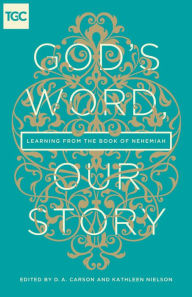
Book Review: God's Word, Our Story

God's Word, Our Story. Learning from the Book of Nehemiah. D.A. Carson and Kathleen B. Nielson, editors. 2016. Crossway. 208 pages. [Source: Review copy]

God's Word, Our Story is a collection of talks from The Gospel Coalition Women's Conference 2014. But. It isn't just the conference in book form. Each chapter concludes with a behind-the-scenes glimpse into bible exposition. How does that contributor read and study the Bible? What does the exposition process look like in real life? How does one go from the Bible text to a polished (somewhat polished) sermon or lesson?!

God's Word Our Story is an exposition of the entire book of Nehemiah. It includes contributions by Kathy Keller (Nehemiah 1, 2); Tim Keller (Nehemiah 3, 4); Paige Brown (Nehemiah 5, 6); Nancy Guthrie (Nehemiah 7, 8); John Piper (Nehemiah 9, 10); Carrie Sandom (Nehemiah 11, 12-1-26); Jenny Salt (Nehemiah 12:44-43); Kathleen Nielson (Nehemiah 12:44-47); and D.A. Carson (Nehemiah 13).

The book begins with an introduction by Kathleen Nielson titled, "On Exposition." In the introduction, she examines the what of exposition, the why of exposition, and the where of exposition. I'd like to share several of her reasons WHY biblical exposition is important.
Biblical exposition is so important because the Bible is God speaking. If we had to choose just one reason, this, of course, would be it. If it is true that these words are God-breathed (2 Tim. 3:16), written by men who “spoke from God as they were carried along by the Holy Spirit” (2 Pet. 1:21), then nothing is more important than hearing these words clearly. The One who spoke these words made us. He also made a way to save us from his wrath, which we in our sin deserve. He loves us and lights the way to him. That way is found in his Word. That way is Jesus, who is at the center of this Word. Hearing this Word clearly and truly is a life-and-death matter. Submitting to God’s Word as to the Lord himself is what we human beings were created to do, for his glory and for our good. When a person stands up to handle the Word of the God of the universe, eternal realities are at stake. These realities are personal, not abstract. God’s Word is alive and active because God is alive and active. Sometimes we actually forget he is there as we receive and discuss his words to us. ~ Kathleen Nielson
Biblical exposition is so important because it gives us confidence in our message. ~ Kathleen Nielson
Biblical exposition is so important because those who preach or teach should be guides, not gurus. ~ Kathleen Nielson
Biblical exposition is so important because regular expository teaching tells God’s story truly. ~ Kathleen Nielson
We take in the Word in whole books because that is the form in which God has delivered his Word to us. He’s made us a “people of the book.” Even though in this day we all tend to be people of topics and snippets of information digested through one quick link after another, we must respect the beautiful coherence of the book we call the Bible. ~ Kathleen Nielson
The Bible is God’s work of art. Each book’s form and content, and the unity of the whole Bible, represent an unparalleled literary masterpiece, with multiple genres combining to speak one unified story. It’s the universal story, the true story of the universe. It’s God’s telling of his redemption of a people for himself for his glory, through his Son… There’s no other way to get the story right than to listen to it the way God tells it. There’s no other way to delight fully in the story than to contemplate it in its fullness. We deepen our knowledge of Jesus Christ, the Son of God and the Savior of the world, as we grasp his part in the story from the very beginning (in creation) to the very end (at his second coming and into eternity). The cross and resurrection that are the climax at the center of the story cannot be torn away from the beginning and the end— and all the other parts in between. Every passage of Scripture finds its fullness of revelation in the gospel of Jesus Christ. ~ Kathleen Nielson
Biblical exposition is so important because it grows us up into mature followers of Christ. “Little-snippet teaching” is one way to stay on a milk diet forever instead of moving on to meat (see 1 Cor. 3: 1– 2). ~ Kathleen Nielson
The remaining chapters focus in on the book of Nehemiah. I have always loved certain parts of Nehemiah, the story is a great one. But I now have a fuller appreciation for the whole book of Nehemiah, and, how it all comes together.

I love how Bible-centered, Christ-centered this book was. I love that we get to see the process of Bible study. I found it an encouraging read.

Perhaps my favorite chapter was by Paige Brown. It was called "Fearing God In A Fallen World." She wrote her chapter about Nehemiah 5 and 6. But she somehow connected it with John Newton's Amazing Grace, the second verse. And it fit together absolutely beautiful. This was a wow chapter for me!

Some favorite quotes:
We are studying Nehemiah not only to learn from the book itself but also to learn how to learn from the book. ~ Tim Keller
Studying a book like Nehemiah forces us to go back to what we understand the Bible to be. I’d like to show you two basic parts to the doctrine of Scripture. The Bible, on the one hand, is a human book, which means we don’t believe— as did Joseph Smith about The Book of Mormon— that it was written on golden plates by angels or by God himself. It was written by human beings who used Greek, Aramaic, or Hebrew words. Therefore, we need to understand what those words meant and how those languages worked, because human beings used them to give us the message. On the other hand, the Bible is a divine book. It was written by God; every word on the page is there because God guided the human author to write that word. That means the Bible is ultimately one story. It is one large story comprised of many little stories. There’s one large narrative arc, and everything in the Bible is moving and pointing along that arc. ~ Tim Keller
Most people today would scoff at the idea that the central source in which to discover the reality of who you are, of who you were created to be, and of what you are meant to do could be the pages of an ancient book. Maybe we presume that idea would have been more believable in Nehemiah’s day. But consider that when the events we are reading about took place, the Book of the Law of Moses was already an ancient book. It was already a thousand years old. And consider that these were people who had never heard the voice of God speaking to them from a mountain that was on fire, as their ancestors did at Sinai (Exodus 19). They’d never seen a cloud of fire hovering over the temple to signify God’s presence among them, as their ancestors did in Solomon’s day (2 Chron. 7: 1– 3). But they did want to hear from God in their day. So how would that happen? And how can we expect to hear God speaking to us in our day when we’ve never heard an audible voice from heaven or had a supernatural experience? God speaks to us, revealing to us who he is and what he has done, helping us understand who we are in relationship to him, through his written Word. ~ Nancy Guthrie
One of the main lessons from Nehemiah 9 and 10— indeed, from all the Bible— is that God does not exist for the sake of our enjoying biblical stories; biblical stories exist for the sake of our enjoying God. The reason I make a point of this is not only because it stands out amazingly in Nehemiah 9, but also because in our time there is great fascination with tracing out the storyline of the Bible. I simply want to wave a flag over all this fascination with story and narrative to say: there is a point to the story; there is a point to the narrative— and the point is a person. Biblical stories are no more ends in themselves than history is an end in itself or the universe is an end in itself. The universe is telling the glory of God (Ps. 19: 1). And the history of the world is what it is to show that God is who he is. God writes the story of history to reveal who he is— what he is like, his character, his name. ~ John Piper

© Becky Laney of Operation Actually Read Bible

Thursday, April 21, 2016

Quotes from the Cloud #15

This year, I hope share weekly posts of quotes. These quotes are from authors I'm reading and enjoying from the Clouds of Witnesses Reading Challenge. 

For fellow participants, what I would LOVE, LOVE, LOVE to see is for people to share quotes from what they're reading. I'd love for you to share quotes occasionally with your readers and let me know about it. If you don't have a blog, you could always leave quotes in the comments here.
Every time we say, “I believe in the Holy Spirit,” we mean that we believe there is a living God able and willing to enter human personality and change it. ~ J. B. Philips
“A wavering Christian is a Christian who trusts in the love of God one day and doubts it the next, and who is alternately happy or miserable accordingly . . . driven to and fro by every wind of doctrine. . . . You would suppose that even the most ignorant child of God would know without telling that this sort of experience is all wrong, and that to waver in one’s faith after such a fashion was one of the things most dishonoring to the Lord. . . . A wavering faith is not only disloyal to God, but it is a source of untold misery to ourselves and cannot in any way advance our spiritual interests.” ~ Hannah Whitall Smith on James 1:5
God pays in joy that is fireproof, famine-proof and devil-proof. ~ Billy Sunday
Indeed this is one of the greatest mysteries in the world—namely, that a righteousness that resides with a Person in heaven should justify me, a sinner on earth. ~ John Bunyan

© Becky Laney of Operation Actually Read Bible

Wednesday, April 20, 2016

Book Review: No Graven Image

No Graven Image. Elisabeth Elliot. 1966. 267 pages. [Source: Inter-Library-Loan]

No Graven Image is set in Ecuador. It's narrated by an American missionary--a single woman--named Margaret. Ecuador is her first placement, and, it is without a doubt where she feels called by God to serve. She hopes to learn the language--Quichua--and eventually translate the Bible into the native language. She has learned Spanish. She's seeking someone who speaks Spanish and Quichua. About a third of the way through the novel, she meets Pedro. There are some barriers to their friendship--language, culture, social class--but eventually he becomes 'the one' to help her in her work. She will pay him to teach her the language. She will pay him to help her translate the Bible. Now you might think that was challenging enough, but no, before anyone can benefit from this new translation of the Bible, she will have to teach them to read their own native language, that it's worth the time and effort to learn to read. Before she can teach them--at least as she sees it--she has to show them that she's trustworthy and/or worthy of their respect and friendship. She has to overcome the 'who-does-she-think-she-is' and 'is-that-lady-crazy' viewpoint.

From start to finish, Margaret experiences troubles and frustration. Think of it like this: I'm a missionary, now what? Now that I'm actually here in a foreign country instead of back home training to be this missionary whom God will use...what do I do? How does a missionary do missions. Is being a missionary simply living in another country--having other people pay you to live in another country? How does one justify spending one's time when you're a missionary? Is it serving God to go to the marketplace and buy food from natives? Or is the only time that 'counts' the time you spend "sharing the gospel"?

The book has more questions than answers, in my opinion. Margaret wrestles with God quite a bit. Or perhaps I should rephrase that. She wrestles with her beliefs about God quite a bit. She definitely starts out with belief that she is doing God a favor by being a missionary and serving in Ecuador. She definitely believes that by being there and serving, she is doing "her part" to bring people to Christ, and, that God should honor that service by blessing her with definite converts. The issue she doesn't quite address straight-forwardly is the idea that God is sovereign in missions--as He is sovereign over the whole universe--and that it is God who works in the heart, that salvation is all His from start to finish. Her efforts--no matter how mighty and fierce--cannot bring about results. She doesn't have anything to "prove" to God. I'm not sure if Margaret grasped these truths or not. And if Margaret's lacking was intentional on the part of the author, or, if Elliot herself struggled with God's sovereignty.

As a happy, comfy-cozy read, No Graven Image fails to satisfy. If you want to read a book about a woman struggling with living out her calling and wrestling out her doctrines about God in the real world, then this one is worth picking up and reading. Just know that it asks more questions than it answers. There is no tidy ending, no "aha" moment when everything clicks into place and her struggles with herself, with God, cease.

Tuesday, April 19, 2016

My Year With Spurgeon #15

The Love of Jesus--What It Is--None But His Loved Ones Know
Charles Spurgeon
1862

Ephesians 3:19
To know the love of Christ which passes knowledge by contemplation is very high—but there is a higher stage than this. There are times when I almost fear to speak of these things, but there are some here, surely, who will understand me, some here who have passed through the same state, and will not think that I am dreaming. There are times when the soul has long contemplated Christ, and there are some who know not only to contemplate but to enjoy. Even on earth, faith sometimes gives place to a present and conscious enjoyment.
I shall quote but one or two, and I hope there are some here who have known them in their own experience. In the life of Mr. Flavel, who was one of the most temperate of the Puritans, and one not at all given to anything like fanaticism, there is an event mentioned which once occurred to him. He said that being once on a journey alone on horseback, the thought of the love of Christ came upon him with great power. And as he rode gently along the road, the thought seemed to increase in force and strength, till at last he forgot all about earth, and even where he was. Somehow or other his horse stood still but he did not notice it. And when he came to himself, through some passerby observing him, he found that he had bled very copiously during the time. Getting off his horse he washed his face at the brook and he said, "I did verily think as I stood there, that if I was not in Heaven, I could hardly hope to be more blessed in Heaven than I was then." He mounted his horse and rode on to a place of lodging where he was to pass the night. Supper was brought in but left untasted on the table. He sat all night long without sleep, enjoying the presence of Christ, and he says, "I was more rested that night than with any sleep I ever had, and I heard and saw in my soul, by faith, such things as I had never known before." The like occurred to Mr. Tennant, who was a man who spent many hours in private, and sometimes, when it was time to preach, he was quite unable to stand unless first carried into his pulpit. Then he would put his hands out and lean there and say such glorious things of Christ, that those who looked upon him verily thought that they looked upon the face of an angel.
Rutherford, too, is another specimen. When he preached about Christ, he preached so wonderfully, that on any other subject he was not at all like himself. And the Duke of Argyle was once so warmed when Rutherford got upon that subject, that he cried out in Church—"Now, Man, you are on the right strain! Keep to it." And he did keep to it, and the little man's thin voice seemed to swell with supernatural grandeur when he began to talk of his precious, precious Lord Jesus, and to extol and exalt Him who was the Bridegroom of his soul, his Brother and his blessed Companion.
"Oh, these are flights of the imagination," you say. Yes, they may be, indeed, Beloved. But if you could get them some times, you would come back to the world's cares and troubles like giants refreshed with new wine, caring nothing for anything that might happen. Christ would be so sweetly and blessedly within you, that you could bear the burden and think nothing of it. And though the grasshopper was a burden before, you could now carry it right readily.
Well, I have taken you up to where not many go in these times, but I hope there are some who will yet ascend there till they shall even embrace Christ, and who will sit down at His table till they shall know Ralph Erskine's blessed sickness of love and, in the conscious enjoyment of a precious Savior, shall say in the words of the spouse, "Stay me with flagons, comfort me with apples, for I am sick of love. His left hand is under my head and His right hand does embrace me."
To know Christ sympathetically, is a yet higher stage than any to which we have attained before. What do I mean by this? I will show you, first of all, what I do not mean. We will suppose ourselves standing on the brow of the hill with Jerusalem in the alley below. Jerusalem is to be destroyed by the Romans. The decree has gone forth that its sin must be punished. Now, here is a Brother who holds very high doctrines in his head, but who has not much sympathy in his heart. Come up here, Brother. Do you see that city there? That is all to be destroyed! Do you see its streets? They are all to be crimsoned with blood! Do you see its temple? Not one stone of it is to be left upon another! What do you think of it? "Well," he says, "if they are to be saved, they will be saved. If it is in the purpose and the decree it will be so. I am sure I am very sorry if they should not be, but I do not see that it is any particular business of mine. The Lord will have His own and it will all be well."
Get down, Sir! What do you know about the love of Christ? Nothing! Give such a man as you that text, "He beheld the city and wept over it," and you would not know how to preach from it, for you do not know the Savior's heart, and have not known His love.
If you say are not your Brother's keeper, rest assured that you are a Cain, and that you will be your Brother's murderer—for we either do good or hate. It is impossible for us to be devoid of influence. 
If he serves his Master, he is scattering mercy abroad. But let him, if it were possible for him to do so, let him cease to serve the Lord, and become idle, and then he scatters plague and death. Oh, do we know the love of Christ by feeling it in our own hearts?
May He help you to weep like Christ, to work like Christ—yes, and to be ready to die like Christ—if it were necessary by such means to bring sinners to their Savior and their Lord. O that we could get here!