Showing posts with label B&H. Show all posts

Monday, April 29, 2019

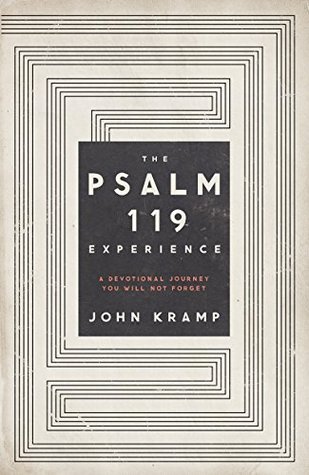
Book Review: The Psalm 119 Experience

The Psalm 119 Experience. John Kramp. 2014. B&H Publishing. 217 pages. [Source: Review copy]

First sentence from the introduction: Watch out. Psalm 119 is about to sneak up and draw you into a life-changing experience.

First sentence from chapter one: If you seek a happy life, discover the secret to a blameless life. Impossible? Can any of us stand before God innocent of wrongdoing, free of guilt and not subject to blame? No. At least not on our own. But God provided a way to the impossible.

The Psalm 119 Experience is a twenty-two week devotional by John Kramp. Kramp set out to write twenty-two songs to aid in memorizing or experiencing Psalm 119. The songs are NOT included and must be purchased separately. Oh, the lyrics are included--but not the actual music.

Psalm 119 has twenty-two sections. Kramp has written five devotions for each section thus making it easy for this book to be a twenty-two week devotional. Each devotion begins with a verse from Psalm 119 as a jumping off place. But the devotion rarely--if ever--stays in Psalms for better or worse. I appreciate that Kramp brings Jesus Christ into each and every devotional. Many--if not all--are open proclamations of the gospel itself. This is a good thing. How could it be anything other than good to exalt Jesus Christ? Yet this one isn't so much an experience of Psalm 119 in and of itself as an experience of the gospel.

If you love devotional books this one is worth your time.

Quotes:
We gain nothing by considering sin inevitable. Why think of ourselves as victims when God has equipped us to battle sin's enticements? God gave us His Word so that we would not sin. That's the good news. God gave us an advocate for when we sin. That is even better news. The more we treasure God's Word in our hearts, the more we can resist sin. We will recognize sin's seduction early and escape quickly. When tripped up by sin, we can confess to Jesus, our advocate, immediately and experience restored fellowship without delay. (21)
We live in a world of mystery explained by the providence of God and held by His absolute power. As we move through time and eternity, He alone is our fixed point. (115)
Those who have gained understanding from God's Word do not simply avoid evil ways; they hate them. They recognize the damage evil inflicts on people. They know the destruction and pain. Even more, they live with the knowledge that there is an alternative. (129)

© Becky Laney of Operation Actually Read Bible

Wednesday, November 29, 2017

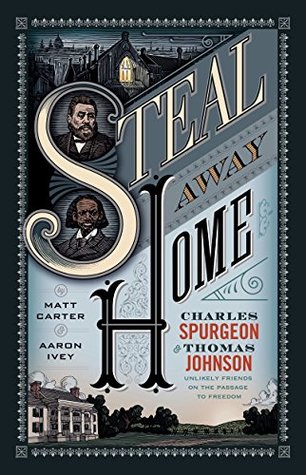
Book Review: Steal Away Home

Steal Away Home: Charles Spurgeon and Thomas Johnson, Unlikely Friends on the Passage to Freedom. Matt Carter and Aaron Ivey. 2017. B&H. 273 pages. [Source: Review copy]

First sentence: There was not a village in the world more pleasant than Stambourne, and although London was only forty miles southward, there was rarely a need to leave.

Premise/plot: Steal Away Home introduces readers to two men: Charles Spurgeon and Thomas Johnson. Chances are, you've heard of Charles Spurgeon. It is less likely that you've heard of Thomas Johnson. The narration switches back and forth between these two. The novel covers five decades.

Charles Spurgeon was a preacher, the celebrity preacher of his day. His sermons were printed, not only in England, but also in America. Thomas Johnson started life as a slave, but, even before the slaves were emancipated, freedom was his through Christ. After the war, he became a preacher as well. His dream--shared by his wife--was to go to Africa as a missionary. Charles Spurgeon helped him realize this goal.

My thoughts: I definitely found this one a fascinating read. I loved both stories. The second half was even better than the first half. By the end, I was EMOTIONAL.

I loved the writing!

Some of my favorite quotes:

  • His grandfather taught him many meaningful things: how to count the stars, how to read the Scriptures at meal times, and the importance of good Puritan books. His reading parlor was littered with books too heavy for little Charles to carry, but the stories in these volumes were a relief to the soul, a healing balm that he would treasure for years to come.
  • “Sometimes, the Lord gives us the opportunity to see things—things that seem wrong—so that we can do something about them. So we can change them. But other times, the Lord lets us see things—things that seem wrong—so those things can change us.” Charles listened and catalogued every word. 
  • The most important thing to understand about our mysterious God is that He is God, and we are not. When we are least expecting it, He will put something so deep inside the caverns of our heart. We won’t see it at first, we won’t even know it’s there. But one day we’ll look back and see He was in control of everything, all along the way. 
  • The cover was green as moss, and possessed a beautiful golden inlay of embossed images and letters. “Other than the Holy Scriptures, this is my favorite book. My grandfather gave it to me when I was just seven years old, and I’ve read it fifty times at least. Each time, I’m charmed all over again.” Charles ran his fingers along the gold-embossed letters that read The Pilgrim’s Progress. He thought of his grandfather, and a familiar peace rushed through his body. “You carry this with you always? Why?” asked Susannah as she leaned towards the table. Charles handed her the wornout book, and she gently put her fingers on the embossed title. “Why, Mr. Spurgeon?” said Susannah, now smiling and incredibly interested. “Because, when you read this book, it makes you feel like the author is a living Bible. You can prick him anywhere, and he bleeds the Bible. He cannot speak without quoting a verse or a section of Scripture. It’s as if his very soul is full of the Word of God.” Charles placed both elbows on the table in front of him, and extended his hands towards the green and gold book in Susannah’s hands. “So this story—which I never seem to tire of—is the best description of the Christian life. And the secret of its freshness is that it’s essentially biblical teaching in the form of a beautiful and striking allegory.”
  • Several nights of the week, Charles and Susannah would meet under the gas lamp in the center of the gardens, reading Puritan writers and discussing the gems of wisdom found within.
  • There are rare moments when one can see, from the outside, what the inside of a person looks like. It was as if Thomas could see the inside of his fellow slaves, clearly. Pain became visible. Sorrow was seen. Hope couldn’t be contained, so it spilled out onto their faces, from their eyes, down their cheeks, to their chins. Joy burst from their hearts, and caused their hands to sway and dance. 
  • “Have you stolen away to Jesus?” Ezekiel paused, letting the question soak. “Have you stolen away from this place—your work, your troubles—have you gotten alone with the Lord? ’Cause that might be the most important question you answer all day long. ’Cause you see, the master . . . he owns our body. The master, he owns our time. The master, he owns everything about us,” Ezekiel continued to whisper, looking only to Thomas. “But. There is something you can’t ever forget. There is one thing that man don’t own. There is one thing that man can’t ever own.” “He don’t own your soul.” 
  • The pain is the measure of grace by which God is choosing to endure me today. 
  • It is a great mercy to be able to toss and turn, changing sides during the night in a bed. It is a great mercy to set one’s head on a pillow for an hour of sleep, interposed between long stretches of pain. It is a great mercy to press eyelids together to catch a glimpse of reprieve, as brief as it may be. We call those things mercies, because like the span of blue between a mass of thunderclouds, so is rest in the midst of suffering.
  •  “Oh, God,” he whispered in the shadows, “the sick bed is soft when You are there. The furnace of affliction grows cool when You are there. Oh, God be there.”
  • “I—I simply do not want to be confined to this bed. I do not want your body to be ravished with pain. I do not want for our lives to be marked with sickness. I do not want it. And yet, if this is what God has for us—I want to want it! Does that make sense?” He lowered his head in frustration and opened his eyes to the tattered leather cover of his Bible, still sitting unopened atop the wooden tray on his bed. “I want to want this hard path we are on.”
  • “Your depressive thoughts aren’t meant to press you down. No! They are meant to fly your soul up. Up to the arms of the Good Master. Charles, you count up your crosses, as bitter as they might seem. You count up your diseases, pains, and sorrows, as many as they might be. Then, you see that Jesus put ’em all there. He put them there so you’d run to Him faster than you’ve ever run. He might not ever take them away. Even if Jesus had never taken slavery away from me, I still think it would have done just what it was supposed to—make me run to Jesus over and over again. That’s when you see how sweet He is. He’s right there. Has been the whole time. Sharin’ in that suffering. Weepin’ with you.
  • Sometimes, during the hardest of seasons, all you can do is whisper songs of hope in the night. But I’ll tell you—God always hears.” 
  • To worry is to bear a burden that is not ours to carry. 
  • When his gout lessened and he was able to preach, Charles preached as he had never before. He gained from illness a wealth of knowledge and sympathy which he could not have gained elsewhere. Undergirding all of his experience in suffering was his conviction that his ill health was God’s gift, and he used that gift every time he opened his mouth, inscribed pages for a book, or preached a sermon from the pulpit of the Tabernacle. 


© Becky Laney of Operation Actually Read Bible

Friday, September 8, 2017

Book Review: Sing

Sing!: How Worship Transforms Your Life, Family, and Church. Keith and Kristyn Getty. 2017. B&H Books. 176 pages. [Source: Review copy]

First sentence: We are a singing people because it is how God has created us. It’s what we do. And when we do, we’re simply joining in with what the rest of creation is doing.

It's September. The year isn't over yet. But I'm thinking Sing! may be my favorite book of the year. We'll see. What is it about? Why should you read it? Why should you read it with others? I hope to do the book justice and answer your questions.

Intended Audience: Any believer. Also: Pastors. Elders. Worship Leaders. Band Musicians. Fathers and mothers. Sunday school teachers. Song writers. Anyone who has ever suffered at any time. Anyone who has ever struggled with depression at any time. Anyone who wants to be happy.

What is it about? It's about singing. It's about congregational singing in local churches. It's about singing at home with our families. It's about individual and corporate singing. Chances are you haven't thought of singing as a spiritual discipline. Yet IT IS. So just as you'd read a book about how to pray or how to read the Bible, the Gettys have given us a book on how to sing.

Why was it written? The Gettys' five point aim in writing Sing!
1. To discover why we sing and the overwhelming joy and holy privilege that comes with singing.
2. To consider how singing impacts our hearts and minds and all of our lives.
3. To cultivate a culture of family singing in our daily home life.
4. To equip our churches for wholeheartedly singing to the Lord and one another as an expression of unity.
5. To inspire us to see congregational singing as a radical witness to the world.
Why should you read it? God designed us to sing praises. Singing praise to the Lord is one of God's ultimate purposes for our lives. Singing is so intimately connected with joy; we are to delight in the Lord and find our satisfaction, our happiness IN HIM.

What did I love about it? I loved, loved, loved everything about this one. I thought it was packed with truth and insight. I thought it was biblical. I thought the authors were persuasive. I loved the passion and enthusiasm. I loved the organization and layout. I loved how practical it was. Also how concise the book was. And I really LOVED the discussion questions. There's also four additional bonus tracks--chapters.

Some of my favorite discussion questions:
1. How has singing played a role in your spiritual development?
2. Can you recall an example of a memorable occasion where you enjoyed singing in church? What about that event made an impact on you?
3. What is the link between thankfulness and singing?
4. What psalm or other Scripture passage resonates with you as your “Song of Salvation”? Why?
5. What song would you consider to be your personal “testimony” song?
6. Is there a hymn, or hymns, from your past that acts as a “milestone marker” for your walk with Christ? Why is it still significant and how does it speak to your heart today?
7. What modern song (new to you in the past few years) has connected with you in such a way that you believe it may become a “milestone” hymn for you in the future?
8. If you grew up in a Christian home, what songs from your childhood do you most remember? What hymns do you know? What Bible verses and stories do you know because of songs? What hymns do you want to pass down to your children?
9. If I were a visitor to your church and knew nothing of the gospel, what would your church music (selections, presentation, and congregational engagement) convey to me about your faith and understanding of the gospel?
10. Do your favorite songs that you love to sing give a broad and deep picture of the character and nature of God? Can the same be said of how we think about God and how we pray to Him? 
The book wasn't just about singing in church--at church. It was about singing seven days a week and really living out what you're singing.
Favorite quotes:

  • We are commanded to sing the Word of God—the truth revealed in the Scriptures, the story of redemption. Fundamentally, we’re to sing about God, revealed in Christ and supremely in His suffering and His glory, since that’s what the Word of God is all about (Luke 24:26–27).
  • The songs we sing should not brush along the surface, or pluck phrases out of context, or focus exclusively on ourselves, or describe Jesus in a way His Word does not (or, still worse, to speak in contradiction to His Word). Every part of a lyric should link together to bring a wonderful, thoughtful, deep expression of Scripture to every singer. 
  • Worship comes as a response to revelation. Praise is prompted by—compelled by—the revelation of something glorious. And the gospel is the revelation of the most glorious truth in history. 
  • Singing gives voice to a heart that deeply knows the gospel of grace. It is the overflow of a heart captivated by the gospel. In as many voices that join together to sing there are as many hearts that are called to know Christ as Lord and Savior. From that place there is a genuine and rich overflow of praise.
  • People say you are what you eat. Well, songs are food for the soul. What you sing, and don’t sing, changes you. Your heart and mind require a good, balanced diet of gospel truth that will build you up for your working week, your times of trial, and for each season of life.
  • If we are to be prepared to live for Christ in the whole of life, we need to be singing about the whole of life.
  • If our songs are not giving us a balanced, rich, nutritious diet, we will not be spiritually healthy people. 
  • Our singing can prepare us for every season of life, and sustain us through every season of life. We don’t need a musical escape from our lives; we need to gaze on the Savior of our lives—our refuge and help and comfort. 
  • We need to make singing Bible truths second nature to our children, a “second language” in our homes. Sing about those truths when you sit at home and when you walk along the road, when you lie down, and when you get up. Sing with your kids as you put them to bed at night, or you sit down for dinner, or as you drive in the car with a CD on. Sooner or later, they’ll start singing unprompted. Join in with them.
  • Songs help us train children in the “language” of the Christian faith. What we want to teach our kids travels deeper inside them when we sing it rather than only speak it to them. 
  • While our faith must be taught, it is also “caught” in our homes, through what our kids see and hear from us. And singing is catchy. So sing with your kids. You don’t need to be able to sing well. Our singing always remains more important than the sound it makes.  
  •  There may never be a perfect day to start singing truths with your kids. But there is today. They are not too old. They are not too young—we have been surprised that even our two-year-old knows several songs well.
  • Our singing casts a light after we are gone. We each bear responsibility in the singing legacy we leave behind us. We should sing with a mind toward those younger than us who are listening in and learning from us.
  • Someone took the time to share hymns of faith with us and we are to be faithful in doing the same. 
  • As you stand and sing in your church this Sunday, you do not know who is listening, and you can never imagine what the Lord might be doing. 
  • As you wake each day, and as you walk through your day, we pray that the lyrics and melodies of your faith will ring around the spaces where you live your life.  


© Becky Laney of Operation Actually Read Bible

Monday, June 5, 2017

Book Review: The Will of God is the Word of God

The Will of God is the Word of God. James MacDonald. 2017. B&H Books. 216 pages. [Source: Review copy]

First sentence: Do You wonder about God’s will for your life personally? Do you ponder specific decisions you need to make and if they are in line with God’s will? It might reassure you to know that most believers frequently wrestle with God’s will for their lives. Welcome to the puzzle party!

Premise/plot: Ever been confused about the will of God? Or confused about what God's will for your life is? James MacDonald has some good news to share with you. He explores misconceptions about the will of God, how Christians have perceived and applied this concept of doing-being-finding-seeking-discovering God's Will. His argument is simple yet profound:
The will of God IS the Word of God. The Word of God IS the will of God. Each IS true. And that discovery leads to a glorious experience of freedom for every Christ-follower. You no longer need to worry and wonder about the minute details of life. If you are increasingly the person God wants you to be, then you can be confident you are living the fullest and most joyful life possible. That, in the end, encapsulates for you personally what the will of God actually IS.
and
Stated simply, the will of God IS about who you are. The will of God IS about your sanctification, that refining process in which you are conformed more and more into the image of Christ Jesus.When we are increasingly the people God wants us to be, then we can be confident we are where God wants us to be and with whom God wants us to be. In other words, your character traits, spiritual priorities, and manner of living—what Christians have for twenty centuries called “holiness”—this is the will of God.
Throughout the book, MacDonald's focus is on God, on the Bible, and on the importance of obeying the revealed will of God found within the Word. The book is practical and packed with advice on how to understand and apply the Word of God.

My thoughts: I liked this one very much. I still prefer, I think, John MacArthur's glorious little book on the subject. It is more concise, perhaps. But this is a solid, straightforward, practical book on the subject. I agreed with much of what MacDonald has to say.

Favorite quotes:

  • The world is going where God wants it to go. History is headed in His direction. God is at the wheel, and understanding God’s sovereignty is foundational to fully knowing and appreciating what God’s will IS.
  • The Bible applies to you the same way it applies to every other human being. God practices equal opportunity engagement when it comes to His will. His will IS His Word, and you have the chance to believe and obey, just like everyone else. In fact, that is what His will for you IS. 
  • Every morning when you wake up, you can ask, “What’s God’s will for me today?” And the answer is the same every morning: “My sanctification.” That’s an awesome, biblical answer that will more than occupy you all day. What is sanctification? Sanctification is the lifelong process in which Christ-followers are refined and increasingly conformed to the behavior pattern of Jesus Christ. “And we all, with unveiled face, beholding the glory of the Lord, are being transformed into the same image from one degree of glory to another” (2 Cor. 3:18).
  • God’s Word never teaches us how to know God’s will. Though the Bible reveals God’s guidelines on how to live, God’s Word does not teach us how to know His will. Nowhere in the Bible can we find a set of directions, a process, or a system that decodes God’s specific will for a situation. This is an important distinction. Unless you are obeying a direct command in Scripture, it’s never a good idea to explain a decision by saying, “It’s God’s will that I do this.” Christians should respect God’s will too highly to attach His authority and weight to our decisions by calling them “God’s will.”
  • God’s dream for your future is not that He would somehow get on your program. God’s dream for your future IS that you would get on His program.
  • God continually calls us deeper and deeper into the fullness of life in Him. God envisions a day when what matters most to you is unrelated to the trappings of life (which you may have been tempted to refer to as God’s will for your life) but instead relates to Him! God’s will for you IS a vertical relationship where those things become less and less important as you are caught up into the depth and glowing height of knowing and loving the Lord. (If you crave more evidence, take a moment to read Ephesians 3:14–19 in a fresh, new way.)
  • What is God’s will for your life? The first layer of a proper foundation is submission to God’s sovereign will. God’s will is for us to submit to His sovereign will, because it deals with matters over which we have no control. We function best when we are consciously dependent on God for our very existence. We never translate our responsibility into independence from God. This shapes the way we make plans. The second layer of a proper foundation is knowing that God wants us to be sanctified by His Word. God has delivered the bulk of His will to us in the form of the Bible. Whenever we talk about knowing and obeying God’s will, we are primarily talking about what God has spelled out in His Word. If you want to know God’s will regarding your behavior, conduct, and actions—look for clear answers in the Bible. Back to the parked car analogy, a believer’s life should never be in park, sitting still, waiting to know God’s will. There is always plenty of God’s Word to put into practice. To be sanctified by God’s Word means that we are being shaped and trained by God’s directions toward Christlikeness. The third layer of a proper foundation is being guided by His Word in matters of personal choice. If I had to identify a central passage in Scripture that points to wise living, I would choose the following verses from Ephesians: “Look carefully then how you walk, not as unwise but as wise, making the best use of the time, because the days are evil. Therefore do not be foolish, but understand what the will of the Lord IS” (Eph. 5:15–17, emphasis mine). 
  • Wise decision-making begins by being a student of God’s Word. Because it is the written expression of God’s will, we can confidently rule out choices that would violate its directions. In those instances, we can definitively say, “According to God’s Word, this is not God’s will for me.” In order to make wise decisions, both our heads and our hearts must be in God’s Word. Psalm 119:11 puts it clearly: “I have stored up your word in my heart, that I might not sin against you.”
  • Our central purpose in life, our number one reason for existing, is to bring glory to God. It’s not something God needs; it’s something we need to do in order to fulfill our ultimate purpose.


© Becky Laney of Operation Actually Read Bible

Friday, March 3, 2017

Book Review: The Curious Christian

The Curious Christian. Barnabas Piper. 2017. B&H. 176 pages. [Source: Review copy]

I definitely enjoyed reading Barnabas Piper's newest book, The Curious Christian. In this book, he explores what it means to be a curious person and argues that Christians should be more curious. The first half of this one was my favorite. It is "To Be Christian is to Be Curious." The second half was also good. It is "Curious About….?" In this second section, one of the many things he addresses is the importance of reading books!!! How could I not love that chapter?!

In his own words,
I will do my best to show how curiosity is one of the most significant ways we have to be image bearers of God, how it can deepen and expand our relationships with others, how it can lead us to an entirely more significant impact on society, and how it will lead us deeper into beautiful relationship with God for all time. Curiosity leads to discovery of great truth throughout all of life. Without it we tread the same paths to and from work, in and out of relationships, through our churches, across the pages of books and Scripture, all without ever seeing what’s really there.
One of the points he emphasizes throughout is that real curiosity seeks TRUTH.
We don’t get to define truth or select it. Instead we must recognize and adhere to it. Truth is what is real, what is, but it is more than this—much more. If all we did was look around and determine truth by what we saw, we would end up exactly where are: in a society where truth shifts, morphs, changes, and loses credibility and value each day. Instead we must recognize that truth expresses reality as it ought to be. It is a standard for reality not just a reflection of what currently exists and happens.
He continues,
Truth reflects some aspect of God’s character and persons—Father, Son, and Holy Spirit, in some way—though no truth in this world can display any of them fully. It displays His plan, work, or creation as He intended it to be and will one day make it again. This is the ultimate real and while it is a great adventure we do not choose what it will be. We do not pick the ending or the workings or the plot; the Author does that. Truth is entirely shaped and determined by God. All truth is God’s truth and reflects this Trinitarian reality.
He argues that curiousity "is the key to sorting it all out, to making a way forward, to actually fulfilling the vocational calling we have to reflect God’s image. We are not only created to reflect and echo God, we are tasked with doing so in all of life…In order to represent God to the world, we must know Him, and to do that we must learn. We must search for truth about His nature, His character, and His work. We must explore both His Word and His world. We absolutely must be curious if we are Christians. Without it we cease to grow and we become incapable of fulfilling our purpose in life. If we start by growing in this divine curiosity we will then be prepared to begin exploring this weird, complicated messy world that is full of so much amazing truth and beauty and so many awful lies and horror."

I loved this book. Why? Because it made me think and rethink how I see the world. I'd never really given much thought to if I was curious, or to what degree I was curious. But Piper shows that there are many ways to be curious. And we don't have to all be curious about the same things in the same ways. Our different ways to be curious makes us unique in a way. 

One of my favorite quotes:
Without curiosity we cannot be what God designed us to be. We cannot know Him or His truth as we ought or care for His creation as He wishes. We cannot understand this world or its creator or its faults or its blessings. Curiosity is where that all begins, and curiosity must begin at God Himself—searching, asking, digging, discovering, growing. If we start there, His image will reflect and His voice will resonate from us into a world that needs it deeply.
See that is food for thought!!!!

In addition to discussing curiosity, Piper discusses perspective. And I thought how the two relate to one another was important.
Perspective comes from seeing things differently, from experiencing things widely. Perspective comes from feeding curiosity and giving it a chance to roam and see and feel. And it comes from seeing and experiencing all these things in a context of biblical truth. Perspective feeds curiosity because it sees life from different sides and from different points of view. Curiosity then feeds perspective because it asks and seeks and explores and finds new points of view and hidden truths. Most people in the world are strangers to us. We don’t know them. We know nothing about them. We view them as stranger than us. Or we don’t view them as anything at all because they are nonentities to us. Only curiosity overcomes this. 
And…
Some will read this and think I am saying we should only read Christian fiction and watch Christian films. Good gravy, no. All that will do is turn you into a sheltered, unrealistic, fearful idealist with no concept of the real world or how to function in it. If you are a discerning person you can learn much of God, of people, of God’s creation through distinctly non-Christian stories and depictions of reality too. If we do not expand our horizons, we are missing out on the people who love those horizons and the artists who create them.
And…
Do not assume anyone or anything has nothing to offer you. If God made it then it has value, and if it is a person then he or she bears God’s imprint the same as you. It is arrogance to treat anyone or anything as valueless and uninteresting. If, then, all created things have value and hold interest, we should ask questions, and only humble people are free to do this. Asking questions is an admission of ignorance and a tacit statement of need. Pride abhors this stance. Proud people are embarrassed to ask questions and to look vulnerable. Pride kills curiosity quicker than anything. So foster humility by constantly looking at the expanse of God, His creation, and all you don’t yet know about it.
Barnabas Piper on reading:
Nothing has grown and shaped my curiosity like books. I do not think there is a single medium in the world that so effectively shares information, opens new worlds, and ignites the imagination as books. It would seem you agree since you are, after all, reading or listening to a book. Books are largely what made me want to write. Books have shaped my perspectives on God, friends, sports, civil issues, faith, church, art, and nearly everything else. I read for fun and I read to learn. My greatest risk in reading is that I will collect knowledge but do not act on it, that I will become a card catalog of knowledge instead of being intent on bringing my curiosity to bear in the world.
A novel shows truth, it presents a deeper layer of truth that, if described, would be boring at best and unrecognizable at worst. But when we find it woven in a story, we know it to be true. Good vs. evil, nobility, honesty, courage, friendship, self-sacrifice—these are truths that fiction reveals in a way nonfiction often struggles to do.


© Becky Laney of Operation Actually Read Bible

Monday, January 23, 2017

Book Review: My Heart

My Heart. Julie Manning. 2017. B&H. 224 pages. [Source: Review Copy]

Julie Manning's My Heart is a mother's memoir. (Though one doesn't have to be a mother--or a nurse--to appreciate it.) Manning shares her story--her testimony. During the birth of her second child--a son--her heart stops working. Further tests reveal that her heart is in failure, and, that it could stop beating at any time, without much warning. Her life will never be the same. She's a wife, a mother--a mother of two young boys--and a Christian. This is her testimony of how she found Christ in the midst of her suffering. Of how she's able to hold onto joy and hope and peace despite all of her health issues.

Throughout the book she shares her story. But she also shares some of her journal entries and some letters she's written to her sons. These letters to her sons are by necessity emotional masterpieces. How could you read them and not be touched?!

This book may not be theology proper, but, I'd argue that it is theology lived out. Readers need both.

Favorite quotes:
  • "We do not need to die in order to experience Jesus; we just need to stop, pause, and cease striving long enough to need Him, love Him, and rest in Him." 
  • "Our sufferings do not produce belief or unbelief of the Lord in our lives; rather our sufferings will reveal our belief or unbelief in Jesus."
  • "What would our lives look like if we really did live with our life’s brevity at the forefront of our mind? Would we pursue the temporary, or would we pursue the eternal?"
  • "When you fail to take all of the emotions and heartaches and fears of your present circumstances to the Lord, just for the sake of numbing yourself, you are telling God that you believe He messed up and that He did not know what He was doing."
  • "Yes, the risk of vulnerability can be scary. It is true that the Holy Spirit often leads us into areas where we feel vulnerable. But we can go there because in God we have eternal security. Though it feels “dangerous” to walk in this direction, we are already safe in the embrace of God’s powerful love—so no place is truly dangerous for us. And, when the Holy Spirit leads us to be vulnerable, God shows up and blesses us through it with His peace and freedom."
  • " In the midst of suffering, we will look one of two places. We will either look at the suffering, and we will doubt God; or we will look at God and read the promises of His Word, and it will cause us to cry out to Him in utter desperation, leaning on Him as the One who is able to see us through our circumstances."
  • "I absolutely believe it is not only possible for us to experience hope and joy in the midst of suffering but that God desires to show us that He alone is our only hope and our only source of fulfilling joy."
  • "Do I believe that God being in control is better than me being in control? Do I believe that following God’s leading is better than my own comfort?"
  • "Our sufferings do not negate God’s call on our life to love Him and love others." 
  • "We share our stories to remember God’s faithfulness. We share our stories to direct our hearts back to what is important in this life as we feel the tug to drift away from a surrendered posture unto the Lord to a life of selfsufficiency. This life is not about us. Rather, this life is about Jesus. This life is not about our individual lives but about the day when the entire big “C” Church body is in the same place at the same time for eternity surrounding the throne of God, proclaiming “Holy, holy, holy, Lord God, the Almighty” (Rev. 4:8). We are not yet home, but rest assured, we WILL be home one day. Until then we must battle against complacency and against comfort and against taking things into our own hands of control. Even when we seek Jesus fervently. Even when we rely on the Lord for every ounce of energy and sustaining breath. "
  • "We can only view this life through the lens of the gospel of Jesus to the extent in which we know and believe the gospel itself."
  • "The more time we spend putting God’s Word into our minds, the more His Word will become our thoughts. The more Scriptures we study, the more we will learn about our God’s character. The more times we read through God’s redemption story for His people, which is you and me, the more our hearts will humbly rejoice in the grace poured out upon our souls. The Lord has much work to do in our lives. He accomplishes this work through His Word, the working of His Holy Spirit, and the presence of other believers in our lives. The more time we spend reading about Jesus, the more we will view this life and all of this life’s circumstances with the perspective that this place is not our forever home."

© Becky Laney of Operation Actually Read Bible

Friday, August 26, 2016

Book Review: Exalting Jesus in Leviticus

Exalting Jesus in Leviticus. Allan Moseley. 2015. B&H. 288 pages. [Source: Bought]

Without a doubt the book of Leviticus is an under-appreciated book even among Christians, or perhaps especially among Christians. Truth be told, few would rank it a favorite even if you were to narrow it down to Old Testament books or the Pentateuch. Moseley's commentary on Leviticus may just help you better appreciate what you're probably only skimming.

Early on, he lists FIVE reasons why Leviticus is important:
  • Leviticus describes the entire religious system of ancient Israel. If we hope to understand how religion worked in Israel, we must understand the book of Leviticus.
  • Leviticus provides the theological foundation for the atoning work of Christ. The idea of a substitutionary sacrifice receives its fullest explication in the book of Leviticus.
  • Leviticus demonstrates how important holiness is to God. Holiness is the main theme of Leviticus—God’s holiness and the holiness God expects from His people. Holiness is still important to God, and God reminds His people of that crucial fact in the book of Leviticus.
  • Leviticus is important because it contains the very words of God in direct speech. 
  • The New Testament frequently alludes to the contents of Leviticus.
Though he lists five reasons, really only one is needed:
All Scripture is breathed out by God and profitable for teaching, for reproof, for correction, and for training in righteousness, that the man of God may be complete, equipped for every good work. 2 Timothy 3:16-17
Each chapter of the book focuses on a chunk of Scripture. Sometimes a few verses--sometimes a few chapters. Each chapter is well-organized. Each begins with a main idea, follows an outline, and ends in reflection questions. 

I haven't always loved the book of Leviticus. But I have come to better appreciate it over the last seven or eight years. I have come to see it not as a boring book of rules but as a how-to book of worship. God's glory is very prominent in Leviticus and God's glory is a beautiful thing. Reading this book has deepened my appreciation for the book of Leviticus.

Some of my favorite quotes:
Atonement is a central theme in Leviticus. The root word translated “atone” or “atonement” occurs 53 times in Leviticus, and only 43 times elsewhere in the whole Old Testament. Thus, Leviticus says more about atonement than any other book in the Old Testament.
God is perfectly holy, and sin is not allowed in His presence. Therefore, for sinners to be in the presence of God their sin must be removed, and that is the purpose of atonement.
All of God’s Word teaches us that sin is serious. We may not like it, but sin is what is wrong with humanity; it’s what is wrong with us. The question is, What do we do with sin? Praise God, He not only tells us our problem, He also gives the solution to our problem!
Our fallen nature will always be prone to think that the fire we invent is better than the fire God commands.
To be free of sin they had to confess sin. So do we. The reason for the sacrifice of Jesus on the cross was our sin, and to be reconciled to God we confess our sin and our need for the salvation from sin Jesus offers.
The message of the Bible is that all of humanity is in a war, and a hand grenade landed next to all of us. That hand grenade is sin, and it will destroy our lives and send us to everlasting condemnation. Jesus, who is the best friend we could possibly have, has jumped on that hand grenade for us. When He died on the cross as our substitutionary sacrifice, He was dying in our place, taking our sin and its penalty on Himself so that we might live. He could have chosen to let us die for our own sin; we deserve it. Instead, He gave Himself as our sacrifice, even though it cost His life.
Our holiness arises from a relationship with God. The key to holiness is staying close to God.
God is perfectly holy and cannot abide where there is sin, and sin leads to death. So the question of the Bible is not How could a loving God possibly send people to hell? but How could the holy God who always judges sin possibly allow guilty sinners in heaven?

© Becky Laney of Operation Actually Read Bible

Monday, August 22, 2016

Book Review: Exalting Jesus in Ecclesiastes

Exalting Jesus in Ecclesiastes. Daniel L. Akin and Jonathan Akin. 2016. B&H. 288 pages. [Source: Review copy]

Exalting Jesus in Ecclesiastes is part of the Christ-Centered Exposition commentary series published by B&H. This title is written by Daniel L. Akin and Jonathan Akin.

Ecclesiastes is an interesting read--especially in a text-only Bible. What are readers to make of it? No doubt it is relevant to our lives--and not just because it is in the Bible--but because we can relate to the feelings described by Solomon. For example, that every day is the same and there really isn't anything new under the sun. But as Christians, how are we to be influenced by the book of Ecclesiastes? Is it hopeful or depressing?

Here is the table of contents:

  • Everything is Meaningless without Jesus
  • The American Dream is Meaningless without Jesus
  • Time is Meaningless without Jesus
  • Politics and Justice are Meaningless without Jesus
  • Religion is Meaningless without Jesus
  • Money is Meaningless without Jesus
  • Wisdom in a Meaningless World
  • Death is Meaningless without Jesus
  • Aging is Meaningless without Jesus
  • The Preacher on Preaching

Each chapter focuses on a chunk of text. Each chapter gives a straightforward 'main idea' for interpreting or making sense of the text. This is followed by an outline. Each chapter ends with reflect and discuss questions. I love the organization of the series. This is how every book in the series is structured. Readers know exactly what to expect and how to use the book.

I love that the book focuses on EXALTING JESUS in the book of Ecclesiastes. I think Ecclesiastes without Christ would be a very different read. Solomon's "life is meaningless" message could easily be misinterpreted without Christ as teacher and guide. Early on in the book, the author writes: "Ecclesiastes wants to push us to faith and contentment in God." The author urges readers to consider the message of the book to be, "More will not satisfy us; only God can."

I love that the book is reader-friendly. I would never, ever, ever say the book is made more relevant by references to songs, movies, tv shows, etc. Ecclesiastes is relevant because it is an inspired book in the Word of God. It is relevant because it tells us something about God and it tells us something about ourselves. But I will say that the authors writing style resonated with me. And that I could relate to what the authors were saying. Which in my opinion makes it reader-friendly.

I love that the authors quote Alistair Begg a LOT. And not just Begg but other preachers I like as well. (Matt Chandler, Sinclair Ferguson, Tim Keller, Martyn Lloyd-Jones, John MacArthur, J.I. Packer, Charles Spurgeon, etc.)

I like the length of the chapters. I like that the book is short and to the point. Again going back to reader-friendliness. A commentary does not have to be terribly lengthy and actually heavy to be worth reading.

I would definitely recommend this book in the series.


© Becky Laney of Operation Actually Read Bible

Wednesday, June 22, 2016

Book Review: First Virtues

First Virtues for Toddlers. Mary Manz Simon. 2016. B&H. 256 pages. [Source: Review copy]

From Letter to Parents: In the middle of their busy days, parents might find themselves asking a lot of questions. How can I teach my toddler to share? How can I help my two year old learn to forgive? These questions aren't surprising. Research shows that parents care deeply about building character in their children. In today's world, outside influences can impact even a young child. As a result, parents must be intentional about teaching  core beliefs.

Premise/plot: First Virtues is a storybook collection with twelve virtue-teaching stories for toddlers and preschoolers. The twelve stories are: "Kitty Shows Kindness," "Piglet Tells The Truth," "Bunny Loves Others," "Duckling is Patient," "Tiger Forgives," "Puppy Makes Friends," "Squirrel Says Thank You," "Bear Obeys," "Lamb is Joyful," "Lion Can Share," "Panda is Polite," and "Koala Does His Best."

Each of the twelve stories, as I'm sure you've noticed, stars an animal. Each of the twelve stories begins with a similar refrain along the lines of "Kitty, Kitty, share today what the Bible has to say." Each of the stories defines and illustrates the chosen virtue in a simple, straightforward way. Each story is written in rhyme. Each of the stories concludes with a bible verse and a note to parents on how to further help teach or instruct their child.

Kindness
Kindness means I am aware when someone needs help and care. (14)
Patience
Patience means that I am fine standing in a long, long line. (74)
Forgiveness
To forgive means move on past. Don't let angry feelings last. (94)
My thoughts: My favorite of the twelve is probably Tiger Forgives. "If I friend does not play fair, I forgive to show I care. God forgives, so I can too. That is what I try to do. "I forgive," God says to you. Are those words that you say too?" (104-8).

My least favorite of the twelve is probably Lamb is Joyful. This concept be the most difficult to describe--not just for children but for adults as well. Is joy distinct from happiness? Is there a difference between the "joy" that comes from singing a praise song and eating a piece of candy? How does joy relate to one's circumstances? How closely connected is joy with thankfulness and contentment? I see a difference between joy and happiness. (Not all Christians do.) And to compare genuine joy in the Lord with "the joy" you get from blowing bubbles doesn't really do anyone any favors.

I can see some definite strengths. The author definitely connects each story to a particular bible verse. And many virtues are clearly taught in both Old and New Testaments. The focus of this book is on virtues and morals. On plainly teaching and instructing a set of virtues to young children. The book is not focused on the gospel, on teaching and instructing who Christ is and what Christ has done for us.

While this book clearly presents the Christian aspect of these virtues, there is nothing exclusively Christian about these virtues in general. These are twelve universal virtues that are routinely seen as being good for children to acquire. These type of lessons could just as easily be taught on shows like Daniel Tiger's Neighborhood.

© Becky Laney of Operation Actually Read Bible

Monday, June 6, 2016

Book Review: Exalting Jesus in Philippians

 Exalting Jesus in Philippians. Tony Merida and Francis Chan. 2016. B&H. 209 pages. [Source: Review copy]

Favorite quote: "Apart from knowledge of God and His Word, we will not love in a way that glorifies God and blesses others." (p. 41)

Exalting Jesus in Philippians is one of the commentaries in the Christ-Centered Exposition commentary series published by B&H. I have reviewed several of the commentaries in this series now, and I must say that I really am pleased with this series.

Thirteen chapters cover every verse in the book of Philippians. There are six chapters focusing on Philippians 1. (One of those chapters also deals with the first four verses of Philippians 2). There are three chapters focusing on Philippians 2. (Not counting the one that also covers some of Philippians 1.) There are two chapters focusing on Philippians 3. There are two chapters focusing on Philippians 4.

Each chapter contains a main idea, and an outline. I loved both features. The main idea because it summarizes and condenses. It will also be great for future reference. The outline because it provides a logical, organized way of approaching both the Scripture text and the chapter itself.

The main idea for Philippians 2:5-11:
In this amazing passage, Paul magnifies the humility and exaltation of Jesus, which should lead us to emulate Jesus' example and adore Him as Lord of all. (89)
The outline for Philippians 2:5-11
I. The Mind of Christ (Philippians 2:5)
II. The Humility of Christ (Philippians 2:6-8)
A. His humble renunciation (Philippians 2:6)
B. His humble incarnation (Philippians 2:7)
C. His humble crucifixion (Philippians 2:8)
III. The Exaltation of Christ (Philippians 2:9-11)
A. His exalted position (Philippians 2:9)
B. Everyone's adoration and confession (Philippians 2:10-11) 
Each chapter concludes with reflection or discussion questions. Here are three example discussion questions from the chapter on Philippians 2:5-11. (These questions are found on page 104).

  • How is Jesus' model of leadership different from a worldly view of leadership? How can you put this type of life in practice today?
  • What would happen in our relationships if we lived out Philippians 2:5-11? How can you go from being a "grasper" to a "giver"?
  • Why should we be overwhelmed by the fact that we (Christians) know Christ and that He knows us?

Occasionally charts and other visual aids were used as well. Here is one I loved, loved, loved from page 96. I recreated it so I could share it with you in the review.

I also loved how the authors pulled in quotes and ideas from others--both past and present. Here is a D.A. Carson quote I really found incredibly useful.
D.A. Carson points out that the cross can be viewed from five perspectives. From God's perspective, Jesus died as a propitiation for our sins (1 John 2:2). He absorbed God's wrath and turned away God's anger from us. From Christ's perspective, Jesus obeyed His Father perfectly, saying "Not My will, but Yours, be done" (Luke 22:42). He carried out His assignment to "give His life--a ransom for many" (Mark 10:45). This text in Philippians highlights Christ's perfect obedience (also a major theme in John's Gospel). He became "obedient to the point of death--even to death on a cross" (Philippians 2:8). From Satan's perspective, the cross means the accuser's defeat (see Rev. 12:11). From sin's perspective, the cross is the means by which our debt is paid. Finally, from our perspective, while acknowledging all of these truths, treasuring the love and justice of God as well as the substitutionary life and death of Jesus--His victory over Satan and sin--we must also note that the cross serves "as the supreme standard of behavior." It's the primary point that Paul makes here in Philippians 2:5. (90)
I would definitely recommend this one! It is clearly written, well-organized, practical, rich in insights.


© Becky Laney of Operation Actually Read Bible

Saturday, April 23, 2016

Book Review: Looking for Lovely

Looking for Lovely. Annie F. Downs. 2016. 208 pages. [Source: Review copy]

Looking for Lovely was a quick and (mostly) enjoyable read. It is a personal narrative of a young, single Christian woman. (I see it as a polished form of stream of consciousness; it is organized not random, but, it's almost an uncensored look at a woman's private thoughts.) If the book has spiritual insights to pass along, it is probably in the showing and not telling. In other words, that she is--that we all are--works in progress; that we all struggle with ups and downs, good days and bad days. That in spite of how we appear to others, how we appear to ourselves even, God loves us because God is that good and gracious and faithful.

Readers can benefit from the chapter "Looking for Lovely." In that chapter, she stresses two things: 1) God made you on purpose and 2) God made you to be brave.

Most of the book focuses on the author: on her past, on her present, on her dreams for the future, on her desperate pleading to the Lord to send her a husband, on her desperate need to be married, on her fears, on her doubts, on her strengths, on her weaknesses, on her good days, on her bad days, on her weaknesses, on her successes. She doesn't seem to hold much of anything back from her readers.

One doesn't particularly learn much about God and the Bible directly. It is more indirect and subtle than that. If you look for it, you can find Him there in her messy, chaotic, fun-filled life. But this isn't particularly my favorite type of "Christian nonfiction."

© Becky Laney of Operation Actually Read Bible

Friday, April 8, 2016

Book Review: 100 Bible Verses Everyone Should Know By Heart

100 Bible Verses Everyone Should Know By Heart. Robert J. Morgan. 2010. B&H Publishing. 288 pages. 288 pages. [Source: Bought]

I recently decided to buy this one. I had been thinking about buying it for a couple of years at least. I don't regret my decision. I found the book to be well-organized, practical, and substantive.

In the first part of the book, Morgan shares WHY believers should memorize Scripture. He concludes this section by sharing ten tips for HOW to memorize Scripture. His list begins with, "First, make up your mind you can memorize just one verse. That’s all. Just one. (Of course, if you can memorize one verse, you can memorize two.)" I believe Morgan is familiar with excuses and knows how intimidating the idea of memorizing verses can be.

In the second part of the book is the heart of the book. In this section, Morgan shares one hundred Bible Verses that he believes everyone should know by heart. These are arranged into categories.

  • Beginnings: The Bible's Fantastic Four (Genesis 1:1, John 1:1, John 1:14, John 3:16)
  • The Roman Road: The Plan of Salvation (Romans 3:23, Romans 6:23, Romans 5:8, Romans 10:9, Romans 10:10)
  • Listening: The Word of God and Prayer (2 Timothy 3:16, Joshua 1:8, Psalm 119:11, Deuteronomy 6:6, Deuteronomy 6:7, Hebrews 4:12, Hebrews 4:16, 1 John 5:14, 1 John 5:15)
  • Assurance: Inner Peace and Security (1 John 5:11, 1 John 5:12, John 14:1, John 14:2, John 14:3, John 14:6, John 14:27, Isaiah 26:3, Isaiah 53:5, Isaiah 53:6)
  • Praise: Worship and Thanksgiving (1 Peter 1:3, Psalm 100:4, Psalm 100:5, Revelation 4:11)
  • Promises: Verses to Stand On (Matthew 6:33, Romans 8:28, Jeremiah 29:11, 1 John 1:7, 1 John 1:9, Proverbs 3:5, Proverbs 3:6, 1 Corinthians 10:13, Psalm 55:22, 1 Peter 5:7)
  • Holiness: Obeying God's Commands (2 Chronicles 7:14, Romans 12:1, Romans 12:2, Romans 12:11, Romans 12:12, Romans 12:18, 2 Corinthians 9:7, Hebrews 10:25, Proverbs 1:7, Proverbs 15:1)
  • Fullness: The Holy Spirit's Role In Our Lives (Ephesians 5:18, Ephesians 5:19, Ephesians 5:20, Ephesians 5:21, Galatians 5:22, Galatians 5:23)
  • Joy: God's Kind of Happiness (Psalm 118:24, Philippians 4:4, Philippians 4:5, Philippians 4:6, Philippians 4:7, James 1:2, James 1:3, James 1:4, James 1:5, 1 Thessalonians 5:16, 1 Thessalonians 5:17, 1 Thessalonians 5:18)
  • Faith: Trusting God and Resting (Ephesians 2:8, Ephesians 2:9, Ephesians 2:10, Galatians 2:20, Colossians 3:15, Colossians 3:16, Colossians 3:17, Romans 1:16, Romans 1:17, Psalm 56:3, Psalm 4:8, Hebrews 11:6)
  • Sent: The Great Commission and Our Global Task: Matthew 28:18, Matthew 28:19, Matthew 28:20, Acts 1:8)
  • The Twenty Third Psalm: The Lord is My Shepherd (Psalm 23:1, 2, 3, 4, 5, 6)
  • Alpha and Omega: The First and Second Comings of Christ (Isaiah 9:6, Luke 2:10, Luke 2:11, Luke 2:12, Acts 1:11, Revelation 21:1, Revelation 21:2, Revelation 22:20)

Each chapter in this section focuses on the verse itself. What the verse means in its context, how it is interpreted. Why the verse was chosen, or, why it's important for us to know it and live by it. Each chapter generally shares a few quotes by famous writers about the verse. I was impressed by the organization and layout of each chapter. The book is very practical.

For example,
In memorizing John 1:14, take time to study the entire passage, using this outline as a guide. 1. Jesus is the God who made us (1:1–3). He is God, existing from the beginning and through whom all things were made. 2. He is the life who sustains us (v. 4a). In Him was life! 3. He is the light who illumines us (vv. 4b–5). His life is our light. It shines in the darkness, and the darkness can’t overcome it. 4. He is the message who excites us (vv. 6–9). John the Baptist testified about Him, and so can we. 5. He is the Savior who redeems us (vv. 10–13). All who receive Him and who believe in His name are given the right to become children of God. 6. He is the friend who dwells among us (v. 14). He pitched His tent here and tabernacles among us. 7. He is the Lord who surpasses us (v. 15). John the Baptist said of Him, “The One coming after me has surpassed me, because He existed before me.” 8. He is the Son who blesses us (vv. 16–18). No one has ever seen God, but the one and only Son has revealed Him, and from the fullness of His grace we have all received one blessing after another (v. 16 NIV).
The book concludes with an appendix for further tips on memorizing Scripture.

Favorite quotes:
"Scripture memory is our most powerful tool in changing our habits of thought, and the internalized truths of God’s Word keep us mentally healthy. It’s the greatest secret I know to personal resiliency. It molds our thoughts, and our thoughts shape our lives; for as we think in our hearts, so we are."
"Bible verses, committed to memory and applied by the Holy Spirit, are the most powerful medications in the whole world. They’re a balm for sore hearts, an elixir for low spirits, an immunization for bad habits, a booster shot of high spirits, a pick-me-up for dreary days, and a stimulant for positive nerves."
When you’ve memorized Genesis 1:1; John 1:1; 1:14; and 3:16, you have the entire Bible in the palm of your hand. These verses are the four corners of God’s Word.
Only three people in the history of the world have been perfect and sinless, and the first two didn’t stay that way—Adam and Eve. That leaves only Jesus Himself. No one else can ever gain access into God’s presence or eternal life on the basis of one’s own perfections or righteous efforts. We have all sinned and have fallen short of the requirements of God’s glory. We can never be reconciled to God by trying to live a good life, for we are intrinsically, internally sinful; and nothing sinful can exist in the blazing holiness of God’s presence and perfections. Only when we realize this can we fully appreciate what Christ has done for us.
With the possible exception of John 3:16, no other text in Scripture better sums up all sixty-six books and thirty-one thousand verses of the Bible. [Romans 6:23] This is the ultimate Reader’s Digest version of God’s Word. Notice the way the verse is balanced between its two clauses: The wages of sin is death. The gift of God is eternal life.
Beware of getting alone with your own thoughts. Get alone with God’s thoughts. There is danger in rummaging through waste and barren desert-thoughts that can be labeled—daydreaming or worse. Don’t meditate upon yourself but dwell upon God. . . . Make this a built-in habit of daily living.
Little verses, little truths, little insights, shared spontaneously, memorized in the family circle—this is the most powerful technique we have in raising our children in the fear and nurture of the Lord.

If you were a sentence, what mark of punctuation would follow you? Is your life a question mark because you’re without answers? A comma because you’re in transition? A period for everything’s at a standstill? Or a dash because you’re in a continual rush? This verse can put an exclamation point to our lives. [1 Peter 1:3]

© Becky Laney of Operation Actually Read Bible

Monday, September 14, 2015

Book Review: Exalting Jesus in Galatians

Exalting Jesus in Galatians (Christ-Centered Exposition) David Platt and Tony Merida. 2014. B&H. 288 pages. [Source: Bought]

This is the second commentary I've read in the Christ-Centered Exposition series published by Holman. I've also read and reviewed Exalting Jesus in Matthew. I am enjoying this series, and I do plan to seek out other titles and read and review them in the future. It's hard for me to imagine that just a few years ago, I was too intimidated by commentaries to give them a try. Now commentaries are one of my favorite things to read! Do you read commentaries? Do you have a favorite series or a favorite author? Share in the comments!

So this September, I am attempting to read Galatians thirty times. I like using the 'John MacArthur' approach to reading the Bible though I admit that if I tried to do it every single month, I wouldn't get much other Bible reading done. So it's something I do a few times a year instead of once a month. Because I am reading and studying Galatians, I wanted to read a commentary. And I chose Exalting Jesus in Galatians. I am so glad I did. It is a WONDERFUL book.

Each chapter focuses on a section of text and begins with a main idea and an outline. Each chapter concludes with discussion/reflection questions. I admit I do like books with structure! It does make it easier to digest the information.

I don't know about you, but, to me Galatians has always been something of an intimidating read. It's not that I find it impossible to understand start-to-finish, more that there are sections within it that take some work to process and absorb. And that's something I'm not always willing to do when I read it. So at times I'm guilty of rushing through it. This commentary on Galatians was quite helpful and reader-friendly. The writers acknowledging that the book isn't always easy and obvious and presenting the material in a way that is packed with insight. I loved the passionate writing emphasizing WHY Galatians is such a great book and WHY it's important to take the time to understand it. And HOW it is ever-relevant today. (All the talk of circumcision and Jews and Gentiles, well, it isn't always obvious how it is relevant to me today. But when the author(s) stress that the book is about legalism and hypocrisy and the importance of avoiding both extremes in the Christian life, that is when I saw the book's relevance in a whole new way. I saw that Galatians was all about answering the question: HOW AM I MADE RIGHT WITH GOD? Paul's answer: JESUS, ONLY JESUS, ALWAYS AND FOREVER ONLY JESUS.

Quotes:
To distort the gospel is to destroy the church because the church is created and lives by the gospel. The greatest troublemakers in the church are those who wish to distort the gospel message. I believe Satan operates more effectively through false gospels than through any other avenue. He twists, confuses, and changes the gospel, using philosophy and rule-keeping to put people in mental manacles that blind their eyes to the truth.
The gospel of grace is like water: people did not invent it, and people cannot live without it. We are spiritually thirsty creatures in need of the living water of the gospel. As believers, we need to keep drinking from this well of grace. Many Christians think they should move on from the gospel—as if there is something more important that Christ’s work. No, keep drinking more of grace; keep working the gospel into your heart. You will be prepared to tell unbelievers that what they desperately need is not good advice or moral improvement, but the good news from God about new life in Jesus.
Despite how we normally think about Christianity, we are not in debt to Christ. We typically reflect on what He did in the past on the cross, which is obviously a good thing to do, but if we’re not careful, we will leave it there and start to think, Jesus has done this for me, so what can I now do for Him? The reason we must be careful here is because Jesus hasn’t stopped doing for you. You’re not paying Him back, because He’s still paying you. We are indwelt by Christ! Christ is in us. And the Christian life is not so much about you and I living for Christ as it is trusting Christ to live for us and through us and in us. This is faith. By faith we are accepted before God, and by faith we are alive to God because we are attached to Christ.
We live by faith when we believe Christ every moment of every day. We believe Him to be our sustenance and our strength. We believe Him to be our love and joy and peace. We believe Him to be our satisfaction—more than money and houses and cars and stuff. We believe Christ to be our purity and our holiness and our power over sin. This is Christianity: believing Christ to be everything you need for every moment you live. You live by faith in the Son of God.
The Westminster Shorter Catechism asks: “What does every sin deserve?” Answer: “Every sin deserves God’s wrath and curse, both in this life, and that which is to come.” That answer may not be popular, but it’s true that each of us stands guilty before God’s law. And the more you try to obey it—the more you go to church, the more you try to pray, the more you try to be good, the more you try to lead your family the right way—the more the law says, “Guilty.”
Praise God that though there was nothing in us to draw Him to us, God determined to redeem us. And lest that sound like an exaggeration of our evil and sinfulness, look at the cross. Look at the picture of God’s wrath against sin. It was no minor offense for which Jesus died.
Let me put this into contemporary language: if you go to church, sing songs, and study the Word, thinking this is how you’re going to work to earn God’s favor, then you are no different from the over one billion Hindus in the world today who are bowing down to their gods. If your Christianity is a check-off box in order to make you feel good about yourself before God, in order to save your skin on the day of judgment, then your Christianity is no different from every other religion in the world, and ultimately it will condemn you. What if Satan actually wants you to come to church, lead a small group, teach, and lead your home in an upright way? What if he’s in favor of you doing all those things, just so long as you think that by doing those things you’re working your way to God?
Do not be a Christian ninja, just sliding in and out of worship services without anyone seeing you! The Lord saved us so we could love and serve others.

© Becky Laney of Operation Actually Read Bible

Wednesday, August 26, 2015

Bible Review: The Study Bible for Women, Large Print

The Study Bible for Women: HCSB Large Print Edition. Dorothy Kelley Patterson and Rhonda Harrington Kelley. 2015. B&H. 2208 pages. [Source: Review copy]

I am very happy to be reviewing the Study Bible for Women. This study bible is written and designed for women by women. And it's a serious (not-fooling-around) STUDY Bible. (Not every Bible labeled "a study Bible" actually IS a study Bible. I've found this to be quite true.) I really appreciate the amount of notes within this Bible, and the assumption that women are capable learners. (And the fact that so many notes focus on specific words in the original language--Hebrew or Greek. I've always found word studies to be fascinating. And not all study Bibles meet this need.)
Overwhelmingly women purchase more Bibles and more Bible study materials than men do. By all rights, just the amount of materials in the marketplace should make women the best equipped Bible students of the modern era. However, one only has to peruse those materials to see that there is a great gulf fixed between most of what is being produced by women for women and even the most basic devotional commentary. Inspirational thoughts, practical application, and systematic topical studies are all important, but women need more. Women can study the Bible in depth; they can learn to do genuine exposition or verse-by-verse interpretation of God's Words, using the best hermeneutical principles; and this study tool is a step in making available to women resources produced especially for them. Here is a clarion call to women to demand the best in biblical scholarship--even resources prepared by women and men who have been formally trained in biblical studies--and to spend the time necessary to dig deeply into God's Word and pull out its rich truths and full knowledge. (1907, Biblical Womanhood: Digging Deeper Into God's Word, Titus)
This edition of the Study Bible for Women is large print. If ever a large print edition was needed it was here. Why? The font size in the original was teeny-tiny. I had to squint to even see the text of the Bible. (Yes, the font-size of the notes was teeny-tiny as well. But squinting didn't really help with the notes. It was just a personal impossibility.) Is the font size improved? Yes and no. Mostly. The size of the Bible text is larger. I wouldn't exactly call it "large print." But it is definitely larger than the original font size. And I can read it somewhat comfortably--that is without squinting! So that's a very good thing. The font size of the notes is still tiny. I can read it if I squint. It is definitely a larger font size than it was. But I can't comfortably read it either. That is slightly disappointing if I'm honest. But it's not a huge problem either. (I do wish that publishers of large print study Bibles would take into consideration that if your sight is poor enough that you need a large size print to read the Bible text, that one would also need the study notes in large print too. That is why people buy study Bibles after all, because they're interested in reading study notes. At the same time, I realize that the larger the print--the heavier the weight. And if the study notes were written in a comfortable-to-read size, then the weight of the Bible would probably double. And a six pound Bible wouldn't be practical or comfortable!!!) Overall, a definite improvement upon the original edition.

Strengths of the Study Bible for Women:
  • black letter, not red letter
  • two column, not single column
  • plenty of notes for each chapter of the Bible, notes appear in the side column, some notes feature Hebrew or Greek word studies and definitions
  • thorough book introductions, question and answer format, plus book outlines and timelines
  • additional Hebrew/Greek word studies
  • charts, articles, maps, and other features throughout each book of the Bible
  • beautiful layout
  • HCSB translation
Weaknesses of the Study Bible for Women:
  • the Bible text is in a nice font size, however, the study notes seem TINY to my eyes
  • I've caught a few theological flaws*, so far; just a small reminder that only the text of the Bible itself is infallible! 
*Are the notes Reformed? That is a big question for me when approaching any Bible. I am Reformed. And I have strong opinions! I know there are others out there with some of the same questions and/or hesitations. I do not think the notes are especially Reformed. There are a few places where the notes are decidedly unReformed.
The spirit helps sinners understand the reasons for their separation from a holy and awesome God. Atonement has already been graciously accomplished by the Son, the Second person of the Trinity, thus making restoration and fellowship with God possible. When sinners accept that atonement made on their behalf, the Holy Spirit performs the work of regeneration, what Jesus called being "born again" (John 3:3). Further the Holy Spirit of God takes up residence in and continues to sanctify the believer. ~ Doctrine: Holy Spirit: Ezekiel 36:24-37:1-14, p. 1343
Salvation is a gift for all who believe and trust in the Lord. god is the sole author of salvation. Yet each person has a choice on how he responds. ~ Doctrine: Salvation: John 3:16, p. 1677
There are no helpful notes for John 6. Notes on John 6:44, 45, 46, 63, 65 would have been most helpful in discerning the position the editor takes on election and predestination.

There are no notes specifically for Romans 8:28, 29, 30 concerning interpreting these verses and how they relate to election and predestination. Though they do GREEK WORD STUDIES for the words foreknew, predestined, called, justified, and glorified. This is on page 1784.

There is one article that specifically addresses Election. It is found on page 1873. In part, it reads:
The doctrine of election has been debated and misunderstood in the history of Christian thought. Election does not mean a person is not required to repent to come to faith in Christ. However, all those who do repent and come to faith have been elected. Election does not mean that Christians do not need to share the gospel. It is through the sharing of the gospel that people see their sin and need for repentance. The response to the concept of election should be gratitude to God and should encourage believers during difficult times. ~ Doctrine: Election: 1 Thessalonians 1:4, p. 1873
There is nothing in that article that I disagreed with. It doesn't really explain the doctrine of election. But it does clarify what it isn't. Which is helpful.

© Becky Laney of Operation Actually Read Bible

Wednesday, July 22, 2015

Book Review: Embracing Obscurity

Embracing Obscurity. Anonymous. 2012. B&H. 192 pages. [Source: Borrowed]
Introduction
What do you, me, a student, a musician, a stay-at-home mom, a laid-off blue-collar worker, a pastor, and a successful entrepreneur all have in common? We're drunk. In our defense the epidemic is so common that most of us don't even know we're under the influence. We're confused, blinded, and wandering around like sailors at dawn; but, then again, so is everyone else, so why should we be alarmed? But this unsuspected poison is simultaneously nimbus us, diverting our attention from the kingdom and undermining the gospel of Christ. We're drunk all right. We're intoxicated with a desire to be known, recognized, appreciated, and respected. We crave to be a "somebody" and do a notable things, to achieve our dreams and gain the admiration of others. To be something--anything--other than nothing.
Embracing Obscurity is a quick, light read, and, I definitely enjoyed reading it. I didn't love it exactly. But I didn't dislike it either. It wasn't a wow book for me. It was easy-reading, light and casual--definitely not an intimidating read. It's full of stories and good advice. One thing that I definitely appreciated was how rich it was in scripture: there are so very many verses quoted. I also appreciated the discussion questions at the end of each chapter.

© Becky Laney of Operation Actually Read Bible

Sunday, July 5, 2015

Bible Review: Super Giant Print HCSB

HCSB Super Giant Print Reference Bible. 2015. B&H Publishing. 1824 pages. [Source: Review copy]

I believe that Bible reading should be comfortable. No, not exactly comfortable for the heart, soul, and mind:
For the word of God is living and effective and sharper than any double-edged sword, penetrating as far as the separation of soul and spirit, joints and marrow. It is able to judge the ideas and thoughts of the heart. No creature is hidden from Him, but all things are naked and exposed to the eyes of Him to whom we must give an account. (Hebrews 4:12-13)
But comfortable on the eyes. Perhaps you can relate. Have strained and tired eyes ever kept you from reading as much as you liked in the Bible? 

The print in some Bibles is so tiny. And unless they're also super-light-weight--meaning you can bring it in as close as you need--it is near impossible to read without squinting--without strain. And if that tiny-print Bible is also red-letter, then forget it! My eyes simply can't handle the stress of trying to read red-letter in small print. (The MEV Thinline Bible comes to mind as a recent example. I wanted so badly to read that one since it's a new translation. And I did manage to read all the New Testament. But oh, how my eyes suffered, and suffered especially in the gospels which were red letter, of course, and the orange-y red letter too.) 

So I have been looking for a comfortable-on-the-eyes Bible for quite a while. I am happy to say that I've found a perfect-for-me line of Bibles. B&H publishes a line of Super Giant Print Reference Bibles. So far, the translations include: the HCSB, the KJV, the NKJV, and RVR 1960. And each one, I believe, is available in many different covers and indexed or not. For example: mint green, cobalt blue, teal, brown/tan, purple, brown/chocolate, brown, mahogany, pink, burgundy, charcoal, genuine cowhide, and saddle brown. 

The font is 18 points. Chances are you'll either be: WOW, THAT'S WAY TOO BIG. Or, like me, WOW THAT'S PERFECT! My goal is not to try to convince the "wow, that's way too big" crowd to buy a Super Giant Print Reference Bible. 

The Super Giant Reference Bible would be great for personal use for believers who like or need large print. It might also be great for church use: for example, for use on the altar or the pulpit. 

This review will focus on the HCSB Super Giant Print Reference Bible. There are a few things you should know. 

It's the HCSB Translation. I am not as familiar with the HCSB translation as I am say with the ESV. But I have had the opportunity to read all of the Old Testament in the HCSB earlier this year, and, I'm now making my way through the New Testament too. I am enjoying it very much. 
For no one will be justified in His sight by the works of the law, because the knowledge of sin comes through the law.
But now, apart from the law, God’s righteousness has been revealed—attested by the Law and the Prophets —that is, God’s righteousness through faith in Jesus Christ, to all who believe, since there is no distinction. For all have sinned and fall short of the glory of God. They are justified freely by His grace through the redemption that is in Christ Jesus. God presented Him as a propitiation through faith in His blood, to demonstrate His righteousness, because in His restraint God passed over the sins previously committed. God presented Him to demonstrate His righteousness at the present time, so that He would be righteous and declare righteous the one who has faith in Jesus. Romans 3:20-26
If I have told you about things that happen on earth and you don’t believe, how will you believe if I tell you about things of heaven? No one has ascended into heaven except the One who descended from heaven—the Son of Man. Just as Moses lifted up the snake in the wilderness, so the Son of Man must be lifted up, so that everyone who believes in Him will have eternal life.
“For God loved the world in this way: He gave His One and Only Son, so that everyone who believes in Him will not perish but have eternal life. For God did not send His Son into the world that He might condemn the world, but that the world might be saved through Him. Anyone who believes in Him is not condemned, but anyone who does not believe is already condemned, because he has not believed in the name of the One and Only Son of God.
“This, then, is the judgment: The light has come into the world, and people loved darkness rather than the light because their deeds were evil. For everyone who practices wicked things hates the light and avoids it, so that his deeds may not be exposed. But anyone who lives by the truth comes to the light, so that his works may be shown to be accomplished by God.” John 3:12-21
“The poor in spirit are blessed,
for the kingdom of heaven is theirs.
Those who mourn are blessed,
for they will be comforted.
The gentle are blessed,
for they will inherit the earth.
Those who hunger and thirst for righteousness are blessed,
for they will be filled.
The merciful are blessed,
for they will be shown mercy.
The pure in heart are blessed,
for they will see God.
The peacemakers are blessed,
for they will be called sons of God.
Those who are persecuted for righteousness are blessed,
for the kingdom of heaven is theirs. Matthew 5:3-10
Here are just a few reasons I'm enjoying the HCSB:
  • I love, for example, that Old Testament passages used within the New Testament (quoted in the New Testament) are in bold font. 
  • I love that the HCSB has "bullet notes" (a glossary of terms)
  • I love that it translates the word servant as slave. (For example, Romans 1:1, HCSB; James 1:1, HCSB)  Paul calls himself a slave. The Greek word doulos is mistranslated in most Bibles as "servant" or "bond servant." A slave was owned, was bought for a price, received no wages, and could not quit. A servant could quit, got paid, and was a free person. Jesus Himself took the form of a slave ( Php 2:7), and Paul reminded Christians that "you are not your own, for you were bought at a price" ( 1Co 6:19b-20).
  • I love that it is readable, yet, holds onto rich theological words like PROPITIATION. Here is the "bullet note" definition for propitiation: the removal of divine wrath; Jesus' death is the means that turns God's wrath from the sinner. 
The font is large, 18 points. 

It is red letter. But. Honestly, for once, I don't mind. The font is large enough that even red letter is easy on my eyes. 

When appropriate, it is in paragraph format, not verse-verse-verse. Poetry, of course, is written as poems.

The cross-references, though fewer than a traditional cross-reference Bible perhaps--though I haven't compared side by side--are found at the end of paragraphs.

It has a small topical concordance. More than I was expecting since I wasn't expecting one at all. But not as large as I've seen in other Bibles. 

It has in addition a three page "where to turn" guide for helping you find Bible passages.

It has a few color maps

It does have a presentation page, and places to record marriages, births, deaths, etc.

It does not have book introductions, a bible reading plan, or any notes. It does have a ribbon marker, however. 

It lays flat well. The text in the margins is just as readable as the rest of the text.

© Becky Laney of Operation Actually Read Bible

Wednesday, June 24, 2015

Book Review: The Underestimated Gospel

The Underestimated Gospel, edited by Jonathan Leeman. 2014. B&H Publishing. 224 pages. [Source: Review copy]

The Underestimated Gospel is a collection of sermons from the Together for the Gospel (T4G) 2012 conference. The theme was "The Underestimated Gospel." The book features contributions from R. Albert Mohler Jr, Thabiti Anyabwile, David Platt, Kevin DeYoung, Mark Dever, C.J. Mahaney, Matt Chandler, John Piper, and J. Ligon Duncan III. The book also features eight testimonies.

The book is divided into four sections highlighting the power of the gospel, power for the church, power for the pastor, and the power of God.

The sermons:

  • The Power of the Articulated Gospel by R. Albert Mohler Jr. (watch)
  • Can Your Gospel Transform a Terrorist? by Thabiti Anyabwile (watch)
  • Divine Sovereignty: The Fuel of Death-Defying Missions by David Platt (watch)
  • Spirit-Powered, Gospel-Driven, Faith-Fueled Effort by Kevin DeYoung (watch)
  • False Conversions: The Suicide of the Church by Mark Dever (watch)
  • When a Pastor Loses Heart by C.J. Mahaney (watch)
  • Hope and Fulfillment of the Gospel by Matt Chandler (watch)
  • Glory, Majesty, Dominion, and Authority Keep Us Safe for Everlasting Joy by John Piper (watch)
  • The Underestimated God by J. Ligon Duncan III (watch)


The testimonies:

  • Mezz McConnell
  • Hezekiah Harshit Singh
  • Matthias Lohmann
  • John Joseph
  • William "Trip Lee" Barefield III
  • Sonia Jenkins
  • George Paz
  • John Folmar

Together the sermons and testimonies celebrate the gospel, and celebrate our gracious God!!! I enjoyed reading this sermon collection.

Favorite quotes:
Christian, feel the weight and wonder of this. God purposed to save you. Christ purposed to purchase you. Amidst your weakness, amidst your struggles, amidst your suffering, amidst trying moments in your family, amidst conflicts in the church, and amidst days that you want to quit, don't forget this: Before the sun was ever formed, before a star was ever placed in the sky, before mountains were ever laid upon the earth, before oceans were ever poured upon the land, Almighty God set his sights on your soul. And he sent his Son, according to the purpose of his sovereign will, to purchase you for him. That's a graciously particular atonement. (David Platt, 70)
Our preaching will be greatly helped if we remember to preach not just the content but the mood of the text. You cannot assume that everyone in your church needs a kick in the pants or that everyone in your church needs a hug. You have to preach the text. Let the sweet texts sing sweetly and let the stern warnings sound stern. You have to pray for the Spirit to work and give each person just what they need. Give them grace every week, without fail, without exception. But make sure it is the grace that saves a wretch like me and the grace that leads us home. (Kevin DeYoung, 106)
If we deny or just ignore God's role as judge of this world, then people will follow their own evil desires. And it is comparatively easy to fill a church by ignoring this truth, drawing people instead with one reason or another. But beware this temptation. Avoiding the doctrine of hell is one step away from denying it all together. (Mark Dever, 120)

© Becky Laney of Operation Actually Read Bible