Showing posts with label bible commentary. Show all posts

Wednesday, June 4, 2025

46. Exalting Jesus in 1,2,3 John

46. Exalting Jesus in 1, 2, 3 John. (Christ Centered Exposition) Daniel L. Akin. Edited by David Platt and Tony Merida.  2014. 187 pages. [Source: Bought] [5 stars, christian nonfiction, commentary]

First sentence: Christianity stands or falls on the person and work of Jesus Christ. It succeeds or fails on whether or not a true and genuine incarnation actually took place in space and time. The options as to who Jesus is and what Jesus did can basically be reduced to four. He could have been a liar--someone who simply was not who he claimed to be and knew it. He could have been a lunatic--someone who thought he was somebody, but in fact he was not. He could have been a legend--someone who was not who others later imagined him to be. Or He could be the Lord--He is who He said He is, and His birth, life, death, and resurrection prove it to be true.

What you see is what you get. This commentary is part of the Christ-Centered Exposition series by Holman Bible Publishers. It is a commentary of 1 John, 2 John, 3 John.

The book is well-organized. It is clear, easy to understand, easy to follow. It isn't so incredibly scholarly that you feel overwhelmed having to look up words every few sentences. It is not as casual and conversational as say J. Vernon McGee, but it isn't dense or dull. I really LOVED some of the quotes Daniel Akin uses in the book. 

Each chapter features discussion questions. I think this one would be good for Bible study or Sunday School.

Quotes:
  • This is the stumbling block of the incarnation--when God becomes a man, he strips away every pretense of man to be God. 
  • We must receive Jesus--the Word of life, the eternal life, the Son of God--not as we imagine Him to be, or as we like to think of Him, or as someone else believes Him to be. We do not truly receive Jesus if we do not accept Him as He defines Himself. We know that we are Christians and have received God's salvation when we humbly accept the Word of life, which means to believe in Jesus Christ, the Son of God, who appeared in our flesh, was crucified to take our punishment from our sin, was raised from the grave three days later for our justification with God, and is coming again to bring the fullness of God's kingdom. Is that the Jesus you have received? ~ Thabiti Anyabwile


Friday, May 16, 2025

43. 1-3 John: Fellowship in God's Family


43. 1-3 John: Fellowship in God's Family (Preaching the Word). David L. Allen. 2013. 435 pages. [Source: Bought] [5 stars, bible commentary]

First sentence: Tucked away at the back of your Bible is a little letter called 1 John. John the apostle, one of the original twelve disciples of Jesus, wrote it. 

The Preaching the Word Bible commentary series is published by Crossway. I've a few of these in my collection. This was my first time to read the commentary on 1-3 John by David Allen. 

What should YOU know? It is a Bible commentary. It is a Bible commentary that prints out the entirety of the Bible book being studied. It isn't solely just expository preaching, it allows room for application and stories. That being said, it does provide insight and context into studying the book of the Bible. It isn't 'just' stories and anecdotes. (It isn't even primarily that.) It does try to weave in pop culture references, references that may not have aged all that well in the years since it was published. Again the main thing of the commentary is Scripture itself. It definitely has its casual moments though perhaps not as casual as say J. Vernon McGee. So expect a few more degrees of seriousness than McGee but less than say a more scholarly commentary. 

I definitely appreciated this one! 

© Becky Laney of Operation Actually Read Bible

Monday, April 28, 2025

39. Expository Thoughts on the Gospel of John


39. [Expository Thoughts on the] Gospel of John. J.C. Ryle. 1879. 353 pages. [Source: Bought] [5 stars, Christian nonfiction, commentaries]

First sentence: The Gospel of John, which begins with these verses, is in many respects very unlike the other three Gospels. It contains many things which they omit. It omits many things which they contain. 

It has been a long time since I reviewed J.C. Ryle's Expository Thoughts on the Gospel of Matthew. It was a GREAT read. John being my particular favorite gospel, I decided to read J.C. Ryle's Expository Thoughts on the Gospel of John in anticipation of Lent/Easter season. It was a WONDERFUL read. 

This one is essentially a commentary on a single book of the Bible, the gospel of John. The book divides each chapter into sections. It will print the Scripture itself [not just a reference] AND then provide expository commentary on Scripture. I love it when commentaries take the time to share the Scripture itself instead of just expecting you to have your Bible open as well. Being printed in the nineteenth century--originally--I'm guessing that it is likely the King James Version being used.

J.C. Ryle was a GREAT preacher and teacher. I love his work. I agree with most of what I've read. His work can be convicting for sure. 

Quotes from John 1 commentary:
  • If no one less than the Eternal God, the Creator and Preserver of all things, could take away the sin of the world, sin must be a far more abominable thing in the sight of God than most men suppose. The right measure of sin's sinfulness is the dignity of Him who came into the world to save sinners. If Christ is so great, then sin must indeed be sinful!
  • When He rose again, as the Head of the body of believers, He rose not as a mere man, but as God. Let these things sink deeply into our hearts. The second Adam is far greater than the first Adam was. The first Adam was only man, and so he fell. The second Adam was God as well as man, and so He completely conquered.
  • No man ever errs on the side of giving too much honor to God the Son. Christ is the meeting-point between the Trinity and the sinner's soul. "He that honors not the Son, honors not the Father which sent Him." (John 5: 23.)
  • Let us take heed that in all our thoughts of Christ, we first think of Him as John the Baptist here represents Him. Let us serve him faithfully as our Master. Let us obey Him loyally as our King. Let us study His teaching as our Prophet. Let us walk diligently after Him as our Example. Let us look anxiously for Him as our coming Redeemer of body as well as soul. But above all, let us prize Him as our Sacrifice, and rest our whole weight on His death as an atonement for sin. Let His blood be more precious in our eyes every year we live. Whatever else we glory in about Christ, let us glory above all things in His cross. This is the corner-stone, this is the citadel, this is the rule of true Christian theology. We know nothing rightly about Christ, until we see him with John the Baptist's eyes, and can rejoice in Him as "the Lamb that was slain."
  • Christ is a COMPLETE savior. He "takes away sin." He did not merely make vague proclamations of pardon, mercy, and forgiveness. He "took" our sins upon Himself, and carried them away. He allowed them to be laid upon Himself, and "bore them in His own body on the tree." (1 Pet. 2: 24.) The sins of every one that believes on Jesus are made as though they had never been sinned at all. The Lamb of God has taken them clean away.
  • Christ is a PERPETUAL and UNWEARIED Savior. He "takes away" sin. He is daily taking it away from every one that believes on Him--daily purging, daily cleansing, daily washing the souls of His people, daily granting and applying fresh supplies of mercy. He did not cease to work for His saints, when He died for them on the cross. He lives in heaven as a Priest, to present His sacrifice continually before God. In grace as well as is providence, Christ works still. He is ever taking away sin.
  • Christ must be set forth again and again, as the "Lamb of God who takes away the sin of the world." The story of grace must be told repeatedly--line upon line, and precept upon precept. It is the constant dropping which wears away the stone. The promise shall never be broken, that "God's word shall not return unto him void." (Isaiah. 55:11.)
  • Do we find it hard to see Christ in the Old Testament, because we do not see His name? Let us be sure that the fault is all our own. It is our spiritual vision which is to blame, and not the book. The eyes of our understanding need to be enlightened. The veil has yet to be taken away. Let us pray for a more humble, childlike, and teachable spirit, and let us take up "Moses and the prophets" again. Christ is there, though our eyes may not yet have seen Him. May we never rest until we can subscribe to our Lord's words about the Old Testament Scriptures, "They are they which testify of me." (John 5: 39.)
Commentary on John 3
  • No man is the author of his own existence, and no man can quicken his own soul. We might as well expect a dead man to give himself life, as expect a natural man to make himself spiritual. A power from above must be put in exercise, even that same power which created the world. (2 Cor. 4:6.)
  • Let us take heed that our views of the love of God are Scriptural and well-defined. The subject is one on which error abounds on either side. On the one hand we must beware of vague and exaggerated opinions. We must maintain firmly that God hates wickedness, and that the end of all who persist in wickedness will be destruction. It is not true that God's love is "lower than hell." It is not true that God so loved the world that all mankind will be finally saved, but that He so loved the world that He gave His Son to be the Savior of all who believe. His love is offered to all men freely, fully, honestly, and unreservedly, but it is only through the one channel of Christ's redemption. He that rejects Christ cuts himself off from God's love, and will perish everlastingly. On the other hand, we must beware of narrow and contracted opinions. We must not hesitate to tell any sinner that God loves him. It is not true that God cares for none but His own elect, or that Christ is not offered to any but those who are ordained to eternal life. There is a "kindness and love" in God towards all mankind. It was in consequence of that love that Christ came into the world, and died upon the cross. Let us not be wise above that which is written, or more systematic in our statements than Scripture itself. God has no pleasure in the death of the wicked. God is not willing that any should perish. God would have all men to be saved. God loves the world. (John 6:32; Titus 3:4; 1 John 4:10; 2 Pet. 3:9; 1 Tim. 2:4; Ezek. 33:11.)
  • When Christ died upon the cross, our many sins were laid upon Him. He was made "sin" for us. He was made "a curse" for us. (2 Cor. 5:21; Gal. 3:13.) By His death He purchased pardon and complete redemption for sinners. The bronze serpent, lifted up in the camp of Israel, brought health and cure within the reach of all who were bitten by the snakes. Christ crucified, in like manner, brought eternal life within reach of lost mankind. Christ has been lifted up on the cross, and man looking to Him by faith may be saved. The truth before us is the very foundation-stone of the Christian religion.
  • It is true that we are sinners--but Christ has suffered for us. It is true that we deserve death--but Christ has died for us. It is true that we are guilty debtors--but Christ has paid our debts with His own blood. This is the real Gospel! This is the good news! On this let us lean while we live. To this let us cling when we die. Christ has been "lifted up" on the cross, and has thrown open the gates of heaven to all believers.
  • "He that believes on the Son has everlasting life." He is not intended to look forward with a sick heart to a far distant privilege. He "has" everlasting life as soon as he believes. Pardon, peace, and a complete title to Heaven, are an immediate possession. They become a believer's own, from the very moment he puts faith in Christ. They will not be more completely his own, if he lives to the age of Methuselah.
Commentary on John 4
  • If we let ignorant people fancy that we think we are doing them a great favor in talking to them about religion, there is little hope of doing good to their souls.
Commentary on John 5
  • Sin was the original root, and cause, and fountain of every disease in the world. God did not create man to be full of aches, and pains, and infirmities. These things are the fruits of the Fall. There would have been no sickness, if there had been no sin.
  • Simple, regular reading of our Bibles is the grand secret of establishment in the faith. Ignorance of the Scriptures is the root of all error.
Commentary on John 6
  • We must read our Bibles, like men digging for hidden treasure. We must wrestle earnestly in prayer, like men contending with a deadly enemy for life. We must take our whole heart to the house of God, and worship and hear like those who listen to the reading of a benefactor's will. We must fight daily against sin, the world, and the devil, like those who fight for liberty, and must conquer, or be slaves. These are the ways we must walk in if we would find Christ, and be found of Him.
Commentary on John 8
  • Let us never suppose that there is any lack of charity in speaking of hell. Let us rather maintain that it is the highest love to warn men plainly of danger, and to beseech them to "flee from the wrath to come." It was Satan, the deceiver, murderer, and liar, who said to Eve in the beginning, "You shall not surely die." (Gen. 3: 4.) To shrink from telling men, that except they believe they will "die in their sins," may please the devil, but surely it cannot please God.
Commentary on John 9/10
  • We must never suppose for a moment that our Lord had no power to prevent His sufferings, and that He was delivered up to His enemies and crucified because He could not help it. Nothing could be further from the truth than such an idea.
  • Let us grasp it firmly, and never let it go. Let us maintain boldly the complete inspiration of every word of the original Hebrew and Greek Scriptures. Let us believe that not only every book of the Bible, but every chapter--and not only every chapter, but every verse, and not only every verse, but every word, was originally given by inspiration of God. Inspiration, we must never shrink from asserting, extends not only to the thoughts and ideas of Scripture, but to the least words.
Commentary on John 11
  • The highest degree of faith is to be able to wait, sit still, and not complain.
Commentary on John 13
  • Once let a man begin tampering with the devil, and he never knows how far he may fall. Trifling with the first thoughts of sin--making light of evil ideas when first offered to our hearts--allowing Satan to talk to us, and flatter us, and put bad notions into our hearts--all this may seem a small matter to many. It is precisely at this point that the road to ruin often begins. He that allows Satan to sow wicked thoughts will soon find within his heart a crop of wicked habits. Happy is he who really believes that there is a devil, and believing, watches and prays daily that he may be kept from his temptations.
Commentary on John 14
  • Heaven is "a Father's house,"--the house of that God of whom Jesus says, "I go to my Father, and your Father." It is, in a word, HOME--the home of Christ and Christians. This is a sweet and touching expression. Home, as we all know, is the place where we are generally loved for our own sakes, and not for our gifts or possessions; the place where we are loved to the end, never forgotten, and always welcome. This is one idea of heaven.
  • Heaven is a prepared place for a prepared people--a place which we shall find Christ Himself has made ready for true Christians. He has prepared it by procuring a right for every sinner who believes to enter in. None can stop us, and say we have no business there. He has prepared it by going before us as our Head and Representative, and taking possession of it for all the members of His mystical body.
  • Christ is "the WAY,"--the way to heaven and peace with God. He is not only the guide, and teacher, and lawgiver, like Moses; He is Himself the door, the ladder, and the road, through whom we must draw near to God. He has opened the way to the tree of life, which was closed when Adam and Eve fell, by the satisfaction He made for us on the cross. Through His blood we may draw near with boldness, and have access with confidence into God's presence.
  • Christ is "the TRUTH,"--the whole substance of true religion which the mind of man requires.
  • Christ is "the LIFE,"--the sinner's title to eternal life and pardon, the believer's root of spiritual life and holiness, the surety of the Christian's resurrection life. He that believes on Christ has everlasting life. He that abides in Him, as the branch abides in the vine, shall bring forth much fruit. He that believes on Him, though he were dead, yet shall he live. The root of all life, for soul and for body, is Christ.
Commentary on John 15
  • He would have us know that we can never think too highly of love, attach too much weight to it, labor too much to practice it. Truths which our Master thinks it needful to enforce on us by repetition, must needs be of first-class importance.
  • To see light and not use it, to possess knowledge and yet not turn it to account, to he able to say "I know," and yet not to say "I believe," will place us at the lowest place on Christ's left hand, in the great day of judgment.
Commentary on John 16
  • Then let us never forget, in reading the Bible, to pray for the teaching of the Holy Spirit. We must not wonder if we find the Bible a dark and difficult book, if we do not regularly seek light from Him by whom it was first inspired. In this, as in many other things, "we have not because we ask not."
  • The storms of trial and persecution may sometimes beat heavily on us; but let them only drive us closer to Christ. The sorrows, and losses, and crosses, and disappointments of our life may often make us feel sorely cast down; but let them only make us tighten our hold on Christ. Armed with this very promise let us, under every cross, come boldly to the throne of grace, that we may obtain mercy, and find grace to help in time of need.
Commentary on John 20
  • Where sin is not felt at all, nothing is done; and where sin is little felt, little is done. The man who is deeply conscious of his own guilt and corruption, and deeply convinced that without the death and intercession of Christ he would sink deservedly into the lowest hell, this is the man who will spend and be spent for Jesus, and think that he can never do enough to show forth His praise.
  • Let us daily pray that we may see the sinfulness of sin, and the amazing grace of Christ, more clearly and distinctly. Then, and then only, shall we cease to be cool, and lukewarm, and slovenly in our work for Jesus.
  • Let us love all who love Christ in sincerity, and thank God that they love Him at all. The great thing is to love Jesus.
  • Let us believe that things are often working together for our peace and joy, which seem at one time to contain nothing but bitterness and sorrow.
Commentary on John 21
  • There is no such thing as luck, chance, or accident, in the journey of our life. Everything from beginning to end is foreseen--arranged by One who is too wise to err, and too loving to do us harm.

Tuesday, February 11, 2025

13. Christ Crucified


13. Christ Crucified: A Theology of Galatians. Thomas R. Schreiner. 2024. 176 pages. [Source: Review copy] [christian nonfiction, theology, bible commentary, 4 stars]

First sentence: Galatians heralds the truth of the gospel, and this gospel stands as the authority over all people everywhere.

Who is this book for? Who is this book not for? I feel that the casual bible reader with little to moderate experience with scholarly deep-dives will struggle with this book. Primarily for two reasons: first, Galatians is a weighty book to unpack. It covers some of the same topics as Paul's letter to the Romans, however, it is less general, more specific, and more layered. You have a LOT of decoding context to do before you even get to the theological bits. Second, the book is scholarly. This in and of itself is neither good nor bad. It is what it is. This is not something that can be read, understood, comprehended, mastered by a casual read-through. It requires YOU the reader to engage in complex, weighty theological ideas and concepts so that you can keep up or follow along with the author. If your understanding begins to weaken, if things begin to slide right on over your head, there is no "catching up" and "muddling through" and hoping that the next chapter will clarify. For those more experienced with [weighty] theology and are used to reading scholarly books--textbooks even--then this one will prove an easier go. 

One thing that I was able to appreciate was its clarity. You might be confused. Didn't I just say this one was too complex for the average reader? (And I am definitely in that grouping with this one. I struggled.) The book is clearly laid out and organized. It tells you what to expect in each part or section, each chapter. Each chapter has a CONCLUSION which sums up the main points of the chapter. If nothing else, the conclusions help clarify some of the arguments. If not for the conclusions, then I might have given up all hope of finishing this one. 

What I did read and understand--there were some bits--I found thought-provoking. I appreciated that he was trying to put the book into context and piece together WHAT Paul's opponents actually-actually believed instead of just diving into the Scripture itself. If Paul is arguing THIS in response, can we figure out more clearly WHAT position(s) were being held. At one point it was like theological algebra--solving for x. The discussion on circumcision, for example, brought up some points that I had not considered. 

I decided to rate four stars because I think most likely what is here is solid theologically, I just couldn't quite understand it well enough to fully engage and benefit from it. Perhaps ministers and teachers could benefit more from it because it was written more on their level. 

© Becky Laney of Operation Actually Read Bible

Friday, January 10, 2025

3. The Lord of Psalm 23


3. The Lord of Psalm 23: Jesus Our Shepherd, Companion, and Host. David Gibson. 2023. 157 pages. [Source: Library] [4 stars, christian nonfiction, christian living]

First sentence from the introduction: Some texts of Holy Scripture are hard to preach on or write about, not because they are especially difficult for the pastor or theologian to understand but because they are already so profoundly precious to the hearer and reader. I suspect this is more true of Psalm 23 than of any other part of the Bible.

The Lord of Psalm 23 could be classified as a weighty devotional or a light commentary. It isn't properly either absolutely. It approaches all six verses of the psalm and invites the reader to take a closer, deeper look to the psalm, to perhaps see it with fresh eyes, though the author is not pushing a "new" or "improved" way of reading it. He breaks the psalm into three main sections: The Sheep and the Shepherd, The Traveler and the Companion, The Guest and the Host. He also encourages readers to link the psalm with the exodus story or exodus theme which is prevalent throughout the Bible--but certainly appears 'again-again' throughout Israel's songbook--the Psalms. 

I enjoyed reading this one. 

Something to think about:

Some of us want Jesus to protect us from our enemies with his rod, but we don't want Jesus to protect us from ourselves with his staff. We like the idea of Jesus coming down hard on others; we are less enamored when he reaches us personally and directs us somewhere we don't want to go. But what is my greatest enemy right now as I type these lines? It is my own sinful heart. My love of myself, my self-pity, my distorted belief that the path of righteousness might not be the path of happiness. "Prone to wander, Lord, I feel it,/ Prone to leave the God I love," the hymn says. Oh how I need Christ's staff in my life to continually pull me back to him. 

© Becky Laney of Operation Actually Read Bible

Friday, July 5, 2024

37. Saved


Saved: Experiencing the Promise of The Book of Acts. Nancy Guthrie. 2024. 304 pages. [Source: Review copy]

First sentence: If you think about it, Acts is kind of a funny name for a book, isn't it? It immediately raises the question, "Whose acts? what acts?"

Saved is a commentary for the book of Acts by Nancy Guthrie. It is more detailed than a general, broad overview. It is not thorough, however. IF by thorough you mean it covers (in a commentary style, method) verse by verse, chapter by chapter. There are seventeen chapters that cover twenty-eight chapters of Acts. 

It definitely provides a good, basic overview or outline of the book of Acts. You do pick up on recurring themes and significant, key passages. The 'lens' through which Acts is viewed is SALVATION and what it means to be saved, to live saved, to walk that 'saved' life. Salvation has a "now what?" element to it. Salvation changes, transforms, etc. 

This blends devotional elements into the commentary, HOWEVER, it isn't a traditional devotional OR a traditional commentary. If you are looking for something less-blended, and more strictly one or the other, this might disappoint. 

If you are bored by the book of Acts, if it isn't one of your favorites, perhaps this one will help you see Acts in a new light. I do personally wish that it was more one chapter per chapter of Acts. I do feel in a few places that it was rushed. I personally wanted *more* time to dwell in a section of Acts. 

© Becky Laney of Operation Actually Read Bible

Tuesday, June 11, 2024

33. Deuteronomy Loving Obedience to a Loving God


(Preaching the Word) Deuteronomy: Loving Obedience to a Loving God. Ajith Fernando. 2012. 768 pages. [Source: Bought]

First sentence: The book of Deuteronomy consists primarily of speeches that Moses gave to the Israelites shortly before he handed over the leadership to Joshua.

This book is part of Crossway's commentary series, Preaching the Word. I have read and reviewed a handful of books in this series. 

This commentary doesn't cover every single verse in every single chapter. It doesn't go through the book line by line, phrase by phrase. It is more a thematic overview with focus on relevance and application. I do think the book is intended for preachers, but, I don't think it is exclusively focused on preaching or teaching. I think theology can be for everyone. This one definitely has a more global feel to it; the author lives abroad in Sri Lanka. So his takes are perhaps more unique than typical. He doesn't approach Christianity from an American or "Western" viewpoint. 

The book is by necessity LONG. There are over sixty book chapters covering thirty-four chapters of Deuteronomy. I tried to read about eight to ten chapters per week. Because this is a book that I read for almost two months, my memories on the contents isn't the best. On the one hand, I don't remember frustration, disappointment, aggravation, irritation. I don't remember disagreeing with his theology. On the other hand, I don't remember specific chapters or passages that I loved. I did make a few highlights. 


I bought this book eleven years ago and am just now getting to it. There's always hope, I suppose, that I will get to all the books. 

Quotes:

How can we remain faithful to God? How can we avoid compromise when the lure of the society around us is so powerful? And how can we help our children and the people we lead to be faithful? Deuteronomy tells us how Moses tackled these challenges.

When will we learn that our great responsibility as leaders is to get our people into the Word? That is what will help them successfully tackle the challenges they face. I think one reason for the woeful statistics, showing that Christians are not behaving very differently from non-Christians today, is that the church has focused much on keeping the people entertained and much less on making them strong through the Word. In this marketing-oriented era we have concentrated on providing people a program they will like and have neglected our responsibility to give them “the whole counsel of God” (Acts 20:27).

The promises of God are to a righteous nation. I think this should influence the way we look at modern Israel. I am convinced from passages like Romans 9—11 that even though the church is now the representative of the kingdom of God, God has a plan for Israel, especially for a large number of its people turning to Christ.

We need to develop the habit of reading the Bible with a view to learning more about obedience. Bible knowledge is worthless without obedience. Someone has said, “The only part of the Bible you truly believe is the part you obey.”

One way to develop this habit is to keep a devotional journal where you record what God taught you from your reading of the Bible.

Let me reiterate here that the Bible presents an awesome approach to God’s revelation that is missing in the attitude of present-day Christians toward the Bible. We would do well to ask ourselves what this awesomeness should do to the way we handle God’s Word. Thoughts that come to me are: care in studying it, so that we can understand what it truly means; care in obeying what it says; conscientious preparation before communicating its truth to others, so that it will be accurately and effectively communicated; not claiming Scriptural authority for ideas if we are not certain they are clearly taught in the Scriptures; care in not using Scripture to make wild conjectures that may not be implied by what the text says; not rejecting things in the Bible that we find difficult to accept.

Tuesday, April 2, 2024

26. Isaiah: God Saves Sinners


Isaiah: God Saves Sinners. Raymond C. Ortlund, Jr. R. (Preaching The Word Commentaries). Crossway. 2005. 496 pages. [Source: Bought]

First sentence from the preface: God saves sinners. We don’t believe that. We bank our happiness on other things. But God says to us, “I’m better than you think. You’re worse than you think. Let’s get together.” The prophet Isaiah wants to show us more of God and more of ourselves than we’ve ever seen before. He wants us to know what it means for us to be saved. Do we have the courage to listen? But God has opened a way for us to swim eternally in the ocean of his love. Our part is to look beyond ourselves and stake everything on God, who alone saves sinners.

First sentence from chapter one: We can know, because God has spoken.

This was my second time to read Raymond C. Ortlund's commentary on Isaiah. I first read it in April of 2015. I loved it just as much the second time. I read about five or six chapters a week over several weeks.

This commentary covers every chapter of Isaiah. It may not cover every verse of every chapter, but it does serve at the very least as an excellent overview of the book as a whole. And to be honest, this overview has so much depth and substance that most readers would not really feel cheated that perhaps it didn't cover every single verse and sentence. There is so much to unpack. 

This commentary is a great happy medium. It is more serious perhaps than J. Vernon McGee's super conversational commentaries. But it is not dry or scholarly. It is still very much written for you and me and everyone. It is meant to be read and understood by all believers. Not just those with a string of alphabet letters behind their name. 

I learned so much from each and every chapter. Here's a small taste of what to expect.

From the preface:
As a pastor, it’s not my job to protect people from the living God. My job is to bring people to God, and leave them there.
From chapter one the introduction to Isaiah:
Every day we treat God as incidental to what really matters to us, and we live by our own strategies of self-salvation. We don’t think of our choices that way, but Isaiah can see that our lives are infested with fraudulent idols. Any hope that isn’t from God is an idol of our own making... A salvation we don’t even know how to define, Isaiah is an expert at explaining to us. He wants to lead us into a life that outlasts our earthly expiration date.
J. I. Packer puts into words the greatness of the Isaianic message: God saves sinners. God — the Triune Jehovah, Father, Son and Holy Spirit; three Persons working together in sovereign wisdom, power and love to achieve the salvation of a chosen people, the Father electing, the Son fulfilling the Father’s will by redeeming, the Spirit executing the purpose of the Father and Son by renewing. Saves — does everything, first to last, that is involved in bringing man from death in sin to life in glory: plans, achieves and communicates redemption, calls and keeps, justifies, sanctifies, glorifies. Sinners — men as God finds them, guilty, vile, helpless, powerless, blind, unable to lift a finger to do God’s will or better their spiritual lot. God saves sinners. . . . Sinners do not save themselves in any sense at all, but salvation, first and last, whole and entire, past, present and future, is of the Lord, to whom be glory forever, amen!
If the world is not experiencing the grace of God, the church is being untrue to its destiny. 
From chapter two: Our Urgent Need: A New Self Awareness I
We need a sense of sin. We shouldn’t fear it or resent it. It is not destructive. It is life-giving, if we have the courage to let Christ save us. We are often told — or just whispered to — that what we need is more self-esteem. That is false. What we need is more humility and more Christ-esteem. 
What is conviction of sin? It is not an oppressive spirit of uncertainty or paralyzing guilt feelings. Conviction of sin is the lance of the divine Surgeon piercing the infected soul, releasing the pressure, letting the infection pour out. Conviction of sin is a health-giving injury. Conviction of sin is the Holy Spirit being kind to us by confronting us with the light we don’t want to see and the truth we’re afraid to admit and the guilt we prefer to ignore. Conviction of sin is the severe love of God overruling our compulsive dishonesty, our willful blindness, our favorite excuses. Conviction of sin is the violent sweetness of God opposing the sins lying comfortably undisturbed in our lives. Conviction of sin is the merciful God declaring war on the false peace we settle for. Conviction of sin is our escape from malaise to joy, from attending church to worship, from faking it to authenticity. Conviction of sin, with the forgiveness of Jesus pouring over our wounds, is life.
The reason we see so little repentance in the world is that the world sees so little repentance in the church.

The church survives because God saves sinners. He sees what we would become, left to ourselves, and in mercy he stretches out his hand and says, “I will not let you go.” That is why the evil inside every one of us doesn’t explode with its actual power, to our destruction (Romans 9:29). Apart from God’s preserving grace, we would relive the story of Sodom and Gomorrah. We are what they were. We deserve what they got. That’s what God says. And the only reason we’re still here is his overruling mercy saving us from ourselves. 
From chapter three: Our Urgent Need: A New Self Awareness II
Rebellion against God is our problem. But God saves rebels. And true worship is rebels like us waving the white flag of surrender before our rightful Lord in repentance.
Let’s ask ourselves, what do we think is unbearably repulsive to God, to his very soul, right down to the depths of the Divine Being? We might answer, hard-core crime, the exploitation of children, terrorist mayhem —that sort of thing. It might not occur to us that what the soul of God hates and is burdened and wearied by is the worship we offer him, if we are not in repentance. 
The problem with worship — it must take some form or other — is this: The more Biblical and beautiful its form becomes, the more useful it is as a mechanism for evading honest dealings with God and the more plausible as a substitute for repentance. 

From chapter four: Our Urgent Need, A New Self Awareness III
What is redemption? Redemption explains how God saves us. How does he? By paying a personal price. In real life, we sin our way right into bondage, and there’s no easy way out. If we try to cover it up or make excuses, we dig ourselves in deeper. Every day we create the conditions in which we literally deserve Hell. But what does God do? He offers to get us out of trouble at his own expense. He offers to absorb within himself the consequences we have set in motion. He pays the price, so that we don’t have to, because we can’t anyway. That’s redemption. If you have sinned your way into helplessness, where you deserve to reap what you have sown, you can be redeemed. God is not only willing to pay the price, he already has — at the cross of Christ. You can enter into redemption freely, by his grace.
We add nothing to the value of Jesus’ sacrifice, but his love does claim all that we are. The flip side of God paying the price is that we are no longer our own (1 Corinthians 6:19b20a). What else can we do but repent? We need to repent of our sins every day. We need to repent of our fifth-rate righteousness every day. We need to receive afresh, with the empty hands of faith, real righteousness from Jesus Christ every day. The cross becomes a redeeming power for us as we learn what it means to repent. 
From chapter five: The Transforming Power of Hope and Humility
We think too well of ourselves and too poorly of God to believe that his love for his glory and his love for us are one love, drawing him on to the final day when we will be forever happy with his glory alone. But how could it be otherwise? Human fulfillment is union with God.
Do you believe that there is enough glory in God to make you happy forever? If you don’t, why? What failing have you found in God? The gospel promises that his glory will remake the whole world. Stop valuing the idols you not only might lose but inevitably must lose. Learn to enjoy God. The triumph of his glory is enough to make your complete happiness forever invincible.
From chapter eight: 

If your heart does not leap at God’s grace in Christ, what you need is more grace. Nothing else can save you from your own deadness. Therefore, fear your own hardness of heart more than anything else.9 Beware of rigidity, ingratitude, a demanding spirit. Beware of an unmelted heart that is never satisfied. Beware of a mind that looks for excuses not to believe. Beware of the impulse that always finds a reason to delay response. Beware of thinking how the sermon applies to someone else. God watches how you hear his Word. If you are ever again to receive it with at least the capacity for response that you have at this very moment, hear it now.
From chapter thirteen:
The heart sings when we accept how little it matters that we are in control and how much it matters that God is in control for us, when we discover how little it matters that we are able and how much it suffices that God is able on our behalf. The day we step into the messianic kingdom and find that God has been true to his word, we redeemed will erupt in music as never before.


© Becky Laney of Operation Actually Read Bible

Wednesday, June 7, 2023

50. Be Heroic


Be Heroic (Minor Prophets): Demonstrating Bravery by Your Walk. Warren Wiersbe. 1997. 208 pages. [Source: Bought]

First sentence: “Thank God He gives us difficult things to do!” said Oswald Chambers in My Utmost for His Highest. The first time I read that statement, I shook my head in disagreement, but I was young and inexperienced then, and it seemed smarter to do the easy things that made me look successful.

This is the third commentary series highlighting the minor prophets of the Old Testament. This one focuses on Ezra, Haggai, and Zechariah. These are all postexhilic in nature. The Babylonian Captivity is ending and Jews are beginning to return to resettle, rebuild, re-establish. 

Wiersbe goes through these three books, chapter by chapter. He also shares some conclusions tying together these books of the Bible. 

This is one of the rare times I read the book cover to cover but my mind was on vacation. I don't know where my brain was when I was turning pages over the course of a week. It wasn't like I retained the information but took too long to review (which happens sometimes). I do not blame Wiersbe for my empty mindedness. (This also happened with Beauty by Robin McKinley that I was reading over the same week.) 

I would recommend this one to those that like his "Be" series commentaries. I have read a handful of his commentaries and enjoyed them. Some I've learned quite a bit from. 

© Becky Laney of Operation Actually Read Bible

Monday, May 22, 2023

48. Be Concerned


Be Concerned: Making a Difference in Your Lifetime (Minor Prophets). Warren Wiersbe. 1996. 148 pages. [Source: Bought]

First sentence: If the prophet Amos were to come to our world today, he would probably feel very much at home; for he lived at a time such as ours, when society was changing radically. 

This commentary covers the books Amos, Obadiah, Micah, and Zephaniah. It is one of three commentary books written by Warren Wiersbe that treats the Old Testament minor prophets. Each book covers multiple books of the Bible. 

To be honest I have almost always struggled with the minor prophets. Some of the books I find a little intimidating to digest. I know that they are the Word of God. I know they are there to teach, to edify, to convict, to encourage, etc. I know they are still God-breathed despite me not quite "getting" them. 

I enjoyed reading Warren Wiersbe's commentary. I felt that the book was definitely relatable. It made me want to try harder, or, perhaps pray more fervently for wisdom and understanding when reading the Bible. Perhaps a realization that I need spiritual eyes to read this spiritual book. 

Favorite quotes:

From Amos:

The test of a spiritual experience is not “Do I feel good?” or “Did we have a big crowd and a good time?” The real test is “Do I know God better, and am I more like Jesus Christ?” 
Christian music is big business today, but we wonder how much of it really glorifies the Lord. What we think is music may be nothing but noise to the Lord. 
Whether we’re looking at the broader religious scene or the services in our local churches, it takes spiritual discernment to separate the wheat from the chaff. We need to ask, “Where is prayer in this meeting? Is God getting the glory? Is there a brokenness before Him? Does the fruit remain, or is it gone when the meeting is over and the enthusiasm dies down? Are we overwhelmed by the holiness and the glory of God, or are we just applauding religious celebrities?” 
The way we treat God’s Word is the way we treat God, and the way we treat God’s messengers is the way we treat the Lord Himself (John 15:18–21). “God … has in these last days spoken to us by His Son. … See that you do not refuse Him who speaks” (Heb. 1:1–2; 12:25 NKJV). 
To seek the Lord means first of all to change our thinking and abandon the vain thoughts that are directing our wayward lives.  
Children of God are thinking wrongly about God, sin, and life. They think God will always be there for them to turn to, but they forget that sinners reap what they sow. To walk “in the counsel of the ungodly” is folly indeed (Ps. 1:1 NKJV), for it leads to a fruitless and joyless life. 
True repentance begins with naming sins and dealing with them one by one. 
No matter how much “religious activity” we participate in, if we don’t love our brothers and our neighbors, we can’t honestly worship and serve the Lord.

From Micah:

Few men are as pitiable as those who claim to have a call from God yet tailor their sermons to please others. Their first rule is “Don’t rock the boat”; their second is “Give people what they want.” But a true servant of God declares God’s message regardless of whether the people like it or not. 
Any theology that makes it easy for us to sin is not biblical theology. 
To make Micah 6:8 a salvation text is to misunderstand what the prophet was saying to God’s disobedient covenant people. None of us can do what God requires until first we come to God as broken sinners who need to be saved. Unsaved people who think they are doing justly, loving mercy, and walking humbly with God are only fooling themselves, no matter how moral their lives may be. “Not by works of righteousness which we have done, but according to his mercy he saved us” (Titus 3:5).

From Zephaniah:

When was the last time you sang a hymn about the future judgment of the world? Most modern hymnals don’t contain songs about the day of the Lord, and you certainly won’t find the phrase in your daily newspaper or weekly news magazine. 
Our God is a “singing” God. God the Father sings to the Jewish remnant entering the kingdom (v. 17). God the Son sang at the close of the Passover Feast, and then went to the garden to pray (Matt. 26:30). He also sang after His triumphant resurrection from the dead (Ps. 22:22; Heb. 2:12). God the Spirit sings today through the hearts and lips of Christians who praise God in the Spirit (Eph. 5:18–21).

© Becky Laney of Operation Actually Read Bible

Friday, May 12, 2023

46. Be Amazed


Be Amazed: Restoring an Attitude of Wonder (Minor Prophets). Warren W. Wiersbe. 1996. 212 pages. [Source: Bought]

First sentence: Prophets sometimes do strange things.

Warren Wiersbe has three commentaries covering the Minor Prophets. Be Amazed covers--I believe--the greatest number of minor prophets. (Though math is not my strongest subject.) It covers Hosea, Joel, Jonah, Nahum, Habakkuk, and Malachi. Each chapter covers multiple chapters of the Bible. I don't know that I would describe the commentary as being verse by verse commentary so much as covering passages from all chapters. 

I wanted to read Be Amazed because I'm reading Jonah through thirty times in a row. And Wiersbe's insights on Jonah were definitely worth it. I underlined SO much in these chapters on Jonah. 

I do think if you're looking for insights on all of these minor prophets it would be worth your time. 

Quotes:

One of the greatest judgments God can inflict on any people is to let them have their own way. God is holy and will not permit His people to enjoy sin for long or to live on substitutes. Eight times in the Bible we read, “Be holy, for I am holy”; God means what He says.

What is the book of Jonah about? Well, it’s not simply about a great fish (mentioned only four times), or a great city (named nine times), or even a disobedient prophet (mentioned eighteen times). It’s about God! God is mentioned thirty-eight times in these four short chapters, and if you eliminated Him from the book, the story wouldn’t make sense.

The book of Jonah is about the will of God and how we respond to it. It’s also about the love of God and how we share it with others.

To Jesus, the will of God was food that satisfied Him; to Jonah, the will of God was medicine that choked him.

Jonah also had a wrong attitude toward the Word of God. When the Word of the Lord came to him, Jonah thought he could “take it or leave it.” However, when God’s Word commands us, we must listen and obey. Disobedience isn’t an option. “But why do you call Me ‘Lord, Lord,’ and not do the things which I say?” (Luke 6:46 NKJV).

At one time or another during their ministries, Moses, Elijah, and Jeremiah felt like giving up, but God wouldn’t let them. Jonah needed Nineveh as much as Nineveh needed Jonah. It’s in doing the will of God that we grow in grace and become more like Christ.

There is no substitute for good theology, whether in our sermons or in our songs. The shallowness of some contemporary sermons, books, and songs may be the major contributing factor to the weakness of the church and the increase in “religious entertainment” in meetings where we ought to be praising God. The thing that lifted Habakkuk to the mountaintop was his understanding of the greatness of God. We need a return to the kind of worship that focuses on the glory of God and seeks to honor Him alone.

The great British expositor G. Campbell Morgan said, “Our joy is in proportion to our trust. Our trust is in proportion to our knowledge of God.”


© Becky Laney of Operation Actually Read Bible
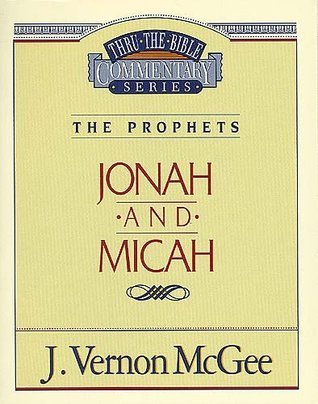
Monday, May 8, 2023

45. Jonah and Micah (Thru the Bible)


Thru the Bible #29: Jonah and Micah. 1979. 173 pages. [Source: Bought]

First sentence: Jonah is the book of the Bible which perhaps has been criticized more than any other. Unfortunately, many Christians thoughtlessly cast aspersions upon this important book in the canon of Scripture without realizing that they are playing into the hands of the critics and innocently becoming the dupes of the skeptics. 

This commentary covers two minor prophets--the books of Jonah and Micah. J. Vernon McGee continues his paragraph by paragraph commentary of the Bible. I wouldn't say that he goes into great detail with each and every verse. It's more "thought for thought" if you will. He's hoping to capture the "thought" and "meaning" of passages of bible books. If you're looking for breakdowns of Hebrew and Greek, then McGee probably isn't your man--your theologian. 

McGee is very casual, very conversational. Not because he doesn't have a high view of Scripture. He believes the Bible to be the very Word of God. He believes in all the things--inerrant, infallible, inspired, authoritative, etc. But he wants to reach people--all people. Not just elite scholars, but everyone. He wants EVERYONE to feel comfortable reading, studying, comprehending the Bible. 

I've read a dozen or so of McGee's commentaries. This one is slightly odd--for me. McGee's take on Jonah is perhaps not unique but not entirely expected. It was the first time I'd heard this interpretation. McGee believes that Jonah was DEAD for three days. Literally dead. God resurrected him and sent him on his way. I'd never really thought about if Jonah was DEAD or alive in the belly of the fish. I suppose it isn't a point on scripture that is absolute, that you have to make an absolute stand on. But the traditional view is that he was kept alive in the belly of the fish. Again, this was my first exposure to McGee's views. He argues that this is where the Old Testament makes it crystal clear that resurrection is possible. I think there are other examples of resurrection in the Old Testament--though perhaps not with the dead several days implication. But I don't think Jonah had to be literally dead for three days in order for Christ to make use of Jonah in his illustration. 

I do like the book of Micah. I think it is a relevant book in many, many ways. But McGee got a little subtracted, in my humble opinion. Again he made a point or two that I wasn't quite on board with. Namely he argues that the United States of America is in decline (if he left it at that it might not be worth a mention) and will not be a player--a world power--in the end days because it is not mentioned by name in the Bible. I'll let you think about that for a minute. That's neither here nor there as far as I'm concerned. I'd be more concerned if the United States of America was mentioned by name in the original languages of Scripture thousands of years before Christopher Columbus sailing the ocean blue. I don't think the lack of a country's name, a state name, indicates ANYTHING positive or negative. McGee will not be popular, perhaps, for his opinion that the Great Depression and World War II are judgments of God on the United States of America. Though that goes down a LOT more smoother than his statements on the Holocaust. I can't even begin to get into that here in this review. 

There were still plenty of good insights into both books. But this particular volume isn't topping my favorites list. 

© Becky Laney of Operation Actually Read Bible

Friday, April 28, 2023

43. Thru the Bible: Mark


Mark. (Thru the Bible #36) J. Vernon McGee. 1975. 204 pages. [Source: Bought]

First sentence: The Gospel of Mark is chronologically the first gospel that was written. It was actually one of the first books written in the New Testament—not the first, but one of the first. It was probably written from Rome prior to A.D. 63.

I am reading the Bible in 2020 using the daily M'Cheyne (Robert Murray M'Cheyne) plan. I thought it would add a layer of substance to in addition to the four chapters a day, to also read commentaries for those chapters. For that I am using Matthew Henry's Commentary on the Whole Bible. But the plan goes through the New Testament (and Psalms, I believe) twice. So now that I've finished Henry's commentary for the New Testament, I am tackling the New Testament commentary section of J. Vernon McGee's series.

This is not my first time reading J. Vernon McGee. I've read twelve or so of his commentaries. (Most recently his volume on Matthew 1-13). Overall, I like his laidback, casual, straightforward, tell it like it is approach to teaching Scripture. There is something so grounded and down to earth about him. Each reader is "his" friend. It's hard not to feel like he is a friend too.

One of the things that I love about McGee's commentaries is that he just speaks timeless truths. 

Mark isn't necessarily one of my favorite gospels. But reading McGee helped me appreciate it more. 
There probably is more content in this first chapter of Mark than any other chapter in the Bible (with the exception of Gen. 1). It covers the ministry of John the Baptist, after going back to the prophecies of Isaiah and Malachi.
There are three beginnings recorded in Scripture. Let us put them down in chronological order: 1. “In the beginning was the Word” (John 1:1). This goes back to a dateless beginning, a beginning before all time. Here the human mind can only grope. It is logical rather than chronological because in my thinking, I must put my peg somewhere in the past in order to take off. If I see an airplane in the air, I assume there is an airport somewhere. I may not know where it is, but I know the plane took off from some place. So when I look around at the universe, I know that it took off from somewhere and that somewhere there is a God. But I don’t know anything about that beginning. God comes out of eternity to meet us. I just have to put down the peg at the point where He does meet us, back as far as I can thinkJ and realize He was there before that. 2. “In the beginning God created the heaven and the earth” (Gen. 1:1). This is where we move out of eternity into time. However, although many people have been attempting to date this universe, no man so far knows. Man’s guesses have ranged from six thousand to three billions of years. We know so little but, when we come into His presence and begin to know even as we are known, then we will realize how we saw through a glass darkly. I’m sure we will marvel at our stupidity and our ignorance. Our God is a great God. He has plenty of time. 3. “The beginning of the gospel …” (v. 1) is the same as “That which was from the beginning …” (1 John 1:1). This is dated. It goes back to Jesus Christ at the precise moment He took upon Himself human flesh. Jesus Christ is the gospel! 
What we need in the church today is stretcher-bearers—men and women with that kind of faith to go out and bring in the unsaved so they can hear the gospel. There are many people today who are paralyzed with a palsy of sin, a palsy of indifference, or a palsy of prejudice. A great many people are not going to come into church where the gospel is preached unless you take a corner of the stretcher and bring them in. That’s what these men did. They had the faith to bring this poor man to hear the Lord Jesus deal with him personally and say, “Son, thy sins be forgiven thee.”
Whether we like it or not, He does the choosing. “Ye have not chosen me, but I have chosen you, and ordained you, that ye should go and bring forth fruit, and that your fruit should remain: that whatsoever ye shall ask of the Father in my name, he may give it you” (John 15:16). It is not irreverent to say that since He chose them and they did not choose Him, He’s responsible for them. That’s a real comfort to know. God has saved you, begun a good work in you, and He’s going to stick right with you, friend. He’s going to see you through. That is what this means. And when the Lord Jesus calls, they respond.
It is impossible to commit an unpardonable sin today—if by that you mean one can commit a sin today, come under conviction because of it tomorrow, come to God in repentance, and He would not forgive you. You see, Christ died for all sin, not just some sin. He didn’t die for all sin but one, the unpardonable sin. There is no such thing as being able to commit a sin today that He will not forgive. The attitude and state of the unbeliever is unpardonable—not the act. When a man blasphemes with his mouth, that is not the thing that condemns him; it is the attitude of his heart, which is a permanent condition—unless he stops resisting.
And he said unto them, He that hath ears to hear, let him hear [Mark 4:9]. He puts up a danger signal. It’s like the “Stop—Look—Listen” sign at a railroad crossing.
We sometimes use the expression—I know I say it rather carelessly—that you’ll be lost if you do not accept Christ as your Savior. That is not really the truth, friend. The truth is that you are already lost. The point that should be accurately stated is that you will continue to be lost if you do not receive Christ as your Savior.
Every chapter is the most important chapter when you are studying it! But this one is important because the Gospel of Mark is a gospel of action. There are more of the miracles given in this gospel than in any other, and in this chapter there are three outstanding miracles related. They could be performed only by the hand of Omnipotence. That is why I think this is a remarkable chapter.
The Word of God is the Bread of Life because the Word of God reveals Him. We are to feed on the Bible and to beware of false teaching. I think that ought to be clear to us here in the teaching that He gives.
By the way, that “Jesus Only” is a marvelous headline, is it not? “Jesus Only” is not only a headline in Mark’s gospel, but it ought to be a headline in the lives of believers today. In a brief way he states such great and weighty words—Jesus Only!
And the tragic thing about this hour is that the church is helpless in the presence of the world’s need. Right now, the organized church in desperation is reaching out, protesting and marching and getting involved in all kinds of things, and the world is actually criticizing the church because they feel it should get even more involved. But social matters are not our business! We ought to be able to help a poor demon-possessed boy today by presenting a Savior to him who will make him rational and who will bring him into a right relationship with God. Unfortunately, the same thing has to be said of the church, “They could not.” The disciples could not and we cannot.
Bring him unto Me! We are attempting to do everything except bring lost men to Jesus Christ.
Do you realize who it is here that is talking about hell? There are those today who say that He is the gentle Jesus. Friend, He is the only One who talked about hell. Paul never talked about it, but Jesus did. And since He did, it would be well for us to listen to Him.
And thou shalt love the Lord thy God with all thy heart, and with all thy soul, and with all thy mind, and with all thy strength: this is the first commandment [Mark 12:30]. By the way, do you keep this commandment, my friend? If you say that you don’t need Christ as a Savior, that you obey God, then I ask you this question, “Do you love God with all your heart and mind and soul?” If you don’t, then you are breaking His commandment and you need a Savior. I know I need a Savior. I don’t measure up here. I wish I did. I love Him but not as I should.
We find this is a constant warning—a warning against false Christs. Some may think that this is not a danger today. I think it is very pertinent right now. For example, the Christ of liberalism is an antichrist—he is not the real Christ! Some of you may think that they preach the Christ of the Bible. They do not.
My friend, may I say to you, none of us knows the depths of the human heart. Only the Word of God can let us see what sinners we are.
If we take the emphasis away from the Word of God, we can find that people get one problem solved with the help of the psychologist and come away with two more problems. Then the last estate of the man is worse than the first. Let’s be very clear. The only solution to a problem is the Lord. You don’t solve the problem so that you are enabled to go to the Lord. No, you go to the Lord and He is the chief and the great Physician. By the way, He is the great Psychologist and He alone knows us. In the final analysis, He is the only One.


© Becky Laney of Operation Actually Read Bible

Tuesday, September 6, 2022

33. Galatians: Gospel Rooted Living


Galatians: Gospel-Rooted Living. Todd Wilson (Preaching the Word series). 2013. 288 pages. [Source: Bought] 

First sentence: I WOULD LIKE TO TELL you a story. It’s about a young man who ruined his life.

I definitely found this commentary on Paul's letter to the Galatians to be helpful. Galatians isn't the easiest book to read and understood. Easy to relate to at times, yes, but easy to grasp (or grasp and apply) not always. In August and September, I (will) read Galatians thirty times. In August, the assignment (for the Facebook group) was Galatians 1-3. In September, the assignment is Galatians 4-6. Most nights I read one chapter in the commentary. I thought that was a good pace. Wilson tackles the book of Galatians in sections. Some chapters cover very, very, very short sections of the book. Other chapters cover longer portions. He blends original context (history) with application. He does offer contemporary examples of how the book is still relevant.

Quotes:

From Genesis to Revelation the Word of God is a treasure trove of grace. Golden coins of comfort, costly pearls of assurance, precious jewels of promise are all found in the pages of Scripture. In fact, everything that was written in the Bible was written for us, that “through the encouragement of the Scriptures we might have hope” (Romans 15:4). Therefore, every time we make a mess of things, we must go back to grace by going back to the Word of God.

Deliverance from sin and from “the present evil age” comes only one way; indeed, grace itself comes only one way: through the death of the Lord Jesus Christ. “Grace to you and peace from God our Father and the Lord Jesus Christ, who gave himself for our sins to deliver us from the present evil age” (vv. 3, 4). Thus Paul drives the Galatians back to this fundamental fact: Christ gave himself for our sins. For the death of Christ alone explains the presence of grace in our lives; and the death of Christ alone opens the wellspring of salvation: justification, sanctification, glorification.

“Amen” is something we say with our heart. When we say, “Amen,” we’re more than observers; we’ve moved from being spectators to being participants. “Amen” is our way of entering into this divine drama, taking up our part, assuming our role in the story of grace called the death and resurrection of Jesus Christ. Until we do that, we’re simply sitting in the audience, out of the action, away from the benefits of grace. “Amen” is, then, the only entry point into the world of grace. There’s no other way in. We can’t find grace in any other way because grace is only given to those who have faith; and the voice of faith is expressed in the word “Amen.”

I challenge us all to make the following not only a New Year’s resolution but a perpetual resolution that we are determined to keep: Every time I blow it, I’ll go back to grace. I won’t ignore it, play dumb, hide, or try to pass the buck to my spouse or my boss or my mom or my dad or my neighbor or my genes or my personality or my upbringing or my financial situation! Instead I’ll look my misstep in the face and then go back to grace—to the cross, that place where Jesus Christ has already taken the blame and condemnation and guilt upon himself.

Death isn’t the goal of the cross. Life is. God’s designs go beyond crucifixion: they move inexorably toward resurrection, new life, and new creation. By sending his Son into the world, God dealt a blow to the world, so much so that he blew open a hole large enough for the new creation. The cross thus clears the way for the new creation.


© Becky Laney of Operation Actually Read Bible

Friday, March 11, 2022

13. Suffering Wisely and Well


Suffering Wisely and Well: The Grief of Job and the Grace of God. Eric Ortlund. 2022. 193 pages. [Source: Review copy]

First sentence: This book is about suffering both wisely and well as a Christian. 

Suffering Wisely and Well is mostly a commentary on the book of Job. Ortlund works through the book of Job. His approach is mainly to look at what each person (and God) has to say. (There are also chapters on the introduction and conclusion to the book of Job.) I believe his lens of reading is a practical one. What can you--the reader--learn from the book of Job. Even the super-messy wrong-ness of Job's friends is spun as a lesson of how not to interact with modern-day sufferers. At times the present is stressed so much that the focus is never on the past context. 

One thing that I definitely appreciated was how each chapter ended in a very straight-forward, no-nonsense summary; it was even numbered. It was as if the author was saying: here are the important points I was making in this chapter.

This one definitely has some insights. Like, "Job's friends are actually his tormentors, and no matter how much stage time they are given, they cannot manage to say a single helpful thing to him."

Suffering Wisely and Well isn't your traditional commentary on Job. It opens almost by pretending to be something it's not. The opening chapter makes it sound like it's going to be about ALL types of suffering and how you can use these principles of suffering to discern in what ways you (and others) are suffering and learn how to do it wisely and well. But literally every other chapter in the book is a commentary from the book of Job. 

© Becky Laney of Operation Actually Read Bible

Tuesday, December 29, 2020

113 Psalms 90-150


Psalms 90-150 (Thru the Bible #19) J. Vernon McGee. 1977. 211 pages. [Source: Bought]

First sentence: The setting for this psalm is out there on the desert during Israel’s wanderings.

I am reading the Bible in 2020 using the daily M'Cheyne (Robert Murray M'Cheyne) plan. I thought it would add a layer of substance to in addition to the four chapters a day, to also read commentaries for those chapters. For that I am using Matthew Henry's Commentary on the Whole Bible. But the plan goes through the New Testament (and Psalms, I believe) twice. So now that I've finished Henry's commentary for the New Testament, I am tackling the New Testament commentary section of J. Vernon McGee's series.

This is not my first time reading J. Vernon McGee. I've read probably thirty or so of his commentaries. Most recently Revelation 14-22.

I really am LOVING McGee. This has been the best idea--to correspond my Bible reading with commentary reading. 

I love McGee's enthusiasm of the psalms. He doesn't spend an equal amount of time discussing/analyzing/commentating each psalm. But he always has a little something to say at least. 

I would recommend his commentaries on Psalms as a good place to start to get to know McGee.

Quotes: 
  • If you live for eighty years, it is going to be uphill all the way. We talk about coming to the “sunset” of life, but that is when you start going uphill, not downhill.
  • If you haven’t formed the habit of praising God, you should.
  • If you are going to heaven, you had better tune up, because you are going to spend a lot of time praising Him in heaven and the best place to tune up is down here.
  • I am going to make a confession to you: I can’t worship the Lord like I want to. Do you know why? This old flesh of mine can’t rise to that level. It is only by the Holy Spirit that you and I can worship the Lord in spirit and in truth.
  • We ought to recognize the fact that many of God’s choicest servants have been ill and afflicted and have never been healed in this life.
  • My friend, if God would deal with us according to our sins and according to our iniquities, none of us would be saved.
  • The psalmist does not say, “As far as the north is from the south.” That is quite a distance; but when you start moving from the east to the west, there is no end. When you start going west, you keep going west. When you go north, you eventually reach a point where you start going south, but when you go west, you never stop going west. That is how far God has removed our transgressions from us!
  • Dr. George Gill used to put it like this: “God remembers that we are dust. We forget it, and when dust gets stuck on itself, it is mud.” That is a picture of man.
  • My friend, there is something wrong with you if you cannot look back through your life and find something to thank God for.
  • A little girl has defined lovingkindness. She said, “If you ask your mother for a piece of bread and butter, and she gives it to you, that is kindness. But if she puts jam on it without you asking her, that is lovingkindness.”
  • The Lord Jesus made it very clear that the condition of the lost is a terrible thing. In John 3:36, where He gave that wonderful invitation, He also gave the other side of it; He contrasted light and darkness: “He that believeth on the Son hath everlasting life: and he that believeth not the Son shall not see life; but the wrath of God abideth on him.” I don’t know how you can make that verse any stronger. The teaching that somehow or other folks who are lost are going to have a second chance, and that there is a larger hope, and that God may have another way, is completely foreign to the Word of God, which says that the wrath of God abides on the person who has not trusted Christ. Jesus Christ endured God’s wrath for us on the cross. He did it for us, and our only way of salvation is to trust Him. If we do not, God’s wrath will be upon us.
  • God is good. God is righteous, and for that very reason He has to deal with sin. The day will come when He will make things right, and I want Him to make things right.
  • We really do not know how good God is. If we did, we would sing the Hallelujah chorus more often.
  • Oh, that God’s people would praise Him! My friend, tell somebody today that God is good, then back it up with your experience of His goodness.
  • Man is in distress and calls upon God, and God hears in mercy. It is a love song. It is a Hallel psalm. It is a simple psalm that speaks of the past sufferings of Christ in the presence of death. The night He was arrested and the day before He died the Lord sang this psalm. I wish I could have heard Him sing it!
  • It is a gracious word for those in distress and trouble. It will relieve your anxiety and dispel your doubts. The Lord Jesus sang this psalm the night before He was crucified. In verses 1–5, God hears. In verses 6–13, God helps. In verses 14–19, God is holy.
  • Gracious is the LORD, and righteous; yea, our God is merciful [Ps. 116:5]. God is merciful, but God is righteous. He cannot just arbitrarily forgive sin. He has to be right when He does it. God is the moral Ruler of this universe. He has to be right; He has to be holy; He has to be just, but He also wants to be merciful. The only way was to pay the penalty for the sin of man.
  • Return unto thy rest, O my soul; for the LORD hath dealt bountifully with thee [Ps. 116:6–7]. After a difficult, frustrating, pressure-filled day, we need to seek out a quiet place where we can confess our sins, read the Word, and talk with God. That is the sanctuary of the soul. Oh, how all of us need this—“Return unto thy rest, O my soul.” This will enable us to walk out and face the world for God.
  • Precious in the sight of the LORD is the death of his saints [Ps. 116:15]. Precious was the death of Christ to God. Precious will be the deaths of those who lay down their lives as martyrs during the Great Tribulation period, and many will do so. I am not sure but what we can apply this today. The death of God’s children is precious in His sight.
  • Psalm 117 is a tremendous psalm. It is like an atom bomb in the midst of the psalms, and when this little bomb explodes, you won’t find a postmillennialist or an amillennialist anywhere, for it will blow them all away. The fulfillment of this psalm will come during the Millennium when Christ reigns on this earth—and not before.
  • Praise to the Word of God We come now to the longest psalm and the longest chapter in the Bible. It has in it 176 verses, and every verse (with the possible exception of two verses) is praise to the Word of God.
  • Oh, that you and I might put an emphasis upon the Word of God. As believers, we need to put the emphasis where God puts it. In our day there is too much emphasis upon programs and methods and ceremonies and church activities.
  • Our emphasis should be on the Word of God, because that is the only thing He has promised to bless.
  • He has never promised to bless me or my ministry or any other ministry, but He has promised to bless His Word.
  • my friend, if you receive life from the dead—if you receive eternal life—it will come through the Word of God. “Being born again, not of corruptible seed, but of incorruptible, by the word of God, which liveth and abideth for ever” (1 Pet. 1:23). We are begotten by the Word of God that reveals Jesus Christ. God’s Word will bring life to you, it will bring liberty to you, it will bring joy to you, and it will bring blessing to you.
  • Oh, that we would seek God with the whole heart—not halfheartedly.
  • Thy word have I hid in mine heart, that I might not sin against thee [Ps. 119:11]. Many people believe that this verse only means that Scripture should be memorized. I think memorizing God’s Word is a wonderful thing, but some of the meanest little brats I have seen in Sunday school were the ones who could stand up and quote one hundred verses of Scripture.
  • God’s mercy is channeled to us—the pipe that brings it to us is the Word of God. Therefore, the psalmist says: And I will delight myself in thy commandments, which I have loved [Ps. 119:47]. Does it give you joy to read the Word of God? Do you love the Bible? If you don’t love God’s Word, ask Him to give you a love for it. I did that for years. I prayed, “Lord, give me a love for your Word.” I was not brought up in a home where I heard the Word of God, and it took me a long time to become interested in it.
  • Have you ever thanked God in the middle of the night for His Word? Well, wake up tonight and do it.
  • Thy hands have made me and fashioned me: give me understanding, that I may learn thy commandments [Ps. 119:73]. God made us. He knows exactly what we need. One of our basic needs is His Word, and that is what the psalmist is talking about here.
  • He meditated in God’s Word because he loved it, and then he loved it even more because he meditated in it.
  • Each of us should use the Word of God personally, practically, and habitually as we make our way through this dark world.
  • How much time do you spend reading the newspaper, or reading trash, in comparison to the time that you spend reading the Bible? God is telling us, through the psalmist, that He hates vain thoughts.
  • If you spend time in the Word of God, the day will come when you will not be interested in a lot of the trash that is published.
  • The only thing that can revive us is God’s Word. Dwight L. Moody said that the next great revival will be a revival of the Word of God.
  • As long as the Word of God is in your heart, my friend, as long as there is a longing deep within you to come to God, the Shepherd is out looking for you. He will put you on His shoulder and bring you back into the fold. Psalm 119 is a glorious psalm. It glorifies the Word of God which is the foundation of all liberty. And it reveals the Savior—“If the Son therefore shall make you free, ye shall be free indeed” (John 8:36). Oh, what liberty the Word of God will give to your heart and life!
  • Praise the LORD; for the LORD is good: sing praises unto his name; for it is pleasant [Ps. 135:1–3]. We do not say enough that God is good. My friend, have you told anyone today that God is good? Oh, He is good! This is a call to praise Him.
  • Every verse in this psalm mentions the mercy of God. It exalts God’s mercy. In Ephesians 2:4 Paul says, “But God, who is rich in mercy, for his great love wherewith he loved us.” I want mercy from God, and He is rich in it. I receive many letters from folks who tell me they have committed some sin. They ask, “Do you think God will forgive me?” Friend, He is rich in mercy. Have you called on Him? If you really want forgiveness, He will give it to you. He deals with us according to His mercy.
  • I don’t know about you, but I feel like saying “Hallelujah” again. How wonderful is our God. Learn to fall down before Him and worship Him. He is worthy. When you get down in the dust (and you have to get down to get up), He will lift you up with His mercy.
  • There are those who say, in a naive sort of way, “I believe the Bible from cover to cover”—yet they are ignorant of what is between the covers! This is the reason those of us who are conservative are accused of being anti-intellectual. Multitudes of conservative folk claim to believe the Bible but are ignorant of it. This is the reason I put such an emphasis on teaching the Word of God. It is one thing to say you believe it; it is another thing to know what it says.
  • The child of God today is a pilgrim and stranger in this world.
  • Every Christian today should have a song in his heart. I don’t say a song on his lips—David made it very clear that we’re to make a joyful noise unto the Lord.
  • But we are to sing in a strange land. God has given us a song, the song of redemption.
  • When all the sorrow and all the grief of your sin and my sin was put upon Him, He was a Man of Sorrows. But He had none of His own, for He had no sin of His own. He was made sin for us, and He was made our sin offering, completely identified with your sin and mine.
  • My friend, you and I need to examine our own hearts to see how we are worshiping God. Do we worship Him with our whole heart? One of the things which impressed me about Horatius Bonar was what he said when he went to God to repent of the coldness, the indifference, and the sin in his life. He said, “Then I went back to God and repented of my repentance.” His first confession was merely lip service, and he repented of that.
  • The LORD will perfect that which concerneth me: thy mercy, O LORD, endureth for ever: forsake not the works of thine own hands [Ps. 138:8]. This is the Old Testament way of saying, “Being confident of this very thing, that he which hath begun a good work in you will perform it until the day of Jesus Christ” (Phil. 1:6).
  • This is a theological psalm in that it reveals something of the attributes of God in relation to His creation. It reveals His omniscience, His omnipresence, and His omnipotence. These are what I call four-cylinder words, but they simply mean that God is all-knowing (omniscient), He is everywhere present (omnipresent), and He is all-powerful (omnipotent). God can do anything that is the object of His power. Sometimes the ridiculous question is asked, Can God make a rock so big that He cannot lift it? The answer to that is that God never does anything ridiculous.
  • I poured out my complaint before him; I shewed before him my trouble [Ps. 142:2]. In other words, David laid out before God everything that was in his heart and life. That is the way you and I should pray. This idea that we should “pray around” something, or rationalize in our prayers, or pray “all around Robin Hood’s barn,” is wrong. We ought to get right down to the nitty-gritty and tell God everything in our lives. David said, “I shewed before him my trouble.” My friend, you can tell Him about your temptations; you can tell Him about everything.
  • He sent His Son to the cross to pay the penalty for sin. You please Him when you accept what He has done for you.
  • God is going to intrude into human history one day. I don’t want to take a fanatical position and say that He is going to do it tomorrow, or even in this century, but the fact is that He is going to do it. Cast forth lightning, and scatter them: shoot out thine arrows, and destroy them [Ps. 144:6]. When the Lord comes again, He is coming in judgment. The whole tenor of Scripture, including the New Testament, is that the Lord is coming in judgment one day.
  • We have never been able to sing the Hallelujah chorus perfectly yet. But there is coming a day when Christ will return to this earth. The day that He comes forth will be a great day, and then the Hallelujah chorus will be sung correctly and completely.
  • “Every day will I bless thee”—this is not for only one day in the week when we go to church but for every day. There are days when we don’t feel like blessing Him. We sometimes sing, “We praise Him for all that is past, and trust Him for all that is to come.” We can change that around and sing, “We trust Him for all that is past and praise Him for all that is to come.”
  • He healeth the broken in heart, and bindeth up their wounds [Ps. 147:3]. God will do this for those who have passed through the horrors of the Great Tribulation. And, friend, He does it for you and me. He telleth the number of the stars; he calleth them all by their names [Ps. 147:4]. What a contrast! He who cares for our broken hearts is the same God who not only knows the number of the stars—a number so vast that no human figures can express it—but has a name for each one!
  • And the Scriptures say that God is a jealous God. I can’t find where He asks me to apologize for Him for this. He has created us for Himself. He has redeemed us for Himself.
  • God apparently created man for the purposes of fellowship with Himself and that man might praise Him. There is no other reason for man’s existence. What is the chief end of man? Man’s chief end is to glorify God and enjoy Him forever.
  • Worship is divine intoxication.
  • The Book of Revelation does not tell us much about heaven, but one thing we are sure about—every time we read of someone in heaven they are either getting down on their faces to worship God, or getting up off their faces from worshiping God.
  • My friend, some types of worship compare to going downtown, sitting in a department store window, and holding the hand of a mannequin in there. It has no more life in it; it has no more vitality in it than that! Oh, to have a heart that goes out to God in adoration and in love to Him!
  • A young fellow wrote a love letter to his girl. He waxed eloquent and said: “I would climb the highest mountain for you. I would swim the widest river for you. I would crawl across burning sands of the desert for you.” Then he put a P.S. at the end: “If it doesn’t rain Wednesday night I will be over to see you.” A whole lot of so-called worship is like that today. It will not take very much to keep us away from God.


© Becky Laney of Operation Actually Read Bible