Showing posts with label 1953. Show all posts

Thursday, January 12, 2023

3. From Pearl Harbor to Calvary


From Pearl Harbor to Calvary. Mitsuo Fuchida. 1953/2011. eChristian. 96 pages. [Source: Bought]


This is a short autobiography. Mitsuo Fuchida concisely relates for readers his experiences during World War II; his restlessness after the war, and his quest for answers; and ultimately his  conversion to Christ, and his subsequent evangelical work for the Lord. It may be short, but, it is nevertheless compelling.

In chapter one, the author recalls bombing Pearl Harbor.

In chapter two, the author relates his further experiences during the war itself.

In chapter three, the author writes of his experiences after the war, his longing for peace, and his quest for answers.

In chapter four, the author writes of his conversion and shares his testimony.

The final chapters (chapter five through chapter seven), readers learn of his evangelical work, his work for the Lord, how he shared his testimony with others, and how his focus changed so completely.

It was originally published under the title From Pearl Harbor to Golgotha in 1953. 

© Becky Laney of Operation Actually Read Bible

Wednesday, March 23, 2016

Book Review: The Silver Chair

The Silver Chair. (Chronicles of Narnia #4) C.S. Lewis. 1953. HarperCollins. 243 pages. [Source: Bought]

First sentence: IT WAS A DULL AUTUMN DAY AND JILL Pole was crying behind the gym. She was crying because they had been bullying her. This is not going to be a school story, so I shall say as little as possible about Jill’s school, which is not a pleasant subject.

The Silver Chair is the fourth book in the Chronicles of Narnia. (The first three are: The Lion, the Witch, and The Wardrobe; Prince Caspian; and The Voyage of the Dawn Treader.) It is an enjoyable installment in a wonderful fantasy series. It is neither my absolute favorite nor my least favorite. (Voyage of the Dawn Treader and The Lion, The Witch, and the Wardrobe battle it out for top place. My opinion as to which is my favorite and my best varies depending on the day. The Last Battle is my least favorite simply because Lewis' weird theology sours the book.)

Jill Pole and Eustace Scrubb find themselves unexpectedly whisked away to another country. After Jill "accidentally" tumbles Eustace off a cliff, she has a close encounter with a lion. 

This encounter with Aslan is one of my absolute favorites:
But her thirst was very bad now, and she plucked up her courage to go and look for that running water. She went on tiptoes, stealing cautiously from tree to tree, and stopping to peer round her at every step. But although the sight of the water made her feel ten times thirstier than before, she didn’t rush forward and drink. She stood as still as if she had been turned into stone, with her mouth wide open. And she had a very good reason; just on this side of the stream lay the lion.... And the thirst became so bad that she almost felt she would not mind being eaten by the lion if only she could be sure of getting a mouthful of water first. “If you’re thirsty, you may drink.” They were the first words she had heard since Scrubb had spoken to her on the edge of the cliff. For a second she stared here and there, wondering who had spoken. Then the voice said again, “If you are thirsty, come and drink,” and of course she remembered what Scrubb had said about animals talking in that other world, and realized that it was the lion speaking. Anyway, she had seen its lips move this time, and the voice was not like a man’s. It was deeper, wilder, and stronger; a sort of heavy, golden voice. It did not make her any less frightened than she had been before, but it made her frightened in rather a different way. “Are you not thirsty?” said the Lion. “I’m dying of thirst,” said Jill. “Then drink,” said the Lion. “May I—could I—would you mind going away while I do?” said Jill. The Lion answered this only by a look and a very low growl. And as Jill gazed at its motionless bulk, she realized that she might as well have asked the whole mountain to move aside for her convenience. The delicious rippling noise of the stream was driving her nearly frantic. “Will you promise not to—do anything to me, if I do come?” said Jill. “I make no promise,” said the Lion. Jill was so thirsty now that, without noticing it, she had come a step nearer. “Do you eat girls?” she said. “I have swallowed up girls and boys, women and men, kings and emperors, cities and realms,” said the Lion. It didn’t say this as if it were boasting, nor as if it were sorry, nor as if it were angry. It just said it. “I daren’t come and drink,” said Jill. “Then you will die of thirst,” said the Lion. “Oh dear!” said Jill, coming another step nearer. “I suppose I must go and look for another stream then.” “There is no other stream,” said the Lion. It never occurred to Jill to disbelieve the Lion—no one who had seen his stern face could do that—and her mind suddenly made itself up. It was the worst thing she had ever had to do, but she went forward to the stream, knelt down, and began scooping up water in her hand. It was the coldest, most refreshing water she had ever tasted. You didn’t need to drink much of it, for it quenched your thirst at once.

 After asking her where Eustace is--he knows, of course, having blown him to Narnia on his breath himself--he gives her a mission, a task.
And now hear your task. Far from here in the land of Narnia there lives an aged king who is sad because he has no prince of his blood to be king after him. He has no heir because his only son was stolen from him many years ago, and no one in Narnia knows where that prince went or whether he is still alive. But he is. I lay on you this command, that you seek this lost prince until either you have found him and brought him to his father’s house, or else died in the attempt, or else gone back to your own world.
She must learn the four signs that go along with the mission. She'll need to know them backwards and forwards and be able to recall them perfectly. And, of course, she'll need to share them with Eustace.
“I will tell you, Child,” said the Lion. “These are the signs by which I will guide you in your quest. First; as soon as the Boy Eustace sets foot in Narnia, he will meet an old and dear friend. He must greet that friend at once; if he does, you will both have good help. Second; you must journey out of Narnia to the north till you come to the ruined city of the ancient giants. Third; you shall find a writing on a stone in that ruined city, and you must do what the writing tells you. Fourth; you will know the lost prince (if you find him) by this, that he will be the first person you have met in your travels who will ask you to do something in my name, in the name of Aslan.”
She's confident that she can do it. How hard could it be, after all?! Knowing this, he warns her:
But, first, remember, remember, remember the signs. Say them to yourself when you wake in the morning and when you lie down at night, and when you wake in the middle of the night. And whatever strange things may happen to you, let nothing turn your mind from following the signs. And secondly, I give you a warning. Here on the mountain I have spoken to you clearly: I will not often do so down in Narnia. Here on the mountain, the air is clear and your mind is clear; as you drop down into Narnia, the air will thicken. Take great care that it does not confuse your mind. And the signs which you have learned here will not look at all as you expect them to look, when you meet them there. That is why it is so important to know them by heart and pay no attention to appearances. Remember the signs and believe the signs. Nothing else matters. And now, daughter of Eve, farewell—”
Aslan then blows Jill to Narnia. She finds Eustace who arrived just minutes before. She tells him the signs, but, unfortunately he's already missed the opportunity of greeting an old friend--King Caspian. But the two will go on their mission all the same. They may not have the help of a king, but, they do have the help of some friendly owls. And it is through the owls that they meet one of my favorite, favorite characters: Puddleglum, a Marsh-wiggle. (The owls also tell them essentially everything they need to know about Prince Rilian and his mysterious disappearance). 


These three set off on a dangerous adventure quest together. And it's a memorable journey, I think....

Will they be successful? Will they find Prince Rilian? Will Rilian return to Narnia and be crowned king? Will they meet Aslan again?

Some additional quotes I loved:
IT IS A VERY FUNNY THING THAT THE sleepier you are, the longer you take about getting to bed; especially if you are lucky enough to have a fire in your room.
“How beastly one feels after sleeping in one’s clothes,” said Jill, sitting up. “I was just thinking how nice it was not to have to dress,” said Eustace. “Or wash either, I suppose,” said Jill scornfully.
“Good morning, Guests,” he said. “Though when I say good I don’t mean it won’t probably turn to rain or it might be snow, or fog, or thunder. You didn’t get any sleep, I dare say.” “Yes we did, though,” said Jill. “We had a lovely night.” “Ah,” said the Marsh-wiggle, shaking his head. “I see you’re making the best of a bad job. That’s right. You’ve been well brought up, you have. You’ve learned to put a good face on things.” “Please, we don’t know your name,” said Scrubb. “Puddleglum’s my name. But it doesn’t matter if you forget it’. I can always tell you again.”
“Well, I don’t know that you’d call it help,” he said. “I don’t know that anyone can exactly help. It stands to reason we’re not likely to get very far on a journey to the North, not at this time of the year, with the winter coming on soon and all. And an early winter too, by the look of things. But you mustn’t let that make you down-hearted. Very likely, what with enemies, and mountains, and rivers to cross, and losing our way, and next to nothing to eat, and sore feet, we’ll hardly notice the weather. And if we don’t get far enough to do any good, we may get far enough not to get back in a hurry.”
“The bright side of it is,” said Puddleglum, “that if we break our necks getting down the cliff, then we’re safe from being drowned in the river.”
However tired you are, it takes some nerve to walk up to a giant’s front door.
“Don’t you mind him,” said Puddleglum. “There are no accidents. Our guide is Aslan; and he was there when the giant King caused the letters to be cut, and he knew already all things that would come of them; including this”
Puddleglum was still fighting hard. “I don’t know rightly what you all mean by a world,” he said, talking like a man who hasn’t enough air. “But you can play that fiddle till your fingers drop off, and still you won’t make me forget Narnia; and the whole Overworld too. We’ll never see it again, I shouldn’t wonder. You may have blotted it out and turned it dark like this, for all I know. Nothing more likely. But I know I was there once. I’ve seen the sky full of stars. I’ve seen the sun coming up out of the sea of a morning and sinking behind the mountains at night. And I’ve seen him up in the midday sky when I couldn’t look at him for brightness.” Puddleglum’s words had a very rousing effect. The other three all breathed again and looked at one another like people newly awaked.
Suppose we have only dreamed, or made up, all those things—trees and grass and sun and moon and stars and Aslan himself. Suppose we have. Then all I can say is that, in that case, the made-up things seem a good deal more important than the real ones. Suppose this black pit of a kingdom of yours is the only world. Well, it strikes me as a pretty poor one. And that’s a funny thing, when you come to think of it. We’re just babies making up a game, if you’re right. But four babies playing a game can make a play-world which licks your real world hollow. That’s why I’m going to stand by the play-world. I’m on Aslan’s side even if there isn’t any Aslan to lead it. I’m going to live as like a Narnian as I can even if there isn’t any Narnia. So, thanking you kindly for our supper, if these two gentlemen and the young lady are ready, we’re leaving your court at once and setting out in the dark to spend our lives looking for Overland.
Have you read The Silver Chair? What did you think of it? Do you have a favorite book in the series? A favorite character?

© Becky Laney of Operation Actually Read Bible

Friday, March 4, 2016

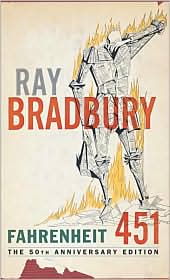
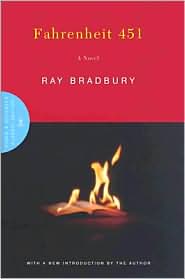
Book Review: Fahrenheit 451

Fahrenheit 451. Ray Bradbury. 1953/1991. Del Rey. 179 pages. [Source: Bought]

Can I go a year without reviewing Ray Bradbury's Fahrenheit 451? Apparently not! This one is an obvious favorite of mine. What is it about? What isn't it about! It's about war, destruction, and the decay of society. It's about the need for noise, noise, NOISE--anything to keep people from thinking and feeling. It's about the consequences of choosing not to read, not to think (THINK), not to engage with one another.

Here's the plot at its simplest: Guy Montag, a fireman who burns books for a living, is forced to stop living his double life when his wife turns him in for bringing books into their home. After his secret comes out, and there is no turning back after that, he runs for it leaving society and city-life behind him forever. He seeks to join like-minded men and women in the great unknown living off the grid, so to speak.

On the surface, perhaps, it's about firemen burning books and "destroying" the ideas within the books. But a closer look reveals that almost everyone voluntarily gave up reading and thinking decades before the firemen burned their first book. It's about people's need for immediate gratification--the need to feel good, to feel happy, to keep that good-happy feeling--all the time.

For this review, I want to frame my thoughts around a few quotes I found within an A.W. Tozer book. I hope you'll agree with me, that they are super-relevant to the themes of the novel.
A German philosopher many years ago said something to the effect that the more a man has in his own heart the less he will require from the outside; excessive need for support from without is proof of the bankruptcy of the inner man. If this is true (and I believe it is), then the present inordinate attachment is evidence that the inner life of modern man is in serious decline. The average man has no central core of moral assurance, no spring within his own breast, no inner strength to place him above the need for repeated psychological shots to give him the courage to go on living. He has become a parasite on the world, drawing his life from his environment, unable to live a day apart from the stimulation which society affords him.
and
For there are millions who cannot live without amusement; life without some form of entertainment for them is simply intolerable; they look forward to the blessed relief afforded by professional entertainers and other forms of psychological narcotics as a dope addict looks to his daily shot of heroin. Without them they could not summon the courage to face existence.
and
The all-out devotion to entertainment as a major activity for which and by which men live is definitely something else again. The abuse of a harmless thing is the essence of sin. The growth of the amusement phase of human life to such fantastic proportions is a portent, a threat to the souls of modern man. It has been built into a multimillion dollar racket with greater power over human minds and human character than any other educational influence on earth.

I think the society created in Fahrenheit 451 is deadened and numbed to actual emotions, thoughts, and ideas. (Perhaps the result of an extreme reaction to fear, worry, and anxiety. Perhaps not.) How can anyone know themselves, if they're never alone with themselves, when they are always tuned in and tuned out--when they're always connected technologically. It's always me, me, me; now, now, now; more, more, more; noise, noise, noise. Buy this. Buy that. Not only do they fail to know themselves, it makes it really difficult to actually know other people as well. Everything--everyone--is superficial, shallow, eerily following the crowd. No one is original; no one thinks their own thoughts and forms their own opinions.

Fahrenheit 451 is a coming-of-age novel, of sorts, for the very-much-an-adult, Guy Montag. In a way, it's like he's been dead for decades, and, is only recently--the past few weeks, few months--started to come alive, to awaken. He has questions, a lot of questions; and there really isn't any one for him to talk to because no one understands his struggles, his doubts, his questions, his skepticism. True, there is Clarissa and Faber. But these two friends don't really overlap, and, talking with them doesn't solve all his problems or answer all his questions. But Montag is realizing that he'd rather feel SOMETHING than feel nothing. He'd rather experience the ups and downs of feelings than to try to mask all his humanity with noisy, nosy entertainment. He wants what he can only seem to find in books. Though he learns through his conversations with Faber, that it isn't something exclusive to books alone. Once ideas could be expressed in many ways, in many forms. All sorts of ideas--conflicting ideas, at times. There was depth; there was beauty; there was truth.

I love the complexity of this one. The premise of it--it is thought-provoking from cover to cover.

I love the writing. It is so very quotable, and, in my opinion, relevant and increasingly more relevant to our own society.

I love the dialogue. Montag's scenes with various people--Clarissa, Faber, his wife, his boss, etc. It's packed with world-building, but it's a NATURAL world-building.

What I don't quite "love" about this one is the language. I am not particularly in support of censorship--I'm not--but I can see why people would be tempted to want to censor out some of the language to make it "cleaner" and more appropriate to a wider audience. I can live with some of the "bad" words--though it is heavy in places--but taking God's name in vain is another matter. There are many instances where God's name is used at the very least too casually and irreverently. The frustrating thing is that this one has many biblical allusions. There are scenes that I think every Christian needs to read, needs to think about. I like how there are scenes that could be conversation-starters about faith, about God, about Christianity. So there are definite reasons to recommend it to believers, and, a few cautions as well. I'm reminded of James 3:8-11.


© Becky Laney of Operation Actually Read Bible

Thursday, October 28, 2010

Book Review: Fahrenheit 451

Fahrenheit 451. Ray Bradbury. 1953. 179 pages.

It was a pleasure to burn. It was a special pleasure to see things eaten, to see things blackened and changed.

Our hero, Guy Montag, is a fireman. It is his job to start fires, to burn books. In Ray Bradbury's imagined future, intellectual thinking is too dangerous for the masses, as is reading. Thinking leads to feeling, and feeling leads to unhappiness, to self-awareness. To have a people aware of their feelings--their dissatisfaction, their differences, the true state of the world around them--would be dangerous. The threat of war is high in Fahrenheit 451. Yet, for all the concern people show, you'd hardly notice it. Why? Because people are too connected with the walls in their homes--their "families" on the screen--and listening to the shells in their ears. Guy's wife, Mildred, is just one of the mindless, pleasure-driven, 'family'-addicted individuals in this society. She has three walls--but she needs a fourth. She needs her family to surround her. It's not a big surprise that Guy Montag finds himself married to a stranger, unable to remember when they first met and why they fell in love.

Guy Montag is a fireman with a secret. Though he knows he's breaking all the rules, he can't help himself from rescuing the occasional book--from hiding them in his own home. Yes, he knows if he gets caught then that will be the end of him. The books will be burned. He'll be killed or arrested. But. Since a conversation with a man--Faber, a former English professor--he hasn't been the same. Guy Montag can't help noticing the world around him; can't help noticing the war--the threat of war; can't help noticing how hopelessly lost the world has become; how horrible, how bleak the situation really is. He sees but doesn't quite know what to do about it. One day he decides to visit Faber. He brings him the Bible.
’It’s been a long time. I’m not a religious man. But it’s been a long time.’ Faber turned the pages, stopping here and there to read. ‘It’s as good as I remember. Lord, how they’ve changed it in our parlors these days. Christ is one of the family now. I often wonder if God recognizes His own son the way we’ve dressed him up, or is it dressed him down? He’s a regular peppermint stick now, all sugar-crystal and saccharine when he isn’t making veiled references to certain commercial products that every worshiper absolutely needs.’ (81)

Do you know why books such as this are so important? Because they have quality. And what does the word quality mean? To me it means texture. This book has pores. It has features. This book can go under the microscope. You'd find life under the glass, streaming past in infinite profusion. The more pores, the more truthfully recorded details of life per square inch you can get on a sheet of paper, the more 'literary' you are. That's my definition, anyway. Telling detail. Fresh detail. The good writers touch life often. the mediocre ones run a quick hand over her. The bad ones rape her and leave her for the flies.
So now do you see why books are hated and feared? They show the pores in the face of life. The comfortable people want only wax moon faces, poreless, hairless, expressionless. we are living in a time when flowers are trying to live on flowers, instead of growing on good rain and black loam. (83)
The novel is very intense. And Guy Montag's life is in danger, and his world is on the verge of collapse. But it's such a great, thought-provoking novel!!!

Earlier this month, I reviewed the graphic novel, Fahrenheit 451, at Becky's Book Reviews. It had been several years since I'd read the original novel, and I wanted to see if it had been adapted well. I enjoyed it so much, I decided to take a risk--to watch the movie adaptation. I expected many changes--it is a movie adaptation after all. So I wasn't particularly surprised by the change of which book our hero, Guy Montag, "becomes" at the close of the film. You see, in the book--and even in the graphic novel--Montag "becomes" Ecclesiastes. He reveals to his new friends--new allies--that he has a little bit of Revelation and some Ecclesiastes. The Bible is one of the books he'd hidden away--"rescued" from the flames he--as a fireman--was required to start. The novel closes with TWO scriptural references! Ecclesiastes 3:1-8 and Revelation 22:2.


© Becky Laney of Operation Actually Read Bible