Showing posts with label j fiction. Show all posts

Monday, December 16, 2024

61. Best Christmas Pageant Ever

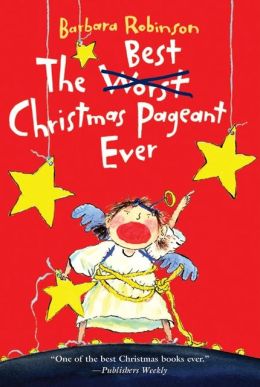
61. The Best Christmas Pageant Ever. Barbara Robinson. 1972. HarperCollins. 128 pages. [Source: Bought]

The Herdmans were absolutely the worst kids in the history of the world. They lied and stole and smoked cigars (even the girls) and talked dirty and hit little kids and cussed their teachers and took the name of the Lord in vain and set fire to Fred Shoemaker's old broken-down toolhouse.

Let me ask you a question. Who is the gospel for? Think about it if you want. I'll wait.

Is the gospel for people who have it all together, the people who are good and are always striving to do better, to do more?  Or is the gospel for people who don't have it all together, who don't have the answers, who don't even know that they need to be asking questions? Is the gospel for broken, messed-up, difficult-to-get-along-with people? Or is the gospel for people who aren't-all-that-bad-all-things-considered?

On one hand, The Best Christmas Pageant is a comedy through-and-through. It's narrated by a child who's been tormented by the Herdmans for years. And it captures all the reactions of a town to all the bad stuff the Herdmans do (and say). The narrative voice, for most of the book, is just hysterical.

On the other hand, The Best Christmas Pageant is a much-needed reminder of what Christmas is all about, of what the gospel is all about.
The saying is trustworthy and deserving of full acceptance, that Christ Jesus came into the world to save sinners, of whom I am the foremost. 1 Timothy 1:15
And when the Pharisees saw this, they said to his disciples, “Why does your teacher eat with tax collectors and sinners?” But when he heard it, he said, “Those who are well have no need of a physician, but those who are sick. Go and learn what this means, ‘I desire mercy, and not sacrifice.’ For I came not to call the righteous, but sinners.” Matthew 9:11-13 
For the Son of Man came to seek and to save the lost. Luke 19:10 
The Best Christmas Pageant Ever provides an inside-out look at the nativity story, and captures best why Christ came in the first place.

It is told from the "inside" Christian perspective, a Christian perspective with varying degrees of self-righteousness. That is some characters are presented as more self-righteous than others. But many characters are a bit blind. They have never thought of the gospel as being for the Herdmans. They see themselves as better--significantly better--than those Herdmans!

As if God's grace wouldn't dare include the Herdmans. Jesus die for the Herdmans????? You've got to be kidding, right???? Not them, Lord! Why, that's ridiculous. But the truth is, it's ridiculous for God to save any one of us. None of us--not one of us--merits God's salvation: his mercy and grace.

I liked seeing the Christmas story from a new angle.
They knew that Christmas was Jesus' birthday, but everything else was news to them--the shepherds, the Wise Men, the star, the stable, the crowded inn. It was hard to believe. At least, it was hard for me to believe--Alice Wendleken said she didn't have any trouble believing it. "How would they find out about the Christmas story?" she said. "They don't even know what a Bible is." (55) 
I couldn't believe it. Among other things, the Herdmans were famous for never sitting still and never paying attention to anyone--teachers, parents (their own or anybody else's), the truant officer, the police--yet here they were, eyes glued on my mother and taking in every word. (59) 
When we got home my father wanted to hear all about it. "Well," Mother said, "just suppose you had never heard the Christmas story, and didn't know anything about it, and then somebody told it to you. What would you think?" (68)

© Becky Laney of Operation Actually Read Bible

Saturday, January 20, 2024

10. God Is Here


God Is Here. Lisa Tawn Bergren. Illustrated by Greg Stobbs. 2023. 40 pages. [Source: Library] [picture book; children's book]

First sentence: "Mama, where is God?" 

God is Here is a picture book for Christian parents to share with little ones. (Well, I think it goes beyond "little ones." I think it can be read aloud, shared, with a wide range of ages. It is a picture book--not a board book. There is a moderate amount of text per page. Not heavy. Not light--moderate.) It teaches the doctrine of God's omnipresence. God is EVERYWHERE all the time. God is on heaven and earth. God is with us from birth to death--on earth. We will spend eternity with God in heaven. Forever and ever and ever and ever and ever God is with us. No matter what--all situations, all circumstances. 

It does contain a full gospel presentation. (Well, a full-ish gospel presentation. It doesn't come right out and define what sin in and why we need a Savior, so parents might want to paint a bigger picture of what God is saving us from.) 

Here's the text:

"Another name for Jesus is Immanuel," Mama whispered. "It means 'God is with us.' God sent his Son to live with us, to show us how much he loves us." "That was nice of him," the girl said. "It was the nicest, best thing anybody could've ever done for us," Mama said with a nod. "But then Jesus died?" "He did--to save us. Because he lived and died for us, he'll always be in our hearts." "Whew," the girl said. "You can't get closer than that." 

As this theological discussion is taking place, the girl and her mother are being the "hands and feet" of the Lord as they go about their lives in the city. They are shown being "the light of the world" and the "city on a hill." The illustrations reveal faith in action. The text is doctrinally substantive. For example, in not so many words, the conversation is had where is God when bad things happen. 

© Becky Laney of Operation Actually Read Bible

Thursday, July 14, 2022

27. The Dragon and the Stone


The Dragon Stone. (The Dream Keeper Saga #1) Kathryn L. Butler. 2022. 240 pages. [Source: Review copy]

First sentence: Lily McKinley trudged into the house, plodded to the kitchen, and froze. On the counter in front of her, with its barbed tail curled like a question mark, a dragon gobbled her mother's Crock-Pot chili.

Lily's world is falling apart. I was tempted to say seemingly falling part. But that wouldn't be true. No doubt, it is. Her father has died--or at least been reported so, no body found. Her mother is stressed, stressed, super-stressed. Her grandmother has dementia--or presumably so. Her mom is carrying the weight of the world, and Lily is trying to do her share--more than her share. She can no longer "afford" to daydream or let her imagination run away with her. So when she sees a DRAGON in her kitchen, well, she's flabbergasted, scared, and worried. Worried that her imagination is at play again. How could there be an actual real life dragon in her kitchen??? Her mother can't handle dragons! Her grandmother, well, she's too fragile. So once again, Lily feels the pressure to handle something on her own. And this dragon in the kitchen, well, it's just the start. Things only get weirder from here...

Lily soon finds herself NOT in this world but swept away to a fantasy realm where she, Lily, may be called upon to save the world...or at least do her share in saving the world. And it all has something to do with a STONE necklace that her father left for her. This stone is magical--not just because of who gave it to her--but because of its origin. It is from Eden. There were twelve stones, I think, and twelve keepers to protect the stones??? Anyway, the realm is in trouble and Lily (and her ever-growing company) are needed. But beware a betrayer may be in her midst.

I really enjoyed this one! I was super skeptical when I requested it for review. I didn't know how it would hold up. Would it be good? entertaining? something that I could actually recommend? Christian publishers and Christian authors aren't particularly well known for doing children's fantasy--C.S. Lewis excluded. But to be fair, the Narnia books were published in the 1950s. But I really enjoyed this one. I found it a compelling read. I enjoyed all the characters introduced. I thought the story was well-written. 


© Becky Laney of Operation Actually Read Bible

Monday, December 9, 2019

Book Review: Countdown

Countdown (The Sixties Trilogy #1) Deborah Wiles. 2010. 394 pages. [Source: Library]

First sentence: I am eleven years old, and I am invisible.

Premise/plot: Franny Chapman and her family star in Deborah Wile’s historical coming of age novel. It is set in October 1962 and the world is more than a little anxious. Can nuclear war be avoided?! Can an old friendship be saved? Does Franny’s crush like her back?

My thoughts: I love, love, love this one. I believe this is the third time I’ve read it? I know it is at the very least the second! There are two more books in the series that I have never read. It’s my goal to read both before the year ends.

This is a documentary novel. It blends genres and media. It uses photographs, newspaper headlines and quotes, song lyrics, other quotes (from books), etc. it also includes a series of biographical sketches on key figures of the times.

I love the characters and relationships. Uncle Otts is a particular favorite of mine. I also can appreciate the relationship between Franny and her older sister.

Favorite quotes:

I’ve memorized the geography of every one of those records. “Johnny Angel” has a yellow label, “Twistin’ the Night Away” has a tiny scratch at the beginning edge, and “Runaway,” which is my current favorite, by my favorite singer, Del Shannon, has a heart drawn on the label—by me. Jo Ellen doesn’t know this yet. (76)

There are always scary things happening in the world. There are always wonderful things happening. And it’s up to you to decide how you’re going to approach the world...how you’re going to live in it, and what you’re going to do. (84)

”I’m invisible around here. I could disappear for days and nobody would miss me.” Now it’s Jo Ellen’s time to sigh. “Franny, you’re eleven. That’s the problem in a nutshell.” She pulls an envelope out of her purse. “Everybody feels persecuted when they’re eleven. It will pass.” (85)

I like revival. It’s entertaining. I know almost every hymn in the Methodist hymnal by heart, every verse, and I can play most of them on the piano. Revival lasts two weeks, so we go every night to church, and every night there is tarnation preaching and seventeen verses of “Just As I Am,” until someone walks up to the altar to be saved. Trouble is, Halleluia is a small town, and most everybody in church has already been saved. So unless somebody new shows up, or an older kid is pushed into the aisle by his mother, we just sing and sing that hymn, until my grandmother stands up and ambles in her square shoes up the aisle with a half-exasperated look on her face, and gets saved once again. Mostly she is saving all of us, and she knows we know it. (130)

I am always amazed at how long thirty minutes is when I practice my piano....Now I can play whatever I want. So I pull out Miss Mattie’s Cokesbury Hymnal. It’s old, thin, and brown, and I love everything about it. I love the way it smells, the texture of the pages, and the hymns on every page. I start with my favorites, “In the Garden” and “Love Lifted Me,” which is almost too hard for me. I don’t play them very well—I start and stop a lot, but I don’t care. I sing as I play—I’m a good singer. Soon I move to a new favorite, “Come Thou Fount.” I love the words as much as the tune, so I play every verse, and I sing it loud. (138)

By the glow of my night-light, Uncle Otts says, “There was a time—I wasn’t much older than you are now—when I was sure it was the end of the world.” “Were you afraid?” I ask him. “Oh, yes,” says Uncle Otts. “Very afraid.” “What happened?” “I grew up to become an old man,” says Uncle Otts. “That’s what happened. And that’s what will happen to you, too.” (200)

© Becky Laney of Operation Actually Read Bible

Friday, November 22, 2019

Book Review: Crossroads in Jerusalem

Crossroads in Jerusalem. Elizabeth Raum. 2019. JourneyForth/BJU Press. 112 pages. [Source: Review copy]

I love choose your own adventure books. I do. Elizabeth Raum has written several biblical choose your own adventure for young elementary-aged readers. Others in the series include Crossroads Among the Gentiles, Christmas Crossroads, and Crossroads in Galilee. Each book offers a series of journeys. In the newest Choose Your Journey, the three journeys are: Journey with a Boy of Jerusalem (and witness Jesus overturning the money-changing tables at the temple), Journey with a Servant Girl (and witness Jesus healing the man at the Bethesda Pool), and Journey with the Lawyer's Assistant (and witness Jesus telling the parable of the Good Samaritan). Of course those are just a tiny selection of the events you may witness in this one. Each story has multiple endings, of course--as all choose your own adventure books do--and readers can reread the book until he/she has read them all.

First sentence from Journey 1: It’s spring in Jerusalem, time for Passover. Passover is the greatest of the Jewish feasts. It occurs every spring and lasts for a week. Jews from all over the world come to the temple in Jerusalem to celebrate the Exodus from Egypt and the barley harvest.
First sentence from Journey 2: Now that you are eleven years old, you can be a great help. You are a member of Chuza’s household. Chuza is an important man. He works for Herod Antipas, the ruler of Galilee and Perea.
First sentence from Journey 3: The lawyer calls you his assistant. Servant is a better title. You’re actually a slave. Your mother was a slave, which makes you one too.

I love how the back matter includes references for all the events in the book. Readers can choose to read the biblical accounts for themselves in their original context. The choose your own adventure books do tend to rearrange things quite a bit!

I definitely enjoy the series.

© Becky Laney of Operation Actually Read Bible

Wednesday, October 23, 2019

Book Review: Rising Above Shepherdsville

Rising Above Shepherdsville. Ann Schoenbohm. 2019. 320 pages. [Source: Library]

First sentence: There I was, Mama, standing in the tall grass right next to Redeemer Baptist Church, the day after the Fourth of July, when I spied what I would have sworn on a heap of Bibles was an angel rising straight up to heaven.

Premise/plot: Dulcie Louise Dixon stars in Ann Schoenbohm’s coming of age historical novel. (It is set in 1977.) After her mother’s death, Dulcie has lost the ability to speak. Ray, her mother’s steady boyfriend, has tried his best to raise her since her mother’s death. But both are grieving—though in different ways. He’s a trucker. His livelihood depends on him trucking. Someone needs to be there day to day to take care of her. Ray sends her to Aunt Bernie. Dulcie is reluctant for another change. But life in Shepherdsville might just be the absolute best thing for Dulcie...the place where she finds her voice.

My thoughts: I loved this one. I did. Dulcie’s narrative was amazing. I don’t particularly share her interest in swans. But I absolutely loved the sideline with Evangeline and Faith. This one has characters that I loved and championed.

One thing that I absolutely loved was the religious/spiritual aspect of it. The book wasn’t preachy. Christianity is just a major backdrop for the story. While it isn’t at all unusual for middle grade novels to have a strong school setting, a church setting is unique and refreshing. Reverend Love’s patience and empathy is something beautiful. I loved how his relationship with Dulcie developed. (There isn’t a hint of creepiness.)

© Becky Laney of Operation Actually Read Bible

Thursday, April 11, 2019

Book Review: A Surprise for Lily

A Surprise for Lily (The Adventures of Lily Lapp #4) Mary Ann Kinsinger and Suzanne Woods Fisher. 2013. Revell. 272 pages. [Source: Review copy]

First sentence: All morning, Lily hurried to pull weeds in the garden.

A Surprise for Lily is the fourth and final book in the series by Mary Ann Kinsinger and Suzanne Woods Fisher. I knew going into it that it was the last--but it was still sad to come to the end.
Lily Lapp has matured so much since the first book. Now she's in fifth grade and experiencing the highs and lows of growing up. She's still struggling with a few of her classmates; but she's doing it with a certain amount of grace and dignity. Most of the time.

It is just a treat to spend time with the whole Lapp-Miller family. I love them all. I even love to "hate" a few of the characters. (Think Nellie Oleson.)

I think it would be awesome if the authors decided to write a young adult or even adult series starring an older Lily. Just enough time has passed--in the real world--for Lily to mature into a young woman who might just be interested in boys and courting and marriage and settling down. Would Aaron Yoder still be a PEST and NUISANCE? Part of me really wants these two to get together.


© Becky Laney of Operation Actually Read Bible

Friday, April 5, 2019

Book Review: A Big Year for Lily

A Big Year for Lily (The Adventures of Lily Lapp #3) Mary Ann Kinsinger and Suzanne Woods Fisher. 2013. Revell. 267 pages. [Source: Review copy]

First sentence: Lily's toes felt tingly.

This is the third book in this contemporary Amish middle grade series. When the series first started Lily was oh-so-precious and just six years old. In this one she turns ten years old. She's matured so much since that first book. Which is both good and bad. Good because maturity is to be expected and appreciated. One can't stay frozen in time. It's impossible. Bad because I miss the Lily-that-was. The little-Lily made me laugh time and time again.

Lily at home. Lily at school. Lily at church. That's what we get to see in this newest book. Lily continues to struggle to "get along" with her two archenemies--Effie and Aaron. Lily has a VERY HARD time understanding why her cousin Hannah thinks Aaron is oh-so-dreamy.

I am still loving the series. I am. I am a little sad that there's just one more book in the series. 

© Becky Laney of Operation Actually Read Bible

Thursday, March 28, 2019

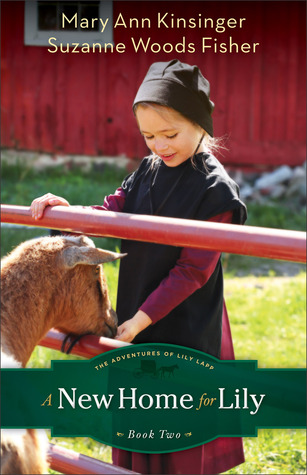
Book Review: A New Home for Lily

A New Home for Lily (Adventures of Lily Lapp #2) Mary Ann Kinsinger and Suzanne Woods Fisher. 2013. Revell. 266 pages. [Source: Review copy]

First sentence: There was only one thing Lily Lapp liked about her new house in Pennsylvania. One thing.

Premise/plot: If the first book in the series reminded me of Little House on the Prairie (the books), the second book reminds me of the Ramona Quimby series by Beverly Cleary. The Lapp family has moved from New York to Pennsylvania. They have just been in their new home a day or two when Lily and her brother, Joseph, start school. The novel focuses on their lives and relationships.

My thoughts: I loved, loved, loved this one! Lily is such a dear of a character. Don't take that to mean that she's super-wholesome and sweet. She's very relatable. We're kindred spirits. I think my favorite scene in this one involves Lily's mishap with Jello. She's starting to take an interest in cooking, in learning to cook. Her mother has her make jello for a family get together. Lily either doesn't read the instructions or ignores the instructions. She adds A CUP of dry jello for every person coming. As you can imagine that would require mixing different flavors to get enough. By the time her mother realizes Lily's mistake, it's too late!

I also love the writing in this one. It's great.

© Becky Laney of Operation Actually Read Bible

Thursday, March 21, 2019

Book Review: Life With Lily

Life with Lily (The Adventures of Lily Lapp #1) Mary Ann Kissinger and Suzanne Woods Fisher. 2012. Revell. 280 pages. [Source: Review copy]

First sentence: It was still dark outside. Lily tried to keep up with Papa's long strides as he carried little Joseph across the yard to where the horse and buggy were tied to the hitching post.

Life with Lily is a middle grade novel set in the Amish community in modern times. It is not a historical novel, though it may remind readers--particularly adult readers--of historical novels that have achieved classic status.

It covers a year--give or take a month or two--in the life of Lily, our heroine. (I believe she's six.) She is the oldest of three children.  She has two younger brothers: Joseph and Daniel. Daniel is just a wee little thing--in fact when the novel opens he's getting ready to make his entrance into the world.

Readers see Lily at home with her immediate family, visiting her family that lives close (her grandparents, aunts, uncles, cousins), attending church meetings, going to school, visiting neighbors (she delivers milk and eggs).

Lily is a curious child--and observant.

Though Lily may have her moments when she seems more like Mary than Laura, she is not a perfect child by any means. She struggles with temptations and sometimes disobeys her parents.

The book definitely reminds me of Little House in the Big Woods or even All-of-a-Kind Family. There is something wholesome about it. But not in a bad way. That almost seems silly to say--that if you call a book wholesome it carries negative connotations. Like if a book is wholesome then it must not be enjoyable. Or if a book is wholesome then it must be preachy. Or if a book is wholesome then it must not be relatable.

I definitely related to Lily. One of her least favorite things in the whole world is to have her hair brushed. I could also relate to her love of dolls and kittens.

I did not find it preachy. Yes, it is a Christian book. There are teachable moments throughout where Lily observes her parents living out the faith. But it isn't preachy-preachy.

I found it very enjoyable. I loved rereading it. In fact I think I loved it even more the second time around.

© Becky Laney of Operation Actually Read Bible

Tuesday, May 15, 2018

Book Review: Rebekah in Danger

Rebekah in Danger: Peril at Plymouth Colony. Sisters in Time #2. Colleen L. Reece. 2004. Barbour Books. 144 pages. [Source: Review copy]

First sentence: "I'm tired of working," eleven-year-old Rebekah Cunningham muttered to herself as she crawled into her familiar hiding place under the chicken coops on the Mayflower's deck.

Rebekah is very much her brother's keeper in this historical children's novel set in Plymouth Colony. Will can get into trouble easily. He always means well. Or so he claims. He wants to help out. He wants to be a big manly, man--even though he's a boy. So he "helps" out by following along behind the men when they go exploring or hunting. He also "helps" out by going hunting on his own. He doesn't always tell anyone he's about to wander off. So without Rebekah's oh-so-watchful eye upon him, his whereabouts would be more unknown. Unfortunately, Rebekah hates tattling and prefers scolding herself. (A few times a crisis would have been avoided if she'd left him and gone to tattle to someone--anyone.)

But believe it or not there were real threats facing ALL the colonists and not just the Cunningham family. Whether it was intentional or not on the author's part, the very real perils are overshadowed by family dramas and childish woes. Woes like Rebekah's complaining and muttering about having to work because she's a girl. (Does she not realize that EVERY single person--perhaps minus the babies and toddlers--is hard at work. That every single day brings its challenges. That their survival is very much uncertain. They are surviving--or not--day by day, week by week, month by month. No family--except the oh-so-lucky Cunninghams--is free from loss.)

If a young girl complaining about being a girl is your idea of fun, then this one is worth your time.

I was disappointed with this second book in the series. I liked some aspects of it. But I would have appreciated some continuity between book one and two. After all, they are both set at the same time and the same place. 1620-1621, the Mayflower and Plymouth Colony. Would it have been so difficult to have Rebekah be friends with Sarah and John be friends with Will. After all, the community IS small. After spending all those months together they are bound to have known each other.

I like historical fiction generally. And plenty of times historical fiction feels authentic. But there are times when it feels like the heroine is too modern--her sensibilities so thoroughly modern--that all she does is complain that things in 1621 aren't as they are in 2001.

Times were DANGEROUS and PERILOUS. I just wish the characterization had been better. Perhaps a book for an older audience wouldn't be afraid to be more authentic and intense.

© Becky Laney of Operation Actually Read Bible

Wednesday, May 9, 2018

Book Review: Sarah's New World

Sarah's New World: The Mayflower Adventure. (Sisters in Time #1) Colleen L. Reece. 2004. Barbour Books. 138 pages. [Source: Review copy]

First sentence: Twelve-year-old John Smythe lay flat on the floor of the dark hallway. His right ear was pressed against the crack under the door to the parlor. He strained to make out what his parents' low voices were saying.

Premise/plot: Sarah and John Smythe are two of the children aboard the Mayflower. The Smythe family is excited to be going to the New World, a place where they can worship freely without threat of persecution. But the journey to America will not be an easy one. The voyage will be difficult for both Pilgrims and Strangers alike.

My thoughts: I enjoyed this one. I may not love, love, love the cover. But books should not be judged by their covers in the first place, right?! I will add that this is more John's story than Sarah's story. He is two years older. He is the one who likes to eavesdrop. He's the one who is often sharing news--even gossip--with his family. He is the one who is more adventurous and active on board the Mayflower. Sarah is definitely more of a passive heroine. She listens. She scolds. She obeys. She encourages.

The book blends fictional characters in with historical figures--men, women and children who actually sailed on the Mayflower. The book does a good job of providing context. Part of this comes through info dumps--sections of text where a LOT of information is shared via dialogue for the benefit of young readers. Faith is central to the family and there is discussion of what religious freedom is and why it's important.

© Becky Laney of Operation Actually Read Bible

Friday, April 21, 2017

Book Review: The Magician's Nephew

The Magician's Nephew (Chronicles of Narnia #6) C.S. Lewis. 1955. 221 pages. [Source: Bought]

First sentence: This is a story about something that happened long ago when your grandfather was a child. It is a very important story because it shows how all the comings and goings between our own world and the land of Narnia first began.

Premise/plot: In this sixth book in the series, Lewis takes us back to 'in the beginning.' The Magician's Nephew introduces readers to the Professor when he was just a young boy, Digory. The adventures concern Digory, his friend and neighbor, Polly, and Digory's very foolish and slightly wicked uncle who sees himself as a MAGICIAN. The magician manipulates and tricks the children into taking part in his experiment--yellow rings and green rings, traveling to other worlds. Digory gives into temptation and awakens an evil queen named Jardis. This one has plenty of action but also a great deal of beauty. Readers witness the creation of Narnia, witness Aslan speaking--or singing--the world into being, witness Aslan establishing order and making provisions for his creation.

My thoughts: I really do like this one. I hate that some people want to make this the first in the series. But the story itself is well worth reading.

Favorite quotes:
“Oh, I see. You mean that little boys ought to keep their promises. Very true: most right and proper, I’m sure, and I’m very glad you have been taught to do it. But of course you must understand that rules of that sort, however excellent they may be for little boys—and servants—and women—and even people in general, can’t possibly be expected to apply to profound students and great thinkers and sages. No, Digory. Men like me, who possess hidden wisdom, are freed from common rules just as we are cut off from common pleasures. Ours, my boy, is a high and lonely destiny.”
“Silence, sir!” said Uncle Andrew, bringing his hand down on the table. “I will not be talked to like that by a little, dirty, schoolboy. You don’t understand. I am the great scholar, the magician, the adept, who is doing the experiment. Of course I need subjects to do it on. Bless my soul, you’ll be telling me next that I ought to have asked the guinea-pigs’ permission before I used them! No great wisdom can be reached without sacrifice. But the idea of my going myself is ridiculous. It’s like asking a general to fight as a common soldier. Supposing I got killed, what would become of my life’s work?”
“Very well. I’ll go. But there’s one thing I jolly well mean to say first. I didn’t believe in Magic till today. I see now it’s real. Well if it is, I suppose all the old fairy tales are more or less true. And you’re simply a wicked, cruel magician like the ones in the stories. Well, I’ve never read a story in which people of that sort weren’t paid out in the end, and I bet you will be. And serve you right.”
“There’s not much point in finding a magic ring that lets you into other worlds if you’re afraid to look at them when you’ve got there.”
“Don’t you understand?” said the Queen (still speaking to Digory). “I was the Queen. They were all my people. What else were they there for but to do my will?” “It was rather hard luck on them, all the same,” said he. “I had forgotten that you are only a common boy. How should you understand reasons of State? You must learn, child, that what would be wrong for you or for any of the common people is not wrong in a great Queen such as I. The weight of the world is on our shoulders. We must be freed from all rules. Ours is a high and lonely destiny.”
Children have one kind of silliness, as you know, and grown-ups have another kind.
In the darkness something was happening at last. A voice had begun to sing. It was very far away and Digory found it hard to decide from what direction it was coming. Sometimes it seemed to come from all directions at once. Sometimes he almost thought it was coming out of the earth beneath them. Its lower notes were deep enough to be the voice of the earth herself. There were no words. There was hardly even a tune. But it was, beyond comparison, the most beautiful noise he had ever heard. It was so beautiful he could hardly bear it.
The earth was of many colors; they were fresh, hot and vivid. They made you feel excited; until you saw the Singer himself, and then you forgot everything else. It was a Lion. Huge, shaggy, and bright, it stood facing the risen sun. Its mouth was wide open in song and it was about three hundred yards away.
THE LION WAS PACING TO AND FRO about that empty land and singing his new song. It was softer and more lilting than the song by which he had called up the stars and the sun; a gentle, rippling music. And as he walked and sang the valley grew green with grass. It spread out from the Lion like a pool. It ran up the sides of the little hills like a wave. In a few minutes it was creeping up the lower slopes of the distant mountains, making that young world every moment softer. The light wind could now be heard ruffling the grass. Soon there were other things besides grass. The higher slopes grew dark with heather. Patches of rougher and more bristling green appeared in the valley. Digory did not know what they were until one began coming up quite close to him. It was a little, spiky thing that threw out dozens of arms and covered these arms with green and grew larger at the rate of about an inch every two seconds. There were dozens of these things all round him now. When they were nearly as tall as himself he saw what they were. “Trees!” he exclaimed.
IT WAS OF COURSE THE LION’S VOICE. The children had long felt sure that he could speak: yet it was a lovely and terrible shock when he did. Out of the trees wild people stepped forth, gods and goddesses of the wood; with them came Fauns and Satyrs and Dwarfs. Out of the river rose the river god with his Naiad daughters. And all these and all the beasts and birds in their different voices, low or high or thick or clear, replied: “Hail, Aslan. We hear and obey. We are awake. We love. We think. We speak. We know.”
“Creatures, I give you yourselves,” said the strong, happy voice of Aslan. “I give to you forever this land of Narnia. I give you the woods, the fruits, the rivers. I give you the stars and I give you myself. The Dumb Beasts whom I have not chosen are yours also. Treat them gently and cherish them but do not go back to their ways lest you cease to be Talking Beasts. For out of them you were taken and into them you can return.
For what you see and hear depends a good deal on where you are standing: it also depends on what sort of person you are.
Now the trouble about trying to make yourself stupider than you really are is that you very often succeed.
“Foolish boy,” said the Witch. “Why do you run from me? I mean you no harm. If you do not stop and listen to me now, you will miss some knowledge that would have made you happy all your life.” “Well I don’t want to hear it, thanks,” said Digory. But he did. “I know what errand you have come on,” continued the Witch. “For it was I who was close beside you in the woods last night and heard all your counsels. You have plucked fruit in the garden yonder. You have it in your pocket now. And you are going to carry it back, untasted, to the Lion; for him to eat, for him to use. You simpleton! Do you know what that fruit is? I will tell you. It is the apple of youth, the apple of life. I know, for I have tasted it; and I feel already such changes in myself that I know I shall never grow old or die. Eat it, Boy, eat it; and you and I will both live forever and be king and queen of this whole world—or of your world, if we decide to go back there.”

© Becky Laney of Operation Actually Read Bible

Saturday, August 27, 2016

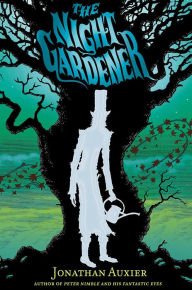
Book Review: The Night Gardener

The Night Gardener. Jonathan Auxier. 2014. Abrams. 350 pages. [Source: Bought]

First sentence: The calendar said early March, but the smell in the air said late October. A crisp sun shone over Cellar Hollow, melting the final bits of ice from the bare trees. Steam rose from the soil like a phantom, carrying with it a whisper of autumn smoke that had been lying dormant in the frosty underground.

Premise/plot: Molly and Kip are Irish orphans desperate for a new start. (Kip doesn't remember their parents death, and Molly is less than honest about why their parents aren't around.) They've been hired on as servants at a rundown, creepy estate. (The book is set in the Victorian era, by the way). The two soon understand why everyone warned them away from the job. There's something very, very wrong about the house, the family, and THE TREE. (It isn't too long after their arrival that Kip sees a mystery man wearing a top hat entering the house at the dead of night. And Molly, well, she sees his muddy footprints all throughout the house, and, even discovers his blown-away hat.) But desperate for work AND coming to love the little girl, Penny, she's reluctant to leave with no other place to go. And then she pieces together enough clues as to why the family stays…and their reason soon becomes her own…

My thoughts: I love this one. That would be a big understatement. I love, love, love, LOVE this one. It was published in 2014, I've already read it FOUR TIMES. 

I love the writing style, the atmospheric setting, the characterization, the symbolism, the layers of meaning. I notice something new every time I read it. It's such a wonderful, amazing book. One that every Christian should read!!!

Now is it officially a Christian book? No. Not really. Not at all. I'm sure there are plenty of readers who never "see" biblical truth in the pages of this middle grade fantasy. But I'm convinced it is there all the same. 

© Becky Laney of Operation Actually Read Bible

Friday, July 8, 2016

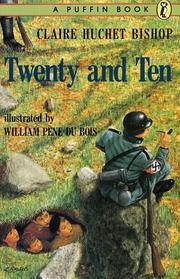
Book Review: Twenty and Ten

Twenty and Ten. Claire Huchet Bishop. Illustrated by William Pene du Bois. 1952/1978. 76 pages. [Source: Bought]

First sentence: It all started when we were playing at The Flight into Egypt. Make-believe. It was in the schoolyard, at recess time, right after the Christmas vacation, beginning of the year 1944.

Premise/plot: Twenty fifth-graders* under the care of Sister Gabriel welcome ten Jewish children into their lives and agree to risk their lives to save them and hide them from the Nazis. This short little children's novel is set in France during the Second World War.

In the first chapter, the twenty children are introduced. The story is narrated by Janet, the one playing Mary when the story opens. Other key characters are George, Philip, Henry, Denise, and "baby" Louis. By the end of the chapter, Sister Gabriel brings them together to tell them a secret. They'll be joined by ten new children, all Jews. The children are excited to 'be Egyptians' and help save Jews from their persecutors. They see Hitler as a modern-day King Herod.

In the second chapter, one of the new children, Arthur, offers Henry a piece of chocolate. Henry offers to share with Janet. They devise a hiding place so none of the other children can steal it. Chocolate being a big, big, big luxury of course.

In the third chapter, the children discover that 'their' chocolate is missing. Denise has taken it. But in her flight, she fell into a CAVE. Arthur, Janet, Denise, and Henry are the four children that now know of this cave.

In the fourth chapter, Sister Gabriel leaves the children on their own to go to town and get the mail. She's hoping that some of the children will have received care packages containing food. But while on their own, the Germans come. The children are once again playing 'Flight into Egypt' and so spot the Nazis before they are spotted. They tell Arthur to lead the other Jews to safety and to hide in the cave immediately. The Jews are safe, but, the Germans are suspicious and determined. The Germans can't get ANY of the children to talk…about anything…let alone about hiding Jews.

In the fifth chapter, the Germans take out their secret weapon….oranges and chocolates. Will any of the children talk now?

My thoughts: This one was short but lovely. I really enjoyed reading it. I would definitely recommend it. It has just enough action and intensity for young readers--third to fifth graders--but isn't too much, too soon. The writing is also very well-paced.


*Well, nineteen fifth graders, and one four-year-old brother.


© Becky Laney of Operation Actually Read Bible

Friday, June 24, 2016

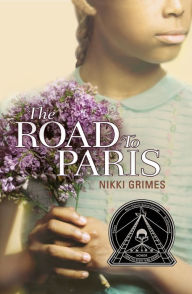
Book Review: The Road to Paris

The Road to Paris. Nikki Grimes. 2006. 153 pages. [Source: Bought]

From the prologue: Ask Paris if a phone call can be deadly. She'll tell you. She learned the truth of it last night.

From chapter one: The trouble with running away is you know what you're leaving behind, but not what's waiting up ahead. Paris Richmond learned that a year ago when she and her brother Malcolm ran away from a foster home in Queens.

Premise/plot: Malcolm and Paris have spent most of their lives in foster care. Their mother is living, but, unable and/or unwilling to keep them herself. Same with their grandmother. Some homes are okay, but, not really HOME. When they run away, they run to their grandmother. Why did they run in the first place? Child abuse. The grandmother ended up separating them. Malcolm went to a children's home, Paris went to another foster home. But it was the one foster home that felt like HOME. It was also the home where Paris met Jesus.

My thoughts: I've read this one three times now. I LOVE, LOVE, LOVE, LOVE, LOVE, LOVE it. I adore Paris' foster family. I love seeing Paris bloom in that home. I love her becoming attached to the other children in the home (one older sister, several brothers). I love witnessing her life at home and school...and church. This one feels so natural, so authentic, so RIGHT. In particular, the narrative and the characterization.

Favorite quotes:
Home was such a funny word. For most kids, home was where your mom and dad lived, where you felt safe, where the bogeyman was merely make-believe. Home was where you knew every square inch of the place by heart, where you could wake up in the middle of the night and know exactly where you were without even opening your eyes. Paris didn't have a place like that. She didn't even have an address she'd lived at long enough to memorize, no single place that felt familiar as all that. Except maybe the city itself. For Paris, home was more a person, and that person was Malcolm. (30)
The next evening, when Paris and David were alone in the dining room setting the table, David said out of the blue, "I used to be afraid of the dark. And of the bogeyman, and of spiders--all sorts of things."
"Really?" said Paris.
"Really."
"What did you do?"
"I started keeping God in my pocket."
"Huh?"
"It's something my mom told me once. To keep God in my pocket."
"I don't understand. How can God fit inside your pocket."
"No, that's not it. It just means to keep God close, you know, like he's right there, in your pocket, close enough to call on, or to talk to. That's what I do when I'm afraid." (41)
Because he lives, I can face tomorrow. Because he lives, all fear is gone... Paris sang the words and they became true for her. She wasn't afraid anymore. Not of being beaten, or being locked in a closet. Not of the dark, or of never seeing Malcolm again, or of nobody wanting her. And she wasn't even afraid of sticking out on Easter. Paris could hardly recognize the fearless person she was turning into. Because I know he holds the future... She was learning to keep God in her pocket, and because she had him to talk to, she was beginning to have faith that she'd be all right. (103)

© Becky Laney of Operation Actually Read Bible

Wednesday, March 23, 2016

Book Review: The Silver Chair

The Silver Chair. (Chronicles of Narnia #4) C.S. Lewis. 1953. HarperCollins. 243 pages. [Source: Bought]

First sentence: IT WAS A DULL AUTUMN DAY AND JILL Pole was crying behind the gym. She was crying because they had been bullying her. This is not going to be a school story, so I shall say as little as possible about Jill’s school, which is not a pleasant subject.

The Silver Chair is the fourth book in the Chronicles of Narnia. (The first three are: The Lion, the Witch, and The Wardrobe; Prince Caspian; and The Voyage of the Dawn Treader.) It is an enjoyable installment in a wonderful fantasy series. It is neither my absolute favorite nor my least favorite. (Voyage of the Dawn Treader and The Lion, The Witch, and the Wardrobe battle it out for top place. My opinion as to which is my favorite and my best varies depending on the day. The Last Battle is my least favorite simply because Lewis' weird theology sours the book.)

Jill Pole and Eustace Scrubb find themselves unexpectedly whisked away to another country. After Jill "accidentally" tumbles Eustace off a cliff, she has a close encounter with a lion. 

This encounter with Aslan is one of my absolute favorites:
But her thirst was very bad now, and she plucked up her courage to go and look for that running water. She went on tiptoes, stealing cautiously from tree to tree, and stopping to peer round her at every step. But although the sight of the water made her feel ten times thirstier than before, she didn’t rush forward and drink. She stood as still as if she had been turned into stone, with her mouth wide open. And she had a very good reason; just on this side of the stream lay the lion.... And the thirst became so bad that she almost felt she would not mind being eaten by the lion if only she could be sure of getting a mouthful of water first. “If you’re thirsty, you may drink.” They were the first words she had heard since Scrubb had spoken to her on the edge of the cliff. For a second she stared here and there, wondering who had spoken. Then the voice said again, “If you are thirsty, come and drink,” and of course she remembered what Scrubb had said about animals talking in that other world, and realized that it was the lion speaking. Anyway, she had seen its lips move this time, and the voice was not like a man’s. It was deeper, wilder, and stronger; a sort of heavy, golden voice. It did not make her any less frightened than she had been before, but it made her frightened in rather a different way. “Are you not thirsty?” said the Lion. “I’m dying of thirst,” said Jill. “Then drink,” said the Lion. “May I—could I—would you mind going away while I do?” said Jill. The Lion answered this only by a look and a very low growl. And as Jill gazed at its motionless bulk, she realized that she might as well have asked the whole mountain to move aside for her convenience. The delicious rippling noise of the stream was driving her nearly frantic. “Will you promise not to—do anything to me, if I do come?” said Jill. “I make no promise,” said the Lion. Jill was so thirsty now that, without noticing it, she had come a step nearer. “Do you eat girls?” she said. “I have swallowed up girls and boys, women and men, kings and emperors, cities and realms,” said the Lion. It didn’t say this as if it were boasting, nor as if it were sorry, nor as if it were angry. It just said it. “I daren’t come and drink,” said Jill. “Then you will die of thirst,” said the Lion. “Oh dear!” said Jill, coming another step nearer. “I suppose I must go and look for another stream then.” “There is no other stream,” said the Lion. It never occurred to Jill to disbelieve the Lion—no one who had seen his stern face could do that—and her mind suddenly made itself up. It was the worst thing she had ever had to do, but she went forward to the stream, knelt down, and began scooping up water in her hand. It was the coldest, most refreshing water she had ever tasted. You didn’t need to drink much of it, for it quenched your thirst at once.

 After asking her where Eustace is--he knows, of course, having blown him to Narnia on his breath himself--he gives her a mission, a task.
And now hear your task. Far from here in the land of Narnia there lives an aged king who is sad because he has no prince of his blood to be king after him. He has no heir because his only son was stolen from him many years ago, and no one in Narnia knows where that prince went or whether he is still alive. But he is. I lay on you this command, that you seek this lost prince until either you have found him and brought him to his father’s house, or else died in the attempt, or else gone back to your own world.
She must learn the four signs that go along with the mission. She'll need to know them backwards and forwards and be able to recall them perfectly. And, of course, she'll need to share them with Eustace.
“I will tell you, Child,” said the Lion. “These are the signs by which I will guide you in your quest. First; as soon as the Boy Eustace sets foot in Narnia, he will meet an old and dear friend. He must greet that friend at once; if he does, you will both have good help. Second; you must journey out of Narnia to the north till you come to the ruined city of the ancient giants. Third; you shall find a writing on a stone in that ruined city, and you must do what the writing tells you. Fourth; you will know the lost prince (if you find him) by this, that he will be the first person you have met in your travels who will ask you to do something in my name, in the name of Aslan.”
She's confident that she can do it. How hard could it be, after all?! Knowing this, he warns her:
But, first, remember, remember, remember the signs. Say them to yourself when you wake in the morning and when you lie down at night, and when you wake in the middle of the night. And whatever strange things may happen to you, let nothing turn your mind from following the signs. And secondly, I give you a warning. Here on the mountain I have spoken to you clearly: I will not often do so down in Narnia. Here on the mountain, the air is clear and your mind is clear; as you drop down into Narnia, the air will thicken. Take great care that it does not confuse your mind. And the signs which you have learned here will not look at all as you expect them to look, when you meet them there. That is why it is so important to know them by heart and pay no attention to appearances. Remember the signs and believe the signs. Nothing else matters. And now, daughter of Eve, farewell—”
Aslan then blows Jill to Narnia. She finds Eustace who arrived just minutes before. She tells him the signs, but, unfortunately he's already missed the opportunity of greeting an old friend--King Caspian. But the two will go on their mission all the same. They may not have the help of a king, but, they do have the help of some friendly owls. And it is through the owls that they meet one of my favorite, favorite characters: Puddleglum, a Marsh-wiggle. (The owls also tell them essentially everything they need to know about Prince Rilian and his mysterious disappearance). 


These three set off on a dangerous adventure quest together. And it's a memorable journey, I think....

Will they be successful? Will they find Prince Rilian? Will Rilian return to Narnia and be crowned king? Will they meet Aslan again?

Some additional quotes I loved:
IT IS A VERY FUNNY THING THAT THE sleepier you are, the longer you take about getting to bed; especially if you are lucky enough to have a fire in your room.
“How beastly one feels after sleeping in one’s clothes,” said Jill, sitting up. “I was just thinking how nice it was not to have to dress,” said Eustace. “Or wash either, I suppose,” said Jill scornfully.
“Good morning, Guests,” he said. “Though when I say good I don’t mean it won’t probably turn to rain or it might be snow, or fog, or thunder. You didn’t get any sleep, I dare say.” “Yes we did, though,” said Jill. “We had a lovely night.” “Ah,” said the Marsh-wiggle, shaking his head. “I see you’re making the best of a bad job. That’s right. You’ve been well brought up, you have. You’ve learned to put a good face on things.” “Please, we don’t know your name,” said Scrubb. “Puddleglum’s my name. But it doesn’t matter if you forget it’. I can always tell you again.”
“Well, I don’t know that you’d call it help,” he said. “I don’t know that anyone can exactly help. It stands to reason we’re not likely to get very far on a journey to the North, not at this time of the year, with the winter coming on soon and all. And an early winter too, by the look of things. But you mustn’t let that make you down-hearted. Very likely, what with enemies, and mountains, and rivers to cross, and losing our way, and next to nothing to eat, and sore feet, we’ll hardly notice the weather. And if we don’t get far enough to do any good, we may get far enough not to get back in a hurry.”
“The bright side of it is,” said Puddleglum, “that if we break our necks getting down the cliff, then we’re safe from being drowned in the river.”
However tired you are, it takes some nerve to walk up to a giant’s front door.
“Don’t you mind him,” said Puddleglum. “There are no accidents. Our guide is Aslan; and he was there when the giant King caused the letters to be cut, and he knew already all things that would come of them; including this”
Puddleglum was still fighting hard. “I don’t know rightly what you all mean by a world,” he said, talking like a man who hasn’t enough air. “But you can play that fiddle till your fingers drop off, and still you won’t make me forget Narnia; and the whole Overworld too. We’ll never see it again, I shouldn’t wonder. You may have blotted it out and turned it dark like this, for all I know. Nothing more likely. But I know I was there once. I’ve seen the sky full of stars. I’ve seen the sun coming up out of the sea of a morning and sinking behind the mountains at night. And I’ve seen him up in the midday sky when I couldn’t look at him for brightness.” Puddleglum’s words had a very rousing effect. The other three all breathed again and looked at one another like people newly awaked.
Suppose we have only dreamed, or made up, all those things—trees and grass and sun and moon and stars and Aslan himself. Suppose we have. Then all I can say is that, in that case, the made-up things seem a good deal more important than the real ones. Suppose this black pit of a kingdom of yours is the only world. Well, it strikes me as a pretty poor one. And that’s a funny thing, when you come to think of it. We’re just babies making up a game, if you’re right. But four babies playing a game can make a play-world which licks your real world hollow. That’s why I’m going to stand by the play-world. I’m on Aslan’s side even if there isn’t any Aslan to lead it. I’m going to live as like a Narnian as I can even if there isn’t any Narnia. So, thanking you kindly for our supper, if these two gentlemen and the young lady are ready, we’re leaving your court at once and setting out in the dark to spend our lives looking for Overland.
Have you read The Silver Chair? What did you think of it? Do you have a favorite book in the series? A favorite character?

© Becky Laney of Operation Actually Read Bible

Friday, December 18, 2015

Book Review: Voyage of the Dawn Treader

The Voyage of the Dawn Treader. C.S. Lewis. 1952. HarperCollins. 248 pages. [Source: Bought]

Is Voyage of the Dawn Treader by C.S. Lewis my absolute favorite, favorite of the Chronicles of Narnia series? Almost, yes. It is at the very, very least my second favorite. The only other book that even comes close is the FIRST book in the series, The Lion, The Witch, and The Wardrobe.

Returning to Narnia in The Voyage of the Dawn Treader is Lucy and Edmund. The two siblings are joined by a cousin, I believe, Eustace. Lucy and Edmund are quite happy to be reunited with Prince Caspian--now King. Eustace is shocked and angry and irritable. The last place he wants to be is in Narnia. Or should I say on a Narnian ship, sailing with a Narnian crew, led by a Narnian king. Eustace himself doesn't actually step foot into Narnia--the country--at least not in this book. Readers will remember quite a few characters from Prince Caspian.

Caspian is on a mission to find out the fates of seven lords who were loyal to his father, lords that have been missing for over a decade if not two. Caspian is sailing from island to island making inquiries, and exploring new lands and countries. This can be risky and dangerous...

Does Aslan make an appearance? Yes!!! And it's probably one of my favorite, favorite scenes. Eustace and Aslan have some business between them! If Eustace hadn't been turned into a literal dragon, would he have been beastly forever? Probably. Turning into a dragon, changed, him for the better!

The book is a lovely adventure, and, a joy to read.

Sunday, December 6, 2015

Book Review: Best Christmas Pageant Ever

The Best Christmas Pageant Ever. Barbara Robinson. 1972. HarperCollins. 128 pages. [Source: Bought]

The Herdmans were absolutely the worst kids in the history of the world. They lied and stole and smoked cigars (even the girls) and talked dirty and hit little kids and cussed their teachers and took the name of the Lord in vain and set fire to Fred Shoemaker's old broken-down toolhouse.

Let me ask you a question. Who is the gospel for? Think about it if you want. I'll wait.

Is the gospel for people who have it all together, the people who are good and are always striving to do better, to do more?  Or is the gospel for people who don't have it all together, who don't have the answers, who don't even know that they need to be asking questions? Is the gospel for broken, messed-up, difficult-to-get-along-with people? Or is the gospel for people who aren't-all-that-bad-all-things-considered?

On one hand, The Best Christmas Pageant is a comedy through-and-through. It's narrated by a child who's been tormented by the Herdmans for years. And it captures all the reactions of a town to all the bad stuff the Herdmans do (and say). The narrative voice, for most of the book, is just hysterical.

On the other hand, The Best Christmas Pageant is a much-needed reminder of what Christmas is all about, of what the gospel is all about.
The saying is trustworthy and deserving of full acceptance, that Christ Jesus came into the world to save sinners, of whom I am the foremost. 1 Timothy 1:15
And when the Pharisees saw this, they said to his disciples, “Why does your teacher eat with tax collectors and sinners?” But when he heard it, he said, “Those who are well have no need of a physician, but those who are sick. Go and learn what this means, ‘I desire mercy, and not sacrifice.’ For I came not to call the righteous, but sinners.” Matthew 9:11-13 
For the Son of Man came to seek and to save the lost. Luke 19:10 
The Best Christmas Pageant Ever provides an inside-out look at the nativity story, and captures best why Christ came in the first place.

It is told from the "inside" Christian perspective, a Christian perspective with varying degrees of self-righteousness. That is some characters are presented as more self-righteous than others. But many characters are a bit blind. They have never thought of the gospel as being for the Herdmans. They see themselves as better--significantly better--than those Herdmans!

As if God's grace wouldn't dare include the Herdmans. Jesus die for the Herdmans????? You've got to be kidding, right???? Not them, Lord! Why, that's ridiculous. But the truth is, it's ridiculous for God to save any one of us. None of us--not one of us--merits God's salvation: his mercy and grace.

I liked seeing the Christmas story from a new angle.
They knew that Christmas was Jesus' birthday, but everything else was news to them--the shepherds, the Wise Men, the star, the stable, the crowded inn. It was hard to believe. At least, it was hard for me to believe--Alice Wendleken said she didn't have any trouble believing it. "How would they find out about the Christmas story?" she said. "They don't even know what a Bible is." (55)
I couldn't believe it. Among other things, the Herdmans were famous for never sitting still and never paying attention to anyone--teachers, parents (their own or anybody else's), the truant officer, the police--yet here they were, eyes glued on my mother and taking in every word. (59) 
When we got home my father wanted to hear all about it. "Well," Mother said, "just suppose you had never heard the Christmas story, and didn't know anything about it, and then somebody told it to you. What would you think?" (68)

© Becky Laney of Operation Actually Read Bible