Showing posts with label 1971. Show all posts

Thursday, January 10, 2019

Book review: What is an Evangelical?

What is an Evangelical? D. Martyn Lloyd-Jones. 1992. Banner of Truth. 80 pages. [Source: Bought]

First sentence: This [Jude 1-3], as most of you realize, is a very interesting statement, for it is rather unusual in the New Testament. Here Jude is telling the people to whom he is writing that his original intention was to write a letter giving an exposition of the common salvation of the Christian faith, something similar or analogous, one imagines, to what the apostle Paul did in the Epistle to the Romans. That was what he intended to do, but he tells them he was not able to do so, that his great purpose had to be laid on one side. Why was this? It was because news had come to him of certain attacks upon the faith so that, in a sense, what he is saying is this: We have not the time, nor can we afford to enjoy the luxury of just expounding the truth and taking our time over it as we do so. A very urgent matter has arisen and all of us must now contend earnestly for the faith. And that is what Jude does and that is the reason why it is such a short letter. 

In 1971, D. Martyn Lloyd-Jones gave a series of three lectures for the International Fellowship of Evangelical Students. In 1992, those lectures were printed and published for the first time. In these lectures he addresses one big question: WHAT IS AN EVANGELICAL? He answers many other questions along the way--for example, why a definition matters, what doctrines are essential to the faith and which doctrines are secondary, why denominations have a tendency to shift away from evangelical, how you can safeguard against false doctrines creeping subtly into your faith, your church, etc.

Lloyd-Jones speaks with a zealous urgency, and with good cause as time has revealed. What was true of the times in 1971 was equally true of 1992, though one could argue that the state or condition had worsened considerably. The book is still incredibly relevant and timely in 2019.

He starts his lecture at 'the very beginning.' Why do we need to define--to clarify--what it means to be evangelical? The answer goes back to Adam and Eve in the Garden of Eden. Sin. A short little word that is hardly ever popular. He argues that because the church consists of humans, of sinners--though redeemed sinners, though bound-for-glory sinners--it has a tendency to stray, to wander, to fall asleep, to stop watching and guarding, to shift and change with the times. (Also, of course, not every single person who attends church or belongs to church is a Christian, there will always be a handful of wolves clothed as sheep in our congregations.) Denominations, institutions, schools, colleges, boards, organizations, publishing companies should be careful to keep guard and stay true. Just because they were doctrinally sound when they were founded, when they were started, doesn't mean that they will never waver and lose their way.

Lloyd-Jones writes,
There is a process at work, because of sin and evil, which tends to produce not only change but even degeneration...It is always a subtle and slow process...The change is almost imperceptible... The really dangerous man is the man who introduces some very slight or very subtle change. (11)
He spends some time discussing the necessary but tense balance between unity and division. It is important that there be some division--between truth and error--but it should not be taken to extremes. When the church is so focused on unity that anything and everything goes--that is a dangerous place to be. Likewise when the church is so divided over every single little thing--no matter how trivial--it's not good or healthy. The church should not spend its time, its energy, its focus on attacking one another.

There are doctrines that are absolutely essential to the faith. All true believers will believe, affirm these essential doctrines. These are the doctrines where no compromises should ever be allowed. To change these doctrines to fit with the times, to fit with the latest scholars, to fit with the popular philosophy of the day is to lose one's way, to fall away from truth and begin sliding deeper and deeper into heresy.

There are also doctrines that are secondary to the faith. These secondary doctrines are important, but, not essential to the faith. Lloyd-Jones points out two examples: mode of baptism and predestination.

Much time is spent defining what an evangelical believes and what an evangelical rejects. It's important, he points out, that the definition includes positives and negatives. We affirm this, this, and this. We reject that, that, and that.

The book is worth seeking out and reading.

Quotes:
The church, though she has been reformed, must be constantly re-formed, semper reformanda. Always reform! The church is always to be under the Word; she must be; we must keep her there. You must not assume that because a church started correctly, she will continue so. She did not do so in the New Testament times; she has not done so since. Without being constantly reformed by the Word the church becomes something very different...And we have got to do this with the term evangelical. Every generation has got to examine this for itself. (30)
We are concerned about the souls of men and women. We are here to spread the good news of salvation and to win people out of darkness into light. That is why we should be so careful about the truth, and always contend for it. (35)
The evangelical starts with the Bible. He is a man of the Bible. He is a man of the Book. This is his only authority and he submits himself in everything to this. (35)
We have got to keep our eye on these two sides: what men do not say, and what they add on, over and above what we regard as the true faith. (41)
Another characteristic of this evangelical is that he is a man who is always watching...and he is always watchful, of course, because the Scripture teaches him to be so. (43)
You will always find in evangelical circles that there is great emphasis on the study of the Bible, personal and corporate, that great attention is paid to expositions of the Scripture and to prayer. Prayer is vital in the life of the evangelical. (58)


© Becky Laney of Operation Actually Read Bible

Tuesday, October 16, 2018

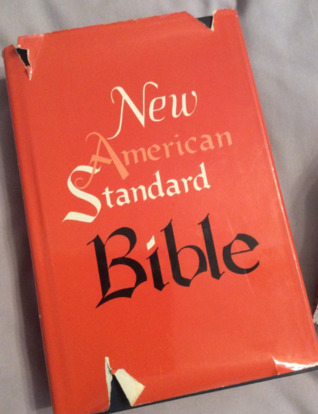
Bible Review: NASB (1971, First Edition)

New American Standard Bible Reference Edition. 1971. Lockman Foundation. 1730 pages. [Source: Bought]

First sentence: In the beginning God created the heavens and the earth. And the earth was formless and void, and darkness was over the surface of the deep; and the Spirit of God was moving over the surface of the waters.

I have read the NASB 1995 translation quite a few times in my life. This was my first time reading an earlier edition of the NASB. In fact, this is a first edition of the NASB that was published in 1971.

It was verse by verse and not paragraph.
It was black letter and not red letter.
It did have references and textual notes on the sides. The text was in the center.
The Old Testament and New Testaments were paged separately.
There was little to no bleed through. The pages were just the right thickness.
The size of the font was small. In a perfect, perfect world it would have had larger font. But it wasn't impossible to read.
It was a little large to read in bed, but just right for reading in a cozy chair with a cup of tea.
It does use thees and thous.

I enjoyed reading this one. I started reading it the first week of September. I finished it October 15, 2018.


© Becky Laney of Operation Actually Read Bible
Wednesday, October 8, 2014

Book Review: The Hiding Place

The Hiding Place. Corrie Ten Boom. With John and Elizabeth Sherrill. 1971/1984/1995. Chosen. 228 pages. [Source: Bought]

I love, love, love, love, LOVE The Hiding Place. This is an amazing read that I'd recommend to believers and unbelievers. It is a powerful testimony. It is an incredible memoir.

Corrie ten Boom and her family (her father, her sister) hid Jews in their home during World War II. They were betrayed and then imprisoned. Her father died soon after their arrest. Corrie and her sister, Betsie, spent time in a concentration camp. That is a simple enough summary, I suppose. It doesn't really do justice to their story, however. This one that deserves to be read and reread.

The book is set in Holland, primarily in the 1930s and 1940s. It is a memoir. She does take a chapter or two to recall her life, her past. (What her family life was like. Memories of her parents, aunts, siblings, nieces and nephews. Memories of going to school. Her first (and only) love. Her work in the family's watch shop. What life was like in her community or neighborhood. It's detailed enough that it gives you a real sense of time and place.) But most of the book focuses on the Nazis and the ever-increasing dangers to Jewish people and those who helped them.

One of my biggest interests is World War II. I love to read fiction and nonfiction set during this time period. I've read plenty of memoirs and biographies. Each has a story to tell, a story worth reading. But The Hiding Place goes even beyond this. It is more than one woman's narrative about the war, about injustice and violence, about terror and uncertainty. It is a powerful testimony of God, of one family's faith in God, of the POWER of God and the astonishing effect of hope and forgiveness.

Quotes:
It was a day for memories. A day for calling up the past. How could we have guessed as we sat there--two middle-aged spinsters and an old man--that in place of memories we were about to be given adventure such as we had never dreamed of? Adventure and anguish, horror and heaven were just around the corner, and we did not know. (6)
"Corrie," he began instead, "do you know what hurts so very much? It's love. Love is the strongest force in the world, and when it is blocked that means pain. There are two things we can do when this happens. We can kill the love so that it stops hurting. But then of course part of us dies, too. Or, Corrie, we can ask God to open up another route for that love to travel." (42)
It was astonishing, really, the quality of life she was able to lead in that crippled body, and watching her during the three years of her paralysis, I made another discovery about love. Mama's love had always been the kind that acted itself out with soup pot and sewing basket. But now that these things were taken away, the love seemed as whole as before. She sat in her chair at the window and loved us. She loved the people she saw in the street--and beyond: her love took in the city, the land of Holland, the world. And so I learned that love is larger than the walls which shut it in. (45)
"It is wrong to give people hope when there is no hope," he said. "It is wrong to base faith upon wishes. There will be war. The Germans will attack and we will fall." He stamped out his cigar stub in the ashtray beside the radio and with it, it seemed, the anger too, for his voice grew gentle again. "Oh, my dears, I am sorry for all Dutchmen now who do not know the power of God. For we will be beaten. But He will not." (58)
But Betsie put a finger on my mouth. "Don't say it, Corrie! There are no 'if's' in God's world. And no places that are safer than other places. The center of His will is our only safety--O Corrie, let us pray that we may always know it!" (64)
Love. How did one show it? How could God Himself show truth and love at the same time in a world like this? By dying. The answer stood out for me sharper and chiller than it ever had before that night: the shape of a Cross etched on the history of the world. (87)
Was it possible that this--all of this that seemed so wasteful and so needless--this war, Scheveningen prison, this very cell, none of it was unforeseen or accidental? Could it be part of the pattern first revealed in the Gospels? Hadn't Jesus--and here my reading became intent indeed--hadn't Jesus been defeated as utterly and unarguably as our little group and our small plans had been? But… if the gospels were truly the pattern of God's activity, then defeat was only the beginning. I would look around at the bare little cell and wonder what conceivable victory could come from a place like this. (141)
"Betsie!" I wailed, "how long will it take?" "Perhaps a long, long time. Perhaps many years. But what better way could there be to spend our lives?" I turned to stare at her. "Whatever are you talking about?" "These young women. That girl back at the bunkers. Corrie, if people can be taught to hate, they can be taught to love! We must find the way, you and I, no matter how long it takes…" (165)
More than conquerors…It was not a wish. It was a fact. We knew it, we experienced it minute by minute--poor, hated, hungry. We are more than conquerors. Not "we shall be." We are! Life in Ravensbruck took place on two separate levels, mutually impossible. One, the observable, external life, grew every day more horrible. The other, the life we lived with God, grew daily better, truth upon truth, glory upon glory. Sometimes I would slip the Bible from its little sack with hands that shook, so mysterious had it become to me. It was new; it had just been written. I marveled sometimes that the ink was dry. I had believed the Bible always, but reading it now had nothing to do with belief. It was simply a description of the way things were--of hell and heaven, of how men act and how God acts. I had read a thousand times the story of Jesus' arrest--how soldiers had slapped Him, laughed at Him, flogged Him. Now such happenings had faces and voices. (183-4)
And so I discovered that it is not on our forgiveness any more than on our goodness that the world's healing hinges, but on His. When He tells us to love our enemies, He gives, along with the command, the love itself. (224)

© Becky Laney of Operation Actually Read Bible