I thought I would share a top ten list with you today. (I do love making lists!) And since Ash Wednesday is this week, I thought it would be timely to connect it with Lent. I know not everyone observes Lent, or observes Lent
traditionally. (I like to do my own little thing--
super-intense Bible reading.) But reading good Christian nonfiction, reading books that celebrate Jesus, well, surely the upcoming months are as good as any other! (The books are NOT presented in any order.)
1.
Loving the Way Jesus Loves.
Phil Ryken. 2012. Crossway. 224 pages. [
My review]
First sentence:
There is nothing I need more in my life than more of the love of Jesus.
About the book*:
One of the best ways to learn more of the love of Jesus is to study 1 Corinthians 13 in conjunction with the Gospels. In Matthew, Mark, Luke, and John we discover that everything the apostle Paul told the Corinthians about love is perfectly illustrated in the perfect life, atoning death, and glorious resurrection of Jesus Christ. Jesus never does anything without love. Indeed, his love is everything the Love Chapter says that love should be. It is patient with sinners and kind to strangers. It does not envy or boast but offers itself in humble service. It does not insist on its own way but submits to the Father. It is able to forgive, trust, hope, and persevere. In other words, the love of Jesus is everything that we are not.
2.
Jesus + Nothing = Everything. Tullian Tchividjian. 2011. Crossway Books. 220 pages. [
My review.]
First sentence:
Never had I experienced anything so tough. I could hardly eat, had trouble sleeping, and was continually battling nausea. I felt at the absolute end of myself.
My quick summary: This book is all about God's grace, God's mercy. It is about how the Christian life SHOULD be led. It is all about learning simple truths that can free you from yourself, free you from guilt and shame, free you from lies. It is all about accepting God's word as truth and living day by day in his grace, in his love.
(This may be the book I reread for Lent. I haven't decided yet).
3.
Cries From the Cross: A Journey Into the Heart of Jesus. Erwin Lutzer. 2002. Moody. 170 pages. [
My review]
First sentence:
Were you there when they crucified my Lord?
About the book: Lutzer studies each of Jesus' cries from the cross. All seven of them:
- A Cry for Pardon: "Father, forgive them, for they do not know what they are doing." (Luke 23:34)
- A Cry of Assurance: "Today you will be with me in paradise." (Luke 23:43)
- A Cry of Compassion: "Dear woman, here is your son...Here is your mother." (John 29:26-27)
- A Cry of Anguish: "My God, my God, why have you forsaken me?" (Matthew 27:46)
- A Cry of Suffering: "I am thirsty." (John 19:28)
- A Cry of Victory: "It is finished." (John 19:30)
- A Cry of Submission: "Father, into your hands I commit my spirit." (Luke 23:46)
It would be hard to truly pick a favorite quote, but I'll try anyway:
"Either Jesus bears our sin, or we do. If the Father turned His face away from His beloved Son when He was regarded as a sinner, we can be sure that the Father will turn away from every sinner who stands before the Judgment Bar on his own merits. We are either saved by His rejection, or we must bear our own rejection for all of eternity."
4.
The Big Picture Story Bible. David R. Helm. 2004/2010. Crossway Publishers. 456 pages. [
My review]
First sentence paragraph (or two):
The Bible is God's story, and it begins with these big words: "In the beginning, God created the heavens and the earth." Do you know how God created everything? Simply by speaking words. Imagine, making the world with words! Strong words. Powerful words. With words God created everything! He made the stars, the sun, and the moon. He made the animals, the fish, the trees, and flowers too. Everything! And then after all these things, God created... People!
Can you see Adam and Eve? God put his people in the Garden of Eden. They were made in the image of God. They were to be the rulers of God's place.
Adam and Eve were very special to God. Did you know that you are also very special to God? You are special because you are made in his image too! Being created in the image of God must have made Adam and Eve very, very happy. God was happy too. He was pleased with his world and his people because he saw that they were very good. Nothing was wrong. Nothing was bad. Nobody disobeyed God. In the very beginning, everything and everyone knew how good God was. God gave Adam and Eve good words to obey. He told them not to eat from a special tree. You see, God was teaching Adam and Eve that he was their king, that people were to obey God's word. God also said that if Adam and Eve disobeyed his word, they would surely die. So God's people, Adam and Eve, lived in God's place, the Garden of Eden. And they ruled God's world by obeying his good word. Do you know what happened next?
About the book: This may just be my favorite, favorite, favorite children's storybook bible. (Well, I actually have about two or three that I think are the best of the best. But this one is probably at the top of my list). I think it is just the right proportion of text to illustration. I think the stories are written in a kid-friendly way making this one a great choice for parents (grandparents, aunts, uncles, Sunday School teachers, etc.) to read aloud. But it's profound enough, evangelical enough, that it may just move adult readers to think about the gospel too. I LOVE that you really, truly can get the BIG PICTURE of the
whole Bible just by sitting down to read this 'simple' storybook.
5.
The Everlasting Tradition: Jewish Customs, Holidays, and Historical Events That Reveal Biblical Truth. Galen Peterson. 1995. Kregel Publications. 160 pages. [
My review]
From the preface:
We live in an age where there are few secrets. Through science we are discovering the secrets of the atom and the stars. Through tabloids we are discovering the secrets of celebrities. We may even attend churches and synagogues to worship the Creator of atoms and "stars" alike. But do we truly understand that God has a very detailed plan for our lives? And do we realize that He has presented it in a most mysterious and creative manner? This book unwraps many of those mysteries. It draws upon the specific features of both everyday and holiday customs of the Bible. It zeroes in on those elements which have either been misunderstood or have great underlying meaning. It also brings in some intriguing but little-known historical events which have profoundly shaped our perception of of the message of the Bible. There is a Hebrew folk expression that says more or less, "The apple does not fall far from the tree." This saying conveys the idea that we tend to stay close to our comfort zone, whatever it may be. But when it comes to the Bible, how many of us truly understand the cultural practices and traditions that formed the context of what we believe? These are the roots of our tree of faith. It can be said that, in many ways, our "apples" have rolled a long way down the hill from the tree which bore our fruit. We have lost track of our biblical heritage. In the pages which follow, we will take a journey back to the place where it all began, a back-to-basics approach that will consider four primary biblical themes--tradition, blessing, redemption, and celebration. Each one will take us to a special place where we can discover what God has to say to you and to me. We will discover that it really is no secret. There is an essential message in the Bible that permeates every chapter. But we will have to look carefully in order to solve the mysteries that lie just beneath the surface. Our journey begins with a walk along the path of tradition. (8-9)
About the book: I just LOVED this one. I found it fascinating and informative. I loved learning more about Jewish culture, traditions, celebrations, etc. And I thought it was very well-written. Understanding these things
does add more to your reading of the Bible.
6.
Scandalous: The Cross and Resurrection of Jesus. D.A. Carson. 2010. February 2010. Crossway Publishers. 173 pages. [
My review]
First paragraph:
Nothing is more central to the Bible than Jesus' death and resurrection. The entire Bible pivots on one weekend in Jerusalem about two thousand years ago. Attempts to make sense of the Bible that do not give prolonged thought to integrating the crucifixion and resurrection of Jesus are doomed to failure, at best exercises in irrelevance. Jesus' own followers did not expect him to be crucified; they certainly didn't expect him to rise again. Yet after these events their thinking and attitudes were so transformed that they could see the sheer inevitability that Jesus would die on a cross and leave an empty tomb behind, and absolutely everything in their lives was changed.
About the book: A series of five messages by D.A. Carson. The messages are:
- The Ironies of the Cross (which focuses on Matthew 27:27-51a)
- The Center of the Whole Bible (which focuses on Romans 3:21-26)
- The Strange Triumph of a Slaughtered Lamb (which focuses on Revelation 12)
- A Miracle Full of Surprises (which focuses on John 11:1-53)
- Doubting the Resurrection of Jesus (which focuses on John 20:24-31)
7.
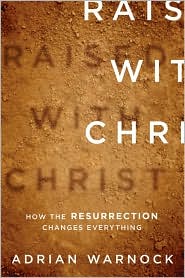
Raised With Christ: How The Resurrection Changes Everything by Adrian Warnock. 2010. January 2010. Crossway. 272 pages. [
My review]
First few paragraphs:
"What did Jesus come back to life again?" This was the surprised reaction when a young Englishwoman heard about the resurrection of Jesus. She was drinking coffee with other mothers, including my wife. It seems almost impossible to believe that she had never heard that Christians believe Jesus rose from the dead. She hadn't rejected the gospel. No one had ever told her about it!
How many other people do we know who would have a similar reaction? It is much more comfortable for us to assume that our relatives, friends, neighbors, and coworkers have already dismissed the gospel than to think they have never heard it.
Without Jesus' resurrection there is no good news at all. John Stott said, "Christianity is in its very essence a resurrection religion. The concept of resurrection lies at its heart. If you remove it, Christianity is destroyed."
About the book: Raised With Christ is about the resurrection of Jesus Christ. Sounds simple, right? Chances are at some point that you've contemplated what the cross means to you, means to the church, to the faith. But have you given equal attention to what Jesus' resurrection means? How his resurrection impacts you still today?
8.
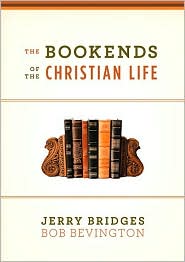
The Bookends of the Christian Life. Jerry Bridges and Bob Bevington. 2009. March 2009. Crossway Publishers. 160 pages. [
My review]
First sentence:
Most of us have experienced the difficulty of putting books on a bookshelf without having a set of bookends to keep them in place. You know what happens.
About the book: Bridges and Bevington argue that there are two bookends of the Christian life. The first bookend is the Righteousness of Christ. The second bookend is the Power of the Holy Spirit. (In a way, you could say this book was all about justification and sanctification.) By understanding these two bookends, these two concepts, readers will get a very good picture of the gospel, a good idea of what it means to be a Christian. The book also addresses three gospel enemies: self-righteousness, persistent guilt, and self-reliance.
My favorite-favorite quote:
There's an old play on the word justified: "just-as-if-I'd never sinned." But here's another way of saying it: "just-as-if-I'd always obeyed." Both are true. The first refers to the transfer of our moral debt to Christ so we're left with a "clean" ledger, just as if we'd never sinned. The second tells us our ledger is now filled with the perfect righteousness of Christ, so it's just as if we'd always obeyed. That's why we can come confidently into the very presence of God (Hebrews 4:16; 10:19) even though we're still sinners--saved sinners to be sure, but still practicing sinners, every day in thought, word, deed, and motive.
The perfect righteousness of Christ, which is credited to us, is the first bookend of the Christian life. The news of this righteousness is the gospel. Christ's righteousness is given to us by God when we genuinely trust in Christ as our Savior. From that moment on, from God's point of view, the first bookend is permanently in place. We're justified; we're credited with his righteousness. Or to say it differently, we're clothed with his righteousness (Isaiah 61:10) so that as God looks at us in union with Christ, he always sees us to be as righteous as Christ himself. And that changes everything. (26-27)
9.
Grace God's Unmerited Favor. Charles Spurgeon. 1996. Whitaker House. 175 pages. [
My review]
First sentence:
That God would enter into gracious covenant with men is an amazing thing. That He would create man and be gracious to man is barely conceivable. However, that God would shake hands with His creature and would subject His august majesty to an unbreakable bond with many by His own pledge is astonishing.
About the book: I love this one. I just LOVE, LOVE, LOVE it. It is one I just recently finished reading, and already I want to read it again. It is about grace. God's grace. It is about the covenant of grace. (So if you're familiar with covenant theology, you might know what to expect...in part.) It is about the
doctrines of grace--how God's grace applied to us...changes EVERYTHING! It is an amazing, amazing book!
10.
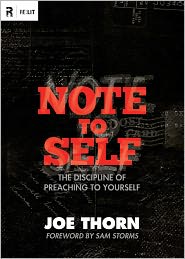
Note to Self: The Discipline of Preaching to Yourself. Joe Thorn. Foreword by Sam Storms. 2011. Crossway Books. 144 pages. [
My review]
First paragraph from the introduction:
Christians value the preaching of Scripture and are genuinely excited when it is preached well (when God and the gospel are on full display). We like being challenged by the Word, and we need the comfort that comes from the heralding of God's promises to all who believe. We need good preaching. Yet many who value the preaching of Scripture by pastors and teachers are not benefiting from the kind of preaching that should be most consistent and personal--preaching to ourselves.
About the book: This book is so VERY, VERY quotable. Each chapter is short, direct, and oh-so-relevant. This book is so rich, so rewarding, so NEEDED! I can't recommend it enough!!!
Just a few quotes:
To preach to yourself is to challenge yourself, push yourself, and point yourself to the truth. It is not so much uncovering new truth as much as it is reminding yourself of the truth you tend to forget. (32)
From chapter seven "Jesus is Big"
Dear Self,
Take note--your view of Jesus tends to shrink over time. It is not that your theology itself drifts, but sometimes you so focus on one aspect of Jesus that you tend to forget the rest. The result is a shrinking Jesus (in your faith). And as your shrinking Jesus becomes small Jesus, he is easily eclipsed by your idols and ego.
The bigger and more biblical your understanding of who Jesus is, the more likely he is to be such an object of love and adoration that the idols that aim at capturing your attention and swaying your allegiance will lose their power. This is why you sometimes lack earnestness for the kingdom and the glory of God while you overflow with passion concerning temporal things. Instead of making a joyful noise and singing earnestly for the victory Christ has over sin and death, you express a dispassionate approval and mouth the words to the songs sung in worship. But there is often fire in your belly and shouts of joy when your favorite college football team is victorious over the competition. This is probably why the church is shrinking in North America--because small Jesus does not inspire awe, command respect, lead to worship, or compel us to talk of him (much less suffer for him). And small Jesus is too little to arrest the attention of the world.
So please remember--Jesus is bigger than you tend to think. He is the perfect revelation of God, the radiance of his glory, the exact imprint of his nature; he is the Creator and Sustainer of all that exists. Everything belongs to him and exists for him. He is the author of your salvation, the perfecter of your faith, and the only one in whom you can find life. (47-48)
*This is what I would consider the "topic sentence"
from the book. I am using the book's own words to describe it.
© Becky Laney of
Operation Actually Read Bible