Last Words: Seven Sayings from the Heart of Christ on the Cross. Robert J. Nash. 2020. New Growth Press. 96 pages. [Source: Review copy] [Christian Nonfiction; Theology; Devotional]
First sentence: The last words of a hero or heroine in a story pack a punch. The final chapter of a book ties up loose ends. Epitaphs and eulogies have a summarizing power. Phone calls, visits, and whispers of those on hospice become riches locked away in the fading memories of those left behind. Jesus shared seven last thoughts as he died that contain a wealth of meaning we should not forget or neglect. This book seeks to mine those words to challenge the soul.
My favorite devotionals tend to be short devotionals. Not those that span an entire year, but those that can be picked up and treasured ANY time of the year. Last Words is a short read--under a hundred pages--but its packed with treasures. Nash is closely examining the last words of Jesus Christ on the cross. And believers could profit from such a close study of their Savior's last words.
Each saying gets its own chapter. Two chapters are much longer than the others. These happened to be my favorites. But really all of the chapters are GOOD. Each chapter is broken into sections: "See Your Need," "See Jesus," "Come Near to God," and "Go To Others."
So as a refresher course....Here are Jesus’s seven last statements made while on the cross: “Father, forgive them, for they know not what they do” (Luke 23:34). “Truly, I say to you, today you will be with me in paradise” (Luke 23:43). “Woman, behold, your son!” Then he said to the disciple, “Behold, your mother!” (John 19:26–27). “My God, my God, why have you forsaken me?” (Matthew 27:46). “I thirst” (John 19:28). “It is finished” (John 19:30). “Father, into your hands I commit my spirit!” (Luke 23:46).
This book would make a wonderful gift to a friend or a lovely treat for yourself. You could read it at any time but it might mean the most to you during Advent or Passion Week.
© Becky Laney of Operation Actually Read Bible
Showing posts with label New Growth Press. Show all posts
Wednesday, January 8, 2020
Friday, January 3, 2020
2. A Small Book for the Hurting Heart
A Small Book for the Hurting Heart. Paul Tautges. 2020. New Growth Press. 192 pages. [Source: Review copy] [Christian nonfiction; Devotional; Christian Living]
First sentence: Loss comes in many forms: loss through the death of a spouse, child, or other loved one; loss of relationships through conflict, betrayal, estrangement, divorce, or a move across the country; loss of financial security due to business failure, foreclosure, or long-term unemployment; loss of health or personal dreams because of disability or terminal illness. And the list goes on. Whatever your grief, whatever your pain, whatever your loss, there is comfort available.
A Small Book for the Hurting Heart is a fifty-day devotional for men and women. Each entry is rooted deeply in gospel truths and saturated with Scriptural promises. Each entry is short, concise, a bit no-nonsense. What your heart needs--what any heart needs--is to better know who God is and to better trust His word to us.
I read this one in one sitting. I wasn't supposed to. The author urges his readers to read one per day. To take their time. To let the ministering words have their effect. But I was wearing my book reviewer hat. I didn't have fifty days to slowly absorb with biblical truths. I instead immersed myself in the book. While his approach may be preferred for most readers, I don't know if there's a wrong way to read it. What did I appreciate most about this one? I loved the scripture-saturation. I love, love, love, LOVE the Bible. The Bible is my meat-and-drink. It is where I come to feast. I suppose you could say without a doubt I am a Bible glutton. I don't come sporadically to the table; I come many, many, many times a day. I don't just want a tiny bit here and there. I want MORE, MORE, MORE. So I appreciated his use of Scripture throughout. I thought the book covers the basics well. I could see this one being of benefit to those who are new to Scripture and don't know where to turn in the midst of their pain and grief.
© Becky Laney of Operation Actually Read Bible
First sentence: Loss comes in many forms: loss through the death of a spouse, child, or other loved one; loss of relationships through conflict, betrayal, estrangement, divorce, or a move across the country; loss of financial security due to business failure, foreclosure, or long-term unemployment; loss of health or personal dreams because of disability or terminal illness. And the list goes on. Whatever your grief, whatever your pain, whatever your loss, there is comfort available.
A Small Book for the Hurting Heart is a fifty-day devotional for men and women. Each entry is rooted deeply in gospel truths and saturated with Scriptural promises. Each entry is short, concise, a bit no-nonsense. What your heart needs--what any heart needs--is to better know who God is and to better trust His word to us.
I read this one in one sitting. I wasn't supposed to. The author urges his readers to read one per day. To take their time. To let the ministering words have their effect. But I was wearing my book reviewer hat. I didn't have fifty days to slowly absorb with biblical truths. I instead immersed myself in the book. While his approach may be preferred for most readers, I don't know if there's a wrong way to read it. What did I appreciate most about this one? I loved the scripture-saturation. I love, love, love, LOVE the Bible. The Bible is my meat-and-drink. It is where I come to feast. I suppose you could say without a doubt I am a Bible glutton. I don't come sporadically to the table; I come many, many, many times a day. I don't just want a tiny bit here and there. I want MORE, MORE, MORE. So I appreciated his use of Scripture throughout. I thought the book covers the basics well. I could see this one being of benefit to those who are new to Scripture and don't know where to turn in the midst of their pain and grief.
Tears are a gift from God, a means to embracing your pain, releasing emotion, and revealing the depth of your love. Poetically, if God collects all the tears you cry during your life’s journey, if he keeps track of all your sorrows, then surely he cares about them. He is aware of what causes them. God records them all in his book!
Life hurts, but God heals. He heals through Jesus. Because of Jesus’s suffering, you can be assured there is no grief or loss you experience that is outside his understanding or compassion. There is nothing beyond his redemption.
In the Son of God, you have one who is more than qualified to comfort you in the burdens you now bear and the tears you now shed, since he is well acquainted with grief. Though he suffered unimaginable loss, he triumphed in the end. Because of Jesus’s resurrection from the grave, and ascension into heaven, you can have confident hope that all your hurts will one day be healed in heaven. As you think about that future day when God “will wipe away every tear” from your eyes (Revelation 21:4), remember that Jesus is now at the right hand of God praying for us (Romans 8:34).
Grief can lead to worship, if we recognize God’s hand in it. If we allow our grief to focus exclusively on our loss, we might be tempted to try to go it alone—even without help from God. But when grief is embraced by faith, it results in the humility of worship. Worship can and should coexist alongside grief. In fact, grief that does not worship will eventually become self-destructive.
We persevere through the valleys of sorrow and pain by strengthening the grip of our faith on the immovable mountain of God. Since Jesus is a sympathetic high priest, “all the promises of God find their Yes in him” (2 Corinthians 1:20).
© Becky Laney of Operation Actually Read Bible
Thursday, November 21, 2019
Book Review: A Small Book for the Anxious Heart
A Small Book for the Anxious Heart: Meditations on Fear, Worry, and Trust. Edward T. Welch. 2019. New Growth Press. 192 pages. [Source: Review copy]
First sentence from the introduction: Anxieties remain among my top bugaboos. My own grappling with them is different than it was even a year ago, but I see so much more that is available, so much room for growth. In this book I will raise some themes from books on fear that I have previously written, but I will also introduce new themes and, I hope, add the benefit of additional experience.
First "sentence" from day one: Could there be a more important topic? Our lives are full of uncertainties. We never know what the day will bring. Worries, fears, and stress are part of daily life. We shouldn’t be surprised, then, that Scripture says so much about it, and that what it says is both attractive and helpful. The Lord responds to our fears with words of comfort, which he is pleased to repeat again and again. His words to us cluster around two themes: your God is very near, and he gives the grace and power you need for today. The aim of this book is to help us become more skillful in how we identify our fears and anxieties, hear God’s good words, and grow. You could say that our goal is wisdom. Wisdom is another name for skill in living.
Is it a devotional? Is it a Bible study? It's a happy-happy blend of both. It's a book of daily readings--fifty days--that challenge readers to grow in their faith. The devotions are substantive--packed with information both practical and biblical.
There were some readings that I just LOVED, LOVED, LOVED, LOVED, LOVED, LOVED. I thought they were timely, relevant, and just what I needed. Other readings I "merely" loved, loved, loved. Overall, I would say I was an enthusiastic reader and definitely part of Welch's target audience.
I would say the book has the potential--with the Spirit--to offer hope and change to readers.
I loved that each daily reading ended with a question or two--or an activity. Sometimes he's asking readers to write what they're thinking and feeling. Sometimes he's asking readers to "be brave" and reach out to someone--anyone--to talk to about their feelings and experiences. He's a big advocate that there's nothing to be ashamed about. Talking about what you're feeling with someone else can be life-changing. He is also a BIG advocate of PRAYER.
I disobeyed Welch in that I did NOT read just one a day. I was wearing my BOOK REVIEWER HAT. Yes, I'm part of his target audience--someone who has wrestled with anxiety and fear--but I'm also a book blogger who wanted to finish the book so I could review it and recommend it to others. I didn't want to wait FIFTY whole days before I started spreading the word: BUY THIS BOOK. Or THIS WOULD MAKE A LOVELY CHRISTMAS GIFT.
Quotes:
© Becky Laney of Operation Actually Read Bible
First sentence from the introduction: Anxieties remain among my top bugaboos. My own grappling with them is different than it was even a year ago, but I see so much more that is available, so much room for growth. In this book I will raise some themes from books on fear that I have previously written, but I will also introduce new themes and, I hope, add the benefit of additional experience.
First "sentence" from day one: Could there be a more important topic? Our lives are full of uncertainties. We never know what the day will bring. Worries, fears, and stress are part of daily life. We shouldn’t be surprised, then, that Scripture says so much about it, and that what it says is both attractive and helpful. The Lord responds to our fears with words of comfort, which he is pleased to repeat again and again. His words to us cluster around two themes: your God is very near, and he gives the grace and power you need for today. The aim of this book is to help us become more skillful in how we identify our fears and anxieties, hear God’s good words, and grow. You could say that our goal is wisdom. Wisdom is another name for skill in living.
Is it a devotional? Is it a Bible study? It's a happy-happy blend of both. It's a book of daily readings--fifty days--that challenge readers to grow in their faith. The devotions are substantive--packed with information both practical and biblical.
There were some readings that I just LOVED, LOVED, LOVED, LOVED, LOVED, LOVED. I thought they were timely, relevant, and just what I needed. Other readings I "merely" loved, loved, loved. Overall, I would say I was an enthusiastic reader and definitely part of Welch's target audience.
I would say the book has the potential--with the Spirit--to offer hope and change to readers.
I loved that each daily reading ended with a question or two--or an activity. Sometimes he's asking readers to write what they're thinking and feeling. Sometimes he's asking readers to "be brave" and reach out to someone--anyone--to talk to about their feelings and experiences. He's a big advocate that there's nothing to be ashamed about. Talking about what you're feeling with someone else can be life-changing. He is also a BIG advocate of PRAYER.
I disobeyed Welch in that I did NOT read just one a day. I was wearing my BOOK REVIEWER HAT. Yes, I'm part of his target audience--someone who has wrestled with anxiety and fear--but I'm also a book blogger who wanted to finish the book so I could review it and recommend it to others. I didn't want to wait FIFTY whole days before I started spreading the word: BUY THIS BOOK. Or THIS WOULD MAKE A LOVELY CHRISTMAS GIFT.
Quotes:
God never intended us to bear the overwhelming burdens of life by ourselves. Instead, he gives himself—just the right person to bear them with us. The Lord is at hand; do not be anxious about anything. (Philippians 4:5–6) Whenever God speaks to you about your fears, you can be sure he will say something about being close. He even patiently persuades you that he is close. He piles up the evidence. Still, you can be blind to that evidence when fears are close and anxieties ring loud. The process of letting anxieties go takes practice that engages with God himself—which means you will engage with Jesus.
Our goal is to persist in listening to God’s words until we really hear them and they speak God’s comfort and healing to our souls. Often it can seem like Scripture is too hard to understand and too far removed from our daily life. But it is a treasure that yields more and more as you go further in. Anything of value comes through perseverance. So listen, and keep listening. You will find well over three hundred places in the Bible where God speaks directly to your fears, and, with practice, you will hear his words to you on every page.
Response 1. Psalm 23 makes no requests. It is a declaration of truth to your soul and a confession to the Lord. Like all psalms, it is also a prayer that you can modify to the contours of your own soul. Rewrite it for yourself. Or simply speak it to the Lord in your words. 2. “You are with me” is the center of the psalm. What else do you hear that gives you hope? 3. Are there any other songs that would be good to sing?
© Becky Laney of Operation Actually Read Bible
Saturday, May 25, 2019
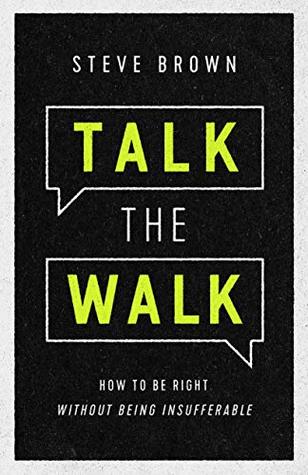
Book Review: Talk the Walk
Talk the Walk: How To Be Right Without Being Insufferable. Steve Brown. 2019. New Growth Press. 160 pages. [Source: Review copy]
First sentence (from the introduction): The modern world says that it is impossible for a thinking person to have a metanarrative—an interpretation that accounts for all reality... At the risk of sounding arrogant and offensive, let me say here that there is, in fact, a true metanarrative. It is called the Christian faith. It is a stable, clear, and profound metanarrative.
It is near impossible to read Steve Brown without hearing Steve Brown's voice in your head. Now that the obvious has been said, I'll skip to the review.
Talk The Walk is an engaging, challenging read. I found myself strongly agreeing and strongly disagreeing with the text--sometimes within the same paragraph. (Is Steve Brown just playing devil's advocate or does he really believe this outrageously?) At the very least it is a thought-provoking read. Do I agree? disagree? why is he right? why is he wrong? does the Bible really mean this? and say that? am I guilty of what he's describing?
has my mind been changed about this or that?
The premise of Talk the Walk is startling and a bit outrageous. He asserts that Christians are dangerous when they're right. The more Biblically sound and doctrinally correct we are, the more likely we are to value TRUTH and devalue love and compassion. In other words, if we know we are right and others are wrong, we are less likely to be kind, compassionate, and gracious. Christians who know they are right may perhaps talk about love, mercy, and grace. But they display it infrequently--if at all. Correct orthodoxy can fail to lead to correct orthopraxy. Brown believes that orthopraxy is just as important if not more important than orthodoxy. Orothopraxy is about how we put into practice our beliefs, how we live out the faith in the day to day.
Brown does not seem to be advocating throwing out the truth. "As someone has said, once you see truth you cannot simply unsee it." He is not one of those that redefines the virtue of humility as introducing doubt, embracing uncertainty, and throwing assurance out the window. Where the Bible is clear, plain, obvious, assertive, believers should have confidence and certainty. To not trust in God's promises is not a virtue.
What Brown does seem to be advocating is selectively sharing the truths we believe. Brown seems to be saying that just because you know something to be true or something to be false does not mean you have to share that. You can remain silent and perhaps should remain silent in many situations. Sometimes speaking up or standing up for the truth you hold so dear makes the situation worse not better. You may feel satisfied that you defended God's truth, but the person on the other end, the other side, now has even more reason to distrust or despise Christians.
He discusses this in-depthly in chapter three, "The Sound of Silence." He opens it with this sentence, "Christian truth is about as welcome in today’s culture as a wet shaggy dog shaking himself at the Miss America Pageant. Truth does not matter, but intolerance does. If the subject is salvation, Christian truth suggests that there are those who are saved and those who are not. If the truth is about sin, then some things are right and others are wrong. If it is about hell and heaven, it means that one place is hot and the other is not. If it is about forgiveness, then some are forgiven and others are not." While we are called to speak gospel truths in love and rely on God's power, he says, "The truth we have is precious, dangerous, and explosively powerful in the way it can heal or hurt. There are times when silence really is golden."
Here are some quotes from this chapter. I give you food for thought:
And in chapter four, he again addresses selective truth-sharing.
Brown is most concerned with the ATTITUDE of Christians who are doctrinally right or correct. These are people who believe rightly about God and hold to the truths of the Christian faith. You can have a correct faith but hold a wrong attitude.
I offer more food for thought:
© Becky Laney of Operation Actually Read Bible
First sentence (from the introduction): The modern world says that it is impossible for a thinking person to have a metanarrative—an interpretation that accounts for all reality... At the risk of sounding arrogant and offensive, let me say here that there is, in fact, a true metanarrative. It is called the Christian faith. It is a stable, clear, and profound metanarrative.
It is near impossible to read Steve Brown without hearing Steve Brown's voice in your head. Now that the obvious has been said, I'll skip to the review.
Talk The Walk is an engaging, challenging read. I found myself strongly agreeing and strongly disagreeing with the text--sometimes within the same paragraph. (Is Steve Brown just playing devil's advocate or does he really believe this outrageously?) At the very least it is a thought-provoking read. Do I agree? disagree? why is he right? why is he wrong? does the Bible really mean this? and say that? am I guilty of what he's describing?
has my mind been changed about this or that?
The premise of Talk the Walk is startling and a bit outrageous. He asserts that Christians are dangerous when they're right. The more Biblically sound and doctrinally correct we are, the more likely we are to value TRUTH and devalue love and compassion. In other words, if we know we are right and others are wrong, we are less likely to be kind, compassionate, and gracious. Christians who know they are right may perhaps talk about love, mercy, and grace. But they display it infrequently--if at all. Correct orthodoxy can fail to lead to correct orthopraxy. Brown believes that orthopraxy is just as important if not more important than orthodoxy. Orothopraxy is about how we put into practice our beliefs, how we live out the faith in the day to day.
Brown does not seem to be advocating throwing out the truth. "As someone has said, once you see truth you cannot simply unsee it." He is not one of those that redefines the virtue of humility as introducing doubt, embracing uncertainty, and throwing assurance out the window. Where the Bible is clear, plain, obvious, assertive, believers should have confidence and certainty. To not trust in God's promises is not a virtue.
What Brown does seem to be advocating is selectively sharing the truths we believe. Brown seems to be saying that just because you know something to be true or something to be false does not mean you have to share that. You can remain silent and perhaps should remain silent in many situations. Sometimes speaking up or standing up for the truth you hold so dear makes the situation worse not better. You may feel satisfied that you defended God's truth, but the person on the other end, the other side, now has even more reason to distrust or despise Christians.
He discusses this in-depthly in chapter three, "The Sound of Silence." He opens it with this sentence, "Christian truth is about as welcome in today’s culture as a wet shaggy dog shaking himself at the Miss America Pageant. Truth does not matter, but intolerance does. If the subject is salvation, Christian truth suggests that there are those who are saved and those who are not. If the truth is about sin, then some things are right and others are wrong. If it is about hell and heaven, it means that one place is hot and the other is not. If it is about forgiveness, then some are forgiven and others are not." While we are called to speak gospel truths in love and rely on God's power, he says, "The truth we have is precious, dangerous, and explosively powerful in the way it can heal or hurt. There are times when silence really is golden."
Here are some quotes from this chapter. I give you food for thought:
- Silence, for instance, is better than saying too much that would be confusing and unduly irritating.
- Answering questions that are not asked, defining issues that are not raised, and going places that are not presently important is offensive and a waste of time. It is better that Christians remain silent.
- Silence is also appropriate when a Christian has not been given permission to speak. Christians should not shilly-shally about who they are, and should at least give an indication of what they believe. But more information requires permission, and that permission is often given in the questions that are asked. If there are no questions and if no interest is expressed, it is wise to remain silent.
- Permission opens the door to speaking truth. If permission is not given, silence is a good practice. Silence is also a wise practice when spoken truth is spoken for the wrong reasons.
- If you are reading this book because you feel guilty about not speaking truth, let me suggest that you continue not speaking truth. Guilt makes communication phony and shallow, and often causes people to use a cannon when a BB gun would do.
- Guilty people make others feel guilty. Free people make people feel free. Because of those truths, if people have not experienced the freedom of unconditional forgiveness that is at the heart of the Christian faith, remaining silent is best.
- Some Christians are looking for power over others by being right, and speaking truth is the way to get it.
- Silence is also golden when we speak with an agenda of self-interest.
- There are others who try to bring their witness of truth to the people they know, yet are simply not very informed about the nature of the truth they speak. When that happens, it is better to remain silent than to keep talking.
- Ultimately, nobody will misunderstand the truth because Christians did not say it right, and nobody will be lost for eternity because Christians were unfaithful. God is bigger than our mistakes and misstatements. It’s the Spirit who draws people to God.
- Sometimes it is best to be silent and to let love, freedom, and joy do the talking. There are some things Christians cannot say without words, but there are other matters that are only confused by words.
- What if we remained silent by not defending ourselves? What if we remained silent when others are condemning those whose lifestyle, politics, or religious views are deemed unacceptable? What if we remained silent and refused to be the social, political, and religious critic of every opinion that wasn’t our own? What if we remained silent in the face of rejection? What if we refused to share the secrets we’ve been told or tell the stories we’ve overheard? What if we remained silent and overlooked the foibles of others? What if we looked at the pain of our neighbor and just loved him or her, instead trying to fix the unfixable? What if our response to confusion, fear, and guilt was simply, “I know”? There is a powerful witness in that kind of silence.
- If time is limited (and it is), and there are some who want to hear and some who do not want to hear (and there are), then Christians need to walk away from those who do not want to hear and go to those who do.
- Christians need to first check and see if unbelievers want to go further; but once it is clear that they have drawn a line, for God’s sake, do not cross it.
I offer more food for thought:
- The problem with us Christians who have truth to share is that, when we talk about love, we either make it insipid and shallow, or we add a kicker to it (e.g., “God loves you, but don’t let it go to your head!” “God loves you, but there is more to it than that” or maybe, “Now the ball is in your court, and that ball requires that you respond with goodness, obedience, and submission”).
- But watered-down love or conditional love are not the Christian faith, or the truth God gave us. God loved us with love that is hard as nails, driven into hands and feet, and without a kicker. It simply says, “I love you. Is that okay?”
- Jesus is often counterintuitive about what he says, what he does, and whom he loves. Masters do not wash a slave’s feet, religious leaders do not hang out with prostitutes, and religious teachers do not contradict the very tenets of the discipline in which they teach. But Jesus does, and almost everything that one would expect from a messiah is exactly what Jesus refuses to do. So if we are followers of Jesus, it is incumbent on us to let him do the defining—not our religion, our preconceived notions, or our personal proclivities.
- Jesus gets to decide and define who, what, when, and where. His story, love, and presence precede and define every Christian message believers speak.
- Believers are not responsible for anybody else’s salvation, and they are not responsible for anybody being lost for eternity.
- Effectively speaking and living truth to people who do not want to hear or see is mostly a matter of attitude—not knowledge, planning, training, and technique.
- Jesus knew that being right could make people mean. If the Pharisees were not so close to God’s truth, Jesus would have left them alone.
- Orthopraxy recognizes sin and calls it what it is, but it also recognizes the pain of the sinner, the failed efforts at obedience, and the power of temptation. Orthodoxy speaks the name of a holy God whose law is perfect. But Christian orthopraxy also speaks the name of the God, Jesus, a God of redemption and mercy.
- God and people can put up with almost anything except self-righteousness. Well, God does put up with it, but it is because of Jesus. Still, I suspect, self-righteousness is irritating to him, and it is certainly irritating to everybody else.
- God is never shocked when people are not righteous. God never says, “I had such high hopes for you.” God does not have perspiration on his forehead over people’s failing struggle to get better. He knows and has always known all of that. Instead, God sent his Son to die for all of that, so believers could be justified in his presence.
- Self-righteousness is maybe the only sin that, by its very nature, denies the reality of its own existence. Self-righteousness often wears the mask of piety, compassion, concern, and love. It is the emperor-has-no-clothes sin that requires that others point it out (which, by the way, is hard to do without being self-righteous). Self-righteous people hardly ever know they are self-righteous, and good people rarely ever know they are good.
- On occasion God allows believers to see their growth so they will not be discouraged, but he knows that it will go to their head if they take that growth too seriously. On the other hand, because he loves them, he allows believers to see the glass house in which they live, makes knowledge of their sin a gift, and regularly puts them in embarrassingly uncomfortable places where they can see who they really are—sinners saved by faith alone, Christ alone, and grace alone.
- The least hypocritical Christian is probably the worst person around who is not overly concerned that people know it. That is a demonstration of truth, not a violation of it. The pretending is the problem.
- “Be a sinner, and let your sins be strong, but let your trust in Christ be stronger, and rejoice in Christ who is the victor over sin, death, and the world.” ~ Martin Luther
- Someone has suggested that a good practice for Christians is to read the passages in Scripture that they did not underline. Believers have a tendency to underline only what feeds their own proclivities, affirms their righteousness, and confirms their theological particulars. Jesus referenced this problem in John 5 when he said that the religious folks spent a lot of time searching the Scriptures for eternal life but had missed him. Selectively communicating truth can be dangerous.
- I have a friend who says that you often hear fat preachers yelling at gay people, but rarely hear gay people yelling at fat preachers. That has some truth to it, because you and I both know that in some circles sexual sin is condemned while the sin of gluttony gets a pass. However, that is not to assume that the gay community does not do their selective yelling, too. People have their most favorite sins and their least favorite sins, and we are all willing to condemn others on the basis of that understanding.
- Christians have to speak truth about what is and what is not sin. However, people will stop listening (and rightly so) when they see how selective their list is. Racists who do not smoke pot, misogynists who do not gossip, and liars who do not cheat, must speak quietly about pot, gossip, and cheating.
- Having the mind of Christ is an attitude of identification with Christ and with those who are outsiders, in the same way Christ identified with his Father and with outsiders.
- Believers are sent to sympathize with others’ weaknesses because we have been tempted just as they are and have yielded to the temptations in the same way others have. Jesus identified with weaknesses from his strength. A Christian’s identification is from weakness with weakness.
- If Christians want to speak and live truth to those who do not want to see it and hear it, the first place of identification is with their sin and weakness. That sounds like a violation of everything the Christian faith teaches, but it is not. It is at the heart of the only witness believers have.
- The Scripture says, “Let love be genuine” (Romans 12:9). What this means is that there is a kind of love that is not genuine. It is so very important that love be the real thing, or the attitude will become just another cliché that nobody understands and therefore nobody experiences.
- Telling unloving people that they should love is the equivalent of telling people who are drowning that if they would just swim, they would be fine. If they could swim, they would not be drowning. Love is like that. There are a lot of sermons on love (I have preached them on occasion) that suggest that if people are not loving, they should stop being unloving and just love. I wish sermons like that were powerful, but they are not. No one can talk anyone into loving or tell them to manufacture it. Love just happens.
- Christians have been trying way too hard to love, and the harder they try, the less they love. The more people chase love, the more it recedes. Try to define, manufacture, control, earn, or use love, and love will not be found. But if people give up trying to look for love in all the wrong places, love finds them. And that love will become the key to their efforts to speak and live the truth we’ve been given. The reason God did not send a book to express his love, but instead sent his Son, was because of the nature of love. Love is not a concept, an action, or a doctrine. Love is an experience, both when it is received and when it is given.
- Let Jesus love you. I am not even sure what that means but it feels like forgiveness, acceptance, and delight. Go back and read 1 Corinthians 13. Instead of reading it as a condemnation of the love you do not have or a definition of what you want, change the words “love is” to “Jesus’s love for me is.” It does not matter that you are not worthy (and I’m talking to Christians in general here, and to myself in particular), that you have sinned, or that you have a lot of doubts. It does not matter where you have been, what you have done, what you have been smoking or drinking, the shameful secrets you cannot share with anyone, the people you have hurt, the anger you feel, the unfairness you have experienced, the piled-up failures you have, or what people who do not know you think about you. In fact, the most important part of the Christian faith is not church or doing religious things or witnessing or being good. It is simply hanging out with Jesus and experiencing his unconditional and relentless love for you.
- Love is never manifested by ignoring truth.
- If you have an agenda for someone else, stop it. There are few things more irritating and more of a hindrance to real communication than trying to be someone’s mother.
- Christians mother each other with subtle hints and outright criticisms, when they simply have not earned the right to be heard.
- The condemnation, correction, and admonishments are not helpful. The message should be, “Jesus loves you, and I’m trying. I don’t care what your sexual proclivity is, whom you voted for, who you hate and who you love, or where you hang out, and Jesus doesn’t either. Run to him and you might be surprised.” If unbelievers heard that message (as antinomian as it sounds), the gospel would once again be attractive to the world.
- What would happen if Christians were less critical and more affirming? Would you be willing to rein in your political and even moral views if you knew that people would come to Christ because you did?
- God’s sovereignty relieves me of a great responsibility—the responsibility of assuming the role of God. No matter what I do, say, or think, no matter if I succeed or fail, no matter if I do it right or wrong, God is still in charge, things are under his control, and in the end, “every knee should bow, in heaven and on earth and under the earth” (Philippians 2:10).
- Another truth that flows from God’s sovereignty is that Christians do not have anything to protect or lose. When Paul said in Romans that we should consider/reckon ourselves dead (Romans 6:11), it sounds like bad news. Actually, it is good news and points to what should and should not be important to dead people: not much.
- I get reminded often that I do not have to protect or defend the church, my Christian faith, or my commitments. I really do not, and you do not have to either.
- The church has been around a long time and has buried most of its critics. It still does. Not only that, there is hardly anything negative that one can say about the church that is not at least partially true, and there is hardly anything positive that one can say about the church that is not at least partially true. Christians are a bad bunch (the Bible is clear on that), and when someone points that out, a proper response should be “duh!”
- The problem with secular culture is not so much the bad things that are promulgated, but that Christians have either hidden or fled to more comfortable places. That is true of almost all of pop culture. Christians have run and then thrown rocks back at those places.
- We believers really do not have to be as irritating as we often are. We do not have to defend secondary truth. We are often wrong in our political, theological, and social views. We should be sensitive to the culture in which we have been placed. And we should model the important truths of forgiveness and love everywhere. In other words, there are biblical attitudes and beliefs that should keep us from being insufferable—sometimes.
- We Christians have been loved without reservation or exception, and now we have found that we can love without reservation or exception. Truth and love are a pretty scary combination for Christians who want to be safe and never to offend.
- God calls believers to love people, love God, and speak truth. That sounds so simple and easy, but it is not. Just the opposite—it is really hard.
- Luther said that Christians need to preach the gospel to each other, lest they become discouraged. He was right. In fact, Christians need to be reminded more than they need to be taught.
- If you continue to remind yourself about who you are—and allow God’s Spirit and your Christian family to remind you—much of this book will be irrelevant. You are the son or daughter of the King. You are loved, accepted, and forgiven, without reservation or exception. Your Father, the King, will never let you go, never leave you alone in the dark, and never ask you to go anywhere or do anything where he will not stand with you. Actually, he always thinks that a party without you is not even a party.
- As is often said, if all you have is a hammer in your toolbox, everything starts looking like a nail. Once we believers demonize “them” and fail to remember their sleepless nights, the guilt that haunts them, and the pain they experience, the hammer becomes our weapon of choice.
- Remember that they need what you needed. The only difference between you and them is Jesus. We had very little to do with that. We still do not.
- You will find that there are divine appointments happening all the time. All you have to do is to speak truth, and do it in a kind and loving way.
- It is helpful to remember that when you speak truth, you do not stand alone either. All kinds of supernatural forces stand with you. No matter how poorly you speak that truth, no matter how horribly you live it, and no matter how little you know it, when you stand, angels stand with you, Jesus prays for you, and God directs it all.
© Becky Laney of Operation Actually Read Bible
Friday, October 14, 2016
Book Review: Show Them Jesus
Show Them Jesus: Teaching the Gospel to Kids. 2014. New Growth Press. 224 pages. [Source: Book I Bought]
If you teach Sunday School, Show Them Jesus: Teaching the Gospel to Kids comes close to being a must-read. It is one of those breathe-the-gospel-in and breathe-the-gospel out kinda books. The premise is that teachers (and parents) should use every opportunity--both formal and informal "lessons"--to point their kids to the gospel message of Jesus Christ. But not just a fuzzy, vague gospel. He wants kids to fall in love with Jesus. He wants Jesus to be their 'one thing.' their one great desire. He wants to teach--wants others to teach--in such a way that kids know that Jesus is really, truly worthy of their worship. In other words, a BIG, BIG, BIG Jesus that will grow with them long past the days of flannel boards and talking vegetables.
The chapters are very practical and rich in examples. He doesn't just share what he's done right, he shares a lot of what he's done wrong. Being a teacher doesn't make him right, doesn't make him infallible, doesn't make him better. Neither would being a pastor. All of us--one and all, no matter our age or occupation--are sinners saved by grace. There is a realness to this one about using everyday moments to show the gospel--to "show Jesus" to those in our lives.
He urges us to change the way we approach "teaching" the Bible to others. Perhaps focusing less on what is easy and natural.
If you teach Sunday School, Show Them Jesus: Teaching the Gospel to Kids comes close to being a must-read. It is one of those breathe-the-gospel-in and breathe-the-gospel out kinda books. The premise is that teachers (and parents) should use every opportunity--both formal and informal "lessons"--to point their kids to the gospel message of Jesus Christ. But not just a fuzzy, vague gospel. He wants kids to fall in love with Jesus. He wants Jesus to be their 'one thing.' their one great desire. He wants to teach--wants others to teach--in such a way that kids know that Jesus is really, truly worthy of their worship. In other words, a BIG, BIG, BIG Jesus that will grow with them long past the days of flannel boards and talking vegetables.
The chapters are very practical and rich in examples. He doesn't just share what he's done right, he shares a lot of what he's done wrong. Being a teacher doesn't make him right, doesn't make him infallible, doesn't make him better. Neither would being a pastor. All of us--one and all, no matter our age or occupation--are sinners saved by grace. There is a realness to this one about using everyday moments to show the gospel--to "show Jesus" to those in our lives.
He urges us to change the way we approach "teaching" the Bible to others. Perhaps focusing less on what is easy and natural.
Don’t: Look for a moral lesson about a human character. Instead: Look for the worth and work of the main character, God.
We’ve been dispensing good advice instead of the good news. Eventually, kids will tire of our advice, no matter how good it might be. Many will leave the church. Others will live decent, churchy lives but without any fire for Christ. We’ll wonder why they’ve rejected the good news, because we assumed they were well grounded in it. In fact, they never were. Although we told stories of Jesus and his free grace, we watered it down with self-effort—and that’s what they heard.
The gospel goes against our nature. It just does. Even though we know grace, grace, all by grace, always by grace, through grace, with grace, much grace. It doesn't take but a few glances away from Jesus and we've allowed some self-effort (do better, try harder, do more, give it all you got) to creep back in.
Favorite quotes:
© Becky Laney of Operation Actually Read Bible
Favorite quotes:
The good news is the Bible’s drumbeat. To ignore it at any point is to misplay the theme song.
No how-to-live lesson can wake the spiritually dead.
Any kid could be the one who needs to be saved. Much of the time, we just don’t know.
None of us learns to love anyone—including God—by having someone tell us to love them. You love people because you find them beautiful and lovable, and because they love you. The good thing is that God is far, far more beautiful and love-worthy than anything or anyone else, and he loves us far, far more than anyone else ever could.
The greater error is to teach from the Bible and fail to point out Jesus at all.
We shouldn’t build self-esteem. We should build Christ-esteem. We must give kids the best kind of encouragement of all—the kind that comes from knowing that Jesus is in you and for you.
© Becky Laney of Operation Actually Read Bible
Sunday, January 15, 2012
Book Review: The Gospel Story Bible
The Gospel Story Bible: Discovering Jesus in the Old and New Testaments. Marty Machowski. 2011. Illustrated by A.E. Macha. New Growth Press. 328 pages.
While I can't say I absolutely loved this storybook Bible, I can say that it has many strengths. There were a few things about this one that--for me--count as weaknesses. I'll just mention those briefly. First, the layout or style of this one just didn't thrill me. The colored pages WERE colorful. And bold, bright colors are for some people a positive. But each two-page spread is a different color, and the font color varies based on the background color of the page. Some of these color combinations were hard on my eyes. (Granted, they may not be hard on your eyes. Because of my headaches, I'm sensitive to things others aren't.) I'm old-fashioned in a way. I'm just as happy with black font on a white page and illustrations on one side or another. This more artistic approach may please many readers, but, for me, less is more. Second, the glossiness of the pages reflected the light horribly. Again, I think this is something that will only bother people with light-sensitivity. (I don't like the pages of any book to glare at me!) Third, I found the illustrations
I do feel the book has definite strengths. It's a BIG story collection. There are a wide variety of stories from both the Old and New Testaments. Most story collections have weaknesses. They may offer a dozen (or so) stories from Genesis, and most are good for stories about Moses and David and Jonah. But many collections just don't offer enough from all the other books in the Old Testament. Not many, for example, include Elijah and Elisha. And with the New Testament, many focus exclusively on the gospels. They don't offer much of anything to share with young readers about the epistles in the New Testament. Perhaps feeling that theology doesn't lend well to storytelling. But this story collection seems to include many things that other collections have chosen not to include. So it was refreshing to see these included.
- 78 stories from The Gospel Story Bible are from the Old Testament.
- 78 stories from The Gospel Story Bible are from the New Testament.
- 26 stories from The Gospel Story Bible are from Genesis.
- 16 stories from The Gospel Story Bible are from Exodus and Numbers
- 36 stories from The Gospel Story Bible are about the nation/kingdom of Israel, full circle (entering and conquering the land, the times of the judges, the establishing of kings, the division of the kingdom, the rise of prophets, the judgment and exile, the restoration)
- 43 stories from The Gospel Story Bible are from the gospels (Matthew, Mark, Luke, and John)
- 35 stories from The Gospel Story Bible are from Acts and other New Testament books (the epistles)
Each story is a two-page spread. The Scripture reference for the story is included. In just a few paragraphs, the heart of the passage is retold. The last paragraph (or two) always includes some theology. A few sentences to help readers connect the story with the big picture. To tie in that one story to the gospel and to Christ.
The publisher of The Gospel Story Bible has also created a three year curriculum for three different age groups: preschool, lower elementary, upper elementary. I believe the Old Testament curriculum is available now, and the New Testament will be published in January 2013. There are two devotional books available for families as well. Long Story Short: Ten Minute Devotionals to Dray Your Family to God (Old Testament) and Old Story New: Ten Minute Devotionals to Draw Your Family to God (New Testament). (Again, I think the Old Testament is available before the New Testament). These devotionals complement the curriculum. The storybook Bible, I'm assuming, complements them both.
Subscribe to:
Posts (Atom)