Showing posts with label grief. Show all posts

Thursday, January 5, 2023

Album Review: Life After Death


Life After Death
TobyMac
2022
15 songs, 50 minutes.
Spotify. YouTube.

If you'd told me even last week that I'd be listening to a TobyMac album on repeat day after day, well, I wouldn't have believed you. TobyMac has never really been my cup of tea. But this new album of new songs composed [I'm assuming/presuming] after the death of his adult son, well, it is something. Even if you think TobyMac's music isn't your genre of choice, even if you think it's a bit out of your comfort zone, give it a listen. 

The songs on the album:

Help Is On the Way 
The Goodness
Deeper
Show Up Choose Love
Promised Land
Everything About You
Life On It
Faithfully
Cornerstone
Found
Fire's Burnin'
Space
21 Years 
I'm Sorry (a lament)
Rest 

The songs that will break and then heal your heart: Everything About You; Faithfully; 21 Years.

I rarely skip any songs on the album. 

I would say that FAITHFULLY is my absolute favorite, favorite, favorite song on the album. 


© Becky Laney of Operation Actually Read Bible

Saturday, December 18, 2021

85. Zanna's Gift


Zanna's Gift. Orson Scott Card. 2020. 250 pages. [Source: Review copy]

First sentence: There are many ways to lose a child, and none of them is merciful. But like all unbearable things it can be borne, and in the weeks before Christmas 1938, the Pullmans were learning how.

Premise/plot: Zanna's Gift is a LOVELY Christmas novel. Zanna, the youngest of the Pullman family, has a special way to memorialize her older brother, Ernest, after his unexpected death at age fifteen.

The best way to read Zanna's Gift is without knowing a thing about it. I promise you. I'm doing you a favor by NOT summarizing the plot and sharing what Zanna's GIFT was and how it was a gift that kept giving and giving, how that gift came to symbolize so much to the entire family. 

My thoughts: LOVE. I loved this one absolutely and completely from start to finish. It was one of those perfectly perfect EXPERIENCES. It feels like more than just a book, a story, a fictional work. THESE CHARACTERS ARE REAL. How it hasn't been adapted into a movie if it was truly published originally in 2004 is beyond me. It would make an excellent movie.

I would recommend this one to people who aren't necessarily readers. Of course I recommend it to readers who read anything and everything. But for those who are reluctant to pick up books, please consider reading this wonderful amazing book. 

If you LOVE Christmas, this is an absolute must. I could easily see it becoming a book that you feel you HAVE to read each and every year. 

This was my SECOND year to read Zanna's Gift. Last year I was surprised by how magical this read was--a celebration of life, love, and family. This year I was reminded of just how beautiful and touching it is. These characters have remained with me throughout the year. 

Is it Christian fiction? Maybe? Faith plays out in the background of this one. Faith isn't fleshed out in this one--in terms of theology. But I'm not so sure it needs to be for the beautiful themes to come through. There is nothing in Zanna's Gift that is anti-Christian. It is a treat of a book for ALL readers regardless of faith background. 


© Becky Laney of Operation Actually Read Bible

Friday, January 3, 2020

2. A Small Book for the Hurting Heart

A Small Book for the Hurting Heart. Paul Tautges. 2020. New Growth Press. 192 pages. [Source: Review copy] [Christian nonfiction; Devotional; Christian Living]

First sentence: Loss comes in many forms: loss through the death of a spouse, child, or other loved one; loss of relationships through conflict, betrayal, estrangement, divorce, or a move across the country; loss of financial security due to business failure, foreclosure, or long-term unemployment; loss of health or personal dreams because of disability or terminal illness. And the list goes on. Whatever your grief, whatever your pain, whatever your loss, there is comfort available.

A Small Book for the Hurting Heart is a fifty-day devotional for men and women. Each entry is rooted deeply in gospel truths and saturated with Scriptural promises. Each entry is short, concise, a bit no-nonsense. What your heart needs--what any heart needs--is to better know who God is and to better trust His word to us.

I read this one in one sitting. I wasn't supposed to. The author urges his readers to read one per day. To take their time. To let the ministering words have their effect. But I was wearing my book reviewer hat. I didn't have fifty days to slowly absorb with biblical truths. I instead immersed myself in the book. While his approach may be preferred for most readers, I don't know if there's a wrong way to read it. What did I appreciate most about this one? I loved the scripture-saturation. I love, love, love, LOVE the Bible. The Bible is my meat-and-drink. It is where I come to feast. I suppose you could say without a doubt I am a Bible glutton. I don't come sporadically to the table; I come many, many, many times a day. I don't just want a tiny bit here and there. I want MORE, MORE, MORE. So I appreciated his use of Scripture throughout. I thought the book covers the basics well. I could see this one being of benefit to those who are new to Scripture and don't know where to turn in the midst of their pain and grief.

Tears are a gift from God, a means to embracing your pain, releasing emotion, and revealing the depth of your love. Poetically, if God collects all the tears you cry during your life’s journey, if he keeps track of all your sorrows, then surely he cares about them. He is aware of what causes them. God records them all in his book!

Life hurts, but God heals. He heals through Jesus. Because of Jesus’s suffering, you can be assured there is no grief or loss you experience that is outside his understanding or compassion. There is nothing beyond his redemption.

In the Son of God, you have one who is more than qualified to comfort you in the burdens you now bear and the tears you now shed, since he is well acquainted with grief. Though he suffered unimaginable loss, he triumphed in the end. Because of Jesus’s resurrection from the grave, and ascension into heaven, you can have confident hope that all your hurts will one day be healed in heaven. As you think about that future day when God “will wipe away every tear” from your eyes (Revelation 21:4), remember that Jesus is now at the right hand of God praying for us (Romans 8:34).

Grief can lead to worship, if we recognize God’s hand in it. If we allow our grief to focus exclusively on our loss, we might be tempted to try to go it alone—even without help from God. But when grief is embraced by faith, it results in the humility of worship. Worship can and should coexist alongside grief. In fact, grief that does not worship will eventually become self-destructive.

We persevere through the valleys of sorrow and pain by strengthening the grip of our faith on the immovable mountain of God. Since Jesus is a sympathetic high priest, “all the promises of God find their Yes in him” (2 Corinthians 1:20).

© Becky Laney of Operation Actually Read Bible

Friday, November 3, 2017

Book Review: Pizza with Jesus

Pizza with Jesus (No Black Olives). P.J. Frick. 2017. CreateSpace. 158 pages. [Source: Review copy]

First sentence: God sends his angels and love in many forms. One of my favorites is the dog. Always I learn from dogs--my own and every single stray.

Premise/plot: P.J. Frick shares her story, her testimony, with readers in Pizza With Jesus (No Black Olives). The book is about her many losses, the grieving process, and walking with Jesus through it all. She writes, "Loss is as varied as a fingerprint--as are the many responses to it."

My thoughts: Throughout the book of Psalms, believers are called to TELL.

Psalm 107:2a reads, "Let the redeemed of the LORD tell their story--"

Psalm 66:16 reads, "Come and hear, all you who fear God; let me tell you what he has done for me."

Psalm 71:15 reads, "My mouth will tell of your righteous deeds, of your saving acts all day long--though I know not how to relate them all."

Telling is just what Pizza with Jesus is all about. She writes, "This book is an attempt to answer His call to share my journey of faith through the most difficult times of my life."

It's a personal story. The book begins with a preview of all the losses coming her way. She then goes back, addresses each loss one by one.

This isn't a how-to-grieve book. I'm not sure it's even a how-I-grieved book. I don't think there is a tidy "the end" to the grieving process. If it isn't a how-to-grieve book, what is it? It's a how-Jesus-was-there-through-every-single-moment book. I would also say it's a memorial of sorts to her husband. Within the book she shares memories of her husband and even asks others to participate in sharing memories of David. The book reads as a love letter to her husband.

I would categorize this as a memoir of a Christian woman not a theological book on grief. The distinction isn't just that it is incredibly personal, though that's part of it. Frick's story includes some elements that I would categorize as not quite biblically sound. For example, the pre-existence of souls in heaven. She talks of her dogs, cats, and even her husband as returning to heaven. This notion of "returning" is problematic--theologically. If she'd written going to heaven, going to be with the Lord, going HOME, I wouldn't have thought twice. When writing about death, it can be a slippery slope to try to poetically talk about death and dying and the deceased. Lots of metaphors abound--each person has their own preferred way of saying it. What one person likes, another doesn't.

I will note that more dogs die in this book than in any other book I've EVER read in my thirty-plus years of reading.

© Becky Laney of Operation Actually Read Bible

Wednesday, March 15, 2017

Book Review: Through the Eyes of a Lion

Through the Eyes of a Lion. Levi Lusko. 2015. Thomas Nelson. 240 pages. [Source: Bought]

First sentence (from introduction): It is early morning, and I am walking along the waterfront in Seattle near the Pike Place Market. Bracing myself against the damp, chilly air, I zip my leather jacket up to my throat but still feel the wind cut daggers through me. I will them to run me through. Clouds fill all of the visible sky—dark, menacing, and turbulent. My hands are burning. I start to run. Can I outrun this? I run until my legs burn too. The sky matches my soul. Seattle is a good place to be sad. I will never walk her down the aisle. She will never have a baby. She lost only one tooth. She will never read a chapter book. Memories from only thirty days ago race past like flood-waters and sweep me off my feet. It’s as though I am in an abandoned movie theater inside my mind, being forced to watch archival footage from a horror movie that is my life.

Premise/plot: Levi Lusko shares the lessons he's learned from his pain and grief. His five year old daughter died a few days before Christmas of a bad asthma attack. He preached the Christmas sermon--he is a pastor--and buried his daughter the next day. The book was written several years, I believe, after this huge loss. It is a book about grief, in part, but more than anything it's a book about living each day with hope because Jesus rose again.

He writes, "You must learn to see life through the eyes of a Lion. Doing so is to utilize the telescope of faith, which will not only allow you to perceive the invisible—it will give you the strength to do the impossible."

His message: As long as you have breath, LIVE. Live for God. "There are things God intends for you to accomplish that no one else has been chosen for. Words he wants you to speak. Actions that speak louder than words. And through it all, he wants you to leave a mark, to put a dent in the universe."

My thoughts: This one has some good insights. His writing is engaging. I liked it well enough most of the time. I definitely stumbled across some bad theology in this one. In particular, he seems to very oh-so-casually challenge God's sovereignty. And he is DEFINITELY not Reformed.
When things don’t go our way, we get sad and can be grieved, just like God. This might surprise you, but God doesn’t always get what he wants, and neither do we. Jesus knocks at the doors of our hearts, and we have to invite him inside in order to be saved. He is a gentleman, so he knocks. He won’t go all SEAL Team Six and kick the door down. He gives us the dignity and responsibility of making our own decisions.
But just because I disagree with him on a few things doesn't mean I didn't benefit from his insights in other areas.

Favorite quotes:
We do a disservice anytime we try to rush people through the process of grief, as though it were spiritual to put a happy face on a horrible thing. Masking pain doesn’t heal it any faster; it actually slows it down and stunts your rehabilitation. Expecting someone to bounce back as some sort of benchmark of holiness is kind of like asking a person who has had an arm amputated if he is over it yet.
People commonly say “Rest in peace” or “RIP” as a final salvo over a grave. God has three different words for you to hold onto in faith as you approach the death of believers. Those three words are “Raised in power!”
The most important battle is the one you fight within, in your mind and heart, to not give up. If you give up hope, you won’t have the motivation to do anything else in a critical situation.
Pain is a microphone. And the more it hurts, the louder you get. Suffering isn’t an obstacle to being used by God. It is an opportunity to be used like never before.

© Becky Laney of Operation Actually Read Bible

Monday, July 6, 2015

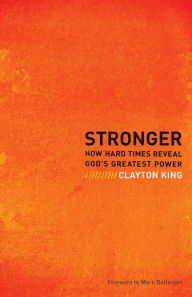
Book Review: Stronger

Stronger. Clayton King. 2015. Baker Books. 208 pages. [Source: Review copy]

I have read some great books this past year, Stronger may be one of my personal favorites. The subtitle explains why: how hard times reveal God's greatest power. Within pages, I knew that Stronger was going to be an absolutely amazing read for me. I admit it. I cried reading some sections of this one.

Here is an excerpt from his journal which he shared in the introduction:
Hard times don't make me happy, but by God's grace, they can make me holy.
Where there's no death, there can be no resurrection. Where there's no cross, there can be no empty tomb.
Peace isn't the absence of crisis. It's the presence of Christ in my crisis.
Just because I feel invisible, it doesn't mean I'm not valuable.
God works in our weakness because that's all he has to work with.
Before every triumph, there is a trial. Before every testimony, there is a test.
I can't stop when I feel stuck. I have to keep moving forward in faith that Jesus is stronger.
I want to give up, but if I'm not dead, then God's not done. If I'm still breathing, then I can keep going.
I don't have to feed every feeling. Just because I'm lonely, it doesn't mean that God has left me.
I can grow bitter or I can become better. If my pain serves the purpose of seeing Jesus more clearly and preaching the gospel more boldly, then I want to embrace it, not escape it.
I keep asking Jesus to give me something, but he keeps trying to show me something. Maybe the real gift is the revelation of his presence in my pain.
I should stop seeking happiness in my weakness and start seeking holiness. Pain has a way of purifying my motives and clarifying my calling.
God is not punishing me for failure. He is pruning me for fruitfulness.
The things that break me are the things that bring me closer to God. (15-16)
He writes clearly, honestly, powerfully. There isn't a page of Stronger where he doesn't make himself vulnerable. The book is his personal story of how God has used his pain, his grief, his suffering. These are truths learned about God, about life, the hard way. It's a compelling read, and a necessary one. For as King points out in the first chapter, we are all broken whether we admit it or not.

King is sharing his experiences with readers. It is a personal story. He writes of losing family members he loved. Of taking care of his mom and dad, but particularly his dad in his final years. These memories are intense and resonate with emotion. I think many readers can relate to his experiences, and will appreciate King's sharing. But it isn't just about him. It is never just about him. Every chapter shows readers something about God. King is challenging readers to grow in their understanding of who God is, and to reexamine how they think.

My favorite chapters were "Presence," "Vulnerability," "Worship" and "Glory."

Quotes:
None of us like to feel broken. We want to feel strong, in charge, full of courage. We want to stop feeling so frail, so human--we wish we could be unaffected by the pain of the world in and around us. We would not choose to be crushed, to feel rejected, to feel spurned. We would not choose to be heartbroken. But we don't get to choose what breaks us. We only get to choose how we respond. We can never escape our weakness. So we must embrace it. (36)
Fear must be present for faith to exist at all. Fear is the thing that calls faith out of us. The obstacle that's too big for us, the situation we can't fix, the sickness we can't cure--these bring fear to the surface. But if we look behind those fears, we will find that faith is hot on their heels. Every fear is an opportunity to have faith in God's power… Fear is actually a kind of faith; it's faith in the wrong thing, the bad thing, the worst thing. We succumb to fear when we forget that God is still there with us, in us, and for us. I think we have gotten the idea of faith all wrong. Faith does not mean the absence of fear. Faith means moving forward in the face of fear. It's owning our fear and forging ahead into an uncertain outcome. (90)

Saturday, July 19, 2008

Book Review: Safe in the Arms of God


MacArthur, John. 2003. Safe in the Arms of God.

Written for those that have lost children (either in or out of the womb), Safe in the Arms of God seeks to expand John MacArthur's theology of "Instant Heaven." It's a question he (and many other pastors and believers in general) have been asked. What happens when a baby dies? His response is and always has been "Instant Heaven." He says this not because he wants to give false assurance to grieving parents and their families, but because he believes that this is what the Word of God teaches.

Theologically, the question is what happens to those who die at an age that they are unaccountable. To those that mentally (physically, emotionally, psychologically) are unable to comprehend the gospel message, unable to have the faith to believe. In other words those that can neither receive or reject the gospel truths. (And when you think about it, there is a lot to grasp. The awareness of sin. The separation from God. The need for a Savior. The realization that Jesus, the very son of God, bridges the gap between sinful man and a holy God. The acceptance of Jesus as your Savior, as your Lord.

John MacArthur's answer may shock some. (It may not shock others.) Some may feel that the 'soul' of the baby is dependent on the faith of the parents. But MacArthur asserts that this just isn't so. He believes, and he argues within these pages, that each and every baby (and/or young child) that dies is welcomed by God into heaven. This is irrefutably good news for believers that have experienced loss in their lives. For the believer, the reunion is just a matter of time. You will see your child again. In the meanwhile, while the loss is difficult to accept, there is much comfort to be grasped in the knowledge that their child is in fact in heaven.

The book also highlights how tremendous a place heaven is. While parents may be sad, there is confidence that their child is anything but. It may sound trite, but heaven is a wonderful place. A place where there are no tears, no sadness, no pain.

Using the Bible as the basis for his theology, MacArthur argues his case quite well.

On a slightly related note, I'd suggest musically listening to "With Hope" by Steven Curtis Chapman from the Speechless album. And "Lullaby" by Andrew Peterson from the Walk album.


Blogged with the Flock Browser