Showing posts with label books read in 2020. Show all posts

Tuesday, December 29, 2020

12. KJV Bible


KJV Everyday Study Bible. 2018. Holman Bible Publishers. 1888 pages. [Source: Bought]

First sentence: In the beginning God created the heaven and the earth.

In 2020 I set out to read the Bible--in the King James translation--using the the daily M'Cheyne (Robert Murray M'Cheyne) plan. The plan has you read four chapters each day. You go through most of the Old Testament--excepting Psalms--once. (Psalms you read twice). And you read through the New Testament twice. 

I printed out a lovely chart that turned out to have MISTAKES. But I stuck with the original print out. It wasn't until I started rereading the New Testament that I noticed the plan was off from the actual-actual M'Cheyne plan. I had signed up for an email devotional and I noticed that their readings were different than mine. Since the print out and sign up for the emails were from the same site, I can only assume at some point in the year they caught their mistake(s) and fixed it. But if they let anyone know about it so they could reprint their sheets--they sure were quiet about it!!!! 

I knew I wanted to read the plan using the King James Version. I wasn't sure at the start of the year *which* Bible I would use. I have many KJV bibles. Many, many, many. I ended up going with the Everyday Study Bible. I didn't read the notes--though I read some book introductions. I liked the layout of this one. It didn't have the text broken up into SYLLABLES. (which I am not a fan of in the KJV or in any translation). It was black letter and not red letter. It was paragraph, not verse by verse. It was double column. 

The size of the font was good--not great, not horrible. But the notes were teeny teeny teeny tiny. I couldn't have read them even if I wanted to. 

For bookmarks I used four rectangles cut from CHRISTMAS WRAPPING PAPER. I really enjoyed seeing the happy candy cane stripes every day throughout the year. And since it was a thick wrapping paper, it held up better than regular paper. 


© Becky Laney of Operation Actually Read Bible

113 Psalms 90-150


Psalms 90-150 (Thru the Bible #19) J. Vernon McGee. 1977. 211 pages. [Source: Bought]

First sentence: The setting for this psalm is out there on the desert during Israel’s wanderings.

I am reading the Bible in 2020 using the daily M'Cheyne (Robert Murray M'Cheyne) plan. I thought it would add a layer of substance to in addition to the four chapters a day, to also read commentaries for those chapters. For that I am using Matthew Henry's Commentary on the Whole Bible. But the plan goes through the New Testament (and Psalms, I believe) twice. So now that I've finished Henry's commentary for the New Testament, I am tackling the New Testament commentary section of J. Vernon McGee's series.

This is not my first time reading J. Vernon McGee. I've read probably thirty or so of his commentaries. Most recently Revelation 14-22.

I really am LOVING McGee. This has been the best idea--to correspond my Bible reading with commentary reading. 

I love McGee's enthusiasm of the psalms. He doesn't spend an equal amount of time discussing/analyzing/commentating each psalm. But he always has a little something to say at least. 

I would recommend his commentaries on Psalms as a good place to start to get to know McGee.

Quotes: 
  • If you live for eighty years, it is going to be uphill all the way. We talk about coming to the “sunset” of life, but that is when you start going uphill, not downhill.
  • If you haven’t formed the habit of praising God, you should.
  • If you are going to heaven, you had better tune up, because you are going to spend a lot of time praising Him in heaven and the best place to tune up is down here.
  • I am going to make a confession to you: I can’t worship the Lord like I want to. Do you know why? This old flesh of mine can’t rise to that level. It is only by the Holy Spirit that you and I can worship the Lord in spirit and in truth.
  • We ought to recognize the fact that many of God’s choicest servants have been ill and afflicted and have never been healed in this life.
  • My friend, if God would deal with us according to our sins and according to our iniquities, none of us would be saved.
  • The psalmist does not say, “As far as the north is from the south.” That is quite a distance; but when you start moving from the east to the west, there is no end. When you start going west, you keep going west. When you go north, you eventually reach a point where you start going south, but when you go west, you never stop going west. That is how far God has removed our transgressions from us!
  • Dr. George Gill used to put it like this: “God remembers that we are dust. We forget it, and when dust gets stuck on itself, it is mud.” That is a picture of man.
  • My friend, there is something wrong with you if you cannot look back through your life and find something to thank God for.
  • A little girl has defined lovingkindness. She said, “If you ask your mother for a piece of bread and butter, and she gives it to you, that is kindness. But if she puts jam on it without you asking her, that is lovingkindness.”
  • The Lord Jesus made it very clear that the condition of the lost is a terrible thing. In John 3:36, where He gave that wonderful invitation, He also gave the other side of it; He contrasted light and darkness: “He that believeth on the Son hath everlasting life: and he that believeth not the Son shall not see life; but the wrath of God abideth on him.” I don’t know how you can make that verse any stronger. The teaching that somehow or other folks who are lost are going to have a second chance, and that there is a larger hope, and that God may have another way, is completely foreign to the Word of God, which says that the wrath of God abides on the person who has not trusted Christ. Jesus Christ endured God’s wrath for us on the cross. He did it for us, and our only way of salvation is to trust Him. If we do not, God’s wrath will be upon us.
  • God is good. God is righteous, and for that very reason He has to deal with sin. The day will come when He will make things right, and I want Him to make things right.
  • We really do not know how good God is. If we did, we would sing the Hallelujah chorus more often.
  • Oh, that God’s people would praise Him! My friend, tell somebody today that God is good, then back it up with your experience of His goodness.
  • Man is in distress and calls upon God, and God hears in mercy. It is a love song. It is a Hallel psalm. It is a simple psalm that speaks of the past sufferings of Christ in the presence of death. The night He was arrested and the day before He died the Lord sang this psalm. I wish I could have heard Him sing it!
  • It is a gracious word for those in distress and trouble. It will relieve your anxiety and dispel your doubts. The Lord Jesus sang this psalm the night before He was crucified. In verses 1–5, God hears. In verses 6–13, God helps. In verses 14–19, God is holy.
  • Gracious is the LORD, and righteous; yea, our God is merciful [Ps. 116:5]. God is merciful, but God is righteous. He cannot just arbitrarily forgive sin. He has to be right when He does it. God is the moral Ruler of this universe. He has to be right; He has to be holy; He has to be just, but He also wants to be merciful. The only way was to pay the penalty for the sin of man.
  • Return unto thy rest, O my soul; for the LORD hath dealt bountifully with thee [Ps. 116:6–7]. After a difficult, frustrating, pressure-filled day, we need to seek out a quiet place where we can confess our sins, read the Word, and talk with God. That is the sanctuary of the soul. Oh, how all of us need this—“Return unto thy rest, O my soul.” This will enable us to walk out and face the world for God.
  • Precious in the sight of the LORD is the death of his saints [Ps. 116:15]. Precious was the death of Christ to God. Precious will be the deaths of those who lay down their lives as martyrs during the Great Tribulation period, and many will do so. I am not sure but what we can apply this today. The death of God’s children is precious in His sight.
  • Psalm 117 is a tremendous psalm. It is like an atom bomb in the midst of the psalms, and when this little bomb explodes, you won’t find a postmillennialist or an amillennialist anywhere, for it will blow them all away. The fulfillment of this psalm will come during the Millennium when Christ reigns on this earth—and not before.
  • Praise to the Word of God We come now to the longest psalm and the longest chapter in the Bible. It has in it 176 verses, and every verse (with the possible exception of two verses) is praise to the Word of God.
  • Oh, that you and I might put an emphasis upon the Word of God. As believers, we need to put the emphasis where God puts it. In our day there is too much emphasis upon programs and methods and ceremonies and church activities.
  • Our emphasis should be on the Word of God, because that is the only thing He has promised to bless.
  • He has never promised to bless me or my ministry or any other ministry, but He has promised to bless His Word.
  • my friend, if you receive life from the dead—if you receive eternal life—it will come through the Word of God. “Being born again, not of corruptible seed, but of incorruptible, by the word of God, which liveth and abideth for ever” (1 Pet. 1:23). We are begotten by the Word of God that reveals Jesus Christ. God’s Word will bring life to you, it will bring liberty to you, it will bring joy to you, and it will bring blessing to you.
  • Oh, that we would seek God with the whole heart—not halfheartedly.
  • Thy word have I hid in mine heart, that I might not sin against thee [Ps. 119:11]. Many people believe that this verse only means that Scripture should be memorized. I think memorizing God’s Word is a wonderful thing, but some of the meanest little brats I have seen in Sunday school were the ones who could stand up and quote one hundred verses of Scripture.
  • God’s mercy is channeled to us—the pipe that brings it to us is the Word of God. Therefore, the psalmist says: And I will delight myself in thy commandments, which I have loved [Ps. 119:47]. Does it give you joy to read the Word of God? Do you love the Bible? If you don’t love God’s Word, ask Him to give you a love for it. I did that for years. I prayed, “Lord, give me a love for your Word.” I was not brought up in a home where I heard the Word of God, and it took me a long time to become interested in it.
  • Have you ever thanked God in the middle of the night for His Word? Well, wake up tonight and do it.
  • Thy hands have made me and fashioned me: give me understanding, that I may learn thy commandments [Ps. 119:73]. God made us. He knows exactly what we need. One of our basic needs is His Word, and that is what the psalmist is talking about here.
  • He meditated in God’s Word because he loved it, and then he loved it even more because he meditated in it.
  • Each of us should use the Word of God personally, practically, and habitually as we make our way through this dark world.
  • How much time do you spend reading the newspaper, or reading trash, in comparison to the time that you spend reading the Bible? God is telling us, through the psalmist, that He hates vain thoughts.
  • If you spend time in the Word of God, the day will come when you will not be interested in a lot of the trash that is published.
  • The only thing that can revive us is God’s Word. Dwight L. Moody said that the next great revival will be a revival of the Word of God.
  • As long as the Word of God is in your heart, my friend, as long as there is a longing deep within you to come to God, the Shepherd is out looking for you. He will put you on His shoulder and bring you back into the fold. Psalm 119 is a glorious psalm. It glorifies the Word of God which is the foundation of all liberty. And it reveals the Savior—“If the Son therefore shall make you free, ye shall be free indeed” (John 8:36). Oh, what liberty the Word of God will give to your heart and life!
  • Praise the LORD; for the LORD is good: sing praises unto his name; for it is pleasant [Ps. 135:1–3]. We do not say enough that God is good. My friend, have you told anyone today that God is good? Oh, He is good! This is a call to praise Him.
  • Every verse in this psalm mentions the mercy of God. It exalts God’s mercy. In Ephesians 2:4 Paul says, “But God, who is rich in mercy, for his great love wherewith he loved us.” I want mercy from God, and He is rich in it. I receive many letters from folks who tell me they have committed some sin. They ask, “Do you think God will forgive me?” Friend, He is rich in mercy. Have you called on Him? If you really want forgiveness, He will give it to you. He deals with us according to His mercy.
  • I don’t know about you, but I feel like saying “Hallelujah” again. How wonderful is our God. Learn to fall down before Him and worship Him. He is worthy. When you get down in the dust (and you have to get down to get up), He will lift you up with His mercy.
  • There are those who say, in a naive sort of way, “I believe the Bible from cover to cover”—yet they are ignorant of what is between the covers! This is the reason those of us who are conservative are accused of being anti-intellectual. Multitudes of conservative folk claim to believe the Bible but are ignorant of it. This is the reason I put such an emphasis on teaching the Word of God. It is one thing to say you believe it; it is another thing to know what it says.
  • The child of God today is a pilgrim and stranger in this world.
  • Every Christian today should have a song in his heart. I don’t say a song on his lips—David made it very clear that we’re to make a joyful noise unto the Lord.
  • But we are to sing in a strange land. God has given us a song, the song of redemption.
  • When all the sorrow and all the grief of your sin and my sin was put upon Him, He was a Man of Sorrows. But He had none of His own, for He had no sin of His own. He was made sin for us, and He was made our sin offering, completely identified with your sin and mine.
  • My friend, you and I need to examine our own hearts to see how we are worshiping God. Do we worship Him with our whole heart? One of the things which impressed me about Horatius Bonar was what he said when he went to God to repent of the coldness, the indifference, and the sin in his life. He said, “Then I went back to God and repented of my repentance.” His first confession was merely lip service, and he repented of that.
  • The LORD will perfect that which concerneth me: thy mercy, O LORD, endureth for ever: forsake not the works of thine own hands [Ps. 138:8]. This is the Old Testament way of saying, “Being confident of this very thing, that he which hath begun a good work in you will perform it until the day of Jesus Christ” (Phil. 1:6).
  • This is a theological psalm in that it reveals something of the attributes of God in relation to His creation. It reveals His omniscience, His omnipresence, and His omnipotence. These are what I call four-cylinder words, but they simply mean that God is all-knowing (omniscient), He is everywhere present (omnipresent), and He is all-powerful (omnipotent). God can do anything that is the object of His power. Sometimes the ridiculous question is asked, Can God make a rock so big that He cannot lift it? The answer to that is that God never does anything ridiculous.
  • I poured out my complaint before him; I shewed before him my trouble [Ps. 142:2]. In other words, David laid out before God everything that was in his heart and life. That is the way you and I should pray. This idea that we should “pray around” something, or rationalize in our prayers, or pray “all around Robin Hood’s barn,” is wrong. We ought to get right down to the nitty-gritty and tell God everything in our lives. David said, “I shewed before him my trouble.” My friend, you can tell Him about your temptations; you can tell Him about everything.
  • He sent His Son to the cross to pay the penalty for sin. You please Him when you accept what He has done for you.
  • God is going to intrude into human history one day. I don’t want to take a fanatical position and say that He is going to do it tomorrow, or even in this century, but the fact is that He is going to do it. Cast forth lightning, and scatter them: shoot out thine arrows, and destroy them [Ps. 144:6]. When the Lord comes again, He is coming in judgment. The whole tenor of Scripture, including the New Testament, is that the Lord is coming in judgment one day.
  • We have never been able to sing the Hallelujah chorus perfectly yet. But there is coming a day when Christ will return to this earth. The day that He comes forth will be a great day, and then the Hallelujah chorus will be sung correctly and completely.
  • “Every day will I bless thee”—this is not for only one day in the week when we go to church but for every day. There are days when we don’t feel like blessing Him. We sometimes sing, “We praise Him for all that is past, and trust Him for all that is to come.” We can change that around and sing, “We trust Him for all that is past and praise Him for all that is to come.”
  • He healeth the broken in heart, and bindeth up their wounds [Ps. 147:3]. God will do this for those who have passed through the horrors of the Great Tribulation. And, friend, He does it for you and me. He telleth the number of the stars; he calleth them all by their names [Ps. 147:4]. What a contrast! He who cares for our broken hearts is the same God who not only knows the number of the stars—a number so vast that no human figures can express it—but has a name for each one!
  • And the Scriptures say that God is a jealous God. I can’t find where He asks me to apologize for Him for this. He has created us for Himself. He has redeemed us for Himself.
  • God apparently created man for the purposes of fellowship with Himself and that man might praise Him. There is no other reason for man’s existence. What is the chief end of man? Man’s chief end is to glorify God and enjoy Him forever.
  • Worship is divine intoxication.
  • The Book of Revelation does not tell us much about heaven, but one thing we are sure about—every time we read of someone in heaven they are either getting down on their faces to worship God, or getting up off their faces from worshiping God.
  • My friend, some types of worship compare to going downtown, sitting in a department store window, and holding the hand of a mannequin in there. It has no more life in it; it has no more vitality in it than that! Oh, to have a heart that goes out to God in adoration and in love to Him!
  • A young fellow wrote a love letter to his girl. He waxed eloquent and said: “I would climb the highest mountain for you. I would swim the widest river for you. I would crawl across burning sands of the desert for you.” Then he put a P.S. at the end: “If it doesn’t rain Wednesday night I will be over to see you.” A whole lot of so-called worship is like that today. It will not take very much to keep us away from God.


© Becky Laney of Operation Actually Read Bible

Monday, December 28, 2020

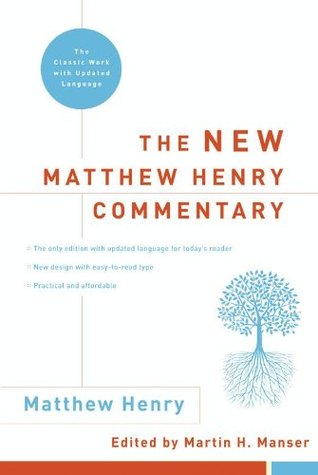
112. The New Matthew Henry Commentary


Matthew Henry's Commentary on The Whole Bible Complete and Unabridged in One Volume. Matthew Henry. Updated by Martin H. Manser. 1710 for the original. 2010? for the update. 4200 pages.  [Source: Bought]

First sentence: Here before us is the Holy Bible, or book, for this is what the word bible means. We call it the Book, for it is incomparably the best book that has ever been written: it is the book of books. We call it the Holy Book, because it was written by holy prophets, moved by the Holy Spirit. The great things of God’s Law and Gospel are here written for us, that they might be transmitted to distant lands and ages in a purer and more complete way than they could possibly be by word of mouth or tradition.

I am reading the Bible in 2020 using the daily M'Cheyne (Robert Murray M'Cheyne) plan. I thought it would add a layer of substance to in addition to the four chapters a day, to also read commentaries for those chapters. For that I am using Matthew Henry's Commentary on the Whole Bible. (Since the plan went through Psalms and the New Testament twice, I did not repeat reading those commentary chapters. Instead I chose to pick up J. Vernon McGee's Thru the Bible commentary to cover this year's second reading Psalms and New Testament.)

I would suggest for anyone that is intimidated by bible commentaries--especially one volume commentaries that cover Genesis through Revelation--to come up with a plan. I'd owned this one for several years. In fact, I'd started it several times--never truly making it past the first few books of the Bible. I know I read Genesis at least twice! By having the BIBLE PLAN I was using be my guide for tackling this CHUNKSTER commentary, I always knew just what to read and how much to read. I would read the Scripture chapters for the day and then pick up the commentary. The Scriptures were fresh on my mind. The commentary was easier to follow since I'd literally just read the Scripture.

I shared quotes each day as I read on Facebook. There are literally 1,573 highlights saved on my kindle book. (I didn't share *that* many on Facebook). There are way too many highlight to meaningfully go through and make a best of list for this post.

Just scanning some of the Genesis quotes, I'm amazed at how timeless this one is. 

  • Our duty as Christians is always to keep heaven in our sight and the earth under our feet.
  • What God requires of us he himself works in us, or it is not done. He that commands faith, holiness, and love creates them in us by the power of his grace alongside his word.
  • The One who made the soul is alone able to make it new.
  • He that made us is alone able to make us happy.
  • It adds much to the comfort of any situation if we have clearly seen God going before us and putting us into it.
  • In our best state in this world we still need one another’s help.
  • Our first parents, who knew so much, did not know this—that they knew enough.
  • The way of sin is downhill; we cannot stop ourselves when we want to.
  • Sin brought sorrow into the world; if we had known no guilt, we would have known no grief.
  • We mock God in saying that we are sorry for our sin, and that it grieves us to the heart, if we then continue to indulge in it.


© Becky Laney of Operation Actually Read Bible

111. Revelation Chapters 14-22


Revelation 14-22 (Thru the Bible Commentary Series #60) J. Vernon McGee. 1979. Thomas Nelson. 204 pages. [Source: Bought]

First sentence: This chapter contains several events. It is an interlude in which we see the Lamb on Mount Zion, hear the proclamation of the everlasting gospel, the pronouncement of judgment upon Babylon and on those who receive the mark of the Beast, then the praise for those who die in the Lord, and the preview of Armageddon.

I am reading the Bible in 2020 using the daily M'Cheyne (Robert Murray M'Cheyne) plan. I thought it would add a layer of substance to in addition to the four chapters a day, to also read commentaries for those chapters. For that I am using Matthew Henry's Commentary on the Whole Bible. But the plan goes through the New Testament (and Psalms, I believe) twice. So now that I've finished Henry's commentary for the New Testament, I am tackling the New Testament commentary section of J. Vernon McGee's series.

This is not my first time reading J. Vernon McGee. I've read probably thirty or so of his commentaries. Most recently Revelation 6-13.

I really am LOVING McGee. This has been the best idea--to correspond my Bible reading with commentary reading. 

This is NOT my first time reading McGee's commentary on Revelation. In fact, I'd say that his commentary on Revelations was one of the first of his to read way back when. (The only one that might have come first was Isaiah or Jeremiah?) 

Overall, I have enjoyed these books. I haven't always agreed with every single sentence or every single paragraph. But his insights have been at times thought-provoking or fascinating. The third volume focuses on the very end of the tribulation. It also covers the millennial reign of Christ and the New Jerusalem. 

Favorite quotes:
Let me make it clear that I make no apology for these scenes of judgment. God has not asked me to apologize for His Word. He has told me to give it out. We need to face up to the facts:1. Sin is an awful thing.2. Sin is in the world.3. You and I are sinners. The only remedy for sin is the redemption Christ offered when He shed His blood on the cross and paid the penalty for our sins.4. You and I merit the judgment of God. Our only escape is to accept the work of Christ for us on Calvary's cross. (52-53)
What God is doing may not look right to you, but if you don't think God is doing the right thing, you are wrong, not God. We need to adjust our attitudes and our thinking. (65)
As we contemplate the destruction of Babylon, we think of other great cities and civilizations of the past which have fallen. One of the most widely read books of all times is The Decline and Fall of the Roman Empire by Edward Gibbon in 1788. In it he gives five basic reasons why that great civilization withered and died:1) The undermining of the dignity and sanctity of the home, which is the basis for human society.2) Higher and higher taxes; the spending of public money for free bread and circuses for the populace.3) The mad craze for pleasure; sports becoming every year more exciting, more brutal, more immoral.4) The building of great armaments when the real enemy was within--the decay of individual responsibility.5) The decay of religion; faith fading into mere form, losing touch with life, losing power to guide the people. (117)
My friend, learning to know Him is one of the things that is going to make heaven heaven. He is so wonderful that it is going to take the rest of eternity to really know Him. The folk we meet down here are not very exciting folk when we get to know them, are they? But the more we know Jesus, the more exciting He will be. (134)

© Becky Laney of Operation Actually Read Bible

110. Revelation 6-13


Thru the Bible Commentary Series: Revelation 6-13. J. Vernon McGee. Thomas Nelson. 192 pages. [Source: Bought]

First sentence: The sixth chapter of Revelation is the great watershed, the great divide, of the Book of Revelation. Here is a division that is all-important.

I am reading the Bible in 2020 using the daily M'Cheyne (Robert Murray M'Cheyne) plan. I thought it would add a layer of substance to in addition to the four chapters a day, to also read commentaries for those chapters. For that I am using Matthew Henry's Commentary on the Whole Bible. But the plan goes through the New Testament (and Psalms, I believe) twice. So now that I've finished Henry's commentary for the New Testament, I am tackling the New Testament commentary section of J. Vernon McGee's series.

This is not my first time reading J. Vernon McGee. I've read probably thirty or so of his commentaries. Most recently Revelation 1-5.

I really am LOVING McGee. This has been the best idea--to correspond my Bible reading with commentary reading. 

This is NOT my first time reading McGee's commentary on Revelation. In fact, I'd say that his commentary on Revelations was one of the first of his to read way back when. (The only one that might have come first was Isaiah or Jeremiah?) 

The second volume covers chapters six through thirteen. These are very intense chapters! The focus is on the Great Tribulation. McGee's approach is not to read our present into the interpretation of the Scripture. So you won't see McGee arguing that these Scriptures are being fulfilled in our days. He has definite ideas on what is important and what is less important. On what it is necessary to know and what is impossible to know.

What I have come to appreciate about the Thru the Bible commentaries is that even when I don't agree with every single little detail, every little point or insight made by McGee, I still find it of benefit overall. I enjoy his writing style, his accessibility, his enthusiasm.  
 
Favorite quotes:
Do you know that the Lord Jesus is the only One who is able to judge this earth? He is the One who is able to judge, not only because of who He is—He is God manifest in the flesh—but also because of what He has done. He created this earth, and that gives Him a right. He is worshiped in chapter 4 as the Creator. But then He also redeemed this earth, and in chapter 5 He is worshiped as the Redeemer. Since He is the Creator and the Redeemer, He is the only One worthy to judge this earth. He is the only One who is able to rule this earth. What a reflection upon the consummate conceit of little men down here who want to be judges!
Antichrist does not appear as a villain. After all, Satan’s angels are angels of light. He is not going to have horns or cloven feet. Rather, he is going to be the most attractive man the world has ever seen. They will elect him, and the world will acclaim him because he has come in his own name. But when he takes over, it sure is going to be bad for the world.
When Antichrist comes to power, he is going to talk peace, and the world will think that it is entering the Millennium when it is actually entering the Great Tribulation. The Great Tribulation comes in like a lamb, but it goes out like a lion. A promise of peace is the big lie the world is going to believe.
Death evidently has an all–inclusive, three–fold meaning that we do not ordinarily attach to it. We think of death as referring only to the body. (1) This is physical death, and it refers only to the body. It comes to a man because of Adam’s sin. (2) Then there is what is known as spiritual death, which is separation from, and rebellion against, God. We inherit a dead nature from Adam; that is, we have no capacity for God and no desire for Him at all. (3) Finally, there is eternal death, which is eternal separation from God. Unless a man is redeemed, this inevitably follows. This is the second death that we will find later on in Revelation 20:14.
Since this book is the last book of the Bible, the only requirement is to have a working knowledge of the sixty–five books which go before. Then you will find that this book makes a great deal of sense and is quite logical.
Then, does anybody get saved in the Great Tribulation period? My friend, I believe that there will be a greater company saved in that period than in any other seven–year period in the history of the world.
A great company is going to be saved, and this reveals that these judgments will accomplish a purpose for God. It will cause multitudes to turn to Him in this period, and it will cause another multitude to turn against Him. It is just like the effect of the sun shining down on a piece of soft clay. What will the sun do to the clay? It will harden it. What would be the effect of that same sunlight upon wax? It would melt it. The sun has the opposite effect upon clay and wax. The judgments of God are the same. In our lives as believers, when trouble comes to us—I’ve discovered this in my own life—it will either draw us to God or drive us from Him.
The gospel is not God asking you to do something; it is God telling you that He has done something for you. The gospel is not your giving something to God; the gospel is God’s giving something to you. The gift of God is eternal life in Christ Jesus.
The Book of Revelation is the last book in the Bible because a working knowledge of the sixty–five books preceding it is the basic requirement for an understanding of its vivid language.
You do not interpret Revelation by itself; there are sixty–five books before it. 
That all of God’s men are immortal until God is through with them is a wonderful comforting thought for today. And when He is through with you, He will remove you from the earth.

In the Gospels the emphasis is on the death of Christ. In the Epistles the emphasis is upon the resurrection of Christ. In the Book of Revelation the emphasis is upon the ascension of Christ. Protestantism, and even fundamentalism, has ignored the ascension of Christ, and this is one reason we have not had a great enough emphasis upon the present ministry of Christ.

© Becky Laney of Operation Actually Read Bible

Thursday, December 24, 2020

109. Joy to the World: A Regency Christmas Collection

Joy to the World: A Regency Christmas Collection by Carolyn Miller, Amanda Barratt, and Erica Vetsch. 2020. Kregel. 336 pages. [Source: Review copy]

Joy to the World contains three holiday-themed novellas set in Regency England; the novellas are Heaven and Nature Sing by Carolyn Miller, Far as the Curse is Found by Amanda Barratt, and Wonders of His Love by Erica Vetsch. 

First sentence of Heaven and Nature Sing: THE MUTED GOLD-and-rose-flowered wallpaper of the drawing room seemed to dip and sway as Lady Grantley’s words crept past Edith Mansfield’s disbelieving ears.

Premise/plot: Edith Mansfield is attending a house party--hosted by her godmother. When she arrives she learns that her former fiance, George Bannerman, is also a guest. The two were madly in love last Christmas, unfortunately, after saying yes to his proposal, she had to take it back the next day. This
Christmas will they fall in love again? Will she get a second chance with his heart? Will he forgive her for not explaining fully why the engagement had to end? Is she still in his heart? 

My thoughts: I found this story thoroughly charming. Yes, it is a bit reminiscent of "Last Christmas," but it's super sweet and not a bit annoying. I enjoyed the characters and the plot.

First sentence of Far as the Curse is Found: EVEN THE SKY wept at the sight of him. Dwight Inglewood, the Earl of Amberly, stared out the rain-streaked window of the carriage. London, that grand and fabled city, wore the raiment of a storm. Thunder growled. Thick clouds hung low in the sky. Rain pelted the carriage roof. Pedestrians, dark-garbed blurs of movement, hurried down cobbled streets.

Premise/plot: Dwight Inglewood, our hero, wears a mask to hide his war scars; he shuns the world because he fears rejection--no, he fears repulsion. He doesn't want to be labeled a 'monster' or 'beast.' Nor is he seeking pity. He's content--for the most part--to stay hidden away in the country and remain out of sight and out of touch with the world. But this December sees him visiting London for a few days on business. And while there he rescues Jenny Grey, our heroine--not once but twice! He offers her a job--as a housekeeper in training--at his country estate (he's an earl, of course). And there's a place for her baby, Anna, as well. Can opening his heart to her friendship prepare the way for opening his heart to the wider world? Can she see past his scars and love him just the way she is? Will a few fights in the falling snow and a wondrous library work its magic?

My thoughts: This *has* to be inspired by Disney's Beauty and the Beast. It is a CHARMING and heart-warming story of second chances and redemption. I love, love, loved this one so much.

First sentence of Wonders of His Love: DID A TURTLE ever protest the restrictions of its carapace? Did the canary resent the cage, no matter how gilded, and imagine soaring through the sky? Did a sheep long to leap like a stag and escape the paddock? Cilla played another series of arpeggios on the pianoforte, letting her mother-in-law’s monologue about her various aches and dissatisfactions drift around her. This day varied little from those that had come before it, for weeks, months.

Premise/plot: This novella is set at Haverly Manor. Our heroine, Cilla Haverly, is a widow with a baby--a girl. If her baby had been a son, he'd be the heir. Alas, her husband's younger brother has inherited the title and estate. Him and his wife are expecting a child of their own soon. The mother-in-law (Cilla and Charlotte's mother-in-law) has commissioned portraits of the happy couple to be painted. Hamish Sinclair is a portraitist. He is hoping to be accepted soon in the Royal Academy of Artists. He is immediately attracted to Cilla--but is it mutual???--he can't resist drawing and sketching her and her young baby as well--even though his 'real' commission is of the duke and duchess. Will this holiday season give Cilla a voice and a choice? 

My thoughts: I LOVED, LOVED, LOVED this one. Primarily because it stars a Scots man, HAMISH SINCLAIR. Scottish dialect gets me every single time. It's one of my biggest weaknesses. Now the story is good too--solidly good. 

Overall I greatly enjoyed the three stories. 

© Becky Laney of Operation Actually Read Bible

Tuesday, December 22, 2020

108. An Ivy Hill Christmas


An Ivy Hill Christmas (Tales from Ivy Hill) Julie Klassen. 2020. 224 pages. [Source: Review copy]

First sentence: Walking past a linen draper’s, Richard Brockwell surveyed his reflection in the shop windows with approval. He cut a fine figure, although he said it himself.

An Ivy Hill Christmas revisits some of the families first introduced in Klassen's earlier Ivy Hill series. Richard Brockwell, the hero of this particular title, is going home for Christmas. Not particularly because he's family-oriented and loves Christmas, but, because he's not on good standing with his family and his 'freedom' to live a life of leisure is being threatened. (He lives in London and not near Ivy Hill). There is a house party going on--gathering single men and women together in hopes that matches will be made. Richard is bringing with him a publisher friend, David Murray, and a dog, Wally. 

The heroine, Arabella Awdry, is one of the guests at the house party. She knows one thing: Richard Brockwell is TROUBLE, TROUBLE, TROUBLE. She's not going to be tempted--not even a little bit--to socialize with him and become friendly. But how well does she really know him? 

I enjoyed this historical romance. I haven't reread the Ivy Hill books. It did take me a few chapters to reorient myself to the neighborhood. I am sure there are still things I missed because it's been a while since I read the earlier books. But. I enjoyed this one. I liked the characters and the setting. It was a good read.


© Becky Laney of Operation Actually Read Bible