Saturday, January 13, 2018

My Victorian Year #2

This week I spent time reading some J.C. Ryle's sermons and the devotional Morning and Evening by Charles Spurgeon.

The Character of the True Christian (John 10:27)
True Christians, then, are compared to SHEEP, and we shall find a great depth of meaning in the comparison if we look into it. Sheep are the most harmless, quiet, inoffensive creatures that God has made. So should it be with Christians: they should be very humble and lowly-minded, as disciples of Him who said, "Learn of me, for I am meek and lowly in heart."
They should be known as people of a very gentle and loving spirit, who desire to do good to all around them, who would not injure anyone by word or deed; who do not seek the great things of this world but are content to go straightforward on the path of duty and take whatever it shall please God to send them.
When, therefore, we see people biting and devouring one another, saying and doing uncharitable things to their neighbors, fierce, and passionate and evil-tempered and angry on the slightest occasion; full of envy and strife and bitter speaking surely we are justified in saying, "You do not belong to Christ's flock; you have yet to be born again and made new creatures; there must be a mighty change. Profess what you please, at present we can only see in you the mind of the old man, even Adam the first but nothing of the Second Adam, even Christ Jesus the Lord. We can discern the spirit of the wolf, however fair your clothing, and we want instead to discover in you the spirit of the lamb."
We must study to do good in our day and generation, and lay ourselves out for the spiritual and temporal advantage of our brethren. All can do much: it is not the rich alone, and the great, who are able to be useful; there are a hundred ways of conferring benefits beside the form of giving gold and silver; and each in his respective station can do good if he desires.
Has not a poor man a tongue? Then surely, if he is a sheep of Christ's flock, he will use it for his neighbors' profit, when occasion is afforded; he will warn and entreat and counsel and persuade; he will reason and argue, as a witness and servant of God, against sin and carelessness in every shape; he will show himself an affectionate lover of men's souls, who would gladly impart to others the knowledge he has found valuable to himself.
And then has not a poor man a feeling heart? Then surely, if he is a true sheep of Christ's flock, he will remember those who are in adversity, as being himself in the body. He will not shun the house of mourning but strive to be a comforter, bearing in mind the proverb "A word spoken in season, how good is it." He will weep with those who weep, as well as rejoice with those who rejoice. He will let men see that he is a real child of his Father in heaven, who does good to the just and the unjust too, and is kind even to the unthankful and the evil.
A genuine Gospel-faith has nothing selfish about it; it never makes a man think only of his own salvation. It stirs him up, on the contrary, to concern about the souls of others. I always suspect that those who care nothing whether their brethren are saved or not, must in reality be ignorant or thoughtless about their own state.
The last thing I would remark about sheep is this: they are of all animals most helpless, most ready to stray, most likely to lose themselves and wander out of their pasture; and so it is with Christ's people.
They imagine that they are strong enough to get on without this constant vigilance, and so they take their eye off the Chief Shepherd, and wander on from this field to that, after their own desires, until they find themselves at last in darkness and doubt. And Christ's sheep, too, like other sheep, do seldom return to the fold without some damage and loss, for it is far more easy to get out of the right way when you are in than to get into it when you are out.
Our Lord does not simply call His people sheep but He says also "My sheep." It is as though Jesus would have us understand He looks upon them as His property; they are, as it were, stamped and sealed and marked as the possession of the Lord Jesus Christ Himself, and it is a blessed, comfortable thought that even as men are careful and tender about their earthly belongings, and will not willingly allow them to be lost and damaged, so is our Lord and Savior careful of the souls that belong to Him.
We are "His" by ELECTION. We were chosen and given to Him by the Father before the foundations of the world were laid; our names were written in the covenant of salvation before we were born, we were predestined or fore-ordained to be His people from all eternity.
But again: Christ's people are "His "by PURCHASE. Death and hell had claims upon everyone of them, they had all broken the law and forfeited eternal life but Christ has redeemed them. Christ paid the heavy price of their salvation, even His own most precious blood, and well may He call them "Mine," for He has bought them off from captivity and Satan at the cost of His own life. He can say "They are Mine by fair purchase in time, as well as Mine by free election in eternity."
And lastly, Christ's people are "His" by ADOPTION. He has put His Spirit in them, and overturned the power of sin in their hearts. He has given them a child-like frame of mind, so that they cry Abba Father; they are become part of His family, the very sons and daughters of the Almighty; He looks upon them as a portion of Himself, as members of His body and flesh and bones, and loves them and cherishes them accordingly.
"My sheep" is the name that Jesus gives to Christians. "Mine" by election, by purchase, by adoption. Oh, believe: you may sometimes be cast down and faint-hearted but if you have any real interest in that blessed title, if you are really in the number of Christ's sheep, you have indeed good reason to rejoice. 
This hearing of Christ's voice, what is it? It cannot be the mere hearing of the ears, for many do that who die in their sins. It must be the hearing with the heart, the listening with attention; the believing what is heard the acting manfully on what is believed. And where may Christ's voice be heard?
To follow Christ, that is the grand mark of Christians. No man shall ever say of them, they profess and do not practice, they say and do nothing for their Master's sake; they must not only hear their Master's voice but follow Him.
To follow Christ is to place implicit trust in Him as our Redeemer, Savior, Prophet, Priest, King, Leader, Commander and Shepherd; and to walk in His ways, straightforwards.
I told you this was a text for self-inquiry; and in that light I press upon each of you now. I call upon you, O man or O woman, to put your hand upon your heart and ask that little question, "Am I a sheep of Christ's flock or am I not? Do I hear His voice or do I not? Do I follow Him or do I not?"
Remember, then, this day, I tell you, that God is willing to receive you if you will only turn to Him: if you will only resolve to think for yourself and never mind the world, if you will only hear the voice of the Lord Jesus Christ and follow Him, if you will only be in earnest and come unto Him for forgiveness and His Holy Spirit, He shall grant you your heart's desire, and you shall never perish but have eternal life.
But whether you will hear or whether you will forbear, Christ and Christ only is the way, the truth, and the life and whatever the world may tell you, no man shall ever come unto the Father but by Him.
The Privileges of the True Christian (John 10:27-29)
1. God's children, His real believing people, are compared to sheep, because they are gentle, quiet, harmless and inoffensive; because they are useful and do good to all around them; because they love to be together, and dislike separation; and lastly because they are very helpless and wandering and liable to stray.
2. Jesus calls them "My sheep," as if they were His peculiar property. "Mine," He would have us know, by election, "Mine" by purchase, and "Mine" by adoption.
3. Christ's sheep hear His voice, they listen humbly to His teaching, they take His word for their rule and guide.
4. Christ's sheep follow Him, they walk in the narrow path He has marked out, they do not refuse because it is sometimes steep and narrow--but wherever the line of duty lies they go forward without doubting.
I warn you plainly, except you will hear the voice of Christ and follow Him, you have no right or portion in this blessed fountain of consolations.
Hear now what Jesus says of His believing people: "I know them. . . . I give unto them eternal life; they shall never perish, neither shall any man pluck them out of my hand."
Before we look into the meaning of these words more closely, I wish to answer two questions which may arise in the minds of some before me. Of whom is the Lord Jesus speaking? This text may become the property of the worst of sinners if he will only hear Christ's voice and follow Him. It is for all who repent and believe the Gospel; it is for all who mourn over their past sins with a true godly sorrow, and flee to the Lord Jesus Christ with faith and prayer as their only hope, their all-sufficient Savior, their all in all. The other question I wish to answer is this: why did the Lord Jesus Christ give us this full and complete promise? Because He knew that true Christians would always be a very doubting, fearful, faint-hearted generation, always ready to believe they shall not be saved, always afraid they shall never see the New Jerusalem, because of the inbred corruption which they find continually in their hearts.
I. First, says the Lord Jesus Christ of His sheep who hear His voice and follow Him, "I know them." I know their number, their names, their particular characters, their besetting sins, their troubles, their trials, their temptations, their doubts, their prayers, their private meditations; I know everything about everyone of them.
Be comforted, all you who are tried and buffeted with difficulties in your way towards heaven, difficulties from without and difficulties from within, difficulties abroad and difficulties at home, grief for your own sins and grief for the sins of others: the Good Shepherd Jesus knows you well, though you may not think it.
You need not fear His not understanding your needs, you need not be afraid your prayers are too poor and unlearned to be attended to; He knows your particular necessities far better than you do yourselves, and your humble supplications are no sooner offered up than heard. You may sometimes sigh and mourn for lack of Christian fellowship, you may sometimes lament that you have not more around you with whom you might take sweet converse about salvation but remember there is a Good Shepherd, who is ever about your path and about your bed, His eyes are on all your movements, and no husband, brother, father, mother, sister, friend, could take more tender interest in your soul's welfare than He does.
II. What is the next part of my text? The Lord Jesus says of His sheep, "I give unto them eternal life!" What is the portion which Jesus gives His people? "eternal life"a perfect, never-ending happiness for that which is the most important part of a man his immortal soul.
III. The third promise in my text is as follows: Jesus says of His sheep, "They shall never perish!" They shall never be finally cast away, if they have once been sealed and numbered in my flock.
Where in the whole world can you find a work which the Lord has attempted, and yet been obliged to give up and leave all incomplete? Then far be it from us to suppose that a true believer can ever be cast away!
True Christians shall never perish. Are they not Christ's special property, the servants of His house, the members of His family, the children of His adoption? Then surely He will never let them be overthrown, He will watch them as tenderly as we watch over our own flesh and blood, He will guard them as we guard our valuable and precious possessions, He will cherish them as we cherish that which is most dear to our hearts; He never would have laid down His life for their sakes if He had intended to give them up.
IV. There remains one thing more. Jesus adds, "Neither shall any man pluck them out of my hand." There is assurance upon assurance, that none may have an excuse for doubting.
Are you indeed Christ's sheep? Then beware of ever trusting to yourselves; nothing offends the Good Shepherd more than to see the members of His flock, forgetting that in Him alone is all their safety, and glorying in their own attainments and performances.
Think only of your Savior Jesus Christ, trust Him entirely, love Him affectionately, look to Him continually.
As long as you lean on Him you are strong and none can touch you. Without Him and in your own might, you are weak and unstable as water.
Are you indeed Christ's sheep? Then beware of wandering from the pasture He has provided.
Charles Spurgeon's Morning and Evening:

  • Christian! do not dishonor religion by always wearing a brow of worry—come, cast your burden upon your Lord. You are staggering beneath a weight—which your Father would not feel. What seems to you a crushing burden—would be to Him but as the small dust of the scale.
  • From the moment of the new and celestial birth—the man begins to live to Christ. Jesus is to believers the one pearl of great price—for whom we are willing to part with all that we have. He has so completely won our love, that it beats alone for Him; to His glory we would live, and in defense of His gospel we would die. He is the pattern of our life, and the model after which we would sculpture our character.
  • The iniquities of our public worship—its hypocrisy, formality, lukewarmness, irreverence, wandering of heart and forgetfulness of God—what a full measure have we there! The iniquities of our work for the Lord—its ambition, selfishness, carelessness, slackness, unbelief—what a mass of defilement is there! Our private devotions—their laxity, coldness, neglect, sleepiness, and vanity—what a mountain of dead earth is there! If we looked more carefully—we would find this iniquity of the holy things, to be far greater than appears at first sight.
  • Just so, while Jesus bears our sin, He presents before His Father’s face, not our unholiness—but His own holiness. O for grace to view our great High Priest by the eye of faith!
  • Nothing gives the believer so much joy—as fellowship with Christ. He has enjoyment as others have, in the common mercies of life; he can be glad both in God’s gifts and God’s works.
  • The joy of the Lord is solid and enduring.
  • The capacity of our desires—who can measure? but the immeasurable wealth of God can more than overflow it. I ask you—if you are not complete—when God is yours? Do you need anything but God? Is not His all-sufficiency enough to satisfy you—if all else should fail?
  • Delight in divine service is a sign of acceptance with God. Those who serve God with a sad countenance, because they do what is unpleasant to them, are not serving Him at all; they bring the form of homage—but the life is absent. Our God requires no slaves to grace His throne; He is the Lord of the empire of love, and would have His servants dressed in the livery of joy.
  • Cheerfulness is the support of our strength; in the joy of the Lord, we are strong. Joy acts as the remover of difficulties.
  • I love the quaint saying of a dying man, who exclaimed, “I have no fear of going home; I have sent all before me; God’s finger is on the latch of my door, and I am ready for Him to enter.” “But,” said one, “are you not afraid lest you should miss your inheritance?” “Nay,” said he, “nay; there is one crown in heaven, which the angel Gabriel could not wear—it will fit no head but mine. There is one throne in heaven which Paul the apostle could not fill—it was made for me, and I shall have it.”
  • Remember, that to receive the Word in the ear is one thing—and to receive Jesus into your very soul is quite another.
  • How encouraging is the thought of the Redeemer’s never-ceasing intercession for us. When we pray—He pleads for us. And when we are not praying—He is advocating our cause, and by His supplications shielding us from unseen dangers.
  • We little know what we owe to our Savior’s prayers! When we reach the hill-tops of heaven, and look back upon all the way whereby the Lord our God has led us—how we shall praise Him who, before the eternal throne, undid the mischief which Satan was doing upon earth. How shall we thank Him because day and night, He pointed to the wounds upon His hands, and carried our names upon His breastplate!
  • Mercy outruns malice.
  • “You are Christ’s.” You are His by donation—for the Father gave you to the Son. You are His by His bloody purchase—for He paid the price for your redemption. You are His by dedication—for you have consecrated yourself to Him. You are His by relation—for you are named by his name, and made one of His brethren and joint-heirs.
  • If you are of a nervous temperament and of retiring disposition, take care that you do not too much indulge this trembling propensity, lest you should be useless to the church. Seek in the name of Him who was not ashamed of you—to do some little violence to your feelings, and tell to others what Christ has told to you. If you cannot speak with trumpet tongue, use the still small voice. If the pulpit must not be your tribune, if the press may not carry your words on its wings—yet say with Peter and John, “Silver and gold have I none—but such as I have, I give you.”


© Becky Laney of Operation Actually Read Bible

Friday, January 12, 2018

Book Review: The Lacemaker

The Lacemaker. Laura Frantz. 2018. Revell. 416 pages. [Source: Review copy]

First sentence: Elisabeth took a breath, breaking an intense hour of concentration. Mindful of the pinch of her stays, she straightened, the ache in her back and shoulders easing. In her apron-clad lap was the round pillow with the new lace she'd worked.

Premise/plot: The Lacemaker is Laura Frantz's newest historical novel; it is set in Virginia in 1775-76. Elisabeth Lawson, our heroine, has grown up in an unhappy--though extremely privileged--home.

Her mother and father have VERY different political views. Elisabeth has always proven herself to be a submissive and obedient daughter, unlike her mother perhaps. She's even agreed to a loveless arranged marriage with a scoundrel. But the political turmoil "caused" by the dispute between Loyalists and Independence Men threaten her marriage before it can even take place.

Several days before her wedding, her father runs away essentially--he takes flight with several other prominent loyalists--leaving her behind. He assumes, perhaps, that her fiancé will go through with the marriage, take her into his home, protect and look after her. After all, the dowry has been paid, the betrothal publicly and extravagantly celebrated. Miles isn't such a good guy. His cousin is, however. And it is into his home that she goes, taking her indentured maid with her. His name is Noble Rynallt; he's a patriot, an "Independence" man.

But will she remain under his care and protection? Or will she struggle to find her own independence? Can a woman make a respectable living for herself? Maybe--maybe not. It doesn't help that her father was a very prominent (though unpopular) Loyalist. The town is in many ways glad to be rid of him and see little use for his daughter.

This novel is all about new beginnings and self-discovery.

My thoughts: I loved, loved, loved, LOVED Laura Frantz's newest book. She is one of my favorite authors; though I don't love every single novel equally. This isn't my absolute favorite time period. But that didn't end up mattering very much in the end. The characterization was well done; the romance was just right. I cared about the characters, found the book to be well-paced, and enjoyed it cover to cover. The Welsh hero was swoon-worthy.

© Becky Laney of Operation Actually Read Bible

Thursday, January 11, 2018

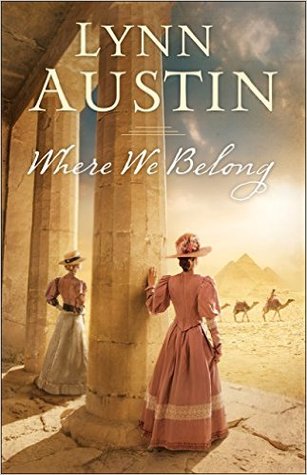
Book Review: Where We Belong

Where We Belong. Lynn Austin. 2017. Bethany House. 480 pages. [Source: Review copy]

First sentence: Rebecca Hawes lay awake in her tent, convinced that the howling wind was about to lift her entire camp into the air and hurl it to the far side of the desert.

Premise/plot: Where We Belong tells the story of two adventuring sisters Rebecca and Flora Hawes. The novel opens in the Sinai Desert in 1890, the sisters are on a quest to find ancient manuscripts. In particular, Becky is looking for ancient copies of the New Testament. She has, by this point, co-written several books on her archaeological discoveries. She's hoping that a new discovery will help skeptics believe that the Bible is reliable and reasonable.

The story line set in 1890 is packed with action and adventure. But the book doesn't stay in 1890, in fact it is dominated by flashbacks--flashbacks for four main characters: Becky, Flora, Soren, and Kate. The earliest flashbacks take us back to the school years of Becky and Flora and how their love of 'adventure' began when they were still teens. (Their first adventure being skipping school and exploring Chicago.)

The two sisters--in particular Becky Hawes--are unconventional in many ways. The two share a love for traveling the world, learning new languages, bargaining with the natives and picking up souvenirs. The two also share concern for others. Flora has a heart for the poor, particularly orphaned and abandoned children. Becky has a heart for the lost. She sees her love of archaeology being in line with that concern. Her work may remove barriers keeping people from believing that the Bible is the true word of God. That's how she sees it anyway. Both sisters have a strong faith in God.

My thoughts: I liked this one. I didn't love, love, love it. I honestly thought it was a bit too long. The story set in 1890 was compelling, but the flashbacks were not equally so. In fact, I found some of the flashbacks to be more tedious than not. (Not all the flashbacks lacked action; one sequence takes readers to the Chicago Fire.)

I found it interesting that this one is based very loosely on real sisters--Agnes and Margaret Smith. But the authors note makes it clear that it is VERY loosely based. Agnes and Margaret Smith were Scottish, not American, and most of the book is complete fiction.

© Becky Laney of Operation Actually Read Bible
Wednesday, January 10, 2018

Book Review: Good News

Good News: The Gospel of Jesus Christ. John MacArthur. 2018. Reformation Trust. 148 pages. [Source: Review copy]

First sentence: Who is Jesus? It’s a very basic question, but one that many struggle to answer. Virtually all the world’s religions and philosophies attempt to identify Him: as a gentle prophet, a faithful wise man, a spiritual teacher, or a social revolutionary ahead of His time. Others position Him as a sorcerer or a demigod, with access to supernatural power but subordinate to a greater divine overseer. Still others skirt the biblical accounts, treating Jesus as a great man whose legend has grown through myth and folklore—almost like a first-century Paul Bunyan.

Does the world need another book about the gospel of Jesus Christ? The good news never loses relevancy; it is ever-true. The lost of the world need to hear the good news just as much as they ever did. The truth is, however, that the lost of the church need to hear the good news too. And that is, in part, what this one is about: Recovering the good news for the church itself, or, distinguishing the true good news from various false gospels that are abundant.

This one has six chapters: "Jesus is the Messiah," "Jesus is Holy," "Jesus is the Only Way," "Jesus is the Redeemer," "Jesus is Righteous," and "Jesus is the Head of the Church." All the chapters address the question first asked: Who is Jesus? Answering that question correctly is a matter of life and death, and that is no exaggeration.

The book is concise and clear, though not without potential to offend. The truth is the good news of Jesus Christ is by its very nature offensive to the soul(s) that are perishing. The truth should be proclaimed, but proclaimed with love and in love. Those that have received the good news--been transformed by the good news--should be eager--zealous--to share the good news. MacArthur argues that there is no such thing as private faith.

I would also say the book is thought-provoking. The gospel should make you think, reflect, consider, reconsider. The gospel should not be taken for granted, put aside, seen as simple or childish.

Favorite quotes:
We will never deal honestly with our sins until we have seen a vision of the holiness of God and Christ. And on this side of Christ’s redeeming work, we live in the joyful assurance that the One who is so frightening is the same One who has paid the price for our sins in full, and whose holy justice has been satisfied. And amazingly, He still can use us to bring the light of His gospel to a world blinded by sin. 
May we always be stunned by this calling to represent the holy Christ, of whom we are not worthy, but in whom we shall eternally rejoice. 
Historically, the message of Christianity has always been the message of faith in Christ. The objective content of that message is found in Scripture. Since the New Testament era, true Christians have always believed that the only way sinners can be rescued from hell and be reconciled to God is through the gospel of Jesus Christ. For centuries, Christians have given their lives and shed their blood to make that message known. They have spent their fortunes to send missionaries to the farthest corners of the world. In many cases, those missionaries gave their lives to spread that exclusive and unique message. Throughout church history, the core message of Christianity has always been that salvation comes only to those who believe the truth about the person and work of Jesus Christ and receive it by faith alone. 
If you’re ashamed of the gospel, it’s a strong indication that you have yet to believe it. True, saving faith must not be hidden away. It ought to be the most public thing about you.
That’s what I do—I tell people how to be reconciled to God. It’s my job; it’s my life. And it’s yours, too, if you’ve been reconciled to God through Christ. That’s what Christians do—it’s our primary function. We preach the forgiveness of sins and redemption by God through the shed blood of Jesus Christ.
From the human side, hell is inevitable. Damnation will occur. As hopeless sinners, we are dead—unable to awaken ourselves, shed our blindness, or bend the knee to God. There’s nothing we can do to shift the affections of the heart away from sin and toward the Lord. As sinners, our destination is eternal punishment. 
The only reason God has kept us in the world is for the work of evangelism. Yes, we’re saved to worship, but God tolerates our imperfect worship on this side of eternity for the sake of adding to His kingdom. We’re also saved to be sanctified, but God tolerates our inadequate, incomplete sanctification to keep us here to evangelize. He endures all our consistent errors and failures because He has work for us here that we cannot accomplish in heaven. 
God doesn’t just ignore our past offenses—He obliterates them. He forgives perfectly, completely, and eternally. That’s what it means to be reconciled to Him—He has dealt with our sins once and for all. Through His gracious forgiveness, our sins are gone for good. 
All the judgment, all the torment, all the excruciating punishment was poured out on Christ as He died in our place. That’s a breathtaking reality, especially when you consider that Jesus was only on the cross for about three hours. In that brief window of time, Christ paid for all the sins of all those whom God would one day reconcile to Himself. In the span of a scant few hours, He was “offered once to bear the sins of many” (Heb. 9:28). “He was pierced through for our transgressions, He was crushed for our iniquities; the chastening for our well-being fell upon Him, and by His scourging we are healed” (Isa. 53:5). 
Salvation isn’t merely addition. God’s work of salvation is not simply stacking a new nature on top of our old nature. Our old selves have died, and through God’s power, we are entirely new creatures. In fact, the transformation that takes place in salvation is more dramatic and radical than the change we will undergo when we pass from this life into eternity. 
Like justification, sanctification originates in the free grace of God. In fact, our sanctification begins simultaneously with our justification—in the moment God declares us righteous, He also begins to refine us through the process of sanctification. Both are also tied to the work of Christ—He is the source of our pardon and our purification. In sanctification, we break the sinful patterns of our former selves and grow in conformity to the likeness of Christ. The two realities are always linked—you can’t be sanctified without being justified, and if you aren’t being sanctified, there’s no reason to believe you’ve truly been justified. 
In justification, the sinner is counted righteous because Christ’s righteousness has been imputed to him. In sanctification, the sinner is actually being made righteous, though to a limited degree, through the work of the Spirit. Furthermore, our works play no part in justification, while they do play an important part in our sanctification. God commands us to “work out [our] salvation with fear and trembling” (Phil. 2:12). Finally, justification is an instantaneous and finished work—it doesn’t grow, deepen, or improve in any way. On the other hand, sanctification is the progressive process by which God’s people are always growing in godliness and spiritual maturity. It’s an imperfect work, lasting for the rest of our lives, always incomplete until our glorification.  
© Becky Laney of Operation Actually Read Bible
Tuesday, January 9, 2018

Book Review: What Can We Know About God?

What Can We Know About God? R.C. Sproul. 2017. Reformation Trust. 53 pages. [Source: Review copy]

First sentence: Several years ago, a well-known Christian school invited me to address the faculty and administration on this question: “What is a Christian college or university?” Upon my arrival, the dean gave me a tour of the campus. During the tour, I noticed this inscription on a set of office doors: “Department of Religion.” When it came time to address the faculty that evening, I mentioned the inscription I had seen, and I asked whether the department had always been called by that name. An older faculty member replied that years ago the department had been called the “Department of Theology.” No one could tell me why the department name had been changed.

What Can We Know About God? is the twenty-seventh book in the Crucial Questions series by R.C. Sproul. Many of the books in this series are available as free ebooks for kindle. Most of the books are quite short. This is probably for the best since not every believer is an active reader. What Can We Know about God? is even shorter, in my opinion, than some of the other books in the series. If I'd been writing the book, it would have been even shorter.

The question Sproul asks is: What Can We Know About God?

The answer Sproul gives is essentially: What we can know about God is what God has revealed to us within his Holy Word. Sproul then begins an extremely basic review of a few of the attributes of God which we learn through Scripture.

Sproul has written other books--longer books, more detailed books--that address these same questions. The book feels very familiar, like I've read it before--from Sproul--in nearly the same words. That is possible. I've heard a lot of sermons by Sproul. I've read a handful of books written by Sproul.

I would recommend this one to Christians who are not big readers but who genuinely have questions about the faith.

Favorite quotes:
God does not speak to us in His language; He speaks to us in ours. And because He speaks to us in the only language we can understand, we are able to grasp it.
God is never required to be merciful or gracious. The moment we think that God owes us grace or mercy, we are no longer thinking about grace or mercy. Our minds tend to trip there so that we confuse mercy and grace with justice. Justice may be owed, but mercy and grace are always voluntary.


© Becky Laney of Operation Actually Read Bible
Monday, January 8, 2018

True or False with the Puritans #1

True or False with Matthew Henry

TRUE OR FALSE. Our duty as Christians is always to keep heaven in our sight and the earth under our feet.

TRUE OR FALSE. God is not only the author of everything living, but the fountain of life and spring of every change. Dead matter would remain dead if he did not bring it alive. And this makes us believe that it is possible for God to raise the dead.

TRUE OR FALSE. What God requires of us he himself works in us, or it is not done. He that commands faith, holiness, and love creates them in us by the power of his grace alongside his word.

TRUE OR FALSE.  The One who made the soul is alone able to make it new.

TRUE OR FALSE. It adds much to the comfort of any situation if we have clearly seen God going before us and putting us into it.

TRUE OR FALSE.  None of us was sent into the world to be lazy. The One who made these souls and bodies has given us something to work with; the One who made us living wants us to labor, to serve him and our society, and to work out our salvation. It is the will of God that each one of us should have something to do in this world.

TRUE OR FALSE. Those that would not eat the forbidden fruit must not go near the forbidden tree.

TRUE OR FALSE. Satan teaches people first to doubt and then to deny; he makes them skeptics first, and so gradually makes them atheists.

TRUE OR FALSE. Our first parents, who knew so much, did not know this—that they knew enough.

TRUE OR FALSE. Satan may tempt, but he cannot force; he may persuade us to throw ourselves down, but he cannot throw us down (Mt 4:6).

TRUE OR FALSE. The way of sin is downhill; we cannot stop ourselves when we want to.

TRUE OR FALSE. Although God knows all our sins, yet he wants to know them from us, and requires from us a simple confession of them; not so that he may be informed, but that we may be humbled.

TRUE OR FALSE. Sin deceives us, and, by deceiving, cheats us. It is by the deceitfulness of sin that the heart is hardened.

TRUE OR FALSE. No sooner was the wound given than the remedy was provided and revealed.

TRUE OR FALSE. Sin brought sorrow into the world; if we had known no guilt, we would have known no grief.

TRUE OR FALSE. Our aim in all acts of religion is God’s acceptance: we do well if we reach this, and we worship in vain if we miss it (2Co 5:9).

TRUE OR FALSE. So close are sin and punishment that the same word in Hebrew signifies both. If sin is harbored in the house, the curse waits at the door, like a bailiff ready to arrest sinners whenever they look out.

TRUE OR FALSE. Adam’s eating the forbidden fruit seemed just a little sin, but it opened the door to the greatest.

TRUE OR FALSE. Those that reject God cannot find rest anywhere else.

I have found reading Matthew Henry's Commentary on the Whole Bible to be profitable. These quotes are from his commentary covering Genesis 1-4. I find each quote that I've selected is worth pondering and meditating on.

© Becky Laney of Operation Actually Read Bible

Saturday, January 6, 2018

Week in Review: December 31-January 6

KJV Readers Bible

  • 2 Chronicles 
  • Ezra
  • Nehemiah
  • Esther
  • Ecclesiastes
  • Song of Solomon
  • Isaiah
  • Matthew
  • James


© Becky Laney of Operation Actually Read Bible