Showing posts with label Matthew Henry. Show all posts

Monday, December 28, 2020

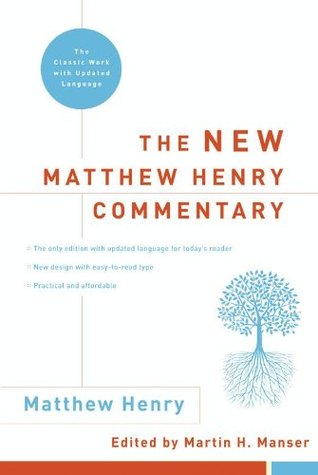
112. The New Matthew Henry Commentary


Matthew Henry's Commentary on The Whole Bible Complete and Unabridged in One Volume. Matthew Henry. Updated by Martin H. Manser. 1710 for the original. 2010? for the update. 4200 pages.  [Source: Bought]

First sentence: Here before us is the Holy Bible, or book, for this is what the word bible means. We call it the Book, for it is incomparably the best book that has ever been written: it is the book of books. We call it the Holy Book, because it was written by holy prophets, moved by the Holy Spirit. The great things of God’s Law and Gospel are here written for us, that they might be transmitted to distant lands and ages in a purer and more complete way than they could possibly be by word of mouth or tradition.

I am reading the Bible in 2020 using the daily M'Cheyne (Robert Murray M'Cheyne) plan. I thought it would add a layer of substance to in addition to the four chapters a day, to also read commentaries for those chapters. For that I am using Matthew Henry's Commentary on the Whole Bible. (Since the plan went through Psalms and the New Testament twice, I did not repeat reading those commentary chapters. Instead I chose to pick up J. Vernon McGee's Thru the Bible commentary to cover this year's second reading Psalms and New Testament.)

I would suggest for anyone that is intimidated by bible commentaries--especially one volume commentaries that cover Genesis through Revelation--to come up with a plan. I'd owned this one for several years. In fact, I'd started it several times--never truly making it past the first few books of the Bible. I know I read Genesis at least twice! By having the BIBLE PLAN I was using be my guide for tackling this CHUNKSTER commentary, I always knew just what to read and how much to read. I would read the Scripture chapters for the day and then pick up the commentary. The Scriptures were fresh on my mind. The commentary was easier to follow since I'd literally just read the Scripture.

I shared quotes each day as I read on Facebook. There are literally 1,573 highlights saved on my kindle book. (I didn't share *that* many on Facebook). There are way too many highlight to meaningfully go through and make a best of list for this post.

Just scanning some of the Genesis quotes, I'm amazed at how timeless this one is. 

  • Our duty as Christians is always to keep heaven in our sight and the earth under our feet.
  • What God requires of us he himself works in us, or it is not done. He that commands faith, holiness, and love creates them in us by the power of his grace alongside his word.
  • The One who made the soul is alone able to make it new.
  • He that made us is alone able to make us happy.
  • It adds much to the comfort of any situation if we have clearly seen God going before us and putting us into it.
  • In our best state in this world we still need one another’s help.
  • Our first parents, who knew so much, did not know this—that they knew enough.
  • The way of sin is downhill; we cannot stop ourselves when we want to.
  • Sin brought sorrow into the world; if we had known no guilt, we would have known no grief.
  • We mock God in saying that we are sorry for our sin, and that it grieves us to the heart, if we then continue to indulge in it.


© Becky Laney of Operation Actually Read Bible

Thursday, August 30, 2018

Book Review: Commentary on Genesis

"Commentary on Genesis." From Matthew Henry's Commentary on The Whole Bible Complete and Unabridged in One Volume. Matthew Henry. Updated by Martin H. Manser. 1710 for the original. [Source: Bought]

We have now before us the holy Bible, or book, for so bible signifies. We call it the book, by way of eminency; for it is incomparably the best book that ever was written, the book of books, shining like the sun in the firmament of learning, other valuable and useful books, like the moon and stars, borrowing their light from it. We call it the holy book, because it was written by holy men, and indited by the Holy Ghost; it is perfectly pure from all falsehood and corrupt intention; and the manifest tendency of it is to promote holiness among men. The great things of God’s law and gospel are here written to us, that they might be reduced to a greater certainty, might spread further, remain longer, and be transmitted to distant places and ages more pure and entire than possibly they could be by report and tradition: and we shall have a great deal to answer for if these things which belong to our peace, being thus committed to us in black and white, be neglected by us as a strange and foreign thing, Hos. 8:12. The scriptures, or writings of the several inspired penmen, from Moses down to St. John, in which divine light, like that of the morning, shone gradually (the sacred canon being now completed), are all put together in this blessed Bible, which, thanks be to God, we have in our hands, and they make as perfect a day as we are to expect on this side of heaven. Every part was good, but all together very good. This is the light that shines in a dark place (2 Pet. 1:19), and a dark place indeed the world would be without the Bible.

Genesis is easily one of my favorite books of the Old Testament. Every time I begin a new Bible project, Genesis is my favorite place to begin. Likewise, Revelation is my favorite place to finish. I may read the other sixty-four books in any order, but Genesis and Revelation are my book ends.

I have read a few commentaries on the book of Genesis. My latest to read was by Matthew Henry. He began with a few introductory remarks about the Bible in general and then proceeded on to Genesis.

The edition of the commentary I read did not include the text of the Bible. (I imagine some do.) It is broken down into chapters, and within each chapter it is arranged by verses. The book includes summary or highlights for each section. The arrangement seems to be entirely in outline form. At first I found this slightly odd. But the more I read, the more accustomed I became to the style. I think perhaps Puritans did this quite a bit with their sermons. (I've also read some Thomas Manton and John Owen.)

I will point out one little thing. While I agree with Henry's overall theology most of the time, I do disagree with him here and there. In particular, I (strongly) disagree with his assessment that Dinah--Jacob's daughter who was raped--was asking for it. His argument is that Dinah was in the wrong and that if she'd just stayed at home--near her home and the protection of her father and brothers, she'd never have been raped. Not content to just blame Dinah, he also finds a way to blame her mother, Leah, for encouraging her daughter's "vain curiosity." He writes, "SHE WENT TO BE SEEN." His application is that fathers should exercise great(er) authority over their families and in particular their daughters.

At best, Henry's remarks are 99.9% speculation. The Bible simply says that Dinah "went out to visit the women of the land." In the next verse, we're told: Shechem saw her, took her, raped her. Henry's argument it seems is that the sin that started it all was the sin of being seen. He speculates that Dinah wanted to be seen. That she was seeking attention and flattery.  That she was inviting men to approach her. That if she'd taken care not to be seen by men, then she'd never have been raped.

Here are some of my favorite quotes:


  • Our duty as Christians is always to keep heaven in our sight and the earth under our feet.
  • God is not only the author of everything living, but the fountain of life and spring of every change. Dead matter would remain dead if he did not bring it alive. And this makes us believe that it is possible for God to raise the dead.
  • What God requires of us he himself works in us, or it is not done. He that commands faith, holiness, and love creates them in us by the power of his grace alongside his word.
  • The glory and goodness, the beauty and harmony, of God’s works, both of providence and grace, will best appear when they are perfected. So the lesson is: judge nothing before the right time.
  • The One who made the soul is alone able to make it new.
  • It adds much to the comfort of any situation if we have clearly seen God going before us and putting us into it.
  • None of us was sent into the world to be lazy. The One who made these souls and bodies has given us something to work with; the One who made us living wants us to labor, to serve him and our society, and to work out our salvation.
  • Satan teaches people first to doubt and then to deny; he makes them skeptics first, and so gradually makes them atheists. He could not have persuaded them to run the risk of ruining themselves if he had not suggested to them a great probability of improving themselves.
  • Our first parents, who knew so much, did not know this—that they knew enough.
  • Satan may tempt, but he cannot force; he may persuade us to throw ourselves down, but he cannot throw us down (Mt 4:6).
  • The way of sin is downhill; we cannot stop ourselves when we want to.
  • What a dishonor and restlessness sin brings; it causes trouble wherever it is admitted. What a deceiver Satan is. He told our first parents, when he tempted them, that their eyes would be opened; and so they were, but not as they understood it; they were opened to their shame and grief.
  • Although God knows all our sins, yet he wants to know them from us, and requires from us a simple confession of them; not so that he may be informed, but that we may be humbled.
  • A perpetual quarrel is here begun between the kingdom of God and the kingdom of the Devil among human beings. It is the fruit of this enmity that there is a continual conflict between grace and sin in the hearts of God’s people and that there is similarly a continual struggle between the wicked and the godly in this world.
  • A gracious promise is here made of Christ, as the deliverer of fallen humanity from the power of Satan. It was said in the earshot of our first parents, who, doubtless, saw a door of hope opened to them. Here was the dawning of the Gospel day. No sooner was the wound given than the remedy was provided and revealed. They are told three things concerning Christ: His incarnation, that he would be the seed of the woman, the offspring of that woman; therefore his genealogy (Lk 3:23-38) goes so far as to show him to be the son of Adam, but God does the woman the honor to call him rather her offspring, because it was she whom the Devil had deceived, and Adam had laid the blame on her. In this we can see that God magnifies his grace, in that, though the woman was first in the rebellion, it is she who will be saved by childbearing, that is, by the promised offspring who will descend from her (1Ti 2:15). He was similarly to be the offspring of a woman only, of a virgin. His sufferings and death, pointed at in Satan’s bruising his heel, that is, his human nature. Satan tempted Christ in the wilderness, to draw him into sin; and some think it was Satan that terrified Christ in his agony, to drive him to despair. It was the Devil that put it into the heart of Judas to betray Christ, of Peter to deny him, of the chief priests to try him, of the false witnesses to accuse him, and of Pilate to condemn him. In all this, they aimed at destroying the Savior, and so destroying salvation. But on the contrary, it was by death that Christ destroyed him that had the power of death (Heb 2:14). Christ’s heel was bruised when his feet were pierced and nailed to the cross, and Christ’s sufferings are continued in the sufferings of the saints for his name. His victory over Satan in this. Satan had now trampled on the woman, and insulted her; but the offspring of the woman would be raised up in the fullness of time to triumph over him (Col 2:15). He shall bruise his head, that is, he shall destroy all his schemings and all his powers, and overthrow completely his kingdom and concerns. Christ thwarted Satan’s temptations; by his death, he gave a fatal blow to the Devil’s kingdom, a wound to the head of this Beast that can never be healed.
  • Sin brought sorrow into the world; if we had known no guilt, we would have known no grief.
  • How wonderfully the satisfaction our Lord Jesus made by his death and sufferings fulfills the sentence here passed on our first parents. Did travailing pains come in with sin? We read of the travail of his soul, the soul of Christ, the suffering servant (Isa 53:11). Did subjection come in with sin? Christ was born under law (Gal 4:4). Did the curse come in with sin? Christ became a curse for us, died a cursed death (Gal 3:13). Did thorns come in with sin? He was crowned with thorns for us. Did sweat come in with sin? For us his sweat was like drops of blood. Did sorrow come in with sin? He was a man of sorrows, in his agony his soul was extremely sorrowful. Did death come in with sin? He became obedient to death. And so the plaster covers the whole wound completely. Blessed be God for Jesus Christ!
  • It is the will of God that each one of us should have something to do in this world.
  • So close are sin and punishment that the same word in Hebrew signifies both.
  • If sin is harbored in the house, the curse waits at the door, like a bailiff ready to arrest sinners whenever they look out.
  • Adam’s eating the forbidden fruit seemed just a little sin, but it opened the door to the greatest.
  • Those that reject God cannot find rest anywhere else.
  • The human race is not its own maker, therefore we must not be our own master; but the Author of our being must be the director of our activities and the center of them.
  • True religion; what is godliness, but walking with God? The ungodly and worldly are without God in the world, they walk contrary to him: but the godly walk with God, which presupposes reconciliation with God, for two cannot walk together except they be agreed (Am 3:3).
  • To walk with God is to set God always before us, and to act as those that are always under his eye. It is to live a life of fellowship with God both in worship of him and wisdom in our dealings with others. It is to make God’s word our rule and his glory our aim in all our actions. It is to obey his will, to agree with his intentions, and to be workers together with him.
  • The bad will sooner lead astray the good than the good reform the bad.
  • God was grieved that he had made human beings; but we never find him grieving that he redeemed human beings.
  • We mock God in saying that we are sorry for our sin, and that it grieves us to the heart, if we then continue to indulge in it.
  • None are destroyed by the justice of God except those who hate to be reformed by the grace of God.
  • God directs Noah to make an ark (vv. 14-16). This ark was like the hulk of a ship, fitted not to sail on the waters (there was no need for that, as there would be no shore to sail to), but to float on the waters, waiting for them to subside. God chose, however, to use him to make what would be the means of his preservation, both to test his faith and obedience and to teach us that none will be saved by Christ except those who work out their salvation (Php 2:12). We cannot do this without God, and he will not do this without us.
  • God does not command him go into the ark, but come into it, implying that God would go with him, would lead him into it, accompany him in it, and in due time bring him safely out of it. It was this that made Noah’s ark, which was a prison, to be not only a refuge, but also a palace. This call to Noah was a type of the call which the Gospel gives to humble sinners. Christ is an ark already prepared, in whom alone we can be safe when death and judgment come.
  • It is our great duty in obedience to the Gospel call to come by a living faith in Christ into that way of salvation which God has provided for poor sinners. When Noah came into the ark, he left his own house and land. In the same way, we must leave our own righteousness and our worldly possessions, whenever they compete with Christ.
  • He that believes does not make haste to run before God, but he does make haste to go out to meet him (Isa 28:16).
  • Serving God with the little we have is the way to make it more; and we must never think that what God is honored with is wasted.
  • God sets the whole earth before all human beings, tells them it is all their own, while it remains, to them and their heirs. Though it is not a paradise, but instead a wilderness, it is still better than we deserve. Blessed be God that it is not hell.
  • Our lives are not so much our own that we may leave them at our own pleasure, but they are God’s.
  • The thicker the cloud, the brighter the rainbow in the clouds. In the same way, just as sufferings come to us in abundance, God showers his encouragement and comfort upon us all the more (2Co 1:5).
  • If God loves us and has mercy in store for us, he will not allow us to take up our rest anywhere short of Canaan, but will graciously repeat his calls, till the good work that he has begun is truly carried out and our souls rest only in God.
  • God knows how to make his favors fit the needs and necessities of his children. He who has a bandage for every sore will first provide one for what is most painful.
  • Jesus Christ is the great blessing of the world, the greatest blessing that the world has ever known. He is a family blessing, by him salvation is brought to the house (Lk 19:9).
  • Enemies may part us and our homes, us and our altars, but not us and our God.
  • The way of family worship is a good and old way; it is not a novel invention but is the time-honored practice of all the saints. Wherever we go, let us not fail to take our faith along with us.
  • We ought to be ready, whenever it is in the power of our hands, to help and relieve those that are in distress.
  • Though we must never complain about God, we may still complain to him, and it is some ease to a burdened spirit to open up to a faithful and compassionate friend:
  • If Christ is ours, heaven is also ours.
  • What God has promised is as certain as if it were already done; and so it is said, whoever believes hath everlasting life (Jn 3:36), for all that believe will as surely go to heaven as if they were there already.
  • When passion is on the throne, reason has been thrown outdoors and is neither heard nor spoken. Those who are most loud and forward in appealing to God are not always in the right.
  • Tears speak as well as prayers.
  • On this side of heaven we have the food we need, but not a continual feast.
  • What God is himself, that he will be to his people: his wisdom is theirs, to guide and counsel them; his power is theirs, to protect and support them; his goodness is theirs, to provide for and comfort them.
  • God graciously comes to those in whom he has first raised an expectation of him.
  • Religion does not destroy, but improve, good manners, and teaches us to honor all people.
  • Fellowship with God is maintained by the word and by prayer. In the word, God speaks to us; in prayer we speak to him.
  • God’s word does us good when it provides us with matter for prayer and stirs us to it.
  • Though sin is to be hated, sinners are to be pitied and prayed for. God does not delight in their death, and we should not desire, but pray for deliverance from, the day of destruction.
  • We must direct our prayer as we send a letter and then look up to wait for a reply. We must direct our prayer as an arrow and then look up to see whether it reaches its mark (Ps 5:3).
  • God is always punctual according to his timing. Though his promised mercies do not come at the time we set, they will certainly come at the time he sets, and that is the best time.
  • Whatever is the source of our joy, God must be acknowledged as its author, unless it is the laughter of the fool (Ecc 7:6).
  • The best evidence of our fearing God is our being willing to serve and honor him with what is dearest to us.
  • Tears are a tribute due to our deceased friends. When the body is sown, it must be watered. But we must not grieve as those that have no hope (1Th 4:13); for we have a good hope through grace both concerning them and also concerning ourselves.
  • Meditation and prayer ought to be both our business and our delight when we are alone.
  • If we are sure of God’s presence with us wherever we go, then we may move on with God’s encouragement.
  • Divine Providence is to be acknowledged in all the detailed circumstances which go to make a journey or any other undertaking encouraging and successful. If we meet with those who can direct us, we must not say that it was by chance, but that it was at such times God in his providence who was favoring us.
  • Times of fear should become times of prayer; whatever frightens us should drive us to our knees and to our God.
  • We may be going where God calls us and still think our way is obstructed by thorns and thistles. If God is our guide, he will also be our guard.
  • Let sin be recognized as sin (Ro 7:13); we should call it by its name and never lessen it.
  • Let us be content to prove ourselves innocent and not be fond of rebuking others for their guilt.
  • Suffering sometimes turns out to be a fortunate and effective means of awakening our conscience.
  • God sees his work from the beginning to the end, but we do not (Ecc 3:11). 4.3. God often works by opposites. Many of those who put Christ to death were saved by his death.
  • If God is with us while we stay behind in this world and will soon receive us to be with those who have gone on ahead to a better world, we ought not to grieve as those who have no hope.
  • God often brings good out of evil, and furthers the purposes of his providence even by human sins. Not that he is the author of sin; far be it from us to think so; but his infinite wisdom so overrules events that the outcome ends in his praise which in its own nature had a direct tendency to dishonor him, as, for example, the putting of Christ to death (Ac 2:23).


© Becky Laney of Operation Actually Read Bible

Monday, July 23, 2018

True or False with the Puritans #4 (Matthew Henry)

True or False with Matthew Henry
From his commentary on Genesis, chapters 21 and 22.

True or False. God is always punctual according to his timing. Though his promised mercies do not come at the time we set, they will certainly come at the time he sets, and that is the best time.

True or False. Whatever is the source of our joy, God must be acknowledged as its author, unless it is the laughter of the fool (Ecc 7:6).

True or False. God’s favors to his covenant-people are those that exceed both their own and others’ thoughts and expectations.

True or False. God tested him, not to draw him to sin, but to discover his graces, how strong they were, that they might be found to praise, and glory, and honor (1Pe 1:7).

True or False. The best evidence of our fearing God is our being willing to serve and honor him with what is dearest to us.

© Becky Laney of Operation Actually Read Bible

Friday, May 18, 2018

True or False with the Puritans #3 (Matthew Henry)

True or False with Matthew Henry
From his commentary on Genesis, chapters 11-20

TRUE OR FALSE If God loves us and has mercy in store for us, he will not allow us to take up our rest anywhere short of Canaan, but will graciously repeat his calls, till the good work that he has begun is truly carried out and our souls rest only in God.

TRUE OR FALSE The world and all our enjoyments in it must be looked on with a holy indifference; we must no longer look on it as our country or home, but where we are staying for a while, and must accordingly sit loose to it, be independent of it, live above it, and make sure that it does not hold our deepest affection.

TRUE OR FALSE  Jesus Christ is the great blessing of the world, the greatest blessing that the world has ever known. He is a family blessing, by him salvation is brought to the house (Lk 19:9).

TRUE OR FALSE We must continue our journey, going on from strength to strength, as having not yet reached our goal.

TRUE OR FALSE What God has to show is infinitely better and more desirable than anything that the world has to offer to our view.

TRUE OR FALSE We ought to be ready, whenever it is in the power of our hands, to help and relieve those that are in distress.

TRUE OR FALSE Though we must never complain about God, we may still complain to him, and it is some ease to a burdened spirit to open up to a faithful and compassionate friend:

TRUE OR FALSE If Christ is ours, heaven is also ours.

TRUE OR FALSE What God has promised is as certain as if it were already done; and so it is said, whoever believes hath everlasting life (Jn 3:36), for all that believe will as surely go to heaven as if they were there already.

TRUE OR FALSE When passion is on the throne, reason has been thrown outdoors and is neither heard nor spoken. Those who are most loud and forward in appealing to God are not always in the right.

TRUE OR FALSE Tears speak as well as prayers.

TRUE OR FALSE What God is himself, that he will be to his people: his wisdom is theirs, to guide and counsel them; his power is theirs, to protect and support them; his goodness is theirs, to provide for and comfort them.

TRUE OR FALSE God graciously comes to those in whom he has first raised an expectation of him.

TRUE OR FALSE Religion does not destroy, but improve, good manners, and teaches us to honor all people.

TRUE OR FALSE Fellowship with God is maintained by the word and by prayer. In the word, God speaks to us; in prayer we speak to him.

TRUE OR FALSE God’s word does us good when it provides us with matter for prayer and stirs us to it.

TRUE OR FALSE Though sin is to be hated, sinners are to be pitied and prayed for. God does not delight in their death, and we should not desire, but pray for deliverance from, the day of destruction.

TRUE OR FALSE We must direct our prayer as we send a letter and then look up to wait for a reply. We must direct our prayer as an arrow and then look up to see whether it reaches its mark (Ps 5:3).

TRUE OR FALSE If we have entered on a wrong course of action through ignorance, this does not excuse our knowingly persisting in it (Lev 5:3-5).

TRUE OR FALSE The prayers of good people may be a kindness to great people and ought to be valued.


© Becky Laney of Operation Actually Read Bible

Monday, January 15, 2018

True or False with the Puritans #2 (Matthew Henry)

True or False with Matthew Henry

TRUE OR FALSE. The human race is not its own maker, therefore we must not be our own master; but the Author of our being must be the director of our activities and the center of them.

TRUE OR FALSE. That there was a day on which God created the first man. He was not from eternity, but of yesterday.

TRUE OR FALSE. That God made people in his own likeness, righteous and holy, and therefore, undoubtedly, happy.

TRUE OR FALSE. To walk with God is to set God always before us, and to act as those that are always under his eye. It is to live a life of fellowship with God both in worship of him and wisdom in our dealings with others. It is to make God’s word our rule and his glory our aim in all our actions. It is to obey his will, to agree with his intentions, and to be workers together with him.

TRUE OR FALSE. The bad will sooner lead astray the good than the good reform the bad.

TRUE OR FALSE. All the sins of sinners are known to God the Judge.

TRUE OR FALSE.  God was grieved that he had made human beings; but we never find him grieving that he redeemed human beings.

TRUE OR FALSE. We mock God in saying that we are sorry for our sin, and that it grieves us to the heart, if we then continue to indulge in it.

TRUE OR FALSE.  None are destroyed by the justice of God except those who hate to be reformed by the grace of God.

TRUE OR FALSE. If you take away conscience and the fear of God, human beings become animals and devils to one another. Sin fills the earth with violence, and so turns the world into a wilderness, into a battlefield.

TRUE OR FALSE. We must prepare to meet the Lord in his judgments on earth, especially prepare to meet him at death and in the judgment of the great day, build on Christ the Rock (Mt 7:24), and go into Christ the ark.

TRUE OR FALSE. The longer we live in this world, the more we see of its miseries and calamities.

TRUE OR FALSE. It is our great duty in obedience to the Gospel call to come by a living faith in Christ into that way of salvation which God has provided for poor sinners. When Noah came into the ark, he left his own house and land. In the same way, we must leave our own righteousness and our worldly possessions, whenever they compete with Christ.

TRUE OR FALSE. Those who come into the ark themselves should bring as many as they can in with them, by good teaching, by persuasion, and by a good example. There is room enough in Christ for all who come.

TRUE OR FALSE. The waters which broke down everything else supported the ark. The more the waters rose, so the higher the ark was lifted up toward heaven. We can learn from this that sanctified afflictions lift us spiritually.

TRUE OR FALSE. God’s time of showing his mercy is certainly the best time. This will be when the mercy is ripe for us and we are ready for it.

TRUE OR FALSE. Serving God with the little we have is the way to make it more; and we must never think that what God is honored with is wasted.

TRUE OR FALSE. God sets the whole earth before all human beings, tells them it is all their own, while it remains, to them and their heirs. Though it is not a paradise, but instead a wilderness, it is still better than we deserve. Blessed be God that it is not hell.

TRUE OR FALSE. That God is a good Master, and provides, not only that we may live, but that we may live comfortably, in his service; not only for our necessity, but also for our delight.

TRUE OR FALSE. Our lives are not so much our own that we may leave them at our own pleasure, but they are God’s.

TRUE OR FALSE. The thicker the cloud, the brighter the rainbow in the clouds. In the same way, just as sufferings come to us in abundance, God showers his encouragement and comfort upon us all the more (2Co 1:5)

© Becky Laney of Operation Actually Read Bible

Monday, January 8, 2018

True or False with the Puritans #1

True or False with Matthew Henry

TRUE OR FALSE. Our duty as Christians is always to keep heaven in our sight and the earth under our feet.

TRUE OR FALSE. God is not only the author of everything living, but the fountain of life and spring of every change. Dead matter would remain dead if he did not bring it alive. And this makes us believe that it is possible for God to raise the dead.

TRUE OR FALSE. What God requires of us he himself works in us, or it is not done. He that commands faith, holiness, and love creates them in us by the power of his grace alongside his word.

TRUE OR FALSE.  The One who made the soul is alone able to make it new.

TRUE OR FALSE. It adds much to the comfort of any situation if we have clearly seen God going before us and putting us into it.

TRUE OR FALSE.  None of us was sent into the world to be lazy. The One who made these souls and bodies has given us something to work with; the One who made us living wants us to labor, to serve him and our society, and to work out our salvation. It is the will of God that each one of us should have something to do in this world.

TRUE OR FALSE. Those that would not eat the forbidden fruit must not go near the forbidden tree.

TRUE OR FALSE. Satan teaches people first to doubt and then to deny; he makes them skeptics first, and so gradually makes them atheists.

TRUE OR FALSE. Our first parents, who knew so much, did not know this—that they knew enough.

TRUE OR FALSE. Satan may tempt, but he cannot force; he may persuade us to throw ourselves down, but he cannot throw us down (Mt 4:6).

TRUE OR FALSE. The way of sin is downhill; we cannot stop ourselves when we want to.

TRUE OR FALSE. Although God knows all our sins, yet he wants to know them from us, and requires from us a simple confession of them; not so that he may be informed, but that we may be humbled.

TRUE OR FALSE. Sin deceives us, and, by deceiving, cheats us. It is by the deceitfulness of sin that the heart is hardened.

TRUE OR FALSE. No sooner was the wound given than the remedy was provided and revealed.

TRUE OR FALSE. Sin brought sorrow into the world; if we had known no guilt, we would have known no grief.

TRUE OR FALSE. Our aim in all acts of religion is God’s acceptance: we do well if we reach this, and we worship in vain if we miss it (2Co 5:9).

TRUE OR FALSE. So close are sin and punishment that the same word in Hebrew signifies both. If sin is harbored in the house, the curse waits at the door, like a bailiff ready to arrest sinners whenever they look out.

TRUE OR FALSE. Adam’s eating the forbidden fruit seemed just a little sin, but it opened the door to the greatest.

TRUE OR FALSE. Those that reject God cannot find rest anywhere else.

I have found reading Matthew Henry's Commentary on the Whole Bible to be profitable. These quotes are from his commentary covering Genesis 1-4. I find each quote that I've selected is worth pondering and meditating on.

© Becky Laney of Operation Actually Read Bible

Thursday, June 1, 2017

My Year with Henry #22

This year I will be reading Matthew Henry's Concise Bible Commentary alongside the American Standard Version (1901). I will share quotes a few times a month.

Nehemiah 10

  • Conversion is separating from the course and custom of this world, devoting ourselves to the conduct directed by the word of God.


Acts 20

  • Sleeping when hearing the word, is an evil thing, a sign of low esteem of the word of God. We must do what we can to prevent being sleepy; not put ourselves to sleep, but get our hearts affected with the word we hear, so as to drive sleep far away. Infirmity requires tenderness; but contempt requires severity. It interrupted the apostle’s preaching; but was made to confirm his preaching. Eutychus was brought to life again. And as they knew not when they should have Paul’s company again, they made the best use of it they could, and reckoned a night’s sleep well lost for that purpose. How seldom are hours of repose broken for the purposes of devotion! but how often for mere amusement or sinful revelry! So hard is it for spiritual life to thrive in the heart of man! so naturally do carnal practices flourish there!
  • Thanks be to God that we know not the things which shall befall us during the year, the week, the day which has begun. It is enough for the child of God to know that his strength shall be equal to his day. He knows not, he would not know, what the day before him shall bring forth. The powerful influences of the Holy Spirit bind the true Christian to his duty. Even when he expects persecution and affliction, the love of Christ constrains him to proceed. 

Genesis 22

  • We never are secure from trials. In Hebrew, to tempt, and to try, or to prove, are expressed by the same word. Every trial is indeed a temptation, and tends to show the dispositions of the heart, whether holy or unholy. But God proved Abraham, not to draw him to sin, as Satan tempts. Strong faith is often exercised with strong trials, and put upon hard services. The command to offer up his son, is given in such language as makes the trial more grievous; every word here is a sword. Observe, 1. The person to be offered: Take thy son; not thy bullocks and thy lambs. How willingly would Abraham have parted with them all to redeem Isaac! Thy son; not thy servant. Thine only son; thine only son by Sarah. Take Isaac, that son whom thou lovest. 2. The place: three days’ journey off; so that Abraham might have time to consider, and might deliberately obey. 3. The manner: Offer him for a burnt-offering; not only kill his son, his Isaac, but kill him as a sacrifice; kill him with all that solemn pomp and ceremony, with which he used to offer his burnt-offerings.
  • Faith had taught him not to argue, but to obey. He is sure that what God commands is good; that what he promises cannot be broken. In matters of God, whoever consults with flesh and blood, will never offer up his Isaac to God. The good patriarch rises early, and begins his sad journey. And now he travels three days, and Isaac still is in his sight! Misery is made worse when long continued. The expression, We will come again to you, shows that Abraham expected that Isaac, being raised from the dead, would return with him.
  • Reference must be had to the promised Messiah, the blessed Seed. Christ was sacrificed in our stead, as this ram instead of Isaac, and his death was our discharge. And observe, that the temple, the place of sacrifice, was afterwards built upon this same mount Moriah; and Calvary, where Christ was crucified, was near. A new name was given to that place, for the encouragement of all believers, to the end of the world, cheerfully to trust in God, and obey him. Jehovah-Jireh, the Lord will provide; probably alluding to what Abraham had said, God will provide himself a lamb. The Lord will always have his eye upon his people, in their straits and distresses, that he may give them seasonable help.


© Becky Laney of Operation Actually Read Bible

Thursday, May 25, 2017

My Year with Henry #21

This year I will be reading Matthew Henry's Concise Bible Commentary alongside the American Standard Version (1901). I will share quotes a few times a month.

Genesis 21

  • Few under the Old Testament were brought into the world with such expectations as Isaac. He was in this a type of Christ, that Seed which the holy God so long promised, and holy men so long expected.
  • Many who have reason to be comforted, go mourning from day to day, because they do not see the reason they have for comfort. There is a well of water near them in the covenant of grace, but they are not aware of it, till the same God that opened their eyes to see their wound, opens them to see their remedy.


Matthew 20

  • A man may go idle to hell, but he that will go to heaven, must be diligent.
  • There is great proneness in us to think that we have too little, and others too much of the tokens of God’s favor; and that we do too much, and others too little in the work of God. But if God gives grace to others, it is kindness to them, and no injustice to us.
  • It was a ransom for many, enough for all, working upon many; and, if for many, then the poor trembling soul may say, Why not for me?
  • Our Lord speaks of his death in the terms applied to the sacrifices of old. It is a sacrifice for the sins of men, and is that true and substantial sacrifice, which those of the law faintly and imperfectly represented.
  • There is mercy enough in Christ for all that ask. 


© Becky Laney of Operation Actually Read Bible

Thursday, May 18, 2017

My Year with Henry #20

This year I will be reading Matthew Henry's Concise Bible Commentary alongside the American Standard Version (1901). I will share quotes a few times a month.

Matthew 19

  • When the gospel is really embraced, it makes men kind relatives and faithful friends; it teaches them to bear the burdens, and to bear with the infirmities of those with whom they are connected, to consider their peace and happiness more than their own.
  • It is well for us, that Christ has more love and tenderness in him than the best of his disciples have.
  • The gospel is the only remedy for lost sinners.
  • The beginning, progress, and perfecting the work of salvation, depend wholly on the almighty power of God, to which all things are possible.


Nehemiah 9

  • The word will direct and quicken prayer, for by it the Spirit helps our infirmities in prayer. The careful study of God’s word will more and more discover to us our own sinfulness, and the plenteousness of his salvation; thus it calls us to mourn for sin, and to rejoice in him. Every discovery of the truth of God, should render us more unwearied in attendance on his sacred word, and on his worship.
  • When confessing our sins, it is good to notice the mercies of God, that we may be the more humbled and ashamed. The dealings of the Lord showed his goodness and long-suffering, and the hardness of their hearts.
  • Instead of keeping away from God under a sense of unworthiness, let us come boldly to the throne of grace, that we may obtain mercy, and find grace to help in time of need. He is a God ready to pardon. 

Acts 19

  • We ought to be quiet, and to do nothing rashly; to do nothing in haste, of which we may repent at leisure. 


© Becky Laney of Operation Actually Read Bible

Thursday, May 11, 2017

My Year with Henry #19

This year I will be reading Matthew Henry's Concise Bible Commentary alongside the American Standard Version (1901). I will share quotes a few times a month.

Acts 18

  • The love of Christ is the best bond of the saints; and the communings of the saints with each other, sweeten labor, contempt, and even persecution. Most of the Jews persisted in contradicting the gospel of Christ, and blasphemed. They would not believe themselves, and did all they could to keep others from believing. Paul hereupon left them. He did not give over his work; for though Israel be not gathered, Christ and his gospel shall be glorious.
  • The Lord knows those that are his, yea, and those that shall be his; for it is by his work upon them that they become his. Let us not despair concerning any place, when even in wicked Corinth Christ had much people. He will gather in his chosen flock from the places where they are scattered. Thus encouraged, the apostle continued at Corinth, and a numerous and flourishing church grew up.
  • Our times are in God’s hand; we purpose, but he disposes; therefore we must make all promises with submission to the will of God; not only if providence permits, but if God does not otherwise direct our motions. A very good refreshment it is to a faithful minister, to have for awhile the society of his brethren. Disciples are compassed about with infirmity; ministers must do what they can to strengthen them, by directing them to Christ, who is their Strength. Let us earnestly seek, in our several places, to promote the cause of Christ, forming plans that appear to us most proper, but relying on the Lord to bring them to pass if he sees good.


Genesis 20

  • Crooked policy will not prosper: it brings ourselves and others into danger.
  • It is matter of comfort to those who are honest, that God knows their honesty, and will acknowledge it. 


© Becky Laney of Operation Actually Read Bible

Thursday, May 4, 2017

My Year with Henry #18

This year I will be reading Matthew Henry's Concise Bible Commentary alongside the American Standard Version (1901). I will share quotes a few times a month.

Nehemiah 8

  • Masters of families should bring their families with them to the public worship of God. Women and children have souls to save, and are therefore to acquaint themselves with the word of God, and to attend on the means of grace. Little ones, as they come to reason, must be trained up in religion. Ministers when they go to the pulpit, should take their Bibles with them; Ezra did so. Thence they must fetch their knowledge; according to that rule they must speak, and must show that they do so. Reading the Scriptures in religious assemblies is an ordinance of God, whereby he is honored, and his church edified.
  • Those who hear the word, should understand it, else it is to them but an empty sound of words. It is therefore required of teachers that they explain the word, and give the sense of it. Reading is good, and preaching is good, but expounding makes reading the better understood, and preaching the more convincing. It has pleased God in almost every age of the church to raise up, not only those who have preached the gospel, but also those who have given their views of Divine truth in writing; and though many who have attempted to explain Scripture, have darkened counsel by words without knowledge, yet the labors of others are of excellent use.
  • All that we hear must, however, be brought to the test of Scripture. They heard readily, and minded every word. The word of God demands attention. If through carelessness we let much slip in hearing, there is danger that through forgetfulness we shall let all slip after hearing.
  •  Their strength consisted in joy in the Lord. The better we understand God’s word, the more comfort we find in it; the darkness of trouble arises from the darkness of ignorance.
  • Those who diligently search the Scriptures, find things written there which they have forgotten.
  • True religion will render us strangers and pilgrims upon earth. We read and hear the word acceptably and profitably, when we do according to what is written therein; when what appears to be our duty is revived, after it has been neglected. They minded the substance; else the ceremony had been of no use. They did it, rejoicing in God and his goodness. These are the means which the Spirit of God crowns with success, in bringing the hearts of sinners to tremble and to become humbled before God. But those are enemies to their own growth in holiness, who always indulge sorrow, even for sin, and put away from them the consolations tendered by the word and Spirit of God. 


© Becky Laney of Operation Actually Read Bible

Thursday, April 20, 2017

My Year with Henry #16

This year I will be reading Matthew Henry's Concise Bible Commentary alongside the American Standard Version (1901). I will share quotes a few times a month.

Genesis 18

  • There is nothing got by gadding. Those are most likely to receive comfort from God and his promises, who are in their proper place, and in the way of their duty, Luke 2:8
  • We are slow of heart to believe, and need line upon line to the same purport. The blessings others have from common providence, believers have from the Divine promise, which makes them very sweet, and very sure.
  • Consider, as a very bright part of Abraham’s character and example, that he not only prayed with his family, but he was very careful to teach and rule them well. Those who expect family blessings must make conscience of family duty. Abraham did not fill their heads with matters of doubtful dispute; but he taught them to be serious and devout in the worship of God, and to be honest in their dealings with all men. Of how few may such a character be given in our days! How little care is taken by masters of families to ground those under them in the principles of religion! Do we watch from Sabbath to Sabbath whether they go forward or backward?
  • Come and learn from Abraham what compassion we should feel for sinners, and how earnestly we should pray for them. We see here that the effectual, fervent prayer of a righteous man avails much. Abraham, indeed, failed in his request for the whole place, but Lot was miraculously delivered. Be encouraged then to expect, by earnest prayer, the blessing of God upon your families, your friends, your neighborhood. 

Matthew 17

  • Ever since man sinned, and heard God’s voice in the garden, unusual appearances of God have been terrible to man. They fell prostrate to the earth, till Jesus encouraged them; when looking round, they beheld only their Lord as they commonly saw him. We must pass through varied experiences in our way to glory; and when we return to the world after an ordinance, it must be our care to take Christ with us, and then it may be our comfort that he is with us.
  • When all other helps and succors fail, we are welcome to Christ, may trust in him, and in his power and goodness. See here an emblem of Christ’s undertaking as our Redeemer. It encourages parents to bring children to Christ, whose souls are under Satan’s power; he is able to heal them, and as willing as he is able. Not only bring them to Christ by prayer, but bring them to the word of Christ; to means by which Satan’s strong-holds in the soul are beaten down.
  • Christ perfectly knew all things that should befall him, yet undertook the work of our redemption, which strongly shows his love. What outward debasement and Divine glory was the life of the Redeemer! And all his humiliation ended in his exaltation. Let us learn to endure the cross, to despise riches and worldly honors, and to be content with his will.


Nehemiah 7

  • Every good gift and every good work are from above. God gives knowledge, he gives grace; all is of him, and therefore all must be to him. What is done by human prudence, must be ascribed to the direction of Divine Providence. 
Acts 17
  • The drift and scope of Paul’s preaching and arguing, was to prove that Jesus is the Christ. He must needs suffer for us, because he could not otherwise purchase our redemption for us; and he must needs have risen again, because he could not otherwise apply the redemption to us. We are to preach concerning Jesus that he is Christ; therefore we may hope to be saved by him, and are bound to be ruled by him.
  • The Jews in Berea applied seriously to the study of the word preached unto them. They not only heard Paul preach on the Sabbath, but daily searched the Scriptures, and compared what they read with the facts related to them. The doctrine of Christ does not fear inquiry; advocates for his cause desire no more than that people will fully and fairly examine whether things are so or not. Those are truly noble, and likely to be more and more so, who make the Scriptures their rule, and consult them accordingly. May all the hearers of the gospel become like those of Berea, receiving the word with readiness of mind, and searching the Scriptures daily, whether the things preached to them are so.


© Becky Laney of Operation Actually Read Bible

Thursday, April 13, 2017

My Year with Henry #15

This year I will be reading Matthew Henry's Concise Bible Commentary alongside the American Standard Version (1901). I will share quotes a few times a month.

Matthew 16

  • Without doubt Christ himself is the Rock, the tried foundation of the church; and woe to him that attempts to lay any other!
  • We are apt to think we could bear another’s cross better than our own; but that is best which is appointed us, and we ought to make the best of it. We must not by our rashness and folly pull crosses down upon our own heads, but must take them up when they are in our way.
  • Whatever is the object for which men forsake Christ, that is the price at which Satan buys their souls. Yet one soul is worth more than all the world. This is Christ’s judgment upon the matter; he knew the price of souls, for he redeemed them; nor would he underrate the world, for he made it. The dying transgressor cannot purchase one hour’s respite to seek mercy for his perishing soul. Let us then learn rightly to value our souls, and Christ as the only Savior of them.


Nehemiah 6

  • Nehemiah lifted up his heart to Heaven in a short prayer. When, in our Christian work and warfare, we enter upon any service or conflict, this is a good prayer, I have such a duty to do, such a temptation to grapple with; now, therefore, O God, strengthen my hands. Every temptation to draw us from duty, should quicken us the more to duty.
  • Every man should study to be consistent.


Acts 16

  • Pride, prejudice, and sin shut out the truths of God, till his grace makes way for them into the understanding and affections; and the Lord alone can open the heart to receive and believe his word. We must believe in Jesus Christ; there is no coming to God as a Father, but by the Son as Mediator.
  • No place, no time is amiss for prayer, if the heart be lifted up to God. No trouble, however grievous, should hinder us from praise. Christianity proves itself to be of God, in that it obliges us to be just to our own lives.


© Becky Laney of Operation Actually Read Bible

Thursday, April 6, 2017

My Year with Henry #14

This year I will be reading Matthew Henry's Concise Bible Commentary alongside the American Standard Version (1901). I will share quotes a few times a month.

Nehemiah 5

  • The right way to reform men’s lives, is to convince their consciences. If you walk in the fear of God, you will not be either covetous of worldly gain, or cruel toward your brethren. Nothing exposes religion more to reproach, than the worldliness and hard-heartedness of the professors of it.
  • The fear and love of God in the heart, and true love of the brethren, will lead to every good work. These are proper evidences of justifying faith; and our reconciled God will look upon persons of this character for good, according to all they have done for his people.


Acts 15

  • We have great cause to bless God that we have heard the gospel. May we have that faith which the great Searcher of hearts approves, and attests by the seal of the Holy Spirit. Then our hearts and consciences will be purified from the guilt of sin, and we shall be freed from the burdens some try to lay upon the disciples of Christ.
  • May all who profess thy name, O loving Savior, be thoroughly reconciled by that love derived from thee which is not easily provoked, and which soon forgets and buries injuries. 

Genesis 17

  • The covenant of grace is from everlasting in the counsels of it, and to everlasting in the consequences of it. 


© Becky Laney of Operation Actually Read Bible

Thursday, March 30, 2017

My Year with Henry #13

This year I will be reading Matthew Henry's Concise Bible Commentary alongside the American Standard Version (1901). I will share quotes a few times a month.

Genesis 16

  • In every relation and situation in life there is some cross for us to bear: much of the exercise of faith consists in patiently submitting, in waiting the Lord’s time, and using only those means which he appoints for the removal of the cross. Foul temptations may have very fair pretenses, and be colored with that which is very plausible. Fleshly wisdom puts us out of God’s way. This would not be the case, if we would ask counsel of God by his word and by prayer, before we attempt that which is doubtful.
  • Passionate people often quarrel with others, for things of which they themselves must bear the blame.
  • It is a great mercy to be stopped in a sinful way, either by conscience or by providence.


Matthew 15

  • How thankful ought we to be for the written word of God! Never let us think that the religion of the Bible can be improved by any human addition, either in doctrine or practice.
  • Where a weak head doubts concerning any word of Christ, an upright heart and a willing mind seek for instruction.
  • It is the duty of parents to pray for their children, and to be earnest in prayer for them, especially for their souls. 
  •  Those whom Christ feeds, he fills. With Christ there is bread enough, and to spare; supplies of grace for more than seek it, and for those that seek for more.


© Becky Laney of Operation Actually Read Bible

Thursday, March 23, 2017

My Year with Henry #12

This year I will be reading Matthew Henry's Concise Bible Commentary alongside the American Standard Version (1901). I will share quotes a few times a month.

Nehemiah 4

  • God has many ways of bringing to light, and so of bringing to naught, the devices and designs of his church’s enemies. If our enemies cannot frighten us from duty, or deceive us into sin, they cannot hurt us.
  • We must watch always against spiritual enemies, and not expect that our warfare will be over till our work is ended.
  • The word of God is the sword of the Spirit, which we ought to have always at hand, and never to have to seek for it, either in our labors, or in our conflicts, as Christians. Every true Christian is both a laborer and a soldier, working with one hand, and fighting with the other.


Acts 14

  • The apostles spake so plainly, with such evidence and proof of the Spirit, and with such power; so warmly, and with such concern for the souls of men; that those who heard them could not but say, God was with them of a truth. Yet the success was not to be reckoned to the manner of their preaching, but to the Spirit of God who used that means.
  • God has a shelter for his people in a storm; he is, and will be their Hiding-place.
  • The most powerful arguments, the most earnest and affectionate addresses, even with miracles, are scarcely enough to keep men from absurdities and abominations; much less can they, without special grace, turn the hearts of sinners to God and to holiness.
  • So strong is the bent of the corrupt and carnal heart, that as it is with great difficulty that men are kept back from evil on one side, so it is with great ease they are persuaded to evil on the other side. 
  • All who are converted need to be confirmed in the faith; all who are planted need to be rooted.


© Becky Laney of Operation Actually Read Bible

Thursday, March 16, 2017

My year with Henry #11

This year I will be reading Matthew Henry's Concise Bible Commentary alongside the American Standard Version (1901). I will share quotes a few times a month.
In all our approaches to God, by praise as well as by prayer, it is good for us to eye him as a Father, and to fasten on that relation, not only when we ask for the mercies we want, but when we give thanks for the mercies we have received. Mercies are then doubly sweet, and powerful to enlarge the heart in praise, when they are received as tokens of a Father’s love, and gifts of a Father’s hand; Giving thanks to the Father, Col. 1:12. It becomes children to be grateful, and to say, Thank you, father, as readily as, Pray, father.
When we come to God as a Father, we must withal remember, that he is Lord of heaven and earth; which obliges us to come to him with reverence, as to the sovereign Lord of all, and yet with confidence, as one able to do for us whatever we need or can desire; to defend us from all evil and to supply us with all good.
Observe, The Father has delivered his all into the hands of the Lord Jesus; let us but deliver our all into his hand and the work is done; God has made him the great Referee, the blessed Daysman, to lay his hand upon us both; that which we have to do is to agree to the reference, to submit to the arbitration of the Lord Jesus, for the taking up of this unhappy controversy, and to enter into bonds to stand to his award.
The happiness of men lies in an acquaintance with God; it is life eternal, it is the perfection of rational beings.
Those who would have an acquaintance with God, must apply themselves to Jesus Christ; for the light of the knowledge of the glory of God shines in the face of Christ, 2 Cor. 4:6. We are obliged to Christ for all the revelation we have of God the Father’s will and love, ever since Adam sinned; there is no comfortable intercourse between a holy God and sinful man, but in and by a Mediator, John 14:6.


© Becky Laney of Operation Actually Read Bible

Thursday, March 9, 2017

My Year with Henry #10

This year I will be reading Matthew Henry's Concise Bible Commentary alongside the American Standard Version (1901). I will share quotes a few times a month.

Matthew 13

The seed sown is the word of God, here called the word of the kingdom (Matt. 13:19): the kingdom of heaven, that is the kingdom; the kingdoms of the world, compared with that, are not to be called kingdoms. The gospel comes from that kingdom, and conducts to that kingdom; the word of the gospel is the word of the kingdom; it is the word of the King, and where that is, there is power; it is a law, by which we must be ruled and governed. This word is the seed sown, which seems a dead, dry thing, but all the product is virtually in it. It is incorruptible seed (1 Pet. 1:23); it is the gospel that brings forth fruit in souls, Col. 1:5, 6.
The sower that scatters the seed is our Lord Jesus Christ, either by himself, or by his ministers; see Matt. 13:37. The people are God’s husbandry, his tillage, so the word is; and ministers are labourers together with God, 1 Cor. 3:9. Preaching to a multitude is sowing the corn; we know not where it must light; only see that it be good, that it be clean, and be sure to give it seed enough. The sowing of the word is the sowing of a people for God’s field, the corn of his floor, Isa. 21:10.


The ground in which this seed is sown is the hearts of the children of men, which are differently qualified and disposed, and accordingly the success of the word is different. Note, Man’s heart is like soil, capable of improvement, of bearing good fruit; it is pity it should lie fallow, or be like the field of the slothful, Prov. 24:30. The soul is the proper place for the word of God to dwell, and work, and rule in; its operation is upon conscience, it is to light that candle of the Lord. Now according as we are, so the word is to us: Recipitur ad modum recipientis—The reception depends upon the receiver. As it is with the earth; some sort of ground, take ever so much pains with it, and throw ever so good seed into it, yet it brings forth no fruit to any purpose; while the good soil brings forth plentifully: so it is with the hearts of men, whose different characters are here represented by four sorts of ground, of which three are bad, and but one good. Note, The number of fruitless hearers is very great, even of those who heard Christ himself. Who has believed our report? It is a melancholy prospect which this parable gives us of the congregations of those who hear the gospel preached, that scarcely one in four brings forth fruit to perfection. Many are called with the common call, but in few is the eternal choice evidenced by the efficacy of that call, Matt. 20:16.

Now observe the characters of these four sorts of ground.

The highway ground, Matt. 13:4-10. They had pathways through their corn-fields (Matt. 12:1), and the seed that fell on them never entered, and so the birds picked it up. The place where Christ’s hearers now stood represented the characters of most of them, the sand on the sea-shore, which was to the seed like the highway ground.

Observe First, What kind of hearers are compared to the highway ground; such as hear the word and understand it not; and it is their own fault that they do not. They take no heed to it, take no hold of it; they do not come with any design to get good, as the highway was never intended to be sown. They come before God as his people come, and sit before his as his people sit; but it is merely for fashion-sake, to see and be seen; they mind not what is said, it comes in at one ear and goes out at the other, and makes no impression.

Secondly, How they come to be unprofitable hearers. The wicked one, that is, the devil, cometh and catcheth away that which was sown.—Such mindless, careless, trifling hearers are an easy prey to Satan; who, as he is the great murderer of souls, so he is the great thief of sermons, and will be sure to rob us of the word, if we take not care to keep it: as the birds pick up the seed that falls on the ground that is neither ploughed before nor harrowed after. If we break not up the fallow ground, by preparing our hearts for the word, and humbling them to it, and engaging our own attention; and if we cover not the seed afterwards, by meditation and prayer; if we give not a more earnest heed to the things which we have heard, we are as the highway ground. Note, The devil is a sworn enemy to our profiting by the word of God; and none do more befriend his design than heedless hearers, who are thinking of something else, when they should be thinking of the things that belong to their peace.

The stony ground. Some fell upon stony places (Matt. 13:5, 6), which represents the case of hearers that go further than the former, who receive some good impressions of the word, but they are not lasting, Matt. 13:20, 21. Note, It is possible we may be a great deal better than some others, and yet not be so good as we should be; may go beyond our neighbours, and yet come short of heaven. Now observe, concerning these hearers that are represented by the stony ground,

First, How far they went. 1. They hear the word; they turn neither their backs upon it, nor a deaf ear to it. Note, hearing the word, though ever so frequently, ever so gravely, if we rest in that, will never bring us to heaven. 2. They are quick in hearing, swift to hear, he anon receiveth it, euthys, he is ready to receive it, forthwith it sprung up (Matt. 13:5), it sooner appeared above ground than that which was sown in the good soil. Note, Hypocrites often get the start of true Christians in the shows of profession, and are often too hot to hold. He receiveth it straightway, without trying it; swallows it without chewing, and then there can never be a good digestion. Those are most likely to hold fast that which is good, that prove all things, 1 Thess. 5:21. 3. They receive it with joy. Note, There are many that are very glad to hear a good sermon, that yet do not profit by it; they may be pleased with the word, and yet not changed and ruled by it; the heart may melt under the word, and yet not be melted down by the word, much less into it, as into a mould. Many taste the good word of God (Heb. 6:5), and say they find sweetness in it, but some beloved lust is rolled under the tongue, which it would not agree with, and so they spit it out again. 4. They endure for awhile, like a violent motion, which continues as long as the impression of the force remains, but ceases when that has spent itself. Note, Many endure for awhile, that do not endure to the end, and so come short of the happiness which is promised to them only that persevere (Matt. 10:22); they did run well, but something hindered them, Gal. 5:7

Secondly, How they fell away, so that no fruit was brought to perfection; no more than the corn, that having no depth of earth from which to draw moisture, is scorched and withered by the heat of the sun. And the reason is.

They have no root in themselves, no settled, fixed principles in their judgments, no firm resolution in their wills, nor any rooted habits in their affections: nothing firm that will be either the sap or the strength of their profession. Note, (1.) It is possible there may be the green blade of a profession, where yet there is not the root of grace; hardness prevails in the heart, and what there is of soil and softness is only in the surface; inwardly they are no more affected than a stone; they have no root, they are not by faith united to Christ who is our Root; they derive not from him, they depend not on him. (2.) Where there is not a principle, though there be a profession, we cannot expect perseverance. Those who have no root will endure but awhile. A ship without ballast, though she may at first out-sail the laden vessel, yet will certainly fail in stress of weather, and never make her port.

Times of trial come, and then they come to nothing. When tribulation and persecution arise because of the word, he is offended; it is a stumbling-block in his way which he cannot get over, and so he flies off, and this is all his profession comes to. Note, (1.) After a fair gale of opportunity usually follows a storm of persecution, to try who have received the word in sincerity, and who have not. When the word of Christ’s kingdom comes to be the word of Christ’s patience (Rev. 3:10), then is the trial, who keeps it, and who does not, Rev. 1:9. It is wisdom to prepare for such a day. (2.) When trying times come, those who have no root are soon offended; they first quarrel with their profession, and then quit it; first find fault with it, and then throw it off. Hence we read of the offence of the cross, Gal. 5:11. Observe, Persecution is represented in the parable by the scorching sun, (Matt. 13:6); the same sun which warms and cherishes that which was well rooted, withers and burns up that which wanted root. As the word of Christ, so the cross of Christ, is to some a savour of life unto life, to others a savour of death unto death: the same tribulation which drives some to apostasy and ruin, works for others a far more exceeding and eternal weight of glory. Trials which shake some, confirm others, Phil. 1:12. Observe how soon they fall away, by and by; as soon rotten as they were ripe; a profession taken up without consideration is commonly let fall without it: “Lightly come, lightly go.”

The thorny ground, Some fell among thorns (which are a good guard to the corn when they are in the hedge, but a bad inmate when they are in the field); and the thorns sprung up, which intimates that they did not appear, or but little, when the corn was sown, but afterwards they proved choking to it, Matt. 13:7. This went further than the former, for it had root; and it represents the condition of those who do not quite cast off their profession, and yet come short of any saving benefit by it; the good they gain by the word, being insensibly overcome and overborne by the things of the world. Prosperity destroys the word in the heart, as much as persecution does; and more dangerously, because more silently: the stones spoiled the root, the thorns spoil the fruit.

Now what are these choking thorns?

First, The cares of this world. Care for another world would quicken the springing of this seed, but care for this world chokes it. Worldly cares are fitly compared to thorns, for they came in with sin, and are a fruit of the curse; they are good in their place to stop a gap, but a man must be well armed that deals much in them (2 Sam. 23:6, 7); they are entangling, vexing, scratching, and their end is to be burned, Heb. 6:8. These thorns choke the good seed. Note, Worldly cares are great hindrances to our profiting by the word of God, and our proficiency in religion. They eat up that vigour of soul which should be spent in divine things; divert us from duty, distract us in duty, and do us most mischief of all afterwards; quenching the sparks of good affections, and bursting the cords of good resolutions; those who are careful and cumbered about many things, commonly neglect the one thing needful.

Secondly, The deceitfulness of riches. Those who, by their care and industry, have raised estates, and so the danger that arises from care seems to be over, and they continue hearers of the word, yet are still in a snare (Jer. 5:4, 5); it is hard for them to enter into the kingdom of heaven: they are apt to promise themselves that in riches which is not in them; to rely upon them, and to take an inordinate complacency in them; and this chokes the word as much as care did. Observe, It is not so much riches, as the deceitfulness of riches, that does the mischief: now they cannot be said to be deceitful to us unless we put our confidence in them, and raise our expectations from them, and then it is that they choke the good seed.

The good ground (Matt. 13:18); Others fell into good ground, and it is pity but that good seed should always meet with good soil, and then there is no loss; such are good hearers of the word, Matt. 13:23. Note, Though there are many that receive the grace of God, and the word of his grace, in vain, yet God has a remnant by whom it is received to good purpose; for God’s word shall not return empty, Isa. 55:10, 11.

Now that which distinguished this good ground from the rest, was, in one word, fruitfulness. By this true Christians are distinguished from hypocrites, that they bring forth the fruits of righteousness; so shall ye be my disciples, John 15:8. He does not say that this good ground has no stones in it, or no thorns; but there were none that prevailed to hinder its fruitfulness. Saints, in this world, are not perfectly free from the remains of sin; but happily freed from the reign of it.

The hearers represented by the good ground are,

First, Intelligent hearers; they hear the word and understand it; they understand not only the sense and meaning of the word, but their own concern in it; they understand it as a man of business understands his business. God in his word deals with men as men, in a rational way, and gains possession of the will and affections by opening the understanding: whereas Satan, who is a thief and a robber, comes not in by that door, but climbeth up another way.

Secondly, Fruitful hearers, which is an evidence of their good understanding: which also beareth fruit. Fruit is to every seed its own body, a substantial product in the heart and life, agreeable to the seed of the word received. We then bear fruit, when we practise according to the word; when the temper of our minds and the tenour of our lives are conformable to the gospel we have received, and we do as we are taught.

Thirdly, Not all alike fruitful; some a hundred-fold, some sixty, some thirty. Note, Among fruitful Christians, some are more fruitful than others: where there is true grace, yet there are degrees of it; some are of greater attainments in knowledge and holiness than others; all Christ’s scholars are not in the same form. We should aim at the highest degree, to bring forth a hundred-fold, as Isaac’s ground did (Gen. 26:12), abounding in the work of the Lord, John 15:8. But if the ground be good, and the fruit right, the heart honest, and the life of a piece with it, those who bring forth but thirty-fold shall be graciously accepted of God, and it will be fruit abounding to their account, for we are under grace, and not under the law.