Bible Reading
Did I read Revelation this week? Which translation? Yes. J.B. Phillips.
Am I keeping up with my 30 Days of Psalms, Psalms 90-118? Which translations have I read this week? Yes. RSV, NASB 1971, ASV, NASB 1977, NASB 1995, Jubilee Bible, NIV 2011
Am I keeping up with the Daily Chronological Bible Reading Plan for the Growing 4 Life reading group? What have I read so far? Yes we read in 1 Samuel and two Psalms (59, 91).
What have I read in the Old Testament this week?
JPS 1917 - 1 Samuel, 2 Samuel, 1 Kings
My Creative Bible, KJV -- Job, Genesis 1-25
What have I read in the New Testament this week?
RSV -- Ephesians, Philippians
Other Reading
Christian fiction:
A Big Year for Lily (The Adventures of Lily Lapp #3) Mary Ann Kinsinger and Suzanne Woods Fisher. 2013. Revell. 267 pages. [Source: Review copy]
Christian nonfiction:
Gladys Aylward: Missionary to China. Sam Wellman. 1998. Barbour. 204 pages. [Source: Bought]
Unbroken: A World War II Story of Survival, Resilience, and Redemption. Laura Hillenbrand. 2010. Random House. 473 pages. [Source: Bought]
Saving the Reformation: The Pastoral Theology of the Canons of Dort. W. Robert Godfrey. 2019. Reformation Trust. 265 pages. [Source: Review copy]
Joyful Surrender: 7 Disciplines for the Believer's Life. Elisabeth Elliot. 1982/2019. Revell. 176 pages. [Source: Review copy]
© Becky Laney of Operation Actually Read Bible

Saturday, April 6, 2019

Friday, April 5, 2019
My First Impressions of the My Creative Bible

First sentence: In the beginning God created the heaven and the earth.
I received a copy of the My Creative Bible in the mail today! This post is not a proper review of the Bible--the text/translation of the Bible. This post is just sharing my first impressions of the Bible so far. When I've read the Bible in its entirety, then I will do a proper review.
The translation is the King James Version. Chances are you have an opinion of the King James Version already. You may love, love, love it. Or you may find it super-intimidating and not-for-you. How do I feel about the King James Version? I absolutely love it. It is in my top three. (In no particular order my top three are KJV, NASB, and ESV.) I will say this--if you've never tried reading it as an adult, you should give it a try. You might find it more to your liking than you think.

The publisher mentions this would be a good legacy to leave behind for your children and grandchildren. This is food for thought. I would have loved to read a Bible with notes (writing, underlining, etc.) from a grandparent. It would be a wonderfully bittersweet keepsake. Sweet in the connection, and joyous in the knowledge that one day you will see them again. Bitter in the achy way that you want to talk to them here and now.
Single column. I personally love that this Bible is single column instead of double-column.
Verse-by-verse. This one is not in paragraphs but is arranged verse by verse.

Black-letter. The Words of Christ appear in BLACK and not red. Every reader has their preference. This I know. But I love, love, love, love, love black letter Bibles. It's really hard for me to enjoy red letter Bibles because they are difficult for my eyes. I am always looking--and I do mean always--for King James Bibles that are black letter.
Font size. The font size is 8.65. In a perfect, perfect, perfect world the font size would have been 9 point. Just a teeny tiny smidge bigger would have made it a little easier on my eyes. That being said, I found it readable. It is certainly no smaller than your average/typical Bible in print in this day and age.
The cover. I found it tactilely pleasing. I also love the elastic band closure. I don't know that I'd want this on every single Bible I own--but it's a nice treat for a change.
Review copy provided by KJV Bibles Store.
© Becky Laney of Operation Actually Read Bible
Book Review: A Big Year for Lily

First sentence: Lily's toes felt tingly.
This is the third book in this contemporary Amish middle grade series. When the series first started Lily was oh-so-precious and just six years old. In this one she turns ten years old. She's matured so much since that first book. Which is both good and bad. Good because maturity is to be expected and appreciated. One can't stay frozen in time. It's impossible. Bad because I miss the Lily-that-was. The little-Lily made me laugh time and time again.
Lily at home. Lily at school. Lily at church. That's what we get to see in this newest book. Lily continues to struggle to "get along" with her two archenemies--Effie and Aaron. Lily has a VERY HARD time understanding why her cousin Hannah thinks Aaron is oh-so-dreamy.
I am still loving the series. I am. I am a little sad that there's just one more book in the series.
© Becky Laney of Operation Actually Read Bible
Thursday, April 4, 2019
Book Review: Gladys Aylward
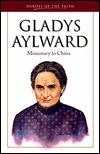
First sentence: Gladys Aylward sat in a hard, high-backed chair across from a square desk.
I first heard of Gladys Aylward in the 1958 movie, The Inn of the Sixth Happiness. After reading this biography, I've learned that she really did not approve of the movie...at all. I'm not sure I'll stop liking the movie, but it's given me food for thought. WHO is telling your story and WHY can definitely influence the outcome. It makes a weird kind of sense that Hollywood would be more interested in DRAMA and ROMANCE and even COMEDY rather than highlighting a humble woman who was all about serving and glorifying the Lord above all else. That doesn't necessarily make it right.
When Aylward first returned to England--after the second World War--she did not come seeking glory or fame for herself. She did not see herself as a hero. She did not see her story as being worth telling or sharing. Her story was coaxed out of her and shared with the world via Alan Burgess.
Her story is worth telling because it is a TESTIMONY of the Lord's working wonders in her life. Gladys Aylward was a woman who felt called by the Lord to service. She was confident the Lord was calling her to China. Not everyone shared her confidence. In fact--few did. She was rejected by the China Inland Mission--because she was "too old" to learn the Chinese language. She didn't feel 'too old' however. She would continue to serve the Lord where she was--London--and save up money to send herself to China. Perhaps she could be an assistant to an older--established--missionary. She would end up going to China and serving alongside Jeannie Lawson--a missionary who was becoming increasingly senile though no less stubborn.
The book tells of her years in China--as an innkeeper, as a foot inspector, guardian of orphans--in the 1930s and 40s. She was unable to stay in China after the Communists took over; but she settled in Taiwan and continued serving the Lord.
Quotes:
When Gladys reflected on her new job she realized it was a gift from God. To think she had resisted. She had the opportunity to travel all over the Mandarin's district and meet every woman and girl of the many thousands in the district. It really was miraculous now that she accepted it. Why had she ever hesitated? Probably because she was single-minded and she could think of nothing but spreading the gospel to the male guests at the inn. But here is yet another way to spread the gospel and to women. (99)
© Becky Laney of Operation Actually Read Bible
Wednesday, April 3, 2019
Book Review: Unbroken

First sentence: IN THE PREDAWN DARKNESS OF AUGUST 26, 1929, IN THE back bedroom of a small house in Torrance, California, a twelve-year-old boy sat up in bed, listenin
I first read this biography of Louis Zamperini in 2014. I've been meaning to reread it for years now. It is the story--for those that don't know--of a rebellious young man whose life was transformed first by running and then by his Lord and Savior, Jesus Christ. It is the story of a soldier during the war. He amazingly survives his plane crashing into the ocean; he and another soldier survive for months adrift on a raft; he's "rescued" by the Japanese, imprisoned for years--tortured, starved, diseased. The story does not end with his return to the United States at the end of the war. It does not end with his touring the country sharing his story. The war he faces once he returns home is just as intense and potentially lethal. But he's not alone. He just doesn't know what God has in store for him.
I love, love, love Zamperini's testimony. His story--his testimony--is amazing. I think everyone should read this one.
Quotes:
It is a testament to the content of Louie’s childhood that his stories about it usually ended with “… and then I ran like mad.”
In a childhood of artful dodging, Louie made more than just mischief. He shaped who he would be in manhood.
Confident that he was clever, resourceful, and bold enough to escape any predicament, he was almost incapable of discouragement. When history carried him into war, this resilient optimism would define him.
Louie was never more than an inch from juvenile hall or jail, and as a serial troublemaker, a failing student, and a suspect Italian, he was just the sort of rogue that eugenicists wanted to cull.
Once his hometown’s resident archvillain, Louie was now a superstar, and Torrance forgave him everything.
Without dignity, identity is erased. In its absence, men are defined not by themselves, but by their captors and the circumstances in which they are forced to live. Dignity is as essential to human life as water, food, and oxygen. The stubborn retention of it, even in the face of extreme physical hardship, can hold a man’s soul in his body long past the point at which the body should have surrendered it. The loss of it can carry a man off as surely as thirst, hunger, exposure, and asphyxiation, and with greater cruelty.
© Becky Laney of Operation Actually Read Bible
Tuesday, April 2, 2019
Book Review: Saving the Reformation

First sentence from the foreword: Reformed confessional theology is a statement of faith set within a story of faith. If we neglect the church’s historic statements of faith, we end up with mindless and spineless Christianity—more fit to drift like a jellyfish than to swim against the stream of this world. (Joel Beeke)
First sentence from the introduction: Most meetings of church assemblies are neither interesting nor significant.
Saving the Reformation by W. Robert Godfrey is an exposition of the Canons of Dort. The Canons of Dort is one of three major documents in the Dutch Reformed tradition. (The other two are the Belgic Confession and the Heidelberg Catechism.) Godfrey argues that the Synod of Dort essentially "saved the Reformation for the Reformed churches."
Godfrey writes,
"Calvinists saw clearly that a proper understanding of election was necessary to protect the Reformation’s “grace alone.” The proper understanding of Christ’s atoning work was necessary to protect the Reformation’s “Christ alone.” A proper understanding of the regenerating and preserving work of the Holy Spirit and of the Christian’s comfort in these doctrines was necessary to protect the Reformation’s “grace alone” and “faith alone.” Implicit in the canons’ conclusions is their commitment to the Reformation’s “Scripture alone” as the only source of religious truth."The canons were written "as a specific response to the Arminian challenge against salvation by God’s grace alone—specifically, the objections to Reformed doctrine expressed in the five points of their Remonstrance."
Godfrey does a good job placing the Canons of Dort in context. Without establishing context--genuinely elaborating on the who, why, how, where, when, and what--one would never fully understand or appreciate the Canons of Dort and/or the Synod of Dort. This is what Godfrey does in the first part of Saving the Reformation. (The appendices provide further details for establishing context. For example, one appendix provides a new look at Arminius. Another appendix provides a detailed outline for the Canons of Dort. There are five appendices in all.)
In the second part of Saving the Reformation, Godfrey provides readers with a NEW TRANSLATION of the Canons of Dort. This translation--in his own words--was written to make it easier for readers to understand. Godfrey breaks long Latin sentences into shorter English sentences.
In the third part of Saving the Reformation, Godfrey provides exposition or commentary on the Canons of Dort.
Believers may not have heard of the Synod of Dort or the Canons of Dort. But perhaps they've heard of the FIVE POINTS OF CALVINISM. The "five points of Calvinism" originated with the Canons of Dort. There were "five points" not because that number sums up the whole of Calvinist thought or doctrine but because the Arminians in their Remonstrance used FIVE POINTS. This was a reaction--a rejection--of those specific Arminian errors. Godfrey points out, "Calvinism is summarized in full confessional statements such as the Heidelberg Catechism, the Belgic Confession, and the Westminster Confession of Faith. To be very accurate, Calvinism does not have—and never has had—five points."
I really enjoyed reading this one. I absolutely loved the second part. At first I was determined to highlight all the good parts, all the parts where I wanted to shout AMEN or PRAISE THE LORD. I soon determined that to do so would be to nearly underline it in its entirety. The commentary was also excellent.
© Becky Laney of Operation Actually Read Bible
Monday, April 1, 2019
Book Review: Joyful Surrender

First sentence: Early in the morning I sit on a window seat in a beautiful stone cottage on a remote hilltop in south Texas. It is springtime.
Elliot selected seven (mostly spiritual) disciplines to focus on in this one which was originally published in 1982. Those seven disciplines are: body, mind, place, time, possessions, work, and feelings. She defines discipline as 'the believer's answer to God's call.'
When Elliot stays on task, she offers some good insights to living the Christian life. When Elliot gets off task--which is more often than I'd prefer--she tends to ramble. For example, she often rambles on and on about where she is when she's writing a specific chapter. Her insights into where she is, what time of day it is, her current view, her feelings of the moment, etc--these don't offer anything of worth, in my opinion. Though I suppose you could argue that they reveal her humanity. (But do we really need a reminder that authors are human and have lives to live?)
Before she settles down to her subject--disciplines for living well--she seems to have several chapters about free will. (Six-ish chapters to be exact). Before reading this one I'd never considered if Elliot was "Reformed" or not. (I am Reformed.) There were some iffy statements that could definitely be construed as NOT Reformed or "free will-y" as I like to say. But I'm unwilling to say for sure--context, context, context always matters. Perhaps she is speaking not of a call to salvation but of a call to live holy lives. If she's speaking of sanctification and sanctification alone perhaps there is (some) truth in what she writes. If she is speaking of salvation, then she's definitely off the mark. It isn't as simple as she's out and out wrong. (It is that simple sometimes with some teachers/preachers/writers. But usually not. Usually there is a mingling of right and wrong, true and false, wisdom and foolishness.)
God calls me. In a deeper sense than any other species of earth-bound creature, I am called. And in a deeper sense I am free, for I can ignore the call. I can turn a deaf ear. I can say that no call came. I can deny that God called or even that God exists. What a gift of amazing grace--that the One who made me allows me to deny His existence! God created me with the power to disobey, for the freedom to obey would be nothing at all without the corresponding freedom to disobey. I can answer no, or I can answer yes. My fulfillment as a human being depends on my answer, for it is a loving Lord who calls me through the world's fog to His island of peace. If I trust him, I will obey Him gladly. (12)
This much we know: a God who is sovereign chose to create a man capable of willing his own freedom and therefore capable of answering the call. (15)
We are required to take the risk, move, trust God, make a beginning. This is what Jesus always asked of those who came to Him for help of any kind. Sometimes He asked them to state their case, to affirm their desire, and often to do something positive before He could do His work. There had to be evidence of faith, some kind of beginning on their part. (19)
The grace makes it possible; the Scripture points the way; the Spirit inspires--but there is one thing more. Yet still there is something for man to do, and it is the greatest thing any man can ever do. It is put his full trust in the living God. Faith is the only thing required. (28)
God, the causer of it all, also causes us to cause. The self-determining power of the individual is part of the ordered predestination of God and of the necessity felt by His love to endow the man with a freedom like His own if He expected man to respond to His own. (34)
When the will of man acts in accord with the will of God, that is faith. When the will of man acts in opposition to the will of God, that is unbelief. (37)
God does not coerce us to follow Him. He invites us. He wills that we should will--that is, He wills our freedom to decline or to accept. (37)In writing of the disciplines, she's not out to make easy friends. Some of what she writes is on the harsher side. For example, in her chapter on discipling the body she makes some harsh-sounding statements about weight. One can easily get the impression that in Elliot's mind to be fat is to be sinning against the Lord. It isn't just gluttony she addresses but also sloth.
But often she does have helpful/truthful insights.
A renewed mind has an utterly changed conception, not only of reality, but of possibility. A turn away from the kingdom of this world to the Kingdom of God provides a whole set of values based not on the human word, but on Christ's. (62)
The deliberate decision to think Christ's thoughts by allowing Him to remold the mind leads to a different way of seeing, which in turn leads to a different way of behaving toward others. (62)
Reality is often evil. There is a common belief that a frank expression of what one naturally feels and thinks is always a good thing because it is honest. This is not true. If the feelings and thoughts are wrong in themselves, how can expressing them verbally add up to something good? It seems to me they add up to three sins: wrong feeling, wrong thought, wrong action. (64)
The work of God is appointed. What was given to the Son to do was the will of the Father. What is given to us to do is also His will. There is always enough time to do the will of God. (100)
Feelings, like thoughts, must be brought into captivity. No one whose first concern is feeling good can be a disciple. We are called to carry a cross and to glorify God. (133)
The world says, "Go with your feelings and be honest."
The Bible says, "Go with your feelings and die."
The world says, "Deny your feelings and you're dead."
The Bible says, "But if on the other hand you cut the nerve of your instinctive actions by obeying the Spirit, you are on the way to real living. (140)
It is the will that must deal with the feelings. The will must triumph over them, but only the will that is surrendered to Christ can do this. (141)
Our love will be shown by obedience, not by how good we feel about God at a given moment. (143)
What I ought to do and what I feel like doing are seldom the same thing. (143)This one definitely kept me thinking.
© Becky Laney of Operation Actually Read Bible
Subscribe to:
Posts (Atom)