Saturday, February 11, 2023

16. We Believe


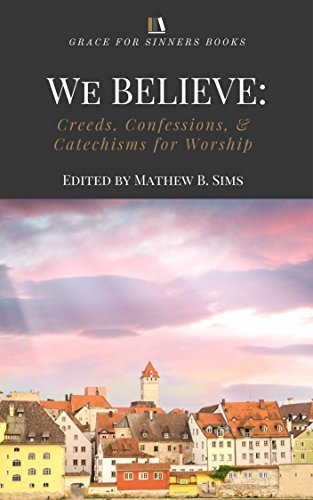
We Believe: Creeds, Confessions, and Catechisms for Worship. Mathew B. Sims. 2015. 360 pages. [Source: Bought]

First sentence (from the introduction): My parents prioritized family worship--but we never used creeds, catechism, and confessions. My parents were former Roman Catholics who were suspicious of these tools because of religious baggage.

We Believe is a collection of confessions, catechisms, and creeds. The book is edited by Mathew B. Sims. The book includes a few pieces that are neither confessions, catechisms, or creeds. There are a handful of 'commentary' pieces or prefaces and the like. 

The book is organized into faith traditions. It opens with the 'Catholic' creeds (Apostle's Creed, Nicene Creed, Athanasian Creed), before moving on to other traditions. The other traditions are: The Dutch Reformed Tradition (Belgic Confession, Heidelberg Catechism, Canons of Dordts); The Scottish-English Tradition (The Westminster Confession of Faith, Westminster Shorter Catechism); The Particular Baptist Tradition (1689 London Baptist Confession of Faith); German-Lutheran Tradition (The Augsburg Confession; Luther's Small Catechism); and finally the Anglican Tradition (The Thirty-Nine Articles; An Outline of the Faith, Commonly Called the Catechism). While the book may not be absolutely complete and thorough, I think it provides more than enough of a 'sample' of what creeds, confessions, and catechisms contain, what they are all about. Readers can see--if they read it cover to cover--what subjects are covered, how they agree with one another, or, perhaps at times how they differ from one another. Some are definitely more practical for daily/weekly practical use. Others seem more of a reference.

I bought this one because I wanted my creeds, confessions, and catechisms all in one place. There are a handful that I absolutely LOVE, LOVE, LOVE. In particular, the Heidelberg Catechism, the Westminster Shorter Catechism, and the Belgic Confession. (I also love The Apostle's Creed and the Nicene Creed.) 

This book was just what I wanted--expected--needed. 

© Becky Laney of Operation Actually Read Bible

Wednesday, February 8, 2023

15. Becoming Free Indeed


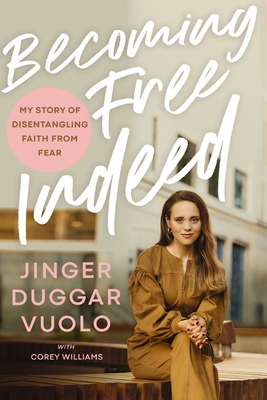
Becoming Free Indeed. Jinger Duggar Vuolo. 2023. 240 pages. [Source: Library]

First sentence: I first had the idea to write this book in the summer of 2017. My husband, Jeremy, and I had just attended an Advanced Training Institute conference in Big Sandy, Texas (later in the book, I'll talk more about what the conference is and why we went). While there, I saw dozens of people I'd grown up with--friends who, like me, had come to Big Sandy every year. But for every old friend I saw that week, there was one or two I expected to see who didn't show up. In the coming months and years, I'd start to hear stories of those friends. I'd find out that some of them no longer loved Jesus and wanted nothing to do with Christianity. As they reached young adulthood, they had rejected everything they'd been taught about God, the Bible, and the Christian faith. While that is not my story--I am a Christian who loves Jesus and wants to follow HIm--I have, like those friends, rejected much of the teaching I heard each year at the conference in Big Sandy. My faith is still intact, but it has changed. Instead of leaving the faith entirely, I have unthreaded, or disentangled, the truth of Christianity from the unhealthy version I heard growing up.

Premise/plot: Becoming Free Indeed is the memoir of Jinger Duggar Vuolo. In this memoir, she writes of her disentangling journey from Bill Gothard's teaching [Institute of Basic Life Principles.] It is a journey of her examining Gothard's teachings in light of Scripture. She'd hold up Gothard's teachings to what the Bible actually says. She learned that what Gothard taught didn't match a common sense reading of Scripture [or stand up to spiritual scrutiny]. She unpacks her childhood faith--the faith that she grew up believing, the faith that she was consistently instructed and raised in--and slowly, deliberately re-examines everything. All of her unpacking is done with the mind to be true to Scripture, to line up her beliefs, her views, her values with Scripture. She writes that this process was scary. Scary because she knew that it might create distance, division, discord with her immediate family members who were still diehard Gothard supporters, to those who are heart-soul-body still believers in the IBLP. But scary also because she was replacing the known, the certain, with the unknown, the uncertain. Letting herself question EVERYTHING she was taught for the first twenty to twenty-two years of her life was--and I think we can all agree--scary. It was "safe" to not ask questions, to push down doubts, to just go with the flow, to just submit to what her parents wanted/needed/preferred. 

Ultimately, I believe we'd both agree that it was the Holy Spirit who led her to the truth, to freedom, to the true, fully-fleshed out gospel. But the catalysts for this change comes down [in some ways] to two things: her relationship with her brother-in-law, Ben. As she spent time with Ben and Jessa as they were courting, as they were married, Ben's influence began to effect her own view of Scripture, of the faith. She began searching and seeking out more and more in Scripture. Her theology got meatier--here and there. She wasn't all-in committed to "disentangling" if you will. But she became hungry for the Word of God, interested in God's character, etc. She later met Jeremy. Her friendship/courtship/marriage with Jeremy led her to re-examine EVERYTHING. He wanted to know more about the IBLP. He was seeking to understand how his wife had been raised, what "made her tick" if you will. They watched over sixty-hours of teachings by Bill Gothard. Together they watched, discussed, studied....all in light of Scripture. Her view of Scripture had shifted considerably. She began to agree with her husband that Gothard's teachings weren't biblical. Some of his messages were scary-dangerous. [She shares several examples of this throughout the book.] Lies were being replaced with truth. Recognizing that Jesus is the ULTIMATE truth. That the Word of God IS truth. One thing she noticed is that Gothard's view of Scripture was lacking. 

My thoughts: Legalism is not restricted to the IBLP. It's not. That's why I think there is plenty within the memoir that would make it relevant to many/most readers. This memoir celebrates the gospel. I found it an interesting read. 

© Becky Laney of Operation Actually Read Bible

Sunday, February 5, 2023

Sunday Salon #6


Current Bible plans and projects:

ESV Church History Bible: Proverbs 29-31. Psalms 139-150. 1 Samuel 21-31. 2 Samuel. 1 Kings. 2 Kings 1-2. Philippians. Colossians. Matthew 1-28. 1 Thessalonians. I finished up Psalms and Proverbs this week. I'll now be doing my Book of Common Prayer readings from those two books in the NRSV. I am still loving the ESV Church History Bible. 
This was Jesus' reason for speaking to them in parables: they could not understand spiritual things, and therefore he gave them no naked doctrine, for then they would not have listened at all. They did not really see what they saw, nor hear what they heard. The plainer the teaching, the more they were puzzled by it. They had become so morally and spiritually diseased, that the only thing they would notice was the attractive dress of a truth; for the truth itself they had no liking and no perception. ~ Charles Spurgeon 

NRSV XL. Psalms 1-23. Proverbs 1-4. Exodus 16-40. Leviticus. Numbers. Deuteronomy. Joshua. Judges. Ruth. 1 Samuel. 

M'Cheyne BSB. Genesis 30-37. Mark 1-7. Esther 6-10. Job 1-3. Romans 1-7. 

Growing 4 Life January (Mark 1-4) and February (Mark 5-8). I read some from each this week since we didn't switch months until mid-week.

Mark 1-4 -- Living, NRSV, 1560 Geneva, NIV 84.
Mark 5-8 -- LSB, Living, NRSV, ESV, 1560 Geneva, NIV 84, NASB 95. 

Current plans for other books:

I finished a handful of books this week! And I've reviewed them already! I am currently reading Laura Frantz' The Rose and the Thistle. 

Questions:

Do you write down quotes? share quotes? mark quotes? I started sharing a tiny selection of quotes from the ESV Church History bible this week. 

© Becky Laney of Operation Actually Read Bible
Saturday, February 4, 2023

14. Sounding Joy


Board book: Sounding Joy. Ellie Holcomb. Illustrated by Laura Ramos. 2022. [September] 24 pages. [Source: Library] 

First sentence: What does joy sound like? Is it quiet like snow? Does joy sound like the laughter of friends that you know? Is joy like the sound of a kiss on your cheek? Or like holding your breath when you play hide and seek? 

Premise/plot: Ellie Holcomb's Sounding Joy is a holiday [Christmas] board book to read aloud to little ones. [I say little ones, but it's also perfectly suitable for the whole family to share together]. It begins by asking readers--or listeners, I suppose--to think about what JOY looks like, sounds like, feels like. What is joy LIKE? It then goes on to share the nativity story of Jesus Christ. That was the full expression of joy. And it is packed with promises that are ever-relevant. Reminders that JOY, inexpressible, resounding, repeating JOY are yet to come. Every Christmas is a reminder of not only what has been fulfilled, but what is coming still.

My thoughts: I definitely enjoyed this one. I loved the art by Laura Ramos. I liked the connections. I liked that it isn't just one or the other. There is a strong connection between what happened in Bethlehem and our present lives. Our joy is found IN Jesus our savior. There is reason to celebrate, rejoice, give thanks, every single day because of Jesus. 

I would have reviewed this one in December of 2022 if my library hold had come in. I am reviewing it now because why wait until next December??? 

© Becky Laney of Operation Actually Read Bible

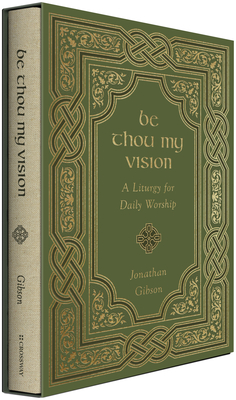
13. Be Thou My Vision


Be Thou My Vision: A Liturgy for Daily Worship. Jonathan Gibson. 2021. [November/December] 352 pages. [Source: Review copy]

First sentence: It may come as a surprise, but there is no explicit command in Scripture to have a time of worship each day, either as an individual or as a family. And yet it is a habit that every Christian believer or Christian family is encouraged to practice. The name of the habit may vary depending on one's Christian tradition or background--"devotion," "quiet time," or "personal or family worship"--but the basic elements of Bible reading and prayer are usually present. 

ETA: I first read this one in 2021. I liked--really liked quite a few things about it. I mentioned at the time that I wanted to give it a 'proper' go. To use it for a month--or two, or three--to see how well I liked it--or not. 

I started using the Be Thou My Vision devotional in December 2022. I also continued using it in January 2023. Now that I've read through it three times, I can now say that I definitely enjoy it. I do think it is solid and steady. 

Original review:

What you see is what you get. This is a LITURGY for DAILY WORSHIP. Thirty-one days of liturgical worship that can be repeated to infinity (and beyond). 

The structure of the liturgy for daily worship is:

CALL TO WORSHIP (thirty-one Scripture readings, these are taken from both Old and New Testaments)
ADORATION (thirty-one prayers--all focused on praise and adoration--taken from church history; I believe the doxology is included under this heading as well)
READING OF THE LAW (seven readings taken from Scripture--from both Old and New Testaments--regarding the law)
CONFESSION OF SIN (thirty-one prayers--all focused on confessing sin--taken from church history)
ASSURANCE OF PARDON (thirty-one Scripture readings--focusing on assurance of forgiveness of sins--taken from both the Old and New Testaments)
CREED (alternates three creeds, but one of the three creeds is divided into three; Apostles' Creed, Nicene Creed, Athanasian Creed)
PRAISE (Gloria Patri, two versions alternating weekly)
CATECHISM (refers you to an appendix where you'll read from the Heidelberg Catechism or the Westminster Shorter Catechism. These are undated; you are encouraged to read one question a day.)
PRAYER FOR ILLUMINATION (seven prayers from church history, repeated weekly)
SCRIPTURE READING (refers you to an appendix where they share the M'Cheyne reading plan. Here's where it gets confusing, the plan clearly has you reading FOUR chapters a day, but the book has you just reading one chapter a day????)
PRAYER OF INTERCESSION (thirty-one prayers from church history; you are also encouraged to pray on your own for personal, church, world needs)
LORD'S PRAYER (daily)

The book has five appendices: musical tunes for the Doxology and Gloria Patri, the two catechisms, the M'Cheyne reading plan, and the collects from the Book of Common Prayer, and author index. 

The book pulls in sources from all over--including the Book of Common Prayer. The structure is different from that of the Book of Common Prayer, and yet there are similarities to a certain degree. It does offer more variety in some ways. 

I think you could definitely improvise with this as well. You wouldn't have to read just one chapter from a daily reading plan that clearly and obviously has four readings. You wouldn't have to follow this reading plan at all.

I do wish that one of the sections was focused on the PSALMS and taking you through the Psalms each month. That's one of my favorite, favorite, favorite things about doing the Daily Offices from the Book of Common Prayer.

© Becky Laney of Operation Actually Read Bible
Friday, February 3, 2023

12. The Heidelberg Diary


The Heidelberg Diary: Daily Devotions on the Heidelberg Catechism. William J Ouweneel. 2019. 768 pages. [Source: Library]

First sentence: Q. What is your only comfort in life and in death? A. That I am no tmy own, but belong--body and soul, in life and in death--to my faithful Saviour, Jesus Christ. What a tremendous start for the catechism! We are not plunged right away into complex theological subjects, instead we are asked a very personal and very practical question. "Your" is singular here. You, Christian, what is your comfort? Whatever your sins, whatever your health condition, whatever you social, economic or any other circumstances, where do you find the comfort and consolation that helps you persevere? 

The Heidelberg Diary is a daily devotional. It is a thoughtful walk through the Heidelberg Catechism. That catechism has fifty-two "Lord's Day" questions and answers. Each Lord's Day has one to three questions and answers. (Sometimes less, sometimes more). Ouweneel has 'stretched' or 'expanded' those questions and answers to last all year long. Some questions and answers have four to five 'parts' or 'days' in this devotional. [I do wish that when he does this he would repeat the question! That would be my only suggestion really, to make it easier what question this answer is in response to.] 

The Heidelberg Catechism covers the basics. What are the basics? Well, at the very least--the Apostle's Creed, the Ten Commandments, and the Lord's Prayer. I believe there are also questions and answers about the sacraments of communion (aka Lord's Supper) and baptism. 

I absolutely LOVE the Heidelberg Catechism, I do. Especially the earlier questions. 

I read this library book in a few weeks. Obviously two weeks is not enough time to read this one as it was designed--one per day all year. I ended up reading twenty plus days per day. (Sometimes more! I remember one day covering a hundred days. Then I realized I didn't have to read it that quickly. That I could slow down some.)

I enjoyed this one for the most part. It does add in a lot of extras. (For better or worse). I think it adds context and detail on some theological issues. The devotions mainly are meaty and substantive. I would say that sometimes the author is critical of the original question and answer. Again for better or worse. (I can't say that I honestly agree 1000% with every single phrase in the original.) This comes into play when it comes to communion. He feels the original is inappropriately harsh and unfair to Roman Catholics. (This doesn't surprise me that the original would be strongly worded. And that *any* differences between Protestants and Catholics would be VERY strongly worded.) It also doesn't surprise me that modern believers would try to 'calm' the original. The author stresses that the original isn't always fair to Catholics because they are writing from a position that may unfairly represent what Roman Catholics believe(d). 


© Becky Laney of Operation Actually Read Bible

Thursday, February 2, 2023

11. Becoming Elisabeth Elliot


Becoming Elisabeth Elliot. Ellen Vaughn. 2020. 320 pages. [Source: Library]

First sentence: It was April 11, 1948 in Wheaton, Illinois, thirty miles west of Chicago. Jim Elliot was a junior at Wheaton College, a star wrestler, Greek major, poet, and jokester. 

Becoming Elisabeth Elliot is...you guessed it...a biography of Elisabeth (Howard) Elliot. This biography doesn't cover her whole life. It is, I believe, perhaps a first volume in a two volume biography set.  (Perhaps. It certainly felt like that was the set up). This one touches briefly on her childhood years, and goes to a more in-depth treatment of her high school and college years [there were journals]. Ultimately everything is building up to her courtship, marriage, and widowhood. Her husband, Jim Elliot, is one of five who were martyred. This husband-and-wife team were serving as missionaries in Ecuador. [There were five men and their families. Perhaps more in the area??? But these five were specifically seeking to witness to this particular tribe; it was a 'first contact' situation.] The biography ends in the early (maybe mid too) 1960s. Elisabeth Elliot has returned to the United States [after much disagreement with another widow] and is now writing Christian books. 

The book relies on Elisabeth Elliot's journals and books. 

I have read two maybe three books by Elisabeth Elliot...including several about her years in Ecuador. (One was on womanhood? or parenting?) 

I did learn more about Elisabeth Elliot. I knew the basic story, this biography fleshes it out in more context. I had made a few assumptions that I shouldn't have. (For example, I assumed that the five widows and their families would have stayed close/tight. That they would have supported each other. It was quite a shock to read of the super-tense, incredibly-tense relationship she had with Rachel Saint.) 

It gives a good, solid overview. But I don't think there's tedious amounts of details. (Though that could be subjective).

© Becky Laney of Operation Actually Read Bible