Showing posts with label 1980. Show all posts

Monday, December 18, 2023

21. KJV New Chronological Bible


The New Chronological Bible (Large Print) (King James Version) God. Edited by R. Jerome Boone. 1980. 1551 pages. World Bible Publishers. [Source: Bought]

First sentence: Thy throne is established of old: thou art from everlasting. Before the mountains were brought forth, or ever thou hadst formed the earth and the world, even from everlasting to everlasting, thou art God. And he is before all things, and by him all things consist. In the beginning was the Word, and the Word was with God, and the Word was God. The same was in the beginning with God. 

There have been other Bibles in the King James Version that have been arranged chronologically. This one is from 1980. I am guessing--pure speculation--that it was not a huge success from a publishing standpoint and did not stay in print. Then again, I had never heard of World Bible Publishers until I started thrifting. 

This one is double column, words of Christ in BLACK. The font size is nice. 

What makes this one unique? Or mostly unique? It is arranged chronologically. Any verse from any chapter any book could be spliced--rearranged--according to one man's editing desires. Some are obvious editorial choices; perhaps others less so. I would love a behind the scenes peek into WHY he put certain verses/chapters where he did. 

The Bible is arranged in an outline with twelve major headings.
  1. Development of the Early World
  2. Development of Israel as a Tribe
  3. Development of Israel as a Nation
  4. Development of Israel as a Kingdom
  5. Division of Israel into a Dual Kingdom
  6. Survival of Israel in the Southern Kingdom
  7. Captivity of Israel in Babylonia
  8. Restoration of Israel as a Nation
  9. Preservation of Israel During the Intertestamental Period
  10. Inauguration of the Kingdom of God on Earth
  11. Continuation of the Kingdom of God on Earth
  12. Consummation of the Kingdom of God on Earth 
The earliest section, so far, is the most choppy. I don't envy anyone the task of trying to mix and blend the whole Bible into a grand opening. (I personally would not mess with Genesis 1:1, but that is just me)

Here is how Boone worked it:

Any arrangement is going to obviously reveal the theological belief system of the arranger, the editor. For example, in this instance the interpretation that Isaiah 14 and Ezekiel 28 refer to Satan's fall. He also places the book of Ruth and the last five chapters of Judges BEFORE the rest of the book. (Perhaps with the exception of Judges 1). He also has SAMUEL contemporaries with SAMPSON. 

He arranges some sections with parallel passages. (Though thankfully not in the New Testament). I found this more annoying than not. I found myself unable to read both in any meaningful way. I was more having to pick and choose which column to focus on and which to skim. And the passages may have dealt with the same king, etc., but the phrasing wasn't the same. So in my personal opinion not all that "parallel." 

Though I didn't particularly know this at the start, I ended up not really being a fan of chronological arrangement. (This isn't to say that I regret my time in God's Word). I much prefer to read whole books to reading spliced books. To each his/her own however. I have no issue with readers--believers--who greatly appreciate/love this method of Bible reading. 

This will almost definitely be my final Bible to complete in 2023. 

© Becky Laney of Operation Actually Read Bible

Friday, March 27, 2015

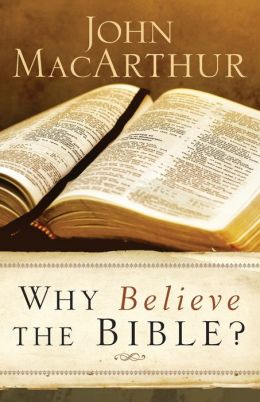
Book Review: Why Believe the Bible?

Why Believe the Bible? John MacArthur. 1980/2015. Baker Books. 208 pages. [Source: Review copy]

For the most part, I really enjoyed reading John MacArthur's Why Believe the Bible? For the record, this is not a new book, but a newly reprinted book with a few pages of new material.

Why Believe the Bible? is divided into three sections: "Can We Really Believe the Bible?", "What Does God's Word Do For Us?", and "How To Get The Most From God's Word." I liked the last two sections better than the first. But the book is solidly good from start to finish.

My favorite chapters were: "God's Word: Guide to His Will," "God's Word: The Way to Grow," "God's Word: The Perfect Pruning Knife," "What Does God's Word Say?" and "What Does God's Word Mean (And What Do I Do About It)?"

I love that so much of this one is about why it's important to read the Bible and on how to read the Bible. I also love the first appendix. In it, he provides examples for people who want to read thirty minutes a day, sixty minutes a day, and ninety minutes a day.

Quotes:
When believers aren't growing, it can usually be traced to failure to be in God's Word. They go to church and sit. They take along their cups and fill them up and then spill them on the steps as they leave. They complain of not getting much out of church or the Christian life. They are weak and rundown when it comes to facing temptations, trials, problems and challenges… Their souls are starved for wholesome spiritual food. The Bible refers to itself as milk, bread and meat, but spiritually a lot of Christians are subsisting on French fries, Cokes, and M&Ms. They aren't growing because they have very little to grow on. Ironically, the solution to their problems is in the very thing they refuse to feed upon--God's Word. (115)
There is no magic in memorizing Scripture. (In fact, it can lead you into the driest kind of legalism.) But there is a tremendous blessing and power in knowing where various passages can be found and what kind of help and resources they can provide. (139)
The first step in Bible study is to read the Bible. I can't emphasize too strongly that effective Bible study has to begin with a systematic reading of the Scriptures. Other methods will be of limited benefit unless you get the entire flow and context of what God's Word is saying. (162)
Of course you need a plan for your reading. For the Old Testament I suggest reading through all of it once a year in a narrative manner (from Genesis to Malachi, no skipping around)… The best way to read the Old Testament is straight through, like a story. As you read, keep a pencil and notebook in hand. Put down notes regarding areas you want to come back to and study in depth later, preferably with the inductive method. (163)
With the New Testament I use a little different approach. Instead of reading through the entire New Testament from Matthew to Revelation, I read each book over and over for 30 days. (164)
If you want to know what the Bible says, this method will do the job like no other. Vary the length of the books you tackle. First a short one, then a long one, then back to a couple of short ones. In two-and-a-half years you will cover the entire New Testament 30 times, and somewhere along the way it will all start to come together as never before. (166)

© Becky Laney of Operation Actually Read Bible

Monday, February 18, 2013

Book Review: Love's Enduring Promise (1980)

Love's Enduring Promise. Janette Oke. 1980. Bethany House. 239 pages.

Love's Enduring Promise is a comfortable read. I've read it half a dozen times at least since it is the second book in one of my favorite series that I read as a child. In this second novel, Marty and Clark have a family together. The first few chapters sees the birth of their first child together. The remaining chapters see their family expand even more: with Marty having more children and with the couple adopting two daughters. By the end of the book, Marty has seen three of her daughters (Missy, Nan, and Clae) become teachers and marry. I can't remember if any of her sons have married by the end of Love's Enduring Promise or not, but, if they haven't it's just a matter of time. Most of the family is all grown up by the novel's end, the others are still attending school. The book gives us quick glimpses of life in the community, and their home life together. But we don't spend much time with the family at any particular time, perhaps with the exception of when Nandry and Clae are first adopted and the family is going through an adjustment period as the girls settle into their new home and as they all prepare for some of the children to attend school. My favorite chapters in this one feature "thet Willie" who is so pesky in Missie's eyes as a child and quite lovable through her grown up eyes.

© Becky Laney of Operation Actually Read Bible

Monday, September 26, 2011

Book Review: Still More Stories from Grandma's Attic

Still More Stories from Grandma's Attic. Arleta Richardson. 1980/2011. David C. Cook. 160 pages.

In June, I reviewed the first two books in the Grandma's Attic series: In Grandma's Attic and More Stories from Grandma's Attic. This fall, two more books in the series have been released: Still More Stories from Grandma's Attic. And Treasures from Grandma's Attic.

I have really enjoyed revisiting these books from my childhood years. As I mentioned before, Mabel and her family were just as dear to me as the Ingalls family.

The stories included in this one:

  • Face Cream from Godey's Lady Book
  • It Rhymes with Mop
  • High Society
  • The Dog Who Could Spell
  • The Wrinkled Stockings
  • Whenever I'm Afraid
  • Grandpa Hobbs
  • The Spelling Bee
  • The Prettiest House in the County
  • My Own Boss
  • The Harvest Home Festival
  • The Surprise Birthday Present
  • The Perfect Party
  • Windfalls

While the first two books felt very, very familiar to me--like old friends--I admit that the third one almost felt unfamiliar. I remembered a few of the stories, but not most of them! Which isn't good or bad, I suppose! I am a bit puzzled at my memory though. For there are stories that I remember--somewhat clearly--that I haven't found in any of the four books. I kept thinking, it'll be in the next one, it has to be in the next one. I seem to remember more stories about a quilt--with the granddaughter asking about each fabric. And the fabrics used weren't just the grandmother's but almost each member of the family was connected in some way. And I remember one story having to do with an apron with TONS of pockets. And I haven't found that one.

I do recommend this series.

© Becky Laney of Operation Actually Read Bible