Showing posts with label book I own. Show all posts

Thursday, March 10, 2022

4. NIV (NIV 84) Young Discoverer's Bible


NIV Young Discoverer's Bible. 1985. Zondervan. 1979 pages. [Source: Childhood copy]

First sentence: In the beginning God created the heavens and the earth. 

There is something incredibly special about going back to your childhood Bible. I've had this Bible since fourth grade. It hasn't always been "my number one" meaning my daily go-to Bible. But two things keep me coming back again again. First, I love HOW large the font is. And because it's old school--1985--there is little to no bleed through or ghosting. So the combination of LARGE PRINT + NO GHOSTING + BLACK LETTER text means that the layout is just about as perfect as you can get. Second, I love the 84 edition of the New International Version translation. This is the version that I almost exclusively read for a little over a decade. And it was that first decade of faith as well. I was in college before I started accumulating other translations---like the NKJV and NASB. There is something HOME-y and JUST RIGHT about going back to revisit this translation as an adult. 

I do wish that the publishers hadn't sought to obliterate the 84 edition of this translation. They *could* have left it readily available online even if they didn't want to keep it physically in print. Online Bibles and e-Bibles could have been kept "alive" even after the 2011 was released. 

© Becky Laney of Operation Actually Read Bible

Monday, January 14, 2019

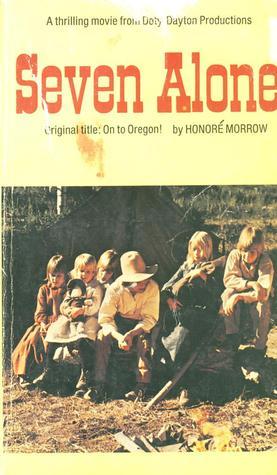
Book Review: Seven Alone

Seven Alone. Honore Willsie Morrow. 1926/1977. Scholastic. 240 pages. [Source: Own]

First sentence: This is the story of a great boy pioneer. Perhaps there have been other boy pioneers, thirteen years of age, who were as great as John Sager, but, if so, I have not heard about them.

Premise/plot: Seven Alone is based on the true story of the Sager family. It was originally published as On to Oregon in 1926. It was retitled Seven Alone in the 1970s when a movie adaptation was made.

Henry and Naomi Sager had seven children: John, Francis, Catherine, Elizabeth, Matilda, Louisa, and Henrietta. Their seventh was born on the Oregon Trail. Both parents died on their way west; first the father and then the mother. Before she died she urged her oldest, John, to keep the family together no matter what.

The book chronicles their journey from start to finish. Even if the parents had not died, it would have been a difficult, near-impossible journey for a family to make. The trail was unkind to all alike--men, women, children, babies. There were many, many dangers. No day was without risks and dangers.

The last third of the book has John and his siblings essentially traveling the trail on their own as they seek--in vain, for the most part--to catch up with the wagon train. The wagon train, meanwhile, had broken up into different groups. It became obvious that the family's only hope was to reach the Whitman Mission.

The book--for better or worse--ends happily with the family reaching the Whitmans. (The Whitman Massacre was in November 1847. John and Francis were among those massacred. The other Sager children were among those held captive.)

My thoughts: I remember watching the movie as a child. I honestly can't remember if I read this one as a child. If I'd known--as a child--how the story really ended, I'm sure I would not have read it. If I didn't know, then there's a possibility I read it oblivious to the tragic ending. I did enjoy--then and now--a good pioneer story.

John's story is one of transformation. When the book opens he is a rebellious, selfish, irresponsible brat. But as the journey progresses as he comes to realize the life-and-death nature of the trail, he matures quickly. He becomes courageous, determined, resilient, responsible. His parents' God becomes his God as he comes to rely on Him. When the book opened, John almost rolled his eyes at the daily Bible reading and prayer. But that foundation was not built in vain as John came to see.


© Becky Laney of Operation Actually Read Bible

Wednesday, August 15, 2018

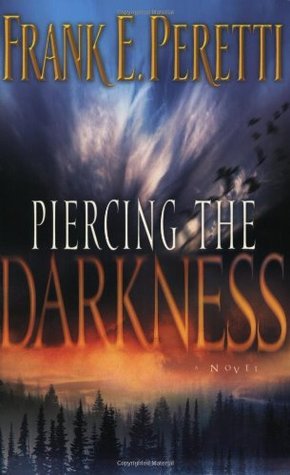
Book Review: Piercing the Darkness

Piercing the Darkness. Frank E. Peretti. 1989. Crossway. 448 pages. [Source: Bought]

First sentence: It could have begun in any town. Bacon's Corner was nothing special, just one of those little farming towns far from the interstate, nothing more than small hollow dot on the AAA road map, with exit signs that offered gas, no lodging, maybe a little food if the place was open, and little more. But it began in Bacon's Corner.

Premise/plot: Piercing the Darkness is a companion book to This Present Darkness. Some of the characters of This Present Darkness--including some of the angels--make an appearance in this one.

Sally Roe is fighting for her life. Escaping from one assassination attempt, she is on the run from both humans and demons that want to silence her permanently. She is a woman with a past--a past that they don't want their opposition to know about.

Tom Harris is a Christian educator. (Principal and schoolteacher?) His two children are taken away from him the day before a lawsuit is filed against him. The accusation is child abuse. The small town's Christian population is torn. Is he guilty of doing something to his own kids or to their kids--or both?! How could they not know?

The woman bringing the lawsuit is Lucy Brandon, who works at the post office. Her daughter, Amber, briefly attended the Christian school. Lucy removed her from the public school system because of behavior issues. The case centers around a spanking and a failed attempt to cast out a demon.

As Harris and his friends try to figure out the hows and whys of the case, they learn of a dangerous curriculum the public school is using; a curriculum that encourages children to meet and befriend spirit guides as they relax and meditate.

My thoughts: Piercing the Darkness is a compelling mystery/thriller. I found it thought-provoking as well.

Would it be an exaggeration to say that most Christians don't think in battle terms--the Christian life as a spiritual battle to be fought day in and day out because the threat is real.

Prayer or lack of prayer is a major topic in the book.

Ideas matter. Ideas have consequences. Few--if any--are completely harmless and divorced from a world view.

Quotes:
In a case like this, public opinion is important. It's the public mind that eventually creates the laws we all have to live by. You see, we fight our battles at two levels: in the courts and in the public arena. A lot of the cases we win today came about because of public opinion that was molded years ago. What we do now to mold public opinion will have a positive effect on legal cases that arise in the future. It's a process. (41)
He was thinking of all those young, impressionable children sitting in all those classrooms down there, and what they must be learning right now. As usual, most of his spirit underlings were occupied with that task. They were the best, and he reveled in the fact that for the past several years, ever since the laws had been changed, their job had been so much easier. Oh, how quickly men could accept the most outrageous lies once the Truth was removed from consideration! (88)


© Becky Laney of Operation Actually Read Bible

Thursday, November 7, 2013

Book Review: Prodigal Cat

Prodigal Cat. Janette Oke. 1984. Bethany House. 160 pages. [Source: Childhood Copy]

The Prodigal Cat is a pleasant little children's novel told from the perspective of a cat. This cat will end up with three names to match the three owners of her life: Mittens, Calico, and Ginger. Mittens, her kitten name, shows her mischievous side best perhaps. For it is the fact that Mittens and her brothers and sisters are a little too rough in their playing that leads all the kittens to being packed away to the animal shelter. There are some uncertain days in this book first when she's at the animal shelter and again when she's homeless (in between "Calico" and "Ginger." Mittens is adopted and renamed Calico. She loves almost everything about her new home--except the dog! But a family picnic with all the pets proves to be a TERRIBLE idea. For Calico runs a little too far away while the dog chases her, and, she never does get to go back to that home. These homeless days are rough. But eventually Calico is adopted again...and renamed again. Ginger is a cat with a calling. Her owner is a nurse, I believe, and Ginger is a nurse as well. She accompanies her owner and keeps company with sick people. She is the bright spot in the midst of their pain and suffering. She is beloved by many...

It's a good, somewhat sweet story. Cat lovers may enjoy this one.

Wednesday, November 6, 2013

Book Review: Spunky's Diary

Spunky's Diary. Janette Oke. 1982/1998. Bethany House. 112 pages. [Source: Childhood Copy]

Spunky's Diary is the diary of a dog. Most of the novel is told from the puppy's perspective. Later entries in the diary reveal a dog that is becoming a bit wiser and less impulsive. The book contains his perspective on leaving his mom and his home behind as he's adopted by an eager family. The family has four kids, and there is much love in his life, and a lot of playing ahead of him. But Spunky's Diary is definitely an odd read in some ways. It's a children's book featuring the death of a young child (one of Spunky's owners). The book captures the uncertainty of those days (as she gets sick and weak) and the sadness of the family as seen through the family pet. I am not sure how popular sad-dying books are with the intended age group. I do know that I AVOIDED any books with any hints of sadness as a kid. It is, I suppose, an interesting twist in a dog book. A book with a dog on the cover, where, it's NOT the dog who dies but the human. But still.

© Becky Laney of Operation Actually Read Bible

Monday, September 30, 2013

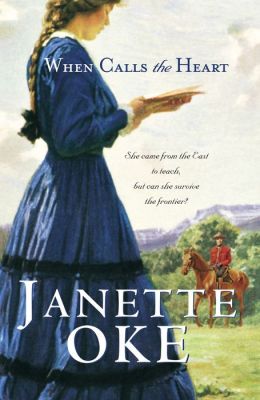
Book Review: When Calls The Heart

When Calls the Heart. Janette Oke. 1983/2005. Bethany House. 224 pages.

It came as a great surprise to me. Oh, not the letter itself. We were all used to the arrival of letters from brother Jonathan. They came quite regularly and always caused a small stir in our household. No, it wasn't the letter, but rather what it contained that caught me completely off guard. And Mother's response to it was even more astounding. 

When Calls the Heart is one of my favorite, favorite books by Janette Oke. The first two books in the Canadian West series make me giddy. (I don't remember the others in the series, they may work for me too; I just don't have the same connection with them in my memory!) As an adult, I can see this book breaking all the so-called rules of what makes Christian fiction "bad" or eye-rolling especially among unbelievers. But at the end of the day, I just don't care if the descriptions are too much in the first half of the book! The truth is that I love, love, love Wynn Delaney. And the romance between Wynn and the heroine, Elizabeth, is extremely satisfying. Elizabeth has come out west to teach school. She wants to teach. She doesn't want her brother to try to match her up with one of his single friends. She wants to prove her independence (it's set circa 1910). She's not horribly independent when the novel starts. In fact, she's never lived alone or managed her own life, not really. So living on her own will be a challenge for her. Especially since she has no idea how to cook and how to keep mice away. Readers see her in and out of the classroom. The best parts of this one focus on her romance with Wynn Delaney. From the moment she sees him--they're not properly introduced--she's wowed. She can't stop thinking of him. When they do finally meet, she is under the belief that he's married, that he's the father of one of her students (she's a teacher). He's not married, he is very available! So when he does all these heroic things (things that would make her swoon and say my hero!) she purposefully distances herself from him. She's out to prove that she's not one of those girls whose daydreams carry them away. When, however, she learns the truth. Well, she can't help BEING in love with him. And while she isn't going to go out of her way to hide the fact that she loves him madly, she's going to modestly do all she can to keep his attention and friendship.


© Becky Laney of Operation Actually Read Bible

Thursday, August 15, 2013

Book Review: Love Finds A Home


Love Finds A Home. Janette Oke. 1989. Bethany House. 240 pages. [Source: Owned for decades]

This is the third book that focuses solely on Belinda Davis, the surprise baby of Marty and Clark Davis. The novel opens with Belinda still in service as a companion and nurse to Mrs. Stafford-Smyth in Boston. She loves her "Aunt Virgie" and couldn't imagine ever leaving her position. She still misses her family, her old home, in theory; but at the same time she can't imagine going back forever. A third of the way through the book, she goes home and discovers how much she has changed, how much her standards have changed. She is very eager to return to Boston. Mrs. Stafford-Smyth is so relieved to see her again. She'd been anxious the entire six weeks of her vacation to New York. But before things really return "to normal" Aunt Virgie dies. Belinda has inherited the house and a good deal of money. What will she do with her inheritance? Is there a special way she can honor the Lord with it? What would He have her do with it. She doesn't feel led to spend it on herself. That is not her style, not really. 

Half of the novel focuses on Belinda's "what-should-I-do-with-this-money?" dilemma. Towards the end of the novel she meets an old friend from her hometown, a young boy we met in the first Belinda book. It is love at first sight for Belinda, but does he feel the same?

I liked this one well enough. I do love the series as a whole. But I'm not sure I love Belinda as much as some of the other heroines we've met. But still, the book was good.  

© Becky Laney of Operation Actually Read Bible

Wednesday, July 10, 2013

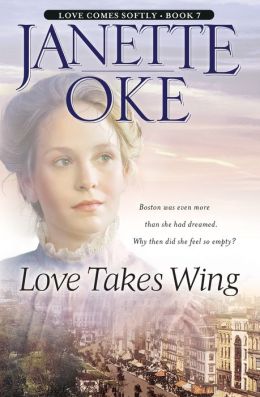
Book Review: Love Takes Wing (1988)

Love Takes Wing. Janette Oke. 1988. Bethany House. 240 pages. [Source: Own].

Love Takes Wing is the seventh book in the Love Comes Softly series by Janette Oke. It is the second book to focus on Belinda Davis, the last child, the "surprise" baby of Clark and Marty. Belinda is all grown up. But though men may be very interested in her, in marrying her, she's not at all interested in marrying. Not yet. Oh, she wants to marry someday. She does. But why do men keep proposing to her now? Perfectly charming, completely delightful men who just don't understand that she's not ready for marriage.

Belinda is a nurse who works closely with her brother Luke and another new doctor, Jackson Brown. When she's not busy nursing patients, there are two men: Rand and Jackson who are competing for her company.

This book sees Belinda becoming a companion of a very wealthy but oh-so-lonely woman and traveling to Boston and then Paris. Will Belinda find her way back home?

© Becky Laney of Operation Actually Read Bible

Friday, June 21, 2013

Book Review: The Pilgrim's Progress (1678)

The Pilgrim's Progress. John Bunyan. 1678. 185 pages?


I've read Pilgrim's Progress a few times now. There are scenes that I absolutely love in this classic allegory. However, there are plenty of scenes in between those scenes that I love.

Christian, our hero, is on a faith journey; when we first meet him, he is burdened down with a pack on his back, a pack of sin and shame, a true burden. But having read the Bible and listening to Evangelist, he repents, believes, and starts on his way to Celestial City. He travels via the Wicket Gate, there being just one way of course. He's given specific instructions on what to do, where to go, warned of special dangers, given certain promises. One of the things he is given is a key--the promises of God--a key that will open any door he needs. 

Along the way, he meets other people. Each person has a special significant name much like his own. For example: Obstinate, Pliable, Formalist, Hypocrisy, Lord Hate-good, Ignorance, Atheist,  etc. (You would think that he would after learning the name of the individual be a little more careful or discerning?) Each place has a name as well: City of Destruction, Slough of Despond, Valley of Humiliation, Vanity Fair, By-Path Meadow, Doubting Castle, The Celestial City, etc.

If there is one thing that Pilgrim's Progress is rich in, it is instruction. Yes, it is a dream-allegory. We're reminded time and time again that Christian is dreaming. But it is a very instructional often didactic dream. I have a few favorite scenes in this one. I love seeing Christian and Hopeful in Doubting Castle, I do. The reason? Well, I love how they "solve" this problem. I also love it near the end when Christian finally takes the time to hear Hopeful's testimony. True, Christian's questions to his friend sound a bit like a catechism, but, I love reading Hopeful's responses.

Monday, April 29, 2013

Book Review: Love's Abiding Joy (1983)

Love's Abiding Joy. Janette Oke. 1983. Bethany House. 240 pages.

I've not read the second half of Janette Oke's Love Comes Softly series quite as many times. Instead of a dozen, probably only three or four times! In this fourth book, Marty and Clark visit their daughter and son-in-law. It has been years since Clark and Marty have seen Missie and Willie, and this will be the very first time they meet their two grandsons Nathan and Joey. They had only intended to visit two weeks with their family, which makes sense since it takes a week to travel to travel there and a week to travel back home. But during their stay, Clark becomes a HERO. Two boys (NOT HIS GRANDSONS) are trapped in an old mine, he is the first to reach the scene, knowing all the dangers he bravely trusts God to guide Him and protect Him. I had forgotten, in a way, how touching and compelling those scenes were! I remembered this as the book with the big DRAMA in it, but I didn't really remember the details rightly. I think I appreciated it more as an adult than I did as a child. God is providentially moving in this book as Clark and Marty face the future...

I definitely liked this one!

© Becky Laney of Operation Actually Read Bible

Monday, March 18, 2013

Book Review: Love's Long Journey (1982)

Love's Long Journey. Janette Oke. 1982. Bethany House. 240 pages.

Love's Long Journey has always been one of my favorites in this series. I love the romance between Missie and Willie, and I found their wagon train journey west interesting. Both Missie and Willie are missing the families they are leaving behind. Both know that they may never see their families again, and that even keeping touch through letters may be difficult. But Missie loves her husband so much that she believes in her husband's dreams fully. Missie also has a secret. She's pregnant. She doesn't want her parents to know--they'd worry. She doesn't want her husband to know too soon either, he'd worry too. But it's a secret that can't be kept for long, and it will change their plans! Willie is determined to leave Missie behind in a town with a doctor despite her protests. It would be too risky to have it in their new home, there wouldn't even be neighbors nearby to help, not even a midwife. But Missie, well, she's not thrilled that her husband is going to leave her behind for a few months and go ahead west to prepare a place for her and the baby...

I really love this book.

© Becky Laney of Operation Actually Read Bible

Wednesday, March 13, 2013

Book Review: The Child's Story Bible

The Child's Story Bible. Catherine F. Vos. (1938, 1949, 1958,) 1969. Eerdman's Publishing Company. 733 pages.

First sentence: GOD IS AND WAS Long, long ago - nobody knows how long ago - this world on which we live, this big ball that we call earth, was not here. The earth did not exist. There was nothing but emptiness, wide empty space. That was before the beginning of the first things, before the beginning of time.

While I have very clear memories of reading the early stories in this bible story collection, I am not sure I made it all the way through this book as a child. I've been meaning to read this one for a few years now, I really feel it is important (for me) to read and review bible story book collections. I think christian parents and caregivers need to be aware of what's available. I think christian families need to be reading together. (Perhaps just as important is the need for children to see people in their lives reading the Bible.)

The Child's Story Bible is one of the most complete story collections I've read. It features 110 stories from the Old Testament; the Old Testament section is divided into seven parts: "Creation," "Wandering," "Laws," "Settlement," "Kings," "Prophets," and "Exile." Almost every narrative section of the Old Testament is represented in some way. (The sacrifices, laws, begats, tabernacle/temple instructions don't get full coverage.) The Child's Story Bible wouldn't be a good introduction to the books of Psalms, Proverbs, Isaiah, Jeremiah, or Amos. But. For the basics, the essentials, it is complete enough. The Child's Story Bible features 92 stories from the New Testament; these stories are taken from Matthew, Mark, Luke, John, Acts, and Revelation. (The letters written by Paul, Peter, James, Jude, John, etc., are mentioned briefly--Vos mentioning that the apostles wrote letters to churches--but not summarized or discussed.) There are 202 stories in all!

This story collection is so thorough that it almost feels more like a paraphrase. It includes so much more detail than most other children's story book collections I've read. The Child's Story Bible could never be a substitute for the Bible, but it could be a good way to introduce the narrative content of the Bible to readers of all ages. The book summarizes and instructs. It adds details, makes conclusions, and seeks to create teachable moments. The book can be creative, descriptive, unique. In an old-fashioned, comfortable way. I love how evangelistic (gospel-oriented) it is. I would definitely recommend this one!


Favorite quotes:
In the city of Nazareth there lived a young girl named Mary, who was a cousin of Elisabeth. She was not yet married, but she soon would be, for she had promised a man named Joseph that she would become his wife.
There was only one place where they found a welcome. That was a stable where animals were sheltered. Here Mary and Joseph found a bed of soft, sweet hay. That night was a blessed night, and that lowly stable became a holy place. For on that night the Saviour of the world was born. God sent His own son into the world to be Mary's baby. How happy Mary was, now that she held the promised child in her arms! Her heart was filled with love and adoration. This tiny child was her own baby, but He was also the son of the great and mighty God. Mary looked at Him tenderly and adoringly, for she knew that this tiny child was to be the Saviour of the world. She put some clean hay in the manger out of which the cattle ate, and laid the baby on this soft bed.
Great crowds came out to hear John preach. And what was this strange man saying? He was telling the people that they were sinful, for before people look for a Saviour, they must know why they need a Saviour, and what they must be saved from. "Turn away from your sins," John said to them. "For even now the axe is laid at the root of the tree. Every tree that does not bring forth good fruit will be cut down and burned."
Sin and death had come into the world when Adam and Eve listened to Satan's lies and disobeyed God. Jesus had come to save people from sin and death. Now Satan tried to persuade Jesus to do wrong, as he had persuaded Adam and Eve so long ago.
Now I shall tell you something very hard to understand. Before Jesus was born as a little baby in Bethlehem, He was with God in heaven. He Himself was God. Jesus always has been God. He was God long before God made the world and the first man and woman. He is God the Son. We know that there is only one God. But that one God is three persons - three separate and equal persons - God the Father, God the Son, and God the Holy Spirit. Before Jesus came to earth as Mary's son, He already was God the Son. He lived in heaven with God the Father and God the Holy Spirit. The Father created the heavens and the earth. The Holy Spirit lives in our hearts today, and makes us love what is right. The Son, Jesus, died for our sins. These three are one God, and have always lived.
Keeping rules does not get us into the kingdom of God at all. Unless the Holy Spirit gives us a new heart, and we put our trust in Jesus who died to pay for our sins, we cannot see the kingdom of God.
The people were astonished at the words Jesus spoke, for He talked as if He had a right to tell them about God and to teach them how to live. And indeed He did have this right, for He was the very Son of God Himself. When the people heard His words, it seemed as if a great light had come into their souls.
Don't you wish you could have been one of the people who sat on the hillside that day and listened to Jesus? We cannot see Him and hear Him talk, as they did that day. But even though we live long afterward, we, too, know what Jesus said as He talked to the people. One of Jesus' disciples was Matthew, who had been a tax collector when Jesus called him. God told Matthew to write down Jesus' words, so that this wonderful sermon on the mountain would not be forgotten. God helped him to write it without a mistake. So, you see, Jesus talked that day not only to that great crowd of people who were sitting on the mountainside below Him, but also to us, and to all the people in the world.
Jesus took the five loaves and the two fish. Looking up to heaven, He thanked God for the food. Then He broke the five little loaves into pieces. He gave them to the disciples, and they gave them to the people. Jesus did the same with the fish. The disciples put the pieces into baskets and passed them to the people, so that everyone could take just as much as he wanted. No matter how much was taken out of the baskets, there was always plenty left. The people seated at the outside edges of the crowd were probably wondering if there would be any left when their turn came. But there was enough, and indeed more than enough!
But Jesus did not come to be an earthly king. He came to be king over the hearts of men. All the people who have ever loved and trusted Jesus are the subjects of His kingdom, the kingdom of heaven.
Jesus took the seven small loaves, and the little fish, and, lifting up His eyes to heaven, He thanked God for the food, as we also ought to do before we eat. Then He broke the seven loaves and the fish into pieces and gave them to the disciples to give to the people. The hungry people took all the bread and fish they wanted, and ate till they were satisfied. Oh, how good that food tasted! After they had eaten, the disciples gathered up seven baskets of pieces that were left over. Some of these people were seeing their friends for the first time in their lives, and their faces shone with happiness that they were no longer blind. There were people walking there who for years had been helpless cripples. There were deaf people who were listening to the voices of their friends for the first time. There were many who had come in pain and suffering. Now their happy faces showed that all their pain was gone. The hearts of the people were filled with love for the Lord Jesus who had healed them! Was there ever such a happy picnic as that one held on the grass among the sweet-smelling flowers of Galilee?
What does this prayer mean? Our Father means that God, the great creator and ruler of the world, loves us as a father loves his children. Hallowed be Thy name means "May everyone in the whole world worship God." Thy kingdom come means "May the time come when all the people in the world will love God." Thy will be done on earth, as it is in heaven means "May the people on earth do what God wants them to, just as the angels in heaven do God's will." Give us this day our daily bread asks God to take care of us, and give us food and whatever else we need. And forgive us our debts as we forgive our debtors means "May the heavenly Father forgive us our sins as we forgive those who sin against us." Lead us not into temptation means "Guide us so that we may be kept from doing wrong."
After the Passover supper Jesus said many things to comfort His beloved disciples before He left them. "Do not let your hearts be troubled," He said. "I am going to My Father. In My Father's house there are many beautiful places. I am going to prepare a place for you." The disciples knew that these were the last words Jesus would teach them. How eagerly they listened!
What joy the enemies of Jesus felt when they heard Pilate give the order for Jesus to be crucified! At last this troublesome fellow would be put out of the way! The Roman soldiers bound Jesus to a post. They beat His back with a cruel knotted whip until Jesus' back was covered with blood. It was you and I who deserved to be beaten that way because of our sins, but Jesus bore it for us. 
Many of the Jews did love Jesus. But most of Jesus' friends did not know what was happening to Him. The priests had been careful to arrest Jesus when no one would know about it. It was evening when Judas came to the garden to betray his Master. Jesus had been kept in Caiaphas' house all night, and had been brought to Pilate's judgment hall in the very early morning. Even now it was only nine o'clock. Many people were quietly eating their breakfast, not knowing what was happening to Jesus. Probably they planned to go to the temple a little later, and expected to hear Jesus teaching there as He had done on so many other days.
It is very painful to you and me to see our beloved Lord hanging there on the cross, with His blood dripping down. But even though it is painful, we need to look, for He hangs there because of what we have done. His blood is being shed to pay for our sins. He loved us so much that He chose to die in our place.
Jesus was suffering pain from the nails in His hands and feet, but He was also suffering a much deeper kind of pain. For during these three hours God Himself turned His back on His dearly beloved Son and left Him. 
All His life on earth Jesus had loved God and served Him perfectly, without any sin. But now He had taken upon Himself all the sin that ever has been done or ever will be done in the whole world - your sin, and my sin, and the sin of every single person who puts his trust in Jesus as his Saviour. God gave Him the punishment you and I deserved to suffer. God separated Himself from Jesus so that Jesus felt only God's anger against sin and no longer His love for His Son. And that is the worst punishment any person can ever suffer. 
If sometimes you get tired of going to school and studying your lessons, remember Paul. Someday God may use you for some great work. God has work for all of us to do, and a child is serving God when he studies to prepare himself for the work God has for him.
And Paul wrote letters to the churches he loved so dearly. The Christians in these churches read Paul's letters in church on Sundays, just as we sometimes do. These letters are God's Word, for God told Paul what to write. God helped every one of these men to write. He told them exactly what to say, because He wanted these books to be part of the Bible, without any mistakes in them. God's telling the writers what to say we call inspiration. The whole Bible is God's book, although it was written by many different men at different times. Everything in it was put there by God.
© Becky Laney of Operation Actually Read Bible

Monday, February 18, 2013

Book Review: Love's Enduring Promise (1980)

Love's Enduring Promise. Janette Oke. 1980. Bethany House. 239 pages.

Love's Enduring Promise is a comfortable read. I've read it half a dozen times at least since it is the second book in one of my favorite series that I read as a child. In this second novel, Marty and Clark have a family together. The first few chapters sees the birth of their first child together. The remaining chapters see their family expand even more: with Marty having more children and with the couple adopting two daughters. By the end of the book, Marty has seen three of her daughters (Missy, Nan, and Clae) become teachers and marry. I can't remember if any of her sons have married by the end of Love's Enduring Promise or not, but, if they haven't it's just a matter of time. Most of the family is all grown up by the novel's end, the others are still attending school. The book gives us quick glimpses of life in the community, and their home life together. But we don't spend much time with the family at any particular time, perhaps with the exception of when Nandry and Clae are first adopted and the family is going through an adjustment period as the girls settle into their new home and as they all prepare for some of the children to attend school. My favorite chapters in this one feature "thet Willie" who is so pesky in Missie's eyes as a child and quite lovable through her grown up eyes.

© Becky Laney of Operation Actually Read Bible