Showing posts with label 1985. Show all posts

Saturday, February 18, 2023

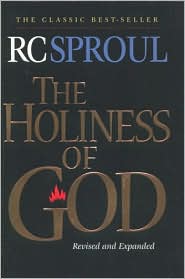
20. The Holiness of God


The Holiness of God. R.C. Sproul. 1985/2012. 226 pages. [Source: Bought]


First sentence: I was compelled to leave the room. A deep, undeniable summons disturbed my sleep; something holy called me.

ETA: I reread The Holiness of God. I wasn't planning to exactly. But after reading Chosen by God, I just *had* to. These books complement each other so well. These two are so essential. Both hold a special place in my heart. 

Holiness of God is a classic by R.C. Sproul that every Christian should read at least once. Emphasis on at least once. I think it happens to be one of those books where you might even want to reread it every other year or so.

So what is it about? It's about God, about who HE is, about his HOLINESS and righteousness. But it is also about who we are. It's about sin--what it is, how it divides us, how it damns us--about grace, about justice. It is about our holiness as well. Why are believers called saints? Why are we called to be holy and to live holy lives? Ultimately, the book is a refresher course on the gospel itself.

In the first chapter, Sproul writes: "Today I am still absorbed with the question of the holiness of God. I am convinced that it is one of the most important ideas that a Christian can ever grapple with...How we understand the person and character of God the Father affects every aspect of our lives. It affects far more than what we normally call the “religious” aspects of our lives." If you agree, then this book is a must read. And if you don't agree, well, then perhaps reading the book will change your mind.

I have read this one three times now. I think I love it more each time.

Quotes:
Here is the promise of God: We shall see Him as He is. Theologians call this future expectation the beatific vision. We will see God as He is.
Right now it is impossible for us to see God in His pure essence. Before that can ever happen, we must be purified. When Jesus taught the Beatitudes, He promised only a distinct group the vision of God: “Blessed are the pure in heart, for they will see God” (Matt. 5:8).
None of us in this world is pure in heart. It is our impurity that prevents us from seeing God. The problem is not with our eyes; it is with our hearts.
Only once in sacred Scripture is an attribute of God elevated to the third degree. Only once is a characteristic of God mentioned three times in succession. The Bible says that God is holy, holy, holy.  Not that He is merely holy, or even holy, holy. He is holy, holy, holy. The Bible never says that God is love, love, love; or mercy, mercy, mercy; or wrath, wrath, wrath; or justice, justice, justice. It does say that He is holy, holy, holy, that the whole earth is full of His glory.
In a very real sense, the word holy is a foreign word. The problem we face, however, is that the word holy is foreign to all languages. No dictionary is adequate to the task. 
Sinful people are not comfortable in the presence of the holy. The cliché is that misery loves company. Another is that there is fellowship among thieves. But thieves do not seek the consoling presence of the fellowship of police officers. Sinful misery does not love the company of purity.
If we fix our minds on the holiness of God, the result might be disturbing.
“Love God? Sometimes I hate Him.” This is a strange quote to hear from the lips of a man as respected for his religious zeal as Luther.
 Two things separated Luther from the rest of men: First, he knew who God was. Second, he understood the demands of God’s law. He had mastered the law. Unless he came to understand the gospel, he would die in torment.
“The just shall live by faith.” This was the battle cry of the Protestant Reformation. The idea that justification is by faith alone, by the merits of Christ alone, was so central to the gospel that Luther called it “the article upon which the church stands or falls.” Luther knew that it was the article by which he would stand or fall.
There is no such thing as evil justice in God. The justice of God is always and ever an expression of His holy character.
What God does is always consistent with who God is. He always acts according to His holy character. God’s internal righteousness is the moral excellence of His character.
God does not always act with justice. Sometimes He acts with mercy. Mercy is not justice, but it also is not injustice. Injustice violates righteousness. Mercy manifests kindness and grace and does no violence to righteousness. We may see nonjustice in God, which is mercy, but we never see injustice in God.
The false conflict between the two testaments may be seen in the most brutal act of divine vengeance ever recorded in Scripture. It is not found in the Old Testament but in the New Testament. The most violent expression of God’s wrath and justice is seen in the Cross. If ever a person had room to complain of injustice, it was Jesus. He was the only innocent man ever to be punished by God. If we stagger at the wrath of God, let us stagger at the Cross. Here is where our astonishment should be focused.
It is impossible for anyone, anywhere, anytime to deserve grace. Grace by definition is undeserved. As soon as we talk about deserving something, we are no longer talking about grace; we are talking about justice. Only justice can be deserved. God is never obligated to be merciful. Mercy and grace must be voluntary or they are no longer mercy and grace.
God never “owes” grace. He reminds us more than once: “I will have mercy on whom I will have mercy” (Exod. 33:19). This is the divine prerogative. God reserves for Himself the supreme right of executive clemency.
The moment awareness of His divine presence begins, the deepest personal struggle a person can experience begins as well.
We may wrestle with the Holy One. Indeed, for the transforming power of God to change our lives, we must wrestle with Him. We must know what it means to fight with God all night if we are also to know what it means to experience the sweetness of the soul’s surrender.
One of the names by which God is revealed in the Old Testament is the name El Shaddai. The name means “the thunderer” or “the overpowerer.” It was by the name El Shaddai that God appeared to Job. What Job experienced was the awesome power of a sovereign God who overpowers all people and is Himself overpowered by no one.
How much time elapses before the sinner begins to become pure? The answer is none. There is no time lapse between our justification and the beginning of our sanctification. But there is a great time lapse between our justification and the completion of our sanctification.
Semi-Pelagianism is the majority report among evangelical Christians and probably represents the theology of the vast majority of people who read this book. But I am convinced that with all of its virtues, Semi-Pelagianism still represents a theology of compromise with our natural inclinations. Evangelicals today have unconverted sinners who are dead in trespasses and sin bringing themselves to life by choosing to be born again. Christ made it clear that dead people cannot choose anything, that the flesh counts for nothing, and that we must be born of the Spirit before we can even see the kingdom of God, let alone enter it. The failure of modern evangelicalism is the failure to understand the holiness of God. If that one point were grasped, there would be no more talk of mortal enemies of Christ coming to Jesus by their own power. The only kind of God we can love by our sinful nature is an unholy god, an idol made by our own hands. Unless we are born of the Spirit of God, unless God sheds His holy love in our hearts, unless He stoops in His grace to change our hearts, we will not love Him.
God is not at the edge of Christians’ lives but at the very center. God defines our entire life and worldview.


© Becky Laney of Operation Actually Read Bible

Thursday, March 10, 2022

4. NIV (NIV 84) Young Discoverer's Bible


NIV Young Discoverer's Bible. 1985. Zondervan. 1979 pages. [Source: Childhood copy]

First sentence: In the beginning God created the heavens and the earth. 

There is something incredibly special about going back to your childhood Bible. I've had this Bible since fourth grade. It hasn't always been "my number one" meaning my daily go-to Bible. But two things keep me coming back again again. First, I love HOW large the font is. And because it's old school--1985--there is little to no bleed through or ghosting. So the combination of LARGE PRINT + NO GHOSTING + BLACK LETTER text means that the layout is just about as perfect as you can get. Second, I love the 84 edition of the New International Version translation. This is the version that I almost exclusively read for a little over a decade. And it was that first decade of faith as well. I was in college before I started accumulating other translations---like the NKJV and NASB. There is something HOME-y and JUST RIGHT about going back to revisit this translation as an adult. 

I do wish that the publishers hadn't sought to obliterate the 84 edition of this translation. They *could* have left it readily available online even if they didn't want to keep it physically in print. Online Bibles and e-Bibles could have been kept "alive" even after the 2011 was released. 

© Becky Laney of Operation Actually Read Bible

Monday, May 13, 2019

Book Review: Billy Sunday, Baseball Preacher

Billy Sunday, Baseball Preacher. Fern Neal Stocker. 1985. Moody. 143 pages. [Source: Bought]

First sentence: "Ma, I want to go swimming!" said Willie one hot June day in 1873.

Premise/plot: This is a children's biography of Billy Sunday a baseball player turned evangelist. It reads almost as a novel--for better or worse. On the one hand, it's the size of a paperback novel, the chapters read quickly, and include plenty of dialogue. On the other hand, it does not include photographs, source notes, or a bibliography.

My thoughts: I found this one to be a quick and interesting read. Billy Sunday's life was not easy. His mother struggled to raise him and his brother after her husband's death. When she remarried her new husband did NOT want the children from her first marriage around. The boys were sent to their grandparents. When their grandmother died, it was decided that the boys must go to an orphanage. Their new mother had a baby and her new husband had abandoned her. At one point, the grandfather sent for one boy but not the other. Both came. But Billy knew he wasn't wanted. It became evident that he'd need to be independent and hardworking if he wanted anything out of life. He excelled at baseball...and that was his salvation, in a way. People were more willing to have him around and give him jobs after they saw him play. The book also focuses on his testimony: how he came to Christ and how he eventually decided to dedicate his life to the Lord as an evangelist.


© Becky Laney of Operation Actually Read Bible

Friday, October 6, 2017

Book Review: Wilfrid Gordon McDonald Partridge

Wilfrid Gordon McDonald Partridge. Mem Fox. Illustrated by Julie Vivas. 1984/1985. Kane/Miller. 32 pages. [Source: Library]

First sentence: There was once a small boy called Wilfrid Gordon McDonald Partridge and what's more he wasn't very old either. His house was next door to an old people's home and he knew all the people who lived there.

Premise/plot: Wilfrid Gordon McDonald Partridge has many friends; but his most special friend has four names just like him: Miss Nancy Alison Delacourt Cooper. When he hears that she is losing her memory--or has "lost" her memory, Wilfrid sets out in search of it. But first, he has to know exactly what a memory is. So, being young and curious, he asks. Equipped with descriptions of exactly what memory is, he sets out on a quest. Will the items he collects be just what Miss Nancy needs?

My thoughts: Wilfrid Gordon McDonald Partridge is a life-affirming picture book that readers of all ages can enjoy. I think perhaps that adults might appreciate it a tiny bit more. The book affirms--celebrates--life, friendship, and memories.

It affirms life, affirms all stages of life. This is a biblical message whether Fox intended it or not. Life has dignity and worth regardless of if you're in the womb or if you're ninety-six years old. One's worth or value does not depend on what we think of ourselves, or what others think of us. Miss Nancy may be "losing" her memory--suffering from dementia. But her life is not without value. Miss Nancy is still one of the best friends worth having--in the eyes of our hero, Wilfrid.

It affirms friendship. Wilfrid values his friends. Most of his friends live in an old people's home. He values them; he values the time they spend together. He doesn't pity them, he values them--values them just the way they are.

It affirms memories--new and old. This book is just as much about creating new memories as it is "finding" or "discovering" lost memories. Life is worth living in the moment. Even if your loved one has "lost" his/her memories. Even if your loved one struggles to remember things--people, places, events, etc--doesn't mean they're incapable of enjoying the moment they're in today. While it may be completely natural to mourn the loss of a relationship, don't lose sight of the continuing relationship.

Earlier in the year I read Finding Grace in the Face of Dementia by John Dunlop. I'm going to share two quotes that I think speak to Wilfrid's character:
Compassion is not only showing love and kindness, but it is also understanding how others feel and then allowing ourselves to feel that same way. It is taking the time and effort to get into their lives to see the world as they see it.
They may feel much more than they know, and how they feel may be far more important to them then what they know.

© Becky Laney of Operation Actually Read Bible

Monday, November 4, 2013

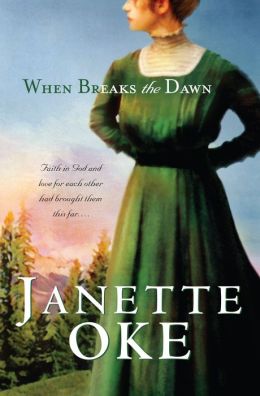
Book Review: When Breaks the Dawn

When Breaks the Dawn. Janette Oke. 1985. Bethany House. 215 pages. [Source: Library]

When Breaks the Dawn continues right where When Comes The Spring leaves off. In When Comes The Spring, the community is desperate but resourceful after a horrible fire destroys the village's supply store. Without these resources to see them through, the whole community is at risk. Alone these families and individuals have little chance, but, working together, well, they might just survive: not that it will be easy, but still, there's hope. When Breaks the Dawn begins with the arrival of the supply wagons and with the return of Ian and Nimmie McLain.

When Breaks the Dawn is about Elizabeth's struggle for peace and contentment, in a way. She loves, loves, loves her husband, but, how can she stop WORRYING about him and where his work takes him?! She has embraced the community and made a handful of good friends, including a BEST friend, Nimmie, but she can't help feeling envious of her friend at times. For Elizabeth's BIG BIG BIG struggle is infertility. She is disappointed and frustrated and angry and bitter and broken up over the fact that she has not been able to conceive. She sees Nimmie have child after child, she watches little ones in the community grow up; she can't understand why something she wants so very very badly doesn't happen for her. Why hasn't God answered that prayer, that very specific prayer, that prayer that she prays so faithfully?! Elizabeth is incredibly vulnerable in this one. She opens her heart and her home TWICE to native children in need of an adoptive home. One, a little girl, Susie, I believe. She lives with Elizabeth and Wynn for months before her mother is able to take her back. And a second child, a newborn baby boy, Samuel, whom they take in for about a year. Elizabeth is emotionally crushed in this book; in many ways, it is a sad book. But I like the fact that this book deals with a hard subject in a very honest way. The happy but shallow Elizabeth from chapter one in When Calls The Heart has been erased by the all-too-human Elizabeth whose dreams of a perfect-perfect-perfect life has failed her. In When Breaks The Dawn, Elizabeth has to choose to be thankful and learn that God is GOOD.

Thursday, October 17, 2013

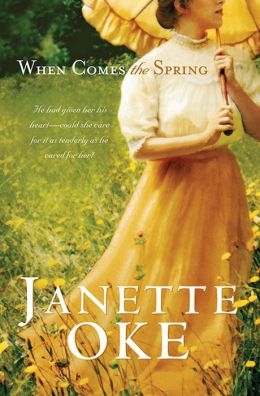
Book Review: When Comes The Spring

When Comes The Spring. Janette Oke. 1985. Bethany House. 252 pages. [Source: Library]

I really do love the first book in the series. And this second book is almost as good. It focuses on the married life of Elizabeth and Wynn, and their first year of marriage. The novel opens with Elizabeth planning her wedding. Oh, the plans she has; oh the plans her sister-in-law has! But Wynn's announcement changes things! He's received a post, in the north, he has to be there on August 1. Elizabeth's September wedding is off. But her quieter, calmer, just-family wedding is on...in just a few days! The book dwells on Elizabeth's life in the North. I liked the focus on Elizabeth having to find her own life within her husband's, of course. She will always be "his wife." But she can't spend each and every moment of the day in the two-room cabin sitting and worrying or working and cleaning. His work is unpredictable. He could be gone most of the day or most of the night. He might be gone for days at a time. He might be going into situations that are extremely dangerous. And she has to learn to be okay with that, okay with her husband's profession, okay with her loneliness too. She needs to embrace this community, this village, as her own. She needs to open her heart and her home to others, and, this means letting go of certain prejudices. This struggle to be content, to accept life just as God has willed it, is not easy. And this is something that only begins in this one. It is continued in When Breaks The Dawn, the third book in the series. These two books are so closely linked I almost wish they were just one big book!

Saturday, May 7, 2011

Book Review: The Holiness of God

The Holiness of God. R.C. Spoul. 1985. Tyndale. 280 pages.

I would definitely recommend The Holiness of God. I found it to be rich in truth, full of treasure. The focus is on God--on God's holiness. On what God's holiness means to humanity. How God's holiness is tied in closely with God's justice and God's wrath--but also his mercy and love. Much of the book is spent on sin, focusing on how humans are captive to sin, on how our sin keeps us separated from God, how sin makes us all deserving of eternal punishment, how sin hurts and angers God, how God's holiness demands that someone pay the price for the sin in the world. But it isn't only about "the bad news." It isn't all sin, sin, sin, sin. It is also about God's mercy and grace. How grace is completely, absolutely undeserved. How grace should not be taken lightly, taken for granted. So other topics covered include justification and sanctification. (It's also about Jesus Christ, our Savior and Redeemer and Lord.)

Sproul relies on the Bible throughout each of his chapters to illustrate his argument. He shines the spotlight on a handful of characters including Peter and Saul/Paul and Isaiah. (There are really too many to list them all). He uses both Old Testament and New Testament examples. One of his chapters focuses on Martin Luther, another on Jonathan Edwards. I found the book getting better with each chapter.

The most brutal act of divine vengeance ever recorded in Scripture is not found in the Old Testament but in the New Testament. The most violent expression of God's wrath and justice is seen in the cross. If ever a person had room to complain of injustice it was Jesus. He was the only innocent man ever to be punished by God. If we stagger at the wrath of God, let us stagger at the cross. Here is where our astonishment should be focused. If we have cause for moral outrage, let it be directed at Golgotha.
The cross was at once the most horrible and the most beautiful example of God's wrath. It was the most just and the most gracious act in history. (185)

There are only two things I ever receive from God--justice or mercy. I never receive injustice from His hand. (196)

The struggle we have with a holy God is rooted in the conflict between God's righteousness and our unrighteousness. He is just and we are unjust. This tension creates fear, hostility, and anger within us toward God. The unjust person does not desire the company of a just judge. We become fugitives fleeing from the presence of One whose glory can blind us and whose justice can condemn us. We are at war with Him unless or until we are justified. Only the justified person can be comfortable in the presence of a holy God. (224)

*The book was revised and expanded in 1997. I read the older edition, so I'm not sure how much of a difference there is between the two.

© Becky Laney of Operation Actually Read Bible