Showing posts with label D.L. Moody. Show all posts

Wednesday, February 10, 2021

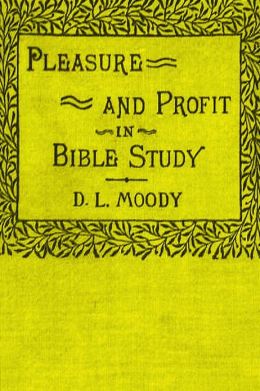
9. Pleasure and Profit in Bible Study


Pleasure and Profit in Bible Study. D.L. Moody. 1898. 167 pages. [Source: Bought]

First sentence of the preface: It is always a pleasure to me to speak on the subject of this volume. I think I would rather preach about the Word of God than anything else except the Love of God; because I believe it is the best thing in this world.

First sentence of chapter one: A QUICKENING that will last must come through the Word of God. A man stood up in one of our meetings and said he hoped for enough out of the series of meetings to last him all his life. I told him he might as well try to eat enough breakfast at one time to last him his lifetime.


I first read this one in 2013. I loved, loved, loved it. Mainly because I love finding wonderful quotes from people who love, love, love reading the Bible just as much--if not more--than I do. It is a very quote-worthy book. It is just GOOD.


Here's one of the helpful lists of how to profit from Bible reading:

1. What persons have I read about, and what have I learned about them?

2. What places have I read about, and what have I read about them? If the place is not mentioned, can I find out where it is? Do I know its position on the map?

3. Does the passage refer to any particular time in the history of the children of Israel, or of some leading character?

4. Can I tell from memory what I have just been reading?

5. Are there any parallel passages or texts that throw light on this passage?

6. Have I read anything about God the Father? or about Jesus Christ? or about the Holy Spirit?

7. What have I read about myself? about man's sinful nature? about the spiritual new nature?

8. Is there any duty for me to observe? any example to follow? any promise to lay hold of? any exhortation for my guidance? any prayer that I may echo?

9. How is this Scripture profitable for doctrine? for reproof? for correction? for instruction in righteousness?

10. Does it contain the gospel in type or in evidence?

11. What is the key verse of the chapter or passage? Can I repeat it from memory?

It is very no-nonsense. Moody gives you tips on how to read and study the Bible. He can be opinionated. 
I don't always agree 100% with every little thing he said. But he's good at giving readers things to think about.

There are about sixteen chapters. For whatever reason the copy I read had two chapter sevens. 

From chapter one: 
  • The more you love the Scriptures, the firmer will be your faith. 
  • When I pray, I talk to God, but when I read the Bible, God is talking to to me; and it is really more important that God should speak to me than that I should speak to Him. 
  • I believe we should know better how to pray if we knew our Bibles better. 
  • What is an army good for if they don't know how to use their weapons? What is a young man starting out in the Christian work good for if he does not know how to use his Bible? A man isn't worth much in battle if he has any doubt about his weapon, and I have never found a man who has doubts about the Bible who has amounted to much in Christian work. 
  • Depend upon it, my friends, if you get tired of the Word of God, and it becomes wearisome to you, you are out of communion with Him. 
  • Bear in mind there is no situation in life for which you cannot find some word of consolation in Scripture. If you are in affliction', if you are in adversity and trial, there is a promise for you. In joy and sorrow, in health and in sickness, in poverty and in riches, in every condition of life, God has a promise stored up in His Word for you. In one way or another every case is met, and the truth is commended to every man's conscience. 
  • But if we have the peace of God, the world cannot take that from us. It cannot give it; it cannot destroy it. We must get it from above the world, it is the peace which Christ gives. 
  • Now, the Bible is a guidebook in the journey of life, and the only one that points the way to Heaven. 
From chapter two:
  • It is not our work to make men believe: that is the work of the Holy Spirit. 
  • A man once sat down to read it an hour each evening with his wife. In a few evenings he stopped in the midst of his reading and said: "Wife, if this Book is true, we are wrong." He read on, and before long, stopped again and said: "Wife, if this Book is true, we are lost." Riveted to the Book and deeply anxious, he still read on, and soon exclaimed: "Wife, if this Book is true, we may be saved." It was not many days before they were both converted. 
  • I thank God there is a height in that Book I do not know anything about, a depth I have never been able to fathom, and it makes the Book all the more fascinating. If I could take that Book up and read it as I can any other book and understand it at one reading, I should have lost faith in it years ago. It is one of the strongest proofs that that Book must have come from God. 
  • A man once said to an infidel: "The mysteries of the Bible don't bother me. I read the Bible as I eat fish. When I am eating fish and come across a bone, I don't try to swallow it, I lay it aside. And when I am reading the Bible and come across something I can't understand, I say, 'There is a bone,' and I pass it by. But I don't throw the fish away because of the bones in it; and I don't throw my Bible away because of a few passages I can't explain." 
  • Now, if I have a right to cut out a certain portion of the Bible, I don't know why one of my friends has not a right to cut out another, and another-friend to cut out another part, and so on. You would have a queer kind of Bible if everybody cut out what he wanted to. Every adulterer would cut out everything about adultery; every liar would cut out everything about lying; every drunkard would be cutting out what he didn't like. 
  • Once, a gentleman took his Bible around to his minister's and said, "That is your Bible." "Why do you call it my Bible?" said the minister. "Well," replied the gentleman, "I have been sitting under your preaching for five years, and when you said that a thing in the Bible was not authentic, I cut it out." He had about a third of the Bible cut out; all of Job, all of Ecclesiastes and Revelation, and a good deal besides. The minister wanted him to leave the Bible with him; he didn't want the rest of his congregation to see it. But the man said, " Oh, no! I have the covers left, and I will hold on to them." And off he went holding on to the covers. If you believed what some men preach, you would have nothing but the covers left in a few months. 
  • I have often said that if I am going to throw away the Bible, I will throw it all into the fire at once. There is no need of waiting five years to do what you can do as well at once. I have yet to find a man who begins to pick at the Bible that does not pick it all to pieces in a little while.
From chapter three: 
  • If the Old Testament Scriptures are not true, do you think Christ would have so often referred to them, and said the Scriptures must be fulfilled? 
  • May God deliver us from the one-sided Christian who reads only the New Testament and talks against the Old!
From chapter four: 
  • What we want to-day is men who believe in it from the crown of their heads to the soles of their feet, who believe the whole of it, the things they understand and the things they do not understand. Talk about the things you understand, and leave the things you do not. I believe that is one reason why the English and the Scotch Christians have got ahead of us, because they study the whole Bible.
From chapter six:
  • Give the people the Word of God. Some men only use the Bible as a text book. They get a text and away they go. They go up in a balloon and talk about astronomy, and then go down and give you a little geology, and next Sunday they go on in the same way, and then they wonder why it is people do not read their Bibles.
From chapter seven:
  • MERELY reading the Bible is not what God wants. There is not a verse in Scripture where I am told to " read " the Bible, but again and again I am exhorted to " search." 
  • Read the Bible, my friends, as if you were seeking for something of value. It is a good deal better to take a single chapter, and spend a month on it, than to read the Bible at random for a month. 
  • I do not think there is a book in the world we neglect so much as the Bible.
From chapter eight:

  • SOMEONE has said that there are four things necessary in studying the Bible: Admit, submit, commit and transmit. First, admit its truth; second, submit to its teachings; third, commit it to memory; and fourth, transmit it. If the Christian life is a good thing for you, pass it on to some one else. 
  • The quicker you learn to feed yourself the better. I pity down deep in my heart any men or women who have been attending some church or chapel for, say five, ten, or twenty years, and yet have not learned to feed themselves. 
  • Many so-called Christians are living on the world's sawdust, instead of being nourished by the Bread that cometh down from heaven. Nothing can satisfy the longings of the soul but the Word of the living God. 
  • Read the Bible itself—do not spend all your time on commentaries and helps. If a man spent all his time reading up the chemical constituents of bread and milk, he would soon starve.
  • There are three books which I think every Christian ought to possess. The first, of course, is the Bible. I believe in getting a good Bible, with a good plain print. I have not much love for those little Bibles which you have to hold right under your nose in order to read the print; and if the church happens to be a little dark, you cannot see the print, but it becomes a mere jumble of words. Yes, but some one will say you cannot carry a big Bible in your pocket. Very well, then, carry it under your arm; and if you have to walk five miles, you will just be preaching a sermon five miles long. I have known a man convicted by seeing another carrying his Bible under his arm. If you get a good Bible you are likely to take better care of it. Suppose you pay ten dollars for a good Bible, the older you grow the more precious it will become to you. But be sure you do not get one so good that you will be afraid to mark it. I don't like gilt-edged Bibles that look as if they had never been used. Then next I would advise you to get a Cruden's Concordance. I was a Christian about five years before I ever heard of it. A skeptic in Boston got held of me. I didn't know anything about the Bible and I tried to defend the Bible and Christianity. He made a misquotation and I said it wasn't in the Bible. I hunted for days and days. If I had had a concordance I could have found it at once. It is a good thing for ministers once in a while to tell the people about a good book. You can find any portion or any verse in the Bible by just turning to this concordance.  Thirdly, a Topical Text Book. These books will help you to study the Word of God with profit. 
From chapter nine:
  • THERE are two opposite ways to study the Bible. One is to study it with a telescope, taking a grand sweep of a whole book and trying to find out God's plan in it; the other, with a microscope, taking up a verse at a time, dissecting it, analyzing it.
From chapter ten:

  • I KNOW some men who never sit down to read a book until they have time to read the whole of it. When they come to Leviticus or Numbers, or any of the other books, they read it right through at one sitting. They get the whole sweep, and then they begin to study it chapter by chapter. It is a good thing to take one  whole book at a time. 
  • How could you expect to understand a story or a scientific text-book if you read one chapter here and another there?
From chapter twelve:
  • I FIND some people now and then who boast that they have read the Bible through in so many months. Others read the Bible chapter by chapter,and get through it in a year; but I think it would be almost better to spend a year over one book. If I were going into a court of justice, and wanted to carry the jury with me, I should get every witness I could to testify to the one point on which I wanted to convince the jury. I would not get them to testify to everything, but just to that one thing. And so it should be with the Scriptures.
From chapter fourteen:
  • An old writer said that some books are to be tasted, some to be swallowed, and some to be chewed and digested. The Bible is one that you can never exhaust. It is like a bottomless well: you can always find fresh truths gushing forth from its pages. Hence the great fascination of constant and earnest Bible study. Hence also the necessity of marking your Bible. Unless you have an uncommon memory, you cannot retain the good things you hear. If you trust to your ear alone, they will escape you in a day or two; but if you mark your Bible and enlist the aid of your eye, you will never lose them. The same applies to what you read. 
  • Bible marking should be made the servant of the memory. If properly done, it sharpens the memory, rather than blunts it, because it gives prominence to certain things that catch the eye, which by constant reading you get to learn off by heart. 
  • It helps you to locate texts. 
  • It saves you the trouble of writing out notes of your addresses. Once in the margin, always ready. 
  • Get full of Scripture and then you can't help but say it. It says itself. Keep the world out of your heart by getting full of something else. 
  • Mark your Bible, and instead of its being dry and uninteresting, it will become a beautiful book to you. What you see makes a more lasting impression on your memory than what you hear. 
  • Do not buy a Bible that you are unwilling to mark and use.
From the last chapter:

1. Have for constant use a portable reference Bible, a Cruden's Concordance, and a Topical Text Book.

2. Always carry a Bible or Testament in your pocket, and do not be ashamed of people seeing you read it on trains, etc.

3. Do not be afraid of marking it, or of making marginal notes. Mark texts that contain promises, exhortations, warnings to sinners and to Christians, gospel invitations to the unconverted, and so on.

4. Set apart at least fifteen minutes a day for study and meditation. This little will have great results and will never be regretted.

5. Prepare your heart to know the law of the Lord, and to do it. Ezra 7:10.

6. Always ask God to open the eyes of your understanding that you may see the truth; and expect that He will answer your prayer.

7 Cast every burden of doubt upon the Lord. "He will never suffer the righteous to be moved." Do not be afraid to look for a reason for the hope that is in you.

8. Believe in the Bible as God's revelation to you, and act accordingly. Do not reject any portion because it contains the supernatural, or because you can not understand it. Reverence all Scripture. Remember God's own estimate of it: "Thou hast magnified thy Word above all thy Name."

9. Learn at least one verse of Scripture each day. Verses committed to memory will be wonderfully useful in your daily life and walk. "Thy Word have I hid in mine heart, that I might not sin against Thee." Some Christians can quote Shakespeare and Longfellow better than the Bible.

10. If you are a preacher or a Sunday school teacher, try at any cost to master your Bible. You ought to know it better than anyone in your congregation or class.

11. Strive to be exact in quoting Scripture.

12. Adopt some systematic plan of Bible study: either topical, or by subjects, like "The Blood," "Prayer," "Hope," etc.; or by books; or- by some other plan outlined in the preceding pages.

13. Study to know for what and to whom each book of the Bible was written. Combine the Old Testament with the New. Study Hebrews and Leviticus together, the Acts of the Apostles and the Epistles, the Prophets and the historical books of the Old Testament.

14. Study how to use the Bible so as to "walk with God" in closer communion; also, so as to gain a working knowledge of Scripture for leading others to Christ. An old minister used to say that the cries of neglected texts were always sounding in his ears, asking why he did not show how important they were.

15. Do not be satisfied with simply reading a chapter daily. Study the meaning of at least one verse.

Friday, January 27, 2017

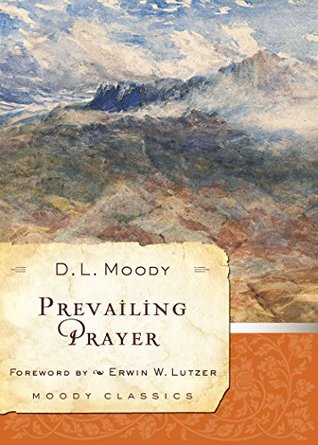
Book Review: Prevailing Prayer

Prevailing Prayer. D.L. Moody. Foreword by Erwin Lutzer. 1987/2016. Moody. 143 pages. [Source: Review copy]

First sentence: THOSE WHO HAVE LEFT the deepest impression on this sin-cursed earth have been men and women of prayer.

I enjoyed reading D.L. Moody's Prevailing Prayer. Prayer is one of those subjects that is always, always relevant for believers. Not all books on prayers are created equal, I've found. Prevailing Prayer is one of the good ones.

What I appreciated most about this one is how practical it is. Moody examined what the Bible had to say about prayer and showed readers how to apply what the Scripture teaches to their own prayers.

How practical is practical? Moody focused on nine elements that are essential to true prayer. These elements are: adoration, confession, restitution, thanksgiving, forgiveness, unity, faith, petition, submission. A few of these terms readers may be familiar with. But I'm guessing a few will be new to you. (I know they were new to me).

Favorite quotes:
  • If our sermons are going to reach the hearts and consciences of the people, we must be much in prayer to God, that there may be power with the word.
  • Holiness belongs to God; sinfulness belongs to us. 
  • When we see the holiness of God, we shall adore and magnify Him. When we hear men trying to make out that they are holy, and speaking about their holiness, they make light of the holiness of God.  It is His holiness that we need to think and speak about; when we do that, we shall be prostrate in the dust. 
  • The judgment of God must begin with us. 
  • God will hear our prayer and turn our captivity when we take our true place before Him, and confess and forsake our transgressions. 
  •  I think if God searches us, we will find a good many things in our lives for us to confess. If we are tried and tested by God’s law, there will be many, many things that Will have to be changed. 
  • Very often when we cry to God we do not really mean anything. 
  • The only way to trouble God is not to come at all. He encourages us to come to Him repeatedly, and press our claims. 
  • Too often we knock at mercy’s door, and then run away, instead of waiting for an entrance and an answer. Thus we act as if we were afraid of having our prayers answered. 

 
© Becky Laney of Operation Actually Read Bible

Thursday, June 23, 2016

Quotes from the Cloud #22

This year, I hope share weekly posts of quotes. These quotes are from authors I'm reading and enjoying from the Clouds of Witnesses Reading Challenge

For fellow participants, what I would LOVE, LOVE, LOVE to see is for people to share quotes from what they're reading. I'd love for you to share quotes occasionally with your readers and let me know about it. If you don't have a blog, you could always leave quotes in the comments here.
It is a great mistake to give a man who has not been convicted of sin certain passages that were never meant for him. The Law is what he needs. Do not offer the consolation of the gospel until he sees and knows he is guilty before God. We must give enough of the Law to take away all self-righteousness. I pity the man who preaches only one side of the truth--always the gospel, and never the Law. ~ D.L. Moody
Just as the world was not ready for the New Testament before it received the Old, just as the Jews were not prepared for the ministry of Christ until John the Baptist had gone before Him with his claimant call to repentance, so the unsaved are in no condition today for the Gospel till the Law be applied to their hearts, for "by the Law is the knowledge of sin." It is a waste of time to sow seed on ground which has never been ploughed or spaded! To present the vicarious sacrifice of Christ to those whose dominant passion to to take fill of sin, is to give that which is holy to the dogs. ~ A.W. Pink

© Becky Laney of Operation Actually Read Bible
Thursday, July 9, 2015

Quotes from the Cloud #27

This year, I hope share weekly posts of quotes. These quotes are from authors I'm reading and enjoying from the Clouds of Witnesses Reading Challenge

For fellow participants, what I would LOVE, LOVE, LOVE to see is for people to share quotes from what they're reading. I'd love for you to share quotes occasionally with your readers and let me know about it. If you don't have a blog, you could always leave quotes in the comments here.
When I am asked what God is, I think I know, but when I try to answer the question, I find that I know nothing. ~ St. Augustine
My sin was all the more incurable because I did not think of myself a sinner. ~ St. Augustine 
I firmly believe that the moment our hearts are emptied of pride and selfishness and ambition and self-seeking and everything that is contrary to God's law, the Holy Spirit will come and fill every corner of our hearts; but if we are full of pride and conceit and ambition and self-seeking and pleasure and the world, there is no room for the Spirit of God; and I believe many a man is praying to God to fill him when he is full already with something else. Before we pray that God will fill us, I believe we ought to pray that He would empty us. There must be an emptying before there can be a filling. And when the heart is turned upside-down and everything that is contrary to God is turned out, then the Spirit will come. ~ D.L. Moody
God sends no one away empty except those who are full of themselves. ~ D.L Moody

© Becky Laney of Operation Actually Read Bible

Friday, January 16, 2015

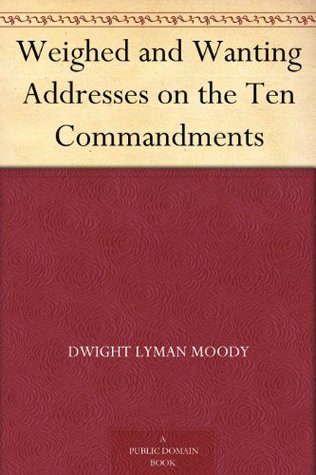
Book Review: Weighed and Wanting

Weighed and Wanting Addresses on the Ten Commandments. D.L. Moody. 1898. The Bible Institute. 128 pages. [Source: Bought]
Weighed in the Balances In the fifth chapter of Daniel we read the history of King Belshazzar. One chapter tells us all we know about him. One short sight of his career is all we have. He bursts in upon the scene and then disappears. “This is the writing that was written, Mene, Mene, Tekel, Upharsin. This is the interpretation of the thing: Mene—God hath numbered thy kingdom and finished it. Tekel—Thou art weighed in the balances, and art found wanting. Peres—Thy kingdom is divided, and given to the Medes and Persians.” If some one had told the king an hour before that the time had come when he must step into the balances and be weighed, he would have laughed at the thought. But the vital hour had come…
Perhaps you say: “I hope Mr. Moody is not going to compare me with that heathen king.” I tell you that a man who does evil in these Gospel days is far worse than that king. We live in a land of Bibles. You can get the New Testament for a nickel, and if you haven’t got a nickel you can get it for nothing. Many societies will be glad to give it to you free. We live in the full blaze of Calvary. We live on this side of the cross, but Belshazzar lived more than five hundred years on the other side. He never heard of Jesus Christ. He never heard about the Son of God. He never heard about God except, perhaps, in connection with his father’s remarkable vision. He probably had no portion of the Bible, and if he had, probably he didn’t believe it. He had no godly minister to point him to the Lamb of God.
All this happened long centuries ago. Let us get down to this century, to this year, to ourselves. We will come to the present time. Let us imagine that now, while I am preaching, down come some balances from the throne of God. They are fastened to the very throne itself. It is a throne of equity, of justice. You and I must be weighed. I venture to say this would be a very solemn audience. There would be no trifling. There would be no indifference. No one would be thoughtless.
I LOVED, LOVED, LOVED, LOVED Moody's Weighed and Wanting: Addresses on the Ten Commandments. It's a thought-provoking, often-convicting, humbling read. You might think that a book about the law, about the Ten Commandments, would be so stern and harsh that it would withhold grace or gospel or hope from its readers. That certainly isn't the case. The book is not anti-gospel or anti-grace. If it has to be anti anything, I'd say it would be anti-pride and anti-conceit. It's humbling to the extent that it makes your own righteousness--your apart-from-Christ-righteousness--appear as God sees it: filthy rags. It brings to mind the lyrics to Caedmon's Calls' I Boast No More:
No more my God, I boast no more
Of all the duties I have done
I quit the hopes I held before
To trust the merits of Thy Son
The best obedience of my hands
Dares not appear before Thy throne
But faith can answer Thy demands
By pleading what my Lord has done
So the premise of the book is a simple one. He challenges his readers to weigh themselves not by their own standards, not by the standards of the church and neighbors, but by God's standard alone. He will examine--carefully elaborate--on each of the Ten Commandments. He'll ask readers to see how they measured up one commandment at a time. There is one chapter per commandment, I believe.
I will admit that if you perfectly keep the commandments, you do not need to be saved by Christ; but is there a man in the wide world who can truly say that he has done this? Now face these Ten Commandments honestly and prayerfully. See if your life is right, and if you are treating God fairly. God’s statutes are just, are they not? If they are right, let us see if we are right. Let us pray that the Holy Ghost may search each one of us. Let us get alone with God and read His law—read it carefully and prayerfully, and ask Him to show us our sins and what He would have us to do.
Favorite quotes:
The conviction deepens in me with the years that the old truths of the Bible must be stated and restated in the plainest possible language.  
Man does not need to be commanded to worship, as there is not a race so high or so low in the scale of civilization but has some kind of a god. What he needs is to be directed aright.
“Thou shalt not” is the pruning-knife that God uses. From beginning to end, the Bible calls for wholehearted allegiance to Him. There is to be no compromise with other gods.
Many a professing Christian is a stumbling-block because his worship is divided. On Sunday he worships God; on week days God has little or no place in his thoughts.
You don’t have to go to heathen lands to-day to find false gods. America is full of them. Whatever you make most of is your god. Whatever you love more than God is your idol.
The road to heaven and the road to hell lead in different directions.
Worship involves two things: the internal belief, and the external act. We transgress in our hearts by having a wrong conception of God and of Jesus Christ before ever we give public expression in action.
The opinions that some people hold about Christ are not in accordance with the Bible, and are real violations of this second commandment.
We are apt to rush into God’s presence, and rush out again, without any real sense of the reverence and awe that is due Him. We forget that we are on holy ground.
I believe that the sabbath question to-day is a vital one for the whole country. It is the burning question of the present time. If you give up the sabbath the church goes; if you give up the church the home goes; and if the home goes the nation goes. That is the direction in which we are traveling. The church of God is losing its power on account of so many people giving up the sabbath, and using it to promote selfishness.
You may be a professing Christian, but I wouldn’t give much for your religion unless it gets into your life and teaches you how to live. I wouldn’t give a snap of my finger for a religion that doesn’t begin at home and regulate your conduct toward your parents.
Did you ever in your heart wish a man dead? That was murder. Did you ever get so angry that you wished any one harm? Then you are guilty. I may be addressing some one who is cultivating an unforgiving spirit. That is the spirit of the murderer, and needs to be rooted out of your heart. We can only read man’s acts—what they have done. God looks down into the heart. That is the birthplace and home of the evil desires and intentions that lead to the transgression of all God’s laws.
The home existed before the church, and unless the home is kept pure and undefiled, there can be no family religion and the church is in danger.
Partial obedience is not enough: obedience must be entire. The little indulgences, the small transgressions are what drive religion out of the soul. They lay the foundation for the grosser sins. If you give way to little temptations, you will not be able to resist when great temptations come to you.
Let your confession be as wide as your transgression.
We may say that covetous desire plunged the human race into sin. We can trace the river back from age to age until we get to its rise in Eden. When Eve saw that the forbidden fruit was good for food and that it was desirable to the eyes, she partook of it, and Adam with her. They were not satisfied with all that God had showered upon them, but coveted the wisdom of gods which Satan deceitfully told them might be obtained by eating the fruit. She saw,—she desired—then she took! Three steps from innocence into sin.
For fifteen hundred years man was under the law, and no one was equal to it. Christ came and showed that the commandments went beyond the mere letter; and can any one since say that he has been able to keep them in his own strength?
“Love to God will admit no other God. Love resents everything that debases its object by representing it by an image. Love to God will never dishonor His name. Love to God will reverence His day. Love to parents makes one honor them. Hate, not love, is a murderer. Lust, not love, commits adultery. Love will give, but never steal. Love will not slander or lie. Love’s eye is not covetous.”
Now is the day and hour to accept salvation, and then He will be with you. Do you step aside and say: “I’m not ready yet. I want a little more time to prepare, to turn the matter over in my mind?” Well, you have time, but bear in mind it is only the present; you do not know that you will have to-morrow. Wasn’t Belshazzar cut off suddenly? Would he have believed that that was going to be his last night, that he would never see the light of another sun? That banquet of sin didn’t close as he expected. As long as you delay you are in danger. If you don’t enter into the kingdom of heaven by God’s way, you cannot enter at all. You must accept Christ as your Savior, or you will never be fit to be weighed. My friend, have you got Him? Will you remain as you are and be found wanting, or will you accept Christ and be ready for the summons? “This is the record, that God hath given to us eternal life, and this life is in His Son. He that hath the Son hath life: and he that hath not the Son of God hath not life.” May God open your heart to receive His Son now!

© Becky Laney of Operation Actually Read Bible
Saturday, September 7, 2013

Journaling Sovereign Grace #3

Sovereign Grace Its Source, Its Nature, and Its Effects. Dwight Lyman Moody. 1891. 90 pages. [Source: Bought.]

In the first two journaling posts, we've covered the first five chapters of D.L. Moody's Sovereign Grace.
There are many Christians who practically limit the grace of God. It is like a river flowing by; and we can have all we need: but if we do not come and get a continual supply, we cannot give it out to others.
Mother! father! are you not longing to see your children won to Christ? What is the trouble? Is it the fault of the minister ? I believe that though ministers were to preach like angels, if there is a low standard of Christian life in the home, there will be little accomplished. What we want, more than anything else, is more grace in our lives, in our business affairs, in our homes, in our daily walk and conversation. I cannot but believe that the reason of the standard of Christian life being so low, is that we are living on stale manna. You know what I mean by that. So many people are living on their past experience-thinking of the grand times they had twenty years ago, perhaps when they were converted. It is a sure sign that we are out of communion with God if we are talking more of the joy, and peace, and power, we had in the past, than of what we have today. We are told to "grow in grace;" but a great many are growing the wrong way.
God give us grace to see our need of grace; give grace to ask for grace; give us grace to receive grace; give us grace to use the grace we have received.
Many say they are anxious to "grow in grace." I do not think they ever will, until they go out into the harvest field and begin to work for others. We are not going to have the grace we need to qualify us for work until we launch out into the deep, and begin to use the abilities and the opportunities we already possess. Many fold their arms, and wait for the grace of God to come to them; but we do not get it in that way. When we "go forward," then it is that God meets us with His Grace.
In 2 Corinthians 9:8, we read: "God is able to make all grace abound towards you ; that ye, always having all sufficiency in all things, may abound to every good work." There are three thoughts here–God makes all grace to abound, that we may have all sufficiency in all things. I think this is one of the most wonderful verses in the Bible.
There is plenty of grace. Many Christians, if they have grace enough to keep them from outward sin, seem to be perfectly satisfied; they do not press on to get fullness of grace, so as to be ready for God's work. Many are satisfied to go into the stream of grace ankle deep, when God wants them to swim in it.
It is said that Alexander the Great had a favorite General to whom he had given permission to draw upon the royal treasury for any amount. On one occasion this General had made a draft for such an enormous sum that the Treasurer refused to honor it until he consulted the Emperor. So he went into his presence and told him what the General had done. "Did you not honor the draft?" said the Emperor. "No; I refused till I had seen your Majesty; because the amount was so great." The Emperor was indignant. His Treasurer said that he was afraid of offending him if he had paid the amount. "Do you not know," replied the Emperor, "that he honors me and my kingdom by making a large draft?" Whether the story be authentic or not, it is true that we honor God when we ask for great things.
It has been well remarked: "Grace is glory militant; and glory is grace triumphant. Grace is glory begun; glory is grace made perfect. Grace is the first degree of glory: glory is the highest degree of grace.
Man lost spiritual life and communion with his Maker by listening to the voice of the tempter, instead of the voice of God. We get life again by listening to the voice of God. The Word of God gives life. 
A man once said that a good many of his congregation would be lost because they were too generous. He saw that the people looked rather surprised; so be said, "Perhaps you think I have made a mistake; and that I ought to have said you will be lost because you are not generous enough. That is not so; I meant just what I said. You give away too many sermons. You hear them, as it were, for other people." So there are a good many now hearing me who are listening for those behind them: they say the message is a very good one for neighbor so-and-so; and they pass it over their shoulders, till it gets clear out at the door. You laugh; but you know it is so. Listen! "Verily, verily, I say unto you, he that heareth My word, and believeth on Him that sent Me, hath everlasting life, and shall not come into condemnation ; but is passed from death unto life" (John 5:24).
The moment a man is willing to part with his sins, God meets him in grace and offers him peace and pardon.
© Becky Laney of Operation Actually Read Bible

Friday, September 6, 2013

Journaling Sovereign Grace #2

Sovereign Grace Its Source, Its Nature, and Its Effects. Dwight Lyman Moody. 1891. 90 pages. [Source: Bought.]

I absolutely LOVED this little book on grace. It is so wonderful!!! Please consider reading some of these quotes!
Many people are working and working, as Rowland Hill says, like children on a rocking horse-it is a beautiful motion, but there is no progress. Those who are working for salvation are like men on a treadmill, going round, and round, and round; toiling, and toiling, and toiling; but nothing comes of it all. There is no progress, and there cannot be until you have the motive power within, till the breath of life comes from God, which can alone give you power to work for others.
God not only gives us salvation freely, but he gives us the power to work it out.
God will not repent for the man; nor believe for the man; nor lead a holy life for the man. God worketh inwardly-man worketh outwardly. And this outward human work is as necessary as the inward Divine work.
I want to ask you this question: If sin needs forgiveness-and all sin is against God-how can you work out your own forgiveness? If I stole $100 from a friend, I could not forgive myself, could I? No act of mine would bring about forgiveness, unless my friend forgave me. And so, if I want forgiveness of sin, it must be the work of God. If we look at salvation as a new life, it must be the work of God. God is the author of life: you cannot give yourself life. If we consider it as a gift, it must come from some one outside of ourselves. That is what I read in the Bible-Salvation as a gift.
The religion of Christ is not man working his way up to God; it is God coming down to man. It as Christ coming down to the pit of sin and woe where we are, bringing us out of the pit, putting our feet upon a rock, and a new song in our mouth.
If you run all through Scripture you will find that the law brings to death. "Sin reigned unto death." A friend was telling me lately that an acquaintance of his, a minister, was once called upon to officiate at a funeral, in the place of a chaplain of one of Her Majesty's prisons, who was absent. He noticed that only one solitary man followed the body of the criminal to the grave. When the grave bad been covered, this man told the minister that he was an officer of the law whose duty it was to watch the body of the culprit until it was buried out of sight ; that was " the end" of the British law.
And that is what the law of God does to the sinner; it brings him right to death, and leaves him there. I pity deep down in my heart those who are trying to save themselves by the law. It never has; it never will; and it never can - save the soul. When people say they are going to try and do their best, and so save themselves by the law, I like to take them on their own ground. Have they ever done their very best? granting that there might be a chance for them if they had, was there ever a time when they could not have done a little better? If a man wants to do his best, let him accept the grace of God ; that is the best thing that any man or woman can possibly do.
But you will ask, What is the law given for? It may sound rather strange, but it is given that it may stop every man's mouth. "We know that what things soever the law saith, it saith to them who are under the law: that every mouth may be stopped, and all the world may become guilty before God. Therefore by the deeds of the law there shall no flesh be justified in His sight; for by the law is the knowledge of sin" (Romans 3:19-20). The law shuts my mouth; grace opens it. The law locks up my heart ; grace opens it - and then the fountain of love begins to flow out. When men get their eyes opened to see this glorious truth, they will cease their constant struggle. They will give up trying to work their way into the kingdom of God by the deeds of the law. They will give themselves up for lost, and take salvation as a free gift.

 Being justified by faith we have peace with God through our Lord Jesus Christ; by whom also we have access by faith into this grace wherein we stand, and rejoice in hope of the glory of God" (Romans 5:1-2). There are three precious things here: peace for the past ; grace for the present; and glory for the future. There is no PEACE until we see the finished work of Jesus Christ - until we can look back- and see the Cross of Christ between us and our sins. When we see that Jesus was "the end of the law for righteousness" (Romans 10:4); that He "tasted death for every man" (Hebrews 2:9); that He "suffered the Just for the unjust" (1 Peter 3:18) - then comes peace. Then there is "the GRACE wherein we now stand." There is plenty of grace for us as we need it - day by day, and hour by hour.
Then there is GLORY for the time to come. A great many people seem to forget that the best is before us. 

© Becky Laney of Operation Actually Read Bible
Thursday, September 5, 2013

Journaling Sovereign Grace #1

Sovereign Grace Its Source, Its Nature, and Its Effects. Dwight Lyman Moody. 1891. 90 pages. [Source: Bought.]

Now and then a book is so good, that it just has to be shared in a deeper way. I hope you'll take the time to read the quotes that I share from this wonderful little book on grace. It isn't the only book I've read on grace lately, but it may just be the best one!!!

There is probably not a word in the language so little understood. 
Now grace means unmerited mercy--undeserved favor. If men were to wake up to the fact, they would not be talking about their own worthiness when we ask them to come to Christ. When the truth dawns upon them that Christ came to save the unworthy, then they will accept salvation. 
Grace not only frees you from payment of the interest, but of the principal also.
I think if you will read your Bible carefully you will find that this wonderful river of grace comes right from the very heart of God...The first promise given to fallen man was a promise of grace.
For six thousand years, God has been trying to teach the world this great and glorious truth--that He wants to deal with man in love and in grace. It runs right through the Bible; all along you find this stream of grace flowing. The very last promise in the closing chapter of Revelation, like the first promise in Eden, is a promise of grace; "Whosoever will, let him take the water of life freely." So the whole revelation, and the whole history of man is encircled with grace, the free favor of God.
Grace found him a rebel--it leaves him a son. Grace found him wandering at the gates of hell--it leads him through the gates of heaven. Grace devised the scheme of Redemption: Justice never would; Reason never could. And it is grace which carries out that scheme. No sinner would ever have sought his God but 'by grace.' 
The treasury of grace, though always emptying is always full: the key of prayer which opens it is always at hand: and the almighty Almoner of the blessings of grace is always waiting to the gracious.
We work because we are saved, not in order to be saved. We work from salvation, not up to it. Salvation is the gift of God.
So if you experience the favor of God, you have to take it as a beggar. Some one has said: "If you come to God as a prince, you go away as a beggar: if you come as a beggar, you go away as a prince." It is to the needy that God opens the wardrobe of heaven, and brings out the robe of righteousness. 
An old man got up in one of our meetings and said, "I have been forty-two years learning three things." I pricked up my ears at that; I thought that if I could find out in about three minutes what a man had taken forty-two years to learn, I should like to do that. The first thing he said he had learned was that he could do nothing towards his own salvation. "Well," said I to myself, "that is worth learning." The second thing he had found out was that God did not require him to do anything. Well, that was worth finding out too. And the third thing was that the Lord Jesus Christ had done it all, that salvation was finished, and that all he had to do was to take it. Dear friends, let us learn this lesson; let us give up our struggling and striving, and accept salvation at once. 
© Becky Laney of Operation Actually Read Bible

Wednesday, August 14, 2013

D.L. Moody on the Bible

From Pleasure and Profit from Bible Study by D.L. Moody:

I have seen questions that will help one to get good out of every verse and passage of Scripture, They may be used in family worship, or in studying the Sabbath School lesson, or for prayer meeting, or in private reading. It would be a good thing if questions like these were pasted in the front of every Bible: 

1. What persons have I read about, and what have I learned about them? 
2. What places have I read about, and what have I read about them? If the place is not mentioned, can I find out where it is? Do I know its position on the map? 
3. Does the passage refer to any particular time in the history of the children of Israel, or of some leading character? 
4. Can I tell from memory what I have just been reading? 
5. Are there any parallel passages or texts that throw light on this passage? 
6. Have I read anything about God the Father? or about Jesus Christ? or about the Holy Spirit? 
7. What have I read about myself? about man’s sinful nature? about the spiritual new nature? 
8. Is there any duty for me to observe? any example to follow? any promise to lay hold of? any exhortation for my guidance? any prayer that may echo? 
9. How is this Scripture profitable for doctrine? for reproof? for correction? for instruction in righteousness? 
10. Does it contain the gospel in type or in evidence? 
 11. What is the key verse of the chapter or passage? Can I repeat it from memory?

© Becky Laney of Operation Actually Read Bible

Monday, August 12, 2013

Book Review: Pleasure and Profit in Bible Study

Pleasure and Profit in Bible Study. D.L. Moody. 167 pages. [Source: Bought]

I loved, loved, loved this one! It's such a great book--a very good resource too! Moody urges his readers to read the Bible, study and meditate upon it. He discusses various ways and methods for reading the Bible, for applying and studying it. He shares a few stories as well, good sermon illustrations perhaps. I also love how this one comes to focus on evangelism as well.

Favorite quotes:
A QUICKENING that will last must come through the Word of God.
The more you love the Scriptures, the firmer will be your faith. There is little backsliding when people love the Scriptures.
If you come into closer contact with the Word, you will gain something that will last, because the Word of God is going to endure.
If I could say something that would induce Christians to have a deeper love for the Word of God, I should feel this to be the most important service that could be rendered to them. Do you ask: How can I get in love with the Bible? Well, if you will only arouse yourself to the study of it, and ask God’s assistance, He will assuredly help you.
When I pray, I talk to God, but when I read the Bible, God is talking to me; and it is really more important that God should speak to me than that I should speak to Him I believe we should know better how to pray if we knew our Bibles better.
If you are impatient, sit down quietly and commune with Job. If you are strong-headed, read of Moses and Peter. If you are weak-kneed, look at Elijah. If there is no song in your heart, listen to David. If you are a politician, read Daniel. If you are getting sordid, read Isaiah. If you are chilly, read of the beloved disciple. If your faith is low, read Paul. If you are getting lazy, watch James. If you are losing sight of the future, read in Revelation of the promised land.
It does not need defence so much as it needs studying. It can defend itself.
A man once sat down to read it an hour each evening with his wife. In a few evenings he stopped in the midst of his reading and said: “Wife, if this Book is true, we are wrong.” He read on, and before long, stopped again and said: “Wife, if this Book is true, we are lost.” Riveted to the Book and deeply anxious, he still read on, and soon exclaimed: “Wife, if this Book is true, we may be saved.” It was not many days before they were both converted. This is the one great end of the Book, to tell man of God’s great salvation. Think of a book that can lift up our drooping spirits, and recreate us in God’s image!
They go on reading the Bible with a pen-knife, cutting out this and that. Now, if I have a right to cut out a certain portion of the Bible, I don’t know why one of my friends has not a right to cut out another, and another friend to cut out another part, and so on. You would have a queer kind of Bible if everybody cut out what he wanted to. Every adulterer would cut out everything about adultery; every liar would cut out everything about lying; every drunkard would be cutting out what he didn’t like.
If the Bible only has a chance to speak for itself, it will interest the people.
MERELY reading the Bible is not what God wants. Again and again I am exhorted to “search.” “These were more noble than those in Thessalonica, in that they received the word with all readiness of mind, and searched the Scriptures daily, whether those things were so.”
Read the Bible, my friends, as if you were seeking for something of value. It is a good deal better to take a single chapter, and spend a month on it, than to read the Bible at random for a month.
I do not think there is a book in the world we neglect so much as the Bible.
SOMEONE has said that there are four things necessary in studying the Bible: Admit, submit, commit and transmit. First, admit its truth; second, submit to its teachings; third, commit it to memory; and fourth, transmit it. If the Christian life is a good thing for you, pass it on to some one else.
It is a great thing for a boy or girl to know how to handle the Bible.
There is no place in the world that is so fascinating as a live Bible class. I believe that we are to blame that they have been brought up in the Sunday school without Bibles and brought up with quarterlies. The result is, the boys are growing up without knowing how to handle the Bible. They don’t know where Matthew is, they don’t know where the Epistle to the Ephesians is, they don’t know where to find Hebrews or any of the different books of the Bible. They ought to be taught how to handle the whole Bible, and it can be done by Sunday school teachers taking the Bible into the class and going right about it at once.
THERE are two opposite ways to study the Bible. One is to study it with a telescope, taking a grand sweep of a whole book and trying to find out God’s plan in it; the other, with a microscope, taking up a verse at a time, dissecting it, analyzing it.
Do you want to win men? Do not drive or scold them. Do not try to tear down their prejudices before you begin to lead them to the truth. Some people think they have to tear down the scaffolding before they begin on the building. An old minister once invited a young brother to preach for him. The latter scolded the people, and when he got home, asked the old minister how he had done. He said he had an old cow, and when he wanted a good supply of milk, he fed the cow; he did not scold her.
That is a popular objection against the Bible—that it tells about the failings of men. We should, however, remember that the object of the Bible is not to tell how good men are, but how bad men can become good.
I FIND some people now and then who boast that they have read the Bible through in so many months. Others read the Bible chapter by chapter, and get through it in a year; but I think it would be almost better to spend a year over one book. If I were going into a court of justice, and wanted to carry the jury with me, I should get every witness I could to testify to the one point on which I wanted to convince the jury. I would not get them to testify to everything, but just to that one thing. And so it should be with the Scriptures.
The Scriptures contain our title-deeds to everything we shall be worth when we die. If a will has your name in it, it is no longer a dry document. Why, then, do not Christians take more interest in the Bible?
No matter how weak you are, God can use you; and you cannot say what a stream of salvation you may set in motion.
It is a great mistake, in dealing with inquirers, to tell your conversion experience. Experience may have its place, but I don’t think it has its place when we are dealing with inquirers; for the first thing the man you are talking to will do will be to look for your experience. He doesn’t want your experience. He wants one of his own.
 © Becky Laney of Operation Actually Read Bible

Saturday, August 10, 2013

Observations on Job

From Pleasure and Profit in Bible Study by D.L. Moody:

An Englishman once remarked to me: “Mr Moody, did you ever notice this, that the book of Job is the key to the whole Bible? If you understand Job you will understand the entire Bible!” “No,” I said, “I don’t comprehend that. Job the key to the whole Bible! How do make that out?” He said: “I divide Job into seven heads. 

The first head is: A perfect man untried. That is what God said about Job; that is Adam in Eden. He was perfect when God put him there. 

The second head is: Tried by adversity. Job fell, as Adam fell in Eden. 

The third head is: The wisdom of the world. The world tried to restore Job; the three wise men came to help him. That was the wisdom of the world centred in those three men. You can not,” said he, “find any such eloquent language or wisdom anywhere, in any part of the world, as those three men displayed, but they did not know anything about grace, and could not, therefore, help Job.” That is just what men are trying to do; and the result is that they fail; the wisdom of man never made man any better. These three men did not help Job; they made him more unhappy. Some one has said the first man took him, and gave him a good pull; then the second and third did the same; the three of them had three good pulls at Job, and then flat down they fell. 

“Then in the fourth place,” said he, “in comes the Daysman, that is Christ. 

In the fifth place, God speaks; 

and in the sixth, Job learns his lesson. ‘I have heard of Thee by the hearing of the ear; but now mine eye seeth Thee. Wherefore I abhor myself, and repent in dust and ashes.’ And then down came Job flat on the dunghill. 

The seventh head is this, that God restores him.” Thank God, it is so with us, and our last state is better than our first. A friend of mine said to me: “Look here, Moody, God gave to Job double of everything.” He would not admit that Job had lost his children; God had taken them to heaven, and He gave Job ten more. So Job had ten in Heaven, and ten on earth—a goodly family. So when our children are taken from us, they are not lost to us, but merely gone before.

© Becky Laney of Operation Actually Read Bible

Saturday, July 27, 2013

Law and Grace

From Sovereign Grace Its Source, Its Nature and Its Effects by D.L. Moody
Some one has compiled the following, which beautifully describes the contrast between law and grace: The Law was given by Moses. Grace and truth came by Jesus Christ. The Law says—This do, and thou shalt live. Grace says—Live, and then thou shalt do. The Law says—Pay me that thou owest. Grace says—I frankly forgive thee all. The Law says—The wages of sin is death. GRACE says—The gift of God is eternal life. The Law says—The soul that sinneth, it shall die. Grace says—Whosoever believeth in Jesus, though he were dead, yet shall he live; and whosoever liveth and believeth in Him shall never die. The Law pronounces—Condemnation and death. Grace proclaims—Justification and life. The Law says—Make you a new heart and a new spirit. Grace says—A new heart will I give you, and a new spirit will I put within you. The Law says—Cursed is every one that continueth not in all things which are written in the book of the law to do them. Grace says—Blessed is the man whose iniquities are forgiven, whose sin is covered; blessed is the man to whom the Lord will not impute iniquity. The Law says—Thou shalt love the Lord thy God with all thy heart, and with all thy mind, and with all thy strength. Grace says—Herein is love: not that we love God, but that He loved us, and sent His Son to be the propitiation for our sins. The Law speaks of what man must do for God. Grace tells of what Christ has done for man. The Law addresses man as part of the old creation. Grace makes a man a member of the new creation. The Law bears on a nature prone to disobedience. Grace creates a nature inclined to obedience. The Law demands obedience by the terror of the Lord. Grace beseeches men by the mercies of God. The Law demands holiness. Grace gives holiness. The Law says—Condemn him. Grace says—Embrace him. The Law speaks of priestly sacrifices offered year by year continually, which could never make the comers thereunto perfect. Grace says—But this Man, after he had offered one sacrifice for sins forever . . . by one offering hath perfected forever them that are sanctified. The Law declares—That as many as have sinned in the Law, shall be judged by the Law. Grace brings eternal peace to the troubled soul of every child of God, and proclaims God’s salvation in defiance of the accusations of the adversary. “He that heareth My word, and believeth on Him that sent me, hath everlasting life, and shall not come into judgment (condemnation), but is passed from death unto life.”

© Becky Laney of Operation Actually Read Bible