Showing posts with label Martin Luther. Show all posts

Thursday, June 28, 2018

Book Review: Commentary on Romans

Commentary on the Epistle to the Romans. Martin Luther. 1954/1976. Kregel. 224 pages. [Source: Gift]

First sentence from the Preface: This Epistle is really the chief part of the New Testament and the very purest Gospel, and is worthy not only that every Christian should know it word for word, by heart, but occupy himself with it every day, as the daily bread of the soul. It can never be read or pondered too much, and the more it is dealt with the more precious it becomes, and the better it tastes. Therefore, I, too will do my best, so far as God has given me power, to open the way into it through this preface, so that it may be better understood by everyone.

This is an abridged commentary for the 'popular' audience looking for the 'fundamentals' of Luther's evangelical teachings. If you count Luther's Preface to the Epistle to the Romans as a chapter, this one has seventeen chapters. There is one chapter per chapter of Romans. This commentary includes the text of Romans.

I am glad I read it. I want to start off by saying that much at least. Perhaps my expectations were on the high side--expecting every single sentence to be a brilliant gem, expecting every sentence to be as wonderful as the Preface itself. With reasonable expectations, I think this one would rate well with most readers.

I'm not sure if the abridged edition is the perfectly perfect fit for me. Not having the unabridged to compare it to, I can't honestly say for sure. There were times that I found this commentary to be rushed. Whole books could be written--have been written--on short sections of Romans. Romans contains so many grand, glorious, foundational doctrines that to spend just a short time per verse seems a slight injustice. (For example, I could easily imagine an author dedicating 224 pages to unpacking the wonders of Romans 8.)

It reads like a commentary and not a devotional. I think the Luther devotional that I read a year or two ago spoiled me.

But because it was abridged, it did move quickly. One or two chapters per day felt like a good speed. And there is a lot to be said for movement and progress. This one wasn't intimidating, and again that is a plus.

Quotes:
Faith is a living, daring confidence in God's grace, so sure and certain that a man would stake his life on it a thousand times. (xvii)
Judgment day is called a day of wrath and a day of mercy; a day of tribulation and a day of peace; a day of damnation and a day of glory. On that day the wicked will be punished and put to shame, while the righteous will be rewarded and crowned with glory. (55)
In this life we never reach such perfection that we fully possess God, but we must continually seek after Him; indeed we must seek Him evermore, as the Psalmist says in Psalm 105:4. Those who do not make progress in seeking after God, are bound to retrogress;... We must never stand still in seeking after God. (71)
To believe God means to trust Him always and everywhere. (82)
Christ's resurrection is not merely the pledge of our righteousness, but also its cause. (87)
It has been said that human nature knows and wills what is good in general, but that it errs and does not will what is good in special cases. It is better, however, to say that human nature knows and wills what is good in special cases, but that in general it does not know and will what is good. The reason for this is that it knows only what it regards as good, honorable, useful and not what is good in the sight of God and the neighbor. Therefore it knows and wills the good only as it is connected with man's own interests. (118)
Abhor that which is evil; cleave to that which is good (Romans 12:9). This command seems easy to perform but it is most difficult because of the emotions of hate, love, fear, and hope. There is no one who can truly save that he abhors what is evil and cleaves to what is good. (174)
In all we do, we must consider not what we have done, or what there is to be done; not what we failed to do or what we should fail to do; also not what good we have done or what good we have omitted, or what evil we have done or omitted. But we should rather consider of what nature and how strong our good will has been, and the readiness and cheerfulness of our heart which with which we have done all or intend to do all. (197)

© Becky Laney of Operation Actually Read Bible

Wednesday, September 27, 2017

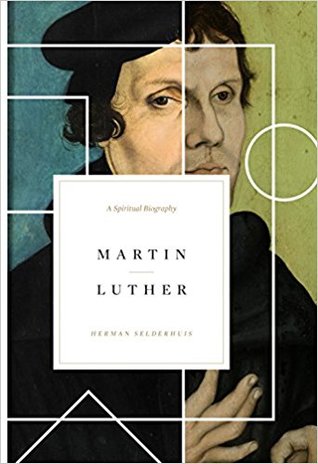
Book review: Martin Luther

Martin Luther: A Spiritual Biography. Herman Selderhuis. 2017. Crossway. 288 pages. [Source: Review copy]

First sentence from the introduction: Luther was a problem. Certainly for the pope and the emperor, but often he was also a problem for his fellow reformers. Prone to outbursts of rage and coarse language, Luther was frequently stubborn and undiplomatic, even with allies.

First sentence from chapter one: God, the Devil, and death were everyday topics in the world into which Martin Luther was born. As a child, Luther learned that God was a Judge more righteous than merciful. The Devil was out to snatch your soul and turn women into witches. Death was not the end of life, Luther was taught, but instead it was the moment you appear before God and enter purgatory. With these dour lessons firmly in his head, is it any surprise that years later Luther would say that every mention of God was “as a clap of thunder in [his] heart”? The god that Martin Luther was told to believe in as a child was a god who signaled his righteousness chiefly through punishment.

Premise/plot: Herman Selderhuis has written a spiritual biography of Martin Luther. He balances writing about Martin Luther's life with letting Martin Luther tell his own story by sharing quotes from his books, letters, sermons, pamphlets, etc. Even if you've read half a dozen books on Martin Luther in the past, I'd invite you to read this newly published biography. Selderhuis' narrative style is compelling.

My thoughts: I loved this book. I have read a handful of books on Martin Luther. Perhaps I should amend that to read, I've struggled my way through a handful of books on Martin Luther. I've almost always found them dull, intimidating, repetitive, or simplistic. Perhaps that isn't fair. Perhaps a fairer description would be not quite ideal in terms of reader appeal or approachability.

I loved Selderhuis' biography because it was packed with information, with detail, but the presentation was such that everything fit together and created a big picture context. It included plenty of information--some of it new to me--in a fascinating narrative. Nothing was dumbed down or made to be concise. The book was not yet another basic outline of his life. There's a passage in Ezekiel that I think applies here.

Ezekiel 37:1-10 reads,
"The hand of the Lord was upon me, and he brought me out in the Spirit of the Lord and set me down in the middle of the valley; it was full of bones. And he led me around among them, and behold, there were very many on the surface of the valley, and behold, they were very dry. And he said to me, “Son of man, can these bones live?” And I answered, “O Lord God, you know.” Then he said to me, “Prophesy over these bones, and say to them, O dry bones, hear the word of the Lord. Thus says the Lord God to these bones: Behold, I will cause breath to enter you, and you shall live. And I will lay sinews upon you, and will cause flesh to come upon you, and cover you with skin, and put breath in you, and you shall live, and you shall know that I am the Lord.”So I prophesied as I was commanded. And as I prophesied, there was a sound, and behold, a rattling, and the bones came together, bone to its bone. And I looked, and behold, there were sinews on them, and flesh had come upon them, and skin had covered them. But there was no breath in them. Then he said to me, “Prophesy to the breath; prophesy, son of man, and say to the breath, Thus says the Lord God: Come from the four winds, O breath, and breathe on these slain, that they may live.” So I prophesied as he commanded me, and the breath came into them, and they lived and stood on their feet, an exceedingly great army." 
Other biographers have given readers the dry bones of Martin Luther. But it is Selderhuis' biography that has given Martin Luther flesh and skin in my opinion. 

I loved LEARNING. There were so many things I did NOT know about Luther even though I've read up on him. 

For example, did you know that Martin Luther once promised his wife fifty guilders if she would read the Bible cover to cover during the period of early October to Easter? (She was SUPER busy being a mom and wife) Selderhuis writes, "Apparently, Käthe accepted this arrangement because on October 28, Luther mentioned to a friend, “She is taking this seriously, because she has already reached Deuteronomy.” 

I was aware of Martin Luther's many stomach ailments. But I was NOT aware of the ringing in his ears. I found out I have something else in common with him!

OR did you know that on his deathbed Martin Luther kept quoting Psalm 31:6?

Favorite Selderhuis quotes:

  • The Middle Ages may not have been as dark as they have often been portrayed, but from a spiritual perspective, the world in which young Martin Luther grew up was more like a haunted house than a playground. 
  • Whoever reads the Bible must be very careful not to wander, Luther insisted. One can expand on the Scriptures, but this should never be directed by feeling. Instead, one must allow the Bible to lead back to the source, that is, to the cross of Christ.
  • Luther did not have an agenda, and he did not have a system of theology. He had a thesis: that God gives grace and does not require merit. The consequences of that thesis were so enormous that they ultimately led to a different Europe. 
  • In a sense, October 31, 1517, could be called the birthday of a new world, a world in which life looked different in every context for those who followed Luther’s lead. A society that was based on the conviction that people have to restore their relationship with God changed radically when a new foundational conviction emerged: that God in Christ accomplished everything.  
  • The Psalms for him were the key to a life with God. Those who want to obey the first commandment can do that best, Luther believed, by reading through the Psalms, to learn them and to pray them. 
  • Despite the constant medical issues, Luther was able to accomplish much work. In 1521, he was sick for seven months but still published thirty treatises, wrote a hundred letters, and preached seventy times. In 1530, he was sick for ten months but produced thirty treatises, one hundred seventy letters, and sixty sermons. In 1536, he was ill for eight months and produced ten treatises, ninety letters, and fifty sermons. In 1545, again sick for ten months, he nevertheless produced thirteen treatises, eighty letters, and thirty-five sermons.

Favorite Luther quotes:

  • This letter [Romans] is the most important chapter in the New Testament and is the purist gospel. It would be worth a Christian’s effort not only to memorize this letter word for word but also to work with it on a daily basis like daily bread for the soul. One can never read or reflect on it too often or too thoroughly. The more frequently you engage yourself with this letter, the more valuable and appetizing it becomes.
  • We are doing our best to translate the Prophets into German. God, what a huge and tiring task this is to force the Hebrew writers to speak German. They do not want to abandon their Hebrew singularity to follow the barbarian German.
  • From a book you will never learn to pray well. You can read in it and receive instruction how and in what way you should pray. And you can let it motivate you to pray, but the prayer should come from the heart, without all the words that have already been written, and you should use words that your heart desires
  •  “The letter to the Galatians is my little letter, and I am married to it. It is my Käthe von Bora.”
  • Every preacher must be so sure and should be so convinced that he has and that he preaches the Word of God that he would be willing to die for it, specifically because preaching concerns life.”


© Becky Laney of Operation Actually Read Bible

Friday, April 28, 2017

Book Review: Martin Luther In His Own Words

Martin Luther In His Own Words. Jack D. Kilcrease and Erwin Lutzer, editors. 2017. Baker Books. 176 pages. [Source: Review copy]

First sentence: This is a book you will want to read more than once.

In the introduction, Lutzer writes:
We can neither forget Luther nor ignore him. Even today his writings still constitute a doctrinal divide that has shaped Western Christianity. He wrote and spoke on many topics, such as the relationship of the church and state, Christian marriage, and the growing menace of the Turks who were overrunning parts of Europe. But his greatest contribution had to do with the nature of salvation, the sinfulness of humanity, and the wonder of God’s grace.
Jack Kilcrease has written introductions (and footnotes) for each excerpt from Martin Luther's works.

The book is divided--rightly so--into five sections: "Sola Fide," "Sola Gratia," "Sola Scriptura," "Solus Christus," "Soli Deo Gloria." Each section contains a few selections from Luther's works. For example, "Sola Fide," features On Christian Liberty and an excerpt from Luther's Commentary on Galatians.

I really LOVED this one. It has been only recently that I've dared to read Martin Luther himself as opposed to just reading about Martin Luther. So far I've just read The Three Treatises. But this book made me want to read MORE…and more this year!

I would recommend this one to anyone looking to be introduced to Martin Luther or the Reformation.

Quotes:
But one thing is necessary for life, justification, and Christian liberty. That is the most holy Word of God, the gospel of Christ, as he says, “I am the resurrection and the life. Whoever believes in me, though he die, yet shall he live” (John 11:25); and also, “If the Son sets you free, you will be free indeed” (John 8:36); and, “Man shall not live by bread alone, but by every word that comes from the mouth of God” (Matt. 4:4). Let us therefore hold to be firmly established that the soul can do without everything except the Word of God, without which none at all of its wants are provided for. But, having the Word, it is rich and lacks nothing, since that is the Word of life, truth, light, peace, justification, salvation, joy, liberty, wisdom, virtue, grace, glory, and all good things. It is on this account that the prophet in a whole psalm (Ps. 119) and in many other places sighs for and calls on the Word of God with so many groans and words. 
There is no crueler blow of the wrath of God than when he sends a famine of hearing his words (Amos 8:11). Likewise, there is no greater favor from him than the sending forth of his Word, as it is said, “He sent out his word and healed them, and delivered them from their destruction” (Ps. 107:20). 
To preach Christ is to feed the soul, to justify it, to set it free, and to save it, if it believes the preaching. For faith alone, and the efficacious use of the Word of God, brings salvation. “If you confess with your mouth that Jesus is Lord and believe in your heart that God raised him from the dead, you will be saved” (Rom. 10:9). And again, “For Christ is the end of the law for righteousness to everyone who believes” (Rom. 10:4); and, “The righteous shall live by faith” (Rom. 1:17). For the Word of God cannot be received and honored by any works, but by faith alone. Hence it is clear that as the soul needs the Word alone for life and justification, so it is justified by faith alone and not by any works. For if it could be justified by any other means, it would have no need of the Word, nor consequently of faith. 


Christ is God and man in one person, and as neither has sinned, nor dies, nor is condemned—indeed, cannot sin, die, or be condemned—and since his righteousness, life, and salvation are invincible, eternal, and almighty, therefore I say that when such a person, by the wedding ring of faith, takes a share in the sins, death, and hell of his wife—indeed, makes them his own—and deals with them in no other way than as if they were his and as if he himself had sinned; and when he suffers, dies, and descends to hell, that he may overcome all things, since sin, death, and hell cannot swallow him up, they must be swallowed up by him in stupendous conflict. For his righteousness rises above the sins of all men, his life is more powerful than all death, and his salvation is more unconquerable than all hell. Thus the believing soul, by the pledge of its faith in Christ, becomes free from all sin, fearless of death, safe from hell, and endowed with the eternal righteousness, life, and salvation of its husband, Christ. 
Who then can value this royal marriage highly enough? Who can comprehend the riches of the glory of this grace? Christ, that rich and pious husband, takes as a wife a needy and impious prostitute, redeeming her from all her evils and supplying her with all his good things. It is impossible now that her sins should destroy her, since they have been laid on Christ and swallowed up in him, and since she has in her husband, Christ, a righteousness that she may claim as her own and that she can set up with confidence against all her sins, against death and hell, saying, “If I have sinned, my Christ, in whom I believe, has not sinned; all mine is his, and all his is mine,” as it is written, “My beloved is mine, and I am his” (Song 2:16). This is what Paul says: “Thanks be to God, who gives us the victory through our Lord Jesus Christ”—victory over sin and death, as he says: “The sting of death is sin, and the power of sin is the law” (1 Cor. 15:57, 56). 
Christ has gained for us this favor, if we believe in him, that just as we are his brethren and coheirs and fellow kings with him, so we should be also fellow priests with him and venture with confidence through the spirit of faith to come into the presence of God and cry “Abba, Father!” and to pray for one another, and to do all things that we see done and figured in the visible and earthly office of priesthood.
Now preaching ought to have the object of promoting faith in him, so that he may not only be Christ but a Christ for you and for me, and that what is said of him and what he is called may work in us. And this faith is produced and is maintained by preaching why Christ came, what he has brought us and given to us, and to what profit and advantage he is to be received.
The curse of God is like a flood that swallows everything that is not of faith. To avoid the curse we must hold on to the promise of the blessing in Christ.
“Sin” in the Scriptures means not only external works of the body but also all those movements within us that stir themselves up and move us to do the external works—namely, the depth of the heart with all its powers. Therefore the word “do” should refer to a person’s completely falling into sin. No external work of sin happens, after all, unless a person commits himself to it completely, body and soul. In particular, the Scriptures see into the heart, to the root and main source of all sin: unbelief in the depth of the heart. Thus, even as faith alone makes just and brings the Spirit and the desire to do good external works, so it is only unbelief that sins and exalts the flesh and brings desire to do evil external works. That is what happened to Adam and Eve in Paradise (cf. Gen. 3).
Faith is not that human illusion and dream that some people think it is. When they hear and talk a lot about faith and yet see that no moral improvement and no good works result from it, they fall into error and say, “Faith is not enough. You must do works if you want to be virtuous and get to heaven.” The result is that, when they hear the gospel, they stumble and make for themselves with their own powers a concept in their hearts that says, “I believe.” This concept they hold to be true faith. But since it is a human fabrication and thought and not an experience of the heart, it accomplishes nothing, and there follows no improvement.
Faith is a work of God in us, which changes us and brings us to birth anew from God (cf. John 1). It kills the old Adam, makes us completely different people in heart, mind, senses, and all our powers, and brings the Holy Spirit with it. What a living, creative, active, powerful thing is faith! It is impossible that faith should ever stop doing good works. Faith does not ask whether good works are to be done, but before it is asked, it has done them. It is always active. Whoever does not do such works is without faith; he gropes and searches about him for faith and good works but doesn’t know what faith or good works are. Even so, he chatters on with a great many words about faith and good works. Faith is a living, unshakeable confidence in God’s grace; it is so certain that someone would die a thousand times for it. This kind of trust in and knowledge of God’s grace makes a person joyful, confident, and happy with regard to God and all creatures. This is what the Holy Spirit does by faith.
The first duty of a preacher of the gospel is, through his revealing of the law and of sin, to rebuke and to turn into sin everything in life that does not have the Spirit and faith in Christ as its base. Thereby he will lead people to a recognition of their miserable condition, and thus they will become humble and yearn for help.
The clarity of the Scripture is twofold, just as the obscurity is also twofold. The one is external, placed in the ministry of the Word; the other internal, placed in the understanding of the heart. If you speak of the internal clearness, no man sees one iota in the Scriptures but he that has the Spirit of God. All have a darkened heart so that, even if they know how to speak of and set forth all things in the Scripture, yet they cannot feel them nor know them. Neither do they believe that they are the creatures of God, or anything else according to that of Psalm 14:1: “The fool says in his heart, ‘There is no God.’” For the Spirit is necessary to understand the whole of the Scripture and every part of it. If you speak of the external clearness, nothing at all is left obscure or ambiguous. But all things that are in the Scriptures are by the Word brought forth into the clearest light and proclaimed to the whole world.
What help is it to you that God is God if he is not God for you?
Therefore, when you view the nails piercing through his hands, firmly believe it is your work. Do you see his crown of thorns? Believe the thorns are your wicked thoughts! Where one thorn pierces Christ, there more than a thousand thorns should pierce you; indeed, they should eternally even more painfully pierce you. Where one nail is driven through his hands and feet, you should eternally suffer this and even more painful nails, as will be also visited on those who let Christ’s sufferings be lost and fruitless as far as they are concerned. For this truthful mirror, Christ, will neither deceive nor mock. For whatever he says must be fully realized.
You must at the time of death, if not sooner, fall into terror, tremble, quake, and experience all Christ suffered on the cross. It is truly terrible to be confronted with this on your deathbed. Therefore you should pray to God to soften your heart and permit you fruitfully to meditate on Christ’s Passion. For it is impossible for us to meditate profoundly on the sufferings of Christ by ourselves unless God presses them into our hearts.
Cast your sins from yourself and on Christ; believe with a celebratory spirit that your sins are his wounds and sufferings, that he carries them and makes satisfaction for them, as Isaiah 53:6 says: “The Lord has laid on him the iniquity of us all”; and St. Peter in his First Epistle (2:24): “He himself bore our sins in his body on the tree” of the cross; and St. Paul in 2 Corinthians 5:21: “For our sake he made him to be sin who knew no sin, so that in him we might become the righteousness of God.” On these and like passages you must rely completely, and so much the more when your conscience torments you. For if you do not take this course but miss the opportunity of stilling your heart, then you will never secure peace and must yet finally despair out of doubt [in your salvation]. For if we deal with the sins in our conscience and let them continue within us and be cherished in our hearts, they become much too strong for us to manage and will live forever. But when we see that they are laid on Christ and he has triumphed over them by his resurrection and we fearlessly believe it, then they are dead and have become as nothing. For on Christ they cannot rest; there they are swallowed up by his resurrection, and you will now see no wound, no pain, in him—that is, no sign of sin.
If a day of sorrow or sickness weighs you down, think how trifling that is compared with the thorns and nails of Christ.
The law of Moses leaves no loopholes. It says that a transgressor should be hanged. Who are the other sinners? We are. The sentence of death and everlasting damnation had long been pronounced over us. But Christ took all our sins and died for them on the cross. “He poured out his soul to death and was numbered with the transgressors; yet he bore the sin of many, and makes intercession for the transgressors” (Isa. 53:12). All the prophets of old said that Christ should be the greatest sinner, murderer, adulterer, thief, and blasphemer that ever was or ever could be on earth. When he took the sins of the whole world on himself, Christ was no longer an innocent person. He was a sinner burdened with the sins of a Paul who was a blasphemer, Peter who denied Christ, and David who committed adultery and murder and gave the heathen occasion to laugh at the Lord. In short, Christ was charged with the sins of all men that he should pay for them with his own blood. The curse struck him. The law found him among sinners. He was not only in the company of sinners. He had gone so far as to invest himself with the flesh and blood of sinners. So the law judged and hanged him for a sinner.
Being the unspotted Lamb of God, Christ was personally innocent. But because he took the sins of the world, his sinlessness was defiled with the sinfulness of the world. Whatever sins I, you, all of us have committed or shall commit, they are Christ’s sins as if he had committed them himself. Our sins have to be Christ’s sins or we shall perish forever.
What a relief for a Christian to know that Christ is covered all over with my sins, your sins, and the sins of the whole world.
The sins of the whole world, past, present, and future, fastened themselves on Christ and condemned him. But because Christ is God, he had an everlasting and unconquerable righteousness. These two, the sin of the world and the righteousness of God, met in a death struggle. Furiously the sin of the world assailed the righteousness of God. Righteousness is immortal and invincible. On the other hand, sin is a mighty tyrant who subdues all men. This tyrant pounces on Christ. But Christ’s righteousness is unconquerable. The result is inevitable. Sin is defeated, and righteousness triumphs and reigns forever.
In the same manner was death defeated. Death is emperor of the world. He strikes down kings, princes, all men. He has an idea to destroy all life. But Christ has immortal life, and life immortal gained the victory over death. Through Christ death has lost its sting. Christ is the death of death. The curse of God waged a similar battle with the eternal mercy of God in Christ. The curse meant to condemn God’s mercy. But it could not do it because the mercy of God is everlasting. The curse had to give way. If the mercy of God in Christ had lost out, God himself would have lost out, which, of course, is impossible.
When we hear that Christ was made a curse for us, let us believe it with joy and assurance. By faith, Christ changes places with us. He gets our sins; we get his holiness.
Whenever sin and death make you nervous, write it down as an illusion of the devil. There is no sin now, no curse, no death, and no devil because Christ has done away with them.
Let this be the first and most important point, that all our prayers must be based and rest on obedience to God, irrespective of our person, whether we are sinners or saints, worthy or unworthy. And we must know that God will not treat it like a joke but be angry and punish all who do not pray, as surely as he punishes all other disobedience. Beyond this, he will not suffer our prayers to be in vain or lost. For if he did not intend to answer your prayer, he would not bid you pray and add such a severe commandment to it. In the second place, we should be the more urged and incited to pray because God has also added a promise and declared that it shall surely be done to us as we pray, as he says [in] Psalm 50:15: “Call upon me in the day of trouble; I will deliver you, and you shall glorify me.” And Christ in the Gospel of St. Matthew 7:7–8: “Ask, and it will be given to you. . . . For everyone who asks receives.” Such promises ought certainly to encourage and kindle our hearts to pray with pleasure and delight, since he testifies with his [own] word that our prayer is heartily pleasing to him, moreover, that it shall assuredly be heard and granted, in order that we may not despise it or think lightly of it and pray at a venture.
But how does [the name of God] become holy among us? The plainest answer can be given as [this]: When both our doctrine and life are godly and Christian. For since in this prayer we call God our Father, it is our duty always to conduct ourselves as godly children, that he may receive not shame but honor and praise from us. Now the name of God is profaned by us either in words or deed. (For whatever we do on the earth must be either words or deeds, speech or act.) In the first place, then, it is profaned when men preach, teach, and speak in the name of God what is false and misleading so that his name serves as a means to adorn and to make acceptable their falsehood. Indeed, that is the greatest profanation and dishonor of the divine name. Furthermore, [the name of God is profaned] also when men, by swearing, cursing, conjuring, etc., grossly abuse the holy name as a covering for their shame.

© Becky Laney of Operation Actually Read Bible

Wednesday, January 4, 2017

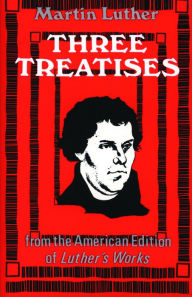
Book Review: Three Treatises

Three Treatises. Martin Luther. 1970. Fortress Press. 316 pages. [Source: Gift]

Martin Luther wrote Three Treatises in 1520. The Three Treatises are: To The Christian Nobility of the German Nation, The Babylonian Captivity of the Church, and The Freedom of A Christian. While I suppose you could read them individually, I think they are best read together sequentially. But. After saying that, if you read only one book in your entire life by Martin Luther, make it The Freedom of a Christian.

In To The Christian Nobility of the German Nation, Luther breaks down the "three walls" protecting the Roman Catholic church from criticism, actual dialogue, and reform. The temporal (national, secular) powers have no jurisdiction over the church in any way. The church is the only judge of the church. The only person who can interpret Scripture is the pope, so it doesn't matter how many people--priests, or whomever--use Scripture to argue for reform--the pope is the only one allowed to be right. No one is allowed to call council meetings except the pope, and the pope, of course, would control what was talked about. So people were locked out--blocked out--from discussion or dialogue. There would be no 'reasoning together' or healthy dialogue. So Luther's reckoning that the church was corrupting Scripture had no official outlet. Luther sets out to break down the walls. The church--the pope--are not infallible. And reform is sometimes essential to staying healthy and pure. One by one, Luther starts knocking down the walls.
When the pope acts contrary to the Scriptures, it is our duty to stand by the Scriptures, to reprove him and to constrain him, according to the word of Christ. (Matthew 18:15-17) (22)
It doesn't take Luther long to knock down the walls. He then spends the rest of the treatise sharing with readers what he would discuss freely and openly in a council meeting if he were allowed to call for one. These are his discussion points. There are many, many, many things he would call to the Pope's attention, the church's attention. These are the issues that demand REFORM.

These sections might prove a tiny bit tedious for the casual reader. But the context they give readers shouldn't be underestimated. If one is to appreciate the Reformation, one must know a great deal about why the reformation was necessary, and why reform was worth fighting for and dying for. It is essential that readers--that believers--know why Luther was protesting so courageously, so loudly, so boldly. These weren't "little" "insignificant" matters.

Favorite quotes from this first treatise:
  • Nobody wants to walk in the straight path of God's commandments common to all of us. Everybody invents new ways and vows for himself as if he had already fulfilled all of God's commandments. (60)
  • O dear Christians, God does not care for much praying, but for true praying. (71)
  • How can we prosper when we behave so wrongly and give the Bible, the holy word of God, a back seat? (97)
  • The number of books on theology must be reduced and only the best ones published. It is not many books that make men learned, nor even reading. But it is a good book frequently read, no matter how small it is, that makes a man learned in the Scriptures and godly. Indeed, the writings of all the holy fathers should be read only for a time so that through them we may be led into the Scriptures. As it is, however, we only read them these days to avoid going any further and going into the Bible. We are like men who read the sign posts and never travel the road they indicate. Our dear fathers wanted to lead us to Scriptures by their writings, but we use their works to get away from Scriptures. Nevertheless, the Scripture alone is our vineyard in which we must all labor and toil. (98)
  • I would advise no one to send his child where the Holy Scriptures are not supreme. Every institution that does not unceasingly pursue the study of God's word becomes corrupt. (100)
  • I greatly fear that the universities unless they teach the Holy Scriptures diligently and impress them on the young students, are wide gates to hell. (100)
The second treatise is about church sacraments. Luther discusses the seven sacraments of the Roman Catholic church. Noting the ways they need reform. Or in some cases noting that they need to be abolished completely. Luther argues that the church needs but two--possibly three--sacraments: communion (The Lord's Supper) and baptism. (The third possible being confession.) He goes through the sacraments one by one, and this book is surprisingly easy to follow.

Favorite quotes from this treatise:
  • It is one thing to misapply the Scriptures and another to understand them in their proper sense. (133)
  • No violence is to be done to the words of God, whether by man or angel. They are to be retained in their simplest meaning as far as possible. Unless the context manifestly compels it, they are not to be understood apart from their grammatical and proper sense, lest we give our adversaries occasion to make a mockery of all the Scriptures. (146) 
  • The authority of God's word is greater than the capacity of our intellect to grasp it. (151)
  • We must be careful to give more heed to the Word of God than to all the thoughts of men and of angels. (156)
  • God does not deal, nor has he ever dealt, with man otherwise than through a word of promise. We in turn cannot deal with God otherwise than through faith in the Word of his promise. (160)
  • Where there is a divine promise, there every one must stand on his own feet; his own personal faith is demanded, he will give an account for himself and bear his own load. (168)
  • You have the utmost certainty of the gospel, and by relying on it, you may well disregard the belief and opinions of men. (175)
  • What is the whole gospel but the good tidings of the forgiveness of sins? (176)
  • The sinner does not so much need to be washed as he needs to die, in order to be wholly renewed and made another creature, and to be conformed to the death and resurrection of Christ, with whom he dies and rises again through baptism. (191) 
  • It is far more forceful to say that baptism signifies that we die in every way and rise to eternal life, than to say that it signifies that we are washed clean of sins. (191)
  • You need continually to be baptized by faith, continually to die and continually to live. (192)
  • It is enough if we lament the sins which distress our conscience at the present moment, as well as those which we can readily call to mind. Whoever is in this frame of mind is without doubt ready to grieve and fear for all his sins, and will grieve and fear whenever they are brought to his knowledge in the future. (211)
The third treatise is The Freedom of a Christian. Written in 1520, this little gem of a treatise is all about the Christian life, how to walk with Christ, how to journey through our earthly pilgrimage. It is a GREAT book and should be required reading!!!

My favorite quotes:
  • I have neither the power nor the will to deny the Word of God. (268)
  • A Christian is a perfectly free lord of all, subject to none. A Christian is a perfectly dutiful servant of all, subject to all. (277)
  • One thing, and only one thing is necessary for Christian life, righteousness and freedom. (279)
  • Let us then consider it certain and firmly established that the soul can do without anything except the Word of God and that where the Word of God is missing there is no help at all for the soul. If it has the Word of God it is rich and lacks nothing, since it is the Word of life, truth, light, peace, righteousness, salvation,joy, liberty, wisdom, power, grace, glory, and of every incalculable blessing. (279)
  • As the soul needs only the Word of God for its life and righteousness, so it is justified by faith alone and not any works; for if it could be justified by anything else, it would not need the Word and consequently it would not need faith. (280)
  • True faith in Christ is a treasure beyond comparison which brings with it complete salvation and saves man from every evil. (281)
  • The promises of God give what the commandments of God demand and fulfill what the law prescribes so that all things may be God's alone, both the commandments and the fulfilling of the commandments. He alone commands, he alone fulfills. (283)
  • Faith works truth and righteousness by giving God what belongs to him. (285)
  • Christ is full of grace, life, and salvation. The soul is full of sins, death, and damnation. Now let faith come between them and sins, death, and damnation will be Christ's, while grace, life, and salvation will be the soul's for if Christ is the bridegroom, he must take upon himself the things which are his bride's and bestow upon her the things that are his. (286)
  • Rather ought Christ to be preached to the end that faith in him may be established that he may not only be Christ, but be Christ for you and me, and that what is said of him and is denoted in his name may be effectual in us. Such faith is produced and preserved in us by preaching why Christ came, what he brought and bestowed, what benefit it is to us to accept him. This is doen when that Christian liberty which he bestows is rightly taught and we are told in what way we Christians are all kings and priests and therefore lords of all and may firmly believe that whatever we have done is pleasing and acceptable in the sight of God. (292-3)
  • So the Christian who is consecrated by his faith does good works, but the words do not make him holier or more Christian, for that is the work of faith alone. And if a man were not first a believer and a Christian, all his works would amount to nothing and would be truly wicked and damnable sins. (297)
  • A man does not live for himself alone in this mortal body to work for it alone, but he lives also for all men on earth; rather, he lives only for others and not for himself. (301)
  • From Christ the good things have flowed and are flowing into us. (309)


© Becky Laney of Operation Actually Read Bible

Thursday, October 13, 2016

Quotes from the Cloud #33

This year, I hope share weekly posts of quotes. These quotes are from authors I'm reading and enjoying from the Clouds of Witnesses Reading Challenge
Thomas à Kempis said, “The Lord has many lovers of His crown, but few lovers of His cross.”
If I profess with the loudest voice and clearest exposition every portion of the truth of God except precisely that little point which the world and the Devil are at that moment attacking, I am not confessing Christ, however boldly I may be professing Christ. Where the battle rages, there the loyalty of the soldier is proved, and to be steady on all the battlefield besides, is mere flight and disgrace if he flinches at that point. ~ Martin Luther
The Lord aims at his own glory and our happiness, and we aim at his glory and our happiness. And though he may seem more to seek his glory than our happiness, and we may fear we seek our happiness more than his glory, yet indeed these two are inseparable and almost coincident. That which advances his glory promotes our happiness, and that which makes us most happy makes him most glorious. Wisdom and mercy have made a sweet connection between his honor and our happiness, so that they cannot be disjoined. We need no more fear to come short of happiness than we need to fear that the Lord will come short of his glory, for these two are embarked together. ~ David Clarkson
We do not pray in order to persuade God to change His mind. Prayer is not an assault upon the reluctance of God, nor an effort to secure a suspension of His will for us or for those for whom we pray. Prayer is not intended to overcome God and "move His arm." God will never be other than Himself, no matter how many people pray, nor how long, nor how earnestly. ~ A.W. Tozer, The Price of Neglect

© Becky Laney of Operation Actually Read Bible

Thursday, September 8, 2016

Quotes from the Cloud #29

This year, I hope share weekly posts of quotes. These quotes are from authors I'm reading and enjoying from the Clouds of Witnesses Reading Challenge
The Lord’s Prayer teaches you to recognize your great misery and corruption before God. In other words, if you think about what you are praying, you will soon notice you’re blaspheming God. You will become terrified by your own prayer. For you certainly haven’t kept God’s name holy. And whoever isn’t keeping God’s name holy is dishonoring his name. Moreover, dishonoring God’s name is a serious sin, and you would deserve the punishment of eternal fire if God were to judge you. Where, then, will you turn? Your own prayer punishes you and works against you. It accuses and deplores you. You’re stuck, lying there. Who will help you? After you have sincerely repented and are humbled by recognizing the miserable position you’re in, then the comforting teaching will come and lift you up again. The Lord’s Prayer teaches you not to despair but instead to ask for God’s kindness and help. You must firmly believe that he will hear you, because he is the one who taught you to pray this way. The result of your prayer will be that God won’t credit your sin to you or deal with you harshly. God approves only of those who seriously confess that they have dishonored his name and sincerely want it to be hallowed at all times. However, it isn’t possible for people to be saved if they trust in their consciences and don’t think they’re dishonoring God’s name, for these people are still too confident, secure, arrogant, and irreverent. They’re not the kind of people Christ speaks about in Matthew: “Come to me, all you who are weary and burdened, and I will give you rest” (Matthew 11:28). They don’t understand the Lord’s Prayer and don’t know what they are praying. ~ Martin Luther, Faith Alone, October 23
Our passion for God should lift us above the elements of the world into the heavenly spheres, where God's praise is supreme. ~ A.W. Tozer

© Becky Laney of Operation Actually Read Bible

Thursday, September 1, 2016

Quotes from the Cloud #28

This year, I hope share weekly posts of quotes. These quotes are from authors I'm reading and enjoying from the Clouds of Witnesses Reading Challenge
All theology begins with God and ends with God, or it is not true biblical theology. Much that passes for theology today is simply the educated man trying to explain God through his own logic and reason. ~ A.W. Tozer
We need to protect ourselves from ideas that go beyond God’s Word and that separate Christ from God. ~ Martin Luther, Faith Alone, October 25
If you meet with a system of theology which magnifies man, flee from it as far as you can. ~ Charles Spurgeon
He is the best Christian who has the clearest knowledge of God in his attributes. ~ Richard Baxter

© Becky Laney of Operation Actually Read Bible
Thursday, February 25, 2016

Quotes from the Cloud #7

This year, I hope share weekly posts of quotes. These quotes are from authors I'm reading and enjoying from the Clouds of Witnesses Reading Challenge

For fellow participants, what I would LOVE, LOVE, LOVE to see is for people to share quotes from what they're reading. I'd love for you to share quotes occasionally with your readers and let me know about it. If you don't have a blog, you could always leave quotes in the comments here.
Let wrath deserved be written on the door of hell, but the free gift of grace on the gate of heaven. I know that my sufferings are the result of my sinning, but in heaven both shall cease. ~ Valley of Vision, "The Mover," p. 8
May I be always amongst those who not only hear but know thee, who walk with and rejoice in thee, who take thee at thy word and find life there. ~ Valley of Vision, "A Present Salvation," p. 12
God will not use a man greatly until He has broken him deeply. ~ A.W. Tozer
“Letting God be God is half of all true religion.” ~ Martin Luther
Faith gives us living joy and bestows dying rest. Christ's resurrection is the cause, the promise, the guarantee, and the proof of the coming resurrection of all His people. ~ Charles Spurgeon, Daily Treasures in the Psalms, January 31

© Becky Laney of Operation Actually Read Bible

Thursday, February 4, 2016

Quotes from the Cloud #4

This year, I hope share weekly posts of quotes. These quotes are from authors I'm reading and enjoying from the Clouds of Witnesses Reading Challenge

For fellow participants, what I would LOVE, LOVE, LOVE to see is for people to share quotes from what they're reading. I'd love for you to share quotes occasionally with your readers and let me know about it. If you don't have a blog, you could always leave quotes in the comments here.
Oh, how foolish we are if we attempt to entertain two guests so hostile to one another as Christ Jesus and the devil! Rest assured, Christ will not be at home in the living room of our hearts if we entertain the devil in the basement of our thoughts… God's judgments are all numbered, but His mercies are innumerable; He gives His wrath by weight, but without weight His mercy. ~ Charles Spurgeon, Spurgeon's Daily Treasures in the Psalms, January 9
Let us learn to think of tears as liquid prayers. My God, I will weep when I cannot plead, for You hear the voice of my weeping. ~ Charles Spurgeon, Spurgeon's Daily Treasures in the Psalms, January 12
We must not doubt what the true and faithful God promises to do. He promises to hear our prayers—yes, he even commands us to pray. He promises this so that we might firmly believe that our prayers will be answered. As Christ says, “Whatever you ask for in prayer, believe that you have received it, and it will be yours” (Mark 11:24; see also Matthew 21:22). Christ also says, “Ask and it will be given to you; seek and you will find; knock and the door will be opened to you. For everyone who asks receives; he who seeks finds; and to him who knocks, the door will be opened” (Luke 11:9–10). By trusting in these promises and obeying these commands, we can pray with confidence. ~ Martin Luther, Faith Alone, October 30
Nothing in this world will in any way feed our passion for God. We must leave the world behind us and pursue on to know God in His arena. The closer I get to God, the further away from the world I become. ~ A.W. Tozer, Delighting in God
© Becky Laney of Operation Actually Read Bible
Thursday, January 21, 2016

Quotes from the Cloud #2

This year, I hope share weekly posts of quotes. These quotes are from authors I'm reading and enjoying from the Clouds of Witnesses Reading Challenge

For fellow participants, what I would LOVE, LOVE, LOVE to see is for people to share quotes from what they're reading. I'd love for you to share quotes occasionally with your readers and let me know about it. If you don't have a blog, you could always leave quotes in the comments here.
Theology is not an end in itself, but rather points to the One who is greater than theology. When theology becomes an end in itself, it ceases to be a way into the knowledge of God. ~ A.W. Tozer, Delighting in God
What people need today is truth--truth organized in a way that allows us to understand what God is about. The primary problem with theology is that we have organized it according to man's prejudice. Theology should be the study of God, not our human interpretation of God. That is where we encounter problems. Is God a Calvinism or is He an Arminian? According to some theology, you must be one or the other. ~ A.W. Tozer, Delighting in God
When sin is stirred to life, the precious blood of God’s Son is the costly medicine needed to remove it. We need to stay away from sin if we can. But if we have fallen into sin, we must learn how to get up again and regain a firm faith. These very struggles show us what it means to really believe. We need to realize that sin is a horrible evil. This doesn’t seem to be true when we’re committing sin. We enjoy it while we are doing it. But after God’s laws make us aware of our sin, we realize that sin is hell itself and far more powerful than heaven or earth. After that, we can’t understand God’s grace without great effort. But a heart burdened by sin can say, “Even though I have committed many sins, ‘God did not send his Son into the world to condemn the world, but to save the world through him’” (John 3:17). Without this comfort, we would have no remedy or defense against sin and its sting. ~ Martin Luther, Faith Alone, October 26

© Becky Laney of Operation Actually Read Bible

Thursday, October 15, 2015

Quotes From the Cloud #41

This year, I hope share weekly posts of quotes. These quotes are from authors I'm reading and enjoying from the Clouds of Witnesses Reading Challenge

For fellow participants, what I would LOVE, LOVE, LOVE to see is for people to share quotes from what they're reading. I'd love for you to share quotes occasionally with your readers and let me know about it. If you don't have a blog, you could always leave quotes in the comments here.
Let your heart yearn for your ungodly neighbors. Alas, there is but a step between them and death and hell. Many hundred diseases are waiting, ready to seize on them and if they die unregenerate, they will be lost forever. Have you hearts of rock that cannot pity men in such a case as this? Do you not care who is damned as long as you are saved? If so, you have sufficient cause to pity yourselves, for it is a frame of spirit utterly inconsistent with grace. . . . Do you live close by them? Or, do you meet them in the streets or work with them or travel with them or sit and talk with them and say nothing to them of their souls? If their houses were on fire, you would run and help them. Will you not help them when their souls are almost at the fire of hell? ~ Richard Baxter
Faith gives God the greatest honor anyone can give him. Giving God honor is believing him, considering him truthful, wise, righteous, merciful, and all-powerful. In short, it’s recognizing that he is the Creator and Giver of every good thing. Reason doesn’t do this; only faith does. Faith makes God real to us and real in us. Without faith, God’s honor, glory, wisdom, righteousness, truth, and mercy cannot be in us. Where there is no faith, God has no majesty and divinity. God doesn’t require anything more from us than to acknowledge his divinity and give him the glory and honor he deserves. ~ Martin Luther, Faith Alone, September 26
The gospel—the most loved and comforting doctrine of all—doesn’t focus on our works or the works of the law. Rather, it shows us the incomprehensible, inexpressible mercy and love of God toward us, who are unworthy and lost people. The merciful Father saw that we were oppressed by the curse of the law and held under it. On our own and through our own efforts, we never could have freed ourselves. He sent his only Son into the world. He put all the sin of all the people on his Son and said, “You will be Peter, who denied me; Paul, who persecuted, blasphemed, and acted violently; David, who committed adultery; the sinner who ate the apple in Paradise; the thief on the cross. In summary, you will be the one who committed all the sins of all the people. Make sure you pay for these sins and make atonement for them.” At this point the law said, “I find Christ to be a sinner—the one who has taken the sins of all the people upon himself. I do not see sin on anyone else except him. Therefore, he must die on the cross.” Then the law grabbed him and killed him. Since this happened, the entire world has been cleansed and atoned of all sin and freed from death and all evil. If everyone in the whole world believed, God would see only purity and righteousness. This is because Christ would have taken away all sin and death. And even if there were any remnants of sin remaining, God wouldn’t see them because of the brightness of Christ, the Sun. ~ Martin Luther, Faith Alone, October 6

© Becky Laney of Operation Actually Read Bible

Thursday, October 8, 2015

Quotes from the Cloud #40

This year, I hope share weekly posts of quotes. These quotes are from authors I'm reading and enjoying from the Clouds of Witnesses Reading Challenge

For fellow participants, what I would LOVE, LOVE, LOVE to see is for people to share quotes from what they're reading. I'd love for you to share quotes occasionally with your readers and let me know about it. If you don't have a blog, you could always leave quotes in the comments here.
When we pray, we’re not telling God anything he doesn’t already know. Rather, we are the ones gaining knowledge and insight. Asking God to supply our needs keeps us from becoming like the unbelieving skeptics, who don’t acknowledge God and don’t thank him for his many gifts. ~ Martin Luther, "Faith Alone," September 11
If our faith were as strong and steady as it should be, we would practically die from sheer joy. But we praise God because we know that even those who have only a little faith are also children of God. That’s why Christ said, “Do not be afraid, little flock” (Luke 12:32). So we always need to pray with the apostles, “Increase our faith!” (Luke 17:5), and pray with the man in the book of Mark who cried out, “I do believe; help me overcome my unbelief !” (Mark 9:24). ~ Martin Luther, Faith Alone, September 19
Our sinful nature is an enemy of prayer. It quickly becomes bored, careless, and indifferent to what God says and the good life he gives us. For this reason, we will never have as much wisdom, knowledge of God’s Word, faith, love, or patience as we should. Every day our sinful nature hangs around our necks and drags us away from prayer. The world is also an enemy of prayer. It’s so envious that we have faith and God’s precious Word that it refuses to put up with any of it, no matter how weak we may be. The world condemns us, tries to take away what we have, and gives us no peace. These are the two enemies of prayer: our sinful nature and the world. On the inside, they try to decrease our desire to pray, and on the outside, they try to chase us away from prayer. All we can do is continue crying out to God. We should pray for strength and better understanding of his Word. ~ Martin Luther, Faith Alone, September 21
God’s Word is a flame that shines in the darkness. Through teaching, preaching, and the sacraments, its glow spreads. If we use this light, then God will no longer remain hidden from us. When we’re faced with disasters, when we’re overwhelmed by darkness, when things seem so dark that we doubt that we are part of the church or pleasing to God, then we should learn to reach for the Bible. Wherever the Bible sheds its light, no real danger exists. Without the Bible, we wouldn’t know or understand anything. ~ Martin Luther, Faith Alone, September 25

© Becky Laney of Operation Actually Read Bible

Thursday, September 10, 2015

Quotes from the Cloud #36

This year, I hope share weekly posts of quotes. These quotes are from authors I'm reading and enjoying from the Clouds of Witnesses Reading Challenge

For fellow participants, what I would LOVE, LOVE, LOVE to see is for people to share quotes from what they're reading. I'd love for you to share quotes occasionally with your readers and let me know about it. If you don't have a blog, you could always leave quotes in the comments here.
“To know him [Jesus], is the shortest description of true grace; to know him better, is the surest mark of growth in grace; to know him perfectly, is eternal life.” ~ John Newton
“Jesus is always near, about our path by day, and our bed by night; nearer than the light by which we see, or the air we breathe; nearer than we are to ourselves; so that not a thought, a sigh, or a tear, escapes his notice.” ~ John Newton
We will not be without sinful desires as long as we live in these bodies. Consequently, none of us will be free of temptation either. But each person is tempted in a different way according to individual differences. One person will be attacked emotionally, such as with depression, blasphemy, unbelief, or despair. Another will be attacked with coarser sins, such as sexual desire, anger, or hatred. But Paul demands that we live by the Spirit and resist the sinful nature. Those who obey the sinful nature and continue to gratify its desires should know that they don’t belong to Christ. Even though people may label themselves with the name “Christian,”they are only deceiving themselves. ~ Martin Luther, Faith Alone, August 18

© Becky Laney of Operation Actually Read Bible

Thursday, September 3, 2015

Quotes from the Cloud #35

This year, I hope share weekly posts of quotes. These quotes are from authors I'm reading and enjoying from the Clouds of Witnesses Reading Challenge

For fellow participants, what I would LOVE, LOVE, LOVE to see is for people to share quotes from what they're reading. I'd love for you to share quotes occasionally with your readers and let me know about it. If you don't have a blog, you could always leave quotes in the comments here.
“I am the way.” You should learn what this eloquent statement of Christ means. Don’t think of a path that you walk on with your feet. Instead, think of one that you travel on by faith—a faith that clings only to the Lord Christ. There are various ways of walking and wandering through life. First, there are many roads and footpaths for physically walking from one place to another, as cows and horses do. The Scripture teaches nothing about these paths. But there are other kinds of paths in this life. A second kind of path pertains to everyday life. On this path, we lead a good and moral life before the world and seek to preserve government, peace, honor, and order. Over all of these ways is still another path, about which the Scripture and Christ speak here. This third path is the way to get from this life to the next. For this journey, we need a much different way, a much different path. Here Christ is saying, “When you have come to me in faith, you are on the right way. This path is reliable and won’t mislead you.” ~ Martin Luther, "Faith Alone," August 9
All the stories in Holy Scripture, if they are interpreted correctly, point toward Christ. ~
Martin Luther, "Faith Alone," August 12
Whoever understands what it means for the Spirit to be our Counselor will have already won the battle. That person will find nothing but pure comfort and joy in heaven and on earth. Because the Father is the one who sends him to help us, and because Christ is the one who asks him to do so, this sending is certainly not done out of anger. Instead, it flows from a fatherly, heartfelt love. So Christians should remind themselves of this name for the Holy Spirit. He is a counselor, and we are the troubled and timid ones whom he helps. ~ Martin Luther, "Faith Alone," August 16
As I laid down your letter, after reading with interest the graphic account it gives of a very striking scene, I could not help feeling with renewed force a truth, trite enough, yet ever impressive; viz., that it is good to be attracted out of ourselves—to be forced to take a near view of the sufferings, the privations, the efforts, the difficulties of others. If we ourselves live in fulness of content, it is well to be reminded that thousands of our fellow-creatures undergo a different lot; it is well to have sleepy sympathies excited, and lethargic selfishness shaken up. If, on the other hand, we be contending with the special grief,—the intimate trial,—the peculiar bitterness with which God has seen fit to mingle our own cup of existence,—it is very good to know that our overcast lot is not singular; it stills the repining word and thought,—it rouses the flagging strength, to have it vividly set before us that there are countless afflictions in the world, each perhaps rivalling—some surpassing—the private pain over which we are too prone exclusively to sorrow. ~ Charlotte Bronte, 1851

© Becky Laney of Operation Actually Read Bible

Thursday, August 27, 2015

Quotes from the Cloud #34

This year, I hope share weekly posts of quotes. These quotes are from authors I'm reading and enjoying from the Clouds of Witnesses Reading Challenge

For fellow participants, what I would LOVE, LOVE, LOVE to see is for people to share quotes from what they're reading. I'd love for you to share quotes occasionally with your readers and let me know about it. If you don't have a blog, you could always leave quotes in the comments here.
God is merciful. He is just — as just as if he were not merciful. He is merciful — as merciful as if he were not just, and in very deed more merciful than if he were too lenient; instead of blending a wise severity of justice with a gracious clemency of long-suffering. ~ Charles Spurgeon, 1857, "Fast-Day Service"
True freedom is being free from sin. How does this happen? It happens when we hear his Word—Christ was born of Mary, suffered, was crucified, died, was buried, and rose again from the dead on the third day. We must preach this message again and again so that all of us may be satisfied and filled with its teaching. My hunger, however, has not yet been satisfied. This teaching is like bread. No one ever grows tired of eating bread. We fill ourselves with all kinds of food, but we never have enough bread, unless we are ill and can’t eat. A healthy person will never grow tired of bread. In the same way, Christians will never learn this completely during their lifetimes, whether they are saints or even Mary or John the Baptist. ~ Martin Luther, "Faith Alone," August 2
All teachers of Scripture conclude that the essence of prayer is simply the lifting up of the heart to God. But if this is so, it follows that everything else that doesn’t lift up the heart to God is not prayer. We should consider our spoken words to be like a trumpet, drum, organ, or other kind of sound that moves our hearts and lifts them up to God. We shouldn’t attempt to pray without words, relying on our own hearts, unless we are well trained spiritually and skilled in removing stray thoughts from our minds. Otherwise, the devil will lead us astray and quickly destroy the prayers in our hearts. So we should cling to the words and let them lift us up—lift us until our feathers grow and we’re able to soar high without the help of words. ~ Martin Luther, "Faith Alone," August 7
There is only one thing I know of that crushes me to the ground and humiliates me to the dust, and that is to look at the Son of God, and especially contemplate the cross. Nothing else can do it. When I see that I am a sinner…that nothing but the Son of God on the cross can save me, I'm humbled to the dust…Nothing but the cross can give us this spirit of humility. ~ Martyn Lloyd Jones

© Becky Laney of Operation Actually Read Bible

Thursday, August 13, 2015

Quotes from the Cloud #32

This year, I hope share weekly posts of quotes. These quotes are from authors I'm reading and enjoying from the Clouds of Witnesses Reading Challenge

For fellow participants, what I would LOVE, LOVE, LOVE to see is for people to share quotes from what they're reading. I'd love for you to share quotes occasionally with your readers and let me know about it. If you don't have a blog, you could always leave quotes in the comments here.
Don’t listen to your own thoughts. Listen to God’s Word. It promises forgiveness of sins to anyone who believes that this Lamb carried the sins of the whole world. Did you hear that? The Lamb didn’t miss any of it. He carried all the sins of the world from the beginning of time. Therefore, he carried your sin too, and he offers his grace to you. ~ Martin Luther, Faith Alone, July 28
Satan keeps on tempting people to commit sexual sins and other terrible crimes because he doesn’t want people to believe in what God says and does. But the church and God’s people should regard Satan’s attacks on God’s Word and work as especially dangerous. Letting go of God’s Word is the root of all temptations. It results in the destruction and violation of all God’s commandments. Unbelief is the source of every sin. If Satan is able to tamper with God’s Word or snatch it out of people’s hearts, he will achieve his goal—people will no longer believe in God. ~ Martin Luther, Faith Alone, July 29

The greatest and best man in the world must say, By the grace of God I am what I am, but God says absolutely I am that I am. ~ Matthew Henry
Have you ever realized that most of your unhappiness in life is due to the fact that you are listening to yourself instead of talking to yourself? ~ Martyn Lloyd-Jones
At every stage of our Christian development and in every sphere of our Christian discipleship, pride is the greatest enemy and humility our greatest friend. ~ John Stott

© Becky Laney of Operation Actually Read Bible

Thursday, July 30, 2015

Quotes from the Cloud #30

This year, I hope share weekly posts of quotes. These quotes are from authors I'm reading and enjoying from the Clouds of Witnesses Reading Challenge

For fellow participants, what I would LOVE, LOVE, LOVE to see is for people to share quotes from what they're reading. I'd love for you to share quotes occasionally with your readers and let me know about it. If you don't have a blog, you could always leave quotes in the comments here.
If you are interested enough to have read thus far you are probably interested enough to make a shot at saying your prayers: and, whatever else you say, you will probably say the Lord’s Prayer.
Its very first words are Our Father. Do you now see what those words mean? They mean quite frankly, that you are putting yourself in the place of a son of God. To put it bluntly, you are dressing up as Christ. If you like, you are pretending. Because, of course, the moment you realise what the words mean, you realise that you are not a son of God. You are not being like The Son of God, whose will and interests are at one with those of the Father: you are a bundle of self-centred fears, hopes, greeds, jealousies, and self-conceit, all doomed to death. So that, in a way, this dressing up as Christ is a piece of outrageous cheek. But the odd thing is that He has ordered us to do it. ~ C.S. Lewis, Mere Christianity
We say a great many things in church (and out of church too) without thinking of what we are saying. For instance, we say in the Creed “I believe in the forgiveness of sins.” I had been saying it for several years before I asked myself why it was in the Creed. At first sight it seems hardly worth putting in. “If one is a Christian,” I thought, “of course one believes in the forgiveness of sins. It goes without saying.” But the people who compiled the Creed apparently thought that this was a part of our belief which we needed to be reminded of every time we went to church. And I have begun to see that, as far as I am concerned, they were right. To believe in the forgiveness of sins is not nearly so easy as I thought. Real belief in it is the sort of thing that very easily slips away if we don’t keep on polishing it up.We believe that God forgives us our sins; but also that He will not do so unless we forgive other people their sins against us. There is no doubt about the second part of this statement. It is in the Lord’s Prayer; it was emphatically stated by our Lord. If you don’t forgive, you will not be forgiven. No part of His teaching is clearer, and there are no exceptions to it. He doesn’t say that we are to forgive other people’s sins provided they are not too frightful, or provided there are extenuating circumstances, or anything of that sort. We are to forgive them all, however spiteful, however mean, however often they are repeated. If we don’t, we shall be forgiven none of our own. ~ C.S. Lewis, Weight of Glory
Don’t make the mistake of thinking that Christians are people who never sin or feel sinful. Rather, because of their faith in Christ, God simply doesn’t attribute their sin to them. This teaching is comforting to those who have terrified consciences. To the extent we are Christians, we stand above the law and sin. Christ is the Lord of the law. He is present and locked in our hearts, just as a precious stone is firmly mounted in a ring. When the law accuses us and sin terrifies us, all we need to do is look to Christ. When we have taken hold of him in faith, we have the victor over the law, sin, death, and the devil with us. Because Christ rules over all of these, we won’t be harmed. ~ Martin Luther, Faith Alone, July 14
The devil knows what prayer can accomplish. That’s why he creates so many obstacles and makes it so inconvenient for us that we never get around to prayer. ~ Martin Luther, Faith Alone, July 16

© Becky Laney of Operation Actually Read Bible