Showing posts with label C.S. Lewis. Show all posts

Friday, April 4, 2025

30. Screwtape Letters


30. The Screwtape Letters. C.S. Lewis. 1942. HarperCollins. 224 pages. [Source: Bought]

First paragraph: I note what you say about guiding your patient’s reading and taking care that he sees a good deal of his materialist friend. But are you not being a trifle naïf? It sounds as if you supposed that argument was the way to keep him out of the Enemy’s clutches. That might have been so if he had lived a few centuries earlier. At that time the humans still knew pretty well when a thing was proved and when it was not; and if it was proved they really believed it. They still connected thinking with doing and were prepared to alter their way of life as the result of a chain of reasoning. But what with the weekly press and other such weapons we have largely altered that. Your man has been accustomed, ever since he was a boy, to have a dozen incompatible philosophies dancing about together inside his head. He doesn’t think of doctrines as primarily “true” or “false”, but as “academic” or “practical”, “outworn” or “contemporary”, “conventional” or “ruthless”. Jargon, not argument, is your best ally in keeping him from the Church. Don’t waste time trying to make him think that materialism is true! Make him think it is strong, or stark, or courageous—that it is the philosophy of the future. That’s the sort of thing he cares about.

I definitely enjoy rereading C.S. Lewis' The Screwtape Letters every few years. These 'letters' are from 'Uncle Screwtape' to his nephew 'Wormwood.' Both Wormwood and Screwtape are demons. That should tell you a little something about this topsy-turvy Christian fantasy. 

Wormwood's human has just become a Christian. But with a little help from his uncle, Wormwood hopes to change that, to reverse the damage, to keep him *his*. Readers only view Screwtape's letters to Wormwood, so, we have to piece together the rest of the story, in a way. Readers can piece together that there is a world war going on. Also perhaps that Wormwood's human dies in a bomb raid. 

Screwtape's letters are packed with advice on how to keep Wormwood's human from being an effective Christian. How to keep him from praying, for example, to name just one. What Screwtape and Wormwood fail to understand is the futility of their efforts. True, C.S. Lewis may not have known how futile himself. Since Lewis most likely believed that one could 'fall from grace' and 'lose salvation.' But. Putting all that aside, one knows from Scripture that isn't the case.
And this is the will of him who sent me, that I should lose nothing of all that he has given me, but raise it up on the last day. For this is the will of my Father, that everyone who looks on the Son and believes in him should have eternal life, and I will raise him up on the last day.” John 6:39-40
My sheep hear my voice, and I know them, and they follow me. I give them eternal life, and they will never perish, and no one will snatch them out of my hand. My Father, who has given them to me, is greater than all, and no one is able to snatch them out of the Father's hand. I and the Father are one.” John 10:27-30
Can believers benefit from reading Screwtape Letters? I think so. The letters are engaging, and, give readers plenty to think about. 

From the first letter: "Your business is to fix his attention on the stream. [The stream of immediate sense experiences]. Teach him to call it 'real life' and don't let him ask you what he means by 'real.'" (2)

From the second letter: "He has not been anything like long enough with the Enemy to have any real humility yet. What he says, even on his knees, about his own sinfulness, is all parrot talk. At bottom, he still believes he has run up a very favorable credit balance in the Enemy's ledger by allowing himself to be converted, and thinks that he is showing great humility and condescension in going to church with these 'smug' commonplace neighbors at all. Keep him in that state of mind as long as you can." (6)

From the third letter: "You must bring him to a condition in which he can practise self-examination for an hour without discovering any of those facts about himself which are perfectly clear to anyone who has ever lived in the same house with him or worked in the same office." (7)
"It is, no doubt, impossible to prevent his praying for his mother, but we have means of rendering the prayers innocuous. Make sure that they are always very "spiritual," that he is always concerned with the state of her soul and never with her rheumatism. Two advantages will follow. In the first place, his attention will be kept on what he regards as her sins, by which, with a little guidance from you, he can be induced to mean any of her actions which are inconvenient or irritating to himself. In the second place, since his ideas about her soul will be very crude and often erroneous, he will, in some degree, be praying for an imaginary person, and it will be your task to make that imaginary person daily less and less like the real mother--the sharp-tongued old lady at the breakfast table." (8)

From the fourth letter: "It is funny how mortals always picture us as putting things into their minds: in reality our best work is done by keeping things out" (11).
"The simplest is to turn their gaze away from Him towards themselves." (11)

From the fifth letter: "In wartime not even a human can believe that he is going to live forever." (15)

From the seventh letter: "All extremes except devotion to the Enemy are to be encouraged" (20).

From the ninth letter: "Never forget that when we are dealing with pleasure in its healthy and normal and satisfying form, we are, in a sense, on the Enemy's ground." (26)

From the twelfth letter: "Do remember, the only thing that matters is the extent to which you separate the man from the Enemy. It does not matter how small the sins are, provided that their cumulative effect is to edge the man away from the Light and out into the Nothing....Indeed, the safest road to Hell is the gradual one--the gentle slope, soft underfoot, without sudden turnings, without milestones, without signposts." (36)

From the sixteenth letter: "Surely you know that if a man can't be cured of churchgoing, the next best thing is to send him all over the neighborhood looking for the church that 'suits' him until he becomes a taster or connoisseur of churches." (46)

From the nineteenth letter: "Nothing matters at all except the tendency of a given state of mind, in given circumstances, to move a particular patient at a particular moment nearer to the Enemy or nearer to us." (56-7)

From the twenty-first letter: "Let him have the feeling that he starts each day as the lawful possessor of twenty-four hours." (61)

From the twenty-fifth letter: "What we want, if men become Christians at all, is to keep them in the state of mind I call 'Christianity And...' (73)

From the twenty-seventh letter: "Anything, even a sin, which has the total effect of moving him close up to the Enemy makes against us in the long run." (79)

© Becky Laney of Operation Actually Read Bible

Tuesday, March 30, 2021

21. Screwtape Letters


The Screwtape Letters. C.S. Lewis. 1942. 228 pages. [Source: Bought]

First paragraph: I note what you say about guiding your patient’s reading and taking care that he sees a good deal of his materialist friend. But are you not being a trifle naïf? It sounds as if you supposed that argument was the way to keep him out of the Enemy’s clutches. That might have been so if he had lived a few centuries earlier. At that time the humans still knew pretty well when a thing was proved and when it was not; and if it was proved they really believed it. They still connected thinking with doing and were prepared to alter their way of life as the result of a chain of reasoning. But what with the weekly press and other such weapons we have largely altered that. Your man has been accustomed, ever since he was a boy, to have a dozen incompatible philosophies dancing about together inside his head. He doesn’t think of doctrines as primarily “true” or “false”, but as “academic” or “practical”, “outworn” or “contemporary”, “conventional” or “ruthless”. Jargon, not argument, is your best ally in keeping him from the Church. Don’t waste time trying to make him think that materialism is true! Make him think it is strong, or stark, or courageous—that it is the philosophy of the future. That’s the sort of thing he cares about.

I definitely enjoy rereading C.S. Lewis' The Screwtape Letters every few years. These 'letters' are from 'Uncle Screwtape' to his nephew 'Wormwood.' Both Wormwood and Screwtape are demons. That should tell you a little something about this topsy-turvy Christian fantasy. 

Wormwood's human has just become a Christian. But with a little help from his uncle, Wormwood hopes to change that, to reverse the damage, to keep him *his*. Readers only view Screwtape's letters to Wormwood, so, we have to piece together the rest of the story, in a way. Readers can piece together that there is a world war going on. Also perhaps that Wormwood's human dies in a bomb raid. 

Screwtape's letters are packed with advice on how to keep Wormwood's human from being an effective Christian. How to keep him from praying, for example, to name just one. What Screwtape and Wormwood fail to understand is the futility of their efforts. True, C.S. Lewis may not have known how futile himself. Since Lewis most likely believed that one could 'fall from grace' and 'lose salvation.' But. Putting all that aside, one knows from Scripture that isn't the case.
And this is the will of him who sent me, that I should lose nothing of all that he has given me, but raise it up on the last day. For this is the will of my Father, that everyone who looks on the Son and believes in him should have eternal life, and I will raise him up on the last day.” John 6:39-40
My sheep hear my voice, and I know them, and they follow me. I give them eternal life, and they will never perish, and no one will snatch them out of my hand. My Father, who has given them to me, is greater than all, and no one is able to snatch them out of the Father's hand. I and the Father are one.” John 10:27-30
Can believers benefit from reading Screwtape Letters? I think so. The letters are engaging, and, give readers plenty to think about. 

From the first letter: "Your business is to fix his attention on the stream. [The stream of immediate sense experiences]. Teach him to call it 'real life' and don't let him ask you what he means by 'real.'" (2)

From the second letter: "He has not been anything like long enough with the Enemy to have any real humility yet. What he says, even on his knees, about his own sinfulness, is all parrot talk. At bottom, he still believes he has run up a very favorable credit balance in the Enemy's ledger by allowing himself to be converted, and thinks that he is showing great humility and condescension in going to church with these 'smug' commonplace neighbors at all. Keep him in that state of mind as long as you can." (6)

From the third letter: "You must bring him to a condition in which he can practise self-examination for an hour without discovering any of those facts about himself which are perfectly clear to anyone who has ever lived in the same house with him or worked in the same office." (7)
"It is, no doubt, impossible to prevent his praying for his mother, but we have means of rendering the prayers innocuous. Make sure that they are always very "spiritual," that he is always concerned with the state of her soul and never with her rheumatism. Two advantages will follow. In the first place, his attention will be kept on what he regards as her sins, by which, with a little guidance from you, he can be induced to mean any of her actions which are inconvenient or irritating to himself. In the second place, since his ideas about her soul will be very crude and often erroneous, he will, in some degree, be praying for an imaginary person, and it will be your task to make that imaginary person daily less and less like the real mother--the sharp-tongued old lady at the breakfast table." (8)

From the fourth letter: "It is funny how mortals always picture us as putting things into their minds: in reality our best work is done by keeping things out" (11).
"The simplest is to turn their gaze away from Him towards themselves." (11)

From the fifth letter: "In wartime not even a human can believe that he is going to live forever." (15)

From the seventh letter: "All extremes except devotion to the Enemy are to be encouraged" (20).

From the ninth letter: "Never forget that when we are dealing with pleasure in its healthy and normal and satisfying form, we are, in a sense, on the Enemy's ground." (26)

From the twelfth letter: "Do remember, the only thing that matters is the extent to which you separate the man from the Enemy. It does not matter how small the sins are, provided that their cumulative effect is to edge the man away from the Light and out into the Nothing....Indeed, the safest road to Hell is the gradual one--the gentle slope, soft underfoot, without sudden turnings, without milestones, without signposts." (36)

From the sixteenth letter: "Surely you know that if a man can't be cured of churchgoing, the next best thing is to send him all over the neighborhood looking for the church that 'suits' him until he becomes a taster or connoisseur of churches." (46)

From the nineteenth letter: "Nothing matters at all except the tendency of a given state of mind, in given circumstances, to move a particular patient at a particular moment nearer to the Enemy or nearer to us." (56-7)

From the twenty-first letter: "Let him have the feeling that he starts each day as the lawful possessor of twenty-four hours." (61)

From the twenty-fifth letter: "What we want, if men become Christians at all, is to keep them in the state of mind I call 'Christianity And...' (73)

From the twenty-seventh letter: "Anything, even a sin, which has the total effect of moving him close up to the Enemy makes against us in the long run." (79)
© Becky Laney of Operation Actually Read Bible

Monday, September 3, 2018

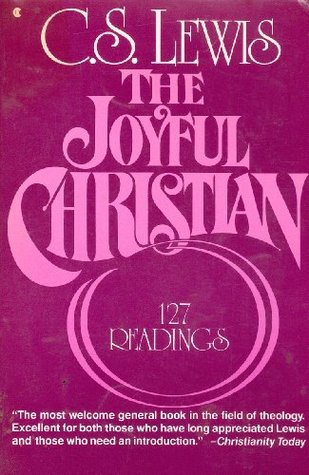
Book Review: The Joyful Christian

The Joyful Christian. C.S. Lewis. 1977. 256 pages. [Source: Bought]

First sentence: If sales are signs, then C.S. Lewis is one of the most popular Christian theologians being published in the United States today.

The Joyful Christian is a collection of 127 readings taken from C.S. Lewis' nonfiction works. Some readings are longer than others--a few pages in length. Other readings are much shorter--less than a single page. Some readings seem to flow together in a particular sequence. Others not as much. Either is fine as far as I'm concerned when it comes to devotional readings.

I think there is a definite place for devotional books that are not 365 days! It can be a little overwhelming to "commit" to reading a particular devotional book for an entire year. There's also something about a book being dated--literally. The dates can mock you if you fail.


  • To some, God is discoverable everywhere; to others, nowhere. Those who do not find Him on earth are unlikely to find Him in space. But send a saint up in a spaceship and he'll find God in space as he found God on earth. Much depends on the seeing eye. (6)
  • If God is Love, He is by definition, more than mere kindness. And it appears, from all records, that though He has often rebuked us and condemned us, He has never regarded us with contempt. He has paid us the intolerable compliment of loving us, in the deepest, most tragic, most inexorable sense. (39)
  • The Son of God became a man to enable men to become sons of God. (50)
  • The doctrine of the Second Coming teaches us that we do not and cannot know when the world drama will end. The curtain may be rung down at any moment...We do not know the play. We do not even know whether we are in Act I or Act V. We do not know who are the major and the minor characters. The Author knows. The audience, if there is an audience (if angels and archangels and all the company of Heaven fill the pit ant the stalls), may have an inkling. But we, never seeing the play from outside, never meeting any characters except the tiny minority who are "on" in the same scenes as ourselves, wholly ignorant of the future and very imperfectly informed about the past, cannot tell at what moment the end ought to come. That it will come when it ought, we may be sure; but we waste our time in guessing when that will be. That it has meaning we may be sure, but we cannot see it. When it is over, we may be told. We are led to expect that the Author will have something to say to each of us on the part that each of us has played. The playing it well is what matters infinitely. (71)
  • There is really some excuse for the man who said, "I wish they'd remember that the charge to Peter was Feed my sheep; not Try experiments on my rats, or even Teach my performing dogs new tricks." (81)
  • For me words are...secondary. They are only an anchor. Or, shall I say, they are the movements of a conductor's baton: not the music. (85)
  • We are always, completely and therefore equally, known to God. That is our destiny whether we like it or not. But though this knowledge never varies, the quality of our being known can. (90)
  • It is a good rule, after reading a new book, never to allow yourself another new one till you have read an old one in between. If that is too much for you, you should at least read one old one to every three new ones. (103)
  • I think we delight to praise what we enjoy because the praise not merely expresses but completes the enjoyment; it is its appointed consummation. (119)
  • In commanding us to glorify Him, God is inviting us to enjoy Him. (120)
  • And finally--though it may seem a sour paradox--we must sometimes get away from the Authorized Version if for no other reason, simply because it is so beautiful and so solemn. Beauty exalts; but beauty also lulls. (123)
  • If anyone would like to acquire humility, I can, I think, tell him the first step. The first step is to realize that one is proud. And a biggish step, too. At least, nothing whatever can be done before it. If you think you are not conceited, it means you are very conceited indeed. (141)
  • I remember Christian teachers telling me long ago that I must hate a bad man's actions, but not hate the bad man: or, as they would say, hate the sin but not the sinner. For a long time I used think this a silly, straw-splitting distinction: how could you hate what a man did and not hate the man? But years later it occurred to me that there was one man to whom I had been doing this all my life--namely myself. However much I might dislike my own cowardice or conceit or greed, I went on loving myself. There had never been the slightest difficulty about it. In fact, the very reason why I hated the things was that I loved the man. Just because I loved myself, I was sorry to find that I was the sort of man who did those things. Consequently Christianity does not want us to reduce by one atom the hatred we feel for cruelty and treachery. We ought to hate them. Not one word of what we have said about them needs to be unsaid. But it does want us to hate them in the same way in which we hate things in ourselves: being sorry that the man should have done such things, and hoping, if it is anyway possible, that somehow, sometime, somewhere, he can be cured and made human again. (143)
  • Christ takes it for granted that men are bad. Until we really feel this assumption of His to be true, though we are part of the world He came to save, we are not part of the audience to whom His words are addressed. (167)


© Becky Laney of Operation Actually Read Bible

Tuesday, April 24, 2018

Book Review: A Hobbit, A Wardrobe, and a Great War

A Hobbit, a Wardrobe, and a Great War. Joseph Loconte. 2015. Thomas Nelson. 256 pages. [Source: Bought]

First sentence: In the throes of one of the most destructive and dehumanizing wars in world history, something extraordinary occurred, never to be repeated. It happened on Christmas Eve, December 24, 1914.

Do we owe the existence of the Chronicles of Narnia and The Lord of the Rings to World War I? Loconte argues in this one that we do. He writes, "It can be argued that these epic tales—involving the sorrows and triumphs of war—would never have been written had these authors not been flung into the crucible of combat." He goes on to say, "the Great War helped to frame the sensibilities of both authors, a fact that seems neglected by scholars and ordinary admirers alike...The story of the war’s impact on the creative outlook of Tolkien and Lewis can help historians better understand its moral and spiritual consequences for an entire generation."

A Hobbit, A Wardrobe, and a Great War: How J.R.R. Tolkien and C.S. Lewis Rediscovered Faith, Friendship, and Heroism in the Cataclysm of 1914-18. It's not often that a title of a book is as long as your typical sentence. The title is an accurate description of the book in its fullness.

You should consider reading it if

a) you are interested in the life and works of C.S. Lewis
b) you are interested in the life and works of J.R.R. Tolkien
c) you are interested in how their friendship influenced each other
d) you are interested in learning what life was like BEFORE the war: the dominant ideas in society and culture in regards to morality, spirituality, psychology, etc. ("The Myth of Progress") (gospel of eugenics)
e) if you are interested in how religion mixed and mingled with the war. How did religion influence the propaganda of the war? Why did every single nation involved in the war claim that God was on their side?
f) you are interested in learning what life was like DURING the war: the physical, mental, emotional, spiritual impact of the war. How did war forever change those who lived and experienced it? What effect did it have on their personal lives when they returned?
g) you are interested in learning what SPIRITUAL effect did the war have on society and culture?
h) you are interested in learning what effect did the war have on the arts and sciences? How did the war impact or effect literature in the decades after the war? How did the war impact/effect how we view the world? our worldview and philosophies?
i) you are interested in the effect the war had on the mental health of nations and generations. How were people treated after the war? Did the war shape how we look at mental illness? Did the war provide opportunities for exploring that field and understanding how the mind works? Did it perhaps reveal how little we know or understand?
j) you are interested in how Lewis and Tolkien countered the culture with their works and views; how they were shaped by the war specifically.
k) if you love history

This book has SUBSTANCE. It is not a light, fluffy book, a gimmicky "cutesy" book. It is a scholarly book packed with detail. If you are interested in spirituality, sociology, history, literature, philosophy, or psychology this one has something to keep you turning pages. I learned SO MUCH by reading this one. It was PACKED with facts and details that I didn't know.

I will point out, however, that there was at least one mistake. He mistakenly says that in the opening pages of THE LION, THE WITCH AND THE WARDROBE readers meet "Jadis, “the last Queen,” a woman of immense wickedness." NO, that would be A Magician's Nephew.

Quotes:

  • Tolkien would play a crucial role in Lewis’s conversion to Christianity, while Lewis would be the decisive voice in persuading Tolkien to complete The Hobbit and The Lord of the Rings. Given the massive and enduring influence of their works, it is hard to think of a more consequential friendship in the twentieth century—a friendship that emerged from the suffering and sorrow of a world war.
  • Tolkien and Lewis were attracted to the genres of myth and romance not because they sought to escape the world, but because for them the real world had a mythic and heroic quality.
  • In an era that exalted cynicism and irony, Tolkien and Lewis sought to reclaim an older tradition of the epic hero. Their depictions of the struggles of Middle-earth and Narnia do not represent a flight from reality, but rather a return to a more realistic view of the world as we actually find it.
  • By the start of the twentieth century, attitudes about war and what it could accomplish were bound up with a singular, overarching idea. Let’s call it “The Myth of Progress.” Perhaps the most widely held view in the years leading up to the Great War was that Western civilization was marching inexorably forward, that humanity itself was maturing, evolving, advancing—that new vistas of political, cultural, and spiritual achievement were within reach.
  • “Whatever the local agendas, Christians in all combatant nations—including the United States—entered wholeheartedly in the spirit of cosmic war,” writes Philip Jenkins in The Great and Holy War. “None found any difficulty in using fundamental tenets of the faith as warrants to justify war and mass destruction.”
  • Unfortunately for the Church of England, many chaplains were out of sight and apparently out of touch during the war. Ordered to remain safely behind the lines, at hospitals or field ambulances, they often seemed incapable of relating to the men fighting for survival. “The key to the whole thing,” wrote Theodore Hardy, a chaplain who later won the Victoria Cross, was for ministers to serve in the combat zone: “If you stay back, you are wasting your time. Men will forgive anything but lack of courage.” Most Protestant ministers, however, followed orders and avoided the front. “There is only one Front here and few Chaplains ever get there, and then not during engagements,” complained David Railton. “It is a mistake on the part of the authorities which will cost the Church dearly.”
  • Thus the battle scenes in The Lord of the Rings possess a grim authenticity. When Tolkien describes the Siege of Gondor—where the “fires leaped up” and “great engines crawled across the field” and the ground “was choked with wreck and with bodies of the slain”—he delivers the realism of the war veteran. “Busy as ants hurrying orcs were digging, digging lines of deep trenches in a huge ring, just out of bowshot from the walls,” he wrote in The Return of the King.
  • Reflecting on his experiences years later, Tolkien acknowledged that his taste for fantasy was “quickened to full life by war” and that “the mythology (and associated languages) first began to take shape during the 1914–18 war.”46 Much of the “early parts” of his epic, he explained, were “done in grimy canteens, at lectures in cold fogs, in huts full of blasphemy and smut, or by candle light in bell-tents, even some down in dugouts under shell fire.”
  • Tolkien the soldier lived among these “ordinary men,” fought alongside them, witnessed their courage under fire, joked with them, mourned with them, and watched them die. Thus the “small people” who fought and suffered in the Great War helped inspire the creation of the unlikely heroes in Tolkien’s greatest imaginative work. Like the soldiers in that war, the homely hobbits could not have perceived how the fate of nations depended upon their stubborn devotion to duty.
  • Lewis insisted that war produced at least one benefit: it forced us to consider our own mortality. “If active service does not prepare a man for death,” he asked, “what conceivable concentration of circumstances would?”
  • In the years after the conflict, the cruelty and senselessness of the war—of any war for any reason—became the dominant motifs of a generation. The writings of authors such as Robert Graves (Goodbye to All That), Siegfried Sassoon (Memoirs of an Infantry Officer), Ernest Hemingway (A Farewell to Arms), T. S. Eliot (The Hollow Men), and Erich Remarque (All Quiet on the Western Front) reinforced these themes in the public mind.
  • Indeed, it can be argued that the Great War launched three of the deadliest forces in the history of the West. The first was Spanish influenza, which originated at a US Army base in Kansas in March 1918. Before it ran its course, upward of sixty million people—four times the number killed in the war—died from influenza worldwide. The second epidemic was atheistic communism.  The third epidemic was fascism. 
  • When Freud’s first psychiatric clinic opened in Berlin in 1920, it paved the way for his views about human nature, guilt, and God. Freud proved especially attractive to a generation struggling to find meaning in the war’s aftermath.
  • Tolkien never intended to write a trench memoir. Instead, he set his mind to create a mythology worthy of his beloved England.
  • Middle-earth is not, Tolkien insisted, an imaginary world, but rather our world—with its ancient truths and sorrows—set in a remote past. Indeed, any legends cast in the form of a supposed primitive history of this world, he said, must reckon with the tragic reality of human frailty.
  • Tolkien had long believed that the “fairy-story” was really a genre for adults and “one for which a starving audience exists.”
  • Tens of thousands were overwhelmed by shell shock. In Britain alone, four years after the end of the war, six thousand veterans were confined to insane asylums.

© Becky Laney of Operation Actually Read Bible

Wednesday, May 3, 2017

Book Review: The Horse and His Boy

The Horse and His Boy. (Chronicles of Narnia #5) C.S. Lewis. 1954. 224 pages. [Source: Library]

First sentence: This is the story of an adventure that happened in Narnia and Calormen and the lands between, in the Golden Age when Peter was High King in Narnia and his brothers and his two sisters were Kings and Queens under him.

Premise/plot: Shasta is a young boy--a boy who's never fit in--who decides to run away when he learns that his "father" is about to sell him as a slave. He discusses the matter over with the would-be-master's horse. Bree is a talking horse from Narnia, a patient horse who's been waiting for the right opportunity to run away. Bree needs a human to ride him. Together these two seek to make their way to Narnia. On the journey, they are pursued by lion(s). Eventually they meet another runaway pair: Aravis, a young girl from a very wealthy family, and another talking horse, Hwin. These four team up, but, it won't be easy to make it all the way to Narnia without running into DANGER. There are many, many risks....

My thoughts: I like this one. There are a few scenes that I absolutely ADORE. My favorite scenes involve Aslan. Aslan has very intimate conversations with Shasta and then Aravis. (There's also a great conversation with Bree.) One definitely sees providence as a theme in this one. One also sees Aslan at work outside of Narnia. He is not a "god" tied to one specific place or country. There is some tension between two religions in this one. (Though not as much perhaps as in The Last Battle.) Aravis has been raised worshiping Tash, and hearing rumors of a lion-demon, but readers have every reason to believe that she comes to worship Aslan and turns from the god(s) of her past.

Quotes:
  • No one can teach riding like a horse. 
  • For in Calormen, story-telling (whether the stories are true or made up) is a thing you're taught, just as English boys and girls are taught essay writing. The difference is that people want to hear the stories, whereas I never heard of anyone who wanted to read the essays.
  • There was only one lion," said the Voice. "What on earth do you mean? I've just told you there were at least two that first night, and--" "there was only one: but he was swift of foot." "How do you know?" "I was the lion." And as Shasta gaped with open mouth and said nothing, the Voice continued. "I was the lion who forced you to join with Aravis. I was the cat who comforted you among the houses of the dead. I was the lion who drove the jackals from you while you slept. I was the lion who gave the Horses new strength of fear for the last mile so that you should reach King Lune in time. And I was the lion you do not remember who pushed the boat in which you lay, a child near death, so that it came to shore where a man sat, wakeful at midnight to receive you.""Then it was you who wounded Aravas.""It was I.""But what for?" "Child," said the voice, "I am telling you your story, not hers. I tell no one any story but his own. "Who are you?" asked Shasta. "Myself," said the Voice, very deep and low so that the earth shook: and again, "Myself," loud and clear and gay: and then the third time: "Myself," whispered so softly you could no longer hear it, and yet it seemed to come from all around you as if the leaves rustled with it.
  • Now, Bree," he said you poor, proud, frightened Horse, draw near. Nearer still, my son. Do not dare not to dare. Touch me. Smell me. Here are my paws, here is my tail, these are my whiskers. I am a true beast.

© Becky Laney of Operation Actually Read Bible

Friday, April 21, 2017

Book Review: The Magician's Nephew

The Magician's Nephew (Chronicles of Narnia #6) C.S. Lewis. 1955. 221 pages. [Source: Bought]

First sentence: This is a story about something that happened long ago when your grandfather was a child. It is a very important story because it shows how all the comings and goings between our own world and the land of Narnia first began.

Premise/plot: In this sixth book in the series, Lewis takes us back to 'in the beginning.' The Magician's Nephew introduces readers to the Professor when he was just a young boy, Digory. The adventures concern Digory, his friend and neighbor, Polly, and Digory's very foolish and slightly wicked uncle who sees himself as a MAGICIAN. The magician manipulates and tricks the children into taking part in his experiment--yellow rings and green rings, traveling to other worlds. Digory gives into temptation and awakens an evil queen named Jardis. This one has plenty of action but also a great deal of beauty. Readers witness the creation of Narnia, witness Aslan speaking--or singing--the world into being, witness Aslan establishing order and making provisions for his creation.

My thoughts: I really do like this one. I hate that some people want to make this the first in the series. But the story itself is well worth reading.

Favorite quotes:
“Oh, I see. You mean that little boys ought to keep their promises. Very true: most right and proper, I’m sure, and I’m very glad you have been taught to do it. But of course you must understand that rules of that sort, however excellent they may be for little boys—and servants—and women—and even people in general, can’t possibly be expected to apply to profound students and great thinkers and sages. No, Digory. Men like me, who possess hidden wisdom, are freed from common rules just as we are cut off from common pleasures. Ours, my boy, is a high and lonely destiny.”
“Silence, sir!” said Uncle Andrew, bringing his hand down on the table. “I will not be talked to like that by a little, dirty, schoolboy. You don’t understand. I am the great scholar, the magician, the adept, who is doing the experiment. Of course I need subjects to do it on. Bless my soul, you’ll be telling me next that I ought to have asked the guinea-pigs’ permission before I used them! No great wisdom can be reached without sacrifice. But the idea of my going myself is ridiculous. It’s like asking a general to fight as a common soldier. Supposing I got killed, what would become of my life’s work?”
“Very well. I’ll go. But there’s one thing I jolly well mean to say first. I didn’t believe in Magic till today. I see now it’s real. Well if it is, I suppose all the old fairy tales are more or less true. And you’re simply a wicked, cruel magician like the ones in the stories. Well, I’ve never read a story in which people of that sort weren’t paid out in the end, and I bet you will be. And serve you right.”
“There’s not much point in finding a magic ring that lets you into other worlds if you’re afraid to look at them when you’ve got there.”
“Don’t you understand?” said the Queen (still speaking to Digory). “I was the Queen. They were all my people. What else were they there for but to do my will?” “It was rather hard luck on them, all the same,” said he. “I had forgotten that you are only a common boy. How should you understand reasons of State? You must learn, child, that what would be wrong for you or for any of the common people is not wrong in a great Queen such as I. The weight of the world is on our shoulders. We must be freed from all rules. Ours is a high and lonely destiny.”
Children have one kind of silliness, as you know, and grown-ups have another kind.
In the darkness something was happening at last. A voice had begun to sing. It was very far away and Digory found it hard to decide from what direction it was coming. Sometimes it seemed to come from all directions at once. Sometimes he almost thought it was coming out of the earth beneath them. Its lower notes were deep enough to be the voice of the earth herself. There were no words. There was hardly even a tune. But it was, beyond comparison, the most beautiful noise he had ever heard. It was so beautiful he could hardly bear it.
The earth was of many colors; they were fresh, hot and vivid. They made you feel excited; until you saw the Singer himself, and then you forgot everything else. It was a Lion. Huge, shaggy, and bright, it stood facing the risen sun. Its mouth was wide open in song and it was about three hundred yards away.
THE LION WAS PACING TO AND FRO about that empty land and singing his new song. It was softer and more lilting than the song by which he had called up the stars and the sun; a gentle, rippling music. And as he walked and sang the valley grew green with grass. It spread out from the Lion like a pool. It ran up the sides of the little hills like a wave. In a few minutes it was creeping up the lower slopes of the distant mountains, making that young world every moment softer. The light wind could now be heard ruffling the grass. Soon there were other things besides grass. The higher slopes grew dark with heather. Patches of rougher and more bristling green appeared in the valley. Digory did not know what they were until one began coming up quite close to him. It was a little, spiky thing that threw out dozens of arms and covered these arms with green and grew larger at the rate of about an inch every two seconds. There were dozens of these things all round him now. When they were nearly as tall as himself he saw what they were. “Trees!” he exclaimed.
IT WAS OF COURSE THE LION’S VOICE. The children had long felt sure that he could speak: yet it was a lovely and terrible shock when he did. Out of the trees wild people stepped forth, gods and goddesses of the wood; with them came Fauns and Satyrs and Dwarfs. Out of the river rose the river god with his Naiad daughters. And all these and all the beasts and birds in their different voices, low or high or thick or clear, replied: “Hail, Aslan. We hear and obey. We are awake. We love. We think. We speak. We know.”
“Creatures, I give you yourselves,” said the strong, happy voice of Aslan. “I give to you forever this land of Narnia. I give you the woods, the fruits, the rivers. I give you the stars and I give you myself. The Dumb Beasts whom I have not chosen are yours also. Treat them gently and cherish them but do not go back to their ways lest you cease to be Talking Beasts. For out of them you were taken and into them you can return.
For what you see and hear depends a good deal on where you are standing: it also depends on what sort of person you are.
Now the trouble about trying to make yourself stupider than you really are is that you very often succeed.
“Foolish boy,” said the Witch. “Why do you run from me? I mean you no harm. If you do not stop and listen to me now, you will miss some knowledge that would have made you happy all your life.” “Well I don’t want to hear it, thanks,” said Digory. But he did. “I know what errand you have come on,” continued the Witch. “For it was I who was close beside you in the woods last night and heard all your counsels. You have plucked fruit in the garden yonder. You have it in your pocket now. And you are going to carry it back, untasted, to the Lion; for him to eat, for him to use. You simpleton! Do you know what that fruit is? I will tell you. It is the apple of youth, the apple of life. I know, for I have tasted it; and I feel already such changes in myself that I know I shall never grow old or die. Eat it, Boy, eat it; and you and I will both live forever and be king and queen of this whole world—or of your world, if we decide to go back there.”

© Becky Laney of Operation Actually Read Bible

Wednesday, January 18, 2017

Book Review: Out of the Silent Planet

Out of the Silent Planet. C.S. Lewis. 1938. 224 pages. [Source: Bought]

First sentence: The last drops of the thundershower had hardly ceased falling when the Pedestrian stuffed his map into his pocket, settled his pack more comfortably on his tired shoulders, and stepped out from the shelter of a large chestnut-tree into the middle of the road.

Premise/plot: When Dr. Ransom (the Pedestrian in the first sentence) intervenes in a private squabble, he gets more than he bargained for. The story begins with him looking for a place to stay the night--a place that is nearby since he's already walked a long way. He is looking for a night's stay when he overhears a boy protesting loudly against two men. The boy claims the men mean him harm, mean to lock him up in a shed, I believe. Ransom intervenes, and, to add another creepy element into the mix, he recognizes one of the men from his university days! The men now mean him--not the boy--harm. It's no shed that he'll be locked up in--after he's drugged--but a spaceship. The three will go to the planet Mars--aka Malacandra. Ransom doesn't know their plans for him, but he overhears enough to fear them more than the unknown planet. He does know that it's populated, however. And that, for better or worse, he's to be given to the aliens.

My thoughts: Out of the Silent Planet is science fiction, adult science fiction. (Though there's no reason why teens couldn't enjoy this as well.) I'd not read it before, and, I'm definitely glad I finally got around to it. I found myself shouting at Ransom several times in this one. Like at the beginning when he meets the two strangers. Even though he's heard a super-creepy conversation, he shows absolutely no caution at all. NO one is expecting me; no one knows where I am or where I might be or where I might be going; no one will miss me because they have no idea when I'll be back. After voluntarily giving them this information, he accepts a drink from them!

Because it is C.S. Lewis expect some philosophy interwoven in the story.

Favorite quotes:
  • "The love of knowledge is a kind of madness" (55)
  • "A pleasure is full grown only when it is remembered" (73)
  • "When you and I met, the meeting was over very shortly, it was nothing. Now it is growing something as we remember it. But still we know very little about it. What it will be when I remember it as I lie down to die, what it makes in me all my days till then--that is the real meeting. The other is only the beginning of it." (73)
  • "And how could we endure to live and let time pass if we were always crying for one day or one year to come back--if we did not know that every day in a life fills the whole life with expectation and memory and these are that day?" (74)
  • "Bent creatures are full of fears." (122)

© Becky Laney of Operation Actually Read Bible

Tuesday, November 29, 2016

Favorite Quotes by C.S. Lewis For His Birthday

All I am doing is to ask people to face the facts--to understand the questions which Christianity claims to answer. And they are very terrifying facts. I wish it was possible to say something more agreeable. But I must say what I think true. Of course, I quite agree that the Christian religion is, in the long run, a thing of unspeakable comfort. But it does not begin in comfort; it begins in the dismay I have been describing, and it is no use at all trying to go on to that comfort without first going through that dismay. In religion, as in war and everything else, comfort is the one thing you cannot get by looking for it. If you look for truth, you may find comfort in the end: if you look for comfort you will not get either comfort or truth--only soft soap and wishful thinking to begin with and, in the end, despair. ~ C.S. Lewis, Mere Christianity
Now God designed the human machine to run on Himself. He Himself is the fuel our spirits were designed to burn, or the food our spirits were designed to feed on. There is no other. That is why it is just no good asking God to make us happy in our own way without bothering about religion. God cannot give us a happiness and peace apart from Himself, because it is not there. There is no such thing. ~ C.S. Lewis, Mere Christianity
A man can accept what Christ has done without knowing how it works: indeed, he certainly would not know how it works until he has accepted it. We are told that Christ was killed for us, that His death has washed out our sins, and that by dying He disabled death itself. That is the formula. That is Christianity. That is what has to be believed. ~ C.S. Lewis, Mere Christianity
He will give us feelings of love if He pleases. We cannot create them for ourselves, and we must not demand them as a right. But the great thing to remember is that, though our feelings come and go, His love for us does not. It is not wearied by our sins, or our indifference, and, therefore, it is quite relentless in its determination that we shall be cured of those sins, at whatever cost to us, at whatever cost to Him. ~ C.S. Lewis, Mere Christianity
Make sure that some of its main doctrines shall be deliberately held before your mind for some time every day. That is why daily prayers and religious readings and church going are necessary parts of the Christian life. We have to be continually reminded of what we believe. Neither this belief nor any other will automatically remain alive in the mind. It must be fed. ~ C.S. Lewis, Mere Christianity
If you do not listen to Theology, that will not mean that you have no ideas about God. It will mean that you have a lot of wrong ones--bad, muddled, out-of-date ideas. For a great many of the ideas about God which are trotted out as novelties today are simply the ones which real Theologians tried centuries ago and rejected. ~ C.S. Lewis, Mere Christianity
For it is not so much of our time and so much of our attention that God demands; it is not even all our time and all our attention; it is our-selves. For each of us the Baptist’s words are true: “He must increase and I decrease.” He will be infinitely merciful to our repeated failures; I know no promise that He will accept a deliberate compromise. For He has, in the last resort, nothing to give us but Himself; and He can give that only insofar as our self-affirming will retires and makes room for Him in our souls. Let us make up our minds to it; there will be nothing “of our own” left over to live on, no “ordinary” life. I do not mean that each of us will necessarily be called to be a martyr or even an ascetic. That’s as may be. For some (nobody knows which) the Christian life will include much leisure, many occupations we naturally like. But these will be received from God’s hands. In a perfect Christian they would be as much part of his “religion,” his “service,” as his hardest duties, and his feasts would be as Christian as his fasts. What cannot be admitted—what must exist only as an undefeated but daily resisted enemy—is the idea of something that is “our own,” some area in which we are to be “out of school,” on which God has no claim.For He claims all, because He is love and must bless. He cannot bless us unless He has us. When we try to keep within us an area that is our own, we try to keep an area of death. Therefore, in love, He claims all. There’s no bargaining with Him. ~ C.S. Lewis, "The Weight of Glory"
I believe in Christianity as I believe that the sun has risen; not only because I see it, but because by it I see everything else. ~ C.S. Lewis, The Weight of Glory
It [The Bible] is, if you like to put it that way, not merely a sacred book but a book so remorselessly and continuously sacred that it does not invite, it excludes or repels, the merely aesthetic approach. You can read it as literature only by a tour de force. You are cutting the wood against the grain, using the tool for a purpose it was not intended to serve. It demands incessantly to be taken on its own terms: it will not continue to give literary delight very long except to those who go to it for something quite different. ~ C.S. Lewis, Selected Literary Essays
The New Testament has lots to say about self-denial, but not about self-denial as an end in itself. We are told to deny ourselves and to take up our crosses in order that we may follow Christ; and nearly every description of what we shall ultimately find if we do so contains an appeal to desire. If there lurks in most modern minds the notion that to desire our own good and earnestly to hope for the enjoyment of it is a bad thing, I submit that this notion has crept in from Kant and the Stoics and is no part of the Christian faith. Indeed, if we consider the unblushing promises of reward and the staggering nature of the rewards promised in the Gospels, it would seem that Our Lord finds our desires not too strong, but too weak. We are half-hearted creatures, fooling about with drink and sex and ambition when infinite joy is offered us, like an ignorant child who wants to go on making mud pies in a slum because he cannot imagine what is meant by the offer of a holiday at the sea. We are far too easily pleased. ~ C.S. Lewis, The Weight of Glory 
We say a great many things in church (and out of church too) without thinking of what we are saying. For instance, we say in the Creed “I believe in the forgiveness of sins.” I had been saying it for several years before I asked myself why it was in the Creed. At first sight it seems hardly worth putting in. “If one is a Christian,” I thought, “of course one believes in the forgiveness of sins. It goes without saying.” But the people who compiled the Creed apparently thought that this was a part of our belief which we needed to be reminded of every time we went to church. And I have begun to see that, as far as I am concerned, they were right. To believe in the forgiveness of sins is not nearly so easy as I thought. Real belief in it is the sort of thing that very easily slips away if we don’t keep on polishing it up.We believe that God forgives us our sins; but also that He will not do so unless we forgive other people their sins against us. There is no doubt about the second part of this statement. It is in the Lord’s Prayer; it was emphatically stated by our Lord. If you don’t forgive, you will not be forgiven. No part of His teaching is clearer, and there are no exceptions to it. He doesn’t say that we are to forgive other people’s sins provided they are not too frightful, or provided there are extenuating circumstances, or anything of that sort. We are to forgive them all, however spiteful, however mean, however often they are repeated. If we don’t, we shall be forgiven none of our own. ~ C.S. Lewis, Weight of Glory

© Becky Laney of Operation Actually Read Bible

Thursday, October 27, 2016

Quotes from the Cloud #35

This year, I hope share weekly posts of quotes. These quotes are from authors I'm reading and enjoying from the Clouds of Witnesses Reading Challenge
You will never know God as you should know Him unless you are helpless in His hands, unless you cannot escape Him. As long as you can run, you are not in God’s hands. ~ A.W. Tozer
A sick society must think about politics, as a sick man must think about his digestion: To ignore the subject may be fatal cowardice for the one as for the other. But if either comes to regard it as the natural food of the mind—if either forgets that we think of such things only in order to be able to think of something else—then what was undertaken for the sake of health has become itself a new and deadly disease. ~ C.S. Lewis
Comfort is the one thing you cannot get by looking for it. If you look for truth, you may find comfort in the end: if you look for comfort you will not get either comfort or truth--only soft soap and wishful thinking to begin with and, in the end, despair. ~ C.S. Lewis
The vigor, and power, and comfort of our spiritual life depends on the mortification of the deeds of the flesh. ~ John Owen
G.K. Chesterton, "We make our friends; we make our enemies; but God makes our next-door neighbor."

© Becky Laney of Operation Actually Read Bible

Thursday, October 6, 2016

Quotes from the Cloud #32

This year, I hope share weekly posts of quotes. These quotes are from authors I'm reading and enjoying from the Clouds of Witnesses Reading Challenge
The woman was made of a rib out of the side of Adam; not made out of his head to rule over him, nor out of his feet to be trampled upon by him, but out of his side to be equal with him, under his arm to be protected, and near his heart to be beloved. ~ Matthew Henry
Every Christian should be a walking miracle and never be the kind of person who can be explained. ~ A.W. Tozer
“Who are the people who have influenced us most?” asks Oswald Chambers. “Not the ones who thought they did, but those who did not have even the slightest idea that they were influencing us.”
If you read history you will find that the Christians who did most for the present world were just those who thought most of the next. The Apostles themselves, who set on foot the conversion of the Roman Empire, the great men who built up the Middle Ages, the English Evangelicals who abolished the Slave Trade, all left their mark on Earth, precisely because their minds were occupied with Heaven. It is since Christians have largely ceased to think of the other world that they have become so ineffective in this. Aim at Heaven and you will get earth “thrown in”: aim at earth and you will get neither. ~ C.S. Lewis


© Becky Laney of Operation Actually Read Bible

Thursday, August 25, 2016

Quotes from the Cloud #27

This year, I hope share weekly posts of quotes. These quotes are from authors I'm reading and enjoying from the Clouds of Witnesses Reading Challenge

A dog barks when his master is attacked. I would be a coward if I saw that God's truth is attacked and yet would remain silent. ~ John Calvin
Before this period [when I came to prize the Bible alone as my standard of judgment] I had been much opposed to the doctrines of election, particular redemption (limited atonement), and final persevering grace. But now I was brought to examine these precious truths by the Word of God. Being made willing to have no glory of my own in the conversion of sinners, but to consider myself merely an instrument; and being made willing to receive what the Scriptures said, I went to the Word, reading the New Testament from the beginning, with a particular reference to these truths. To my great astonishment I found that the passages which speak decidedly for election and persevering grace, were about four times as many as those which speak apparently against these truths; and even those few, shortly after, when I had examined and understood them, served to confirm me in the above doctrines.
As to the effect which my belief in these doctrines had on me, I am constrained to state for God’s glory, that though I am still exceedingly weak, and by no means so dead to the lusts of the flesh, and the lust of the eyes, and the pride of life, as I might be, and as I ought to be, yet, by the grace of God, I have walked more closely with Him since that period. My life has not been so variable, and I may say that I have lived much more for God than before. ~ George Mueller
Remember one is given the strength to bear what happens to one, but not the 100 and 1 different things that might happen. ~ C.S. Lewis

© Becky Laney of Operation Actually Read Bible

Monday, March 21, 2016

Book Review: Mere Christianity

Mere Christianity. C.S. Lewis. 1943. 256 pages. [Source: Library]

I have mixed feelings on C.S. Lewis' Mere Christianity. On the one hand, I remember from previous reads that I disagreed with Lewis' theology a handful of times. If it's only a handful of times, why can't I overlook it? Because they are on points where I strongly, strongly disagree. On the other hand, every time I see Lewis quoted in another book, I almost always agree with the quote. And more often than not, the quote in question is either from Mere Christianity or Screwtape Letters. Since I'm more likely to come across Lewis quotes in other books, I tend to think well of him. I was not writing reviews the last time I read Mere Christianity, so this will be my "first" time to put into words exactly how I feel about the book.

Mere Christianity has four sections. The first section is "Right and Wrong as a Clue to The Meaning of the Universe." In this section, Lewis is arguing that a person--any person--can come to the conclusion that there is a God--or a god. In this section, he mentions--several times--that he isn't aiming for proving the existence of "the Christian God." Just the idea of "a god" or "higher power" or "supreme being" etc. He can reach this conclusion because he knows the difference between right and wrong; there is a "natural" knowing of what is right, what is wrong, what is fair, what is unfair. One can "know" without being taught what is good and what is bad. Is this section timeless? Will Lewis' argument stand throughout the generations? I'm not convinced that it will. Sadly. In the decades since the 1940s--when the section was written--the idea or concept of absolute truth has been attacked; not just attacked here and there, but it has been heavily under attack. Holding to absolute truth--good old-fashioned, solid, unchanging truth--has been likened to "Dancing with the Dinosaur." 

Here are some of my favorite quotes from this section:
It seems, then, we are forced to believe in a real Right and Wrong. People may be sometimes mistaken about them, just as people sometimes get their sums wrong; but they are not a matter of mere taste and opinion any more than the multiplication table. (7)
These, then, are the two points I wanted to make. First, that human beings, all over the earth, have this curious idea that they ought to behave in a certain way, and cannot really get rid of it. Secondly, that they do not in fact behave in that way. They know the Law of Nature; they break it. These two facts are the foundation of all clear thinking about ourselves and the universe we live in. (8)
The Law of Human Nature tells you what human beings ought to do and do not. (17)
We all want progress. But progress means getting nearer to the place where you want to be. And if you have taken a wrong turning, then to go forward does not get you any nearer. If you are on the wrong road, progress means doing an about-turn and walking back to the right road; and in that case the man who turns back soonest is the most progressive man. (28)
If the universe is not governed by an absolute goodness, then all our efforts are in the long run hopeless. But if it is, then we are making ourselves enemies to that goodness every day, and are not in the least likely to do any better tomorrow, and so our case is hopeless again. We cannot do without it, and we cannot do with it. God is the only comfort, He is also the supreme terror: the thing we most need and the thing we most want to hide from. He is our only possible ally, and we have made ourselves His enemies... Goodness is either the great safety or the great danger--according to the way you react to it. (31)
All I am doing is to ask people to face the facts--to understand the questions which Christianity claims to answer. And they are very terrifying facts. I wish it was possible to say something more agreeable. But I must say what I think true. Of course, I quite agree that the Christian religion is, in the long run, a thing of unspeakable comfort. But it does not begin in comfort; it begins in the dismay I have been describing, and it is no use at all trying to go on to that comfort without first going through that dismay. In religion, as in war and everything else, comfort is the one thing you cannot get by looking for it. If you look for truth, you may find comfort in the end: if you look for comfort you will not get either comfort or truth--only soft soap and wishful thinking to begin with and, in the end, despair. (32)

 I don't recall disagreeing with anything in this section. So the book makes a good first impression. I especially love the quote about progress and the quote about comfort. This section has some good stuff in it.

The second section of Mere Christianity is "What Christians Believe." This is a thought-provoking section. Lewis has progressed from talking about "a god" to talking about the Christian GOD. This is a thought provoking section; it will most likely keep you engaged as you consider if you agree or disagree with his conclusions, his arguments.

True or False: If you are a Christian you do not have to believe that all the other religions are simply wrong all through. If you are an atheist you do have to believe that the main point in all the religions of the whole world is simply one huge mistake. If you are a Christian, you are free to think that all those religions, even the queerest ones, contain at least some hint of truth... But, of course, being a Christian does mean thinking that where Christianity differs from other religions, Christianity is right and they are wrong. (35)

True or False: Reality, in fact, is usually something you could not have guessed. That is one of the reasons I believe Christianity. It is a religion you could not have guessed. If it offered us just the kind of universe we had always expected, I should feel we were making it up. But, in fact, it is not the sort of thing anyone would have made up (42).

True or False: If a thing is free to be good it is also free to be bad. And free will is what has made evil possible. Why, then, did God give them free will? Because free will, though it makes evil possible, is also the only thing that makes possible any love or goodness or joy worth having (48).

True or False: A man who was merely a man and said the sort of things Jesus said would not be a great moral teacher. He would either be a lunatic--on a level with the man who says he is a poached egg--or else he would be the Devil of Hell. You must make your choice. Either this man was, and is, the Son of God: or else a madman or something worse. You can shut Him up for a fool, you can spit at Him and kill Him as a demon; or you can fall at His feet and call Him Lord and God. But let us not come with any patronizing nonsense about His being a great human teacher. He has not left that open to us. He did not intend to. (52)

True or false: A man can accept what Christ has done without knowing how it works: indeed, he certainly would not know how it works until he has accepted it. We are told that Christ was killed for us, that His death has washed out our sins, and that by dying He disabled death itself. That is the formula. That is Christianity. That is what has to be believed. (55)

True or false: A Christian is not a man who never goes wrong, but a man who is enabled to repent and pick himself up and begin over again after each stumble--because the Christ-life is inside him, repairing him all the time, enabling him to repeat (in some degree) the kind of voluntary death which Christ Himself carried out. (63)

Isn't this a peculiar book cover?!
 My favorite quotes from this section:
Enemy-occupied territory--that is what this world is. Christianity is the story of how the rightful king has landed, you might say landed in disguise, and is calling us all to take part in a great campaign of sabotage. When you go to church you are really listening-in to the secret wireless from our friends: that is why the enemy is so anxious to prevent us from going (46)
Now God designed the human machine to run on Himself. He Himself is the fuel our spirits were designed to burn, or the food our spirits were designed to feed on. There is no other. That is why it is just no good asking God to make us happy in our own way without bothering about religion. God cannot give us a happiness and peace apart from Himself, because it is not there. There is no such thing. (50)
So far, so good. No big disagreements from me. Note "big." At this point, I'm still thinking the book is good--if not great.

The third section is "Christian Behavior." This section is more on how to live the Christian life, a brief examination of vices to avoid and virtues to pursue.

Food for thought:
An individual Christian may see fit to give up all sorts of things for special reasons--marriage, or meat, or beer, or the cinema; but the moment he starts saying the things are bad in themselves, or looking down his nose at other people who do use them, he has taken the wrong turning. (79)
When a man is getting better he understands more and more clearly the evil that is still left in him. When a man is getting worse he understands his own badness less and less. (93)
There ought to be two distinct kinds of marriage: one governed by the State with rules enforced on all citizens, the other governed by the Church with rules enforced by her on her own members. The distinction ought to be quite sharp, so that a man knows which couples are married in a Christian sense and which are not. (112)
I said in a previous chapter that chastity was the most unpopular of the Christian virtues. But I am not sure I was right...Every one says forgiveness is a lovely idea, until they have something to forgive, as we had during the war. (115)
When you start mathematics you do not begin with calculus; you begin with simple addition. In the same way, if we really want (but all depends on really wanting) to learn how to forgive, perhaps we had better start with something easier than the Gestapo. (116)
C.S. Lewis on pride:
There is no fault which makes a man more unpopular, and no fault which we are more unconscious of in ourselves. And the more we have it ourselves, the more we dislike it in others. (121)
Pride leads to every other vice: it is the complete anti-God state of mind. (122)
C.S. Lewis on charity:
He will give us feelings of love if He pleases. We cannot create them for ourselves, and we must not demand them as a right. But the great thing to remember is that, though our feelings come and go, His love for us does not. It is not wearied by our sins, or our indifference, and, therefore, it is quite relentless in its determination that we shall be cured of those sins, at whatever cost to us, at whatever cost to Him. (133)
C.S. Lewis on hope:
Most of us find it very difficult to want 'Heaven' at all--except in so far as 'Heaven' means meeting again our friends who have died. One reason for this difficulty is that we have not been trained: our whole education tends to fix our minds on this world. Another reason is that when the real want for Heaven is present in us, we do not recognize is. Most people, if they had really learned to look into their own hearts, would know that they do want, and want acutely, something that cannot be had in this world. (135)
C.S. Lewis on faith:
Make sure that some of its main doctrines shall be deliberately held before your mind for some time every day. That is why daily prayers and religious readings and church going are necessary parts of the Christian life. We have to be continually reminded of what we believe. Neither this belief nor any other will automatically remain alive in the mind. It must be fed. (141)
Again, I am liking the book so far. Some bits I especially love, love, love. Some bits I question a bit more. But nothing that I strongly, passionately disagree with...yet. The closest I've come is his second chapter on faith which is a lot more confusing than I would like it to be, that it needs to be. He seems to think faith is all about trying, striving, struggling, and then when you've wrestled enough with God, then, and only then do you get "it" that you're not in a place to merit God's favor or to make a bargain. You reach a place--though it may take you years and years and years to get there--that God is enough and that he will supply what you need.

The fourth and final section of the book is "Beyond Personality: Or First Steps in the Doctrine of the Trinity." How I wish there was no fourth section!!! If the book ended with just the first three sections, how happy I would be! I could gladly give it five stars and gush about it being a true must read. In this last section, Lewis puts on his theologian hat. It's not that I disagreed with every single sentence in the remaining chapters. But all the things I disagree with are mostly--exclusively--found in this section.

More food for thought:
Doctrines are not God: they are only a kind of map. But that map is based on the experience of hundreds of people who really were in touch with God. (154)
If you do not listen to Theology, that will not mean that you have no ideas about God. It will mean that you have a lot of wrong ones--bad, muddled, out-of-date ideas. For a great many of the ideas about God which are trotted out as novelties today are simply the ones which real Theologians tried centuries ago and rejected. (155)
When you come to knowing God, the initiative lies on His side. If He does not show Himself, nothing you can do will enable you to find Him. And, in fact, He shows much more of Himself to some people than to others--not because He has favorites, but because it is impossible for Him to show Himself to a man whose whole mind and character are in the wrong condition. (164)
He [the devil] always sends errors into the world in pairs--pairs of opposites. And he always encourages us to spend a lot of time thinking which is the worse. You see why, of course? He relies on your extra dislike of the one error to draw you gradually into the opposite one. But do not let us be fooled. We have to keep our eyes on the goal and go straight through between both errors. We have no other concern than that with either of them. (186)
Until you have given up yourself to Him you will not have a real self (226).
Where I disagreed strongly:
He does not 'foresee' you doing things tomorrow; He simply sees you doing them: because, though tomorrow is not yet there for you, it is for Him. You never supposed that your actions at this moment were any less free because God knows what you are doing. Well, He knows your tomorrow's actions in just the same way--because He is already in tomorrow and can simply watch you. In a sense, He does not know your action till you have done it: but then the moment at which you have done it is already 'Now' for him. (170)
There are people in other religions who are being led by God's secret influence to concentrate on those parts of their religion which are in agreement with Christianity, and who thus belong to Christ without knowing it. For example, a Buddhist of good will may be led to concentrate more and more on the Buddhist teaching about mercy and to leave in the background (though he might still say he believed) the Buddhist teaching on certain other points. Many of the good Pagans long before Christ's birth may have been in this position. And always, of course, there are a great many people who are just confused in mind and have a lot of inconsistent beliefs all jumbled up together. (209)
Have you read Mere Christianity? What did you think?


© Becky Laney of Operation Actually Read Bible