Showing posts with label Westminster John Knox. Show all posts

Friday, August 11, 2017

Book Review: The Gospel According to Peanuts

The Gospel According to Peanuts. Robert L. Short. Introduced by Martin E. Marty. 1965/2000. 130 pages. [Source: Library]

First sentence: "How shall we sing the LORD's song in a foreign land?" (Ps. 137:4) is a question the Church, always finding itself in but not of the world, urgently needs to reconsider today.

Premise/plot: Are there theological lessons to be learned from engaging (reading thoughtfully) in the comic strip Peanuts? Short says YES, and this book is his argument why Christians should engage with the culture of the world.

My thoughts: The Gospel According to Peanuts is a short book, just six chapters in length.

The chapters are: "The Church and the Arts," "The Whole Trouble: Original Sin," "The Wages of Sin is Aaughh!", "Good Grief," "The Hound of Heaven," and "Concluding Unscientific Postcript."

If you can make it past the first chapter of this one, I think you'll enjoy reading this one. The first chapter suffers from being overly scholarly and long-winded. Instead of coming straight to the point and writing in English, the author offers his argument that essentially says a) comic strips can be important cultural indicators, a type of ART that should not be ignored but engaged in b) Peanuts is well worth reading because there are theological lessons to be found c) Christians often have a hard time communicating with the world in ways that the world can understand, if Christians engage in the culture they can better communicate the gospel in ways--in words and actions--that the world will be more likely to listen and respond.

I really loved the middle chapters of this one. In particular I loved "The Whole Trouble: Original Sin," "The Wages of Sin is Aaughh!" and "Good Grief."
The original sinfulness of man--all men--is almost taken for granted by the New Testament; it is the background for almost everything the New Testament says. Christ himself usually seemed to presuppose this view of human nature. (29)
Short argues that original sin can easily be seen as the background for the Peanuts strip. Each of the characters reveals the lostness--the blindness--of human nature itself.

One of the strips shown in this section:
LUCY: You know what the whole trouble with you is, Charlie Brown?
CHARLIE BROWN: No; and I don't want to know! Leave me alone!
LUCY: The whole trouble with you is you won't listen to what the whole trouble with you is! (30-1)
And here's another that reminds us of Paul's letter to the Romans:
LUCY: This Linus is a picture of the human heart! One side is filled with hate and the other side is filled with love. These are the two forces which are constantly at war with each other..
LINUS: I think I know just what you mean. I can feel them fighting. (36)
An example of a theological insight Short shares:
The inability of the Peanuts kids to produce any radical change for the better in themselves--or in each other--is a constant Peanuts theme. (37)
I enjoyed the comic strips very much. I also enjoyed Short's insights.

One of the points of the book is that ALL of the Peanuts characters have a natural, sinful fallen nature. There aren't "good" characters and "bad" characters. They are all messes. They all make mistakes. They all think mistakenly. If you're used to compartmentalizing the characters into "good" and "bad" then this book might be disconcerting to you. For example, if you are prone to thinking that LUCY IS BAD and LINUS IS GOOD. If you are of the opinion that Linus can do no wrong, and that Linus is wiser than all the rest,  then this one might upset you. For example, Short considers that Linus' blanket is unhealthy as is his insistent belief in the Great Pumpkin.

A few observations I have:

1) If you read enough comic strips, you could find enough to probably prove whatever you wanted. You could pull strips together showing Linus to be practically perfect in every way and Lucy to be a real jerk with no redeeming qualities. In this book, Lucy gets a lot of great lines in and in these strips she seems to be very self-aware while Linus seems to be fascinated with his blanket to the exclusion of seeing the real world.

2) This book was published BEFORE the 1966 Charlie Brown Christmas special. Linus stands out in the special as being wise and observant and GOOD. I think most people associate Linus with that--an image of him reading the birth narratives of Christ. And that image is so solid that it's hard to think of Linus as being anything but wise.

3) The new Peanuts movie is wonderful, but goes against much of what this book says. In the new movie, Charlie Brown comes across as an absolute saint; he may be clumsy, he may be gullible. But he's GOOD; he's LOYAL; he's COMPASSIONATE; he always does the right thing. He may worry a lot. He may be awkward but it seems his good works and good intentions outweigh everything else. He doesn't seem to need a savior; he just needs to believe in himself.

4) This book doesn't consider the comic strips written from 1965-2000. So it isn't a comprehensive look at the comic strip. Again, I think you could pick different strips from these years to prove anything about one of the characters.

© Becky Laney of Operation Actually Read Bible

Thursday, March 17, 2016

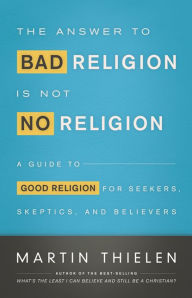
Book Review: The Answer To Bad Religion is Not No Religion

The Answer to Bad Religion is Not No Religion. Martin Thielen. 2014. Westminster John Knox. 160 pages. [Source: Library]

I thought I'd open this review with some words from J. Vernon McGee:
Today many are saying, "Out with religion," and I say, fine, let's sweep it out the back door, and let's invite Jesus Christ, the Light of the World, to come in. (Thru the Bible, Hosea)
Many people wear religion like you would wear a loose fitting garment; it is something they can put on or off at any time. (Thru the Bible, Hosea)
My friend, religion has been the most damning thing this world has ever experienced. Religion has damned the world… Throughout history religion has not helped us but only crippled and damned the human race. Only the Lord Jesus can deliver us. (Thru the Bible, Hosea)
There is a difference between "religion" and the Christian faith--being a Jesus follower. When Christianity is a mere "religion" it can be all shades between "good" and "bad".

I began this review with a digression, I know, so let's get back to the book in question: The Answer to Bad Religion is Not No Religion: A Guide to Good Religion for Seekers, Skeptics, and Believers.

Quite simply his argument is: Religion is turning off people of all ages all across America. He has even been turned off by religion in his own personal life. He has concluded that much of religion is "bad," but argues that it doesn't have to be that way. That "good" religion is to be found. People can find places to suit them to worship. They just have to look in the right places.

He spends one third of the book examining "bad religion," a third of the book arguing against "no religion," and a third of the book promoting "good religion." All sections of the book focus in on stories he's sharing with readers to illustrate his points, his worldview.

One can't tell from the basic premise how he defines "bad religion" and "good religion." It is all a matter of perspective. He's writing what he knows, what he believes. It is his book, after all, and "good" and "bad" are certainly prone to subjectivity. Within a few pages, I got a good idea of where he was heading. I was disappointed, but, not surprised, not really.

I don't want to rush in and say that everything in the book is theologically wrong, or, that he is never, ever, ever right. Sometimes his conclusions contain (some) truth at least, but his reasoning--his system of working it out--is faulty. Sometimes his observations were true (mostly true) but he somehow came to the wrong conclusions.

For example, you could say he has strong, negative feelings for anyone who holds the Bible to be infallible or inerrant. He claims this is not the historic Christian position. (That this is an invention of the twentieth century.) If you hold the Bible to be a divine book, a book that is God-breathed, a book that is all true and not just mostly true or sometimes true, then he is quick to judge you.

The root of most "bad religion" in his opinion is people who take the Bible too seriously. His examples are not just pushing the extreme, but pushed to the very extreme. "Christians" who are loud, arrogant, rude, wear offensive t-shirts, carry offensive signs, joke about killing people, laugh about people burning in hell for eternity. People defined by hate, hate, bitterness, anger, and did I mention, hate. What I found disturbing is that he presents this--it seems he presents this--as the normality. "All Christians who hold the Bible to be infallible and God-breathed" are like this.

The only Christians who are loving, compassionate, given to service, joyful, thankful, humble, fun-to-be-around ARE those who have rejected certain claims about the Bible, and have a better "informed" faith that is more open-minded, inclusive, and tolerant. Those willing to embrace ambiguity and mystery and reject certainty. (Now for the record, there are hundreds--if not thousands--of mysteries that we will never know this side of eternity. And I am not claiming that anyone can fully, absolutely, completely grasp or understand the heart-and-mind of God as He really is. But, for example, to deny there are certainties in the Bible is pushing it too far. God has revealed who He is. He has given us a book--the Bible--and given us His Spirit, the Holy Spirit. So we can know some things without doubt.) Also the author believes that the Bible is full of contradictions, contradictions that cannot be explained or reconciled.

Now, to clarify, he is not denying that the Bible is important, or denying that the Bible is a significant, potentially life-changing book. He affirms its inspired-ness. But I got the sense, I could be wrong, that the way he uses the word "inspired" does not mean God-breathed, God-authored. But instead means, "I was inspired to write this poem by my walk in the woods." "I was inspired to write this song for the most beautiful woman in the world, my wife." In other words, perhaps more like how a movie is "inspired" by "true events."

For example, I believe his argument was that the human authors were trying their best--to the best of their limited ability--to write true things of God, to write what they understood at that time, in that place, to be true of the God they worshiped. But not being God, they sometimes got things wrong. Of course, they sometimes got things right. It was up to future generations to "correct" misconceptions and "fix" the faith so that it better reflected what they themselves thought was true about God. And so it is to this day. "The God I worship would not…."

His way of understanding or comprehending what is meant by a "literal view of the Bible" is a bit frightening. I don't think he did his opponents justice in representing what they actually believe. Or perhaps there are a dozen ways one could theoretically take the Bible literally--and he assumes that the weakest, most ridiculous one is the only one. There are probably hundreds of books on how to read the Bible that would clarify the subject. He misunderstands quite a few things that are basic to reading and interpreting the Bible.

Some core (essential) doctrines he appears to sincerely, legitimately believe and hold closely and respectfully. For example, the resurrection of Jesus Christ, and the hope of our future resurrection. I say appear not to be sarcastic--I'm not trying to be--but because he probably clarifies and explains his beliefs a lot better in a previous book that I've not read.

If there is a section of this one that comes closest to the truth--something I view as absolute, and something he would view as relative, I'm sure--it is his section on "good religion." He makes a few good points now and then. One chapter that I agreed with most of the time was on nominal commitment to Christ and the church.

Here's a sampling:
Believing in a literal Bible is not necessary for Christian believers. in fact, believing in a literal Bible should not be affirmed by Christians, for precisely the kinds of reasons my young visitor laid out. A more faithful Christian response is to take the Bible seriously but not always literately. In fact, The Bible never claims to be perfect or infallible or inerrant. It claims only to be inspired. Although I believe in biblical inspiration and authority, the Bible is also a human document with human limitations, including a prescientific worldview.
© Becky Laney of Operation Actually Read Bible
Wednesday, November 18, 2015

Book Review: Advent in Narnia

Advent in Narnia: Reflections for the Season. Heidi Haverkamp. 2015. Westminster John Knox Press. 96 pages. [Source: Review copy]

Advent in Narnia is a great read for any Narnia lover looking for a book to read during Advent. Not that the book is only for Narnia-lovers. It isn't. Anyone genuinely seeking a book to read and savor during Advent will find this one worth the time it takes. The book does center around C.S. Lewis' The Lion, The Witch, and The Wardrobe. But it does so not at the cost of Scripture. Haverkamp quotes Scripture just as liberally as she quotes Lewis. Which is how it should be.

The first week's readings focus on "the wardrobe." The second week's readings focus on "the witch." The third week's readings focus on "Father Christmas." And finally, the fourth week's readings focus on "The Lion." Each day's reading includes a bit of Scripture, a bit of Lewis, and discussion/reflection questions.

The book also includes four sessions for small groups. Everything is practically organized in case readers want to lead a small group through the book.

If the book does become the interest of a whole church--or congregation--the book includes tips on hosting a Narnia Night for Families at your local church. Again the book gives very thorough advice on implementing this.

Overall, I liked this one very much. I've read The Lion, The Witch, and the Wardrobe many times. I do sometimes forget, however, that it is a Christmas-y book. I do think it's a great choice for families to read together. That is The Lion, The Witch, and The Wardrobe is a great choice for families to read together! I do believe this book is a good follow-up.

© Becky Laney of Operation Actually Read Bible

Monday, August 17, 2015

Book Review: Our Only Comfort

Our Only Comfort. Neal Presa. 2015. Westminster John Knox Press. 160 pages. [Source: Review copy]

Are you familiar with the Heidelberg Catechism? Do you want to be more familiar with it? You should consider reading Neal Presa's devotional book, Our Only Comfort.

Within is the Heidelberg Catechism itself, plus devotional readings and prayers for each Lord's Day. (The Heidelberg Catechism is divided into 52 Lord's Days. Several questions are focused on each week--each Lord's Day. There are 129 questions in all.)

Theological fitness is important, and, the Heidelberg Catechism covers the basics of the faith from a historic Reformed position. The catechism covers--among other things--the Apostles Creed, the Lord's Prayer, the Ten Commandments, and the church sacraments of the Lord's Supper (communion) and baptism. It also quite properly focuses on sin, the law, and man's need for a Savior.

Here's the first question:
Question 1.
What is thy only comfort in life and death?
Answer.
That I with body and soul, both in life and death, (a)
am not my own, (b)
but belong unto my faithful Saviour Jesus Christ; (c)
who, with his precious blood, has fully satisfied for all my sins, (d)
and delivered me from all the power of the devil; (e)
and so preserves me (f)
that without the will of my heavenly Father, not a hair can fall from my head; (g)
yea, that all things must be subservient to my salvation, (h)
and therefore, by his Holy Spirit, He also assures me of eternal life, (i)
and makes me sincerely willing and ready, henceforth, to live unto him. (j)
(a) Rom.14:7,8. (b) 1 Cor.6:19. (c) 1 Cor.3:23; Tit.2:14. (d) 1 Pet.1:18,19; 1 John 1:7; 1 John 2:2,12. (e) Heb.2:14; 1 John 3:8; John 8:34-36. (f) John 6:39; John 10:28; 2 Thess.3:3; 1 Pet.1:5. (g) Matt.10:29-31; Luke 21:18. (h) Rom.8:28. (i) 2 Cor.1:20-22; 2 Cor.5:5; Eph.1:13,14; Rom.8:16. (j) Rom.8:14; 1 John 3:3.
I would definitely recommend reading and studying the Heidelberg Catechism. I think it would prove quite beneficial. 

Our Only Comfort is a devotional book with devotions and prayers. Some people really do enjoy reading devotional books, and benefit greatly from including devotional readings in their spiritual lives. For anyone who does enjoy devotional readings, Our Only Comfort would certainly be worth considering. 

But not every Christian enjoys devotional books. For me, it's a very rare devotional book that impresses and wows. I found myself more interested in the catechism itself than in the devotions.   

Saturday, January 10, 2015

Book Review: Meeting God in Mark

Meeting God in Mark. Rowan Williams. 2015. Westminster John Knox. 108 pages. [Source: Review copy]

Looking for a book to read during Lent this year? You might consider reading Rowan Williams' Meeting God in Mark. In his book, he urges readers to read Mark slowly and thoughtfully, to resist the urge to rush through it. Yes, Mark has a compressed feel to it, a fast-pace, if you will. But it is a substantive book with much to say theologically.

Meeting God in Mark is a quick read. The book includes a schedule for daily/weekly reading in Mark for Lent. The schedule has six days a week for reading the gospel of Mark, and one day a week for reading the reflection in the book. There are also discussion questions for each chapter in Meeting God in Mark.

The book is what it is. The book spends much time--perhaps wastes much time--in introducing the basics of the gospel of Mark. In an effort to be fair to all scholarship, it over-presents and doesn't quite conclude anything. If you accept the Bible for what it is--the very Word of God--and if you accept what the Bible has to say about itself, and what tradition has to say about the Bible, then much of the book is a waste of time. In other words, it is all: who wrote the gospel of Mark? was it written by one person or more than one person? was it a collection of folklore or stories? is it the work of a community, expressing more about the community's needs and interests and wants, or is it factual? are the contents factual and historical? what century was it written in? where was it written? why was it written? should smart readers question all the miracles in Mark? Who was this "Mark"? And should readers believe there was a person named Mark who actually wrote the book? Did this "Mark" actually work closely with Peter? A good study Bible can do a good job of establishing everything readers need to know. Emphasis on GOOD study Bible. The author presents multiple sides of the scholarly debate without really clearly concluding anything at all.

But the book goes beyond that, and that's a good thing. The book examines the theological messages and themes of Mark paying attention to the miracles, the parables, and passion week. It focuses on the unexpectedness of the "good news" message of Mark, focusing on how in Mark God is revealed as a God who doesn't rescue from the sky but endures pain and suffering and ridicule.

Meeting God in Mark is ALL about God in relationship. Mark, he argues, is about revealing God in relationship: showing story by story, verse by verse, Jesus in relationship with many, many people. How the gospel focuses on people's reactions to Jesus, if they take the relationship further, deeper coming to TRUST and FAITH, or if they reject him. How the gospel can be read as offering readers the same invitation of relationship or fellowship.

I liked some of what I read. I definitely found it thought-provoking in places. I didn't like everything I read, however.

Saturday, November 8, 2014

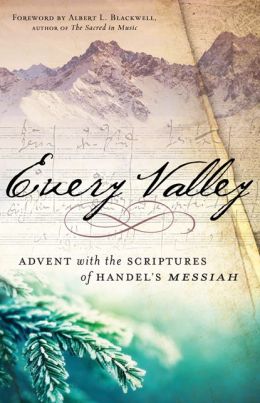
Book Review: Every Valley

Every Valley. Albert L. Blackwell. 2014. Westminster John Knox Press. 160 pages. [Source: Review copy]

From the foreword:
"What did the Holy Spirit do," St. Basil asked in the fourth century, "seeing that the human race was not easily led to virtue?" He answers, "The Spirit mixed doctrine with gladdening song, so that when hearing its agreeable and attractive eloquence we might unwittingly learn things beneficial." So it happened to me as a boy, sixteen centuries after Basil. From Handel's musical settings I unwittingly learned words of the prophets and psalms of Hebrew Scripture, from which Messiah takes three-quarters of its texts. 
Every Valley is an 40 day Advent devotional by Albert L. Blackwell. The premise of this one is simple: to use Handel's Messiah (1741) as inspiration for Advent and Christmas devotions.
The book seeks to place the songs in their scriptural contexts, and, to use each Scripture text as a starting point to contemplate the season.
The reflections in this collection help us comprehend biblical prophecy in its theological, historical, and pastoral dimensions. 
and
Christ's birth must never stand apart from the larger and long story of all that is disclosed to us in Christ--in birth, life, death, atonement, resurrection, and glorification. 
and
Is our Advent devotion about entertainment or edification? Diversion or direction? Amusement or awareness?
At times, the focus is on what it meant then, and, at times the focus is more on what it means now. The devotions can be reflective and ask hard questions of readers. Not every devotion does so equally, however. One of the best examples, perhaps, is
 "What exactly in my life is in need of refining? And how much will it hurt? What might I have to give up (or what might be taken from me) before I would be refined like gold and silver?"

  1. Comfort Ye My People Isaiah 40:1-5
  2. I Will Shake All Nations Haggai 2:1-9
  3. He Shall Come Malachi 2:13-3:1
  4. And He Shall Purify Malachi 3:2-4
  5. God With Us Isaiah 7:10-16
  6. O Thou Tellest Good Tidings Isaiah 40:6-9
  7. Arise, Shine Isaiah 60:1-6
  8. The People That Walked In Darkness Isaiah 9:1-2
  9. For Unto Us A Child Is Born Isaiah 9:3-7
  10. Keeping Watch Luke 2:8-10
  11. Born This Day Luke 2:11-12
  12. Glory to God Luke 2:13-20
  13. Rejoice Greatly Zechariah 9:9-12
  14. The Lame Shall Leap Isaiah 35:1-7
  15. He Shall Feed His Flock Isaiah 40:10-11
  16. His Yoke is Easy Matthew 11:16-30
  17. Behold the Lamb John 1:29-34
  18. He Was Despised Isaiah 52:13-53:3
  19. He Bore Our Griefs Isaiah 53:4-5, 9-12
  20. All We Like Sheep Isaiah 53:6
  21. They Laugh Him to Scorn Psalm 22:1-15
  22. There Was No One To Comfort Him Psalm 69:7-20
  23. Sorrow Like Unto His Sorrow Lamentations 1:1-12
  24. He Was Cut Off Psalm 16:9-11
  25. He Is the King of Glory Psalm 24
  26. Let All The Angels Worship Him Hebrews 1:1-8
  27. Even From Thine Enemies Psalm 68:1-12, 17-20
  28. How Beautiful Romans 10:8-15
  29. Into All Lands Psalm 19
  30. Why Do Nations Rage Psalm 2:1-3, 7-8
  31. The Lord Shall Break Them Psalm 2:4-6, 9-12
  32. Hallelujah Revelation 19:6-16
  33. My Redeemer Liveth Job 19:23-37
  34. For Now Christ is Risen 1 Corinthians 15:12-20
  35. All Shall Be Made Alive 1 Corinthians 15:21-22
  36. We Shall Be Changed 1 Corinthians 15:51-53
  37. Death, Where Is Thy Sting? 1 Corinthians 15:54-58
  38. If God Be For Us Romans 8:31-39
  39. Worthy is the Lamb Revelation 5:11-13
  40. Amen Revelation 5:14

My thoughts. I just want to say that I think it's GREAT to use Advent to meditate on the Savior. To learn more about how Christ can be seen in the Old Testament. To read the passages and imagine the longing and expectancy of waiting centuries for the Messiah to come. To read not only of the birth and childhood of Christ, but to read it all: the birth, the life, the parables, the sermons, the miracles, the tension of opposition, passion week, the resurrection, the ascension, etc. There is no better time to contemplate the person of Christ and the works of Christ. I do believe that very much.

I want to add that Handel's Messiah is rich in Scripture. So using Handel's Messiah as inspiration seems like a good, natural fit for believers. I like to read things in context. So it is a little disjointing that some Scriptures are broken up and spread out. But that is how it is in Handel, so that's just how things will be. (For example, "Comfort Ye My People" is from Isaiah 40:1-5, "O Thou Tellest Good Tidings" is from Isaiah 40:6-9, and "He Shall Feed His Flock" is from Isaiah 40:10-11. The devotions are days apart from one another.)

Looking at these Scriptures--putting aside the musical context of Messiah--one gets a good taste of who Jesus is and what he came to do and why. These scriptures could easily be read in any bible, or perhaps even studied in a good study Bible with great benefit to Christians.

What about the devotions? Well. Honestly, I can't say I loved them. I believe the material from the devotions comes from a long list of contributors. "The majority of the reflections in this volume are excerpted and adapted from essays in the Feasting on the Word commentary series." Some days were better than others, in my opinion. It depends on how picky you are in your theology--if you can look past the viewpoint throughout many of the devotions that there were three Isaiahs, for example. I couldn't. Since the devotions were supposed to be putting the scripture into historical and theological context, and, I could spot some wrong things almost immediately, it puts more of the devotions into doubt than I'm comfortable with. That being said, some of the devotions seemed to have good insight.

For example, from "Comfort Ye My People,"
But these words are not just for us to savor like food at a holiday feast. We are also in the situation of the celestial ones and the prophets in the text, trying to find a way to speak these words to others whom God loves.
From "He Shall Come"
Uncomfortable as it may be, however, Advent calls us to venture into these uncomfortable places with questions like, "How have we wearied him?" and to face head on the possibility that we have wearied the Lord in some of the same ways Malachi's audience had: by convincing ourselves that evil is good or by shirking our own responsibility for the world's ills by asking, "Where is the God of justice?"
Every Valley would be a good fit for you:

  • if you enjoy daily devotions
  • if you enjoy Advent studies (or Lent studies)
  • if you are looking to read more Scripture this holiday season
  • if you're a fan of Handel's Messiah


© Becky Laney of Operation Actually Read Bible