Showing posts with label 2000. Show all posts

Friday, June 14, 2019

Book Review: Because of Winn Dixie

Because of Winn Dixie. Kate DiCamillo. 2000. Candlewick. 182 pages. [Source: Book I bought]

First sentence: My name is India Opal Buloni, and last summer my daddy, the preacher, sent me to the store for a box of macaroni-and-cheese, some white rice, and two tomatoes and I came back with a dog.

Because of Winn Dixie is one of my favorite, favorite, favorite books. I love, love, love this one! Opal Buloni, our young heroine, has recently moved with her father, a preacher, to a small town in Florida. He is the new preacher at a small church, a church held in an old convenient store building, a church with no pews but lawn chairs. The novel is set during the summer. Opal, when the novel opens, is still adjusting. She misses her mother tremendously. Her mother's leaving is not recent, but, as Opal grows up, she is beginning to realize more and more how much she misses her mother. (Opal is now ten). Her curiosity and longing has changed. She feels her father ignores her, not because he doesn't love her, not because he doesn't want her or need her, but simply because he's always busy and quiet. Opal needs friends. Find friends she will and all because of Winn Dixie, the dog she finds at the grocery store. Winn Dixie, the dog with an irresistible smile, needs Opal just as much as she needs him. And with a little love from Opal and her Dad, Winn Dixie sets out to charm EVERYONE in town, even people who don't "like" dogs.

I love, love, love the characters in this one. I love Opal. I do. I love her dad. I love that he listens to his daughter and shares with her ten things about her mother. I love Gloria Dump, Miss Franny, Otis, and Sweetie Pie. And, of course, I love Winn Dixie. I also love Opal coming up with a ten things list for Winn Dixie.

I love the writing. This is one of those novels that is just so easy to quote!!!

Favorite quotes:
“Thinking about her was the same as the hole you keep on feeling with your tongue after you lose a tooth. Time after time, my mind kept going to that empty spot, the spot where I felt like she should be.”
“You can't always judge people by the things they done. You got to judge them by what they are doing now.”
“Do you think everybody misses somebody? Like I miss my mama?” “Mmmm-hmmm,” said Gloria. She closed her eyes. “I believe, sometimes, that the whole world has an aching heart.” 

© Becky Laney of Operation Actually Read Bible

Friday, August 11, 2017

Book Review: The Gospel According to Peanuts

The Gospel According to Peanuts. Robert L. Short. Introduced by Martin E. Marty. 1965/2000. 130 pages. [Source: Library]

First sentence: "How shall we sing the LORD's song in a foreign land?" (Ps. 137:4) is a question the Church, always finding itself in but not of the world, urgently needs to reconsider today.

Premise/plot: Are there theological lessons to be learned from engaging (reading thoughtfully) in the comic strip Peanuts? Short says YES, and this book is his argument why Christians should engage with the culture of the world.

My thoughts: The Gospel According to Peanuts is a short book, just six chapters in length.

The chapters are: "The Church and the Arts," "The Whole Trouble: Original Sin," "The Wages of Sin is Aaughh!", "Good Grief," "The Hound of Heaven," and "Concluding Unscientific Postcript."

If you can make it past the first chapter of this one, I think you'll enjoy reading this one. The first chapter suffers from being overly scholarly and long-winded. Instead of coming straight to the point and writing in English, the author offers his argument that essentially says a) comic strips can be important cultural indicators, a type of ART that should not be ignored but engaged in b) Peanuts is well worth reading because there are theological lessons to be found c) Christians often have a hard time communicating with the world in ways that the world can understand, if Christians engage in the culture they can better communicate the gospel in ways--in words and actions--that the world will be more likely to listen and respond.

I really loved the middle chapters of this one. In particular I loved "The Whole Trouble: Original Sin," "The Wages of Sin is Aaughh!" and "Good Grief."
The original sinfulness of man--all men--is almost taken for granted by the New Testament; it is the background for almost everything the New Testament says. Christ himself usually seemed to presuppose this view of human nature. (29)
Short argues that original sin can easily be seen as the background for the Peanuts strip. Each of the characters reveals the lostness--the blindness--of human nature itself.

One of the strips shown in this section:
LUCY: You know what the whole trouble with you is, Charlie Brown?
CHARLIE BROWN: No; and I don't want to know! Leave me alone!
LUCY: The whole trouble with you is you won't listen to what the whole trouble with you is! (30-1)
And here's another that reminds us of Paul's letter to the Romans:
LUCY: This Linus is a picture of the human heart! One side is filled with hate and the other side is filled with love. These are the two forces which are constantly at war with each other..
LINUS: I think I know just what you mean. I can feel them fighting. (36)
An example of a theological insight Short shares:
The inability of the Peanuts kids to produce any radical change for the better in themselves--or in each other--is a constant Peanuts theme. (37)
I enjoyed the comic strips very much. I also enjoyed Short's insights.

One of the points of the book is that ALL of the Peanuts characters have a natural, sinful fallen nature. There aren't "good" characters and "bad" characters. They are all messes. They all make mistakes. They all think mistakenly. If you're used to compartmentalizing the characters into "good" and "bad" then this book might be disconcerting to you. For example, if you are prone to thinking that LUCY IS BAD and LINUS IS GOOD. If you are of the opinion that Linus can do no wrong, and that Linus is wiser than all the rest,  then this one might upset you. For example, Short considers that Linus' blanket is unhealthy as is his insistent belief in the Great Pumpkin.

A few observations I have:

1) If you read enough comic strips, you could find enough to probably prove whatever you wanted. You could pull strips together showing Linus to be practically perfect in every way and Lucy to be a real jerk with no redeeming qualities. In this book, Lucy gets a lot of great lines in and in these strips she seems to be very self-aware while Linus seems to be fascinated with his blanket to the exclusion of seeing the real world.

2) This book was published BEFORE the 1966 Charlie Brown Christmas special. Linus stands out in the special as being wise and observant and GOOD. I think most people associate Linus with that--an image of him reading the birth narratives of Christ. And that image is so solid that it's hard to think of Linus as being anything but wise.

3) The new Peanuts movie is wonderful, but goes against much of what this book says. In the new movie, Charlie Brown comes across as an absolute saint; he may be clumsy, he may be gullible. But he's GOOD; he's LOYAL; he's COMPASSIONATE; he always does the right thing. He may worry a lot. He may be awkward but it seems his good works and good intentions outweigh everything else. He doesn't seem to need a savior; he just needs to believe in himself.

4) This book doesn't consider the comic strips written from 1965-2000. So it isn't a comprehensive look at the comic strip. Again, I think you could pick different strips from these years to prove anything about one of the characters.

© Becky Laney of Operation Actually Read Bible

Monday, July 27, 2015

Book Review: The Shaping of a Christian Family

The Shaping of a Christian Family. Elisabeth Elliot. 1992/2000. Revell. 240 pages. [Source: Borrowed]

I enjoyed reading The Shaping of a Christian Family by Elisabeth Elliot--for the most part. It is part autobiography, part how-to-parent. Several times, Elliot stresses the fact that it is the shaping of ONE Christian family--her own family. She's not necessarily advocating that there is one and only one 'Christian' way to raise a family. (Though I am guessing that there are a few guiding principles that she would have classified as essential for any and every Christian family.)

Most of the book is grounded in her family history. Therefore most of the book reads like an autobiography. Readers learn about her mother's upbringing, her father's upbringing, their courtship and marriage, and her own upbringing. She's one of six children, and, readers learn more about all six Howard siblings. Because of the way it is written, I felt the book was more of a tribute--a love letter of sorts--to her own mother and father, both passed away, of course. Most of the book is story-oriented. This is what my parents did. This is what my parents believed. These were the rules I grew up with, the routine that I was raised with, this is how it was, and I think it was wonderful.

There are dozens of times when Elliot moved from the personal to the general, where she gave specific advice to parents--new parents especially. The advice is somewhat practical, though not nearly detailed enough perhaps. If readers are going to find something to disagree about--it will be here. That is something that I think happens in any parenting book. You're going to find statements you agree with strongly, and statements you disagree with strongly. You can get a couple of good ideas, perhaps, without embracing each and every idea.
God's way of speaking to you and of getting at you will be through His Word. Dwell in it, therefore. Begin each day with a portion of it. Pray for grace to see when He is speaking to you, and for grace to adjust yourself to what He shows you. (46)
Christ is the Head of this house,
The unseen Guest at every meal,
The silent Listener to every conversation. (53)
How thankful I have been in the dark hours that my parents saw to it that hymns became fixed in our minds and hearts, through what was to us at the time merely a family routine. (58)
No one can make a child love anything, from spinach to sparrows to Scripture, but the parents' love for things exerts a powerful thrust in that direction (and I for one learned to love all of the above). (60)
There are so many wrong ideas about God. Wrong thinking about Him leads to wrong thinking about His actions. (118)
© Becky Laney of Operation Actually Read Bible

Monday, October 20, 2014

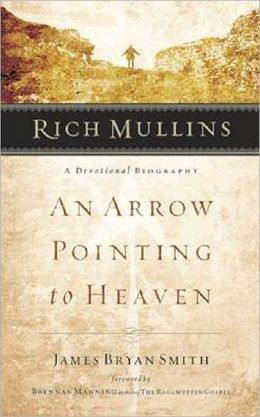
Book Review: An Arrow Pointing to Heaven

Rich Mullins: An Arrow Pointing to Heaven (A Devotional Biography). James Bryan Smith. 2000. B&H. 272 pages. [Source: Bought]

I first read this one years ago, probably seven or eight years ago. I was inspired to pick it up again after watching the new film, Ragamuffin. I was thinking about writing up a post about the movie itself, but, a few sentences in this book review would probably do just as well.

My thoughts on the film. First, I think this one is a movie for Ragamuffins by Ragamuffins. The point of the film seems to be humanity's brokenness: a need for a Savior, a need for honesty or transparency, a willingness to be vulnerable in community, in the church. It is biographical film about Rich Mullins. The film goes to ugly, uncomfortable places. Places that God is more willing to go than His followers, perhaps. There were scenes that were difficult to watch. There were scenes that I loved, however. The book does a better job, perhaps, of contrasting highs and lows, light and darkness. I did think the movie focused more on the darkness and the misery and the ugliness of life. When the movie was good, it was GREAT. I'm thinking in particular of the scenes where Rich and Brennan Manning are together, and he has been given the assignment (by Brennan) to write a letter to himself from his father.

My thoughts on the book. An Arrow Pointing to Heaven is not a traditional biography, a chronological biography. The book shares some details of his life, from various points in his life. But. It's a devotional biography. It is arranged topically. These are topics or subjects that were important to Rich Mullins. These were topics that came up again and again in his writing, in his songs. Each chapter gives readers a glimpse into Rich Mullins' life, a chance to see what was important to him, and why. The book keeps God very central. It is rich in lessons Mullins learned about the God he loved and served.

The table of contents:

  • First Family: Understanding His Roots
  • Creed: Being Made in the Church
  • The Love of God: Encountering the Reckless, Raging Fury
  • Boy Like Me/Man Like You: Trusting in Jesus
  • Calling Out Your Name: Seeing God in The Beauty of Creation
  • Bound to Come Some Trouble: Growing Through Struggle and Pain
  • My One Thing: Finding Freedom in Simplicity
  • Growing Young: Dealing With Sin and Temptation
  • Brother's Keeper: Learning to Love One Another
  • That Where I Am, There You May Also Be: Meditating on Death and the Life to Come
  • Social Aspects of the Beatitudes (by Rich Mullins)
  • Scared of the Dark (by Rich Mullins)

From the introduction:
Rich Mullins was a man who stood among the ruins--the ruins created by his own faults and failings, the ruins that result from the ravages of time. In the midst of the ruins he pointed to heaven, to the God who bundles our brokenness and heals our wounds. (2)
From "The Love of God: Encountering the Reckless Raging Fury"
It is hard to love an angry God. It is also difficult to see ourselves as God's beloved children if we believe we are worthless. (60)
Whatever else we may think we want, the thing we need is God's love. (63)
The love we are longing for is a love that loves not in spite of but in light of our weaknesses and failures. We long to be loved as we are, with all of our defects known. Only then will we truly feel that we are loved. But this kind of love belongs only to God. We humans are too limited to give it. That is why finding it anywhere except in God is impossible. (63)
Comprehending the love of God was difficult for Rich, but it is no less difficult for any of the rest of us. There is no one who can understand how much and how passionately and how tenderly God loves us. There is nothing that is beyond God, but there is much that is beyond us, and grasping this love is one of them. (66)

© Becky Laney of Operation Actually Read Bible

Wednesday, November 27, 2013

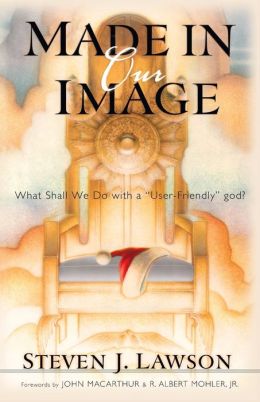
Book Review: Made In Our Image

Made In Our Image. Steven J. Lawson. 2000. Doubleday. 224 pages. [Source: Borrowed From Friend]

I am so thankful to have discovered Steven J. Lawson this year. He has turned out to be an author who does not disappoint! The first section of Made In Our Image focuses on a society that likes--even loves--to remake God into their own image.  What we think about God is so essential, so important. What is shaping our image of God? Think about it. Consider. Is "our God" the God of the Bible, or, are we reshaping God and fixing him to our own liking, perhaps trying to sell him to more people? The second section of Made In Our Image examines who God is, what he is like, his attributes, his character. The third section focuses on the individual, the personal experience of knowing, fearing, loving God. All of it was good--really good. I think the book is very relevant. In many ways, it is similar to A.W. Tozer's Knowledge of the Holy. The books share the same focus and goal. Both books are excellent by the way! 

From the introduction: This is a book about God. Not God as we might loosely imagine Him to be, but as He truly is--holy, awesome, sovereign, righteous, and full of love and goodness. I believe that there is one area of our theology that is most lacking in the church today, it is our understanding of who He really is. Our most rudimentary problem is that we do not fully comprehend who He is. Our thoughts about Him have become very unclear, fuzzy, and oblique. The result of this distorted view of deity is that it leaves everything else out of focus as well. Whenever we lose a right view of God, everything else gets out of perspective. (15)

Favorite quotes:
The most important thing about you is who you believe God is. (25)
Who we believe God is impacts every area of our lives--our attitudes, priorities, choices, and even our destiny. The true knowledge of God is so vast and overreaching that it is the only subject large enough, and powerful enough, to define and determine every aspect of our lives. (25)
The greatest sin anyone can commit is to distort the true knowledge of God. Vandalizing God's image--not with spray cans or permanent markers, but with loose thinking, partial truths, and bad theology--is at the center of every sin. (32)
A demeaned view of the one true God is the result of a pattern of compromise--from watered-down sermons presenting a low view of God to the trendy music of Christian performers who crossover to secular markets but forget to carry the Cross with them. (32)
Too often, we allow our surroundings and imagination, instead of Scripture, to govern our thoughts about who God is. We often project our self-limitations on to our picture of Him, resulting in a god made in our own image. This is the curse of the user-friendly god--namely, low views of Him who is high and lifted up, finite views of Him who is infinite and beyond our comprehension. (62)
Our definition of God should not be left up to our own imaginations; it must be determined from the pages of the Bible. When it comes to defining who God is, individual speculation is no more valid than a roll of the dice. The God we are talking about is the Creator of the universe, the original being, the sovereign ruler of all that is. He is the sole judge of all that is true and false, right and wrong, good and bad. He is the One who communicates to humankind generally in nature and specifically through the words of the Bible. (63)
What is the primary truth about God that we must grasp if we are to have a high view of Him? More than any other of His divine attributes, God has revealed Himself to has as being absolutely holy. Arguably, God's holiness is the most important of all His attributes. It constitutes the core of His nature, the essence of His attributes. It constitutes the core of His nature, the essence of His being, and the crown of His character. If our thoughts of God are to be worthy, the primary truth that should govern how we perceive Him is that He alone is perfectly holy. If we are to properly understand who He is, we must grasp the true meaning of this central aspect of His divine being. (77)
In the minds of so many people today, even some in the body of Christ, the user-friendly god has voluntarily limited his control and given free reign to the actions of people in order to give them unconditional liberty. This restricted ruler is slightly sovereign--enthroned, but not empowered; presiding, but not prevailing; trying, but not triumphing…This is the user-friendly god. But is this God? Has He really chosen to limit the free reign of His sovereignty? Is He limited by the choices of man? Or is God really the supreme ruler of the universe, exercising total control over all the works of His hand? Rest assured, God is in complete control! (93)
Only when we understand that He judges sin--all sin, even our own sin--can we appreciate His glorious grace for what it is. The darkness of God's wrath showcases the flawless gem of His unmerited mercy toward us. But remove the dark background of His wrath, and our appreciation of the brilliance of His amazing love fades. The gospel is not good news until we first know the bad news. The good news of His love does not truly become good news until we know the bad news of His wrath. (109)
From Genesis to Revelation, the Bible presents a consistent picture of a holy God who reserves wrath for sinners, who is angry with the wicked every day, and yet, who, at the same time, loves sinners with the strongest, most tender love. (110)
Despite this biblical account of God's wrath, I frequently hear people talk about God as though He never punishes sin. Many today have adopted the user-friendly god who never judges sinners. Choosing not to entertain frightening thoughts about God's wrath, they favor a feel-good approach to the Almighty. But this approach indicts God. In a court of law, if a judge knowingly acquits the guilty, he himself becomes corrupt, guilty of the same crime. Along this same line, if God is to be the righteous Judge of heaven and earth, he must punish sin, or He Himself would become guilty of it and from moral necessity, topple from His throne of holiness…There are others who believe in God's wrath, but choose never to talk about it or warn lost men and women about it. Their silence is deafening. (113)
Far worse than the physical torment He endured at the hands of the Roman soldiers was the spiritual suffering He endured at the hands of God… Only those who have died without Christ and now endure God's eternal wrath in hell can even begin to comprehend what Christ endured on our behalf… Jesus suffered a wrath equal to the eternal wrath we would suffer forever in hell if we were to die without Him. He who is infinite, the Lord Jesus Christ, suffered in a finite period of time--a few hours upon the cross--what you and I, begin finite, would suffer in an infinite period of time in hell… If God were ever to withhold His wrath against sin, it would have been in the case of His own Son. But He did not--because all sin must be punished! God, who did not spare His Son, will not spare us from being the object of His eternal wrath if we die in our sins. But because God's Lamb bore heaven's wrath for our sins, we need not suffer His vengeance. This is the good news of the gospel. The redemptive wrath of God, unleashed at the cross, means we need not face eternal wrath in hell. When we put our faith in Christ alone, we escape the wrath to come. God will in one way or the other pour out His wrath on every sin ever committed. Every sin will either be pardoned in Christ or punished in hell. God is that holy. (120-1)
Whenever we elevate God's love to a preeminent place in our thinking without first considering His holiness, sovereignty, and wrath, we distort the true picture of God. We reduce His love to syrupy, sentimental mush and turn Him into a user-friendly god who pats us on the head instead of delivering us from condemnation. (125) 
Our view of God has everything to do with how, or whether, we glorify Him with our lives. A diminished view of God demeans the worship we give to Him. The higher our view of God is, the greater our adoration for Him will be. Conversely, the lower our view of God is, the lower our worship of Him will be. Our worship will rise no higher than our thoughts of Him. (162)
No one giggles his way into the kingdom of God. All who enter through the narrow gate that leads to life come with godly fear, brokenness, and mourning over their sin. (Matthew 5:3-4, Matthew 7:13-14) As we walk by faith on the narrow path of the Christian life, we grow in our proper reverence for God. (196)
Fearing God is a heart attitude of worshipful submission to Him. It is a reverential awe for God in which we recognize Him for who He is--the holy, sovereign, righteous God who loves us and desires to have fellowship with us. In coming face-to-face with His holiness, we are overwhelmed and struck with the sheer glory of His being. Fearing God means to live a God-centered life in which our entire beings revolve around Him, not ourselves. It means we take Him very seriously, not superficially. (197)
Reverencing God comes from receiving His Word into our hearts. To know Him is to fear Him. (200)
Whenever we weaken our understanding of who God is, we weaken our resolve to resist temptation and we fall into sin. The most loving thing I can do for you is to lead you to fear God. The wisest thing pastors can do for their congregations is to teach them to fear God. If parents want their children to live pure and godly lives, they must teach them to fear God! (203)

© Becky Laney of Operation Actually Read Bible

Saturday, September 15, 2012

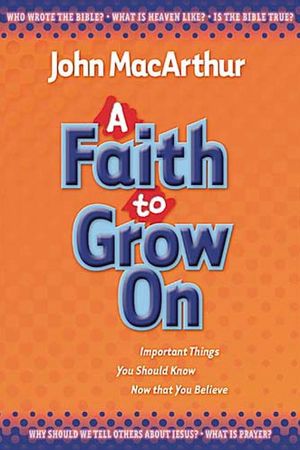
Book Review: A Faith To Grow On

A Faith To Grow On. John MacArthur. 2000/2004. Thomas Nelson. 192 pages.

A Faith To Grow On is essentially a book for children and (younger) young adults on the basics of the Christian faith. The book is divided into twelve chapters:

  • God
  • Creation
  • Sin
  • Bible
  • Jesus
  • Salvation
  • Worship
  • Prayer
  • Church
  • Forgiveness
  • Evangelism
  • Heaven

Each chapter is divided or subdivided into two-page spreads that often focus on questions OR share and explain a portion of Scripture. For example, chapter one is broken down into these questions:

  • Can we see God?
  • Are we like God?
  • How are we different from God?
  • What does God want from us?
  • What keeps us from knowing God?
  • How long has God been alive?
  • Is God perfect?
  • Is there only one God?
  • What should we do when we don't understand God?
  • What we understand about God?

Some of the questions are natural, others feel a little more forced. Each two page spread is a blend of introduction, explanation, and sometimes application. Also included on each spread are a handful of Scripture verses on the topic. I didn't find the "word scrambles" for each spread necessary. But that could just be me!

Some of the chapters are longer than others, some are quite short. But overall, I think the book offers something of substance to readers. I do think it is important to have quality educational books to share with children. This one would be great for families OR for a church setting.

© Becky Laney of Operation Actually Read Bible

Monday, November 7, 2011

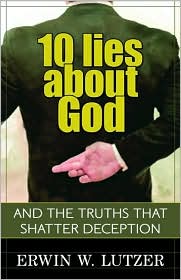
Book Review: Ten Lies About God

Ten Lies About God And How You Might Already Be Deceived. Erwin Lutzer. 2000. Thomas Nelson. 238 pages. (Newly reprinted as paperback by Kregel publications in January 2009).

Does what you believe about God matter? Does believing wrong things about God put you in danger? It may if the God you profess and worship is more of your making than His. If your 'vain imaginings' of God are held more strongly, perhaps, than those revealed in His Holy Word. Of course, no one knows God completely--except the Son (and Spirit). But the Bible does communicate with us. From the Bible we learn of God, of his nature, of his commands. We learn who he is. We learn what he has done. We learn what he is going to do. We see brief glimpses of the big picture. We learn truths that cannot be put aside without risk. When you choose to put your ideas about what God is like over and above the revealed Word of God, well, it may be time to think and rethink.

I love Ten Lies About God. I do. I wouldn't say it was my first Christian nonfiction read--that would probably be Knowing God by J.I. Packer--but it is one of the first that made a BIG, BIG, BIG, BIG difference in my life. (There were probably about five or six that did all around the same time period.)

So here are the ten lies:

Lie 1: God is whatever we want him to be.
Lie 2: Many paths lead into God's presence.
Lie 3: God is more tolerant than He used to be.
Lie 4: God has personally never suffered.
Lie 5: God is obligated to save followers of other religions.
Lie 6: God takes no responsibility for natural disasters.
Lie 7: God does not know our decisions before we make them.
Lie 8: The Fall ruined God's plan.
Lie 9: We must choose between God's pleasures and our own.
Lie 10: God helps those who help themselves.

Each chapter discusses 'the lie' and uses the Bible to present the truth of the matter. Each chapter is clearly written. Each chapter is relevant. Each chapter invites you to THINK DEEPLY about what you believe, what you actually believe. Do you say you believe one thing but act as if you don't? This book may challenge you to reconsider matters. Honestly, some of these "lies" were about issues that I'd truly never thought deeply about before. (The first time that is! This book is a reread for me.) And I imagine your experience may be similar to mine. I believe this book encourages and invites you to seek God as He is, and challenges you to grow stronger in your faith.

I also love how rich this book is in quotes by others. For example, this one by A.W. Tozer:

what we believe about God is the most important thing about us. (ix)

Here are some of my other favorite quotes. If it is Lutzer quoting someone else, I'll let you know who.

as much as possible we must ask not what we want the Bible to say, but what the Bible does say. (xi)

No man can know himself unless he first knows God ~ John Calvin (xii)

Our temptation is to invite ideas of God into our minds that are either just wrong or are notions that diminish Him. (3)

Idolatry is giving respectability to our own opinions of God, formed after our likeness. (3)

To be thoroughly biblical is to be controversial; it is to challenge cultural myths that have developed over generations. It is also to be confronted with a God who will not leave us as He finds us. (15)

The majesty of God should not discourage us but invite us to draw near in contrition and humility. Only a God who judges us can save us. Idols do not judge us, but neither can they redeem us. If we are put off by God's holiness, we probably will also be put off by His grace. (19)

We are invited to come into the "Most Holy Place," but we cannot come alone. (29) 

Only in Christianity do we find that the mediator and the sacrifice are the same person. (36)

The more clearly we see our sin, the more clearly we must see the wonder of Christ's sacrifice and intercession. (37)

The command to love the unlovable is rooted in the very character of God. (45)

God has built a bridge to us and paid the entire cost of its construction. (63)

If you want to see how much God is angered by the sin of the world, look at the cross. (74)
I would definitely encourage you to read this one! It is one of the best books I've ever read!


© Becky Laney of Operation Actually Read Bible
Tuesday, July 19, 2011

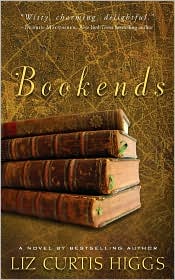
Book Review: Bookends

Bookends. Liz Curtis Higgs. 2000. Multnomah. 340 pages.

It isn't possible! Emilie Getz peered into the window of Benner's Pharmacy, amazed to find every detail exactly as she'd remembered. The soda counter were she'd sat as a child and ordered cherry colas, the stout glass jar stuffed with locally baked pretzels, the racks of colorful greeting cards, the customers--regulars, no doubt--perched on vinyl-covered stools. Gazing out at her, gazing in.

Dr. Emilie Getz, our heroine, has returned to her home town of Lititz, Pennsylvania, to do some historical research for a book she's writing about the 250th anniversary of the Moravian Congregation in Lititz. The novel opens with her attending a Christmas Eve service, she's distracted a bit by the man who sits beside her in the pew. Jonas Fielding, our hero, seems destined to fight with Emilie from the very start. The question, for readers, is not will these two fall or love or when will these two get together. But how will it happen, how will these two admit that what they're feeling is love.

Jonas is her opposite in many, many ways. But this land-developer isn't as evil, as mean, as cruel as Emilie first suspects. He's not out to "destroy" history and "remuddle" things. No, he's a good guy, a very good guy. And she'd be a fool not to realize how great a match he'd be....

As a reader, I often feels less is more especially when it comes to romance. I am not convinced that the Nathan story line was completely necessary to the story--at least for the development of the romance. I think there were enough obstacles between Jonas and Emilie already. And these two were clearly already in love with one another before Nathan arrived to "complicate" things by his desperate actions. And Nathan's scenes, well, they took me away from the characters I did care about. I would never say that Nathan "ruined" the book for me. I wouldn't ever be that silly. But I do think that I would have liked the novel a little more if the Nathan story had been less dramatic.

I don't read a lot of contemporary romance. I tend to prefer historical romance. But. I am SO glad I read this one. While I wouldn't say I loved it, or loved it absolutely, it was such a good read. Maybe not the best, best romance I'd ever read....but it was such a satisfying read!

© Becky Laney of Operation Actually Read Bible