Sunday, July 5, 2015

Week in Review: June 29-July 4

John: That You May Believe, R. Kent Hughes
If I have told you earthly things and you do not believe, how can you believe if I tell you heavenly things? No one has ascended into heaven except he who descended from heaven, the Son of Man. And as Moses lifted up the serpent in the wilderness, so must the Son of Man be lifted up, that whoever believes in him may have eternal life.
“For God so loved the world, that he gave his only Son, that whoever believes in him should not perish but have eternal life. For God did not send his Son into the world to condemn the world, but in order that the world might be saved through him. Whoever believes in him is not condemned, but whoever does not believe is condemned already, because he has not believed in the name of the only Son of God. And this is the judgment: the light has come into the world, and people loved the darkness rather than the light because their works were evil. For everyone who does wicked things hates the light and does not come to the light, lest his works should be exposed. But whoever does what is true comes to the light, so that it may be clearly seen that his works have been carried out in God.” John 3:12-21, ESV
HCSB
  • Psalm 1-10
  • Matthew
  • Romans
  • Galatians
  • Ephesians
  • Hebrews
  • Jude
NKJV
  • John
  • 1 John
  • 2 John
  • 3 John
  • Jude
KJV
  • Genesis 
NIV-UK
  • 2 Kings
ESV
  • Jeremiah 43-52
ERV
  • John
Living Bible
  • John 9-21
© Becky Laney of Operation Actually Read Bible

Saturday, July 4, 2015

Challenge Updates


Host: Operation Actually Read Bible
Title: Clouds of Witnesses (sign up post)
# of Books: my goal is 12
Dates: January - December

What I read:

1. Don't Give Up, Don't Give In. Lessons From An Extraordinary Life. Louis Zamperini and David Rensin. 2014. 272 pages. [Source: Library]
2. Weighed and Wanting Addresses on the Ten Commandments. D.L. Moody. 1898. The Bible Institute. 128 pages. [Source: Bought]
3. Living As A Christian: Teachings from First Peter. A.W. Tozer. 2010. Regal. 224 pages. [Source: Bought]
4. Knowledge of the Holy. A.W. Tozer. 1961/1978. HarperCollins. 128 pages. [Source: Book I Bought]
5. To The Glory of God: A 40 Day Devotional on the Book of Romans. James Montgomery Boice. 2010. Baker Books. 183 pages. [Source: Bought]
6. The Pursuit of God: The Human Thirst for the Divine. A.W. Tozer 1948/2006. WingSpread Publishers. 70 pages. [Source: Bought]
7. No Little People. Francis A. Schaeffer. 2003. Crossway. 239 pages. [Source: Bought]
8. Experiencing the New Birth: Studies in John 3. Martyn Lloyd-Jones. 2015. Crossway. 400 pages. [Source: Review copy]
9. The Root of the Righteous: Tapping The Bedrock of True Spirituality. A.W. Tozer. 1955/2015. Moody Publishers. 192 pages. [Source: Review copy]
10.
11.
12.

So three more books--at least--to read for this year's challenge! Are you participating in this challenge? What have you read? What are you still planning to read? 

Host: Operation Actually Read Bible
Title: Operation Deepen Faith (sign up post for 2015)
Dates: January 2015 - December 2015

I'm signing up for
I. Wonderful Words of Life

My goal: To read the Bible 4 times through in 2015. I'd love to read it each quarter. But I typically end up checking my progress in November/December and making a list of which books I need to read, and how many times, in order to make it to that year's goal.

Early July Check-In
I've read the Bible  through twice so far this year.  The first quarter I read "extra" in the New Testament. The second quarter, I read "extra" in the Old Testament. James and John will have extra  because they've  been MacArthur-ed. Chosen to read 30 times in a row. 

II. How Firm A Foundation

My goal: Same as last year. To spend time with the Apostle John. To focus on John, 1 John, and Revelation. I'd love to read each of these 30 times. (Last year, I read the gospel of John 25 times, and the book of Revelation 43 times. I believe I read 1 John, 21 times.)
Early July Check-In
What have I done to meet this goal? Well, I chose to read John 30 times this summer. So far I'm around 16 or 17? I think. So I'm on my way to getting to that number 30!  I've started reading  R. Kent Hughes' John: That You May Believe Preaching the Word Commentary published by Crossway. I hope to finish that this summer or perhaps this fall. I have several other commentaries that I'd love to get to.  We'll see.

III. Deep and Wide

My goal: To use the MacArthur System of study several times throughout the year. Candidates include: 2 Corinthians, Galatians, James, 1 and 2 Timothy, Titus and Philemon, and Jude. (I am not brave enough to tackle the gospels or Acts.)

Early July Check-In
I've read James. I'm in the process of  reading John. If you haven't tried this way of reading the Bible, you should be brave and just do it! I promise you that it is worth it!!! Yes, it takes time and effort. A commitment to read the Bible each day, but, it is so rewarding!!!
I will probably take a break after reading John, but, maybe one more book before the end of the year? Anyone want to be brave and read a book with me? Let me know! Pick a book, pick a month!!!

IV. Meditate or Memorize.

My goal: I'd love to memorize a verse per week. But. Since I'm completely new to memorization--at least as an adult--I'd be content with 24 or so. I'd rather really, really know 24, than be able to stumble through fifty.

Early July-Check-In
Am I memorizing the Bible? No. Not really. Have I  been meditating on the Bible verses I've selected? Yes and no. That is sometimes.  I seem to be contrary. Either I'm really on-task and read/meditate several times per week--sometimes even five or six days of the week--or else I'm horrible at it and go two or three weeks without. So I'm not as consistent as I'd like. But this has been helpful to me overall. It was a great blessing this spring to have these verses ready-to-go.

V. Christian Nonfiction

My goal: To read twenty-four nonfiction books.

Early July Check-In
I've read 59 Christian Nonfiction books this year.  That's twice my goal.  And the year is just half over. So my best books might be yet to come! 


© Becky Laney of Operation Actually Read Bible

Book Review: End of Me (2015)

The End of Me. Kyle Idleman. 2015. David C. Cook. 240 pages. [Source: Review copy]

I definitely enjoyed reading Kyle Idleman's The End of Me. The book is about how important it is to recognize our brokenness and weakness; the book stresses that it is only when we reach the end of ourselves that we reach out to God who is able to make us whole and strong--in Him.

The book challenges believers to closely examine the teachings of Christ, and also to examine his life. Christ taught some revolutionary ideas that we--if we're honest--are reluctant to follow and embrace. Chapter by chapter, he encourages believers to choose to turn their thinking upside down and inside out. To go against their natural instincts and live as Christ lived and taught. Not to do this in their own strength, of course, that would be impossible. But to turn to the Savior, to surrender to God daily and let God use them where they are--in their weakness, at their weakest.

Kyle Idleman stresses several points throughout the book. But one of the most important is this daily need. Every day needs to be surrendered to the Lord. Every day you need to make the choice to live to God and to die to self. Every day has opportunities--opportunities perhaps so small that most people ignore them or discount them. Opportunities at home, in the car, at work, at the store, etc. Often it's in the small moments when we realize how much we've failed to do the right thing, how far we are from where we want to be--need to be.

Also by Kyle Idleman: Gods At War (my review).

Quotes:
Reaching the end of me is a daily journey I must make because it's where Jesus shows up and my real life in him begins.
Getting to the end of me is not an easy journey because me doesn't want to go there. Me doesn't like confrontation, and me is most interested in the promotion and success of me. Me would much prefer to read a book about advancing me, not ending me.
A great part of the upside-down, inside-out message of Jesus is that God doesn't look so much upon the outside, which is so easy to fake. He looks more on the inside, where we are what we are. 
Emptying is never painless, and not everyone is willing to go there. Jesus is eager and willing to fill.

© Becky Laney of Operation Actually Read Bible

Thursday, July 2, 2015

Book Review: Uncensored

Uncensored: Daring to Embrace the Entire Bible. Brian Cosby. 2015. David C. Cook. 208 pages. [Source: Review copy]

Are you unintentionally censoring the Bible? Perhaps even intentionally censoring the Bible?

Brian Cosby has written a great book on the Bible, on how it is important for Christians to read the whole Bible. In other words, it isn't quite enough to just read and "embrace" the parts you really, really love. You have to consider the Bible as a whole, and try to grasp what the message of the whole Bible is.

He examines why different people "censor" the Bible--possible motivations--and how they "censor" it.

Does this matter to you and me? Or, why should this matter to you and me?! Because when we censor the Bible--intentionally or not--we just aren't censoring a book. We're censoring the God that inspired book reveals. And when we recreate God in our own image, that's idolatry. We're to worship God in spirit and truth. When we worship a god we've made ourselves, that's not true worship. We need the truth--and the whole truth--to worship truly and glorify God.
When we censor the full character of God, we soften His justice, elevate man, and devalue our need for the cross. But when we embrace the entire Bible, we are freed from making God "fit" our politically correct, tame caricatures of a god who seems no more omnipotent than a divine grandpa. But like Aslan, God isn't safe.. The Lion from the tribe of Judah has conquered. Eternally self-sufficient, He's dependent on no one. And His Word reveals His majesty and glory from Genesis to Revelation.
Part One is "Embarrassed by the Bible." And part two is "The Art of Censorship." Part one focuses on the realities facing the Christian church: The need for the whole Bible, and, a need to trust that the Bible is the very Word of God, and that the God of the Bible is worth trusting and believing. This section also includes a summary of the big picture of the Bible, and an overview on how to read the Bible and interpret it correctly.

Part Two highlights seven areas of the Bible that people tend to censor including creation, sin, hell, suffering, parenting, etc.

Who should read this one? First, I recommend it to all Christians. But. Knowing that not everyone is a reader, I'll just add that it would be of special interest to any believer who preaches, teaches, or leads devotions, publicly or privately. (Pastors, teachers, parents) I do think all believers would benefit. Especially those who aren't regularly reading the whole Word of God. (I'm not one that says you have to have a structured plan in place to read the whole Bible in one year. But I am one who encourages you to have some plan in place to read from the (whole) Bible regularly.)
If the Bible is truly inspired by God--as His self-revelation--and profitable for His people, then I should embrace the whole counsel of God for a healthy, balanced, and fruit-filled faith. When I censor the Scriptures and selectively choose which parts to meditate on, day and night, I fail to become the tree planted by streams of water, bearing fruit in its season (Psalm 1:1-3). I miss out on the life-altering and joy-infusing revelation of God which is living and active (Hebrews 4:12).
If you listen closely to our Christianese, you will notice a large amount of extra biblical thought squeezed in. Try to find "God helps those who help themselves," "Invite Jesus into your heart," or "Accept Jesus as your personal Lord and Savior" in the Bible. They're not there. Not only are we cherry-picking the Scriptures, but we're also inserting our own feel-good notions.
An incomplete Word leads to incomplete joy. Why would we settle for an incomplete text when every jot and tittle is inspired by our great God? This is a journey to embrace the Bible--the entire Bible--every book, every verse, and every word. It's both daring and exciting.
When I question, or decide, which passages in the Bible to follow, I miss out on the truth that sets me free. When we avoid the biblical practice of church discipline, for example, we miss out on the joy of seeing wayward sinners reclaimed or seeing Christ establishing greater peace and purity in His bride. When we avoid the doctrine of hell in our preaching and teaching, we miss the experience of gratitude of what we are saved from and the hope of what we are saved for.
To put it bluntly, we don't want sin, wrath, or God's judgment in our Bibles. Richard Niebuhr, the early twentieth century theologian, once remarked that we want a "God without wrath [who] brought men without sin into a kingdom without judgment through the ministrations of a Christ without a cross."
It's tough to convince the world that the Bible is true when we don't communicate our own belief in it. When we are embarrassed by what it says or censor those "difficult" passages in sermons or in conversations on the elevator, we communicate as much. When we cherry-pick those feel-good verses and leave the convicting fruit behind, we rob God of His glory by making ourselves the arbiters of truth. 

© Becky Laney of Operation Actually Read Bible

Quotes from the Cloud #26

This year, I hope share weekly posts of quotes. These quotes are from authors I'm reading and enjoying from the Clouds of Witnesses Reading Challenge

For fellow participants, what I would LOVE, LOVE, LOVE to see is for people to share quotes from what they're reading. I'd love for you to share quotes occasionally with your readers and let me know about it. If you don't have a blog, you could always leave quotes in the comments here.
The idea that God will pardon a rebel who has not given up his rebellion is contrary both to the Scriptures and to common sense. How horrible to contemplate a church full of persons who have been pardoned but who still love sin and hate the ways of righteousness. And how much more horrible to think of heaven as filled with sinners who had not repented nor changed their ways of living. ~ A.W. Tozer, Root of the Righteous
The Lord does not shine on us, except when we take his Word as our light. ~ John Calvin
Contentment with earthly goods is the mark of a saint; contentment with our spiritual state is a mark of inward blindness. ~ A.W. Tozer, Root of the Righteous
They [Adam and Eve] wanted, as we say, to “call their souls their own.” But that means to live a lie, for our souls are not, in fact, our own. They wanted some corner in the universe of which they could say to God, “This is our business, not yours.” But there is no such corner. ~ C.S. Lewis

© Becky Laney of Operation Actually Read Bible

Wednesday, July 1, 2015

Book Review: The Innocent

The Innocent. Ann H. Gabhart. 2015. Revell. 400 pages. [Source: Review copy]

I really loved, loved, loved Ann Gabhart's The Innocent. I was a tiny bit surprised by how much I loved it since it is set during the Civil War, well, directly after the Civil War. But from the start, Gabhart had me hooked. I think one of the reasons I loved it so much--cared so much--was the characterization.

Carlyn Kearney is the heroine of The Innocent. The war has left her a widow, a widow hesitant to declare herself a widow. Her husband is missing in action, has been missing for several years now. Part of her truly wants him to come back home, and expects just that. Another part of her realizes that if he was alive, he'd have found a way to at the very least write her and let her know that he's alive. Carlyn is in a predicament because she cannot make payments on the house, and, the man who loaned her husband the money is a scoundrel not above making threats. The novel opens with him bringing the sheriff to evict her. The sheriff. Well. He's something. He's a big part of why this one works so very well.

Having nowhere else to go, Carlyn Kearney joins the nearby Shaker community. Will she be a permanent Sister of the community? Or is this a temporary fix? Will she get along with the other women? Will she meet their expectations? Will they meet hers? This decision isn't one that is taken lightly.

The Innocent is part mystery novel--I LOVED the mystery element--and part romance novel. I won't say a word about the mystery, but, it's GOOD.

© Becky Laney of Operation Actually Read Bible

Journaling Institutes #3

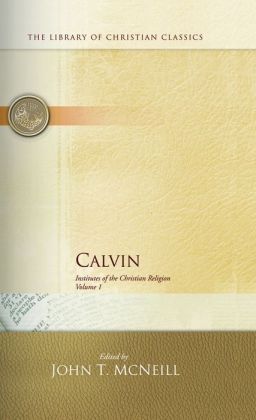
Institutes of the Christian Religion. John Calvin. Translated by Ford Lewis Battles. 1559/1960. Westminster John Knox Press. 1812 pages. [Source: Gift]

I think the best way to approach the Institutes of the Christian Religion is by journaling the experience, sharing as I go. (Journaling Institutes #1, Journaling Institutes #2)

In today's post, I'll be covering most of book three: The Way In Which We Receive The Grace of Christ: What Benefits Come To Us From It, and What Effects Follow. (Why am I splitting up book three? Because the editors divided Institutes of The Christian Religion into two volumes. They split up book three. Chapters 1-19 are included in volume 1. Chapters 20-25 are included in volume 2.) This first section of book three is 314 pages in length.

So what topics are covered in this third book? Well, faith, true converts versus false converts, regeneration, repentance, forgiveness of sins, justification, works righteousness vs. justification by faith alone, importance of self denial, importance of living holy lives (though they do not merit being called "good works" apart from our justification in faith), the work of the Holy Spirit, and the law versus the gospel. (Looking ahead, it seems the remaining six chapters of book three cover prayer, and the doctrine of election. I must say I am MOST EXCITED to get to those chapters!!!) Much of the third book also criticizes the doctrines of the Roman Catholic Church. 
Faith rests not on ignorance, but on knowledge. And this is, indeed, knowledge not only of God but of the divine will. We do not obtain salvation either because we are prepared to embrace as true whatever the church has prescribed, or because we turn over to it the task of inquiring and knowing. But we do so when we know that God is our merciful Father, because of reconciliation effected through Christ (2 Cor. 5:18-19), and that Christ has been given to us as righteousness, sanctification, and life. (545)
This then, is the true knowledge of Christ, if we receive him as he is offered by the Father: namely, clothed with his gospel. For just as he has been appointed as the goal of our faith, so we cannot take the right road to him unless the gospel goes before us. And there, surely, the treasures of grace are opened to us; for if they had been closed, Christ would have benefited us little. Thus Paul yokes faith to teaching, as an inseparable companion. (548)
The human heart has so many crannies where vanity hides, so many holes where falsehood lurks, is so decked out with deceiving hypocrisy, that it often dupes itself. (554)
When we call faith "knowledge" we do not mean comprehension of the sort that is commonly concerned with those things which fall under human sense perception. For faith is so far above sense that man's mind has to go beyond and rise above itself in order to attain it. Even where the mind has attained, it does not comprehend what it feels. But while it is persuaded of what it does not grasp, by the very certainty of its persuasion it understands more than if it perceived anything human by its own capacity. (559)
Faith is certain that God is true in all things whether he command or forbid, whether he promise or threaten; and it also obediently receives his commandments, observes his prohibitions, heeds his threats. Nevertheless, faith properly begins with the promise, rests in it, and ends in it. For in God faith seeks life: a life that is not found in commandments or declarations of penalties, but in the promise of mercy, and only in a freely given promise. (575)
Thus faith believes God to be true, hope awaits the time when his truth shall be manifested; faith believes that he is our Father, hope anticipates that he will ever show himself to be a Father toward us; faith believes that eternal life has been given to us, hope anticipates that it will some time be revealed; faith is the foundation upon which hope rests, hope nourishes and sustains faith. (590)
With good reason, the sum of the gospel is held to consist in repentance and forgiveness of sins [Luke 24:47; Acts 5:31]. Any discussion of faith, therefore, that omitted these two topics would be barren and mutilated and well-nigh useless. Now, both repentance and forgiveness of sins--that is, newness of life and free reconciliation--are conferred on us by Christ, and both are attained by us through faith. (592)
Repentance is preached in the name of Christ when, through the teaching of the gospel, men hear that all their thoughts, all their inclinations, all their efforts, are corrupt and vicious. Accordingly, they must be reborn if they would enter the Kingdom of Heaven. Forgiveness of sins is preached when men are taught that for them Christ became redemption, righteousness, salvation, and life (1 Cor. 1:30), by whose name they are freely accounted righteous and innocent in God's sight. (614)
We must strive toward repentance itself, devote ourselves to it throughout life, and pursue it to the very end if we would abide in Christ. (614)
For whomever the Lord has adopted and deemed worthy of his fellowship ought to prepare themselves for a hard, toilsome, and unquiet life, crammed with very many and various kinds of evil. It is the Heavenly Father's will thus to exercise them so as to put his own children to a definite test. Beginning with Christ, his first-born, he follows this plan with all his children. (702)
Christ was given to us by God's generosity, to be grasped and possessed by us in faith. By partaking of him, we principally receive a double grace: Namely, that being reconciled to God through Christ's blamelessness, we may have in heaven instead of a Judge a gracious Father; and secondly, that sanctified by Christ's spirit we may cultivate blamelessness and purity of life. (725)
He is said to be justified in God's sight who is both reckoned righteous in God's judgment and has been accepted on account of his righteousness. Indeed, as iniquity is abominable to God, so no sinner can find favor in his eyes in so far as he is a sinner and so long as he is reckoned as such. Accordingly, wherever there is sin, there also the wrath and vengeance of God show themselves. Now he is justified who is reckoned in the condition not of a sinner, but of a righteous man; and for that reason, he stands firm before God's judgement seat while all sinners fall. (726)
We compare faith to a kind of vessel; for unless we come empty and with the mouth of our soul open to seek Christ's grace, we are not capable of receiving Christ. (733)
But Scripture, when it speaks of faith righteousness, leads us to something far different: namely, to turn aside from the contemplation of our own works and look solely upon God's mercy and Christ's perfection. (746)
Therefore, if we would give ear to Christ's call, away with all arrogance and complacency! Arrogance arises from a foolish persuasion of our own righteousness, when man thinks that he has something meritorious to commend him before God. Complacency can exist even without any belief in works. For many sinners are so drunk with the sweetness of their vices that they think not upon God's judgment but lie dazed, as it were, in a sort of drowsiness, and do not aspire to the mercy offered to them. Such sloth is no less to be shaken off than any confidence in ourselves is to be cast away in order that we may without hindrance hasten to Christ, and empty and hungering, may be filled with his good things. For we will never have enough confidence in him unless we become deeply distrustful of ourselves; we will never lift up our hearts enough in him unless they be previously cast down in us; we will never have consolation enough in him unless we have already experienced desolation in ourselves. Therefore we are ready to seize and grasp God's grace when we have utterly cast out confidence in ourselves and rely only on the assurance of his goodness--"when," as Augustine says, "forgetting our own merits, we embrace Christ's gifts." (762)
We never truly glory in him unless we have utterly put off our own glory. On the other hand, we must hold this as a universal principle: whoever glories in himself, glories against God. (764)
The conscience, if it looks to God, must either have sure peace with his judgment or be besieged by the terrors of hell. Therefore we profit nothing in discussing righteousness unless we establish a righteousness so steadfast that it can support our soul in the judgment of God. (765)
We must strongly insist upon these two points: first, that there never existed any work of a godly man which, if examined by God's stern judgment, would not deserve condemnation; secondly, if such a work were found (something not possible for man), it would still lose favor--weakened and stained as it is by the sins with which its author himself is surely burdened. (778)
But we define justification as follows: the sinner, received into communion with Christ, is reconciled to God by his grace, while, cleansed by Christ's blood, he obtains forgiveness of sins, and clothed with Christ's righteousness as if it were his own, he stands confident before the heavenly judgment seat. After forgiveness of sins is set forth, the good works that now follow are appraised otherwise than on their own merit. For everything imperfect in them is covered by Christ's perfection, every blemish or spot is cleansed away by his purity in order not to be brought in question at the divine judgment. (811)
Therefore, as we ourselves, when we have been engrafted in Christ, are righteous in God's sight because our iniquities are covered by Christ's sinlessness, so our works are righteous and are thus regarded because whatever fault is otherwise in them is buried in Christ's purity, and is not charged to our account. (813)
© Becky Laney of Operation Actually Read Bible