Showing posts with label John Calvin. Show all posts

Thursday, March 21, 2019

True or False with John Calvin

From book one, "The Knowledge of God the Creator"

True or false. We can never really seek him in earnest until we begin to despair of ourselves. 

True or false. Man never arrives at true self-knowledge before he has looked into the face of God and then come away to look at himself. Men are never really convinced of their own insignificance until they contrast themselves with God's majesty.True or false.

True or false. Until people feel that they owe everything to God, that they are protected by his fatherly care and that he is the Author of all their blessings, so that nothing should be sought apart from him, they will never submit to him voluntarily. Unless they put their complete happiness in his hands, they will never truly have their lives under his control. 
True or false. The pious mind does not create its own god, but looks only to the one true God. Nor does it imagine any trait it likes for him, but is happy to have him as the character which he reveals, always on guard against disobeying his Law and wandering arrogantly from the right way. 
True or false. The pious mind holds on to God as the avenger of sin as much as the rewarder of good, because he realizes that both are part of his glory: he reserves punishment for one and eternal life for the other. 
True or false. This is pure and true religion: it is confidence in God coupled with genuine fear. This fear comprises willing reverence and true worship as God has commanded. 
True or false. Vanity and pride are always present when men seek for God...so they do not think of God in his true character, but imagine him to be like their own random ideas. 
True or false. No religion is genuine that is not in accordance with truth.
True or false. Those whose inclinations oppose God's justice, fervently wish that his tribunal for the punishment of sin could be overthrown. In feeling like this, they are fighting God, because justice is one of his essential attributes. 
True or false. Hypocrites try, in various twisted ways, to make a show of being near God when they are in fact running away from him. 
True or false. Scripture crystallizes ideas about God which had been very confused, scatters the darkness and shows us the true God clearly. 
True or false. It is impossible for anyone to gain an atom of sound doctrine without being a disciple of Scripture. We take the first step towards true knowledge when we reverently take hold of the testimony God has graciously given about himself. 
True or false. If we sincerely long for true awareness of God we must look in God's Word where his character is described accurately and vividly. If we turn away from this, however fast we move, we shall never reach our goal because we are off course. 
True or false. These words will not be given acknowledgment in the hearts of men, until they are sealed by the inner witness of the Spirit. 
True or false. The Lord has intertwined the truth of his Word and his Spirit in such a way that we respect the Word when the Spirit illuminates it, enabling us to see God's face, and we welcome the Spirit with no risk of error, when we recognize him in his Word. These are the facts. God did not put his Word in front of men to make a sudden splash, intending to get rid of it the moment the Spirit arrived. He employed the same Spirit by whom He had given the Word, to complete his work by effectively confirming the Word. 
True or false. The work of the intellect is to make distinction between good and bad, and the function of the will is to choose and follow what the intellect says is good, rejecting what is bad.
True or false. Without reference to God's Providence we cannot understand the full force of what is meant by his being the Creator, however much we may seem to understand it with our minds and confess it with our mouths. 
True or false. The believers' comfort in trouble is that everything they endure is ordained and commanded by God and that they are in his hands. 
True or false. Everything is controlled by God's secret purpose, and nothing can happen except by his knowledge and will. 
True or false. When our lives are in turmoil so that we cannot think straight, we should still believe that God, in the pure light of his justice and wisdom, keeps our problems under his control and finds the right solution. 


© Becky Laney of Operation Actually Read Bible

Wednesday, March 20, 2019

Book Review: The Institutes of Christian Religion

The Institutes of the Christian Religion. Abridged. John Calvin. (1536) Edited by Tony Lane and Hilary Osborne (1987). Baker Books. 272 pages. [Source: Bought] 

First sentence: Our wisdom, if it is to be thought genuine, consists almost entirely of two parts: the knowledge of God and of ourselves. 

I decided to read the abridged edition of John Calvin's Institutes. I have previously read several books of the unabridged edition; Calvin's theological masterpiece contains four books in all: "the knowledge of God the Creator," "the knowledge of God the Redeemer in Christ," "the way of obtaining the grace of Christ," and "outward means by which God helps us." I know I completed the first two books and part of the third book. The length of the book is probably the most intimidating aspect of it. Taking a few days off from reading it, soon became a few weeks, a few months, and then you reach the point: well, it's been twenty plus months since I read the last chapter...do I need to start over on page one?! can I begin at the last section?! It was easier for me to pick up the abridged version. 

I don't know that I can assess how great the abridgment is since I never finished the original...but I will try to be helpful in my review.

Is this one accessible? Is it reader-friendly? Is the subject so heavy--so dense--that it's difficult to comprehend? Do the rewards of reading outweigh the effort to comprehend it? 

I found it to be accessible. I found the layout to be great. Each book, each chapter, each section is clearly labeled. It is clear when whole sections have been removed for the abridgment. I also liked how each chapter has headings. These headings are not only identified in the text itself but also in the table of contents. If you were looking for a specific subject--say predestination or election--you could easily find which section/chapter where Calvin discusses it. (Though, of course, Calvin writes about more than just election. Calvin's name be associated with Calvinism, but Calvinism did not get its start with Calvin.)

I also found it reader-friendly. But this is completely subjective. If you've never picked up any theology whatsoever...if you've never read any christian nonfiction before...you may not find it to be so. 

The content is substantive--not fluffy--but it is rewarding. So it is definitely worth any effort you put into it. 

Who is God? What is God like? What is his nature? 
Who is man? What was man like before the fall? what was man like after the fall? What is his nature? What is he capable of? Does he have free will? 
Who is Christ? What was his mission? what did he come to do? What did his life accomplish? what did his death accomplish? what did his resurrection accomplish? 
What is faith? How is faith given/received/applied? What is saving faith? 
What is justification? what is sanctification? Why is piety important? Why should we live holy lives?
What is the church? What are the sacraments? What elements of the faith are essential?
What role does the Bible play in the lives of believers? What authority does Scripture have?
What is the role of the Holy Spirit? 
What is sin? 
What is grace?
How can God be both just and merciful?
Does God owe mercy to everyone? 
What is predestination or election? 
What comfort can God's providence give believers?
Why is there so much suffering?

These are just a few of the topics/subjects addressed within this comprehensive and historically significant read.

There are WAY too many quotes to share in one post. But I will be sharing quotes.


© Becky Laney of Operation Actually Read Bible
Friday, March 31, 2017

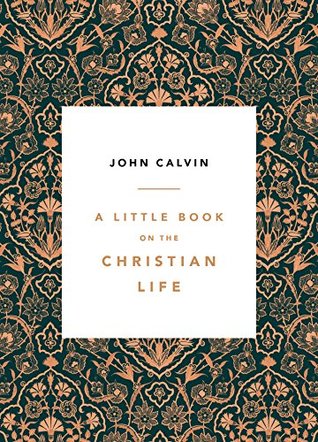
Book Review: A Little Book on the Christian Life

A Little Book on the Christian Life. John Calvin. Edited by Buck Parsons and Aaron Denlinger. 2017. Reformation Trust. 132 pages. [Source: Review copy]

First sentence: THE GOAL OF God’s work in us is to bring our lives into harmony and agreement with His own righteousness, and so to manifest to ourselves and others our identity as His adopted children. We discover in God’s law a picture of God’s own image, to which we are being progressively conformed. But since we are lazy and require prodding and encouragement in this, it will be helpful to construct in this work a model of the mature Christian life from various passages of Scripture, so that those who are truly repentant of heart will not lose their way on the path to greater conformity to God’s image.

Premise/plot: This "little" book is extracted from a much longer one: John Calvin's Institutes of the Christian Religion. But it has a LONG publishing history as being published on its own. The first edition of Institutes was published in 1536, and the first edition of this "little book" was 1540!

A word from the publishers:  We have aimed at faithfulness not just to Calvin’s meaning but, so much as possible, to his own words. We have, however, also striven to make Calvin’s meaning as clear as possible to English readers. Our efforts in this regard have required us to break some of Calvin’s lengthier sentences into shorter ones, to introduce more frequent paragraph breaks than Calvin’s work contains, and to replace some pronouns with their stated antecedents to maximize clarity.

My thoughts: I loved this one. I LOVED, LOVED, LOVED it. I have read roughly half of the Institutes. It was good, but, tough. (I do hope to finish it one day.) This 'little book' is a thousand times easier to read!

Favorite quotes:

  • THERE ARE TWO main parts to the instruction from Scripture on the Christian life that follow. The first is that a love of righteousness—to which we are not naturally prone—must be implanted and poured into our hearts. The second is that we need some model that will keep us from losing our way in our pursuit of righteousness.
  • When we contemplate this relationship between ourselves and God, let us remember that holiness is the bond of our union with Him. Not, of course, because we enter into fellowship with Him by the merit of our own holiness. Rather, we first of all cling to Him, and then, having received His holiness, we follow wherever He calls us. For it is characteristic of His glory that He has no fellowship with sin and impurity. Holiness is the goal of our calling. Therefore we must consistently set our sights upon holiness if we would rightly respond to God’s calling. To what purpose did God pull us out of the wickedness and pollution of this world—wickedness and pollution in which we were submerged—if we allow ourselves to wallow in such wickedness and pollution for the rest of our lives? Furthermore, if we count ourselves among God’s people, Scripture tells us to live as citizens of the holy city of Jerusalem, which He has consecrated to Himself.
  • For true doctrine is not a matter of the tongue, but of life; neither is Christian doctrine grasped only by the intellect and memory, as truth is grasped in other fields of study. Rather, doctrine is rightly received when it takes possession of the entire soul and finds a dwelling place and shelter in the most intimate affections of the heart. So let such people stop lying, or let them prove themselves worthy disciples of Christ, their teacher.
  • If we are not our own but the Lord’s, it’s clear what errors we must flee, and what we must direct our whole lives toward. We are not our own; therefore, neither our reason nor our will should dominate our plans and actions. We are not our own; therefore, let us not make the gratification of our flesh our end. We are not our own; therefore, as much as possible, let us forget ourselves and our own interests. Rather, we are God’s. Therefore, let us live and die to Him. We are God’s. Therefore, let His wisdom and His will govern all our actions. We are God’s. Therefore, let us—in every way in all our lives—run to Him as our only proper end. How far has he progressed who’s been taught that he is not his own—who’s taken rule and dominion away from his own reason and entrusted them to God. For the plague of submitting to our own rule leads us straight to ruin, but the surest way to safety is neither to know nor to want anything on our own, but simply to follow the leading of the Lord.
  • Our very nature inclines us toward self-love. As a result, we don’t easily deny ourselves or our desires in order to seek the good of others. Even less are we willing to give up our right to something and give that right to another.
  • Therefore, you have no cause to evade anyone who stands before you and needs your service. Suppose he’s a stranger. The Lord, however, has stamped him with His own mark that’s familiar to you, and for that reason God forbids you to despise your own flesh. Suppose he is contemptible and worthless. The Lord, however, shows him to be one whom He has condescended to decorate with His own image. Suppose you owe him nothing for what he’s done. But God—to whom you know you are obligated because of His many wonderful benefits to you—puts Himself, as it were, in that person’s place. Suppose he is unworthy of even your smallest labors for his sake. But the image of God, according to which this person is commended to you, warrants your giving of yourself and your all. Supposing a man not only deserves nothing good from you, but he has also provoked you with injustices and injuries—even this is not just cause for you to stop embracing him with affection and fulfilling your duties of love to him. He has deserved, you might say, something much different from me. But what has the Lord deserved? When He orders you to forgive that man for whatever sin he has committed against you, He calls you to do so not because that man deserves it, but because God Himself has forgiven you (Luke 17:3–4). This is the only path to achieving that which is not only difficult for, but entirely adverse to, our human nature—that is, loving those who hate us, repaying evil with good, and blessing those who curse us.
  • We must be sure not to dwell on the wickedness of men, but rather to consider the image of God in them.
  • Something more is required from Christians than wearing a cheerful face and rendering their duties attractive by friendly words. First, they should imagine themselves in the situation of that person who needs their help, and they should pity his bad fortune as if they themselves both bore it and felt it. Thus they will be compelled, by a feeling of mercy and humanity, to give him help as if it were given to themselves. One who has this mind-set and approaches the task of helping his brothers will not contaminate his duties to others with arrogance or resentment. He won’t despise a brother whom he helps because his brother needs such help, nor will he subject his brother to himself as a debtor.
  • However, there are many reasons why we ourselves must spend our lives subject to a constant cross. First of all, there’s the fact that unless our own weaknesses are regularly displayed to us, we easily overestimate our own virtue, being by nature inclined to attribute all good things to our own doing.
  • Our heavenly doctor, having purposed to restore all of us to health, treats some more leniently. Meanwhile, He applies stronger remedies to others. But none of us is left untouched by or remains immune to His medicine—He knows we are all diseased. 
  • Whether we suffer poverty, exile, imprisonment, contempt, sickness, childlessness, or any such thing, let us remember that nothing happens apart from God’s pleasure and providence, and that God Himself does nothing that isn’t perfectly in order. What then? Don’t our innumerable and frequent faults deserve more severe and weighty punishments than those that He, according to His mercy, has placed on us? Isn’t it fair that our flesh be tamed and made familiar with the yoke in order to keep it from running wild with lust according to its natural disposition? Are God’s justice and truth not worthy causes to suffer for?
  • But since in the end we only find attractive those things that we perceive to be for our good and well-being, our kind Father comforts us also in this way—assuring us that He works for our salvation by that very cross with which He afflicts us.
  • If it’s clear that tribulations work toward our salvation, shouldn’t we accept them with a grateful and calm spirit? In bearing them with endurance, we’re not yielding to necessity, but we’re assenting to our own good.
  • If heaven is our home, what is earth but our place of exile? If departure from this world is entrance into life, what is this world but a grave?
  • To sum up everything in a word: The cross of Christ finally triumphs in believers’ hearts—over the devil, the flesh, sin, and the wicked—when their eyes are turned to the power of the resurrection. 


© Becky Laney of Operation Actually Read Bible

Thursday, August 25, 2016

Quotes from the Cloud #27

This year, I hope share weekly posts of quotes. These quotes are from authors I'm reading and enjoying from the Clouds of Witnesses Reading Challenge

A dog barks when his master is attacked. I would be a coward if I saw that God's truth is attacked and yet would remain silent. ~ John Calvin
Before this period [when I came to prize the Bible alone as my standard of judgment] I had been much opposed to the doctrines of election, particular redemption (limited atonement), and final persevering grace. But now I was brought to examine these precious truths by the Word of God. Being made willing to have no glory of my own in the conversion of sinners, but to consider myself merely an instrument; and being made willing to receive what the Scriptures said, I went to the Word, reading the New Testament from the beginning, with a particular reference to these truths. To my great astonishment I found that the passages which speak decidedly for election and persevering grace, were about four times as many as those which speak apparently against these truths; and even those few, shortly after, when I had examined and understood them, served to confirm me in the above doctrines.
As to the effect which my belief in these doctrines had on me, I am constrained to state for God’s glory, that though I am still exceedingly weak, and by no means so dead to the lusts of the flesh, and the lust of the eyes, and the pride of life, as I might be, and as I ought to be, yet, by the grace of God, I have walked more closely with Him since that period. My life has not been so variable, and I may say that I have lived much more for God than before. ~ George Mueller
Remember one is given the strength to bear what happens to one, but not the 100 and 1 different things that might happen. ~ C.S. Lewis

© Becky Laney of Operation Actually Read Bible
Thursday, July 2, 2015

Quotes from the Cloud #26

This year, I hope share weekly posts of quotes. These quotes are from authors I'm reading and enjoying from the Clouds of Witnesses Reading Challenge

For fellow participants, what I would LOVE, LOVE, LOVE to see is for people to share quotes from what they're reading. I'd love for you to share quotes occasionally with your readers and let me know about it. If you don't have a blog, you could always leave quotes in the comments here.
The idea that God will pardon a rebel who has not given up his rebellion is contrary both to the Scriptures and to common sense. How horrible to contemplate a church full of persons who have been pardoned but who still love sin and hate the ways of righteousness. And how much more horrible to think of heaven as filled with sinners who had not repented nor changed their ways of living. ~ A.W. Tozer, Root of the Righteous
The Lord does not shine on us, except when we take his Word as our light. ~ John Calvin
Contentment with earthly goods is the mark of a saint; contentment with our spiritual state is a mark of inward blindness. ~ A.W. Tozer, Root of the Righteous
They [Adam and Eve] wanted, as we say, to “call their souls their own.” But that means to live a lie, for our souls are not, in fact, our own. They wanted some corner in the universe of which they could say to God, “This is our business, not yours.” But there is no such corner. ~ C.S. Lewis

© Becky Laney of Operation Actually Read Bible

Wednesday, July 1, 2015

Journaling Institutes #3

Institutes of the Christian Religion. John Calvin. Translated by Ford Lewis Battles. 1559/1960. Westminster John Knox Press. 1812 pages. [Source: Gift]

I think the best way to approach the Institutes of the Christian Religion is by journaling the experience, sharing as I go. (Journaling Institutes #1, Journaling Institutes #2)

In today's post, I'll be covering most of book three: The Way In Which We Receive The Grace of Christ: What Benefits Come To Us From It, and What Effects Follow. (Why am I splitting up book three? Because the editors divided Institutes of The Christian Religion into two volumes. They split up book three. Chapters 1-19 are included in volume 1. Chapters 20-25 are included in volume 2.) This first section of book three is 314 pages in length.

So what topics are covered in this third book? Well, faith, true converts versus false converts, regeneration, repentance, forgiveness of sins, justification, works righteousness vs. justification by faith alone, importance of self denial, importance of living holy lives (though they do not merit being called "good works" apart from our justification in faith), the work of the Holy Spirit, and the law versus the gospel. (Looking ahead, it seems the remaining six chapters of book three cover prayer, and the doctrine of election. I must say I am MOST EXCITED to get to those chapters!!!) Much of the third book also criticizes the doctrines of the Roman Catholic Church. 
Faith rests not on ignorance, but on knowledge. And this is, indeed, knowledge not only of God but of the divine will. We do not obtain salvation either because we are prepared to embrace as true whatever the church has prescribed, or because we turn over to it the task of inquiring and knowing. But we do so when we know that God is our merciful Father, because of reconciliation effected through Christ (2 Cor. 5:18-19), and that Christ has been given to us as righteousness, sanctification, and life. (545)
This then, is the true knowledge of Christ, if we receive him as he is offered by the Father: namely, clothed with his gospel. For just as he has been appointed as the goal of our faith, so we cannot take the right road to him unless the gospel goes before us. And there, surely, the treasures of grace are opened to us; for if they had been closed, Christ would have benefited us little. Thus Paul yokes faith to teaching, as an inseparable companion. (548)
The human heart has so many crannies where vanity hides, so many holes where falsehood lurks, is so decked out with deceiving hypocrisy, that it often dupes itself. (554)
When we call faith "knowledge" we do not mean comprehension of the sort that is commonly concerned with those things which fall under human sense perception. For faith is so far above sense that man's mind has to go beyond and rise above itself in order to attain it. Even where the mind has attained, it does not comprehend what it feels. But while it is persuaded of what it does not grasp, by the very certainty of its persuasion it understands more than if it perceived anything human by its own capacity. (559)
Faith is certain that God is true in all things whether he command or forbid, whether he promise or threaten; and it also obediently receives his commandments, observes his prohibitions, heeds his threats. Nevertheless, faith properly begins with the promise, rests in it, and ends in it. For in God faith seeks life: a life that is not found in commandments or declarations of penalties, but in the promise of mercy, and only in a freely given promise. (575)
Thus faith believes God to be true, hope awaits the time when his truth shall be manifested; faith believes that he is our Father, hope anticipates that he will ever show himself to be a Father toward us; faith believes that eternal life has been given to us, hope anticipates that it will some time be revealed; faith is the foundation upon which hope rests, hope nourishes and sustains faith. (590)
With good reason, the sum of the gospel is held to consist in repentance and forgiveness of sins [Luke 24:47; Acts 5:31]. Any discussion of faith, therefore, that omitted these two topics would be barren and mutilated and well-nigh useless. Now, both repentance and forgiveness of sins--that is, newness of life and free reconciliation--are conferred on us by Christ, and both are attained by us through faith. (592)
Repentance is preached in the name of Christ when, through the teaching of the gospel, men hear that all their thoughts, all their inclinations, all their efforts, are corrupt and vicious. Accordingly, they must be reborn if they would enter the Kingdom of Heaven. Forgiveness of sins is preached when men are taught that for them Christ became redemption, righteousness, salvation, and life (1 Cor. 1:30), by whose name they are freely accounted righteous and innocent in God's sight. (614)
We must strive toward repentance itself, devote ourselves to it throughout life, and pursue it to the very end if we would abide in Christ. (614)
For whomever the Lord has adopted and deemed worthy of his fellowship ought to prepare themselves for a hard, toilsome, and unquiet life, crammed with very many and various kinds of evil. It is the Heavenly Father's will thus to exercise them so as to put his own children to a definite test. Beginning with Christ, his first-born, he follows this plan with all his children. (702)
Christ was given to us by God's generosity, to be grasped and possessed by us in faith. By partaking of him, we principally receive a double grace: Namely, that being reconciled to God through Christ's blamelessness, we may have in heaven instead of a Judge a gracious Father; and secondly, that sanctified by Christ's spirit we may cultivate blamelessness and purity of life. (725)
He is said to be justified in God's sight who is both reckoned righteous in God's judgment and has been accepted on account of his righteousness. Indeed, as iniquity is abominable to God, so no sinner can find favor in his eyes in so far as he is a sinner and so long as he is reckoned as such. Accordingly, wherever there is sin, there also the wrath and vengeance of God show themselves. Now he is justified who is reckoned in the condition not of a sinner, but of a righteous man; and for that reason, he stands firm before God's judgement seat while all sinners fall. (726)
We compare faith to a kind of vessel; for unless we come empty and with the mouth of our soul open to seek Christ's grace, we are not capable of receiving Christ. (733)
But Scripture, when it speaks of faith righteousness, leads us to something far different: namely, to turn aside from the contemplation of our own works and look solely upon God's mercy and Christ's perfection. (746)
Therefore, if we would give ear to Christ's call, away with all arrogance and complacency! Arrogance arises from a foolish persuasion of our own righteousness, when man thinks that he has something meritorious to commend him before God. Complacency can exist even without any belief in works. For many sinners are so drunk with the sweetness of their vices that they think not upon God's judgment but lie dazed, as it were, in a sort of drowsiness, and do not aspire to the mercy offered to them. Such sloth is no less to be shaken off than any confidence in ourselves is to be cast away in order that we may without hindrance hasten to Christ, and empty and hungering, may be filled with his good things. For we will never have enough confidence in him unless we become deeply distrustful of ourselves; we will never lift up our hearts enough in him unless they be previously cast down in us; we will never have consolation enough in him unless we have already experienced desolation in ourselves. Therefore we are ready to seize and grasp God's grace when we have utterly cast out confidence in ourselves and rely only on the assurance of his goodness--"when," as Augustine says, "forgetting our own merits, we embrace Christ's gifts." (762)
We never truly glory in him unless we have utterly put off our own glory. On the other hand, we must hold this as a universal principle: whoever glories in himself, glories against God. (764)
The conscience, if it looks to God, must either have sure peace with his judgment or be besieged by the terrors of hell. Therefore we profit nothing in discussing righteousness unless we establish a righteousness so steadfast that it can support our soul in the judgment of God. (765)
We must strongly insist upon these two points: first, that there never existed any work of a godly man which, if examined by God's stern judgment, would not deserve condemnation; secondly, if such a work were found (something not possible for man), it would still lose favor--weakened and stained as it is by the sins with which its author himself is surely burdened. (778)
But we define justification as follows: the sinner, received into communion with Christ, is reconciled to God by his grace, while, cleansed by Christ's blood, he obtains forgiveness of sins, and clothed with Christ's righteousness as if it were his own, he stands confident before the heavenly judgment seat. After forgiveness of sins is set forth, the good works that now follow are appraised otherwise than on their own merit. For everything imperfect in them is covered by Christ's perfection, every blemish or spot is cleansed away by his purity in order not to be brought in question at the divine judgment. (811)
Therefore, as we ourselves, when we have been engrafted in Christ, are righteous in God's sight because our iniquities are covered by Christ's sinlessness, so our works are righteous and are thus regarded because whatever fault is otherwise in them is buried in Christ's purity, and is not charged to our account. (813)
© Becky Laney of Operation Actually Read Bible

Thursday, April 16, 2015

Quotes from the Cloud #15

This year, I hope share weekly posts of quotes. These quotes are from authors I'm reading and enjoying from the Clouds of Witnesses Reading Challenge

For fellow participants, what I would LOVE, LOVE, LOVE to see is for people to share quotes from what they're reading. I'd love for you to share quotes occasionally with your readers and let me know about it. If you don't have a blog, you could always leave quotes in the comments here.
We cannot proclaim to the world that the house is afire--it is a disagreeable thing to say, scarcely to be risked in the presence of those whose interest it is not to believe it. But believe it, and how quickly you rush forth to shout the unpalatable truth! … What care we if it be unpalatable, if it be true? For if it be true, it is urgent. ~ B.B. Warfield
Christians are in perpetual conflict with their own unbelief. ~ John Calvin
Almighty God, you alone can bring into order the unruly wills and affections of sinners: Grant your people grace to love what you command and desire what you promise; that, among the swift and varied changes of the world, our hearts may surely there be fixed where true joys are to be found; through Jesus Christ our Lord, who lives and reigns with you and the Holy Spirit, one God, now and forever. Amen. ~ Thomas Cranmer
Health is a gift from God, but sickness is a gift greater still. ~ Charles Spurgeon
For when the heart receives new light, new judgment, and new impulses through the gospel, the external senses also are renewed. Then the ears have the desire to hear God’s Word instead of human ideas and dreams. The mouth and the tongue no longer praise their own works, righteousness, and rules but joyfully praise God’s mercy, which was revealed in Christ. These are not merely changes in words but real changes. They include a new mind, new will, new senses, and also new ways of behaving. Not only do the eyes, ears, mouth, and tongue see, hear, and speak differently than before, but the mind itself resolves to follow a different way of living. ~ Martin Luther, Faith Alone, April 7
Instead, we should realize that all work is made holy through God’s Word and our faith. But the world doesn’t view work in this way. They think that reading stories about people in the Bible doing common, everyday tasks is a waste of time. Only believers are able to see and understand that God is at work in these ordinary activities. This work is precious, not only in our sight, but also in the sight of God. ~ Martin Luther, Faith Alone, April 10
When I’m talking about faith, I’m not talking about merely acknowledging that something is true. That kind of faith doesn’t place any confidence in what God says. It merely states, “Christ’s suffering and death are historical facts.” Genuine faith, however, confesses, “I believe that Christ suffered and died for me. I have no doubts about this, and I rest in this faith. I can depend on God’s Word to help me fight against sin and death.” ~ Martin Luther, Faith Alone, April 14
© Becky Laney of Operation Actually Read Bible

Friday, February 13, 2015

Journaling Institutes #2

Institutes of the Christian Religion. John Calvin. Translated by Ford Lewis Battles. 1559/1960. Westminster John Knox Press. 1812 pages. [Source: Gift]

I think the best way to approach the Institutes of the Christian Religion is by journaling the experience, sharing as I go.

In today's post, I'll be covering book two: The Knowledge of God the Redeemer in Christ, First Disclosed to the Fathers Under the Law, and Then to Us in the Gospel. It's roughly three hundred pages of theology! It covers a handful of topics:

  • Adam, Eve, the fall, original sin, sin, concept of total deprivation
  • free will?! what is "free" and what is "enslaved" about our nature and/or will, election, new birth, etc.
  • the law, the ten commandments, old covenant, new covenant
  • Jesus, the incarnation, his life, his death, his resurrection, the Apostles Creed, the atonement, Christ as prophet, priest, and king.
  • the need for people to understand the bad news before hearing the good news, or, appreciating the wrath of God so you can "get" the mercy of God

All chapters within book two are not of equal worth and importance to modern readers. For example, some chapters focus exclusively on refuting or debating specific arguments by specific theologians. The chapters where Calvin clearly presents his theology and more often than not backs it up with Scripture--many, many Scriptures, are excellent. The chapters where Calvin is discussing  the ideas--often flawed ideas--of dozens of other theologians--some his contemporaries, some from the past--are of less interest perhaps. It is almost always enjoyable, however, to have Calvin quoting Augustine. For example, "For what do you have of your own but sin?" and "Why do we presume so much on ability of human nature? It is wounded, battered, troubled, lost. What we need is true confession, not false defense." (269) "To will is of nature, but to will aright is of grace" (335) and "Unless God helps, we shall be able neither to conquer nor even to fight" (335).

Quotes:
Here, then, is what God's truth requires us to seek in examining ourselves: it requires the kind of knowledge that will strip us of all confidence in our own ability, deprive us of all occasion for boasting, and lead us to submission. (242)
Once we hold God's Word in contempt, we shake off all reverence for him. For, unless we listen attentively to him, his majesty will not dwell among us, nor his worship remain perfect. (245)
Original sin, therefore, seems to be a hereditary depravity and corruption of our nature, diffused into all parts of the soul, which first makes us liable to God's wrath, then also brings forth in us those works which Scripture calls "works of the flesh." (251)
Only those men, therefore, who have heard and have been taught by the Father come to him. What kind of learning and hearing is this? Surely, where the Spirit by a wonderful and singular power forms our ears to hear and our minds to understand. (279)
If anyone wants a clearer answer, here it is: God works in his elect in two ways: within, through his Spirit; without, through his Word. (322)
The will of man is said to be restored when, with its corruption and depravity corrected, it is directed to the true rule of righteousness. (335)
The Word of God does not leave a "half life" to man, but it teaches that he has utterly died as far as the blessed life is concerned. Paul does not call the saints "half alive" when he speaks of our redemption, "Even when we were dead,… he made us alive" [Ephesians 2:5]. He does not call upon the half alive to receive the illumination of Christ, but those who are asleep and buried. [Ephesians 5:14]. (339)
The law is like a mirror. In it we contemplate our weakness, then the iniquity arising from this, and finally the curse coming from both--just as a mirror shows us the spots on our face. (355)
Here, therefore, let us stand fast: our life shall best conform to God's will and the prescription of the law when it is in every respect most fruitful for our brethren. (417)
This is our acquittal: the guilt that held us liable for punishment has been transferred to the head of the Son of God. [Isaiah 53:12] We must, above all, remember this substitution, lest we tremble and remain anxious throughout life--as if God's righteous vengeance, which the Son of God has taken upon himself, still hung over us. (510)
Therefore, we divide the substance of our salvation between Christ's death and resurrection as follows: through his death, sin was wiped out and death extinguished; through his resurrection, righteousness was restored and life raised up, so that--thanks to his resurrection--his death manifested its power and efficacy in us. (521)

© Becky Laney of Operation Actually Read Bible

Monday, January 19, 2015

Journaling Institutes #1

Institutes of the Christian Religion. John Calvin. Translated by Ford Lewis Battles. 1559/1960. Westminster John Knox Press. 1812 pages. [Source: Gift]

I think the best way to approach the Institutes of the Christian Religion is by journaling the experience, sharing as I go.

In today's post, I'll be covering book one: THE KNOWLEDGE OF GOD THE CREATOR. (It's roughly two hundred pages of theology.)

The edition I'm reading is wonderfully organized. The table of contents describes and summarizes the contents of each chapter. For example, Chapter 6: "Scripture is Needed as Guide and Teacher for Anyone Who Would Come to God the Creator" and Chapter 16: "Discussion of Human Nature as Created, of the Faculties of the Soul, of the Image of God, of Free Will, and of The Original Integrity of Man's Nature." In addition, the text of each chapter is broken into sections and paragraphs--with subtitles. If I said it made the book accessible, I'm not sure you'd believe me. So I'll just say it makes the book more accessible than you might think.

My first impressions are positive. I am finding John Calvin quite readable!!! I didn't expect to, mind you. Calvin can be quite straightforward and thought-provoking. Some of his bold statements remind me of what I love about A.W. Tozer.

I am NOT going to discuss the contents of each and every chapter of book one. (The first book has eighteen chapters.) My goal is not to summarize. I think it would be tedious for me and tedious for you. My primary goal, of course, is to read the book myself, to work my way through it. I'll be sharing quotes as I go. The book has some great treasures within, and, I want to remember them. Of course, if that inspires YOU to seek out John Calvin's Institutes that would be great. But at the very least, I hope a few quotes of what I share will benefit you as is.

I will say that the first book is about God, about God's nature and attributes, about how God has revealed Himself in nature and in the Word, about the trinity. Plenty is also said about mankind--humanity--primarily in terms of being God's creation. As God's creatures what do we owe him, what should we think about God, about ourselves, etc. Topics like knowledge and wisdom and truth.
I call "piety" that reverence joined with love of God which the knowledge of his benefits induces. For until men recognize that they owe everything to God, that they are nourished by his fatherly care, that he is the Author of their every good, that they should seek nothing beyond him--they will never yield him willing service. Nay, unless they establish their complete happiness in him, they will never give themselves truly and sincerely to him. (41)
What help is it, in sort, to know a God with whom we have nothing to do? Rather, our knowledge should serve first to teach us fear and reverence; secondly, with it as our guide and teacher, we should learn to seek every good from him, and, having received it, to credit it to his account. (41)
But they do not realize that true religion ought to be conformed to God's will as to a universal rule; that God ever remains like himself, and is not a specter or phantasm to be transformed according to anyone's whim. (49)
We know the most perfect way of seeking God, and the most suitable order, is not for us to attempt with bold curiosity to penetrate to the investigation of his essence, which we ought more to adore than meticulously to search out, but for us to contemplate him in his works whereby he renders himself near and familiar to us, and in some manner communicates himself. (62)
For as rashness and superficiality are joined to ignorance and darkness, scarcely a single person has ever been found who did not fashion for himself an idol or specter in place of God. (65)
For by his Word, God rendered faith unambiguous forever, a faith that should be superior to all opinion. (71)
And let us not take it into our heads either to seek out God anywhere else than in his Sacred Word, or to think anything about him that is not prompted by his Word, or to speak anything that is not taken from that Word. (146)
The theologian's task is not to divert the ears with chatter, but to strengthen consciences by teaching things true, sure, and profitable. (164)
For if we have God's glory at heart, as we should have, we ought with all our strengths to contend against him who is trying to extinguish it. If we are minded to affirm Christ's Kingdom as we ought, we must wage irreconcilable war with him who is plotting its ruin. Again, if we care about our salvation at all, we ought to have neither peace nor truce with him who continually lays traps to destroy it. (174)
At the outset, then, let my readers grasp that providence means not that by which God idly observes from heaven what takes place on earth, but that by which, as keeper of the keys, he governs all events. Thus it pertains no less to his hands than to his eyes. (202)
For our wisdom ought to be nothing else than to embrace with humble teachableness, and at least without finding fault, whatever is taught in Sacred Scripture. (237)
© Becky Laney of Operation Actually Read Bible

Monday, May 5, 2014

Book Review: Calvin on the Christian Life

Calvin on the Christian Life: Glorifying and Enjoying God Forever. Michael S. Horton. 2014. Crossway. 271 pages.

I love Michael Horton. And I love the idea of reading more John Calvin. I admit that I have read more about Calvin than actual works by Calvin, but, in theory, I love him too. I was so excited to get the chance to review Horton's newest book, Calvin on the Christian Life, published by Crossway. This is a wonderful book in an interesting series.
If caricatures are the price of historical fame, then Calvin may be one of the most famous leaders in history. For few figures have unfounded rumors by enemies been allowed to stand more persistently as historical fact. The “tyrant of Geneva,” a “Protestant Pope,” Calvin is reviled as a killjoy whose pastime was ruminating with relish on the fate of the damned and ensuring that the present life of his subjects was as close to that fate as possible. If later legends of a repressed Geneva evolved after Calvin’s death, his contemporary enemies created quite different caricatures.
The survival of such contradictory legends— Calvin the moralistic dictator and Calvin the debauched godfather of vice— is perhaps an indicator of the historical significance of Geneva, and Calvin in particular, for friend and foe alike. Even the popular legends of Calvin burning witches and ruling Geneva with an iron fist have become laughable as historians investigate the primary records.
As we explore Calvin’s view of the Christian life, we discover a teacher who arrived at his convictions not out of ivory-tower speculation or monastic contemplation, but out of constant crises, tests, disappointing setbacks, and personal suffering.
I loved this one. I absolutely loved, loved, loved it! Readers get the chance to learn more about John Calvin: his life and death, his contemporaries, his significance then and now. I loved how Horton puts EVERYTHING or perhaps almost everything into context. I love how he takes the time to explain Roman Catholicism (then, at least, as Calvin and Luther and others would have known it, seen it, experienced it). I love how he takes the time to introduce Calvin's contemporaries, other Reformers. I love seeing how they agree, or, when they agree. Or disagree as the case may be.

For example, in the introduction, Horton first discusses how he is similar to other Reformers; he then begins discussing his distinctive contributions to the Reformation.

  • First, Calvin insisted more than other Reformers that Scripture alone must determine faith and practice.
  • Second, the formula "distinction without separation" pervades Calvin's thinking. [Yes, in almost every chapter, Horton points this out and explains what Calvin means.]
  • Third, Calvin was a pioneering covenant theologian, emphasizing God's promise in Christ as the basis and a communion of saints as the result.

I love how passionate Calvin was, how passionate all the Reformers were when you think about it! This is a fascinating book, an informative book. But it isn't just a history lesson. Yes, everything is grounded in the past to a certain extent, but, it is also very much a theological book. The doctrines explored in this book still matter very much today! Truth is always relevant after all!

Calvin on the Christian Life is rich in quotations! Readers read about Calvin's beliefs in his own words. Yes, Horton does quote other scholars about Calvin. But, for the most part, if you're curious about Calvin and want a good introduction to his actual works, this one does a good job. I also love how rich it is in Scripture references.

Table of Contents:

  • Calvin on the The Christian Life (An Introduction)
  • Calvin on the Christian Life (In Context)
  • Knowing God and Ourselves
  • Actors and Plot
  • Christ the Mediator
  • Gifts of Union with Christ
  • How God Delivers His Grace
  • The Public Service as a "Celestial Theater" of Grace
  • Bold Access: Prayer as "the Chief Exercise of Faith"
  • Law and Liberty in the Christian Life
  • God's New Society
  • Christ and Caesar
  • Vocation: Where Good Works Go
  • Living Today from the Future: The Hope of Glory

Favorite quotes:
It takes the whole biblical gospel to make a whole Christian life.
Doctrine, worship and life are all of one piece. The doctrine is always practically oriented, and practice is always to be grounded in true doctrine.
At least in the popular imagination, especially in our self-obsessed culture, Calvin’s theology is so God-centered that there is no room for human beings. Consequently, it is seen as cold and rationalistic. We can only bow before an utterly sovereign God of blinding majesty. We do not need to go any further than the opening line of his Institutes to conclude otherwise: “Nearly all wisdom we possess, that is to say, true and sound wisdom, consists in two parts: the knowledge of God and of ourselves.” And these two are “inseparable.”
The place where we come to know God and ourselves most definitely is a person: Jesus Christ, both God and human. 
In Roman Catholic theology, general revelation is a stepping stone to redemption. In Calvin’s view, it is the rope by which we hang ourselves. We start not with mere ignorance— an absence of knowledge of or relationship with God— but with a positive knowledge and experience that we intentionally warp, twist, and mangle into idolatry.
Yet if we are to know this God as our Father, we must seek him where he has already found us: the eternal Son clothed in our flesh. 
If this world is a “marvelous theater,” then the Bible is its script through which we come to know the central plot and characters.
Scripture tells us how it came to be that we are no longer as we once were— and how it will be that we are no longer as we are now, or even were before the fall. Christ is the image of God who has taken our humanity with him beyond Adam’s probationary condition to everlasting glory. “Now we see how Christ is the most perfect image of God; if we are conformed to it, we are so restored that with true piety, righteousness, purity, and intelligence we bear God’s image.” Again, we must look to Christ to really know both God and ourselves.
The Reformers disagreed with Rome not merely about the sufficiency of grace (sola gratia), but also over the nature of grace itself. In Roman Catholic theology, grace is viewed as a substance infused into the soul to heal it. By cooperating with this transforming grace, one can attain final salvation. The sacraments function much like an intravenous tube injecting this grace into a somewhat weakened soul. The more that one cooperates with this grace, the more grace one receives. The Reformers saw a completely different definition of grace in Scripture. On a covenantal map, grace is not an impersonal substance but a gift that is given by one party to another. First and foremost, the gift is Christ himself, in whom all of the Father’s treasures are hidden. Grace is the favor and gift of the Father, in the Son, communicated by the Spirit through the gospel. First of all God’s favor toward those who deserve his wrath, it is also God’s gift of justification and the indwelling Spirit who brings renewal and guarantees our resurrection unto immortal life. In Calvin’s understanding, grace is given not as an aid to our spiritual ascent, so that we may attain to union with God; it is God’s free gift of union with Christ by his Spirit.
We must never forget that the place where the triumph of evil seemed so obvious and God's saving care seemed most hidden was at the cross.
We are indeed saved by works--that is, by perfect obedience to God's law--but it is Christ's not ours. He not only bore our guilt in our place on the cross, but fulfilled all righteousness in our place by his life. 
We are not just following Christ, but living in Christ and, by his Spirit, he is living in us. 
Christ dies for us, but he does not repent and believe for us. Repentance and faith are gifts that he gives us by his Word and Spirit, but we exercise them as a deliberate act of the will.
We only find God's goodness and grace where he has revealed it, in Christ and his gospel.
We cannot seek to eliminate emotions without insulting God himself. 
Biblical piety, according to Calvin, directs our faith toward God and our love toward our neighbor. 
© Becky Laney of Operation Actually Read Bible

Friday, February 28, 2014

Worth Quoting #4 (John Calvin)

The Evangelists portray the Son of God as stripped of His clothes that we may know the wealth gained for us by this nakedness, for it shall dress us in God's sight. God willed His Son to be stripped that we should appear freely, with the angels, in the garments of his righteousness and fullness of all good things, whereas formerly, foul disgrace, in torn clothes, kept us away from the approach to the heavens. ~ John Calvin, A Harmony of the Gospels: Matthew, Mark, and Luke, vol. 3, p. 194
© Becky Laney of Operation Actually Read Bible

Sunday, December 1, 2013

Quoting John Calvin


When the Son of God came to us clothed in flesh, he received from the Father a name which plainly told for what purpose he came, what was his power, and what we had a right to expect from him. ~ John Calvin, Commentary on Matthew 1:21
Christ is not truly acknowledged as a Savior, till, on the one hand, we learn to receive a free pardon of our sins, and know that we are accounted righteous before God, because we are free from guilt; and till, on the other hand, we ask from him the Spirit of righteousness and holiness, having no confidence whatever in our own works or power. ~ John Calvin, Commentary on Matthew 1:21
The phrase, God is with us, is no doubt frequently employed in Scripture to denote, that he is present with us by his assistance and grace, and displays the power of his hand in our defense. But here we are instructed as to the manner in which God communicates with men. For out of Christ we are alienated from him; but through Christ we are not only received into his favor, but are made one with him. ~ John Calvin, Commentary on Matthew 1:23
© Becky Laney of Operation Actually Read Bible

Thursday, July 10, 2008

Book Review: Calvin: For Armchair Theologians


Elwood, Christopher. 2002. Calvin For Armchair Theologians. Illustrations by Ron Hill.

Ever since I became "reformed" several years ago (2001? 2002? 2003?) I've been curious about John Calvin. (And Martin Luther. And the Protestant Reformation. And other Reformers especially those in England who braved the turbulent times of Henry VIII, Bloody Mary, and Queen Elizabeth. And while I'm at it, I'll admit a curiosity for all things Puritan.) I haven't quite been brave enough to tackle Institutes of the
Christian Religion yet. (Both intimidated and busy.) But I have made time for Calvin for Armchair Theologians. Actually, I think I've read this one twice. Once in pre-blogging days and once now.

The title says it all. Anything and everything you wanted to know about John Calvin laid out in such a way that the average reader, the non-theologian, the non-scholar, can understand. This is just one of many in a series for "Armchair Theologians."

You've got some biography, some history, some politics, even some geography, but you've also got theology. The heart of this book is chapter three which is entitled "orienting theology." It is an outline of sorts of Calvin's greatest work the Institutes of the Christian
Religion.

The at times irreverent illustrations are done by Ron Hill. And a few of them are real gems. My favorite being one that shows man burdened down by original sin with man-made wings strapped on to his arms, squatting down getting ready to jump, to try to lift his way up, to try to fly.

The book is interesting. It didn't answer all my questions. But it was a nice place to start.

I'd also recommend The Reformation for Armchair Theologians. I think I perhaps even liked it better than this one. The Luther for Armchair Theologians was good but not great. It could have been written better. (They all have different authors.) And coming in October 2008...Jonathan Edwards for Armchair Theologians.)