Showing posts with label 1950. Show all posts

Thursday, May 18, 2023

47. Petunia


Petunia. Roger Duvoisin. 1950. 32 pages. [Source: Library]

First sentence" In the meadow, early one morning, Petunia, the silly goose, went strolling. She ate a bug here, clipped off a clover leaf there, and she picked at the dewdrops on the goldenrod leaves. 

Premise/plot: Petunia stars in this classic picture book from 1950. Petunia doesn't like being thought of as a "silly goose." So when Petunia literally stumbles across a book--though she doesn't really know what books are really for--she becomes a proud goose, a very proud goose. Carrying this newfound "wise book" everywhere she goes, Petunia is convinced that she is the wisest and best. Everyone starts coming to her for advice, but, her advice tends to do more harm than good. Petunia--book or not--is a silly goose. After a near-disaster--pride goeth before a fall--Petunia realizes something--the book is for reading. Possessing a book without having read it, without really knowing it, without really experiencing all it has to offer is shortsighted at best, foolish at worst. So Petunia decides...perhaps just perhaps...it's time she learns how to read.

My thoughts: I read this one and instantly saw some spiritual insights or lessons to be learned. Were these insights intentional by the author--maybe, maybe not. But even if they weren't, I think there's much food for thought to be gleaned. 

Quotes:

So Petunia picked up the Book, and off she went with it. She slept with it....she swam with it...and, knowing that she was so wise, Petunia also became proud, and prouder, and prouder...so proud that her neck stretched out several notches. 

and

Now she saw that there was something written inside the Book which she could not read. So she sat down and thought and thought and thought, until at least she sighed, "Now I understand. It was not enough to carry wisdom under my wing. I must put it into my mind and in my heart. And to do that I must learn to read."

--- 

There are lessons to be learned indeed from Petunia. It isn't enough to own a Bible, to carry a Bible to church, to nominally say you love the Book. One must "put it into the mind and heart..." and this requires "spiritual eyes" to see and read with. The Bible is meant to be read, known, loved, followed, obeyed, cherished, treasured. It's not a prop. Petunia was proud--without reason, without knowledge. And even if it hurts, one must admit that this can sometimes be the case with christians as well.  

One more thing, Petunia also thought the book was "giving" her wisdom--without a single page being opened, without a single page being read. Her advice was coming from her own heart, her own mind. Her "wisdom" which she was proclaiming and so proud of was of her "vain imaginations" if you will. She was a silly goose. Now the book in question is certainly not the book. There's no reason to think Petunia is carrying *that* particular book. But the lesson remains. Just because someone has a Bible as a prop, holding it, waving it around, doesn't necessarily mean that what they're teaching comes from the Book. 

© Becky Laney of Operation Actually Read Bible

Friday, April 14, 2017

Book Review: Here I Stand

Here I Stand. A Life of Martin Luther. Roland H. Bainton. 1950. 336 pages. [Source: Bought]

First sentence: On a sultry day in July of the year 1505 a lonely traveler was trudging over a parched road on the outskirts of the Saxon village of Stotterheim. He was a young man, short but sturdy, and wore the dress of a university student. As he approached the village, the sky became overcast. Suddenly there was a shower, then a crashing storm. A bolt of lightning rived the gloom and knocked the man to the ground. Struggling to rise, he cried out in terror, "St. Anne help me! I will become a monk."

Premise/plot: Here I Stand is a classic biography of the reformer Martin Luther. It was first published in 1950, and a well-written biography can be timeless. This book covers a little bit of everything: his life, the controversies and climaxes of his life, his theology, his writing and preaching, his marriage, his politics, etc.

My thoughts: I definitely liked this one. I absolutely loved, loved, loved some chapters of this one. My favorite chapters were chapter 10, "Here I Stand," chapter 17, "The School for Character," chapter 19, "The Church Tutorial," and chapter 20, "The Church Ministerial." I found some chapters harder to follow, harder to enjoy, than others. But when it was good, it was EXCELLENT. I also appreciated the fact that Bainton often quoted Luther.

I am so glad I finally read this one!

Favorite quote: Unless I am convicted by Scripture and plain reason--I do not accept the authority of popes and councils, for they have contradicted each other--my conscience is captive to the Word of God. I cannot and I will not recant anything for to go against conscience is neither right nor safe. God help me. Amen. (144)
© Becky Laney of Operation Actually Read Bible

Monday, April 20, 2015

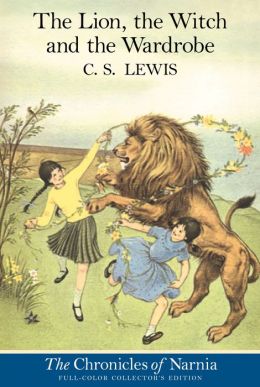
Book Review: The Lion, The Witch, and the Wardrobe

The Lion, The Witch, and the Wardrobe. C.S. Lewis. 1950. HarperCollins. 224 pages. [Source: Bought]

Once there were four children whose names were Peter, Susan, Edmund, and Lucy. This story is about something that happened to them when they were sent away from London during the war because of the air-raids.

Have you read the The Lion, The Witch and the Wardrobe? Do you have a favorite book in the Chronicles of Narnia? Have you read them all? 

I've been reading and rereading the Chronicles of Narnia since I was in fourth grade. The FIRST book, The Lion, The Witch, and the Wardrobe was a classroom read-aloud. It was a powerful experience to listen to this fantasy novel. The story was familiar, in a way, yet new. I loved the characters then and now. This FIRST book is one I've read and reread dozens of times. I love Peter, Susan, Edmund, and Lucy. I love Mr. Tumnus, Mr. Beaver, and Mrs. Beaver. But above all else, I love, love, love Aslan. 

Why the emphasis that The Lion, The Witch, and the Wardrobe is the FIRST book in the series? Well, though I don't like to think about it, some people insist on labeling it the second in the series. This might prove confusing to new readers. The story does have a proper order, and, The Lion, The Witch, and the Wardrobe is the only proper best introduction to Aslan. 
Here the Beaver’s voice sank into silence and it gave one or two very mysterious nods. Then signaling to the children to stand as close around it as they possibly could, so that their faces were actually tickled by its whiskers, it added in a low whisper— “They say Aslan is on the move—perhaps has already landed.” And now a very curious thing happened. None of the children knew who Aslan was any more than you do; but the moment the Beaver had spoken these words everyone felt quite different. Perhaps it has sometimes happened to you in a dream that someone says something which you don’t understand but in the dream it feels as if it had some enormous meaning—either a terrifying one which turns the whole dream into a nightmare or else a lovely meaning too lovely to put into words, which makes the dream so beautiful that you remember it all your life and are always wishing you could get into that dream again. It was like that now. At the name of Aslan each one of the children felt something jump in its inside. Edmund felt a sensation of mysterious horror. Peter felt suddenly brave and adventurous. Susan felt as if some delicious smell or some delightful strain of music had just floated by her. And Lucy got the feeling you have when you wake up in the morning and realize that it is the beginning of the holidays or the beginning of summer. “And what about Mr. Tumnus?” said Lucy; “where is he?” “S-s-s-sh,” said the Beaver, “not here. I must bring you where we can have a real talk and also dinner.”
“It’s no good, Son of Adam,” said Mr. Beaver, “no good your trying, of all people. But now that Aslan is on the move—” “Oh, yes! Tell us about Aslan!” said several voices at once; for once again that strange feeling—like the first signs of spring, like good news, had come over them.
“Who is Aslan?” asked Susan. “Aslan?” said Mr. Beaver. “Why, don’t you know? He’s the King. He’s the Lord of the whole wood, but not often here, you understand. Never in my time or my father’s time. But the word has reached us that he has come back. He is in Narnia at this moment. He’ll settle the White Queen all right. It is he, not you, that will save Mr. Tumnus.” “She won’t turn him into stone too?” said Edmund.
“Lord love you, Son of Adam, what a simple thing to say!” answered Mr. Beaver with a great laugh. “Turn him into stone? If she can stand on her two feet and look him in the face it’ll be the most she can do and more than I expect of her. No, no. He’ll put all to rights as it says in an old rhyme in these parts…
“Aslan a man!” said Mr. Beaver sternly. “Certainly not. I tell you he is the King of the wood and the son of the great Emperor-beyond-the-Sea. Don’t you know who is the King of Beasts? Aslan is a lion—the Lion, the great Lion.” “Ooh!” said Susan, “I’d thought he was a man. Is he—quite safe? I shall feel rather nervous about meeting a lion.” “That you will, dearie, and no mistake,” said Mrs. Beaver; “if there’s anyone who can appear before Aslan without their knees knocking, they’re either braver than most or else just silly.” “Then he isn’t safe?” said Lucy. “Safe?” said Mr. Beaver; “don’t you hear what Mrs. Beaver tells you? Who said anything about safe? ‘Course he isn’t safe. But he’s good. He’s the King, I tell you.” “I’m longing to see him,” said Peter, “even if I do feel frightened when it comes to the point.”
I love everything about The Lion, The Witch, and the Wardrobe: the storytelling, the world-building, the pacing, the dialogue, and the characterization. Most of all, I love how Lewis doesn't waste words with battle-action. Things happen certainly, but, we don't have to endure endless descriptions of the action.

I do wish that every book in the series was as good as the FIRST book in the series. I certainly love others in the series. But not in the same way. My next favorite would be The Voyage of the Dawn Treader. My least favorite is The Last Battle.

© Becky Laney of Operation Actually Read Bible

Saturday, May 19, 2012

Book Review: God's Pursuit of Man

God's Pursuit of Man. A.W. Tozer. 1950/2007. Wingspread. 140 pages.

The unconditioned priority of God in His universe is a truth celebrated both in the Old Testament and in the New. 

This is the first A.W. Tozer book that I've hesitated to say I love. I think my expectations were a bit off which influenced my reading of it.  I expected this to be a book either about election or predestination OR a book about God's sovereignty, a book highlighting how God chooses, calls, draws, elects, predestines, whatever you want to call it. But that really wasn't what this book was about, not really. Some of you may be relieved to learn that! What is this one about? Well, I think this book is truly about the person and work of the Holy Spirit. Which does relate to regeneration, being born again, being justified, being sanctified, being saved, whatever you want to call the all-encompassing act that brings us into a forever-relationship with God. But even this description doesn't truly describe what this one is about. Yes, it's about the Holy Spirit. Yes, it's about how the Spirit is necessary for the Christian life. Yes, it's about how the Holy Spirit is God, has the nature/substance of God. Yes, it's about how Christians can be intimidated, scared, or neglectful of the Holy Spirit. Yes, it's about how the church is weakened because people calling themselves believers lack the power of the Spirit. Yes, it's about the necessity of being filled with the Spirit, of dwelling in the Spirit, of how the Spirit of God dwells and abides in believers securing and empowering them. But this book doesn't flow as well as some of Tozer's other books. It reads more like a collection of essays or sermons about the Holy Spirit. Which is not a bad thing at all. There are some GREAT, GREAT gems to be found in Tozer's book.

Favorite quotes:

We cannot think rightly of God until we begin to think of Him as always being there, and there first. (3)

The man who would know God must give time to Him. He must count no time wasted which is spent in the cultivation of His acquaintance. (5)

We who experience God in this day may rejoice that we have in Him all that Abraham or David or Paul could have; indeed the very angels before the throne can have no more than we, for they can have no more God and can want nothing apart from Him. And all that He is and all that He has done is for us and for all who share the common salvation. With full consciousness of our own demerit we may yet take our place in the love of God, and the poorest and weakest of us may without offense claim for ourselves all the riches of the Godhead in mercy given. I have every right to claim all for myself, knowing that an infinite God can give all of Himself to each of His children. He does not distribute Himself that each may have a part, but to each one He gives all of Himself as fully as if there were no others. (13)

The true Christian ideal is not to be happy but to be holy. The holy heart alone can be the habitation of the Holy Ghost. (103)

The difficulty we modern Christians face is not misunderstanding the Bible, but persuading our untamed hearts to accept its plain instructions. Our problem is to get the consent of our world-loving minds to make Jesus Lord in fact as well as in word. (120)

© Becky Laney of Operation Actually Read Bible